Interlocking Parts of the AI Flywheel and Understanding the Multi-Trillion Dollar Engine
We are living through the largest, most aggressive capital deployment cycle in technological history. What began as a gold rush for silicon chips has rapidly evolved into a multi-trillion-dollar macroeconomic engine.
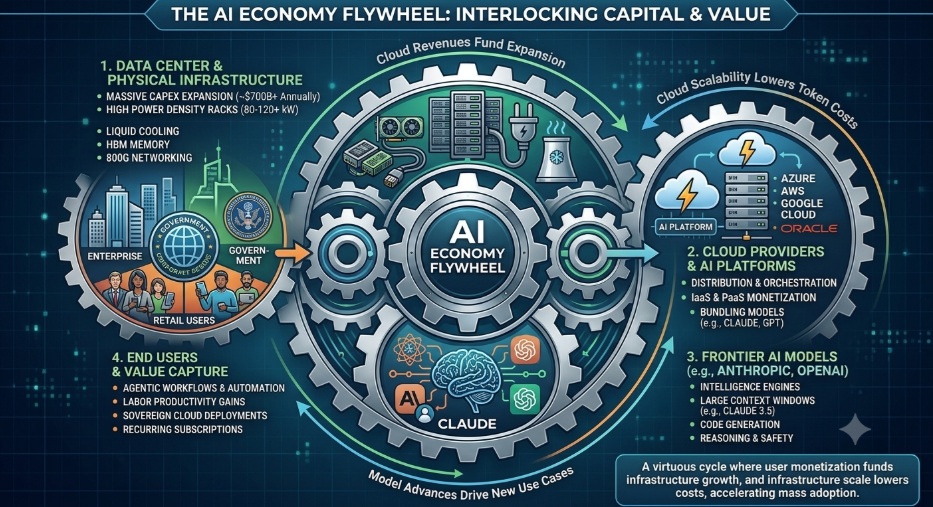
The AI Economy operates as a tightly integrated flywheel: hyperscale physical capital flows directly into compute infrastructure, which powers foundation models, which are then distributed via cloud platforms to power end-user productivity.
For investors navigating this shift, capturing durable value requires looking past individual stock picks and understanding this multi-trillion-dollar supply chain requires examining how capital moves across hardware, cloud orchestration, model intelligence, and commercial monetization.
Anatomy of the AI Economy: Mapping Capital, Infrastructure and Value
A: Data Center & Physical Infrastructure Layer
The physical foundation represents the largest capital expenditure cycle in tech history, with combined hyperscaler CapEx projected to exceed $700 billion annually.
- Space & Power Real Estate: AI workloads demand unprecedented power density (scaling from 10–15 kW/rack up to 100+ kW/rack).
- Key Metrics: Global hyperscaler CapEx allocation to AI infrastructure is ~75%.
- Key Players: Digital Realty, Equinix, CyrusOne, Compass Datacenters.
- Machines & Systems: Custom server racks engineered for intense compute densities.
- Key Players: Supermicro, Dell Technologies, Hewlett Packard Enterprise (HPE), Foxconn, Wiwynn.
- GPUs & Accelerators: The core engine of AI compute, transitioning from pure GPU training dominance to custom inference ASICs.
- Key Players: Nvidia (80%+ market share), AMD, Intel, Google (TPU), Amazon (Trainium/Inferentia), Meta (MTIA).
- Networking & Interconnects: High-speed fabric connecting tens of thousands of clustered GPUs, required to prevent bandwidth bottlenecks.
- Key Metrics: Rapid transition to 800G and 1.6T optical transceivers and Ultra Ethernet Consortium standards.
- Key Players: Broadcom, Arista Networks, Cisco, Marvell, Nvidia (Mellanox InfiniBand/Spectrum-X).
- Memory & Storage: Ultra-fast memory architectures and storage required for multi-terabyte dataset ingestion during training runs.
- Key Metrics: High Bandwidth Memory (HBM3e/HBM4) consumes over 20% of global DRAM wafer capacity.
- Key Players: SK Hynix, Micron Technology, Samsung, Western Digital (Solidigm), Seagate.
- Liquid & Advanced Cooling: Air cooling reaches physical constraints past 40 kW per rack, making liquid cooling mandatory for next-gen clusters.
- Key Players: Vertiv, Schneider Electric, CoolIT Systems, Submer.
B: Cloud & Model Software Layer
Cloud providers act as the primary monetization pipeline, renting the underlying physical infrastructure as a service (IaaS/PaaS) and serve as primary distributors for top-tier foundation models.
- Cloud Providers (Hyperscalers & AI Cloud Specialists):
- Overview: Hyperscalers host foundation models and partner directly with AI labs. The Big Three manage over 65% of global cloud infrastructure, with AI workloads serving as their fastest-growing revenue driver.
- Key Players: Amazon Web Services, Microsoft Azure (OpenAI host), Google Cloud (multi-model distribution), Oracle Cloud (OCI), CoreWeave, Lambda Labs.
Cloud Provider | Market Share | YoY Growth (Q1) | Key AI Advantage / Differentiation |
Amazon Web Services (AWS) | ~31% | +28% | Scale lead, custom Trainium chips, Bedrock multi-model ecosystem. |
Microsoft Azure | ~23–25% | +40% | Strategic OpenAI integration, deep enterprise software lock-in. |
Google Cloud (GCP) | ~11–12% | +63% | First-party TPU infrastructure, native Gemini model integration. |
Neoclouds / GPU Cloud | < 5% | 100%+ | Specialized bare-metal GPU clusters (e.g., CoreWeave, Lambda) renting raw compute to AI labs. |
- AI Models (Foundation & Frontier): High-cost capital investments in model weights that serve as the operating system for generative AI application buildouts.
- Key Players: OpenAI (Chat GPT), Anthropic (Claude), Google (Gemini), Meta (LLaMA – open source), Mistral, xAI.
- Software Platforms & Tools: Application layers that wrap foundation models into enterprise workflows via Agentic frameworks and Retrieval-Augmented Generation (RAG).
- Key Players: Microsoft (Copilot), Salesforce (Agentforce), Databricks, Snowflake, ServiceNow, Palantir, GitHub.
C: End Users & Value Capture
The ultimate ROI of the entire $700B+ infrastructure buildout hinges on end-user monetization and operational productivity gains across three core tiers:
- Commercial Users (Enterprise): Corporations deploying AI for automated software engineering, compliance auditing, automated customer operations, real-time analytics, and supply chain optimization.
- Investor Value Capture: Margin expansion and labor productivity leverage (e.g., JPMorgan Chase, Accenture, Klarna, Walmart, Pfizer, Bridgewater Associates).
- Government & Sovereign AI: Nation-states building localized cloud capacity and defense/intelligence models to secure technological sovereignty and data residency.
- Key Initiatives: US Department of Defense contracts, sovereign AI funds in the UAE/Saudi Arabia, and regional EU sovereign clouds.
- Retail Users (Consumers): Individual subscribers paying recurring SaaS fees for conversational AI, real-time search, personal assistants, and creative media generation.
- Key Players: Anthropic (Claude), OpenAI (ChatGPT Plus), Google (Gemini Advanced), Perplexity, Apple (Apple Intelligence), Midjourney.
The Macro Narrative: How the Flywheel Interlocks
- User Demand Drives Cloud Revenue: Retail subscriptions, enterprise API calls, and government deployments generate recurring revenue for cloud providers and software vendors.
- Cloud Revenues Fund CapEx Expansion: Hyperscalers reinvest cloud cash flows back into physical infrastructure, purchasing GPUs, high-speed networking, and custom data center real estate.
- Hardware Scale Lowers Inference Costs: Manufacturing efficiencies in silicon/chip, cooling, and memory drive down the compute cost per token, making high-reasoning workloads economically viable.
- Lower Token Costs Unlock Mass Adoption: Cheaper, faster compute enables software providers to build more complex AI agent workflows, driving deeper enterprise adoption and restarting the economic cycle.
The Bottom Line: The AI economy is not a series of isolated technology bets; it is a self-reinforcing flywheel where raw compute and commercial utility endlessly feed each other. For investors, the winning strategy isn’t simply picking a single winner in hardware, cloud, or models but it’s identifying the key bottlenecks and value capture points as this multi-trillion-dollar cycle continues to accelerate.
Copy and paste the text from AMT that you want to share
Like this? Get the next one in your inbox.
Independent commentary on global markets, geopolitics, and the forces shaping capital flows. Two to three articles per week.