
AI Economic Flywheel 20260811

Anatomy of the AI Economy: Mapping Capital, Infrastructure and Value

Interlocking Parts of the AI Flywheel and Understanding the Multi-Trillion Dollar Engine

We are living through the largest, most aggressive capital deployment cycle in technological history. What began as a gold rush for silicon chips has rapidly evolved into a multi-trillion-dollar macroeconomic engine. 

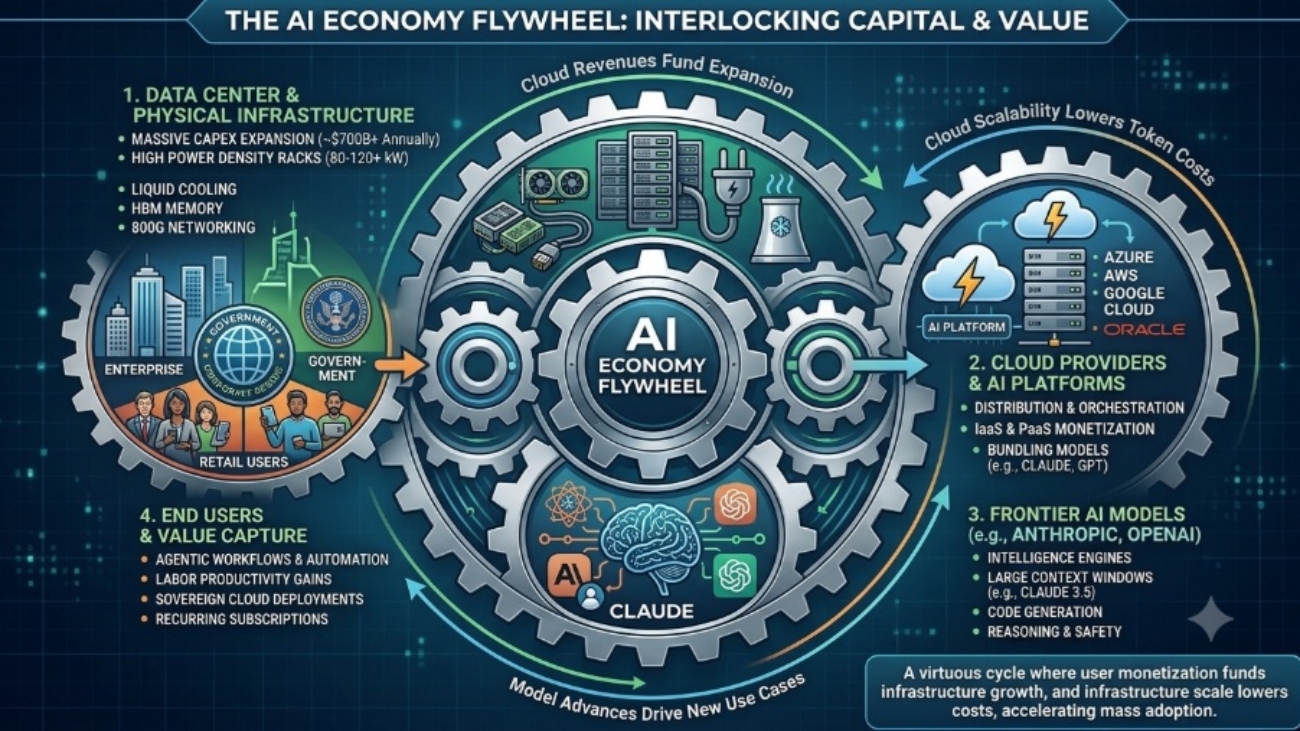
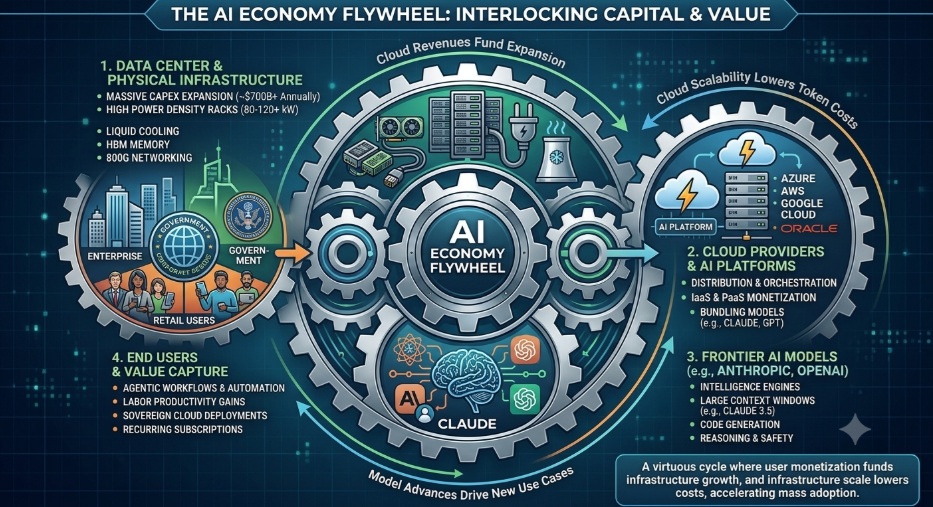
The AI Economy operates as a tightly integrated flywheel: hyperscale physical capital flows directly into compute infrastructure, which powers foundation models, which are then distributed via cloud platforms to power end-user productivity. 

For investors navigating this shift, capturing durable value requires looking past individual stock picks and understanding this multi-trillion-dollar supply chain requires examining how capital moves across hardware, cloud orchestration, model intelligence, and commercial monetization.
Anatomy of the AI Economy: Mapping Capital, Infrastructure and Value 

A: Data Center & Physical Infrastructure Layer

The physical foundation represents the largest capital expenditure cycle in tech history, with combined hyperscaler CapEx projected to exceed $700 billion annually.

  • Space & Power Real Estate: AI workloads demand unprecedented power density (scaling from 10–15 kW/rack up to 100+ kW/rack).
    • Key Metrics: Global hyperscaler CapEx allocation to AI infrastructure is ~75%.
    • Key Players: Digital Realty, Equinix, CyrusOne, Compass Datacenters.
  • Machines & Systems: Custom server racks engineered for intense compute densities.
    • Key Players: Supermicro, Dell Technologies, Hewlett Packard Enterprise (HPE), Foxconn, Wiwynn.
  • GPUs & Accelerators: The core engine of AI compute, transitioning from pure GPU training dominance to custom inference ASICs.
    • Key Players: Nvidia (80%+ market share), AMD, Intel, Google (TPU), Amazon (Trainium/Inferentia), Meta (MTIA).
  • Networking & Interconnects: High-speed fabric connecting tens of thousands of clustered GPUs, required to prevent bandwidth bottlenecks.
    • Key Metrics: Rapid transition to 800G and 1.6T optical transceivers and Ultra Ethernet Consortium standards.
    • Key Players: Broadcom, Arista Networks, Cisco, Marvell, Nvidia (Mellanox InfiniBand/Spectrum-X).
  • Memory & Storage: Ultra-fast memory architectures and storage required for multi-terabyte dataset ingestion during training runs.
    • Key Metrics: High Bandwidth Memory (HBM3e/HBM4) consumes over 20% of global DRAM wafer capacity.
    • Key Players: SK Hynix, Micron Technology, Samsung, Western Digital (Solidigm), Seagate.
  • Liquid & Advanced Cooling: Air cooling reaches physical constraints past 40 kW per rack, making liquid cooling mandatory for next-gen clusters.
    • Key Players: Vertiv, Schneider Electric, CoolIT Systems, Submer.

B: Cloud & Model Software Layer

Cloud providers act as the primary monetization pipeline, renting the underlying physical infrastructure as a service (IaaS/PaaS) and serve as primary distributors for top-tier foundation models.

  • Cloud Providers (Hyperscalers & AI Cloud Specialists):
    • Overview: Hyperscalers host foundation models and partner directly with AI labs. The Big Three manage over 65% of global cloud infrastructure, with AI workloads serving as their fastest-growing revenue driver.
    • Key Players: Amazon Web Services, Microsoft Azure (OpenAI host), Google Cloud (multi-model distribution), Oracle Cloud (OCI), CoreWeave, Lambda Labs.

Cloud Provider

Market Share

YoY Growth (Q1)

Key AI Advantage / Differentiation

Amazon Web Services (AWS)

~31%

+28%

Scale lead, custom Trainium chips, Bedrock multi-model ecosystem.

Microsoft Azure

~23–25%

+40%

Strategic OpenAI integration, deep enterprise software lock-in.

Google Cloud (GCP)

~11–12%

+63%

First-party TPU infrastructure, native Gemini model integration.

Neoclouds / GPU Cloud

< 5%

100%+

Specialized bare-metal GPU clusters (e.g., CoreWeave, Lambda) renting raw compute to AI labs.

  • AI Models (Foundation & Frontier): High-cost capital investments in model weights that serve as the operating system for generative AI application buildouts.
    • Key Players: OpenAI (Chat GPT), Anthropic (Claude), Google (Gemini), Meta (LLaMA – open source), Mistral, xAI.
  • Software Platforms & Tools: Application layers that wrap foundation models into enterprise workflows via Agentic frameworks and Retrieval-Augmented Generation (RAG).
    • Key Players: Microsoft (Copilot), Salesforce (Agentforce), Databricks, Snowflake, ServiceNow, Palantir, GitHub.

C: End Users & Value Capture

The ultimate ROI of the entire $700B+ infrastructure buildout hinges on end-user monetization and operational productivity gains across three core tiers:

  • Commercial Users (Enterprise): Corporations deploying AI for automated software engineering, compliance auditing, automated customer operations, real-time analytics, and supply chain optimization.
    • Investor Value Capture: Margin expansion and labor productivity leverage (e.g., JPMorgan Chase, Accenture, Klarna, Walmart, Pfizer, Bridgewater Associates).
  • Government & Sovereign AI: Nation-states building localized cloud capacity and defense/intelligence models to secure technological sovereignty and data residency.
    • Key Initiatives: US Department of Defense contracts, sovereign AI funds in the UAE/Saudi Arabia, and regional EU sovereign clouds.
  • Retail Users (Consumers): Individual subscribers paying recurring SaaS fees for conversational AI, real-time search, personal assistants, and creative media generation.
    • Key Players: Anthropic (Claude), OpenAI (ChatGPT Plus), Google (Gemini Advanced), Perplexity, Apple (Apple Intelligence), Midjourney.

The Macro Narrative: How the Flywheel Interlocks

  1. User Demand Drives Cloud Revenue: Retail subscriptions, enterprise API calls, and government deployments generate recurring revenue for cloud providers and software vendors.
  2. Cloud Revenues Fund CapEx Expansion: Hyperscalers reinvest cloud cash flows back into physical infrastructure, purchasing GPUs, high-speed networking, and custom data center real estate.
  3. Hardware Scale Lowers Inference Costs: Manufacturing efficiencies in silicon/chip, cooling, and memory drive down the compute cost per token, making high-reasoning workloads economically viable.
  4. Lower Token Costs Unlock Mass Adoption: Cheaper, faster compute enables software providers to build more complex AI agent workflows, driving deeper enterprise adoption and restarting the economic cycle.

The Bottom Line: The AI economy is not a series of isolated technology bets; it is a self-reinforcing flywheel where raw compute and commercial utility endlessly feed each other. For investors, the winning strategy isn’t simply picking a single winner in hardware, cloud, or models but it’s identifying the key bottlenecks and value capture points as this multi-trillion-dollar cycle continues to accelerate.


Copy and paste the text from AMT that you want to share

Share:
Gordons Bay Sunset 20260514

The Great Compression Part 1: The End of the Middlemen

Elevator Boys of GenAI

In the 1920s, every office building had an elevator boy. Although automated elevators already existed, people found the idea of riding in a driverless box dangling by steel cables terrifying, and delegated the role to a uniformed human they trusted, accepting the necessity to pay for the privilege. Over the years, people got used to elevator buttons, but the force of habit and the preference for human touch kept the profession flourishing for years.

The operators were so confident in their indispensability that they went one step too far: in 1945, a New York strike brought the city to a grinding halt, costing it hundreds of millions of dollars. That was the final straw, leading to a massive push to upgrade to automated systems. Within a short while, the job ceased to exist, entering the history books as the only major job category to be completely wiped out from the U.S. Census purely due to automation. The only one so far, that is.

Elevator boys were the cleanest definition of a middleman: someone who exists not because they create value, but because of information asymmetry or transaction friction. The history of modern commerce is largely a history of those “toll booth” trades, and of the technologies that remove them one by one.

Newspapers were once the only viable printed information channel, using their middleman position to bundle content with ads and classifieds, fattening their revenues. People accepted it because nothing else existed – but then the Internet broke their business model. Craigslist alone did more damage to newspaper economics than any editorial failure ever could; Twitter and Facebook finished the job. Today the newspaper is a diminished thing, sustained largely by institutional inertia and nostalgia.

Real estate agents had an informational moat – access to listings, knowledge of comparable sales, relationships with buyers – which was valuable in a world without Zillow. Once that information became freely available, their commission became very hard to justify. The agent survived by clinging to the execution layer, but that too is shrinking.

Here is where the story gets interesting. The companies that dismantled the old middlemen wasted no time building new ones. Uber eliminated the taxi dispatcher and the phone-in booking system, then inserted itself between driver and passenger for a fat slice of every fare. DoorDash did the same between restaurant and customer. Expedia aggregated what travel agents used to know and charged airlines and hotels for access to their own customers. These were genuine technological improvements, but the business model was identical to what they replaced: find a friction point, own it, and extract rent from both sides. The market rewarded them handsomely for this, for a while. Then the next wave arrived.

Generative AI is driving a change of extraordinary scale and speed. We cannot assess the impact of the tsunami from inside it, but we can see the fish floating belly-up, and extrapolate. The agentic economy is eliminating many roles that just a couple of years ago seemed staple of our service-based economy. AI agents will (if they haven’t yet) replace secretaries, clerks of all kinds, brokers, advisors, recruiters, customer service representatives, paralegals – and the buck won’t stop there.

What is happening now to companies like Capgemini, Accenture, and McKinsey is structurally identical to what happened to newspaper classified departments and taxi dispatchers. AI agents do not merely reduce friction – they eliminate the information asymmetry that made the intermediary necessary in the first place. A system embedded inside an enterprise does not need a consultant to explain what it is doing. It does it, iterates, and reports back.

OpenAI and Anthropic understood this early, which is why both recently announced joint ventures – in a parade lockstep – to deploy engineers directly inside corporate clients. OpenAI has built an elite, highly technical consulting wing – a multi-billion dollar venture backed by TPG, Brookfield, Bain Capital and others. Anthropic teamed up with alternative asset titans like Blackstone, Hellman & Friedman, and Goldman Sachs to form a dedicated AI services company. AI labs are moving fast into services and deployment because model commoditization is a risk, and because adoption bottlenecks hurt revenue growth.

The Big Four are seemingly fine for now, touting alliances with the AI leaders, helping them scale AI implementation across their enterprise clients. However, professional consultants are clearly the next elevator boys, hanging by the thread of the “human in the loop” habit. The only chunk of the consulting business that is accelerating involves embedding the AI revolution into enterprises – and very soon, Anthropic and OpenAI will not require the help of PwC or Deloitte for that. They are the owners of the technology: why would they pay a toll for a booth on their own road?

The irony is pointed: the companies building the technology that makes middlemen obsolete are inserting themselves as the new middlemen between the AI model and the enterprise. But even this layer is temporary. Once AI agents can deploy themselves, even that layer compresses. The OpenAI and Anthropic JV story is the last gasp of the middleman era.

The real and durable beneficiaries of the AI economy are not the model builders. Raw intelligence, reasoning, and pattern-matching are no longer rare, expensive breakthroughs – they are becoming cheap, standardized, and universally accessible. Core AI technology is turning into a commodity, just like electricity once did – and the value moves both up and down the stack.

“Up the stack” is a constantly moving target. Right now, it sits in hyper-specific vertical applications – defense, aerospace, finance, and medicine – where proprietary data, regulatory compliance, and domain expertise create durable moats. It also lives in the integration layer: the software plumbing that turns raw AI reasoning into auditable, legally compliant enterprise actions.

In the near term, value will shift further to agentic orchestration – the “Agent Overlords” that coordinate swarms of specialized AI agents, manage workflows, handle exceptions, and maintain oversight across complex business processes. These control planes will become the new scarce and valuable layer, much as operating systems and databases once did. What comes after that is harder to predict, but the pattern is clear: as each layer commoditizes, the economic prize moves to the next bottleneck.

“Down the stack” is the physical layer underpinning everything, and that’s where the true moat is. Every agentic transaction, every automated workflow, every AI-mediated business relationship runs on cloud compute, which runs on power, which runs on tangible assets unlikely to be replaceable for at least the next decade. After a century of disruption, humanity has come full circle: the “boring” material world – acres, bricks, pipes, wires, water, and power – has once again become the real source of scarcity and enduring value.

OpenAI and Anthropic are the last of the middlemen: brilliant, richly capitalized, yet ultimately dependent on infrastructure they do not own. What sits beneath them is not a new intermediary – it is bedrock.

Copy and paste the text from AMT that you want to share