
Supply Chain and Balance of Payment Concerns Remain for the Indian Rupee
The Reserve Bank of India hiked interest rates by 25 basis points recently as inflation has shown signs of becoming entrenched due to higher Crude Oil prices and El Nino effects, and inducing supply side pressures especially in Agri-commodities. The headline inflation rate in India rose to 5.54% in September 2026 from 4.83% in the previous month, the highest reading since October 2024.
Food costs have been 7.74% higher year-on-year with onion prices jumping 108%, while upwards costs for ginger of 62.9% and garlic at 54.6% have been significantly sharp. Meanwhile, higher Crude Oil prices and a weakening Rupee drove transportation inflation to a 5.01% increase. Surging prices have hit restaurants, accommodations by nearly 9.36%, personal care, and social protection costs by around 13.75%. Month-on-month the Indian CPI rose by 0.69%.
Crude Oil prices remain elevated due to the conflict in the Middle East. India’s position as a net energy importer makes it particularly vulnerable to rising import costs. On top of this, the USD has strengthened partly due to a Federal Reserve rate hike and safe haven (risk averse) flows, contributing also to the depreciation of the Indian Rupee. The Indian energy sector having to spend more USD to purchase resources has exacerbated Rupee depreciation as costs for imports have soared and show an ability to remain stubborn.
Global conditions remain unhelpful and the Middle East conflict shows little chance for immediate solutions. Indian officials within the Reserve Bank of India seemingly have felt they had no other choice to fight inflation and falling exchange values via the USD/INR, except by raising interest rates like other global central banks.
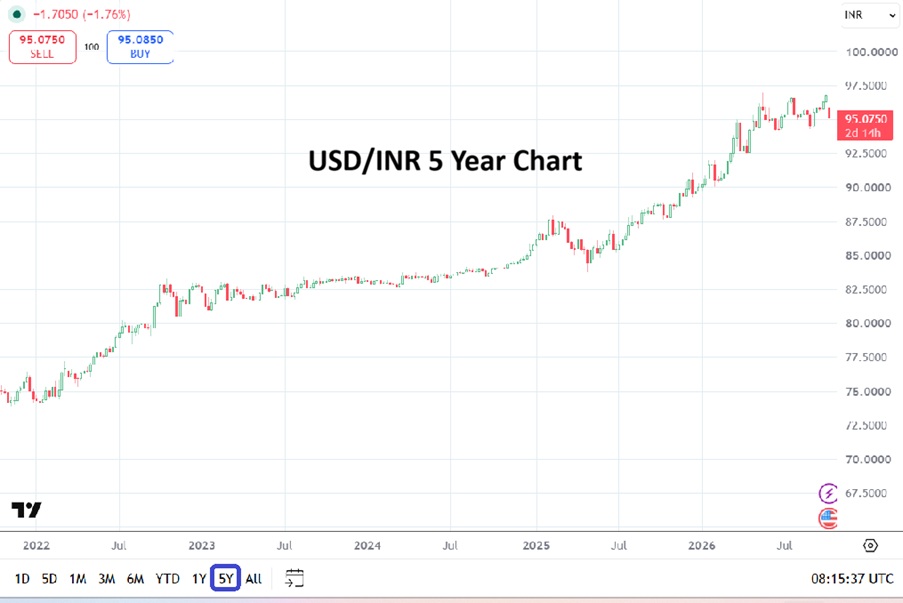
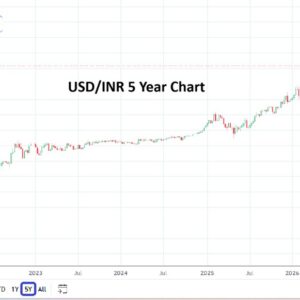
USD/INR Five Year Chart as of 14th October 2026
Robert Petrucci, an astute observer and writer on the Indian Rupee, argues that an interest rate hike to deal with the problem of higher energy costs will not fix the inflation problem caused by the Middle East conflict. In Petrucci’s opinion, even if a central bank has raised interest rates by full basis point of 1%, it would have little effect on the demand of energy as long as prices remain a geo-politically influenced circumstance.
Robert Petrucci has also said that the decline in value of the Indian Rupee could also stimulate India’s exports of tradable goods making them cheaper for foreign importers. Evidence shows the cumulative value of India’s merchandise exports between April and August of 2026 reached USD 215.91 billion. This is a 17.85% increase compared to the same five month period in 2025, when exports were USD 183.21 billion.
Even as prices for commodities also rise due to El Nino weather effects, this storyline cannot be entirely blamed. Professor Narayana Moorthy wrote recently that in the State of Tamil Nadu the rise in prices of Agri-commodities can also be attributed to shrinking cultivation areas and stagnant irrigation improvement. Tamil Nadu’s inflation rate in May 2026 reached 5.11% against the national average of 3.93% comparatively. Crop prices cannot be controlled simply by raising interest rates, as Robert Petrucci alludes, without boosting domestic agricultural production capabilities.
Balance of Payments Highlights Another Influence
Despite generating higher GDP growth and claims of economic strength India’s balance of payments remains severely weakened by massive capital flight. By the end of June 2026 a staggering 543.9 billion USD combined had left India, comprised of 316.1 billion in direct investment outflows, 23.4 billion into portfolio funding, and 204.4 billion into other outward stakes. As Professors Jayati Ghosh and C.P. Chandrasekar have written in a recent BusinessLine article, “for a lower middle income country, with most of its development projects incomplete and greatly in need for additional investments, the extent of capital outflows is quite large. It significantly reduces the net inflows that economies in India’s position require for development.”
Economist Michal Kalecki observed in Poland in early twentieth century, capitalists invest only in when they accumulate profits, no matter whether it stimulates wages or reduces unemployment. In that sense, according to Kalecki, the changes in the prices of goods or wages or household demand would not entice a capitalist other than making a profit. They are there to make profits and want to see accumulated retained earnings on balance sheets. If mass consumption is not sufficient enough for their goods and services, investments would channel or divert into other premium products or markets that command higher profits.
Investments, as Kalecki observed via his practical business experience, are not decided by household demand but by businesses decisions that ultimately influence employment and national income. In that sense Kalecki never argued that investment is independent of demand, his thesis is that the capitalists as a class are protected even in a slump, as they would invest in resources that maximize their profits. According to him, investment was not simply a function of interest rates or consumer expectations. It was connected to profitability, income distribution and the contradictions of accumulation. It literally means, any rise in prices of goods and services due to a depreciating currency or supply chain induced inflation would be passed to consumers as we have seen in the last few years, even as real wages are not growing and become unbearable for households.
What India needs is patient capital that funds infrastructure and development, creates jobs, along with some government allocated capital expenditures, rather than capital that solely chases returns or deviates quickly once returns are achieved. By showing the government can provide long-term commitment allowing low return assets that stimulate household demand, this could make private investments profitable in future rounds.
In planned economies like the failed former Soviet Union, authorities frequently forced investments rates up without genuine profitability or consumption orientation. Capital was often misallocated, funds were dispersed via corruption and outright theft. Accountability was certainly not transparent.
Kalecki reminds us that economic stability cannot be separated from the question of whose interests it serves. A key component is ultimately developing increasingly sophisticated techniques for stabilizing capitalism and understanding why capitalism requires continuous stabilization.
A rise in interest rates may help reduce consumer demand in some areas, but money naturally chases allocations which earn ‘best’ returns. This is highlighted by businesses and financial markets where capital outflows seek profits and do not protect the Indian Rupee. Support for the INR provided by Non-Resident Indians inflows that has helped build the FX Reserves recently cannot be relied upon alone to fix the weakened Indian Rupee problem alone, nor can ‘simple’ fixes like the recent quarter of a point interest rate hike by the Reserve Bank of India. A coordinated and tactical policy is needed.
Copy and paste the text from AMT that you want to share
Like this? Get the next one in your inbox.
Independent commentary on global markets, geopolitics, and the forces shaping capital flows. Two to three articles per week.
Related posts:
 India Insider: Leveraged FCNR Deposits Reliance and Remittances Masks Structural Vulnerabilities
 Progression Upwards for Indian Rupee and Catalysts
 India Insider: Rupee Under Pressure as Oil Prices Surge and Import Bills Rise
 India Insider: Should the RBI Raise Interest Rates?
 India Insider: Rupee’s Prolonged Weakness Remains Unresolved