
Better Streamlined Government Policy Needed for the Rupee
In July of this year Reserve Bank of India Governor Sanjay Malhotra talked to Business Line magazine and argued that recent Rupee depreciation does not reflect any weakness in the country’s economic fundamentals. According to him, pressure on the currency has largely stemmed from geopolitical tensions, USD strength and broader volatility across emerging markets.
However, the USD which strengthened during the outset of the US-Iran war has been losing value in large chunks in the broad Forex market the past month. The U.S Federal Reserve remains neutral regarding its interest rate guidance and U.S labor market data has emerged weaker. On top of that, the U.S Treasury’s decision to intervene in U.S long-term bonds via buybacks in order to cool yields has hastened another USD path lower, while igniting buying in many other currencies and gold.
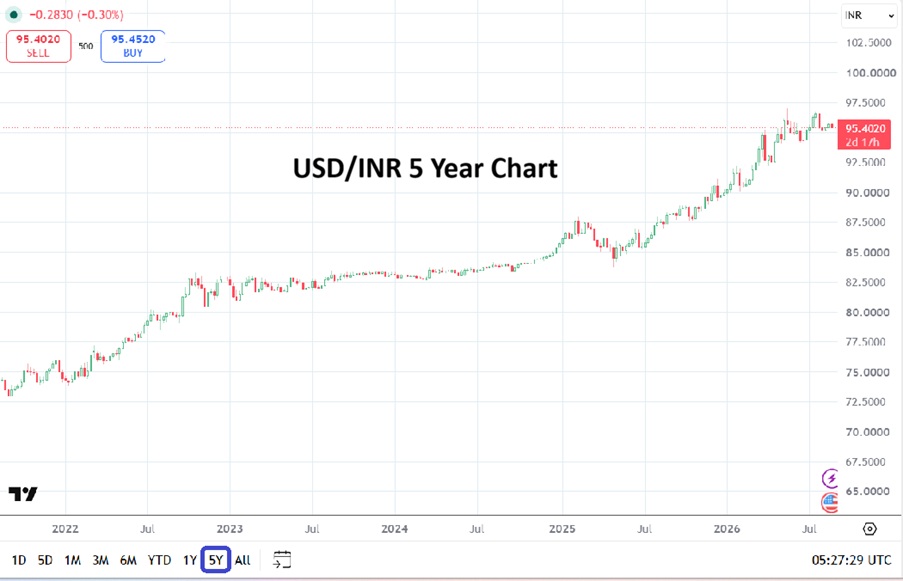
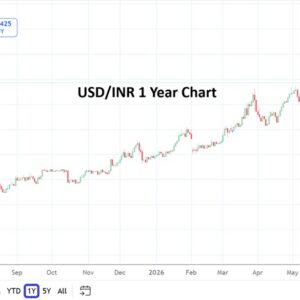
USD/INR Five Year Chart as of 26 August 2026
Despite the Foreign Currency Non-Resident (Bank) deposits coming from overseas investors increasing, which are leveraged products structured by banks and helped to attract more than $50 Billion USD since June, the Rupee’s reaction to this set of recent inflows has been muted. The Indian Rupee is traversing near 95.55 levels as of this writing, notably as other Asian currencies like Korean Won and Singapore Dollar are trading at stronger levels.
India’s Forex reserves climbed to $716.9 billion boosted by these inflows, along with USD related external borrowings by corporate and commercial banks. Nevertheless, the fundamental problems for the Rupee’s prolonged weakness remains unresolved.
Reasons for Rupee’s Weakness Structurally
The Indian Rupee has depreciated around 28% against USD since 2022. Irrespective of this, the merchandise tradable exports have been stagnant, rising a mere 5.7% – from $417 billion to $441.8 billion USD. While on the other hand, merchandise imports have risen 26% from $610 billion to $774.80 billion USD in the period between 2021-2025.
However, India’s balance of payments is not at immediate risk, because even as higher importing needs (especially with Crude Oil and LNG) and lower tradable exports, the total merchandise deficit of around $350 billion USD as of 2025 is being offset by healthy IT exports and foreign remittances.
The fundamental question is why hasn’t the Indian Rupee depreciation expanded merchandise exports in the last few years? As Carlos Dias Alejandro depicts in his seminal work Exchange-rates Devaluations in a Semi-industrialized Country: The Experience of Argentina 1955-1961, throughout Argentina’s history rural producers who supplied most of the exported commodities traditionally advocated a policy of devaluation.
Argentine exporters expected Peso prices for their outputs to rise faster than the Peso prices for their imports, including the wages that they paid for their employees in current prices. In other words, exporters stand to gain from a currency devaluation because it can make their products more competitive in global markets and encourage resources to move towards export production.
Argentina’s experience after Juan Peron who was overthrown in 1955 provides an important context to this argument. The economic policies pursued during the Peron years had already left Argentina with serious inflation , weak agricultural incentives, low investment and balance of payments pressures. The devaluation and stabilization policies that followed were therefore part of a broader attempt to correct the distortions that had built up during the previous period.
Interestingly, the Rupee depreciation has so far not shifted resources from producing goods for foreign products as it is apparently clear via merchandise trade data. The IT sector has been one of the few sectors that has been able to use this shift positively.
It is also important to understand that devaluation does not produce only positive outcomes. A devaluation that increases the overall level of prices can cause a redistribution of income among different social groups, in much the same way as inflation does in a closed economy. Unwieldy redistribution becomes inevitable when the prices of outputs and inputs do not change proportionally.
For instance, wages are central to this process. If prices of food, fuel and other essential goods rise quickly after a devaluation, but nominal wages adjust slowly, workers experience a decline in real wages and purchasing power. Their incomes may remain unchanged in Rupee terms, yet they can afford fewer goods and services. This effectively transfers income from wage earners to firms and producers whose prices or profits adjust more rapidly.
The impact can also differ across workers. Employees in organized sectors may negotiate higher wages or receive inflation linked adjustments, while informal workers, agricultural laborers and those dependent on fixed incomes often have less bargaining power and face a sharper fall in real earnings. At the same time, exporters may benefit if the prices of their products rise faster than their wage and other input costs.
However, if workers eventually demand compensation for the higher cost of living, wage increases can raise production costs and reduce part of the initial competitiveness gained through devaluation. Thus the effect of devaluation depends not only on the exchange rate, bit also on how quickly wages, prices and productivity respond.
In that sense, Argentina’s experience in the 1950s offers a warning for semi industrialized countries like India. A devaluation of the Rupee can make some exports competitive, but it cannot create more productive capacity on its own. Without addressing deeper structural problems, a weaker currency can instead push up prices and reduce households real purchasing power.
Rupee Effects Absorbed and Felt by Those Who Earn Low Wages
Prices of goods and services have increased in the last few years due to the depreciation of the Rupee, especially for imported goods. Since India not only imports oil and gas for consumption, but also imports machinery and intermediate goods for production it has forced households to spend a higher share of their income on the consumption of needed goods.
When households do not earn they need to borrow or hope that their wages increase. In India real wages don’t always go up with inflation. This is due to India having a higher supply of available labor which makes negotiating for higher wages difficult for workers. If employers can find another worker relatively easily as a replacement, the employed worker has limited power.
The ILO (International Labor Organization) notes that India remains characterized by extensive informality and low pay employment, it also estimates that 62 million workers earn below the minimum wage. India’s workers are not necessarily competing in the global market. Manufacturing as a percent of GDP has stayed around 15% over a decade. And irrespective of the fact that India is a major agricultural producer and exporting nation and over 46% of its labor force engages in the sector, total Agri-Exports stayed within a band of $48-$53 billion for the last few years.
The government says that India is growing because services as a percent of GDP is 55%, but the nation employs around one-third of the labor force in the informal economy. While IT employees earn higher wages comparatively because their wages are connected with global demand and have an advantage because they are export services, those who work in construction, domestic help, shops, agriculture and the service sector are earning substantially less. The wages of these people won’t go up until changes are made.
The vast numbers and informality of employment within a significant amount of India’s labor force prevents low wage costs from translating into solid competitiveness, particularly as inflation is seen and depreciation of the INR continues. Economies like China, Vietnam and Korea have created industrial strength by transferring household savings through lower costs for goods and subsidizing businesses.
India’s decade long reluctance to invest in necessary infrastructure, not preventing or fixing regulatory problems, a lack of commitment to invest in skill based education, and not creating conditions for businesses to compete with overseas markets have created conditions that result in low consumption and low wages. The devaluation of the INR hits households who are acting as shock absorbers in the absence of streamlined government policy.
Copy and paste the text from AMT that you want to share
Like this? Get the next one in your inbox.
Independent commentary on global markets, geopolitics, and the forces shaping capital flows. Two to three articles per week.
Related posts:
 India Insider: Rupee Under Pressure as Oil Prices Surge and Import Bills Rise
 India Insider: Real Story Behind the Rupee’s Weakness
 Progression Upwards for Indian Rupee and Catalysts
 India Insider: Should the RBI Raise Interest Rates?
 Sentiment Matters: Speculative Narrative and the False Promise of Data