Challenge Part 4 20260802

The Challenge of October 7: Part 4 – The Political and Legal System

Towards a Convenantal Framework

Opinion: The following article is commentary and its views are solely those of the author. This article was first published the 28th of July via The Angry Demagogue.

Israel’s political and legal systems are broken beyond repair. Created in 1948 in order to allow a smooth transition from the political format of the Jewish Agency, which represented pre-state Palestinian Jewry (as the Jewish population of the British Mandate was called) it has continued more due to the inertia and the comfort with which the faction leaders ruled than to any political efficiency. If the American founding fathers wanted to create a system which de-emphasized factions, Israel’s was specifically formed to retain and sharpen them.

Part of this had to do with the socialist and religious backgrounds of many of the country’s leaders, both of which emphasized a ruling elite. They were comfortable ruling and therefore leadership turned from public service to the rule of the few. Benjamin Netanyahu was not the first Prime Minster or party leader to not voluntarily step aside and under the current system, he won’t be the last.

The Challenge of October 7: Part 4 -Towards a Convenantal Framework

Respect for intellect, expertise and rank formed the basis of the legal system, too. Only those that “know” should pick judges and prosecutors, being experts need have no oversight. The Israeli legal system does not allow any non-judicial oversight of the judicial system and does not allow any oversight of the persecutors besides the prosecutors themselves. At the start, the legal system was based on the British legal tradition and incorporated Ottoman law, too. However, the judges and law professors were almost all German origin. From the start it was a mess.

The current Israeli political system is a parliament, the Knesset, that has 120 members voted in either every 5 years or if the government falls. Voters vote for a party list that is determined before the election. There is strict proportional representation with one caveat – a party needs a minimum of 4 seats to get in. That is approximately 3.5% of the vote. All parties that do not pass the minimum threshold get nothing and their votes do not count. Once the final tallies are made one party needs to convince others to join in a coalition that needs to be at least 61 seats.

The legal system consists of a judiciary that is chosen by a committee that includes 3 sitting Supreme Court justices, two members of the Israeli bar association (selected by the head of the bar association), two cabinet members – one of which is the Justice Minister and chairman of the committee and two members of the Knesset who are not minsters, one of whom is in the opposition. Lower court judges need a simple majority of the committee while Supreme Court justices need 7 of the nine members. In practice, this means that the Chief Justice of the Supreme Court (who chooses the other two members from the Court) has veto power over future members of the Supreme Court. In other words, they choose their successors.

There is another anomaly to the justice system and that is the position of Legal Advisor to the Government. This is a position appointed by the government but who serves a set term so that any specific government does not get to choose their advisor. The Legal Advisor can veto any law and any appointment – and can be overruled only by the Supreme Court. The Legal Advisor also is in charge of the prosecution’s office and decides on whom to indict.

This in a nutshell is the Israeli system that has worked as long as there has been a bit of modesty on the part of all involved. Modesty though, not being the top virtue of politicians, judges and lawyers, is in short supply.

I am by nature a conservative. I don’t believe in radical or revolutionary changes but in slow amendments to what needs to be improved. However, the Israeli political and legal systems are so broken that they need radical overhauls.

Here is our (not so) modest proposal for a reformed political and legal system.

The Israeli political system, being Jewish and free ought to be established under the basis of the “covenant”. A covenantal system establishes sovereignty and reciprocity. A covenantal system is between the citizens and God, with sovereignty not in the hands of the unknowable divine but in the very real citizens. This is a religious concept but it is NOT a basis for a theocracy. Rather, it states forthrightly that sovereignty rests in neither the executive branch, nor the legislative branch nor in the judicial branch. The citizens of the country are sovereign since it is their covenant with God and not the State’s rulers and all decision making must make its way back to its citizens. (I would like to give credit to this idea to an old friend Alan Mittleman – who I have lost touch with – and his book The Scepter Shall not Depart from Judah”, although I may not be interpreting his idea as he stated).

Toward this end we would like to propose the following which keeps the Israeli proportional representation intact but adds stability, checks and balances and most importantly, the centrality of the citizen in the decision-making process. We will be working backwards in that we are not proposing a constitution but rather a form of government that can then decide on the rights and responsibilities that the citizens have and that the government has to its sovereign – the covenanted citizens.

Legislative Branch

Israel needs a bi-cameral legislature but not as it is in the U.S or the UK. In our proposal the Lower House would continue to be elected with proportional representation. They will select a government and the Prime Minister will be a member of the Lower House.

Lower House

The Lower House election would be scheduled every four years and the Knesset would elect the government from its own members as it does today. A simple majority would elect a government and a government would fall with a super-majority of 75 (out of 120). Unlike in most parliamentary democracies, in the structure we propose, a parliament that falls mid term would only serve until the original scheduled 4 year date. This would encourage stability, but still allow a change in government.

If a government falls and another is elected by the current Knesset, that government would also serve out the term of the original government. If a government falls and no government can be agreed upon by the current Knesset, elections for the Lower House would be held to serve out the original term only.

Upper House

The upper house will act as an overseer of the Lower House, the government, the bureaucracy and the Judicial branch. While the Lower House will continue with its 120 members, the upper house will have regional representatives. We suggest 30 districts, equalized in population and each with two representatives. Members will serve 4 year terms and be limited to three terms. There will be elections every two years for half the upper house, with each district always voting for one member every two years.

Members of the upper house would not be allowed to serve in the Lower House after their terms are up, but the opposite would be allowed. This will allow experienced legislators from the Lower House to run and sit in the upper house but they would have to give up their ambition to be Prime Minister as only members of the Lower House could hold that position. Members of the Upper House also cannot be government ministers.

The responsibilities of the Upper House will be legislative, constitutional and investigative. They will have to approve all laws from the Lower House with a simple majority and all “basic laws” – or constitutional laws – will originate in the upper house. These will be passed with at least 40 of the 60 members of the upper house and then sent to the Lower House for their approval

The Upper House will also have the responsibility of choosing lower court judges and Supreme Court justices. The former by a simple majority and the latter by at least 40 of the 60 votes. It will also have the power to remove judges with the same super-majority.

The Upper house will also have investigative and subpoena power – which the legislative branch does not now hold. The debate of the non-investigation of October 7 would have been solved statutorily by the Upper House. It will have total independence from the Lower House and therefore can debate issues and lead investigations without the undo influence of government or opposition.

As for checking and balancing the Upper House, we suggest a recall method that can be triggered by the citizens of the region they represent.

The Government/Executive Branch

One of the main problems with the executive branch is its bloat – too many ministries and too many bureaucrats. There needs to be a statutory limit of 10-15 ministries, appointed by the government and approved by the Lower House.

The Executive Branch also needs independence of action and ought to be able to appoint those who will further its policy goals. Senior bureaucratic and legal officials (in the government – not the Judicial branch) should be appointed by the government as a whole with only a special majority in the Upper House of 40 able to veto them. This should be true regarding the government’s Legal Advisor, Chief Prosecutor, Head of the General Staff and the Shabak (Shin Bet) and Mossad as well as Directors General of the various ministries.

The Prime Minister will be the commander in chief of the military and the internal and external intelligence services will report directly to him. The Prime Minister will have the right to fire ministers at will but can only appoint new ones with the approval of the Lower House.

The Judicial Branch and Legal System

There needs to be a delicate balance between the independence of the court and its being answerable to the citizens of the country. The abuse of power that an unsupervised court system is at least as dangerous to a free society as one that is not independent of the political branches. We try to solve that problem by giving the Upper House the power to appoint judges and justices, and if necessary, to remove judges with a supermajority.

Supreme Court justices should be appointed for one 25 year term irrespective of age. The justices should be able to review all laws except those passed by 2/3rds of the Upper and Lower Houses of parliament. In the case of a law passed by more than 2/3rds of both houses then judicial review should not be allowed.

A total reform must be made of the Government Legal Advisor system. They essentially have veto power over all government decisions, discussions and appointments. They also control the prosecution and the Police’s internal affairs unit. Finally, they have no oversight besides when the government challenges their own legal advisor in the Supreme Court. (This reform needs to be substantial but we do not have room for it here).

This is a rough outline, sometimes detailed and sometimes not, of the changes that need to be made after October 7. The idolatrous rule of the experts brings with it hubris that has caused too many disasters – most especially, October 7. The Upper House of the parliament that we propose should balance the will of the people with the rule of the experts by making it answerable primarily to the citizens of the country.

This is not some utopian proposal that will solve all problems, but rather a framework where people can feel confident in the institutions that are supposed to serve them.

The move towards a covenantal government means that respect must flow from leaders to the citizens and authority from the citizens to the government. For most of the last few decades the reform of government in Israel was limited either to direct election of the Prime Minister or an increase in members of the Knesset. The first was tried and failed. The second is just a power grab by the parties so that they can add more friends to the public payroll.

Our suggestion on the other hand, gives the Prime Minister the authority needed to run the country and the citizens with a tool to keep the government, the legal system and the bureaucracy in line.

Disclaimer: the views expressed in this opinion article are solely those of the author, and not necessarily the opinions reflected by angrymetatraders.com or its associated parties.

Follow Ira Slomowitz via The Angry Demagogue on Substack https://iraslomowitz.substack.com/
Copy and paste the text from AMT that you want to share

Bitcoin 20260730

Debunking Bitcoin Lies

The Paradox, Absurdity, Lies and Myths of Bitcoin

They say it’s an “asset”… but it has zero assets.

They say it’s decentralized… but the large majority of all transactions go through trading platforms.

They say it’s digital gold… but it has none of the physical attributes gold derives its value.

They say it’s immune to censorship… but countries like the US and China manage to be the largest holders without buying any Bitcoin.

They say it’s scarce… but there are 2.1 quadrillion Satoshi units that act exactly like a Bitcoin unit.

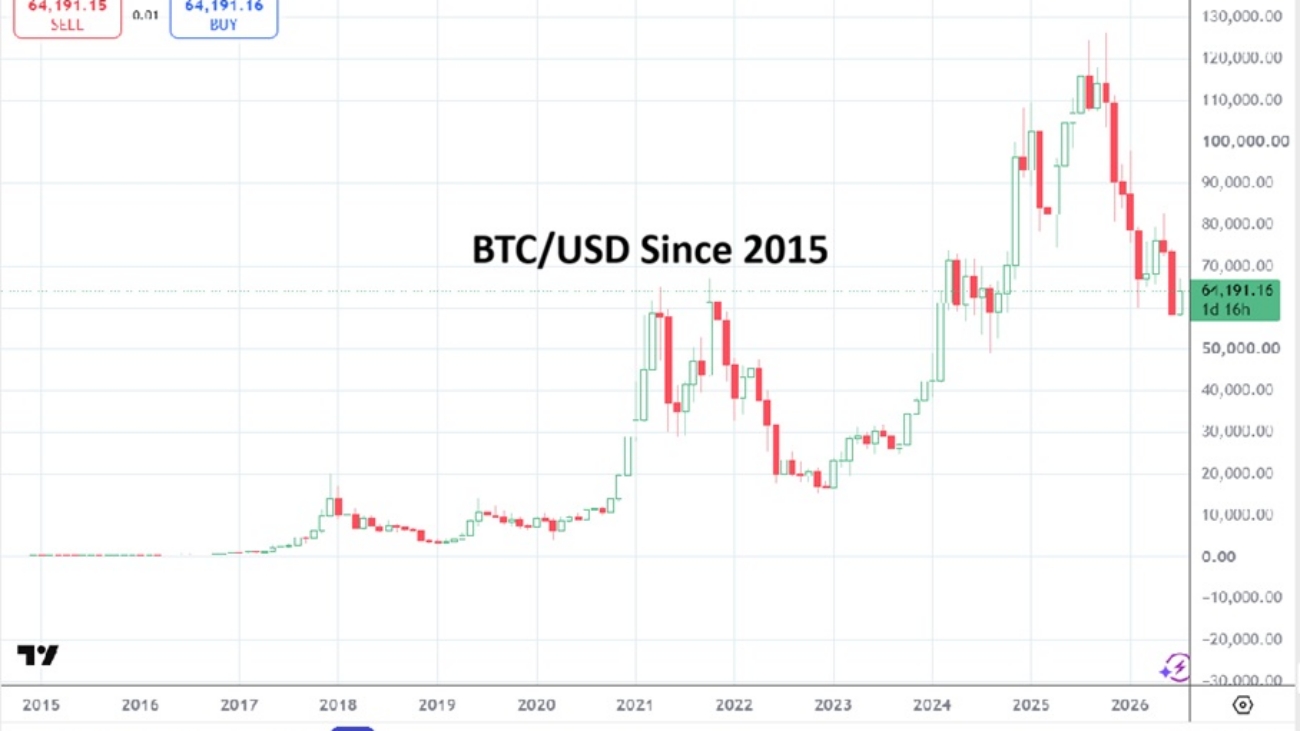
They say it’s a store of value… but it has witnessed several -50% to -80% drawdowns in its short history.

They say it derives its value from energy… but energy is a massive cost that someone has to pay!

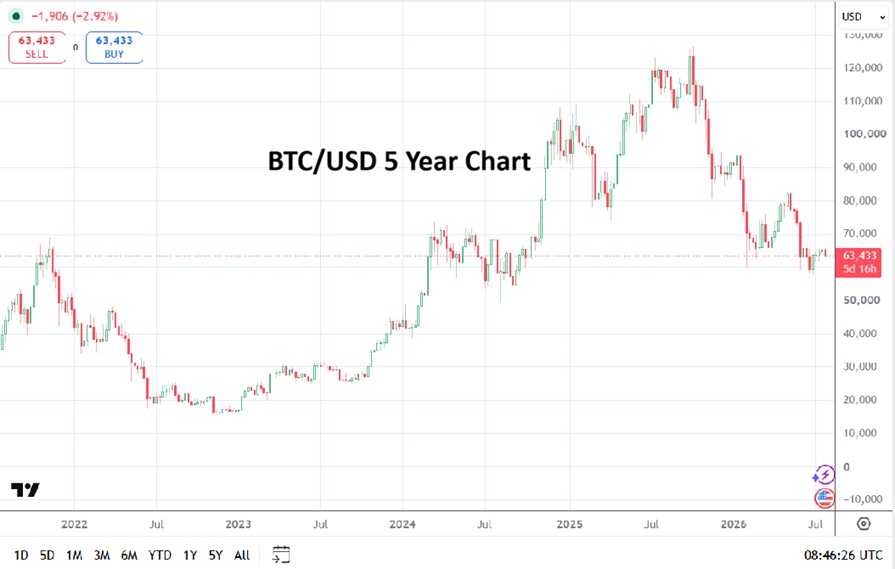
BTC/USD Chart Since 2015 as of 30 July 2026

The Bitcoin protocol was introduced as a new monetary system: decentralized, censorship-resistant, scarce, transparent, secure, and independent of governments and financial intermediaries. It promised to eliminate the need for trusted third parties and replace institutional trust with a code.

However, more than fifteen years later, Bitcoin has failed on all those fake promises…

Today, the Bitcoin ecosystem is increasingly dependent on centralized exchanges, custodians, mining companies, stablecoin issuers, institutional investors, and financial intermediaries. The supposedly revolutionary monetary asset has become deeply intertwined with the very financial infrastructure it was designed to bypass.

And beneath everything lies an uncomfortable economic reality: the Bitcoin mining industry must continuously spend real resources (electricity, capital, land, labor, and massive equipment that becomes obsolete very quickly) to generate a virtual token that is distributed randomly… with the reward being halved by design every four years! What business model can survive such a flawed system where revenues are distributed randomly and halved every four years while costs increase constantly with adoption? It is the exact opposite of an economy of scale. The more successful your product is, the deeper your losses are! Even Fried Thiel, MARA’s CEO, ended up admitting that Bitcoin mining is a “zero sum game”! With miners doomed to fail economically, Bitcoin’s network security is destined to failure.

1. The Decentralization Paradox

The word “decentralized” is perhaps the most important word in the Bitcoin vocabulary.

In practice, it is far from being the case. Most Bitcoin transactions go through exchanges, custodians, brokers, or institutional funds (ETFs). Even miners store their mined bitcoins with custodians like Coinbase.

Today, the entire ecosystem relies on the solvency of companies like Coinbase, Binance, Tether, Strategy… all of which are in a critical financial situation. Should any of them collapse, the whole house of cards will fall down.

The irony is striking. Bitcoin was designed to eliminate the need for trusted intermediaries. Yet Bitcoin users increasingly trust intermediaries to hold their Bitcoins. Even miners do! How absurd is that?

2. The 21 Million Fake Limit

The most used argument for Bitcoin is that there will only ever be 21 million bitcoins.

But the statement requires closer examination too. A bitcoin is divisible into 100 million Satoshis. Each Satoshi has exactly the same “shape,” the same function, and the same attributes as a Bitcoin! Dividing something into exact copies of itself acts like a multiplier! That means the real supply is 2.1 quadrillion units (call them Satoshis or Bitcoins, it doesn’t matter).

The immediate response from Bitcoin supporters is that this is no different from saying that one dollar consists of 100 cents… but the dollar was never designed to have an absolute monetary cap.

The question then becomes whether the 21 million cap creates meaningful economic scarcity or simply a narrative of scarcity for marketing purposes. Anyway, the scarcity of something useless doesn’t make it useful…

The “21 million limit” becomes even more absurd when we consider the enormous number of other cryptocurrencies and tokens that exist. If scarcity itself is the central source of value, why should Bitcoin’s scarcity be uniquely valuable? The crypto ecosystem has demonstrated that creating a new digital asset is technically easy. Anyone can create a token with a fixed supply. If we create another digital token with a 10 million limit, much lower than Bitcoin’s 21 million limit, would it be worth more than Bitcoin because it would be considered scarcer? How can something be considered scarce if it can be replicated indefinitely with exactly the same “unique” attributes?

3. The “Digital Gold” Absurdity

They say Bitcoin is digital gold. Yet gold has physical properties that have made it valuable for thousands of years: durability, divisibility, portability, resistance to corrosion, and usefulness in jewelry and industry. Bitcoin has none of those unique physical attributes. Take away those physical attributes from gold, and it loses all its value. Since Bitcoin is gold without its physical attributes, it is therefore worth nothing! It’s as if we created a virtual token and called it “digital water,” pretending it’s “liquid” and “essential to life.” Still, if we can’t drink it or wash with it, what value would it have? Not only does Bitcoin have no intrinsic value, but it also requires continued investment in heavy infrastructure and massive electricity consumption to stay alive. It is like having a car parked in a garage, continuously consuming gas to remain “alive,” while you pretend it has value because it is unique! Once gold is mined, it costs nothing to continue existing. When Bitcoin is mined, the network needs to keep running on heavy electricity consumption for the Bitcoin to remain “alive.”

4. The “Censorship Proof” Lie

Governments around the world have acquired Bitcoin through seizures, confiscations, enforcement actions, bankruptcies, and other means. That’s how a digital coin created as a challenge to government monetary authority ended up in government-controlled wallets.

Governments do not need to control the blockchain to influence the market. They can shut down crypto platforms and seize their assets. What happened to the promise of monetary freedom?

5. The Myth of Low-Cost Bitcoin

Bitcoin is sometimes described as a cheap way to transfer money. The comparison can be attractive. There is no need for a traditional bank to approve a transaction. The network operates continuously.

But the cost of the system is not simply the transaction fee paid by the user. There is also the cost of maintaining the infrastructure. Bitcoin mining consumes enormous amounts of electricity and requires heavy equipment that becomes rapidly obsolete. The economic cost of maintaining the network is simply unsustainable. All listed miners show constant negative cash flow with massive dilution of shareholders and collapsing stock prices. It is not a coincidence. It is simply a sign that Bitcoin mining is economically unsustainable. It is a fundamentally losing business that is doomed to fail. When most miners inevitably capitulate, they will sell their Bitcoin reserves and provoke a massive collapse in the price. With less than 5% remaining to be mined over the next 100 years, there will be zero incentive for miners to start all over again. Bitcoin is doomed to fail from within.

If Bitcoin were truly revolutionary, all large technology companies, like Apple, Google, Microsoft, and Meta, would have jumped in to get their market share (as they did for AI)… instead we have empty shells with no business model, like Strategy, Nakamoto Inc, and Metaplanet, turning into “Bitcoin treasury” companies while incurring heavy losses and permanent negative cash flow.

Bitcoin was designed as an alternative to financial intermediaries. Now collapsing “treasury companies” and unsecured crypto platforms control the ecosystem. We shifted the risk from banks like JPMorgan, Citi, or Morgan Stanley, supported by the US central bank, to entities like Coinbase, Tether, and Binance… some of which aren’t even audited! And all without any support from a central authority.

The user may distrust banks, but he is asked to trust an exchange. The user may distrust central banks, but he is asked to trust a stablecoin issuer. The system has not eliminated trust. It has redistributed it to a much weaker ecosystem!

Bitcoin will be remembered as the greatest bubble of all time and the largest misallocation of capital and resources in human history.

Copy and paste the text from AMT that you want to share

Challenge Part 3 20260729

The Challenge of October 7: Part 3 – Security and Foreign Policy

Towards a Definition of Israel's National Interests

Opinion: The following article is commentary and its views are solely those of the author. This article was first published the 24th of July via The Angry Demagogue.

Ever since the end of the first Lebanon War, Israeli military strategy has moved from active and aggressive defense of the homeland and its citizens via a policy of taking the fight to enemy territory to passive defense based on the threat of massive force – in other words, deterrence. The object was to create a situation where the enemy feared attacking us and to use our military force as a reason to go to the negotiating table. The assumption was that if we were strong enough, we could make concessions and deal with whatever situation arose. “The IDF is strong enough to deal with it” was the phrase de jour. Israel was at peace with Egypt and Syria’s Hafez Assad had no interest in a frontal attack after his air force was embarrassed in 1982 by losing over 60 aircraft in dogfights with Israel as well as 29 of their 30 SAM anti-aircraft batteries.

The PLO moved to Tunisia after the Lebanon War and other enemies, Iraq and Iran, were too far to be a non-terrorist threat. After Begin destroyed the Iraqi nuclear program, “only” terrorism seemed to be a threat. Terrorism though, to the Israeli leadership did not pose a “existential” threat to Israel, as Yitzchak Rabin was quick to repeat after Oslo, so deterrence seemed like a good military strategy for existential threats.

The Challenge of October 7: Part 3 – Security and Foreign Policy

On the diplomatic front, the Oslo accords of 1993 brought a thaw to the loneliness of the diplomats, but the diplomatic goals were still the same – get countries to like us by providing assistance where we can and by explaining how we are trying to come to a peace agreement with the Palestinians – and anyway, they are worse than we are. In diplomacy, like in the military realm, deterrence was the tool and the goal was quiet. In both realms of foreign policy reacting to the situation was the main tactic as both the generals and diplomats guiding principle to move the country forward was “quiet and prosperity will eventually lead to peace”. The political class might have disagreed amongst themselves with the details, but both the right and the left were sure that actively seeking out victory in foreign policy was not in the cards.

On the military side, the assumption was that the Israeli Air Force could deter any major attack while “minor” terrorist attacks and occasional localized rocket attacks did not threaten the existence of the country. Diplomatically, there were goals like having the U.S and other countries move their embassy to Jerusalem or moderating the inevitable anti-Israel resolutions in the UN and its agencies, but they did not seem to feel that the country had much to offer to the world around them or that Israel had any diplomatic heft so that was the sum of foreign policy.

The diplomats and politicians were circling the world with the thought that the more we meet people the less they will hate us. The politicians and diplomats forgot Lord Palmerston’s notion that countries “have no eternal allies, and we have no perpetual enemies. Our interests are eternal and perpetual, and those interests it is our duty to follow.” The military leaders lost interest in protecting the people, forgetting that in a democratic country individuals count even if the end of their individual lives are not “existential” to the country.

What has October 7th taught us and how do we move forward in our international and security affairs? We will go back to the main theme again and that is the “Jewish people and Israeli persons (Israeli, because there are non-Jewish citizens who need the protection and care of Israel’s security and foreign policies). The main discussion has been about the defense concept, the “conceptzia” in Anglicized Hebrew, where one could deter one’s enemies with a combination of walls, destruction of buildings and providing them with a “good life”. Protecting the people seemed to be secondary as the entire south spent weeks nearly every year in their safe rooms and shelters. Even in the year after October 7, the northern towns were sitting ducks to Hezbollah fire with no attempt to take the fight to their territory. The idea that in a democratic country the military strategy was to allow one’s citizens to be shot at by a foreign power on a regular basis is a strategy that cares about ideas and concepts of peace and land but not about the lives of one’s citizens.

Even in the north, where most of the pre-October 7 military planning occurred, there was an understanding that Hezbollah would be able to conquer some border communities – but that they would eventually be pushed back. Besides the defeatist attitude of the generals, it amazes that these same military minds could not imagine what would happen to these communities under the occupation of Hezbollah – and the politicians that approved these plans did not understand the psychological harm to its own citizens of allowing the enemy conquer its towns and the euphoria that would occur in Arab and Moslem lands who want to destroy Israel.

But we are not here to go through the failures but rather move forward with the reality that October 7 has presented us. Simcha Goldin, who fought for 12 years for the return of his son from the hands of Hamas, spoke during that time (and still does) about a return to values. This goes to the heart of where we need military doctrine to go. A value-full doctrine starts with the value of the lives of a country’s along with victory over one’s enemies. What a military doctrine post-October 7 cannot say is that we will allow our towns to be occupied and we will allow homes to be damaged by rockets or drones or anti-tank rockets, that we will allow our citizens and soldiers to be shot at so long as the “quiet” can last for a few months or even years.

Pre-October 7 deterrence meant that both sides were deterred, post-October7 deterrence can only mean that Israel deters its enemies by taking the military initiative and not only reacting. The value of the safety and comfort of all citizens needs to be at the center of Israel’s military doctrine. Victory over enemies is the only thing that can ensure that, as we know now (but should have known then).

As for Israel’s vital interests, one must be the fate of Jews around the world. That has military and diplomatic angles. Antisemitism cannot be tolerated in “allied” countries and both the Mossad and the foreign ministry must be activated to fight it. While it might not be acceptable for one to operate a spy network in an “allied” country, once antisemitism becomes rampant and Jews lives and livelihoods are at stake, a military response is warranted. That is not to mean tanks and jets and drones, but Mossad operations that put fear into antisemites need be planned and activated.

Diplomatically, simple protests by the foreign ministry will not suffice. The government must make it known, via whatever non-military power it has, that antisemitism is not acceptable. If that means recalling ambassadors or making certain diplomats persona non-grata or if that means creating a real diplomatic crisis, so be it. Antisemitism of the type formed after October 7 needs to be fought as terrorism is – on multiple fronts.

Regarding foreign policy in general, Israel has never established, even informally, its “vital national interests”. The post-October 7 world is forcing Israel to do what it ignored for the last 80 years.

Here is a modest proposal of key points of Israel’s national interests. Obviously these need to be fleshed out (maybe in a future piece) and certainly these points themselves can be debated. The problem is – Israel has never had this debate. Here is a start:

– Free movement of Israel’s people and goods throughout the world.

– Support and defense of diaspora Jewish communities wherever they are.

– Support and defense of non-Israeli communities of Israel’s minority groups – for example, Druze, Bahai, Circassian.

– Unrelenting and unapologetic defense of the country’s borders, citizens and infrastructure.

– Defense of its Jewish and democratic traditions, freedoms and values.

– Unrelenting fight against terrorism against Israeli citizens, diaspora Jews and allied countries.

– Establishment of alliances that support Israel’s national interests.

– Self-reliance on matters of national importance such as the defense industry, food and energy production.

The above points are just that – broad points. There is no expectation and there should be no expectation that everyone should agree on the details. For example, “defense of borders” might mean different things to different people, but the argument should only be on what those borders are and not on if Israel ought to vigorously defend its borders. So too, with the “Jewish and democratic traditions” and each point above. But disagreement on the details of the main points is different than disagreement on the outline of Israel’s national interests.

As we have stated, Israel’s security and foreign policies have mostly been reactive over the past few decades. We can blame the right or the left and anyone we don’t agree with, but the main problem has been a lack of understanding by the country’s decision makers of Israel’s national interests. Once Israel understands what that is, it can act pro-actively to further its own interests and not only to react against localized or even globalized threats to the country and its well-being.

Disclaimer: the views expressed in this opinion article are solely those of the author, and not necessarily the opinions reflected by angrymetatraders.com or its associated parties.

Follow Ira Slomowitz via The Angry Demagogue on Substack https://iraslomowitz.substack.com/
Copy and paste the text from AMT that you want to share

Indian Rupee 20260729

India Insider: Real Story Behind the Rupee’s Weakness

Change of Policy Could Create a Stronger INR

RBI Governor Sanjay Malhotra says, Rupee depreciation doesn’t reflect weaknesses in the underlying economy. He says that the external factors due to geopolitical tensions induced by oil prices rising has created a Dollar demand and created Rupee weakness. 

While it’s true the Rupee has depreciated because of foreign capital fleeing and oil importers’ persistent demand for USD when buying oil and gas, this doesn’t answer the entire issue regarding INR vulnerability.

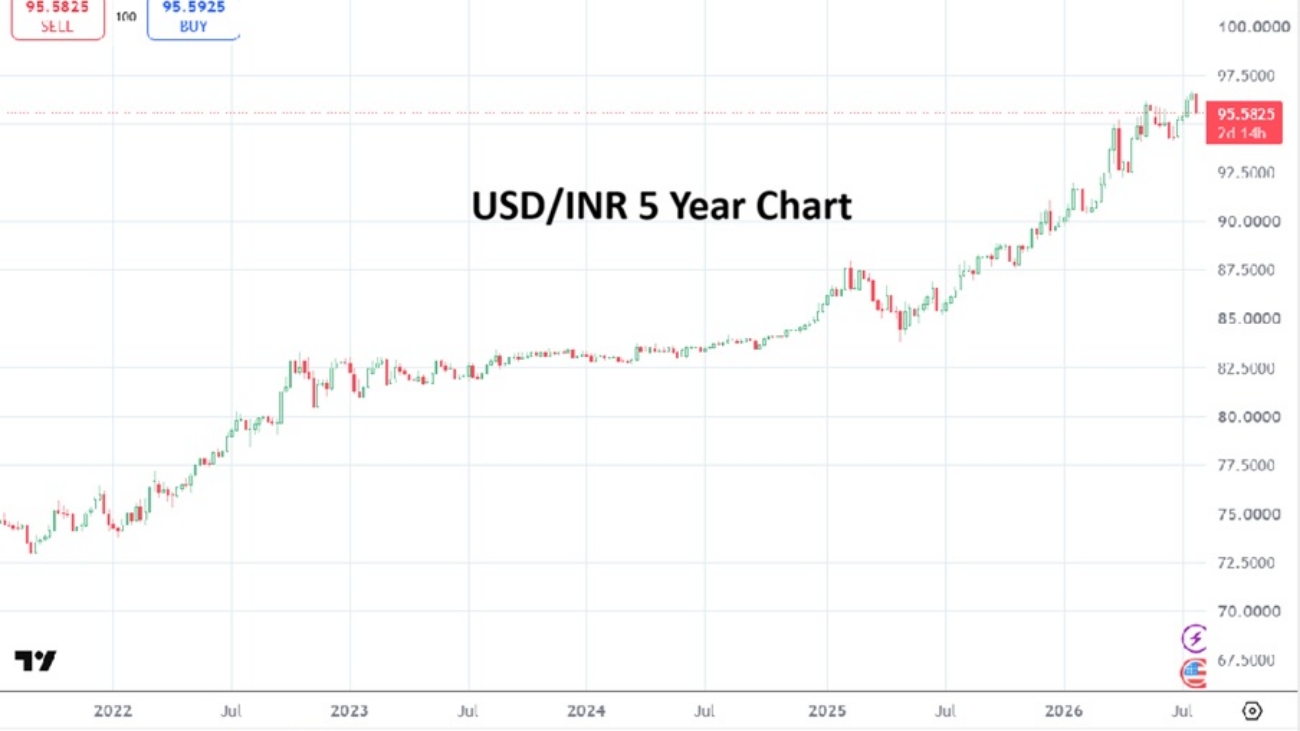
Questions surrounding the Rupee’s weakness should also focus on fundamental causes for depreciation. For instance, the Rupee has largely depreciated the past 5 years from 2021 – from 74.50 per Dollar – and into 2026, where its trading around 95.72 per the USD/INR now. Why?

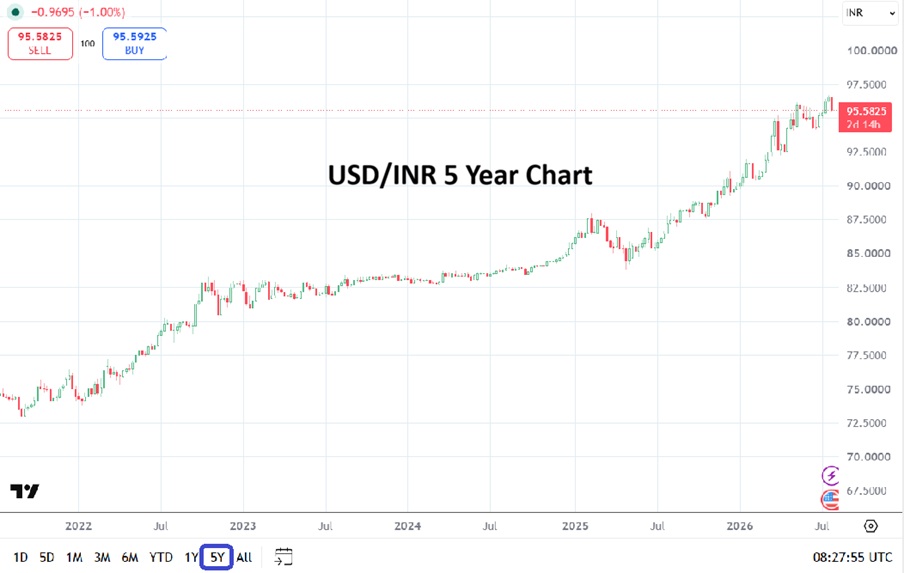
USD/INR Five Year Chart as of 29 July 2026

Nominal depreciation has been 28%, and this is despite service exports growing healthier, and remittances flows that have been good in the last few years. Can the RBI governor say anything related to it?

Why Does the Rupee Remain Weak?

Economists point to the widening gap between India’s foreign inflows and outflows as a structural flaw that’s weighed on the Rupee and growth. A reason for this is India’s struggle to attract long-term capital through Foreign Direct Investment. Net FDI has declined from $28 billion in 2022-23 year to just $7.7 billion in the financial year that ended in March.

Foreign multinationals, venture capitalists and private equity titans have been taking advantage of high valuations to cash out. Despite recent pro-business reforms by Narendra Modi’s government, India’s shabby infrastructure and a bureaucracy that reduces Byzantium schemes to shame, puts off new arrivals. This is also a reason why tradable exports are not growing compared to India’s vast import needs. India’s exchange rate remains relatively overvalued, even though in purchasing power parity (PPP) terms, Indian products are inexpensive compared with those of the United States.

India could have allowed the Rupee to reflect it’s underlying market fundamentals in order to make it’s exports more competitive and restore external balance. Given the high supply of skilled India’s labor force and opportunities in small and medium scale businesses, especially in agricultural value added products where India holds competitive advantages, it’s not impossible to improve tradable export volumes. Instead, the Reserve Bank of India went in the opposite direction by managing the Rupee at 83/USD and made it overvalued, especially when Shaktikanda Das was the Governor of RBI.

If the RBI truly believes in India’s economic fundamentals story, then why did it intervene aggressively during the 2023-2024 period? Critics argued these known interventions may also have had the effect of supporting India’s GDP when measured in USD, although the RBI maintains that its objective was to reduce excessive volatility and preserve financial stability.

Even with respect to headline GDP growth numbers, many economists in India and around the world still believe that Indian statistical numbers overstate the actual strength of the underlying economy. To generate better growth data in India, the government has expanded it capital expenditures to compensate against relatively weak private investment. However, creating jobs and opportunities for linkages – opportunities in sector related industries, and enhancing India’s trade competitiveness via high value exports are important and urgent, rather than depending on foreign capital flows. In this regard, private capital expenditures still need to increase substantially.

Relying on short term capital flows for managing the current account deficit is a difficult strategy. Even if the RBI believes a de-escalation in the US and Iran War will occur, and believes that global liquidity conditions will allow the RBI to accumulate higher Forex reserves, risks remain skewed negatively to the upside without meaningful changes to improve long-term net Foreign Direct Investment.

David Lubin of Chatham House argues that countries should not rely only on high Forex reserves to protect themselves from volatile capital flows. The best strategy in his view is to reduce the potential problems at its source by discouraging unstable, short term inflows, and ensuring banks do not accumulate excessive foreign currency risks.

However, this is exactly what India is doing by mobilizing leveraged foreign currency deposits from non-resident Indian’s and offering hedging for these inflows until September 2026. Reserve Bank of India Governor Malhotra has stated that the RBI has attracted around $32 billion worth of USD inflows via this route.

Arguably, another side of the equation should be examined. If central banks were to accumulate FX reserves for the sake of paying for their imports, without meaningful reforms in their own economy and not creating conditions for capital to be deposited long-term, no capital controls can ably solve the underlying deficits or surplus nature for those respective economies.

In India capital account surplus has created deficits because the net Foreign Direct Investment has been weak resulting in funding costs for transactions in current accounts to increase. Apparently, this dilemma goes beyond the RBI balance sheet capabilities and exposes flaws in the fundamental reality of economic internal policies. The ensuing crisis hits the Rupee faster as capital leaves and damages the exchange rate.

Copy and paste the text from AMT that you want to share

10Y Treasury Yields 20260728

Thoughts on Kevin Warsh, the Fed and USD, Energy, Nasdaq 100, USD/JPY and Bitcoin

Fed’s Rate Announcement Tomorrow and Underlying Market Conditions as Folks Talk

Tomorrow’s FOMC rate decision from the Federal Reserve continues to cause some angst in the investment community as folks try to decipher Fed Chairman Kevin Warsh’s disdain for tea leaf reading. What is being missed by seemingly a lot of the crowd is the open signal from Warsh that he prefers to keep his outlooks rather muted, this because he appears to be focused on the mid and long-term economic picture.

Simply put, I do not think the Federal Reserve is going to raise interest rates tomorrow, nor will the Fed Chair give too much indication about his thoughts for mid-September. It might be stated in the Fed Press Conference afterwards that the costs of energy is being watched, but that is too obvious. Count on it being recorded that the Federal Reserve will watch data and react accordingly. In the meantime, financial institutions may demonstrate volatile overplayed USD centric positions which look overbought looking into the mid-term, as they still worry about the near-term.

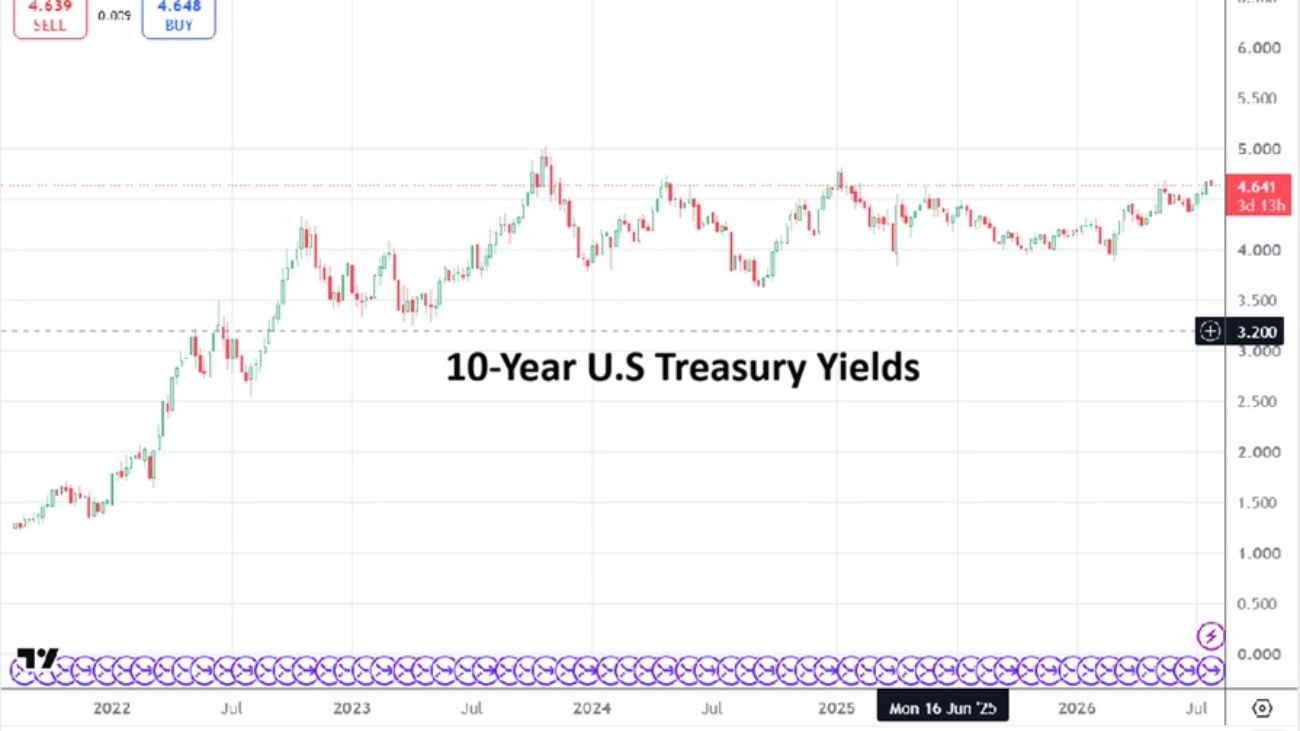
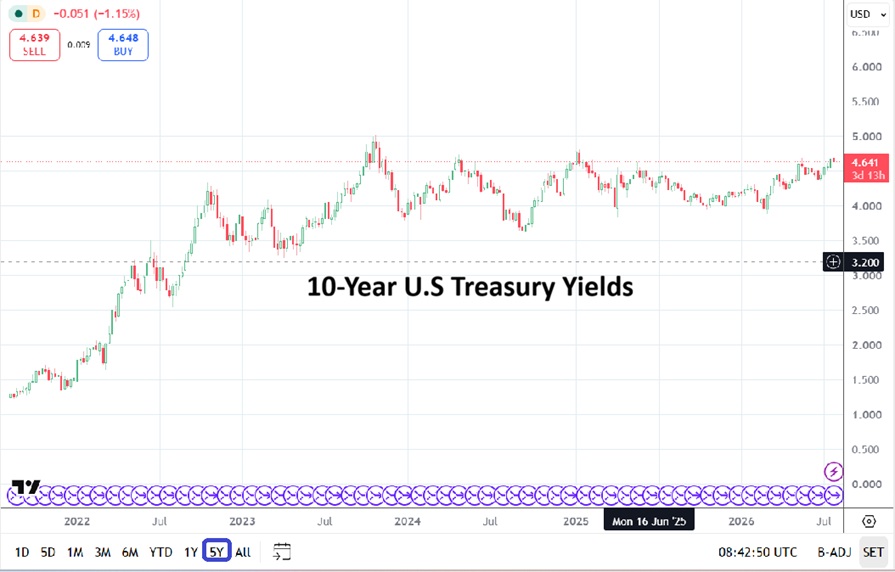
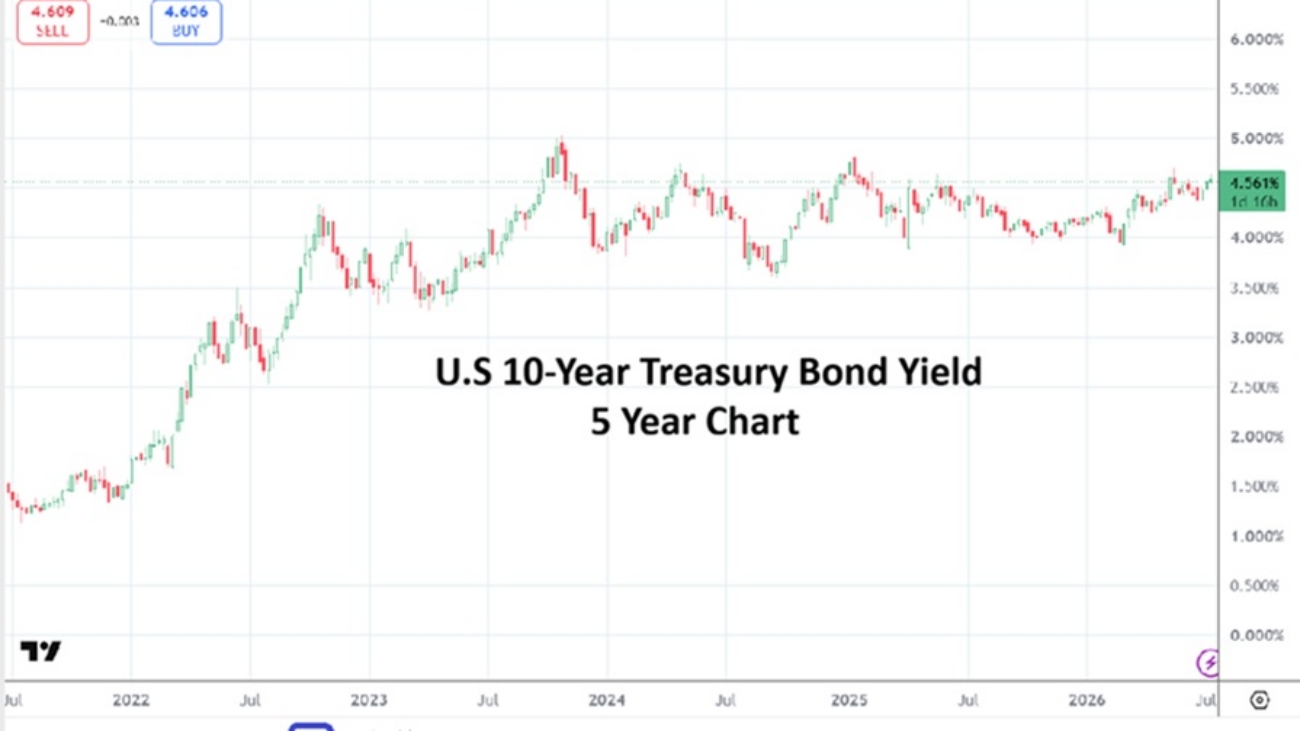
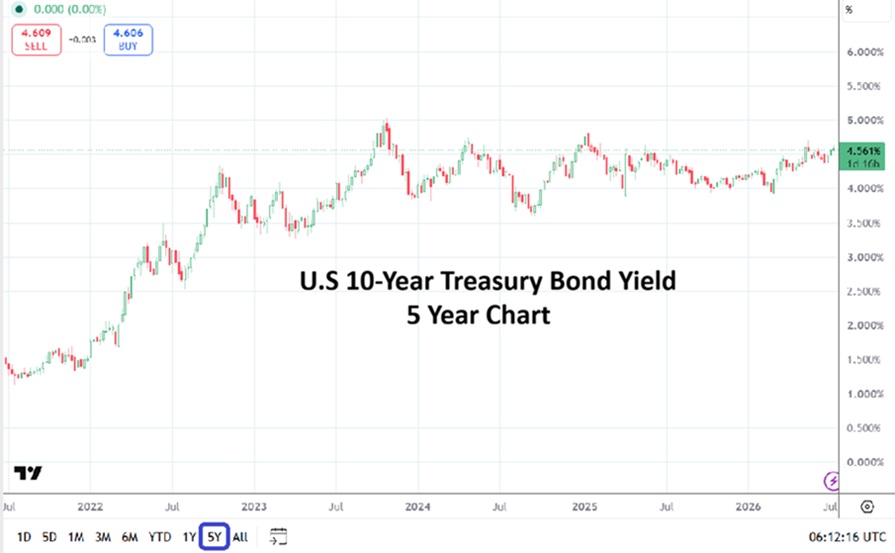
10-Year U.S Treasury Yields Five Year Chart as of 28 July 2026

Political Questions and the Cost of Energy as the Fed Reacts

Let’s for a moment dive into politics. Does anyone think that Kevin Warsh doesn’t speak to Treasury Secretary Scott Bessent who has been a long-time associate? And does anyone think Bessent doesn’t have the constant voice of President Donald Trump in his ear? 

The mid-term elections are nearing ladies and gentlemen. The de-escalation in the Iranian situation certainly has something to do with nations expressing wishes for less military action to the White House. Israel, the UAE, Kuwait, Bahrain, Iraq, Qatar, Saudi Arabia, Pakistan and Turkey are trying to influence positions as President Trump considers his next moves regarding alliances and resources. However, the situation may have something to do with the price of WTI Crude Oil too and its effect on U.S manufacturing and surprise, surprise the Federal Reserve. 

Does anyone else remember that the last de-escalation also started just before the Federal Reserve’s last FOMC meeting in June? I am not being a conspiracy fanatic, just pointing out that lower WTI Crude Oil prices do help the case for a Fed outlook which looks at the costs of energy in a pro-active manner, one which might include the U.S economy and internal White House discussions with politicians who represent voters who have the power of creating a backlash. Lower interest rates equate into lower borrowing costs for consumers.

The Fed’s Impact on Equities and Forex (and the USD/JPY)

So if the Fed does not raise tomorrow, nor gives an indication of what it will do in September and offers a stance of ‘we are vigilant and will watch the economy’ will that help sentiment on the Nasdaq 100 which is starting to have the look of a patient with a bad cold who can’t quite seem to get rid of a cough? Microsoft and Meta step into the limelight tomorrow with earnings reports, Amazon and Apple follow on Thursday.  The combination of the Fed and important quarterly earnings will impact Nasdaq sentiment and other equity indices.

It appears analysts of financial institutions are starting to discuss CAPEX – capital and expenditures – openly. And this is creating shadows as investors weigh the costs of energy and infrastructure against stated profit projections. However, let’s not throw the baby out with the bath water, the Nasdaq 100 has a gain of 20%+ over the past year (July to July), and since March the index has still gained 12%+. The war in Iran (excuse me, conflict) has not had a meaningful impact it appears on the outcome of the Nasdaq 100 via sentiment generated. But the shadow of expenditures, debt and revenue is getting louder bandwidth and speculators need to remain cautious in the indices.

Back to the Fed and Forex, the USD has been strong, you are allowed to say extremely strong if you have been betting on downside incorrectly. The USD/JPY is almost in nosebleed terrain, currently 163.830. The Bank of Japan will announce their interest rate policy very early Friday (for those of us not in Asia) and let’s see if the ‘independent’ Bank of Japan is taking a cue from their government which is clearly interested in continuing to build stronger export ratios. Has the Bank of Japan given up the so-called stated fight to keep the JPY within a solid stance? This is doubtful externally, and Japan is certainly not going to allow the USD/JPY to traverse wildly higher, but it may not consider the 165.000 mark as the end of the world. Beware of saber-rattling from the BoJ in the coming days.

Bitcoin Five Year Chart as of 28 July 2026

Doubts and Remarks Regarding Bitcoin Below $64K

On a last note, the world of cryptocurrency remains interesting and stormy. It appears from watching the awkward statements from influencers and crypto (including Bitcoin) media outlets the past couple of months, as they attempt to explain their pain and convince others that everyone should buy at these lower values that more troubles are coming. 

What are the influencers, crypto media’s and importantly financial institutions’ actual skin in the game relative to those who have lost interest in Bitcoin and the digital market worth? Are influencers and large institutions like BlackRock hoping to pawn off their suffering ‘asset’ holdings to the public, while trying to convince us that today’s cheap prices represent buying opportunities? Is the wave of slanted influence and panic-like banner waving a hope to save themselves in order to cash out of a sinking market, this while hoping someone else takes their place in lifeboats that face a difficult voyage to safe harbors? 

BTC/USD is near $63,4000 now. Yes, we know, we have been told plenty of times before that all the Bitcoin winters eventually turn into summer again. Blossoms will create the sweet scent of profit we are assured, but what if the winter becomes an ice age? What if Michael Saylor and his ability to produce complex financial statements and instruments for MicroStrategy and Strategy equity shares continue to make little mathematical sense? What if all the investors into Bitcoin and cryptocurrencies are left holding the bag and find themselves covered by permafrost? The tundra currently looks harsh. Will the Bitcoin crowd who has been so adamant about being free of regulatory controls and mismanaged central banks cry openly for bailouts from the U.S Treasury with USD? Now that would be entertaining.

Copy and paste the text from AMT that you want to share

Alphabet 20260724

The Not So Coincidental World of Google and WTI Crude Oil

Energy and Commodities in a World Where Legacy and Infrastructure Collide

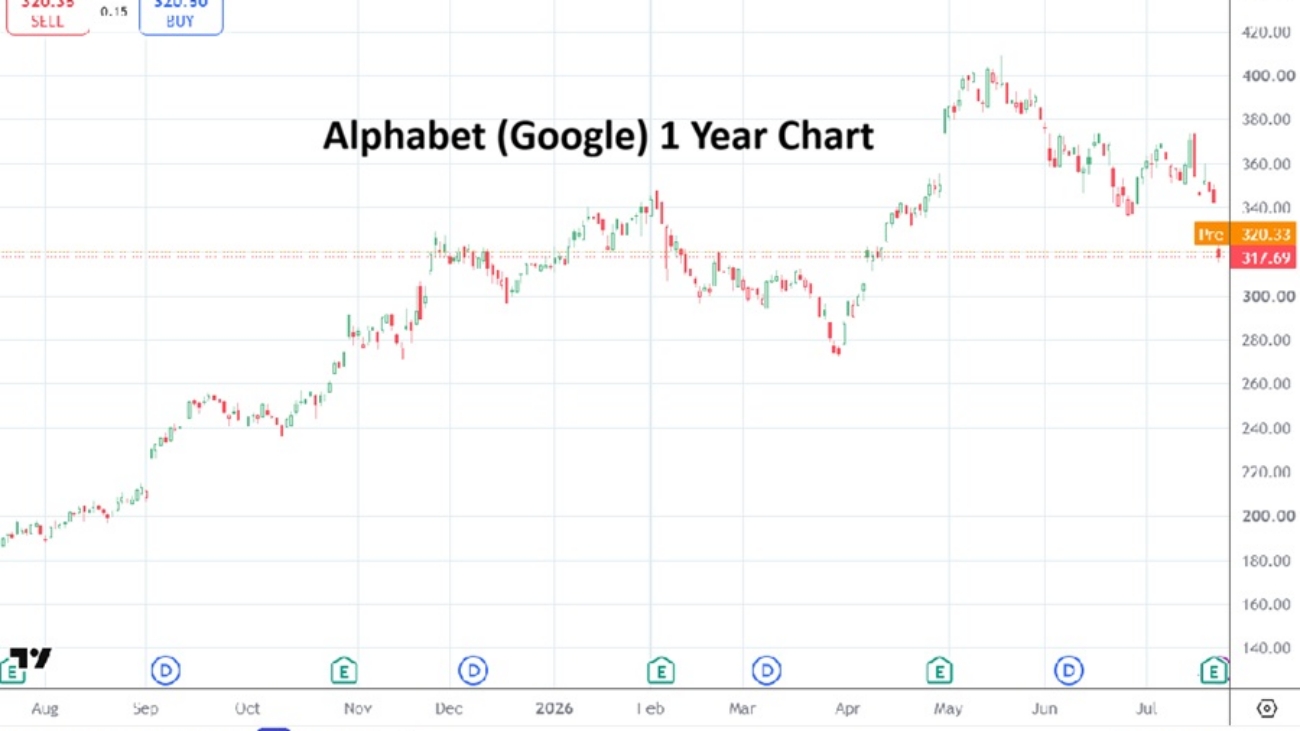
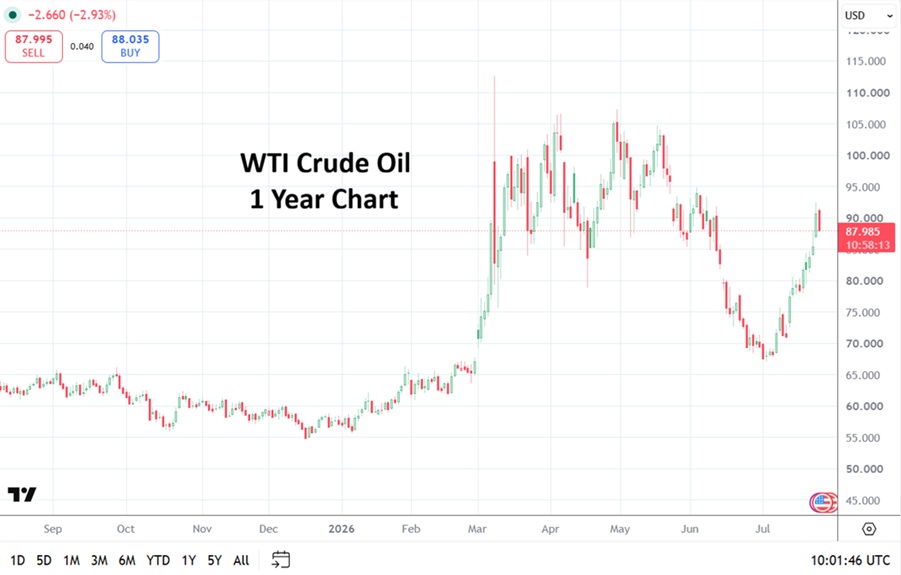
Google (Alphabet) finished yesterday’s trading near $ 317.69, as of this moment WTI Crude Oil is around $88.50. It might seem rather odd to pair the two into the same paragraph, but this is not a coincidence. Both are now relevant regarding energy costs for consumers and produce an abundance of legacy products the world over. And oddly enough their one year charts almost look as if they are dancing in step.

Google is facing headwinds in recent trading as questions surround its capability to produce revenues because of its push into Artificial Intelligence and always growing need for more data center power. AI which has been an abundant source of bullishness in the Nasdaq 100 and had a knock-on effect into the S&P 500 the past couple of years has become shadowed by concerns of turning into a commodity. 

Alphabet (Google) One Year Chart as of 24 July 2026

As competition in the AI sector increases this is creating pressure on prices in order to allure customers away from competing brands. China is also stepping into the world of Artificial Intelligence and it will certainly use its ability to produce less expensive products moving forward. Profit margins are being fought over by competing companies

Google is not a poor company, but there are growing doubts about its debt and revenue ratios. The costs to power its worldwide data ability for its users and its investment into AI via Gemini and its DeepMind technology does not have a particularly easy solution. Estimates from a variety of sources claim that Google has reduced its staff between 1,500 to 3,000 through employee reductions and reorganization, this as the company needs to pile more cash into infrastructure.

The onslaught of other companies able to produce AI which is seen as more robust and capable have also caused a marketing headache for Google, which has an effect on behavioral sentiment. GOOGL was trading at apex levels only two months ago when it was traversing above the $400.00 mark. The downturn thus far has been bad, but not catastrophic. 

WTI Crude Oil One Year Chart as of 24 July 2026

While nervous sentiment can be blamed on the situation in the Middle East the past handful of months, the downturn which has occurred for Google and other important companies on the Nasdaq 100 involved or seen as having an ancillary association with AI needs to be considered a legitimate reaction because of worries surfacing regarding the ability to simply pay for all of the research and infrastructure. 

In order to power AI it is becoming clear that energy costs are part of investing frameworks. Concerns about an AI bubble started to gather an audience last fall and the rumblings have grown louder, yet it can be said the ability of Google and many other companies to gain the past year in value still outweighs this current downturn experienced the past couple of months.

The Iranian war which is ongoing, appears to be entering a phase in which financial institutions are having to succumb to the notion of higher prices not only for WTI Crude Oil but other energy resources with a mid-term viewpoint. While there is abundant supply of Crude Oil worldwide, the current problems surrounding navigation and logistics are causing pandemonium in a consistent manner via WTI’s price as Middle East nations try to ship to their clients. This is causing many Asian nations to look elsewhere for their energy, Brazil has seen an increase in orders. And because of the upwards trend in fuel costs again, the Federal Reserve will have to look hard at inflation data and play a game of interest rate mania, which investors will have to calculate into their outlooks regarding debt ratios.

What does this have to do with Google and AI?

People like nations will search for the easiest and most cost efficient pathway to access their needs. Anthropic, OpenAI, Kimi K3, Microsoft Copilot, DeepBlue Technology, Meta, Sakana AI, IBM, Nvidia are only some of the companies involved in sourcing software and providing hardware to users. Many nations are involved in this AI chase and understand the importance of cybersecurity, data sharing and the problems surrounding the costs to power all of these machines.

Many of these companies above including Google are searching for a holy grail via energy supply and discussing the financing and building of energy infrastructure including nuclear capabilities. But as Google and other companies search for more energy to fuel their dependence on powering their systems for clients, they continue to be confronted by a growing wave which will eventually drown some of the companies in debt that they will not be able to recover from.

I am not forecasting an apocalypse, but I am suggesting not all of these companies which we think of as part of our everyday lives will survive this fight. Legacy companies eventually parish, just like many start ups. The realization that many companies are merely providing what the public is starting to see as necessity is a simple competitive evolution. BlackBerry, Nokia and Motorola are examples of giants falling.

It appears many investors are starting to ask hard questions about costs compared to future earnings in AI. The allure of the next big thing, which AI has been part of the past couple of years, is running into well-practiced investment cycle as froth erodes and financial institutions start to look at the accounting of the companies they are being asked to consider as long-term endeavors. Not all that glitters is gold will certainly start to create a patina on many of the so-called AI companies as they are forced to prove their worth as suppliers of a commodity.

The AI world has run into the time honored financial realization that many exotic tastes soon turn into another form of vanilla. The next big thing is always being anticipated and hoping to attract the deep pockets of investors. Certainly many of the big companies including Google are going to survive the current headwinds. but real profits could become harder to attain. Investors and speculators should not be surprised that reality has a tendency to reduce momentum.  Entropy is part of the investment world, investors and speculators always have to be ready for new disruptions and systems to emerge.

Copy and paste the text from AMT that you want to share

Challenge Part 2 20260723

The Challenge of October 7: Part 2 – The Intellectual Challenge

Stepping Away from Spinoza, Marx, Tolstoy, Post-Modernism and Current Religious Ideas

Opinion: The following article is commentary and its views are solely those of the author. This article was first published the 22nd of July via The Angry Demagogue.

In many ways Israel can be reduced to two things – the Middle Eastern shuk and the Eastern European shtetl. Day to day life in Israel resembles the chaotic, loud, richness and poverty of these two institutions. The shuk, the town market where people go to buy foodstuffs and other daily items still exists in most cities and towns in Israel. The two most famous, Jerusalem’s Machane Yehuda and Tel-Aviv’s Shuk Hacarmel still have their original look and feel (and smell) but have also been gentrified to include pubs and cafes. While modernity does not permit the shtetl to exist in spite of obvious similarities in some fundamentalist communities, it exists in the thoughts and actions of many of the descendants of the old shtetl.

The Challenge of October 7: Part 2 – The Intellectual Challenge

However, there is a philosophical backbone to Israel which started as a semi-socialist country with a vibrant agricultural sector and a European-German intellectual core that includes historical, scientific and cultural departments of the strictest standards. Jerusalem’s Hebrew University and Haifa’s Technion were both modelled on the German university and the other universities that have been established since then were formed on the same model.

There were exciting new subjects being pioneered, notably Gershom Scholem and Jewish mysticism and there was dialogue between many of the rabbis and these intellectuals, many of whom were trained in traditional yeshivot even if they no longer practiced halakhic Judaism. Gershom Scholem was in conversation with Chief Rabbi Avraham Kook (a person he called one of the few true contemporary kabbalists) and others. Shai Agnon, later a winner of the Nobel Prize for literature was a leading voice whose modernist fiction straddled both worlds.

But intellectual life was not found only in Jerusalem’s university and yeshivot – it was spread throughout the country in the new kibbutzim and towns that sprung up over the decades. Many of the pioneers – halutzim – were learned men and women in their own right and the first Kibbutz, Dagania, had its share. One was A.D. Gordon, a Tolstoyan thinker who wanted to turn the country into an agricultural idyll. Another resident of that first kibbutz, a wonderful poet known simply as Rachel the Poetess (Rachel Bluwstein), was a believer of the school of thought that, like Gordon, thought physical labor as liberating to the soul.

But as more kibbutzim were established to the softer Tolstoyan socialism of Gordon was added the harder scientific brand of Marx and Engels and the economic; social and pioneering success of these early kibbutzim along with their ability to “produce” great soldiers led to the acceptance of Marxism as the godfather of many of these socialist communities as well as the Histadrut trade union. Both the Tolstoyan and Marxist ways lasted well into the end of the 20th century. In the 21st century there is still a “romantic” view of Tolstoyan rural life and a neutral or often positive view of Marxist socialism.

The other major influence was that of Spinoza – the renegade Jewish philosopher who was excommunicated by the Amsterdam Jewish community but went on to be, arguably the most influential philosopher of his times. His radical rationalistic view of the world extended not only to his original Biblical analysis but also to the most complex of emotions such as love – in his greatest work, The Ethics. We see Spinoza’s influence in the universities today as an attempt to assume the irrationality of anything not scientifically proven (except that which supports their ideology as in Yuval Hararri’s foolhardy bestsellers). Spinoza is seen as a model of the rebel, honest, heretical Jew and his life is seen, ironically, as saintly in the academic world. It would be safe to say that his influence extends to the religious world too, as a bogeyman against whose heresies one must fight.

Although post-modernism is supposed to be the ultimate challenge to rationalists like Spinoza they are in fact, his grandchildren here in Israel as they take his critical abilities to challenge any and all truths as simple narratives to be adapted, or not. Even the Jewish fundamentalist world has succumbed to the post-modern narrative as they reject the very concept of historical truth and accept only their own fundamentalist narrative of history, as currently believed. As a narrative they have no problem changing it to match whatever is their political need – at the moment.

Something similar has happened in the religious-Zionist camp where the rabbis and academics have accepted this envelope that surrounds intellectual debate. The Tolstoyan idyll is combined with the tought of Rabbi Abraham Kook in many of the new farms that are being established to this day. While Marx himself is not accepted, the socialist dream of equality is often the basis of the economic “thought” of these rabbis.

Even in the arts, leading writers are more political than literary, art is seen to need to “challenge” and not beautify and architecture is more brutalist than anything else.

October 7 has changed all of this in Israel even if the intellectual, political and cultural classes have not yet caught on. Faith in the old guard across the board has been eroded as the intellectual infrastructure that the country counted on failed completely. Not only was it not able to deal with the pointed failures of October 7th but it encouraged the value-less ideas that led up to that failure. In the post October 7th world there were almost no intellectual, religious or artistic responses that tried to deal with these failures but, like the politicians and generals (which we will get to later in another piece), they looked back to justify their own mistaken views and prophecies. There have been attempts to deal with them of course, but they all lapse back into old, tired arguments.

The Israeli intellectual classes have not even been able to think through the rabid antisemitism that has enveloped their own world except to return to the same old cliches and complaints which usually blame their political opponents. This has been true across ideological and religious camps.

There have been exceptions of course. Two rabbis come to mind – Rabbis Ya’akov Madan and Tamir Granot – the latter who lost his son in battle and the former whose son lost both legs, also in in the war. They have challenged the fundamentalists in the religious camp, the secularists of the left and the right and their own religious-Zionist colleagues in an attempt to come to terms with what happened three years ago.

If there were three main secular thinkers, on the religious side we can look to three 20th century rabbis and one who was still active in the 21st century who have dominated the religious thought of the country – Rabbis Avraham KookJoseph Soloveitchik and Avraham Karelitz, also known as the Chazon Ish as well as Rabbi Ovadia Yoesf, who, arguably changed the religious and political life of the country through his authority and charisma in the Israeli Sephardi (Jews from Arab lands) community. Jewish tradition by its nature allows great flexibility in re-interpreting past statements to fit the times so there is hope that new and bold ideas can be teased out of these great thinkers.

There need to be better intellectual models than Marx and Spinoza and while Tolstoy was the artist par-excellence his philosophy of history in “War and Peace” and essays leaves much to be desired. Marx of course should be persona non grata for all freedom loving peoples, especially Jews. Spinoza was a revolutionary thinker but one who, despite the “Theologico-Political Treatise” has nothing new to say in the post-October 7 world. As for the Rabbis mentioned earlier, the current dominant interpretations will need to be overcome in order to breathe fresh air into these communities.

To us it seems that the vast majority of people in Israel are ready to move on from the current idols but the question remains will the universities, filled with thinkers who are afraid to face up to their own failures and afraid of losing their international status, find enough bold people to create a new intellectual framework to help the country move forward or will they be left behind and made to be irrelevant to those they are meant to teach and serve? Will the Rabbis, also cloistered in their own four walls be able to look past their previous modern dogmas to forge a way out of the ethical and religious morass formed by the disaster of October 7?

What does the country need intellectually and theologically to move forward? If the old thinkers needed to come to terms with the end of exile and then a post-Holocaust world, today’s thinkers need to help us face the main challenges of the post October 7, morally, spiritually and intellectually. Settling the land is still important but that in an of itself does not protect us. Learning Torah will help us and according to some, will help defend us but it also allows us to run away from the reality that is around us. Studying the great books, creating new narratives not found in history or reason or depending only on our reason did not stop the profound reintroduction of antisemitism in the academy and around the world.

In short – October 7 challenges not only our peace of mind and way of life, it challenges the very foundations of our intellectual and religious lives that were shattered that Shabbat and Simchat Torah morning. Each and every one of us can find the errors of those we never agreed with, but only a bold and creative thinker can re-examine his or her old, mistaken ways.

However, we need to understand where to start on the intellectual and theological journey and there is one thing that needs to be the center of our post-October 7 philosophical, ideational and theological quest. That one thing is the centrality of the “people of Israel”. Tradition calls it “clal Yisrael” and we need to understand that that must be a focus of our thought. All countries and all peoples have a natural sympathy for the pain of their fellow countrymen, or ethnicities but for the Jewish people, so small and so at risk of destruction in every generation that pain always feels existential.

This is a theme that will follow us in our following essays, but it is something that can unite the various thinkers. This is not a call for unity of ideas or a false political unity, but rather that the thoughts and ideas that come from each thinker needs to focus on the betterment of Jews as individuals and Jews as a people and not on the sectors they strive to represent. Maybe the sectorial thinking was necessary to build the country into what it was (or maybe not) but it is clear that the post October 7 Jewish world has changed and brought challenges that need to look beyond the factions that are at the center of the contemporary Israeli and Jewish life.

We claim now that no single Jewish thinker or group has the good of “clal Yisrael” in mind when they plan their future thoughts and actions. This is as true of the Reform movement as it is of Chabad. It is as true of the American Hasidic and non-Hasidic fundamentalist worlds as it is of the modern Orthodox. In Israel it is as true of the religious Zionist world as it is of the Israeli fundamentalist-Haredi as it is of the secular intellectual world.

What is required is an honest, creative and bold assessment by thinkers in all streams. That is not to say they all must agree on the solutions, but the cynical claim to speak for the Jewish people while really pushing for the success of their own group needs to end.

In the diaspora the explosion of antisemitism needs a solution focused on the Jewish people without the excuses we give to the antisemites for being antisemitic – this or that policy, this or that religious commitment. Bret Stephens opened up a new dialogue on antisemitism and that is a start – but it must go much further and much deeper. We too have proposed a modest way of dealing with this evil – but that too is just a start.

We await the honestly, creativity and boldness necessary to bring the country, the Jewish people and the world into the post-October 7th world. We say the world, because the antisemitic reaction to October 7th is not only a threat to the Jewish world, but also a threat to the free world. The intellectual climate in Israel is not conducive to solving the post-October 7th country as it has become politicized beyond recognition. A de-politicization of all intellectual and theological streams and a concentration on “clal Israel” is the only way out of the mess they, we, have all created.

It is not just the generals and the politicians that failed, but the Rabbis, Professors, writers and artists that have failed along with them.

Disclaimer: the views expressed in this opinion article are solely those of the author, and not necessarily the opinions reflected by angrymetatraders.com or its associated parties.

Follow Ira Slomowitz via The Angry Demagogue on Substack https://iraslomowitz.substack.com/
Copy and paste the text from AMT that you want to share

Iceburg Rose 20260722

India Insider: What Do Rural Areas Say About the Nation’s Fast Growing Economy?

Reflections on a Disappearing Workforce and a Long-Term Strategy

Tamil Nadu is one of the fastest growing States in India with an impressive Gross State Domestic Product result of 11.9% in financial year 2024-2025. Despite the former Dravida Munnetra Kazhagam’s (DMK) government being unseated by the new party Tamilaga Vettri Kazhagam’s (TVK) in State elections recently, Tamil Nadu has continued to attract billions of USD. Automobiles, information technology (IT), electronics, and high-end engineering from global investors continues to be alluring.

As a student of economics, I have looked at and questioned how far this growth has helped raise wages and create jobs. In other words, will these investments help create linkages across the Tamil Nadu economy and generate deeper opportunities? Tamil Nadu may have higher GDP growth than any other State economy in India, but its growth is highly skewed towards a relatively small number of sectors.

India Insider: What Do Rural Areas Say About the Nation’s Fast Growing Economy?

As noted, some of these sectors that attract investment generate high output, but employ a relatively small share of the workforce. As a result the gains are not spread evenly across the labor force.

Since the informal workforce constitutes a large share of employment in Tamil Nadu, many companies rely on contract labor that has created limited individual bargaining power. This is evident in many automobile, textile, and mobile phone assembly plants in Chennai. 

I knew a friend who worked in a mobile phone assembly plant in 2019 and despite completing a Bachelor of Engineering degree, he earned only around USD 150 per month. Since employees have weaker bargaining power, wages do not rise even as inflation increases every year. 

Many people leave these companies within one or two years. However, companies do now worry, because these firms can recruit replacements because the supply of educated workers remains high relative to demand. Tamil Nadu produces a higher number of graduates every year, and it knocks down the wage bargaining power of workers, allowing the formal economy to employ a multitude of people without having to raise wages

In the 1990’s these conditions weren’t prominent because there were fewer people who had accomplished university studies and graduation. Getting into the formal economy became easier and capital started to flow after the end of the License Raj era controls in 1991, this when India opened up it’s economy for foreign direct investment.

In the last two decades, Tamil Nadu’s industrialization has become heavily concentrated in cities such as Hosur, Chennai, Tiruppur and Coimbatore. Despite strong outbound trade, the State records an overall trade deficit. This also means some districts are performing well, while others remain heavily dependent on agriculture or services to generate Gross District Domestic Product (GDDP).

Pudukkottai District as a Case Study

I was doing some field surveys in Pudukkottai district, especially in the town and surrounding rural areas. And since we have no clear up-to-date Census numbers, we have to rely on the 2011 Census to understand the composition of Pudukkottai district’s economy.

According to the 2011 Census, Pudukkottai district is heavily dependent on agriculture, accounting for roughly 45–55% of employment. An important parameter to examine in the next Census will be whether this composition has changed.

Because the census is not giving us clear answers, we need to conduct random surveys across multiple villages to understand the reality. And during my visits around Pudukkottai, I consistently saw people mainly below the age of 20 and above the age of 50. Why?

This was the case in numerous villages around Pudukkottai. Still, we need stronger evidence. I repeated this exercise across different time periods to understand whether the pattern remained the same. The result was remarkably similar regarding ages.

Interestingly, the predominant working age population of India – between 25 and 40 years old – is largely absent from villages and even from Pudukkottai town, although I did see some from this age group employed in the service sector.

Where Did These Missing Workers Go?

The single reason lies in Pudukkottai district’s relatively high agricultural productivity. Since the service sector accounts for only around 30–35% of employment, the district still relies heavily on agriculture and allied activities for income generation.

That model has weakened over the last fifteen years. Lack of small scale manufacturing industries has crippled employment opportunities. Unlike Coimbatore or Tiruppur, Pudukkottai has attracted relatively few large manufacturing or technology investments. Economic growth has therefore remained dependent on agriculture, small businesses, and government employment.

Another important aspect is that many small businesses in the service sector are struggling or have closed altogether in Pudukkottai compared to 2016 because of weak local consumption. This is because people are migrating. That is clearly visible, and businesses cannot survive without a sufficient working age population. While Pudukkottai’s district’s population may have grown, much of the increase may have occurred in rural areas and been offset by outward migration of working age adults to Chennai, Bengaluru, Singapore, Malaysia, the Gulf countries and other employment centers.

The difference is also reflected in income levels. Recent district estimates place Coimbatore district per capita income at around ₹4.1 lakh, while Pudukkottai’s is approximately ₹2.4 lakh. The gap reflects differences in industrialization, labor productivity, and the availability of high value employment rather than population alone.

The next Population Census and the Periodic Labor Force Survey (PLFS) will be important in determining whether outward migration and changes in employment composition support these observations. Indicators such as graduate unemployment, labor force participation, regular salaried employment, and sector wise employment will provide a clearer picture of whether Tamil Nadu’s growth is creating quality jobs.

Limited industrial growth will become a much bigger challenge for Tamil Nadu over the coming years if unemployment among educated youth continues to remain high. Pudukkottai district is a classic example of that challenge.

India’s fast growing economy needs proactive business policies in small towns, together with the infrastructure needed to attract manufacturing and private investment. Depending primarily on IT hubs or remittances from the Gulf and Southeast Asia is not a sustainable long-term strategy.

Copy and paste the text from AMT that you want to share

Challenge Part 1 20260721

The Challenge of October 7: Part 1 – Introduction

Cynicism and Wake Up Calls: World War I, Vietnam, October 7th

Opinion: The following article is commentary and its views are solely those of the author. This article was first published the 20th of July via The Angry Demagogue.

Europe and the UK had WWI, the United States had Vietnam. Israel had the birth of the post-Zionist left in the wake up call that was the Yom Kippur War, and now (learning that the wake up call did not last) the events of October 7 have demanded that the country face new challenges – intellectually, politically and socially.

The Challenge of October 7: Part 1 – Introduction

World War I and Vietnam gave birth to the cynicism and inferiority complex to Europe and the United States respectively that has reached its nadir in the contemporary West. The utter lack of self-confidence in the traditions, virtues and ideas that moved the West forward from ancient Athens and Jerusalem to the Middle Ages to the enlightenment and on to the computer age. As technology moved forward, the ideas that underpinned it retreated to a nihilistic denial of the monotheistic idea that is the basis of all Western life.

Today’s engineers, physicists, humanists and social scientists miss the historical arc that moves from Plato and Aristotle’s break from paganism and the Jewish intellectual monotheistic heritage from late Biblical and post-Biblical times through the Church Fathers and the medieval Jewish, Christian and Moslem thinkers to our current times. The bits and bytes of the computer age didn’t just happen to be created in this cultural milieu. That is not to say that the monotheistic religions over the past 2,500 years have not held back important thinkers, caused wars and acted (shall we say, pagan-like?) over this time. They have. Each of the monotheistic religions have something to atone for, as do great Eastern religions – Hinduism, Buddhism and Confucianism in their various forms. And no one can deny that in addition to freedom and scientific advances, the Western tradition also created evils such as fascism, Nazism and communism.

Racism, slavery and misogyny existed throughout history in all cultures and while it was the Judeo-Christian tradition that finally ended at least the “acceptance” of these practices, they seem to rear their ugly heads again and again. We see that in the rebound of antisemitism in polite society.

The fundamentalists of all religions and ideologies unable to live with the belief that what they hold dear can be challenged and therefore we have before us various post-modern narratives instead of historical honesty. In my own religion, the fundamentalists go so far as to deny that a great rabbi ever visited a Jewish library and read the stories of a non-religious Jewish writer. The hagiography and insistence that “the greats” never sinned is part and parcel of the fundamentalist narrative and is due at least as much to the same loss of self-confidence that the secular world has endured as it is to blind belief. On the other side, we have “great” historians who create theories that belittle ancient truths with as much scientific proof as the ancient traditions themselves.

In Israel, as we stated before, the Yom Kippur War was the shock that told the elites that maybe they were mistaken in their Zionism and that a new post-Zionist, post-nationalist, European style country is what should replace the pioneering, self-sacrificing, idealistic country that had been built. They looked at Western Europe and saw a peaceful, prosperous continent and wanted to copy it. What they ignored of course was the beginnings of a demographic crisis, the total dependence for their defense on the United States, and most importantly a loss of creativity and energy that comes with the cynicism and exhaustion of a continent that went through two world wars and was free only because outside powers fought their occupiers and tormentors. Half the continent was still under occupation of course in 1945, but that did not affect the post-Zionist worship of the free half then under the nihilistic force of post-modernism.

After the Yom Kippur War, the Israeli establishment and not only the establishment was ready to move on from the Zionism and Judaism that formed the basis of the Jewish and democratic state in order to move it from its pariah-hood in its own neighborhood. The lure of peace and stability and the hope of a comfortable future was put in the hands of those who felt it was Israeli pride and self-respect that was the reason why the country could not live in peace with its neighbors. Shimon Peres, the tactician, par excellence, who was more responsible for building up the IDF than any other single person, decided to turn into a strategist and went so far as to oppose the study of history in schools. Only forward-looking people need apply.

October 7 has brought the country to another crisis of confidence, but the consensus that is being established is neither a return to the post-Six Day War euphoria nor the post Yom Kippur War depression. Over the coming few days we will examine the intellectual, political, military, diplomatic, cultural, social and economic changes that the post-October 7 country is forcing on the old leadership of both the left and right, the religious, fundamentalist and secular. The current election battle is being fought along the old lines, but the country is moving away from them. It could be that the change will come in this October election, but it may take more time until the leadership is changed and the discussion moves from the old battle lines to new, unknown disagreements.

Over the next few days, we will examine the changes that need to happen in order for Israel to deal with the trauma and, dare we say, opportunities that the failure of October 7 has brought.

Disclaimer: the views expressed in this opinion article are solely those of the author, and not necessarily the opinions reflected by angrymetatraders.com or its associated parties.

Follow Ira Slomowitz via The Angry Demagogue on Substack https://iraslomowitz.substack.com/
Copy and paste the text from AMT that you want to share

SIngapore Dollar 20260717

Thoughts on the USD/SGD, Cautious Broad Market Sentiment and the Weekend

USD/SGD: Currently a Hope and Prayers Barometer in Global Forex

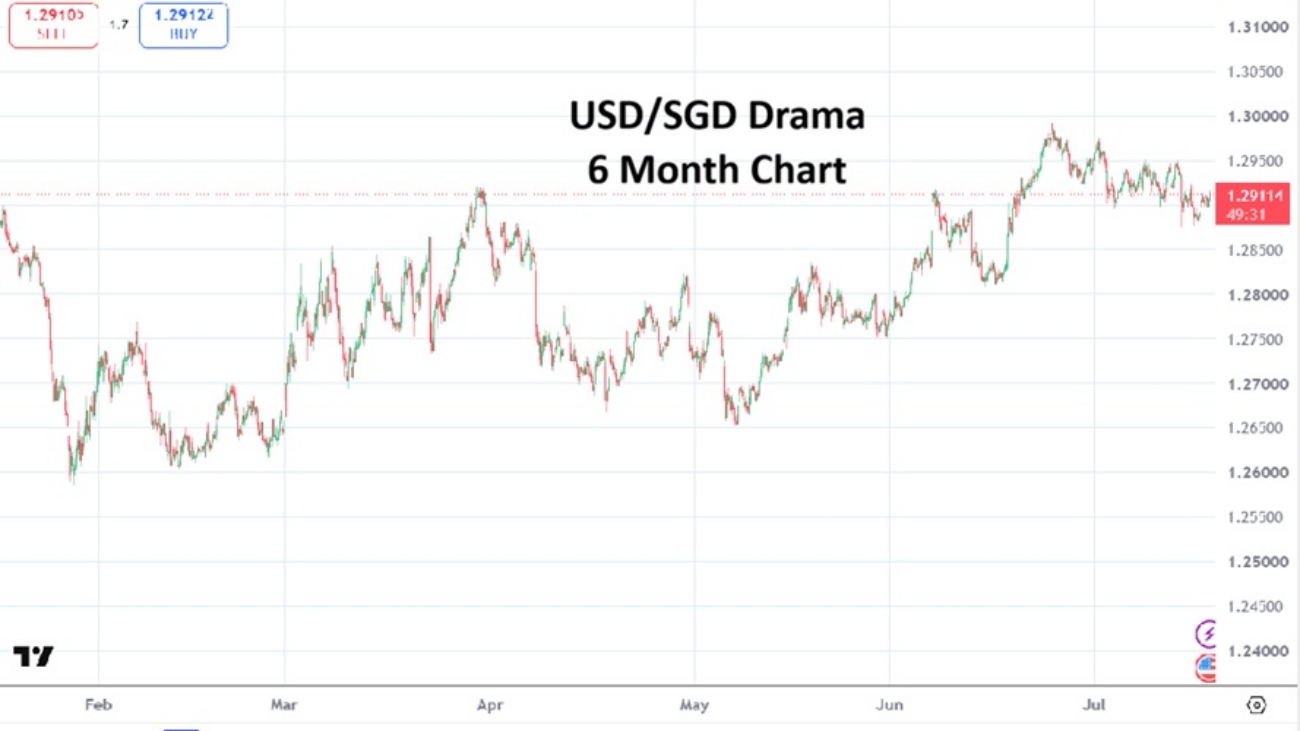
The USD/SGD is near the 1.29110 vicinity as of this writing. Financial institutions apparently have combined their cautious outlooks in the broad Forex market as USD centric strength continues to leak into sentiment, while their instincts technically demonstrate that over the mid-term currencies like the Singapore Dollar should be stronger and the USD/SGD is supposed to show some bearish activity.

For dramatic purposes let’s call this current phase of Forex trading including the USD/SGD as the hope and prayers act. The Singapore Dollar has sustained highs, but it has traversed lower over the past few weeks. On the 24th of June the USD/SGD was near the 1.29940 ratio. Let’s be clear, for small speculative Forex traders broad market wagering on USD direction remains dangerous.

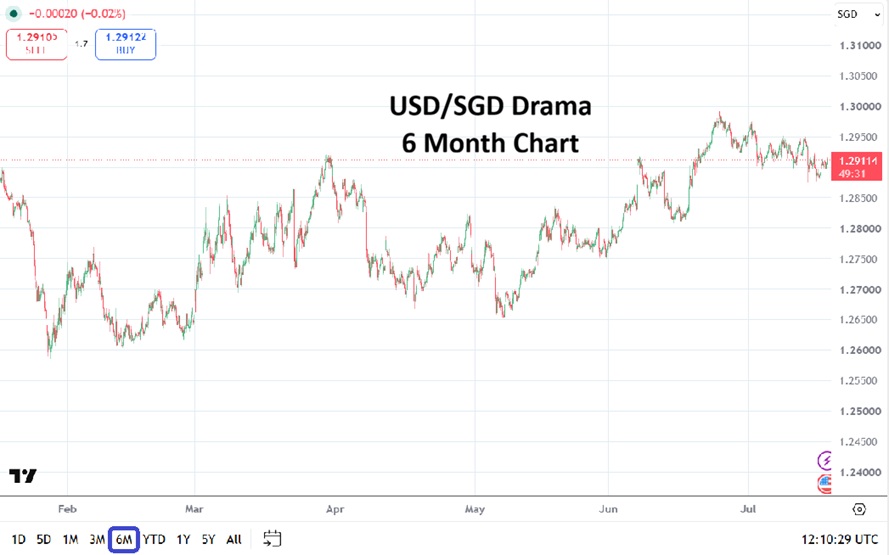
USD/SGD Six Month Chart as of 17th July 2026

Fed Chairman Keven Warsh and His Desire to Introduce New Data

During the recent testimony of Fed Chairman Kevin Warsh in Washington D.C he made it clear he is keen on introducing AI tools into interpretations regarding Federal Reserve policy. However, he also said that AI will not be relied upon alone. From a coding perspective, Warsh essentially said proactive data will become part of the Fed’s thinking with proper supervision: some of you may want to call this a stack developer’s job.

At the same time while refusing to tip his cards regarding his stance on interest rates too much, Forex markets responded by selling the USD in incremental bouts. Intraday trading flared in its usual manner, but started show a core belief that Warsh is demonstrating dovish sentiment regarding interest rates.

USD/SGD as a Forex Barometer and Near-Term Behavioral Sentiment

The USD/SGD serves as a solid barometer of the Forex market. It offers perspectives on Asian sentiment, but also shows how global financial institutions are leaning. The escalation of firepower in the Middle East the past week and into today has caused reactions in the USD/SGD, but somewhat politely.

Having been able to trade below the 1.29000 mark on Tuesday and Thursday of this week, the currency pair is trading near values seen on the 8th of June and 18th. A lack of clarity remains a theme in Forex. The USD/SGD is the 10th biggest Forex pair via transactional averaged volume, so traders should give it attention even if they do not pursue.

Wall Street Remains Nervous and the Tense Weekend to Come

Going into this weekend Forex traders have created downside pressure on the EUR/USD and GBP/USD. The USD/JPY remains stubbornly above the 162.300 ratio. Nervous selling on the Nasdaq 100 via futures trading has been seen today and it looks as if Wall Street will be in for another bumpy ride. The wishful thinking drama in the financial markets is being confronted by the reality of a potentially loud weekend of military conflict between Iran and the U.S, and a seemingly unconvinced marketplace that doesn’t want to demonstrate risk appetite.

WTI Crude Oil prices via futures trading are above $80.00. Having been able to sustain values above the 1.29100 mark in the USD/SGD signals that bearish mid-term perspectives still need additional impetus to create more selling, but this doesn’t appear a wise speculative bet going into the weekend.

A cautious stance over the coming hours should be anticipated as folks wonder what the coming weekend will bring. At least there is the World Cup championship on Sunday (New York time) to take our minds off of concerns. However, Monday will not react to the trophy being raised, but to behavioral sentiment that will takes its cue via today’s finish on Wall Street and noise generated via the Strait of Hormuz this weekend.

Copy and paste the text from AMT that you want to share

Troll

India Insider: A Giant Bureaucracy Needs an Urgent Reset

Paperwork Cyclones and Slow Pace Confront Indian Citizens and Corporate Investment

Almost every single day Indians are confronted by massive bureaucratic problems when they have to approach the government for basic services. When this will change?

For example if you apply for an Aadhaar card (which is used for proof of identity and address in India), birth certificate or ration card (used primarily for getting subsidized groceries in government run stores), or want an electricity connection or passport, you have to move through a myriad of unnecessary bureaucracy in many government offices.

Recently, I went to renew my passport which was authorized and overseen in a regional passport office in Tiruchirappalli of the Tamil Nadu State. To my astonishment, there were no single chairs or any other type of sitting amenities for visitors carrying their applications. Visitors had to sit down on the floor outside the passport office.

India Insider: A Giant Bureaucracy Needs an Urgent Reset

Also applicants inside the premises had no access to office drinking water or restroom facilities. And the waiting hours were too long. The authorities there treat people like teachers treating students, making normal people wonder why they have to apply for their  passports by undergoing this giant bureaucracy as if it were a psychology test of some sort. Many people pour their anger and frustrations onto online forums complaining about the mistreatment.

Some of these people likely wondered how India despite showcasing it can send satellites to space and the Chandrayaan to the moon, doesn’t seem to have a stable, nor easier services for the day to day needs of the people regarding government affairs.

The government may argue that due to large numbers of people constantly applying for various forms and certificates, and a lack of adequate staff, things are more than a little complex in many overburdened government departments. But the fact the government seems to miss and a critical point people are driven to anger about, is that the nation collect taxes from its citizens to insure adequate services which are not fulfilled comfortably in most cases.

Indian citizens are not applying empty handed for a passport and expecting charity or miracles from the government, rather they pay an accepted fee to the passport office. Thus, it’s the duty of the government bureaucracies to be held accountable.

In government run local panchayats (rural government assemblies), there is always rampant corruption. An example can be given regarding the simple renewing of a business license. Corruption is a common thing. Vishalini (name changed) told me that she had to pay a 5000 Rupees fee ($51 USD) in 2019 in order to bribe a local panchayat to get her father’s death certificate

Imagine what would happen if some officers from the government or its employees, went to a restaurant and they were treated badly and charged $20 instead of $2 for a Dosa or Vada Pav. Would they silently pay the bill with cash not resisting, or would they fight back and ask questions?

As a former Forex broker working in the Indian financial markets and servicing retail clients, I have witnessed how this bureaucracy has worked. In April 2024, the authorities simply banned the exchange traded currency derivatives market that allowed retail speculators, small scale exporters and importers to hedge their exposure, wagering on the direction of the Rupee against 4 currencies – the EUR, GBP, Yen and USD. Many clients lost money, because they couldn’t sell at the available market price and some of the trades were liquidated by brokers’ risk management systems when the directive was put into force. The authorities neither compensated, nor took responsibility for these actions. The government action was decisive and swift.

Almost everyone in India knows that we have ‘missed the boat’ by making small manufacturing detrimentally hard due to red tape, poor infrastructure and giant bureaucracy. Free enterprise and entrepreneurship create innovation, less government intervention and greater economic freedom could allow small scale manufacturing to flourish.

Not Only Indian Citizens Suffer, So Do Investors

India has huge gaps to fill, but even if someone injects capital for an infrastructure project, makes money, and is creating jobs, there are still many things to be done about the burden of bureaucracy. The results of government inefficiency and corruption also creates hurdles and disadvantages for investors who would like to participate in India’s growth story with much needed foreign money.

India’s enormous bureaucracy needs urgent improvement and progress in order to facilitate and revitalize its approval system to receive Aadhaar cards, marriage certificates and even death certificate in a more timely manner. Everything can and should be digitized, so people don’t have to wait in long cues to verify or get new documents.  

A lack of effective and transparent services in government offices have to be dealt with effectively. Standards need to be created, upheld and checked on regularly, a host of problems need to be eradicated. Indian citizens would benefit.

India is a current account deficit country and it needs foreign direct capital to help finance its deficit. Investment opportunities need to be made easier for financial institutions abroad to facilitate capital inflows into India so it is less reliant on its own domestic borrowing and savings. Weak frameworks and institutional voids create problems. For India to reverse the weakened foreign direct investment being demonstrated and attract meaningful capital, fundamental changes need to take place, we cannot rely on mere hope for more favorable diversification cycles from abroad. With better policies implemented by the government, India can attract global investment funds easier and help foster improvements for all.

Copy and paste the text from AMT that you want to share

10Y US Treasury Yield 20260716

Why the U.S Fed Should Lower Interest Rates Closer to 2%

Fighting Inflation with Higher Interest Rates is Totally Counterproductive

For nearly a century, central banks have relied on one dominant prescription to fight inflation: raise interest rates. The theory is straightforward. Higher borrowing costs discourage spending and investment, reducing demand and eventually slowing price increases.

While this approach may have worked reasonably well in the past, today’s economy is fundamentally different. Applying the same monetary formula developed in the past century by Irving Fisher is obviously creating more problems than it solves. In many cases, raising interest rates has become a counterproductive way to fight inflation.

  • The first and most obvious consequence is the impact on government finances. As interest rates rise, the U.S. Treasury must refinance its enormous public debt at increasingly expensive rates. The result is an explosion in annual interest payments, which now exceed $1 trillion. Those payments are in fact a direct injection of additional liquidity into the economy while simultaneously widening the federal deficit.

U.S 10-Y Treasury Yields Five Year Chart as of 16th of July 2026

Ironically, a policy designed to reduce inflation is contributing to larger government spending through higher debt-servicing costs. Instead of easing inflationary pressures, excessively high interest rates may actually reinforce them through this fiscal channel.

  • Consumers also bear a heavy burden. Modern households depend far more on credit than previous generations. Credit cards, auto loans, and consumer financing have become an integral part of everyday life. When the Federal Reserve raises interest rates, millions of Americans see the interest on their credit card balances climb to 20% or more.

Many families attribute their declining purchasing power entirely to inflation, when in reality a significant portion of the financial pressure comes from soaring interest payments.

  • Businesses suffer as well. Higher interest rates increase the cost of financing, while the same capital could be dedicated to investment, expansion, innovation, and research. Every additional dollar spent on interest is a dollar that cannot be invested in productive activity.

A recent example is SpaceX, which issued debt carrying a yield of approximately 6.65%. Given the company’s negative cash flow, investors naturally require a risk premium. However, if the Federal Reserve’s policy rate were closer to 2% rather than current levels, the company’s borrowing costs would be at least half their current level. The extra interest payments would instead be directed toward research, development, hiring, that would strengthen long-term economic growth.

In the current race for AI, that requires heavy investments, the Fed should lower the financing burden on U.S companies. Every additional percentage point of interest represents billions of dollars transferred from productive investment to debt servicing. Money that could finance AI chips, data centers, engineers, research laboratories or new factories instead goes to creditors.

The U.S cannot simultaneously declare China its principal strategic competitor while maintaining a monetary policy that systematically makes capital more expensive for American businesses than for their Chinese rivals, that benefit from much lower rates. The Fed may intend to fight inflation, but it is also making it more costly for American companies to invest in the industries that will determine economic leadership over the decade. The Fed may believe it is fighting inflation, but it is simultaneously increasing the cost of winning the AI race.

Perhaps the greatest weakness of relying on high interest rates is that much of today’s inflation originates from supply-side shocks that monetary policy simply cannot fix.

How does raising interest rates reduce the price of oil when energy prices are driven by geopolitical tensions such as the war with Iran?

How does raising interest rates lower egg prices when shortages stem from productivity issues in the poultry industry?

How does raising interest rates lower the prices of wheat, corn, or cocoa when inflation is due to droughts, floods, or other climate-related events?

How does it reduce insurance premiums that are rising because natural disasters have become more frequent and more costly?

In each of these cases, higher interest rates are totally inefficient to address the underlying cause of inflation. Instead, they merely increase financing costs across the economy while leaving supply constraints largely unchanged.

A more effective strategy would be to fight inflation where it actually originates. Governments possess fiscal tools that can be deployed with much greater precision than broad monetary tightening. Temporary subsidies, targeted tax relief, incentives for increased production, strategic investment in critical industries, and, in exceptional circumstances, carefully designed price controls can address specific inflationary pressures without unnecessarily slowing the entire economy.

For example, if geopolitical tensions cause oil prices to spike, temporarily subsidizing fuel or reducing fuel taxes is likely to be a far more direct and effective response than raising interest rates across the entire economy. Similarly, boosting domestic agricultural production is a better solution to food inflation than making mortgages, business loans, and credit cards more expensive.

The Fed should therefore focus on reducing the financing burden on both the federal government and the private sector. Maintaining interest rates closer to 2% would significantly lower debt-servicing costs, support productive investment, and allow fiscal authorities to intervene more effectively with targeted measures when inflation arises from specific sectors.

The doctrine of fighting inflation through higher interest rates was developed by Irving Fisher nearly a century ago, in an era with very different financial institutions, consumer behavior, and sources of inflation. Credit cards did not exist. Household debt was far lower. Global supply chains, geopolitical energy shocks, and climate-related disruptions were not defining features of inflation.

The modern economy requires modern solutions. Rather than relying almost exclusively on higher interest rates, policymakers should recognize that today’s inflation often demands targeted fiscal responses. Persisting with an outdated monetary framework risks imposing unnecessary costs on governments, businesses, and households while failing to address the real drivers of rising prices.

Supporters of high interest rates often argue that they are unavoidable whenever inflation rises. Yet international experience suggests otherwise.

Switzerland has repeatedly maintained policy interest rates close to 1%, or even below zero in previous years, despite being exposed to many of the same global shocks affecting other economies. Switzerland imports energy, is affected by fluctuations in oil prices, and faces the same geopolitical uncertainties. Yet the Swiss National Bank has generally preferred to tolerate modest inflation rather than impose unnecessarily high financing costs on households, businesses, and the government.

This illustrates an important principle: not every inflation shock requires an aggressive monetary response. When inflation is primarily imported through energy prices or supply-chain disruptions, forcing the entire economy to pay dramatically higher borrowing costs creates more economic damage than the inflation itself.

Copy and paste the text from AMT that you want to share