post275

Nvidia: Short-Term Speculative Reactions Versus Investing

Nvidia: Short-Term Speculative Reactions Versus Investing

Nvidia is near 181.60 as of this writing, this after the company issued a quarterly report that beat expectations, but also pointed out that mid-term concerns may slow down the pace of some of its data driven business, and that China enterprise complications remain murky.

Nvidia Five Day Chart Early Morning as of 28th August 2025

Day traders should be certain they acknowledge the difference between a short and near-term wager on Nvidia compared to mid and long-term outlooks. Speculators who want to venture forth and gamble on Nvidia based on last night’s quarterly earnings report are free to do so. However, there is a distinct difference between betting on what today and tomorrow’s reactions in Nvidia will be compared to folks who are investing long-term in the company and believe that over the long haul it will remain a solidly profitable company that adds value to bottom lines.

In early August Nvidia was challenging the 185.00 ratio. As of this morning the stock is near the 181.60 mark. Nvidia faces headwinds currently in after hours markets because the company had the gumption to say it outperformed expectations in the last quarter, but put up a cautionary sign saying its data business may face some obstacles regarding growth, and outlooks for its China enterprise remains solid but could face some complications.

Reacting to Short-Term Temptations and Speculating:

For those who want to sell Nvidia based on the above ‘warnings’ today, they are free to try their luck. However, selling positions could quickly turn into buying opportunities. Nvidia like most equities is about considering reactions due to behavioral sentiment, short-term nervousness could rapidly shift to bullish perspectives in the eyes of investors, programmed trading software, and – yes – day traders.

Lower support for Nvidia technically when a five day chart is looked at may be 170.00 if someone is overly cautious. A look at a one month chart for day traders who have a bit more of an aggressive manner, may believe technical chart evidence suggests a lower move can be taken advantage of at 177.00, this if they are keen on waiting for a downturn to look for an opportunity to buy at lows.

Yes, perhaps some short sellers may target the mentioned values as places to cash out positions while speculating. But there is a chance Nvidia will not touch those lows. Perhaps bearish reactions – if they even happen – will fade quickly and additional bullish sentiment will continue to seep into Nvidia. Does anyone really think Nvidia is about to face a steep selling curve?

Tech Stock Consideration and Looking for a Barometer:

·       Some folks are talking about AI and its potential status as a bubble.

·       However, this is Nvidia we are talking about, even if there is a bubble in the AI sector, Nvidia long-term is a solid stock that will likely do well for years to come.

·       Short-term reactions seen the remainder of this week and perhaps over the next few weeks may be choppy, but this would include reversals in both directions.

·       Betting on a big downside in Nvidia looks to be wrongheaded.

·       Traders who are conservative and believe Nvidia is a good buy short-term after some selling happens, while looking for momentum higher – at least back to known resistance levels – may be making a solid wager.

Nvidia is one of the most important equities in the stock market. Some may justifiably say it is the most important at this moment. As a big driver of the Nasdaq 100, Nvidia has in many respects traded sideways since late July. This has been one of the reasons the Nasdaq 100 has faced headwinds too. The broader S&P 500 has been doing better than the Nasdaq 100 the past few weeks, this because tech stocks like Nvidia are facing some skepticism regarding just how high they can go. However, Nvidia as a stand alone company has excellent long-term prospects.
post274

India Insider: K-Shaped Economy via Growth and Inequality

India Insider: K-Shaped Economy via Growth and Inequality

ndia’s growth story remains inspiring, supported by the National Democratic Alliance (NDA) government’s policies that attract foreign capital into infrastructure projects. The last decade has seen improvements in railways, ports, bridges and highways. In Financial Year 2025 (1st April 2024 to 31st March 2025), gross Foreign Direct Investment inflows reached USD 81.04 billion, a 14% rise from the previous year, reflecting global investor confidence under the China+ strategy. However, net FDI shrank to just USD 353 million, its lowest on record, as significant divestments and profit repatriations offset the inflows.

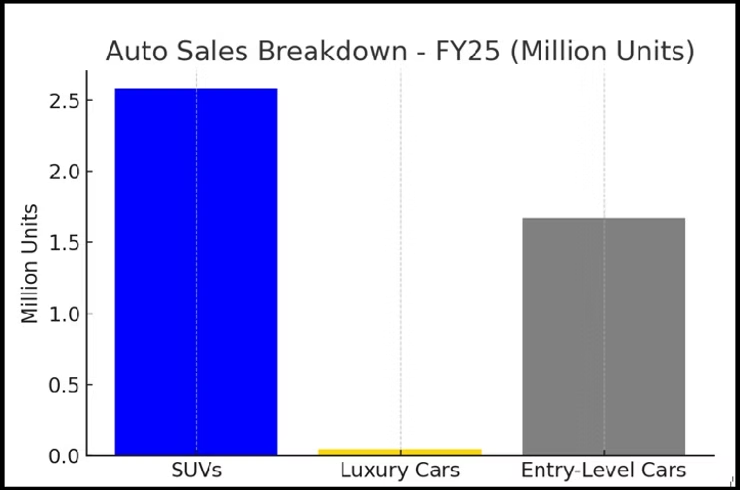
Auto Sales in India from 1st of April 2024 to the 31st of March 2025

India’s stock market has rallied recently, driven by strong corporate performance despite tariff-related jitters. Corporate capital expenditures by listed non-financial companies rose over 20% year-on-year to exceed 11 lakh crore ($125 billion USD) in FY25, surpassing the government’s capital expenditures of 10.5 lakh crore ($120 billion USD). This signals robust investment by large firms.

In contrast, the unlisted corporate sector, contributing two-thirds of corporate value added and holding most corporate debt, remains weak with falling profits and tax payments. The divergence comes from the markets they serve: listed firms cater to higher-income households, while unlisted firms rely on low and middle income consumers, where progress and recovery is slower. Corporate tax receipts remain healthy, but are largely driven by listed firms. Collections in FY25 reached 12.72 lakh crore ($145 billion USD), while net direct tax collections climbed to 22.26 lakh crore ($254.97 billion USD).

Consumer trends mirror this imbalance. Passenger vehicle sales hit a record 4.3 million units, led by SUVs and luxury cars, while entry level cars and two-wheelers saw subdued demand. The aspirational middle class, especially tech professionals in their late 20s and 30s, drives premium demand, leaving the mass market segments of the population behind.

Nearly half of the nation’s workforce remains in low productivity sectors contributing only a fifth of national income. Wage growth is stagnant in several States. Micro, medium and small enterprises struggle with credit, policy bottlenecks, and institutional constraints. This is India’s K-shaped economy as large corporates and affluent consumers thrive, while smaller businesses and lower-income groups lag. India’s booming economy hasn’t delivered progress for all quite yet.

The country remains the fastest-growing major economy in the world, above 6%. A crucial question is whether this astonishing growth will create mass employment and better equality. Unfortunately, without updated consumer expenditures data since 2011–12 due to the lack of a recent census, policymakers rely on capital expenditure and earnings trends to gauge consumption patterns which deliver incomplete insights. The next census for India is scheduled to be conducted in 2027. More transparency is needed statistically to help alleviate the K-shaped results via the Indian economy.

post273

China’s Economic Future: Speculation & Transparency Question

China's Economic Future: Speculation & Transparency Question

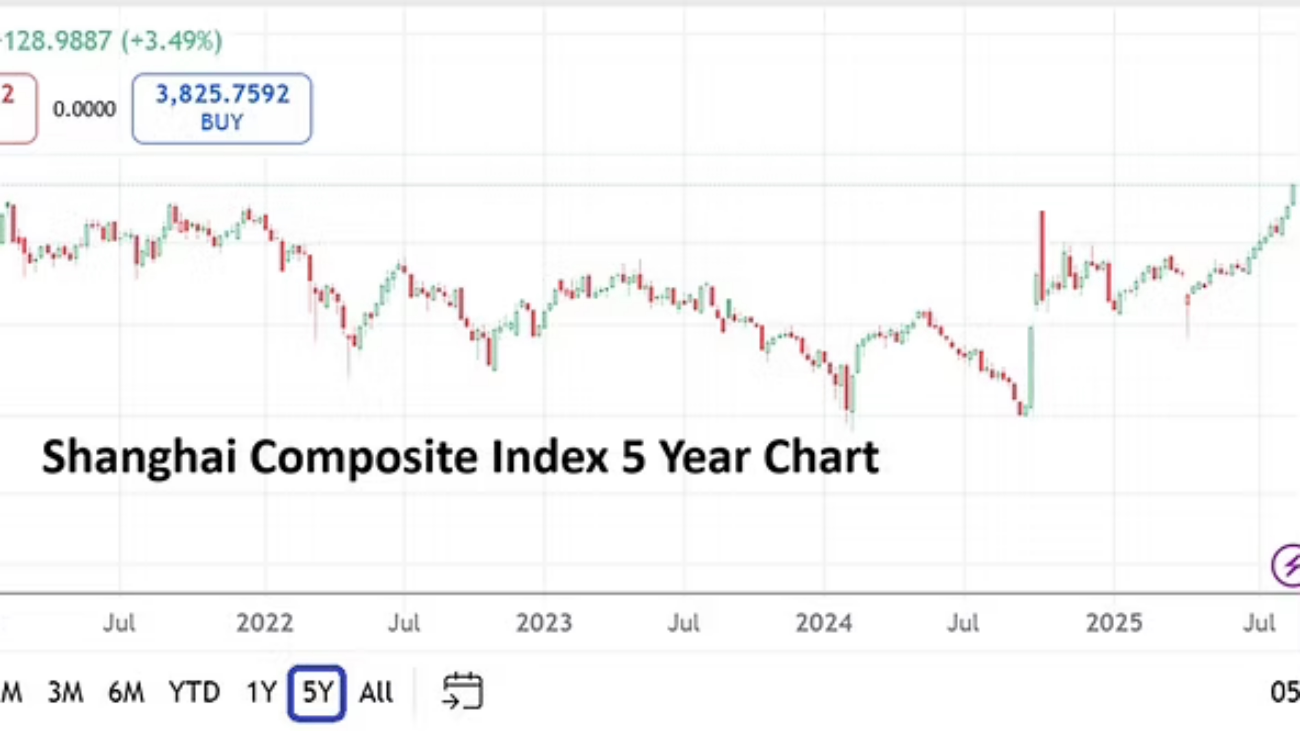
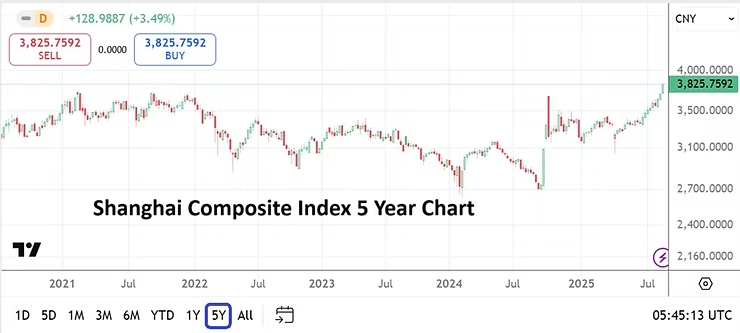
China’s economy has been underperforming for a handful of years. Growth has not only stagnated but has experienced a downturn, deflation has been experienced. Strong leadership from Xi Jinping has led to a firm approach regarding the management of China’s political and economic affairs. Until this year, Xi’s grip on power had grown significantly since he took office as the President and General Secretary of the Chinese Communist Party in 2012, but his control appears to be waning. Yet even as lackluster Chinese economic data has persisted, the Shanghai Composite Index (SSE 000001) has mirrored many global equity indices and done remarkably well since April of this year.

The SSE is near 3,826 currently. In early April the SSE was around 3,080, and in the middle of September 2024 the Shanghai Composite Index was close to 2,700, which was clearly within sight of long-term lows. The current heights of the SSE have not been seen since August of 2015. Yes, the Shanghai Composite Index was over 5,000 in April of 2015 and also in 2007. The point being that highs being traversed have not been seen in a long time. But is the positive speculation in the SSE a sign that economic conditions and political considerations in China are positive? Where is the transparency?

Shanghai Composite Index Five Year Chart as of 24th August 2025

China’s ability to create significant growth over the past four decades has transformed the nation into a global powerhouse economically and militarily. Yet, the past few years have begun to show cracks in the single handed approach to centralized decision making regarding the economy, government data presented has become suspicious. Rampant speculative forces in the SSE have been seen before. Is now the time to buy more Chinese equities or is it time to become cautious? Reliable statistics remain a troublesome aspect for investors.

China’s real estate market collapsed under the weight of too much building and speculative buying of apartments. Yes, inflated property and sudden deflation has been seen in capitalist countries in the past and will be witnessed again in the future. But the bubble in Chinese real estate and its crash also points out problems regarding a lack of transparency. While the Chinese government has tried to fix the fiscal problems caused by the real estate implosion, it has also created significant fractures within its banking system, which are confronting the Chinese government and public, and sometimes feels like a coverup trying to hide bad news. When will there be a recovery in the China real estate sector, is the worst of the crisis fixed?

Chinese political questions and some evidentiary circumstances point to intriguing considerations. There is evidence in China that a change of leadership is progressing. In the past couple of months small hints have been allowed to be published via China’s state media, the Xinhua News Agency. Rule changes have been made regarding decision making processes in the Chinese Communist Party, this was published by Xinhua in late June and republished by the South China Morning Post of Hong Kong in early July. While paraphrasing, both news entities expressed that rule changes meant Xi Jinping would officially have to delegate more decision making.

USD/CNY One Year Chart as of 24th August 2025

Speculation is growing beyond a mere whisper that the Chinese military has become a wildcard and a source of power that is potentially ready to help remove Xi Jinping. The military apparently is not supporting Xi and wants a more collective approach to decision making via the Chinese government. Yes admittedly, this information can be described as being from news services and podcasts that do not favor the Chinese government, but they seem to be singing in unison. It appears that China’s People’s Liberation Army have decided it is time for a change and is ready to play a role in the selection of new Chinese leadership.

The 80th Anniversary Victory Day Parade in Beijing will be held on the 3rd of September, what role will Xi Jinping play in the show of military force? Will it become apparent that Xi is merely a figurehead until an official decision is made on how the Chinese Communist Party will be led? Importantly, the 15th Five Year Planning Conclave for the Chinese Communist Party will be held in October and this is where a leadership change could take place including the official removal of Xi Jinping.

There appears to be – yes, via the dissident information heard, two factions within the Chinese Communist Party vying for power – hardliners and reformers. The army still hasn’t made it clear if they are backing the hardliners or the reformers. What is evident however via many publications, is that China’s PLA has decided along with other important leadership circles in China’s Communist Party that Xi had too much control and they want a more collective leadership.

Regarding the Chinese economy which has undergone a period of stagnation and lackluster results the past handful of years under Xi’s strong centralized approach, something big is about to happen which will have ramifications for the next five years. Who will lead China? The hardliners who are true believers in ideological communism or reformers who want China to move towards more of a market economy? This is a huge question. This type of political infighting has been seen in China during the past four decades and played a role in key leadership changes. It is not a conspiracy plot which is being sounded, it is the possibility of a transfer of power which happens cyclically in many nations when changes are warranted.

China’s Shanghai Index has done well recently. Perhaps this is a correlation reflecting optimism being sparked globally in equities in recent months. Or is it also possible that some folks in the know are betting on the reformists to take control of the Chinese government? Tariff concerns have seemingly been brushed to the side in China and something bigger is certainly at play. President Donald Trump is not the story here. Investors participating in China need to pay attention to the political changes that seem to be brewing. While speculation has certainly brought the Shanghai Composite Index to long-term highs, transparency from China is a concern economically and politically and there will be an impact if changes to leadership occur.

post271

Hard Truth: No Secret Sauce, A Possibly Unfriendly Reminder

Hard Truth: No Secret Sauce, A Possibly Unfriendly Reminder

Day traders face constant battles. Choppy conditions in markets lead many salespeople within brokerage firms to proclaim the ability to take advantage of technical shifts to their clients, but it is much easier to demonstrate what has taken place before compared to what is going to happen next. Technical trading via charts often looks good for those offering its charms until reality bites.

Day traders also have the disadvantage of fighting large market institutional forces that have completely different timeframes, deeper pockets, and perhaps even a fair amount of analyses they can use to validate their reasons for taking a position – not necessarily a correct position – but enough to provide insurance regarding their decision making.

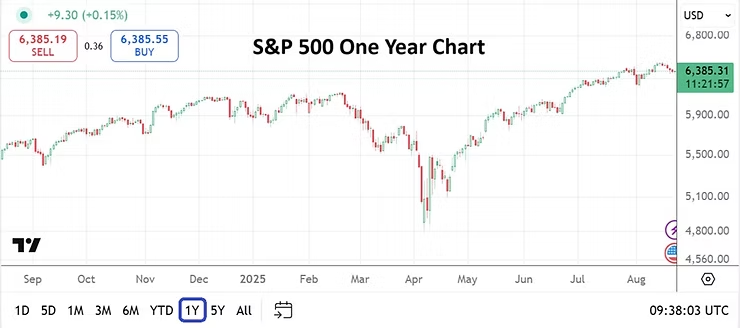
S&P 500 One Year Chart as of 22nd August 2025

Institutional traders can fall back on the analyses they have at their disposal and point to it as the reason why they made a trade. Literally giving them an excuse to explain why things went wrong, so they can tell inquiring management when needed, this in order to protect their miscues. Institutional players do not get fired easily from their positions, they usually just wait a few years and shift to another company when too many bad trades have been made – that is a dirty little secret in the trading world.

Comparatively, day traders simply blow out their own accounts while losing money. Yes, sometimes they have to explain to their romantic partner why they can’t go on the trip they had been planning because there is a sudden lack of funds. Hopefully they didn’t wipe out too much money that they may have borrowed from family or friends, this via ambitions and proclamations that a coming trade was a once in a lifetime opportunity.

But wait, yes, there are speculators and large traders who do make money. These are the folks many allude to who are – in many peoples’ minds – sitting on a yacht in a lovely ocean locale and enjoying the fruits of their labors. They do exists and we should acknowledge this, even if we sometimes think they are merely lucky and one day will face a losing streak.

However, many of these anointed winners do not exists either. Beware of experts ladies and gentlemen. Influencers are often selling a dream they know a day trader desires. Commissions drive the brokerage business. Unfortunately, it is seldom profits made by an emerging victorious crowd via newly minted speculators that make brokerages money.

I am frequently warned that this is not what day traders want to read. They do not want to be reminded that 90% of their group usually loses most of their money, or at a minimum walks away with less money than they started. The U.S Fed’s Jackson Hole Symposium is now underway in Wyoming. Yet, most day traders will only be able to take advantage of this event by trying to ride on the sentiment tides created by large institutional traders in Forex. The headline: Fed Rhetoric and Jackson Hole, will be the talking point of the media today.

However wait a moment please, the retail brokerage business in the States must be pointed out as a reason for some positive momentum in the major U.S indices the past handful of years and needs to be watched regarding its sentiment. Reddit, X, Instagram, Quora and other social media sites can be monitored to gather this info. Behavioral sentiment is becoming important in the markets. While some institutional investors are showing caution via inquiries (polling) and actual market positions, some public cash appears to be supporting the S&P 500, Nasdaq 100 and Dow Jones 30 via purchases through reputable brokers who do buy the actual asset.

That is a contradiction of sorts compared to what has been written in previous paragraphs, but then again this is trading (and investing) we are discussing, so there are no straight lines, and often complexity rules. Perhaps you noticed that I didn’t say, institutional players are smarter than day traders. In many cases institutions and their managers merely have more money to wager with, and can do this without too much leverage and over much longer timeframes – giving them the ability to ride out financial storms and survive.

Under the current market circumstances the Fed is expected to cut interest rates in September by 25 basis points. But the U.S central bank is going to face a possible battle via murky data that will have to be factored into October, November and decisions beyond, meaning caution prevails. Trading choppiness in Forex will continue in the near term. The possibility that financial institutions may believe current pricing represents fair value is legitimate.

Let’s remember that the movements in Forex, stocks and indices, commodities, bonds and other assets always appear more volatile for smaller traders, because intraday price action and the absurd amount of leverage being used by many folks often leads to dangerous speculative circumstances.

Traders need patience, shouldn’t use too much leverage and allow for the ability to walk away from a losing trade with limited losses. Leaving enough cash in your account to participate again later can lead to other opportunities. There are no guarantees in trading. Good trading discipline is essential.

post270

India Insider: Strategic Balancing Act Comes with Risks

India Insider: Strategic Balancing Act Comes with Risks

On the 15th of August, India’s Independence Day, Prime Minister Narendra Modi announced a large reduction on Goods and Services Tax rates to boost domestic consumption. The Indian economy is certainly slowing, this as lackluster domestic consumption has prompted the Reserve Bank of India to cut the repo rates from 6.5% to 5.5% in 2025.

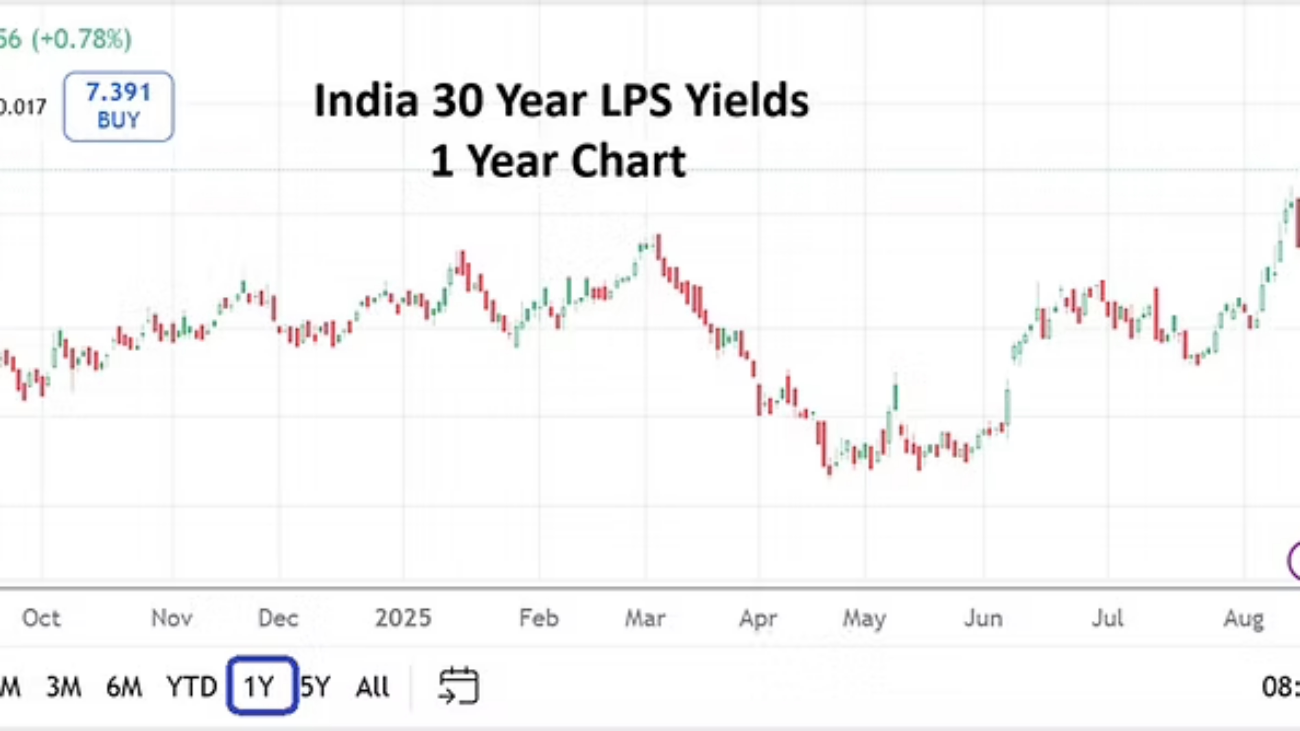
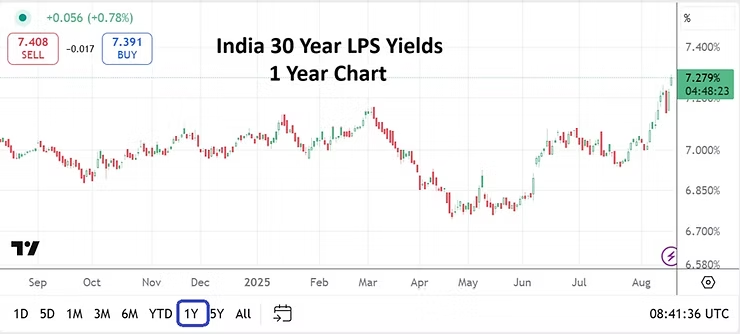
Indian Bonds 30 Year LPS Yields One Year Chart as of 19th August 2025

As trade deal discussions with Washington flounder, New Delhi is being forced to shift economic considerations towards China. The diplomatic relationship between India and China has grown colder, particularly since they clashed on the eastern border region in 2020.

Relying on China also comes with challenges for New Delhi. Since 2021, the trade deficit with China has expanded from $73.3 billion to $99.27 billion USD, showing that India still depends increasingly on China for significant importing needs.

According to Bloomberg, India’s major conglomerates have already established excellent relationships with Chinese suppliers of lithium ion batteries and EV components, although they try to discreetly tread under the radar in order to avoid the wrath of New Delhi government.

The fact is India can sustain its economy and maintain its geopolitical posture of non-alignment by practicing a multi-polar stance with Washington and Beijing. But despite clinching trade deals with the U.K and reviving trade negotiations with the E.U, New Zealand & Australia, and its deepening bilateral relationships with many central Asian nations and within BRICS, New Delhi’s major trading partner for exports remains the United States. Around 18% of India’s exports go towards the U.S, while 15% of imported goods come from China. The numbers do demonstrate an intriguing balance.

While India’s negotiations with the U.S have stalled and appear postponed indefinitely, other Southeast Asian countries, including Vietnam, Indonesia and the Philippines have secured lower tariffs with the Trump administration making them more competitive in the U.S. market. These nations are using the U.S for economic and military security, but they also rely on China for manufacturing and logistical needs.

India Faces Additional Challenges with Washington and Beijing:

Indian IT companies derive nearly 57% of their export revenues from U.S clients, making them heavily dependent on that market. And rapid advances in AI and the erosion of legacy outsourcing models are putting India’s traditional profit engines under pressure.

Meanwhile, China is not keen on helping India achieve expertise and manufacturing competitiveness which would threaten its own business model. China wants to make inroads by selling goods to the world’s largest consumer market, rather than technology transfers which would allow India to attain manufacturing supremacy.

Some economists warn that India’s own plans for mitigation of its current circumstances will likely be disinflationary. India’s bond results via yields clearly express concern about potential fiscal costs and difficulties. New Delhi’s focus has shifted towards appeasing domestic consumers, while trying to deal with uncertain foreign partners. Government capital expenditures have been declining since last year, signaling that both corporate and public investment confidence remains weak.

India’s neutrality is welcomed. It’s not anti-Western or pro-Western, and attempts to balance between the U.S and China while trying to forge new trade agreements and ties are a constant high-stakes game capable of creating strains economically and politically. The path forward with the U.S and China will remain complex and it must be worked on with precision in order to help achieve success.

post269

India Insider: Labor Productivity and Rising Household Debt

India Insider: Labor Productivity and Rising Household Debt

The desire for India to become a fast growing economy can be alluring, but without proper distribution of income and improved labor codes, this remains a major challenge to achieve. During coronavirus, acute problems were faced by those working in private enterprises. While some businesses and institutions supported their employees, many people were left behind without social protective measures.

According to Business Line newspaper analysis, from July 2022 to June 2023, an average salaried Indian male made 20,666 Rupees ($236 USD) and a woman made 15,722 Rupees ( $180 USD) per month.

Experience tells us that lower salaries in the rural areas are pervasive. Many private sector nurses, schoolteachers, and other service workers earn less than the international poverty line of $3 per day (around 250 Rupees per current Forex). Sometimes due to extensive workforce supply, some educated people must work blue collar service jobs additionally to make their ends meet.

Agriculture and Low Productivity:

Wage disparity and underemployment exists rampantly. Half of India’s labor force works in agriculture, where productivity is poor. In agriculture, farmers are both producers and consumers. There are barriers in food supply and demand for agricultural products. Farmers need access to local markets where their buyers can afford to purchase their produce. Without solid markets or better road infrastructure to reach them, many rural areas have less incentive to improve productivity.

As a result, many farmers produce low volumes. This is also one of the reasons why New Delhi is reluctant to permit U.S imports of agricultural and dairy products. Smaller farmers cannot afford to invest in education, which hinders their efforts to move into industries with higher wages. Without increasing labor productivity and better opportunities, most of the population will continue to work in agriculture.

Stagnant Wages, Informal Work and Problems in Micro-Finance:

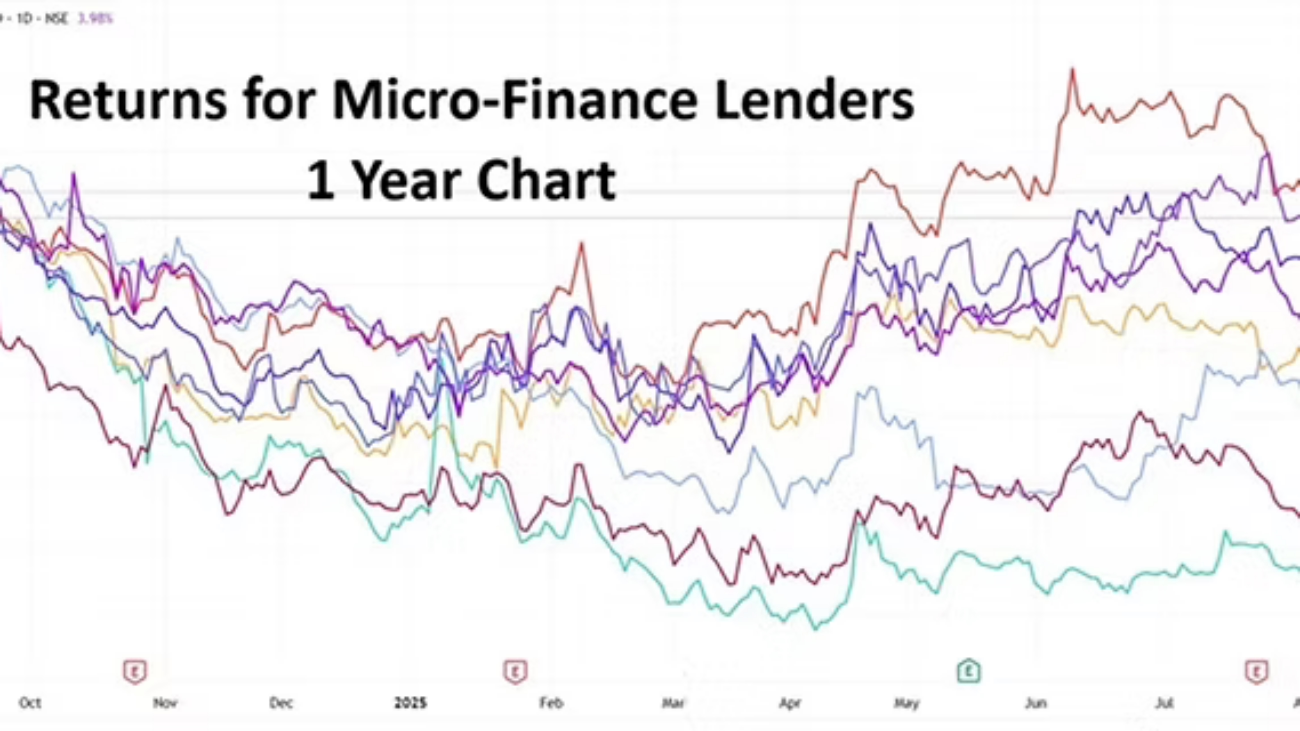
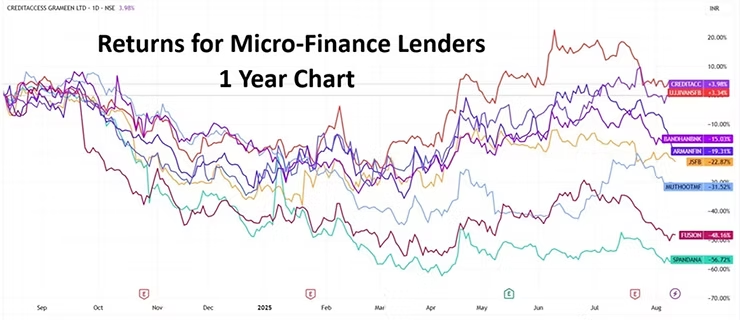
India’s Micro-Finance Lenders Culminative Returns Past Year

A large portion of the workforce is employed via informal and low-paying jobs. If wage growth does not keep pace with increased productivity, domestic consumption will remain weak, making the economy more fragile during global downturns. Drivers and gig workers provide some insights because of their inability to make ends meet. Minimum wage policies are lacking for many gig workers. Employees work higher hours in these enterprises. Yet another reason why Indian households prefer to prepare their children for government jobs.

India’s micro lending industry is under stress as delinquencies rise at an alarming pace. This has prompted the Reserve Bank of India to intervene and impose fines on lenders charging excessive interest rates. Loan disbursements shrank 13.5% year-on-year, and shares of some small finance banks have fallen, this as they have been forced to set aside higher provisions for bad loans.

Total loans outstanding in the industry are around 3.75 lakh crore rupees ($43 billion USD) in financial year 2025, with non-housing retail loans accounting for nearly 55% of total household debt. Small ticket loans were meant to ensure financial inclusion in underserved areas. The RBI defines microfinance as collateral-free loans to households with annual incomes of up to 3 lakh Rupees (approximately $3,400 USD).

But when wages do not rise in line with inflation, households begin to borrow to cover deficits, often at high interest rates. This creates risk for small finance banks when borrowers default, besides many consumers who are clearly struggling. A bank employee in Tamil Nadu has said loan disbursements are now scrutinized more closely, and applicants with monthly EMIs – equated monthly installments – above 10,000 Rupees ($115 USD) are no longer eligible for micro-loans.

Job creation in the Manufacturing:

Despite media portrayals of India’s manufacturing ascent, Harvard economist Dani Rodrik offered a compelling remark paraphrased here which points out obstacles ahead, ‘what made manufacturing a vehicle for transformational growth was its ability to generate productivity while drawing unskilled labor from traditional farming’. Rodrik seems to believe manufacturing remains a lower income sector in India due to its large work force and inability to transform efficiently, while also facing globalization problems from other Asian competitors.

The reason why manufacturing companies in India can pay lower salaries is because of high unemployment ratios and a steady supply of new graduates every year, making it easy to find new employees. Wages don’t see much improvement because workers are replaced easily. Many employees working in manufacturing actually have engineering and Masters’ degree backgrounds. Their average salary is around 15,000 Rupees a month ($170 USD), the same amount paid to low skilled employees who have technician diplomas.

India needs to work on improving core manufacturing capabilities, creating better infrastructure via land reforms and logistical capabilities. Implementing a fair minimum wage policy would also influence the economy via better household wages. Yes, inflation is a concern, but India’s aspiration to become a $10 trillion economy will remain hard to attain unless coordinated policy changes occur.

Notes: 1 USD = 87.5 Rupees

post267

Inflation Numbers from U.S and Fed Outlook, and Intel Corp.

Inflation Numbers from U.S and Fed Outlook, and Intel Corp.

Two key inflation reports will come from the U.S this week. Tomorrow the U.S CPI data will be published and the PPI results will be presented on Thursday.

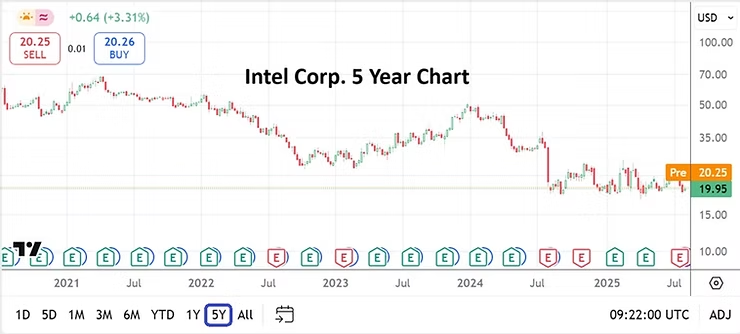
Intel Corp. Five Year Chart as of 11th August 2025

Via corporate news and perhaps effecting sentiment on Wall Street, Intel’s CEO Lip-Bu Tan is scheduled to visit the White House today. Intel Corp. closed around $19.95 going into the weekend. Intel has been a laggard in the stock market. It remains an important barometer, but its price action the past year has opened the door to consideration of the company as a takeover target – this if Intel’s boards allows its dissatisfaction of results to fester. A look at the five year chart of Intel printed above shows vast underperformance for shareholders.

Lip-Bu Tan became a target in the Senate last week because of his close business ties to China and companies there which have ‘security’ connections to the Chinese government. Intel should be watched this week. It is possible the company can produce a turnaround, but negativity makes it a questionable speculative short-term trade for pursuers. What could possibly go wrong as the Intel CEO meets with President Trump at the White House?

The USD has been weaker in Forex the past handful of days and major currencies are approaching values which clearly indicate financial houses are leaning into notions that the Federal Reserve will cut the Federal Funds Rate in September. The next Fed FOMC decision is due on the 17th of Sept. This is more than a full month from now, allowing financial institutions the ability to gamble on their cash forward positions and cause more volatility and price velocity in Forex. The fact that Donald Trump has added Stephen Miran as temporary Fed Governor adds to the ability and outlook that the Federal Reserve will become increasingly dovish. Tame inflation results from the Consumer Price Index tomorrow and the Producer Price Index on Thursday would help USD centric weakness become sustained.

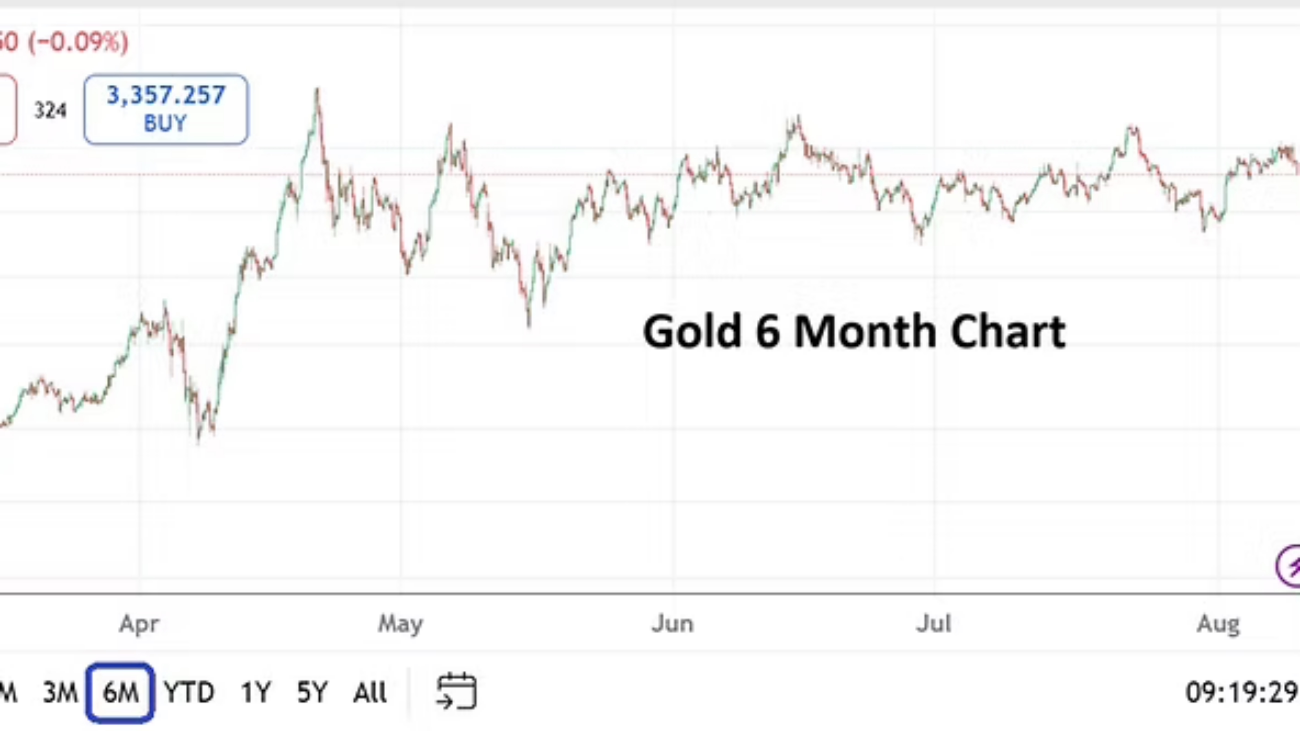
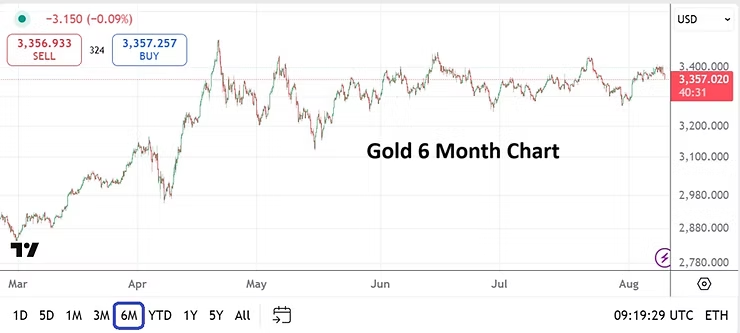
Gold Six Month Chart as of 11th August 2025

Gold near $3,355.00, Bitcoin around $121,500.00, GBP/USD close to 1.34580 as of this writing.

U.K will publish GDP reports on Thursday, last week the Bank of England lowered their Official Bank Rate to 4.00%

post266

India Insider: Manufacturing Strategy to Create Rural Jobs

India Insider: Manufacturing Strategy to Create Rural Jobs

Across much of India’s rural landscape, manufacturing remains scarce and finding a solution for this remains a priority. While some towns do have small scale industries that offer jobs, this is still limited. As of financial year 2023, agriculture accounts for only 16% of India’s GDP, down sharply from around 35% in the 1990s, due to a structural shift toward services and manufacturing.

A large share of rural families still depend on agriculture, often engaging in farming and irrigation with modern equipment. However, marketing their produce remains a persistent challenge. Meanwhile, many rural workers are engaged in low-wage trade and commerce, often in informal settings such as small shops and roadside businesses. These roles typically offer limited income and little upward mobility. Falling real wages have pushed many to migrate to India’s urban centers or venture overseas to Singapore, Malaysia, and the Gulf countries in search of better livelihoods, aided by favorable exchange rates.

Capitalism and Efficient Manufacturing

Adam Smith, in his seminal work The Wealth of Nations wrote that, ‘it is not by gold or silver, but by labor that all the wealth of nations is created’. This fundamental idea underpins the modern economic thought that wealth is not derived merely from money, but from the productive capacity of people.

When capital is invested in a capitalist enterprise, it generates profits for the owner, provides wages for employees, and delivers returns (such as dividends) for shareholders. But this cycle of value creation depends on active and efficient enterprise, particularly manufacturing which has been missing or underdeveloped in many parts of rural India.

Unlike countries such as the United States, where people readily relocate across States, India faces some unique challenges. Like the European Union, India is a union of diverse linguistic and cultural regions. It is uncommon for a small business owner from Himachal Pradesh to directly access markets in Tamil Nadu or Karnataka due to language barriers, cultural differences, and logistical constraints. These frictions further isolate rural producers from wider markets.

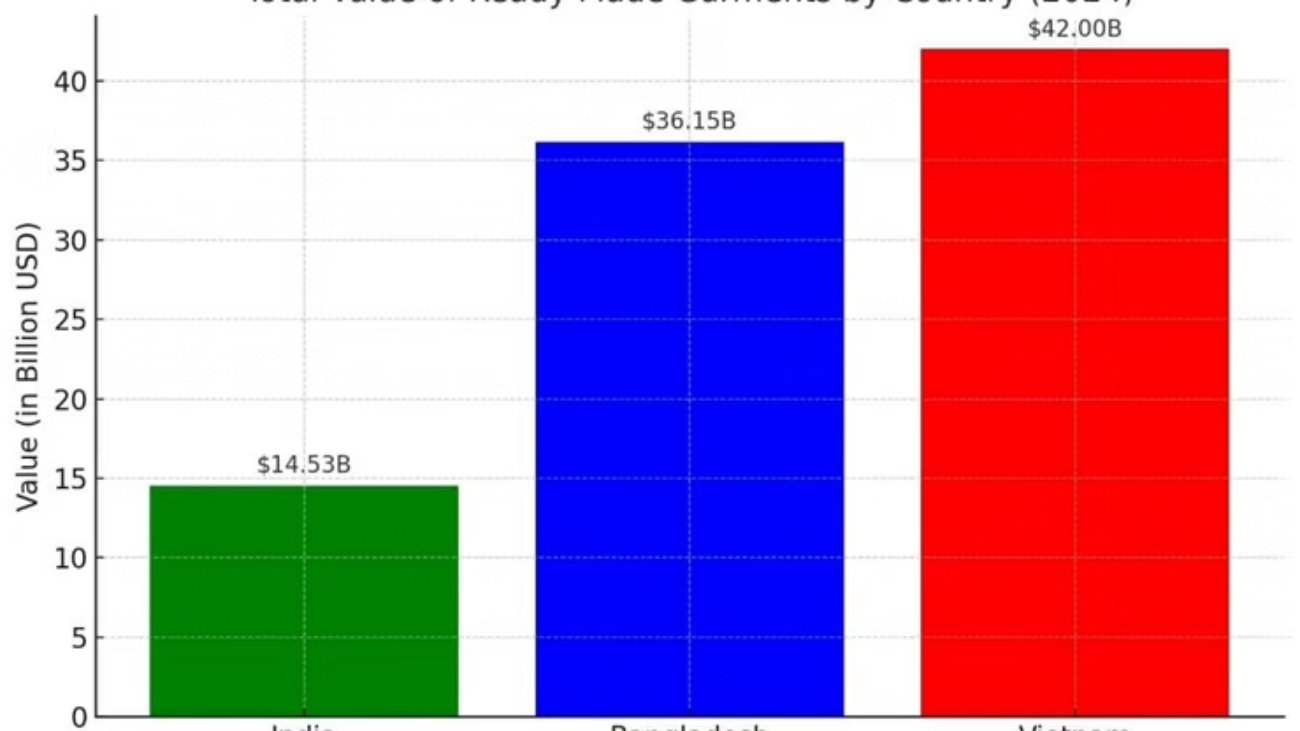
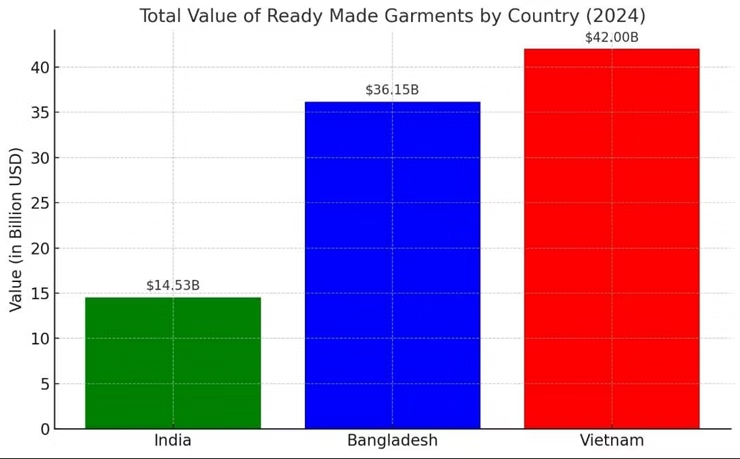
Garment Industry Values in India, Bangladesh and Vietnam

Strategic Solutions and the Role of State Governments

To revive rural economies, business people along with their state governments must identify and invest in strategic sectors that create jobs and add value. Kerala is a fine example: as one of India’s top spice-producing States, Kerala has the potential to establish local industries focused on spice processing, packaging, and export. Coordination between agriculture and manufacturing can generate employment, stimulate local economies, and enhance foreign exchange earnings.

Albert Hirschman, a development economist, highlighted this approach through his theory of unbalanced growth and economic integration. He argued that certain industries have strong reciprocal connections with other parts of the economy. By prioritizing sectors with good synergy potential, developing countries can achieve significant growth even with limited resources.

Growing competition from countries like Bangladesh and Vietnam which both enjoy favorable trade agreements do pose new challenges, this must be taken seriously by India and create a focus on forward looking international commerce. There will always be competition from distant enterprises and nations, this must be accepted and planned for via commercial insights.

Within India is Tiruppur, a city in Tamil Nadu, known as the ‘Manchester of South India’ due to its vibrant textile industry. The city has created an ecosystem of manufacturing that consistently offers higher real wages compared to other towns in the region. It has successfully shifted labor from agriculture to industry, thereby increasing productivity and income. It is a bright example and defines one way to make progress.

Protecting New Industries and Creation of Success

In his book How Rich Countries Got Rich and Why Poor Countries Stay Poor, economist Erik Reinert argues that nations develop not just by doing what they are currently good – such as agriculture or mining, but by nurturing industries that can become more productive long-term. Typically manufacturing and technology sectors lead to greater innovation and economic resilience.

Reinert provides numerous examples, like South Korea’s emerging growth in steel and its automotive industries, and Ireland’s rise in information technology where specific protections and support for young industries has led to long-term prosperity.

India’s rural transformation cannot rely on New Delhi alone. State governments along with business people must take the lead by identifying sectors that have the potential to foster high growth and employment. Helping to create local value chains, investing in infrastructure, training, and market access will build resilience in these communities. By encouraging small-scale manufacturing and leveraging regional strengths, the country’s rural areas can become engines of economic growth.

post265

Trading Thud Ending Last Week and Early August Insights

Trading Thud Ending Last Week and Early August Insights

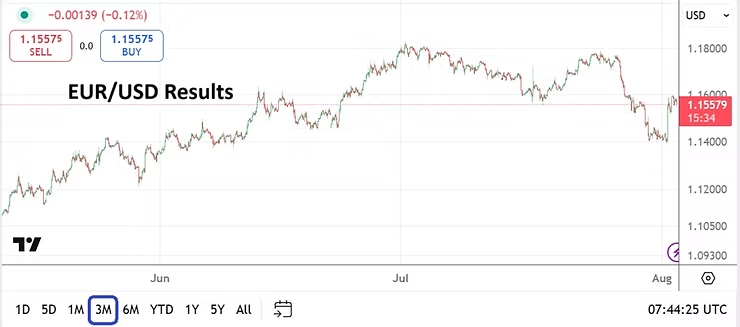
The EUR/USD is near 1.15650 early this morning. The USD/JPY around 147.850. Forex has provided fast reversals and most major currency pairs are within well established known realms, but caution prevails. Friday’s U.S jobs numbers before going into weekend provided additional mud to filter through for those seeking clear outlooks. Were the employment numbers rigged by the Bureau of Labor Statistics?

EUR/USD Three Month Chart as of 4th August 2025

Questionable economic statistics have become an open sore spot for some analysts in the U.S, this has been a problem since the financial crisis of 2007/08 and ensuing years when politically expedient numbers were rumored to be in use so the Federal Reserve and U.S Treasury could work in a more comfortable manner. Let’s just say there are actual reasons why and how economic statistics could be used to hurt and help policies. For some evidence take a look at the art of revisions that has been practiced with key economic data the past handful of years. Financial institutions now need to consider the possibility that numbers cannot be trusted, interpret reports, try to decipher reality and consider impact.

Effect on the Federal Reserve is a big question. Fed Chairman Jerome Powell continues to preach uncertainty and say a wait and see approach is needed because of implications regarding tariffs. However, conspiracy theories are also somewhat blown out of the water regarding the recent jobs numbers, because the lackluster results will actually put pressure on the Fed to cut rates in September in order to help spur on a better jobs market. So in other words, financial institutions, big investors and day traders are back to square one.

The ISM Services Purchasing Managers Index stats will be published tomorrow for the U.S, but this report is likely to be a mere ingredient that affects the marketplace. Behavioral sentiment will remain the cornerstone in Forex, equity indices, Treasuries and commodities. August is typically a rather calm month of trading taking into consideration that holidays are being taken by many market participants, but as the S&P 500, Nasdaq 100 and the Dow 30 remain elevated and capable of achieving new record highs, the USD creates chaos regarding outlook influenced by a Federal Reserve that is now in a difficult spot, and tariff implications are contemplated it would be wise to keep an eye on all near-term outcomes.

Technical trading and computer generated algos will factor into conditions as psychological levels are challenged and perceptions are debated. Has the global marketplace grown comfortable to the tactics used by President Trump? While it is easy to say yes, there are still plenty of reasons to remain concerned, this because White House policy seemingly has the ability to shift without notice.

Which has helped produce what may be the golden rule that develops under the current circumstances. Stay alert, stay optimistic but practice caution. Financial institutions have always practiced the art of realpolitik behind closed doors to chase profits, but they must remain vigilant to fast reactions caused from the potential sudden fear of shifting doctrine. President Trump’s rather swirling mix of laissez faire enterprise, and his stark ability to express anger at those who stand in his way or disagree with him do make for a new trading reality. Cautious optimism is likely to rule the world of investment and speculation going forward.