
Interlocking Parts of the AI Flywheel and Understanding the Multi-Trillion Dollar Engine
We are living through the largest, most aggressive capital deployment cycle in technological history. What began as a gold rush for silicon chips has rapidly evolved into a multi-trillion-dollar macroeconomic engine.
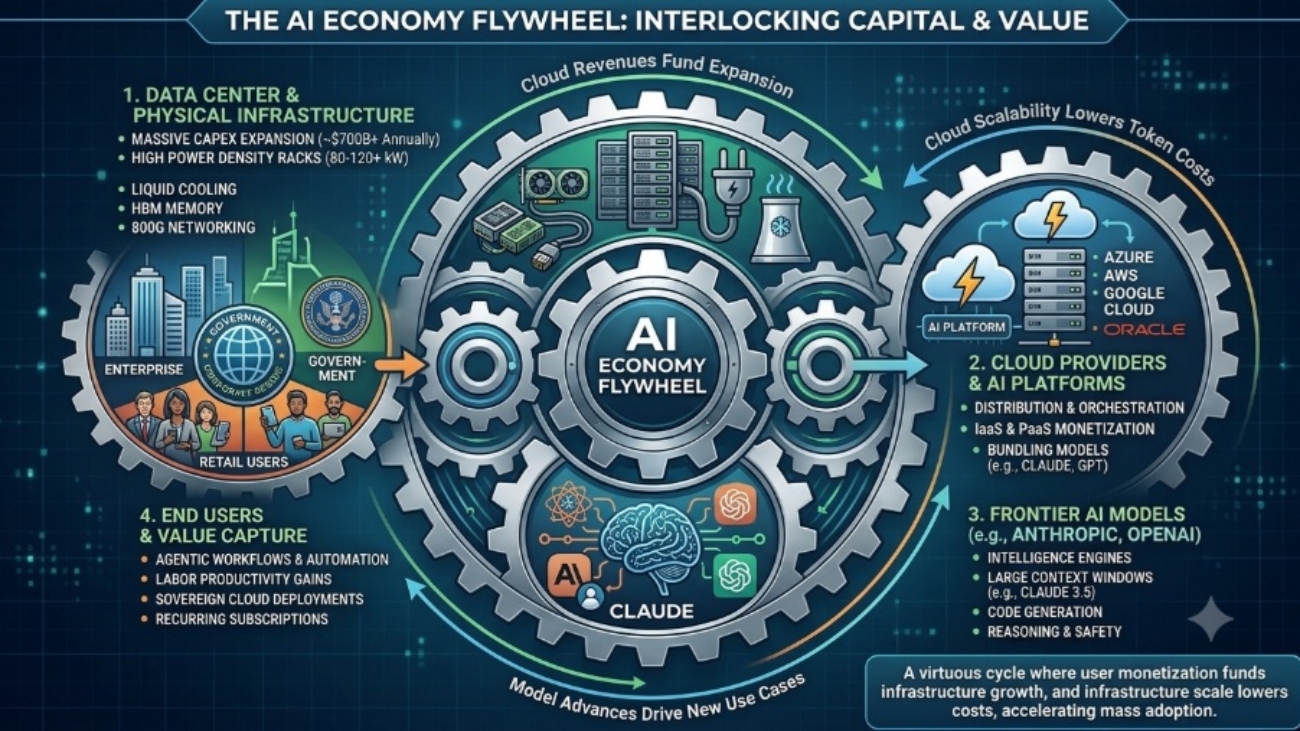
The AI Economy operates as a tightly integrated flywheel: hyperscale physical capital flows directly into compute infrastructure, which powers foundation models, which are then distributed via cloud platforms to power end-user productivity.
For investors navigating this shift, capturing durable value requires looking past individual stock picks and understanding this multi-trillion-dollar supply chain requires examining how capital moves across hardware, cloud orchestration, model intelligence, and commercial monetization.
Anatomy of the AI Economy: Mapping Capital, Infrastructure and Value
A: Data Center & Physical Infrastructure Layer
The physical foundation represents the largest capital expenditure cycle in tech history, with combined hyperscaler CapEx projected to exceed $700 billion annually.
- Space & Power Real Estate: AI workloads demand unprecedented power density (scaling from 10–15 kW/rack up to 100+ kW/rack).
- Key Metrics: Global hyperscaler CapEx allocation to AI infrastructure is ~75%.
- Key Players: Digital Realty, Equinix, CyrusOne, Compass Datacenters.
- Machines & Systems: Custom server racks engineered for intense compute densities.
- Key Players: Supermicro, Dell Technologies, Hewlett Packard Enterprise (HPE), Foxconn, Wiwynn.
- GPUs & Accelerators: The core engine of AI compute, transitioning from pure GPU training dominance to custom inference ASICs.
- Key Players: Nvidia (80%+ market share), AMD, Intel, Google (TPU), Amazon (Trainium/Inferentia), Meta (MTIA).
- Networking & Interconnects: High-speed fabric connecting tens of thousands of clustered GPUs, required to prevent bandwidth bottlenecks.
- Key Metrics: Rapid transition to 800G and 1.6T optical transceivers and Ultra Ethernet Consortium standards.
- Key Players: Broadcom, Arista Networks, Cisco, Marvell, Nvidia (Mellanox InfiniBand/Spectrum-X).
- Memory & Storage: Ultra-fast memory architectures and storage required for multi-terabyte dataset ingestion during training runs.
- Key Metrics: High Bandwidth Memory (HBM3e/HBM4) consumes over 20% of global DRAM wafer capacity.
- Key Players: SK Hynix, Micron Technology, Samsung, Western Digital (Solidigm), Seagate.
- Liquid & Advanced Cooling: Air cooling reaches physical constraints past 40 kW per rack, making liquid cooling mandatory for next-gen clusters.
- Key Players: Vertiv, Schneider Electric, CoolIT Systems, Submer.
B: Cloud & Model Software Layer
Cloud providers act as the primary monetization pipeline, renting the underlying physical infrastructure as a service (IaaS/PaaS) and serve as primary distributors for top-tier foundation models.
- Cloud Providers (Hyperscalers & AI Cloud Specialists):
- Overview: Hyperscalers host foundation models and partner directly with AI labs. The Big Three manage over 65% of global cloud infrastructure, with AI workloads serving as their fastest-growing revenue driver.
- Key Players: Amazon Web Services, Microsoft Azure (OpenAI host), Google Cloud (multi-model distribution), Oracle Cloud (OCI), CoreWeave, Lambda Labs.
Cloud Provider | Market Share | YoY Growth (Q1) | Key AI Advantage / Differentiation |
Amazon Web Services (AWS) | ~31% | +28% | Scale lead, custom Trainium chips, Bedrock multi-model ecosystem. |
Microsoft Azure | ~23–25% | +40% | Strategic OpenAI integration, deep enterprise software lock-in. |
Google Cloud (GCP) | ~11–12% | +63% | First-party TPU infrastructure, native Gemini model integration. |
Neoclouds / GPU Cloud | < 5% | 100%+ | Specialized bare-metal GPU clusters (e.g., CoreWeave, Lambda) renting raw compute to AI labs. |
- AI Models (Foundation & Frontier): High-cost capital investments in model weights that serve as the operating system for generative AI application buildouts.
- Key Players: OpenAI (Chat GPT), Anthropic (Claude), Google (Gemini), Meta (LLaMA – open source), Mistral, xAI.
- Software Platforms & Tools: Application layers that wrap foundation models into enterprise workflows via Agentic frameworks and Retrieval-Augmented Generation (RAG).
- Key Players: Microsoft (Copilot), Salesforce (Agentforce), Databricks, Snowflake, ServiceNow, Palantir, GitHub.
C: End Users & Value Capture
The ultimate ROI of the entire $700B+ infrastructure buildout hinges on end-user monetization and operational productivity gains across three core tiers:
- Commercial Users (Enterprise): Corporations deploying AI for automated software engineering, compliance auditing, automated customer operations, real-time analytics, and supply chain optimization.
- Investor Value Capture: Margin expansion and labor productivity leverage (e.g., JPMorgan Chase, Accenture, Klarna, Walmart, Pfizer, Bridgewater Associates).
- Government & Sovereign AI: Nation-states building localized cloud capacity and defense/intelligence models to secure technological sovereignty and data residency.
- Key Initiatives: US Department of Defense contracts, sovereign AI funds in the UAE/Saudi Arabia, and regional EU sovereign clouds.
- Retail Users (Consumers): Individual subscribers paying recurring SaaS fees for conversational AI, real-time search, personal assistants, and creative media generation.
- Key Players: Anthropic (Claude), OpenAI (ChatGPT Plus), Google (Gemini Advanced), Perplexity, Apple (Apple Intelligence), Midjourney.
The Macro Narrative: How the Flywheel Interlocks
- User Demand Drives Cloud Revenue: Retail subscriptions, enterprise API calls, and government deployments generate recurring revenue for cloud providers and software vendors.
- Cloud Revenues Fund CapEx Expansion: Hyperscalers reinvest cloud cash flows back into physical infrastructure, purchasing GPUs, high-speed networking, and custom data center real estate.
- Hardware Scale Lowers Inference Costs: Manufacturing efficiencies in silicon/chip, cooling, and memory drive down the compute cost per token, making high-reasoning workloads economically viable.
- Lower Token Costs Unlock Mass Adoption: Cheaper, faster compute enables software providers to build more complex AI agent workflows, driving deeper enterprise adoption and restarting the economic cycle.
The Bottom Line: The AI economy is not a series of isolated technology bets; it is a self-reinforcing flywheel where raw compute and commercial utility endlessly feed each other. For investors, the winning strategy isn’t simply picking a single winner in hardware, cloud, or models but it’s identifying the key bottlenecks and value capture points as this multi-trillion-dollar cycle continues to accelerate.