postN87

AMT Top Ten Miscellaneous Missiles and Missives for the 29th of March, 2026

The Iranian War Dominates our Lack of Humor

10. Final Four: The Men’s NCAA Basketball Championship will be set after today’s games. The Arizona Wildcats, our pick, advanced to the Final 4 by beating Purdue last night. Michigan is favored to beat Tennessee and the Duke vs. UConn game is anticipated to be close. The University of Illinois advanced by beating Iowa on Saturday and maybe the biggest underdog – if the Volunteers lose to the Wolverines today.

AMT Top Ten for the 29th of March 2026

9. Jobs Data: U.S Non-Farm Employment Change numbers will be published during a banking holiday on the 3rd of April, this as the Iranian war shadows investment sentiment. Will potential jobs numbers results create nervousness on Thursday, and side effects Monday the 6th of April? 

8. Private Equity: Outflows remain a problem for BlackRock and other firms as deal making comes under a bright light. Investors are questioning valuations, lack of exits and money that sits in ‘zombie’ funds. Imposed limits on redemptions by some firms have created nervous indicators. Is the private equity problem correlated to lackluster momentum on Wall Street, this as desire for the next big thing runs out of marketing hyperbole?

7. 10-Y Notes: U.S 10-Year Treasury yields finished the week near 4.43%, Friday’s price action saw an apex around the 4.48% vicinity, highlighting nervousness. On Friday the 27th of February 10-Y yields were close to 3.94%,

6. Forex: USD/JPY ended this past Friday around 160.250, making it cheaper for tourists to visit Japan as cherry blossom season starts this week and lasts into early May. However, the Bank of Japan and Japanese citizens are not amused by the weakening Yen. USD centric strength continues to resonate loudly. 

5. Fed: Potential drama surrounding the U.S central bank and the replacement of Fed Chairman Jerome Powell has taken a backseat to the Middle East conflict. Concerns about inflation are legitimate. The Federal Reserve will be hard pressed to defend an interest rate cut in the mid-term.

4. President Trump: Speaking from both sides of his mouth (and his opponents might say another area of the body) may be strategic genius from the White House regarding Iran or prove to be a lack of focus. However, it certainly keeps everyone guessing what is going to happen next in the Middle East.

3. $100.00: WTI Crude Oil prices have remained below the one-hundred level for the most part during the Iranian war, yes – there have been outliers above. Will we begin to see sustained prices above the century mark this week? Short-term reactions to the U.S military potentially seizing Iran’s Kharg island would certainly cause price chaos, but could it also soothe some large players in the energy sector via mid-term outlooks? 

2. Good Friday: The holiday at the end of this week will be effected by anxious behavioral sentiment. The potential of a long weekend with plenty of noisy chatter could make for nervous investors this coming Thursday as they position themselves ahead of possible escalating storms.

1. Fear: The S&P 500 and Nasdaq 100 have entered corrective depths. Who will be brave enough to start looking for bottoms as the Iranian war rages with no end in sight? Will a reversal upwards emerge this week?

Copy and paste the text from AMT that you want to share

South African Rand 20260327

G7 Snub for South Africa and other Troubles for the South African Rand

USD Centric Strength and Global Anxiety Weighing on Value of Rand

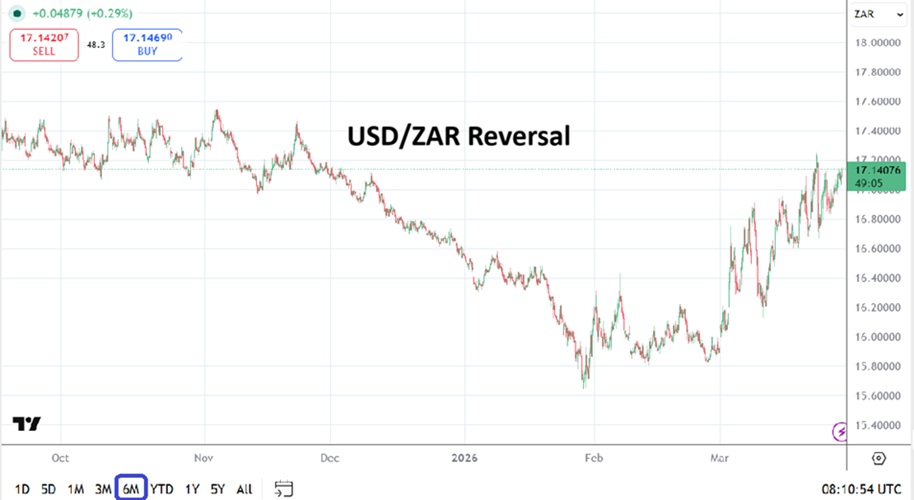
The USD/ZAR is still above 17.00000 in early trading this morning, this as USD centric strength manifests globally due to anxiety which clearly exudes because of the ongoing Iranian war. The USD/ZAR is near the 17.11000 realm, with wide spreads via bids and asks.

The price of Gold is close to $4,450.00 and Palladium is around $1,395.00 – this after touching apex marks in late January when the $2,100.00 level was breached.

USDZAR Six Month Chart as of 27th March 2026

These metals are important for South Africa, but their daily values do not effect the USD/ZAR like they did in the past because of other complexities. The USD/ZAR which had enjoyed a stellar bearish trend and touched lows of 15.68000, late in January, could be correlated to the decrease in value to the precious metals by some, but this is likely false narrative.

When the larger picture of pure behavioral sentiment within the Forex broad market is looked upon other factors are a certainty. The South African Rand, in a rather healthy manner, is largely dependent on financial institutions outlooks regarding the USD, 10-Year U.S Treasury yields, and what the U.S Federal Reserve outlook projects.

The U.S central bank, which many people including myself, was thought to be in position in which the Federal Funds Rate would be lowered in the coming months, now faces complications due to what may become chronic higher energy costs through the mid-term if the war in the Middle East persists and inflation due to logistics, manufacturing and agriculture are effected.

The USD/ZAR near the 17.0000 is a good barometer of South African financial institutional attitudes. Yesterday’s news that South Africa will be excluded from the G7 meetings in France, which will be held in June, will not make folks in South African financial spheres content. However, these same people within the machines of corporate finance in South Africa have grown used to the vagaries of mismanagement, corruption and perceptions these cause for the nation. While some South African government officials initially said France had been pressured by the U.S to disinvite South Africa from the G7 summit, they have changed their tune this morning and are trying to downplay the exclusion as insignificant.

Thus, we return back to the USD/ZAR and near-term considerations. While the currency pair has shown the tendency to reverse lower when marks above 17.10000 have been challenged the past few weeks in March, this morning’s early trading which is sustaining higher values is troubling. The consideration that nervousness among global investors remains skittish at best is unsettling. Those who are making short and near-term wagers on the USD/ZAR are likely concerning themselves with the upcoming weekend and its unknowns. From a trading perspective, folks are usually cautious about taking speculative positions over the weekend when they fear there is a possibility of bad news.

The USD/ZAR is touching important resistance above, if calm doesn’t return to the broad markets across various international assets today, the currency pair may find itself testing higher realms as next week begins.

Looking for downside in the USD/ZAR may prove difficult to attain later today. Traders should keep their eyes on other gauges and watch the U.S 10-Year Treasury yields which are near 4.45% (highs that haven’t been seen since July of 2025), WTI Crude Oil prices and the major U.S equity indices which are in correction territories.

From a betting perspective, if U.S 10-Year yields escalate and the price of energy ebbs upwards today in commodity markets, and there is more trouble on the Nasdaq 100 and S&P 500, this will be problematic. The USD has been volatile, but has certainly shown a tendency to get stronger in recent weeks. A higher USD/ZAR above the 17.20000 is not out of the question.

Copy and paste the text from AMT that you want to share

Indian Diaspora 20260325

India Insider: Why the Gulf Remains a Vital Economic Lifeboat

Indian Expat Labour and Recalibration Realities

The skyline of Dubai, once a symbol of untouchable prosperity, now sits under a shadow of regional recalibration. As Reuters recently noted, Dubai has successfully transitioned to a non-oil economy, with oil accounting for less than 2% of its GDP. It is now a powerhouse of trade, high-end real estate, and financial services. 

However, its “backyard” – the Strait of Hormuz – remains a strategic bottleneck. With 20% of global seaborne crude passing through this narrow vein, the recent tensions in March 2026 have forced a shift in perception: the Gulf is no longer an insulated sanctuary, including Dubai where millions of Indians work and earn for their families in India.

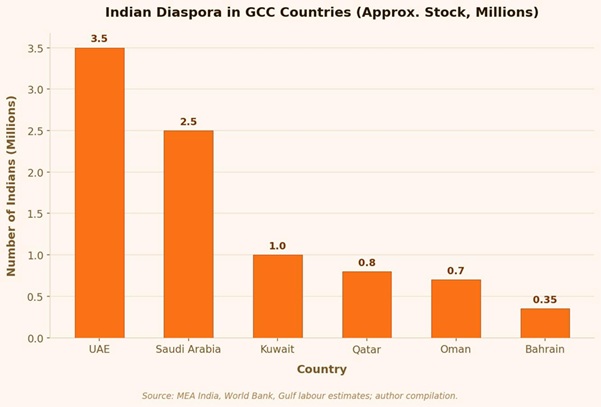
Indian Diaspora Gulf Representation

The scale of this “labour export” is enormous. As of early 2026, approximately 9.5 to 10 million Indians live and work across the GCC (Gulf Cooperation Council) countries. To put that in perspective, that is nearly the entire population of a country like the UAE, made up solely of Indian expats.

A Remittance Driven Economy

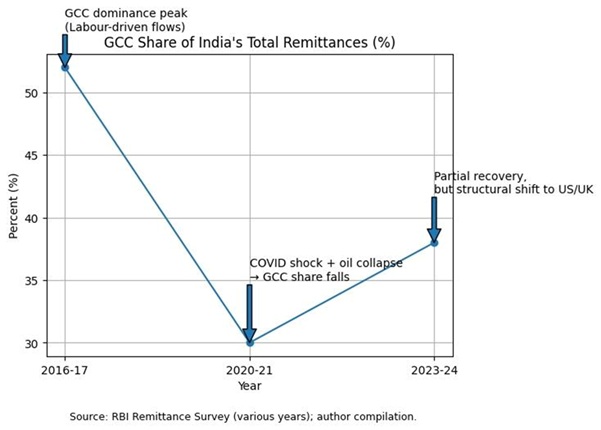
As per Government data sources, India remains the world’s top remittance recipient, with total inflows hitting a record $135.4 billion in the last fiscal year. And despite a rise in high-skilled migration to the US and UK, the GCC remains a juggernaut, contributing roughly 38% of India’s total remittances.

For states like Tamil Nadu, Kerala, and Maharashtra, which receive nearly 50% of these total inflows, it is a macroeconomic stabilizer that funds the current account deficit and keeps the Rupee from a freefall.

India’s Labour Market Paradox

But here is the real question, if people return to India due to the crisis in the Middle East, are there any “good quality” jobs waiting for them in India? The honest answer is no.

Youth unemployment remains elevated, particularly among graduates. Engineers in mechanical and construction fields face limited opportunities. Outside IT, and to some extent automobiles, there are not enough stable, high-paying jobs.

So people adjust. You will find postgraduates working in delivery jobs and informal sectors. I have personally spoken to Amazon delivery workers who told me they hold M.A degrees, or that they had worked in Dubai or Singapore before Covid and are now trying to leave again. This is becoming norm nowadays.

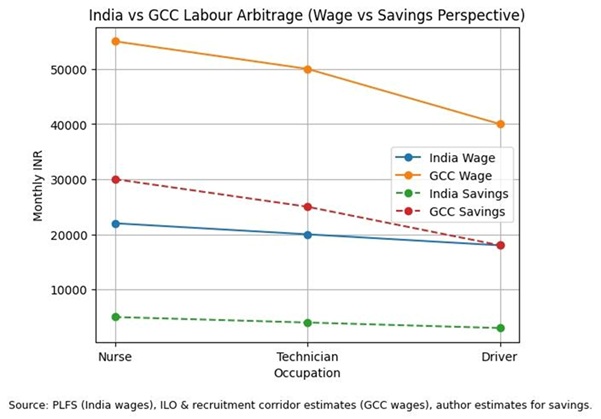
Indian National Wages and Savings Compared to Expat GCC Averages

In many towns in India, migration itself has become an economic model. People move to Singapore, Malaysia, or the Gulf, and the money they send back drives real estate, consumption, and local business activity. In many such regions, the labour market feels tight, not because jobs are available, but because the workforce has already left.

The wage gap explains everything. A nurse or lab technician in India may earn ₹15,000–₹20,000 per month. The same person can earn close to ₹80,000 in the Gulf. A private school teacher in Villupuram city in Tamil Nadu state earns around ₹8,000.

While nominal wages are  2–2.5x higher in GCC, the true driver of migration is savings arbitrage , which can be 5–6x higher.

This reflects structural differences in labour productivity and capital intensity.

India has a large pool of educated labour. But instead of becoming an advantage, it has turned into a wage suppressing force. There is always someone willing to work for less. As a result, wages remain low and bargaining power stays weak.

Percent of India’s Remittances From The GCC

At the same time, we are told growth is strong. Yes, the labour force participation is rising, but inequality is also increasing. A large share of employment remains informal and unstable. Inflation continues to erode purchasing power, and disposable incomes remain under pressure.

Right now, for many Indians, prosperous conditions are easier to find outside the country. Yes, the Gulf has risks. However, geopolitical tensions will come and go, and these are short-term disruptions.

Structurally, GCC economies will stabilize and grow again, and when they do, the flow of Indian labour will continue to pursue these opportunities. Because until India creates enough high-quality jobs at scale, migration will not slow down.

Copy and paste the text from AMT that you want to share

postN50

Clear Betting Environment Is a Winning Proposition for Brokers, Not Day Traders

Things Unlikely To Get Easier for Retail Speculators Remainder of Week

I would like to offer day traders encouragement under the current market circumstances. However, the reality is that the next handful of days will remain difficult for retail traders who do not have comfortable amounts of cash to absorb when intraday chaos occurs. On the other hand as an ex-risk manager for a brokerage house, I can state that CFD providers are singing joyfully because they are making profits from the wild fluctuations in equity indices, Forex and commodities.

Gasoline and Burning Cash Continues

A case in point are the results via the future markets, this via CFD offerings by brokers’ platforms yesterday for the S&P 500 and Nasdaq 100. Early nervousness saw an electric amount of selling get demonstrated and then suddenly a reversal higher, this as President Trump caused a thunderous optimistic reaction as he spoke about the potential of a deal with Iran in the coming days. The dose of optimistic risk taking lasted a couple of hours.

Not only did U.S equity indices bolt higher, but WTI Crude Oil prices slid lower, and Forex suddenly saw the USD losing strength. Here’s the thing, some day traders certainly made money as waves of momentum carried their wagers into positive terrain, but many speculators were likely knocked out of the their trades with sudden loses. CFD trading using leverage has always been a casino, this is not going to change. But the volatility seen the past three weeks has likely not created great wealth for retail traders. Some have gained certainly, but I can guarantee you brokers are making more money via the intraday swings and volatility that knock smaller traders out, this as leverage causes fluctuations that expose too much risk and cause folks to lose money.

Again, this is the nature of the beast. Day traders wanting to participate in the markets have to acknowledge the risks that will confront them. It is a warning worth noting once again as a war rages in the Middle East. 

Markets in the best of times are difficult. Risk management is constantly needed. While the thrill of trading is fantastic, without solid tactics speculating equates into gambling. Think of brokers as bookies, they gear the market via wide spreads, transaction fees including overnight charges to favor themselves. Brokers are certainly glad to pay out winners so others are enticed and bring more business, but strategic day traders who use well practiced methodology are watched closely by brokers – because these folks (good traders who are careful) are a threat for brokers bottom lines – profits are king.

Trading and fundamental notions are proving dangerous too during these loud times. Gold for instance which was trading at all-time highs in January (along with silver – but that is another speculative story) is now traversing near $4,425.00. The precious metal was testing the $5,600.00 vicinity in late January. So how did this long heralded safe haven metal actually see a selloff become stronger since the start of the Iranian war when it was around $5,200.00 on the 27th of February?

IMO, it shows that speculative fervor in gold was fever pitched in January, and even though a war has broken out and caused widespread anxiety in the broad markets (which in theory is supposed to make gold more valuable), the volatile nature of wagering – yes gambling – on the markets including gold, often is a crapshoot. Folks who bought gold as a speculative endeavor have now cashed out their profits, those who believe gold is a safe haven and are buying based on this belief will need another round of speculative fuel to induce significant gains like those made in January. The market sometimes runs out of participants when things get too cautious. In other words, if there are not enough buyers, selling momentum takes over.

And to put a finishing touch on this piece, let there be no doubt that brokers were likely relieved that the one way avenue upwards for gold (and silver) seen into January has now turned into a volatile betting battle. The point here, if I am able to make one is this, market conditions are rough and will remain extreme in the coming days. Folks need to be cautious, the markets are not your friend, they are a tool for making money (or losing it).

Copy and paste the text from AMT that you want to share

Iran What Losing Looks Like 20260323

Iran: What Losing Looks Like

Who is Losing Militarily, Technologically, Economically and Diplomatically?

Opinion: The following article is commentary and its views are solely those of the author. This article was first published the 20th of March via The Angry Demagogue.

It is difficult for many to admit that the US and Israel are winning the war and that conquering a country the size of France, Germany, UK, Netherlands and Spain together with only air power does not take a day or two. However, by any objective (meaning without thinking that all Trump/Bibi/Hegseth, etc. bad) standard, the allied coalition is systematically destroying the military industrial complex that is the Islamic Republic of Iran (what it is not is a State dedicated to the good of its citizens). People forget that the American air campaign in Gulf War 1 was 38 days. It started on January 17, 1991 and only by February 24 did the generals feel that they could invade and take Kuwait.

The air campaign then poured over 88,000 tons of bombs in approximately 100,000 sorties. And this to capture a country a bit smaller than New Jersey.

As we finish the third week of this war we can assess who is winning and who is not. We have spent this past week discussing what it means to be victorious in this war (The Economy and The Military) and to state unequivocally that victory is the moral choice no matter the price of oil. That being said, the price of oil is rising and hit $120 a barrel before dropping. Economists see $138 barrel as the price that could send the US into a recession. So far, the US economy is holding firm. The S&P 500 closed on the Friday before the war at 6740 and yesterday’s close was 6624 – a drop of about 1.7% – not the panic that the front pages would have us think. The Eurostoxx 50 is actually up slightly from 5719 to 5736.

The Federal Reserve did not cut rates, signifying that they don’t need to prop up the economy and risk inflation as they do when they fear a collapse.

The economies of the West seem strong in spite of (or because of?) the war which should end with the cessation of the 47 year of Islamic Republic price premium. The Russian and Chinese economies meanwhile will be under stress for quite some time. While China will have to wonder about its oil supply, Russia understands that $100 a barrel oil will encourage increased US production (and now Russian and Chinese free Venezuelan?) that will hurt them when oil prices go back to normal levels. As we will now discuss, Chinese and Russian arms deals might start to go south, too.

Technologically, this war is a further test of American and Israeli technology and abilities, and they have passed with flying colors. The American and Israeli missile and drone defense systems are outperforming what they did less than a year ago in the “12 Day War” and the U.S Navy is untouchable. The Gulf States are also fairing better than expected although due to the short distance and the lack of experience, they are getting hit more than Israel is. To top it off, the Russians have forced Ukraine to become global leaders in the defense against drones and there are now 2,000 Ukrainian anti-drone personnel in the Gulf States.

But is the air-forces that are performing so well, that one would think that the Iranians did not invest in the most advanced Russian and Chinese air-defense systems over the past few years. The S-300 or S-400 advanced Russian systems or the Chinese HQ-9B long range surface to air missile and the JY-26 (alleged) anti-stealth radar, are performing so poorly, the Chinese themselves must be hoping it is a personnel issue and not a technological one.

Speaking of personnel, this war has shown that pilot skill still matters. It is the bravery, daring and success of American and Israeli aviators that matters as much as the technology. Just look at the Gulf countries who fear sending their combined force of around 400 F-15’s and French Rafale fighters into the air.

The Russian air force (and army) has already shown it is lacking the skill to compete with even poorly trained Ukrainian pilots, let alone with American or Israeli aviators. The Chinese too, must be wondering if their air force, made up of untested, pilots from one-child families will brave the fire coming from Taiwan as well as the American and Japanese navies in order to complete their missions.

Technology is great – especially if it works as advertised, but if the “operators” are inferior, even great technology will not be up to par. No one yet has been able to match American and Israeli personnel, in the air or on the ground.

Which brings us to that annoying wild-card, the Straits of Hormuz. While the Iranians have not succeeded in closing the straits they are scaring off shipping to an extent that it is a concern not only for the present but for the future. By using this tool, by playing this card, if you will, Iran has forced the United States to make the security of the Straits a war aim. The success of the U.S operation in the Straits will turn it from an international waterway under the veto power of Iran to a U.S controlled and protected gateway from the Persian Gulf. In times of war with China the U.S Navy will be able to turn it into a Chinese energy chokepoint. If the U.S was not there prior to the Iranian gamble, they will be there now.

As for pure military, Iran is losing as no one has lost before. The combined forces have destroyed nearly all their production capabilities for military hardware, have destroyed air defenses, command and control centers, leadership on multiple levels and most of their navy. We don’t need much more to declare Iran the military loser.

Diplomatically, things are not as they appear. While no western European countries support the fighting or even the aims of the war, the Gulf States, India and others are quietly forming an unofficial coalition against regional terror. As Europe tries to figure out how to pacify its growing radical Moslem population, other counties, including Moslem ones, are finally realizing that terror against Israel and Jews slowly but surely works its way back to them. For fanatics, no one is religiously or ideologically pure enough, even if you are descended from Mohammed.

Western Europe is a clear diplomatic loser in this war as President Trump is the last person who will forgive their teachery and allow them to share in the spoils of this war. Their role in the Middle East and in global politics generally is done. Their ability to use their victory in WWI to determine and influence events around the world is finished even though they have now backtracked and agreed to help on the Straits of Hormuz issue.

Regarding China, they have now abandoned one of their main allies and the country they have depended on to provide them not only oil but a strong military presence in the Middle East. The war was clearly coming and just as the United States sent carrier groups to protect its and its allies’ interests, so too, could have China. They could have sent naval vessels to help defend Iran – or at least deter the United States but did not, either because they don’t have the ability to do it or they don’t have the will. In either case, China is a diplomatic loser in this war.

Russia is also losing the diplomatic game as Ukraine becomes closer to the Gulf states and Israel and America are neutering their best technology. Regarding Israel’s recent sinking of Iranian naval ships in the Caspian Sea, reports are coming out that they were laden with Russian military aid. Russia, like China, has not raised a finger to help their main Mideast ally, making it hard for them to claim the loyalty of other purported allies.

And Israel? Israel seems always to be a diplomatic loser, war or peace. However, this war has strengthened the bonds between the American and Israeli military in ways that no one could have foreseen just months ago. The cooperation and trust between the two militaries is beyond anything America has had since its partnership with the UK in WWII. Western Europe’s continued irrelevance on the global scene has lightened the pain the Israeli public feels for western Europe’s betrayal.

India on the other hand has tightened its ties with Israel as Prime Minister Modi’s pre-war trip to the country showed. As for the Gulf Countries, the UAE seems to be interested in strengthening its Israeli ties while Qatar does not. While Qatar is angry at Iran for their attacks it is not clear that this will lead them to abandon their goals of Islamicizing the West and ridding the world of Israel. Saudi Arabia is hard to call. We don’t expect any diplomatic breakthroughs especially if the Islamic Republic actually falls.

Israel we can say is neither a winner nor a loser, yet, in the diplomatic arena – which, considering the beating Israel gets on the world stage, might be called a win but most certainly is not a loss.

The United States can hardly be considered a diplomatic loser in this war as they are the only major power to be able to come to the aid of allies when U.S interests are also involved. The tough talk out of western Europe is a very small thorn in the side of the United States.

To summarize, Iran is the big loser of course as their support comes from a neutered Russia, an apathetic China and a global progressive left that has no power to influence, let alone determine events. Iran’s main allies have been proven ineffectual at best, uninterested at worst and their “brand” has been diminished no matter what else happens in the war.

The only part of the war that the United States and Israel can be said to be losing is the news and propaganda (but I repeat myself) war.

For the things that count though, one thing is certain – the United States and Israel are not the losers.

Disclaimer: the views expressed in this opinion article are solely those of the author, and not necessarily the opinions reflected by angrymetatraders.com or its associated parties.

You can follow Ira Slomowitz via The Angry Demagogue on Substack https://iraslomowitz.substack.com/

Copy and paste the text from AMT that you want to share

postN87

AMT Top Ten Thoughts and Trepidations for the 22nd of March, 2026

The Return of AMT's Top 10 Illustrious 'Weekly' Salvos

First we must congratulate those who were willing to climb out from under their rocks (and bomb shelters) to offer musings. But let’s not digress….. to the AMT Top Ten List we go.

AMT Top Ten for the 22nd of March 2026

10. March Madness: The NCAA Men’s Basketball Championship is underway. Some of the more hated schools remain catalysts. Our pick, the University of Arizona Wildcats. 

9. Bitcoin: Traversing above 68,000.00 USD currently almost feels like an accomplishment considering BTC/USD was near 63,000.00 in early February and again in early March. But do not blink your eyes. BTW, MSTR (the much loathed MicroStrategy by some AMT folks) went into this weekend below $136.00 per share.

8. South Africa: The USD/ZAR finished Friday near 16.96800 depending on bids and asks. On the 29th of January the currency pair was close to 15.65000. The South African Rand has done well over the long-term, but it is correlating to the broad Forex market concerns. Day traders should not take things personally, and accept that risk adverse moves – particularly as a major war rages is part of speculation. Near-term viewpoints can differ with long-term prospects. 

7. Not Glimmering: Gold at the start of the Iranian war was around $5,260.00, it has fallen to a mark of $4,491.00 this weekend. Showing gold’s speculative momentum beforehand hand, outmatched current values. Where next?

6. Silver: Above 120.00 USD briefly towards the end of January, the commodity is below 68.00. Wild betting has caused a drop of more than 42%. Too much exuberance.

5. Risks: U.S 10-Year Treasury Yields were below 3.95% on the 27th of February, via Friday’s close rates are above 4.38%. Can you spell f.e.a.r?

4. Safe Haven: The U.S Dollar Index which had been showing solid downside is near 99.500, on the 27th of February it was around 97.850 – a rather legitimate rise. 100.000 may be a target by some large players.

3. Shrieking Hyperbole: WTI Crude Oil prices are certainly getting plenty of attention. However, voices expressing concern about WTI touching higher values starts to sound like an auction in order to get attention for the circus barkers. WTI remains near 100.00 USD and this mark is a barometer. The price is high and it can go higher, but expressed fear about $140.00 and $200.00 should be treated with disdain in the near-term.

2. Iran War: The conflict in the Middle East cannot be downplayed, but it can become fearmongering by Cassandras’. The U.A.E is still open for business and other nations in the Middle East are functioning. Yes, there is noise and the situation can grow more dangerous. But the potential of freedom for the people of Iran is a solid goal, though some may find this naive until it is proven. Can it become fact?

1. Coming Attractions: U.S stock markets are rightfully nervous. Friday’s close for the S&P 500 has brought it into terrain that challenges its 200 day moving average. The combination of weak technical attitudes and behavioral sentiment is a dangerous mix. Risk management may not be enough for day traders to survive current conditions, sitting on the sideline instead of betting on equity indices intraday may be more efficient and less lethal.

Copy and paste the text from AMT that you want to share

Iran: What Victory Looks Like Part 2 - The Military

Iran: What Victory Looks Like, Part 2 – The Military

Missiles, Drones, the Straits and Regime Change

Opinion: The following article is commentary and its views are solely those of the author. This article was first published the 17th of March via The Angry Demagogue.

In a recent X post, Edward Luttwak, the elder statesmen amongst strategists and one who we ignore at our own peril, stated that “The regime is impotent viz the U.S but all-powerful against its own people. So, regime change with bombs may fail but without bombs it might last for ever.” In other words, American and Israeli bombing is a necessary, but not sufficient condition for the overthrow of the Islamic Republic. Luttwak also made it clear that the Iranian people cannot overthrow the regime without native military support.

Not only will bombing not be sufficient to overthrow the regime, but American and Israeli commandos combined with Mossad and CIA operations will not be enough because for the Islamic Republic, internal, Iranian opponents of the regime are a bigger religious and ideological threat than Americans, Israelis or Sunni Arabs and they will always have enough Kalashnikovs and machine guns to kill 30,000 Iranians a night.

But regime change is not the only path to military victory. The mistaken views of the war when the opponents are “shocked”, Casablanca style, when they realize that wars are difficult and unpredictable and come with speed bumps, unexpected ups as well as downs and that not everything is in your control.

The first path to victory is one that is occurring now. That is the destruction of the military and command and control assets of the Islamic Republic. That focuses as we know, on the Revolutionary Guards (IRGC) and the “Basaj” – essentially the IRGC’s domestic militia who are responsible for keeping Iranian citizens in line and are, for the most part, ideological hardheads. With other types of dictatorships, the embarrassing way their military has handled Israeli and American attacks past and present would have been enough to topple them. However, with Shiite fanatics who know no borders (morally or geographically) and whose main enemies are domestic, that is not the case – and no one expected that to be the case.

The attacks must continue until either the regime changes or until their military-industrial infrastructure is destroyed. This means its drone and missile production, its naval forces, air-defenses and underground missile storage and nuclear facilities must be done away with. It does not mean the nearly impossible attempt to secure enriched uranium. Regime change can lead to cease fire and negotiations but without regime change the attacks must continue until the mission is completed.

The second path to victory is the opening and complete control of the Strait of Hormuz. While there still are ships that make it through, this is the one thing that the regime still holds over the United States and the world. The missiles they send to Israel and the gulf will be degraded enough if the bombings continue, but the Western world cannot allow a vicious, cruel dictatorship to control any waterway. Freedom of navigation is one of the key reasons why Taiwan is so important (which Japan knows well – making us wonder why it has not sent ships to help with the Straits) and a key reason this war must be fought. We wrote the other day about the price premium that the Islamic Republic holds over the world (and there was a Jerusalem Post article quoting Peter Navarro, head of the White House Office of Trade and Manufacturing state that the price premium is between $5-15 a barrel – we think that is understated). The Islamic Republic must be denied this ability to blackmail the world.

Of course, it seems that Western Europe is happier with the Iranian regime not losing, than with the American (or Israeli) government winning, but that is something to be dealt with later

The third thing that will bring a military victory is of course, regime change. First, the presence of a new leader on Iranian soil must be attained. This can either be the Shah’s son, Reza Pahlavi, who has been encouraging his countrymen to revolt and therefore needs to show real leadership by making his way home, or someone, possibly a senior military figure, who is in Iran now. Pahlavi is the natural choice, but he must take some risks and show he has the pull and prestige with at least part of the military in order to be able to accomplish the mission of overturning the regime.

In order for that to happen, circumstances must be created where a few divisions of the regular army can protect Pahlavi as he enters the country and he can lead the people to revolt. Once a few divisions defect and with American and Israeli air-power, they can liberate territory, further army divisions will probably join in – assuming they see a path to victory. A revolution need not happen overnight but can come with the army moving across the country and the defeat or defection of some in the IRGC. A few million in Swiss or Dubai bank accounts will also encourage defection.

Without a leader and an organized armed force, the regime just needs small weapons fire to put down any citizen revolt – and they will.

Military victory can come either with the destruction of the drone/missile capabilities and stockpiles along with the forced re-opening of the Strait of Hormuz or with regime change. If the former two, then the Iranian people will continue to suffer, but the Persian Gulf countries, Israel, the United States and the rest of the free world will not. If the latter, then everyone except China and Russia will be winners.

Let us not forget what everyone has been saying since day 1 – that only the Iranians can overthrow the government and that will only be done if the regular army decides to throw itself to the side of the people. The United States and Israel can only create the necessary (but not sufficient) conditions for this to happen. Without regime change, but with the opening and complete control of the Straits, the destruction of the regime’s naval, air defense, missile and drone forces and production, along with the elimination of senior Basaj and IRGC commanders, will still constitute a satisfactory military victory.

Disclaimer: the views expressed in this opinion article are solely those of the author, and not necessarily the opinions reflected by angrymetatraders.com or its associated parties.

You can follow Ira Slomowitz via The Angry Demagogue on Substack https://iraslomowitz.substack.com/

Copy and paste the text from AMT that you want to share

Iran Pt One 20260316

Iran: What Victory Looks Like, Part 1 – The Economy

Ridding the World of the Islamic Republic Price Premium

Opinion: The following article is commentary and its views are solely those of the author. This article was first published the 16th of March via The Angry Demagogue.

There has been much chatter about what “victory” over the Islamic Republic means and it is mostly an attempt to deny the very concept of victory. We wrote about “The End of Defeatism and a Return to Victory” last week where we criticized the whole aversion to victory in Western society. The naysayers don’t like to admit that an anti-Western regime can be all that bad, and therefore endless diplomacy needs to be a goal until the final surrender of the West. They don’t really care about the cost of gasoline in the United States – they actually want it to rise – but as long as it was brought up, let us examine in part, the cost of the Islamic regime and what “economic victory” will look like.

Victory in WWII meant not only the defeat of the evil that was Nazi Germany, but it also meant the resurgence of Europe as an economically successful continent. The Marshall Plan that was the crux of the European revival was as much a part of the Allied (sans the Soviets) victory as the surrender signed by German generals.

What is “economic victory” in this war? The media is all over the costs of the war, but no one has examined the costs of allowing the Islamic Republic to continue as it is. No one has examined the cost that the mere existence of the Islamic Republic (as opposed to non-Islamic Iran) creates for the world in general and the United States in particular.

Let’s start first with the most talked about and panic-ridden event and that is the Strait of Hormuz, the gateway to the Persian Gulf and a chokepoint in international shipping to and from that region. It is the gateway to much of the oil shipped to the world, but also fertilizers and other products. The Wall Street Journal news section in another ignorant headline it considered a “scoop”, wrote that President Trump was told that the Straits might be closed in case of war and he attacked anyway. I am not sure there is a knowledgeable military or diplomatic figure or layman in the world who didn’t consider that an option, but to the WSJ news editors it was the surprise of the century.

As Condoleezza Rice said on the recent episode of Hoover Institutions “Goodfellows” a 50 cent rise in gasoline prices for a few weeks is not a reason not to attack a country who has been at war with you for 47 years. But before we even get to that point, has anyone analyzed the cost of giving Iran a veto over who gets to ship through those straits?

If we look at the insurance rates for shipping through the Strait of Hormuz from Lloyds of London we will get a first hint. From 1970-1979 (before the Islamic Republic) the typical premium was 0.01-0.05%. Once Khomeini took power the rates were 0.05-0.2%. During the Iran-Iraq war when there were the “tanker wars” (between 1984-7) those rates jumped to around 5% with a peak of 7.5%. The post Iran-Iraq and Gulf war period of 2004-19 ranged from .0.05-0.25% – well above the pre-Islamic Republic days.

As for absolute figures, a tanker valued at $200m with a rate of 0.01% (pre-Islamic Republic) cost $20,000 and .05% will cost $100,000. The cost at 0.5% is $1million. So, the pre-Islamic republic rate for a $200m tanker ranged from $20,000-$100,000 while the absolute rate at the lowest level since the Islamic Republic came into existence ranged from $100,000-$400,000 – during the best of times. This does not take into consideration the war premium for the many years Iran threatened and even hit tankers even without the excuse of American or Israeli bombing. The average “war premium” from 1979-2020 was 0.83% or $1.66 million for a $200 million vessel.

We don’t have the wherewithal to continue this analysis, but this is exactly the type of article that we used to expect from the pre-ideological WSJ (or even NY Times) news sections. Maybe some economist or even the WSJ editorial page can start to do the heavy lifting and tell us how much the Islamic Republic of Iran has added to the gasoline bill of the average American even during non-war periods.

In economic terms – victory means a eliminating the price premium for shipping energy and global trade in general brought on by the very existence of the Islamic Republic. We will know victory is here when there is a return to the insurance premiums of the pre-Islamic Republic days and when the price of oil, due to increased supply from a non-terrorist Iran reaches the levels it is capable of. A 50 cent or even a 1 dollar rise in gas prices for a month will be followed by $2-3 decreases permanently. We won’t reach the 28 cents a gallon I remember from my childhood (actually 27.9 cents), but neither will it be $4.00 (except maybe in California).

This economic victory will reverberate to other theatres. While the Russians might profit from a temporary rise in oil to $100 a barrel, in the medium and long term, if oil drops to $40 a barrel or even less, they will struggle to support the war effort.

The short term costs and dire predictions that the journalists and diplomats have foisted upon us will end up being a drop in the bucket after economic victory is achieved.

Disclaimer: the views expressed in this opinion article are solely those of the author, and not necessarily the opinions reflected by angrymetatraders.com or its associated parties.

You can follow Ira Slomowitz via The Angry Demagogue on Substack https://iraslomowitz.substack.com/ 

Copy and paste the text from AMT that you want to share

Slomowitz 20260307

End of Defeatism and a Return to Victory

The Iran War Brings a new Strategy Against Tyrants

Opinion: The following article is commentary and its views are solely those of the author. This article was first published the 8th of March via The Angry Demagogue.

We are witnessing not the end of some amorphous “rules-based international order”, but the end of defeatism and a return to victory.

The defeatist attitude amongst the talking heads regarding the Iran war stems from an inability to imagine victory. For the West, as a friend pointed out, victory has been absent from the vocabulary of war since the end of WWII. The “there is no military solution to the problem” crowd can’t imagine that force is sometimes not only necessary but is the only way to move forward. Giving up on diplomacy does not mean that force will attain the compromises that diplomacy looks for but rather attain the victory that diplomacy can never gain.

This is why the NY Times headline is “In War’s First Week, a Punishing Military Campaign with No Coherent Endgame” while the Wall Street Journal decided that the main story of the day is “Dread and paranoia spread across a 1,000-year-old city” – Teheran. The Financial Times quotes one of America’s foremost defeatists, Richard Haass – “America chose this war — and must now choose how to end it”. These are just small samples of the panic that encrusts the progressive mind when someone stands up to terrorists and tyrants with military force. For the defeatist, the “endgame” can never be victory and the deposing of an illegitimate, tyrannical and genocidal regime.

This is the hope of the tyrants worldwide and they have basically been correct in their assessment of western behavior. The so-called “rules-based international order” is not liberal in any sense of the word but a recipe for the spread of cruelty. This so-called “order” not only tolerated the disorder that tyrants and terrorists have brought for the past 70 years it has funded them, too. In South America, from Maoist terrorists in Peru to the Cuban and Venezuelan kleptocracies, they always knew there would be a chance to “negotiate”. Russia’s Putin was allowed to destroy Chechnya and occupy the Crimea, supported by European thirst for their oil and gas and American desires for a piece of the pie. In the middle east, Yassir Arafat’s Palestinian Authority and later Hamas were given billions of dollars by the United States and Western Europe in spite of their clear and present danger to the West by their spread of terror. Hezbollah and Iran run drugs throughout the world, engage in human trafficking and money laundering all to bring disorder and upset the national governments that support them by purchasing their oil and simply giving them planeloads of cash.

Off ramps are needed when victory is not possible but that is not the case regarding Iran. Imbecilic questions that the press likes to ask like “will you commit ground troops?” trying to trick the leaders of the free countries into showing their hand, are just part of the defeatist culture that has occupied the minds of the chattering classes since the French Revolution. That attitude was fine tuned in Vietnam when defeat was the preferred option and victory deemed immoral. The “end of diplomacy” in this and many other cases is not only the moral option it is the correct strategic option. The WSJ thinks there is no connection between an American victory in this and other theatres and the deterrence of China. The ignorant headline that the WSJ news section has today (one of many since the start of this war) “America’s Military Is Focused on Iran. Its Biggest Challenge Is China” cannot imagine that victory – absolute, total victory – is the greatest diplomatic weapon one can have when dealing with a country the size and strength of China.

A history professor once told me that the reason why diplomats hate war is because it means they have failed but the West has upped the ante on that failure by always insisting on a diplomatic (read: defeatist) end to whatever military action is or is about to take place. Diplomacy might be a necessary end to some conflicts but not to one that one is winning. Any description of the current war as a “quagmire” is bad faith reporting at best, traitorous propaganda at worst.

As we have stated here in the past, predicting President Trump is a fool’s game but it is also a fool’s game to assume this administration thinks in the same defeatist terms that has been the essence of the Western “rules-based international order” for the past half century and more. The same is true regarding Israel’s attitude towards this war. Israel too, has been caught up in the same defeatist attitude as it took the word “victory” out of the goals of the IDF. “Managing crises” is what brought us to October 7 as the IDF General Staff pre-October 7 were mediocrities who gained their positions for political reasons and because they “checked-off” two year stints in various jobs in the military.

Netanyahu was part of that defeatist attitude and that is why people still doubt his ability to see this through to the end. But he now has a military that is determined to win and we all hope he, under encouragement from the US administration, will follow suit. The headline that purposely plays to the anti-semitic woke and Tuckerist followers “Netanyahu Finally Got What He Wanted on Iran by Appealing to an Audience of One” misses the whole point – this is as much Trump’s pressure on Netanyahu as Netanyahu’s on Trump.

This is more than “whatever is good for Trump must be bad”. This is a failure of imagination by a large group of modern day “influencers” (yes, the so-called journalists reporting on the war are no better than Instagram and Tick Tock influencers) who can’t fathom what victory looks like and who believe that a military victory of any sort is one that is, by definition, immoral. The failure of diplomacy is not a failure of morality. Rather it is a realization that the moral way requires military force. The off ramp and the end-game is victory, plain and simple. The fact that some can’t imagine what that looks like does not mean it is not within reach.

The flip side of this of course is that the enemies of the west have an inability to admit defeat. This comes from the fact that the west seems to enjoy surrender in the name of diplomacy so these enemies can always count on the west playing the short game and demanding a return to negotiations. That is why these negotiations failed so miserably. The enemies of the west don’t seem to realize that things have changed and that the Starmer-Macron-Obama defeatist wing of the West is no longer making the decisions.

Contra all the defeatist headlines and analyses, the idea that the off ramp and endgame is now “victory” might actually deter the next tyrant and allow future negotiations to succeed.

Disclaimer: the views expressed in this opinion article are solely those of the author, and not necessarily the opinions reflected by angrymetatraders.com or its associated parties.
You can follow Ira Slomowitz via The Angry Demagogue on Substack https://iraslomowitz.substack.com/ 

Copy and paste the text from AMT that you want to share

WTI Crude Oil 20260309

Fear Factor High in Oil Markets and Outlook is King

WTI Crude Oil Trading in a Storm (War)

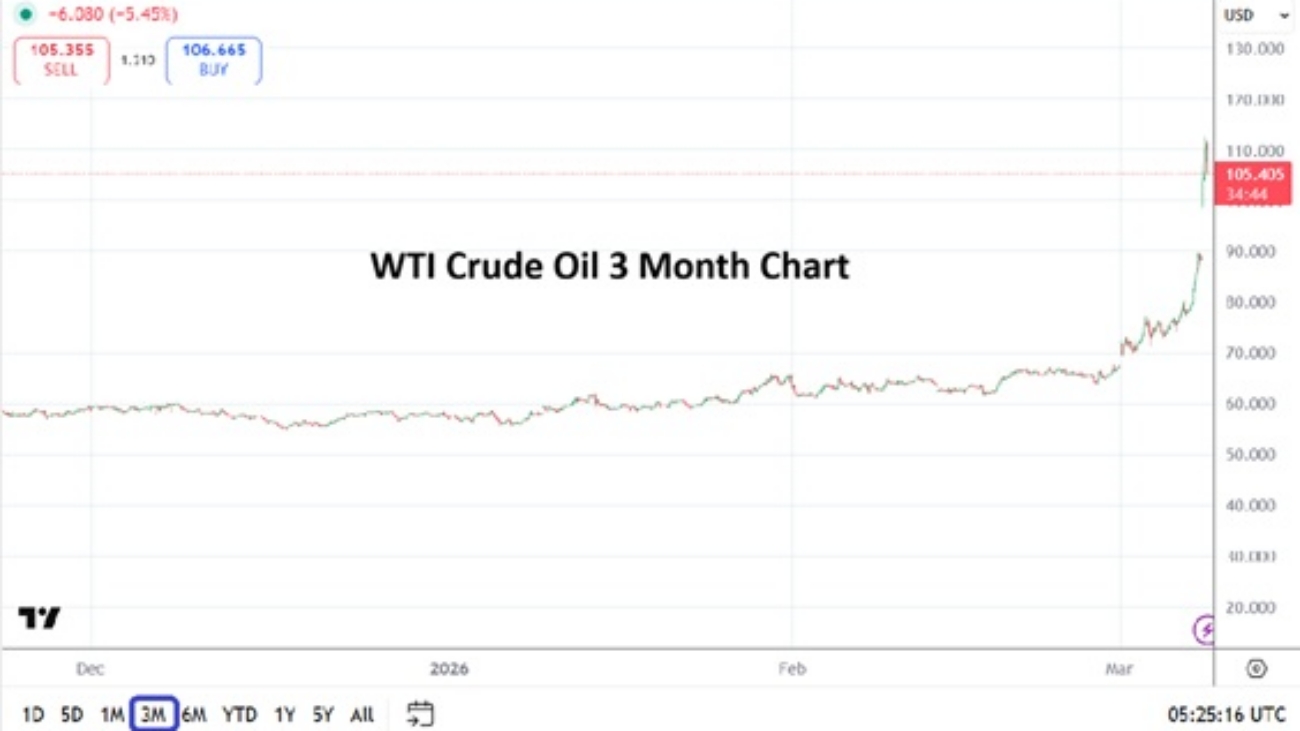
Writing from within the storm, it would be easy to feel a strong sense of nervousness as the newest Middle East War rages. However, this is unlikely the beginning of World War 3. Traders looking at WTI Crude Oil this morning have seen the commodity launch over $110.00. But the price has seen a slight dip and is now hovering above $105.00 in albeit fast conditions.

WTI Crude Oil Three Month Chart on 9th March 2026

Behavioral sentiment is nervous, there is no disregarding that notion and taking it seriously. Iran has been firing missiles and drones at neighbors and Saudi Arabia has been effected via some of their oil production. The Strait of Hormuz is certainly seeing an escalation in tension and is threatening to become a sea battle.

However, while the price of WTI Crude Oil rocks higher and day traders either make or lose money fast, speculators wager on short and near-term notions, there is likely a group of folks taking another approach and watching cash prices compared to options.

Yes, the intra-day price of WTI Crude Oil and all other energy sources will remain volatile near-term, but those with a mid and long-term outlook may be betting on optimism and the belief an end game will produce calmer prices. 

WTI Crude Oil is up close to 40% percent when a mid-term perspective is used. Will the commodity remain above 100.00 USD six months from now? Will WTI Crude Oil be above $100.00 three months from now or even one?

This thinking may deliver some type of price resistance in WTI Crude Oil. Certainly, there is a chance of greater escalation. But even though it was widely reported that oil facilities in Iran were bombed this weekend by Israel, the terminals hit were on the outskirts of Teheran, not on the island of Kharg. As dangerous as the war has become and the potential of worse damage occurring, those who are striking Iran do not want to damage Kharg terminals – at least not yet.

As for endgame, Russian oil is being allowed to be sold more easily, sanctions have been relaxed. Thus, it can be said there are international efforts to fight against price spikes. There are concerns about higher oil prices causing bedlam via inflation for the global economy rightfully. However, at some juncture things will eventually calm down. And that is what day traders need to keep in mind as WTI Crude Oil has raced higher, the notion that tactically the Iranian war will reach a de-escalation period is reasonable. 

Yes, there is a threat that Iran plays the an ‘Armageddon’ card and tries to destroy all vital energy resources in the Middle East, but we have likely passed that stage. Iran in many respects, respectfully, has been declawed. Iran can threaten, but can it really bite at this point? The island of Kharg is a key barometer, its facilities remain mostly kept out of the destruction zone, WTI Crude Oil may not spike too much higher.

As for highs, this morning’s jump occurred on fear, however the price has started to calm. We could certainly still see higher values in WTI Crude Oil this week or next, but thoughts about the potential of an end game resolving the current dangers, whatever that may be and no matter how long it will take – may prove to be an important ointment.  Time shall tell.

Copy and paste the text from AMT that you want to share