post258

The Fed: Beating a Dead Horse as the Bulls want to Run

The Fed: Beating a Dead Horse as the Bulls want to Run

Yesterday’s lackluster and underperforming GDP results from the U.S highlights our often discussed doubts surrounding the Federal Reserve. While Jerome Powell definitely has a right to be ‘uncertain’ and express his concerns regarding sudden inflation emerging, he has also proven to be wrong. The Fed should have begun cutting the Federal Funds Rate three months ago.

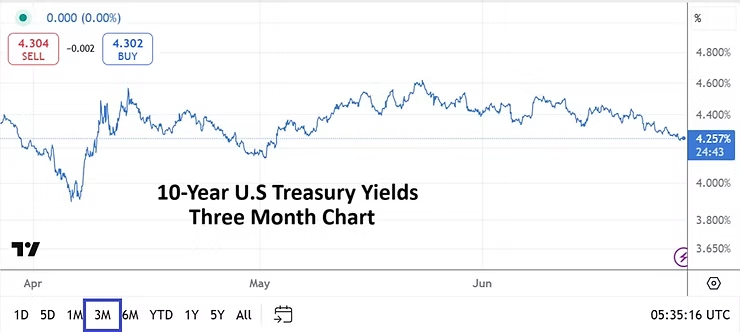
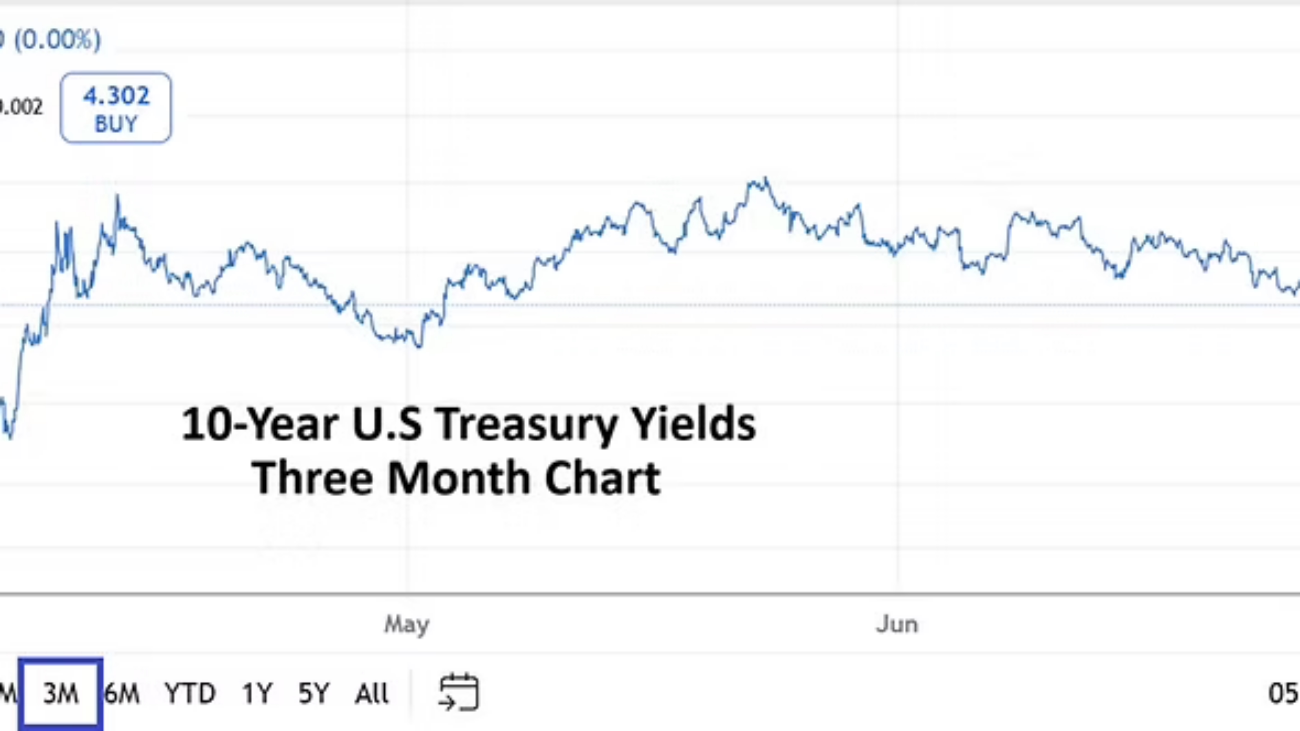
10-Year U.S Treasury Yields Three Month Chart as of 27th June 2025

Although Powell may not be a fan of President Trump, the Fed Chairman and the FOMC has the ability to be more nimble in this era. Instead of being passive about interest rates, the Fed could have lowered borrowing costs and helped spur on the U.S economy months ago instead of watching GDP numbers falter.

For all of the consternation regarding potential tariff pratfalls, the effect from President Trump’s policies have not caused massive inflation. The Fed can begin cutting rates even before the next FOMC meeting in late July, but they will not. In fact, the Fed should now cut the Federal Funds Rate by 0.50% in late July, but again they won’t. We will be lucky to get a 25 point basis cut.

The Federal Reserve remains too passive and acts as if it doesn’t have data technology which can be more proactive. Instead, Fed Chairman Powell chooses to act as if cutting the Fed Funds Rate is an academic exercise and can be done via a polite semester like manner akin to a report card. Dangerously, the U.S is paying an exorbitant amount of interest on long-term Treasuries and short-term Notes. Lower borrowing costs would also help U.S consumers. Jerome Powell doesn’t seem to care about these factors, which raises the consideration regarding his loyalties.

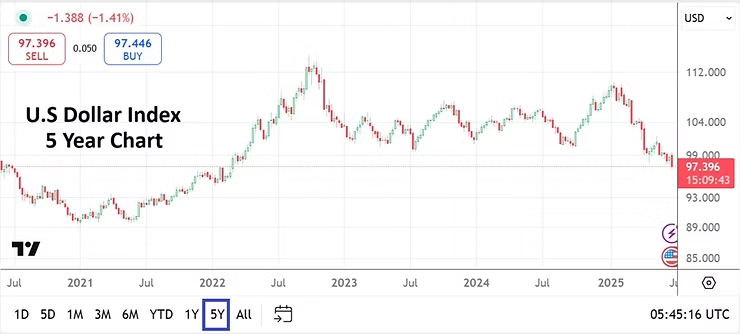
U.S Dollar Index Five Year Chart as of 27th June 2025

In recent weeks there have been at least two FOMC members who have suggested that interest rates need to be cut sooner rather than later. And there are some financial institutions who are clamoring for aggressive interest rate cuts throughout the calendar year and into 2026 in order to jumpstart the U.S economy, this includes Goldman Sachs and UBS. Signs of evidence that interest rate cuts will develop can be seen in the 10-Year Treasury yields which have been eroding recently. Some may claim this is a false narrative and that it is merely risk premium starting to be discounted. Nevertheless yields have lowered in the past month.

Yes, President Trump speaks loudly and delivers brawling negotiations. July 9th is another deadline for tariff agreements. However, financial institutions and many governments have learned to cope with President Trump’s backstreet tactics, which academics like Jerome Powell are not fond of particularly. U.S stock markets are hovering near highs, but still cautious because they are waiting on impetus from the Federal Reserve.

If the Fed fails to deliver an impactful FOMC Statement in late July this will not be greeted well by investors. Many believe the Fed needs to react, and it is quite apparent the S&P 500, Nasdaq 100 and even the Dow 30 are positioning for gates to be opened allowing for a bullish stampede. The USD has been weaker too the past few months as large commercial players anticipate lower U.S borrowing costs. The time for the Fed and Chairman Powell to act is now, making it clear that cuts to the Federal Funds Rate are coming.

post256

Crude Oil: A Guess from the Underbelly On What Happens Next

Crude Oil: A Guess from the Underbelly On What Happens Next

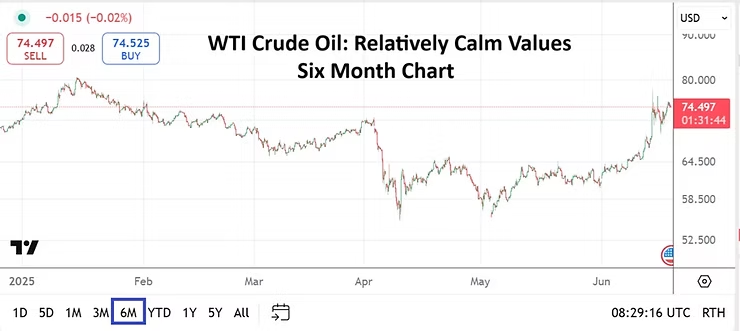
Why has the WTI Crude Oil Spot price remained relatively calm? The war between Israel and Iran has been going on per this latest violent phase since Friday the 13th. While tensions have been high between the two nations from the 7th of October 2023 in a very outward manner, and missiles were fired from Iran towards Israel on two separate dates in 2024 which then featured Israeli retaliation, the past handful of days is a new escalation.

WTI Crude Oil Spot Price Six Month Chart as of 18 June 2025

Day traders of WTI Crude Oil need to understand that large players in the energy sector have a vast amount of experience and intel regarding production and supply worldwide when they make their buying and selling decisions. However, the biggest oil traders do not always share the same political viewpoints, except to say most large players in the energy sector practice the art of realpolitik. Day traders of WTI Crude Oil should try to get into the minds of the real movers of WTI Crude Oil via realpolitik considerations.

As of this writing the price for WTI Crude Oil is around 73.930 Spot, late yesterday it did move higher to within sight of the 75.750 USD mark – this when information that President Trump is considering a U.S military strike on Iran heightened. Traders need to understand Spot Crude Oil and Futures pricing can be different. The current value of WTI Spot is higher than the Futures pricing because of the short and near-term known risks.

However, volatility in WTI Crude Oil Spot has remained fairly muted, almost tame as Israel and Iran wage war. Other spot energy prices like Brent and Natural Gas are being affected directly too because of shifts in behavioral sentiment. But again, the prices within the energy sector have remained calm considering what is at stake for global economics. Here are points that may be affecting the WTI Crude Oil landscape and energy complex, which some large traders may be contemplating:

  • It is highly likely the U.S has told Israel not to harm Iranian Oil production or supply sites, including shipping.

  • The U.S does not want the price of WTI to jump rapidly because of the current war between Israel and Iran.

  • Inflation would be a scrouge for the global economy, not to mention President Trump’s ambitions.

  • Even though the U.S has its own energy supply, the price of WTI is affected by behavioral sentiment within the global Crude Oil complex.

  • Meaning conflicts in the Middle East and elsewhere always cause ripple affects, even if Crude Oil is flowing freely in the U.S via its own production.

  • The U.S doesn’t want China to be given a reason to consider becoming an open belligerent in the Middle East war.

  • China gets a lot of Crude Oil from Iran. The stated percentage is around 15% of its total supply, but it could be more if Iran sends oil to other locations and then reroutes supply to China afterwards.

The U.S not only wants to keep China calm about its energy supply, but also doesn’t want to give China an excuse to escalate political or military tensions elsewhere – read Taiwan.

As an aside there are a lot facts and rumors coming from China, highlighting that a powerplay is emerging between competing factions for leadership in China’s military, this may include the authority that Xi Jinping has too. China will be conducting Politburo meetings in the coming weeks that will get plenty of attention via Beijing analysts. If U.S intelligence knows an internal political fight is taking place in China, they will want to keep China calm regarding external considerations and not give China excuses to act. Concerns regarding the Middle East as a justification for more Chinese actions against Taiwan in some type of economic political/ military theatre is a threat.

By telling Israel not to attack Iranian oil infrastructure, this allows the U.S to placate China. Only if Iran were to attack U.S infrastructure – including military assets or interests in the Persian Gulf via attacks on Gulf States like the UAE, Bahrain or Saudi Arabia would the U.S consider retribution against Iranian Crude Oil.

While the U.S has an interest in global politics certainly, it also wants to maintain a stable global economic environment. President Trump knows this and so does his cabinet supposedly. The Federal Reserve meets later today and they will certainly speak about uncertainty regarding inflation. Whether or not they mention the Middle East war will be interesting.

Thus, it is likely the U.S will only allow an attack on Iranian Crude Oil production and supply if it has been directly threatened. And this is where it gets potentially more interesting for Crude Oil traders. It appears likely the U.S will get involved directly in Iran by hitting known Iranian nuclear facilities deep underground with heavy U.S ordinance. If the U.S does attack Iran via B2s using heavy bombs, how will Iran’s Revolutionary Guard Corps react?

Will the existing IRGC allow for the destruction of its nuclear ambitions and accept that it will have to prepare for a new political environment in which their power will likely be challenged by not reacting? Or will those in power of the IRGC double down on stupidity and attack U.S assets with some of the Iranian military weaponry that still remains? An attack on U.S ‘interests’ would risk aggravating the U.S more – giving the U.S reasons to attack Iranian economic infrastructure which is mostly Crude Oil, and likely close the door on the chances of the IRGC to survive after the war concludes.

Things often do not work out via political and military outlooks. The law of unintended consequences is always a danger. The end game is quickly approaching for Iran’s current leadership. The U.S and Israel also hopefully have taken this into account. Recent outcomes in Iraq and Afghanistan have not gone as planned for the U.S when seeking a serene endgame.

As an example, it might be better not to eliminate the current Ayatollah Khamenei, and allow the people of Iran an opportunity to remove him if they want. The Iranian Revolutionary Guard Corps and its various factions are probably eyeing what will come after a capitulation. There will be a fight for survival politically and a leadership vacuum.

The IRGC fiefdom gets most of its money from Crude Oil revenues. It is quite possible in a forward looking manner the IRGC may choose not to risk having the U.S ruin Iran’s one giant economic asset, thinking rightly or wrongly that they can continue to profit from Crude Oil the day after the war ends.

post255

Quick Hits: Inflation, USD, China and U.S Trade and WTI

Quick Hits: Inflation, USD, China and U.S Trade and WTI

Yesterday’s weaker than anticipated CPI data from the U.S cements the realization that inflation is eroding in the States statistically in a rather consistent fashion. Today’s PPI numbers will be watched, but yesterday’s results clearly show the Federal Reserve has been far too cautious.

Media reported yesterday’s inflation results differently showing bias as some pointed out that inflation rose, compared to some outlets that showed it came in less than expected. Bottom line – inflation has been below expectations consistently and tariff concerns as of yet have not killed the U.S economy with higher prices. The Fed’s insistence on being cautious are comparable to the instincts of an overly protective parent. Day traders need to understand their perceptions are in danger of being affected by folks with confirmation bias.

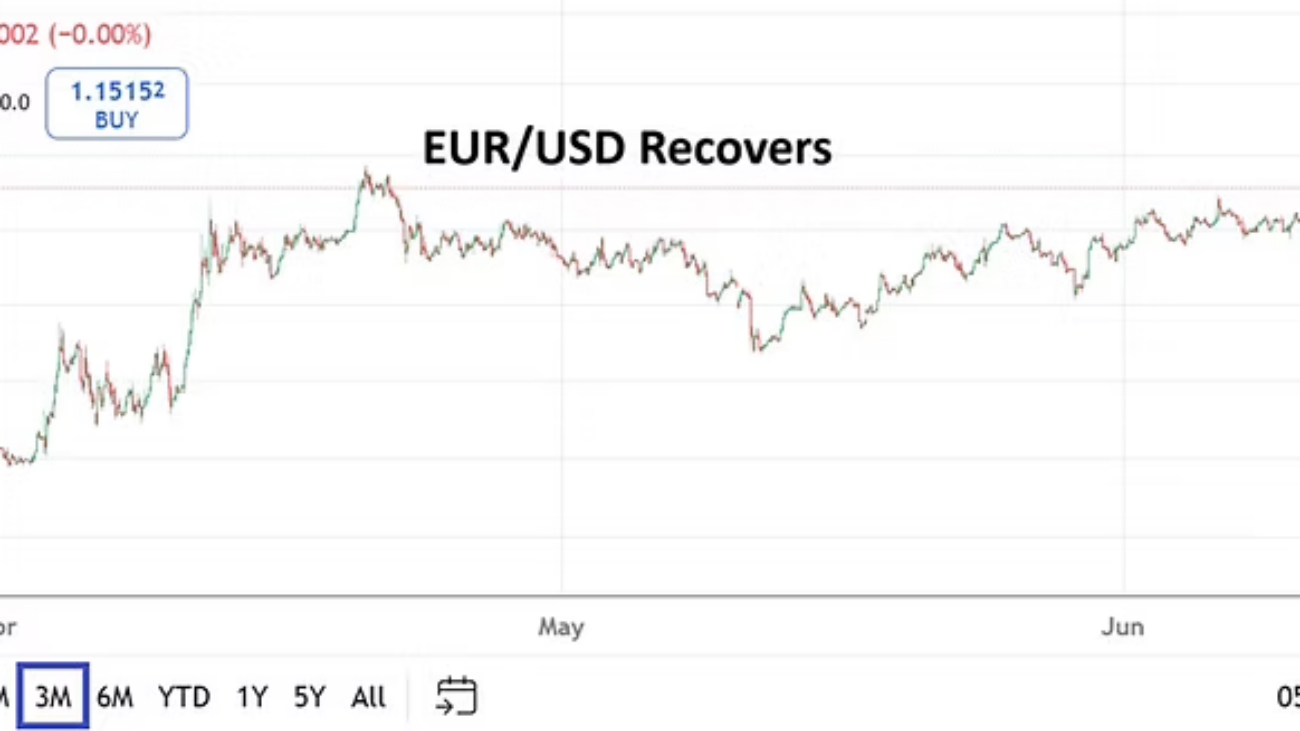
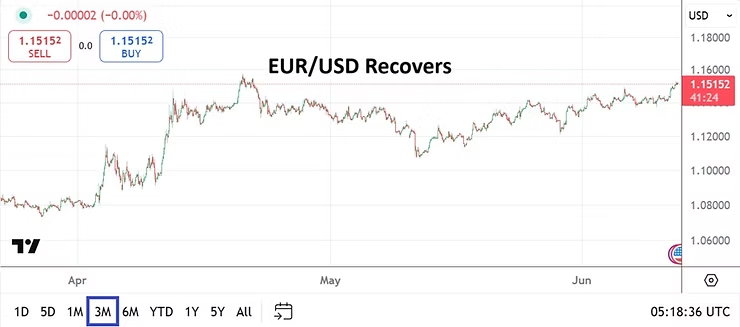
EUR/USD Three Month Chart as of 12th June 2025

The EUR/USD climbed above the 1.15000 level again yesterday confirming mid-term outlook for a weaker USD based on the notion the Federal Reserve will have to lower the Federal Funds Rate exists. While perhaps kicking and screaming against their desires to remain hawkish, the Fed will start feeling the heat to act. Next week’s FOMC meeting is unlikely to be the actual date. However, financial institutions have certainly been leaning into a weaker USD since April, and the upwards trajectory in values by major currencies against the USD may prove to be a solid baseline via support prices moving forward.

Certainly, day traders should consider the notion that larger traders have bet against the USD already, thus leaving the door open to the potential of reversals. Yet, mid-term price levels are what financial institutions are gearing their outlooks towards via cash forward transactions for commercial companies. If financial institutions believe the Fed will have to indicate the potential of a rate cut not only in July, but another one in September this could spur on additional USD weakness. Folks should also consider the notion that the White House won’t be against a somewhat weaker USD in order to help U.S manufacturers and producers export.

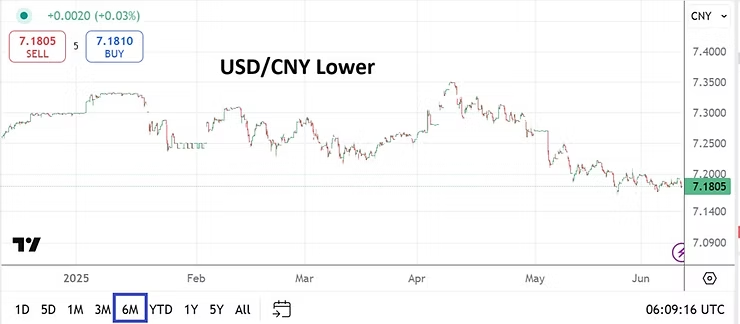
USD/CNY Six Month Chart as of 12th June 2025

U.S stock indices didn’t climb on the results of the China tariff news proclaiming a working agreement has been attained over the past two days. Perhaps markets are inclined to believe there will be more fireworks regarding rhetoric from the U.S and China over the coming months – which appears logical given the circumstances between the two nations.

While rare earth metals got the headlines, there appears to be plenty of line items in the tariff negotiations that still must be worked on. The announcement that the deadline has been pushed back again, this time until the 9th of August shows that talks are making progress – but slowly. Red lines keep getting erased.

Financial markets reacted rather passively to the U.S and China news, seemingly indicating larger players are now focused on other matters, and funds have played most of their cards regarding the China and U.S saga via their existing trading positions. Noteworthy, is the fact, the USD/CNY has reacted in a rather correlated fashion with the broad Forex market the past six months. For all the talk about a catastrophe for China and U.S trade, the USD/CYN has behaved quite well, showing the Chinese government is playing a long game against President Trump and doesn’t want to create a huge firefight via currency manipulation accusations.

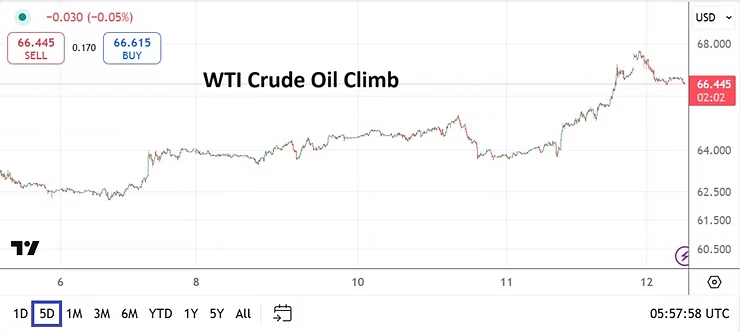
WTI Crude Oil Five Day Chart as of 12 June 2025

Middle East Escalation: WTI Crude Oil jumped late yesterday as news quickly filtered through social circles of embassy evacuations in various proximities within reach of Iran. The loud whispers certainly caused the price of the commodity to surge to almost $67.75 last night, but this morning’s values suggest some deep breaths have been taken as WTI trades near $66.45.

For options traders who want to buy cheap calls on WTI, they will likely have to look several months out and speculate on military escalation under rather speculative circumstances. If traders want an idea of what larger players are doing in options they can use CME (Chicago Mercantile Exchange) info to get some thoughts on positioning pattens in WTI Crude Oil calls and puts. The call options did get more expensive last night – meaning that some large traders are hedging against the threat of higher WTI Crude Oil prices because they are likely leaning into cheaper oil for the time being, or they are betting on the price of the commodity to rise if chaos breaks out in the Middle East.

post252

No Chance of a Nimble U.S Fed as Entitled Investors Served

No Chance of a Nimble U.S Fed as Entitled Investors Served

On Wednesday of this week Consumer Price Index numbers will be published, followed by Producer Price Index data on Thursday. Inflation statistics from the U.S for several months have been coming in rather tame and sometimes below forecasted results. Fed Chairman Powell and his team of FOMC members continue to plead uncertainty as the main reason for a lack of Federal Fund Rate cuts because of tariff concerns. The next meeting by the Fed finishes on Wednesday the 18th of June.

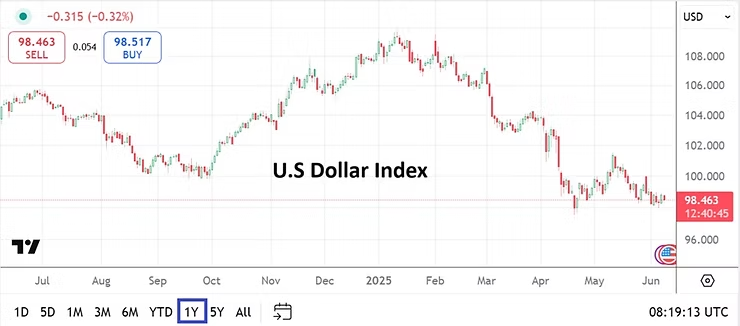
U.S Dollar Index One Year Chart as of 9th June 2025

Even if the inflation numbers come in as anticipated in the next few days, the Federal Reserve is unlikely to cut interest rates next week. President Trump and some in his cabinet have spoken about the need for rate cuts. Not only would it help consumers via mortgage rates, borrowing costs to buy autos and other high ticket items, but it would help the U.S government pay less on interest rate expenditures generated by inflamed Treasury yields.

The Fed continues to stay passive about its outlook, but if inflation data via the CPI and PPI are near forecasts this week, why would the U.S central bank continue to take such a stubborn stance? Interest rate decisions are not supposed to be political. The Fed has pointed to the potential of sudden inflation occurring due to tariff implications. This is a genuine concern. However, why can’t the Federal Reserve be more nimble? Inflation has not shown signs of immediate upwards pressure.

Perhaps it is because the Fed serves large U.S and foreign financial institutions, and has gotten into the habit of telling important folks not only what it anticipates, but handing out its interest rate plans on a silver platter so large players can position themselves beforehand like entitled elites. The Fed is very unlikely to cut interest rates the middle of next week, but it is probable they will open the door to a 25 basis point cut in July. However, July’s meeting is scheduled for the end of that month, in essence this is the middle of the summer, which is a long time to wait for action.

Day traders hoping to ride the trends that flow through the marketplace as they pursue speculative wagers remain in a difficult spot. Intraday volatility remains dangerous. Mid-term outlooks are certainly taking hold in Forex and equity indices, but sudden reversals for those using too much leverage continues to cause harm. Short-term speculators need to remain patient and vigilant, it is important to remember day traders are seen as second class citizens in the big scheme of the financial world, and this is not going to change for the moment.

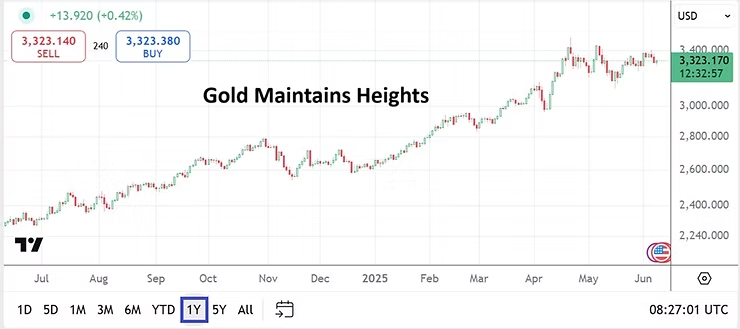
Gold One Year Chart as of 9th June 2025

A lack of clarity has spooked large players in the financial markets the past handful of months, but it does appear many institutions are becoming more comfortable. Though not at all-time highs, the major stock indices are within sight of important values. Behavioral sentiment seems to be leaning into a more positive outlook. Large investors appear to have concluded that while President Trump talks a tough game and often presents a strong stance, that ultimately he allows for tactical maneuvering to achieve deals. Trump is not big on being polite and this occasionally inflames markets. Bullish sentiment is growing on the hope President Trump’s characteristics are understood.

The Fed and the White House are likely to continue locking horns for the next few weeks. Perhaps if Jerome Powell tries to placate Donald Trump with a solid hint of an interest rate cut in July this will smooth things over. However, waiting for an interest rate cut in late July seems like a road too far, particularly when inflation levels the past couple of months avail the U.S economy to proactive actions from a Federal Reserve now.

Let’s remember, there is no law that says the Fed cannot cut or raise interest rates only during the conclusion of FOMC meetings. The U.S central bank has the ability to make changes to the Federal Funds Rate whenever it deems needed. Yet, the Fed refuses to be nimble in an age when technology allows data to be attained faster, this is a detriment.

The inability of the Fed to show it can be agile is another reason why investors are nervous about U.S policy regarding fiscal matters. The U.S government’s bureaucracy is too slow and bloated. The U.S is still a golden place to invest, but it is becoming problematic and this is leading to changes which effect long-term financial decisions.