Contraries 20260831

Why Some Traders Go Bust: What Medieval Logic Knew That Your Backtest Doesn’t

Aristotle's Square of Opposition and Why Traders Still Walk Off Cliffs

Somewhere in a 9th century Carolingian monastery a logician diagrammed four sentences into a square to help him distinguish whether a statement was universally true, or only partially so. A thousand years later and that square can explain why a trader with a positive-expectancy strategy and a spotless backtest can still walk off a cliff. The tool is Aristotle’s Square of Opposition. The victim is anyone who has confused what happens on average across many trades with what happens to one trader using the same strategy over time.

The Square

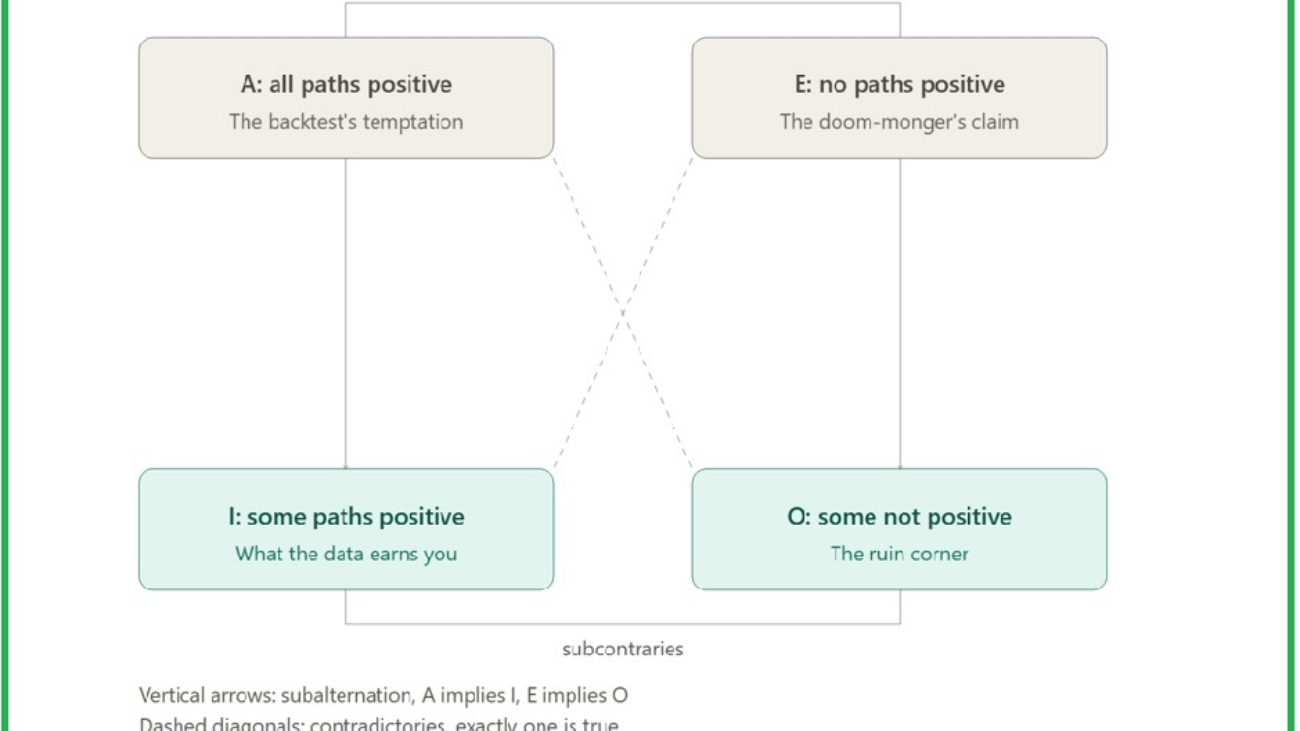
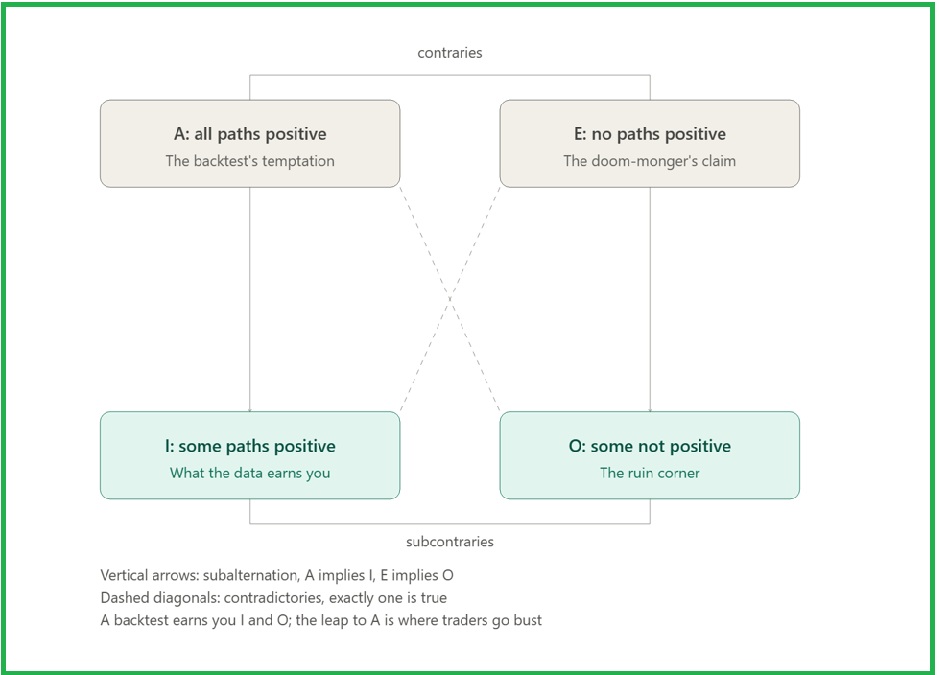
Aristotle’s Square of Opposition sorts any claim about “all,” “none,” “some,” and “some not” into four corners: A (universal affirmative — “all X are Y”), E (universal negative — “no X are Y”), I (particular affirmative — “some X are Y”), and O (particular negative — “some X are not Y”). The corners have relationships: A and E can’t both be true, but can both be false. I and O can’t both be false, but can both be true. And crucially, A and O are direct contradictories — exactly one of them holds. Medieval scholars used this to catch people smuggling a universal claim into an argument that had only earned them a particular one. It turns out finance does this constantly.
Why Some Traders Go Bust: What Medieval Logic Knew That Your Backtest Doesn’t 

The Deception: Ensemble vs. Time

Imagine a bet: 50% chance of +50%, 50% chance of -40%. Average that across a thousand parallel traders taking the bet once, and the ensemble average is comfortably positive. Looks like a great trade. But average it across one trader taking that bet a thousand times in a row, and the time average growth rate is negative. Same bet, opposite verdict, because compounding is multiplicative, not additive. This is the ergodicity problem: the ensemble average and the time average only coincide if the process is ergodic, and most wealth processes — especially leveraged, compounding ones — are not.

Nassim Taleb gave us the gut feeling for this in Fooled by Randomness. As an Options trader he was intimately familiar with the notion of skewed distributions and how these can impact wealth in terminal ways. In FX (my world) the carry strategy buying high yielding currencies and selling them against low yielding currencies has an asymmetric payoff, similar to picking up pennies on the tracks in front of an oncoming train. The formal model of ergodicity as applied to economics was developed later by physicist Ole Peters in a great paper “The Ergodicity Problem in Economics”( 2019) building explicitly on the Kelly criterion. He demonstrates why time averages diverge from ensemble averages in multiplicative systems, and showed the divergence isn’t a glitch,  it is structural.

Putting a Strategy on the Square

It is tempting when reviewing  a backtest with a fat positive Sharpe ratio, to leap straight to A: “this strategy is profitable” — full stop, universal, works everywhere, always. Let’s gear it up. But probably the more honest claim your data has actually earned is closer to I: “some paths through this strategy are profitable” — a particular, not a universal. The Square’s discipline is to check category before you trust quantity. Before asking “how profitable?” ask “profitable for whom, under what — the ensemble of possible paths, or the one path you’ll actually live through?” A strategy can be I-true (some simulated paths win handsomely) while quietly also being O-true (some paths,  including, possibly, yours; go to zero). I and O aren’t contradictions; they’re subcontraries, and they can both hold simultaneously. That’s precisely the shape of a fat-tailed strategy: mostly fine, occasionally ruinous.

Why Expectancy Lies by Omission

Expectancy (“average win × win rate minus average loss × loss rate”) isn’t itself a universal claim. The mistake comes when we quietly promote an ensemble average into one by letting  an I-shaped number pretend to answer an A-shaped question. Positive expectancy tells you the average across scenarios is favourable; it says nothing about whether your single compounding sequence survives long enough to enjoy it. One of the questions that expectancy cannot answer, but survival requires us to ask, is the probability of ruin. Given position sizing and volatility, what fraction of paths hit zero before they hit target? Monte Carlo simulation offers one way to estimate this but it should be used with extreme caution. Feed a Monte Carlo engine the wrong return distribution such as  thin tails in place of  real world fat ones and it will confidently hand you a beautifully wrong answer. A mis-specified Monte Carlo is just a very fast way to fool yourself with more decimal places.

The Habit Worth Keeping

The practical takeaway isn’t a formula, it’s a reflex. Before trusting any metric — a Sharpe ratio, an expectancy figure, a backtested drawdown — ask the medieval logician’s question: is this claim universal, or is it merely particular? Most of what a backtest can honestly give you lives at I and O, not A. The traders who go bust aren’t usually wrong about the arithmetic. They’re wrong about the quantifier — mistaking “true for the ensemble” for “true for me, through time.” Aristotle can’t size your position for you. But he can stop you asking the wrong question about it.

The deeper point of the monastery image we opened with echoes a point Jeremy Naydler makes “In the Shadow of the Machine – a pre history of the computer”.  The instruments we reason with don’t just extend the mind, they reshape it: what counts as thinkable changes with what’s sitting on the desk. The Square of Opposition is one of the earliest such instruments, a piece of technology built to discipline inference. The backtest, the Sharpe ratio, the Monte Carlo engine are its modern descendants — and like any tool, they don’t just answer questions, they quietly decide which questions get asked at all. The trader who never learns to ask “universal or particular?” isn’t missing a fact. He’s missing a habit of mind his tools may not have taught him to have. A framework is most powerful not when it gives us the wrong answer, but when it prevents us from noticing that we have asked the wrong question.
Copy and paste the text from AMT that you want to share

Share:
Indian Rupee 20260826

India Insider: Rupee’s Prolonged Weakness Remains Unresolved

Better Streamlined Government Policy Needed for the Rupee

In July of this year Reserve Bank of India Governor Sanjay Malhotra talked to Business Line magazine and argued that recent Rupee depreciation does not reflect any weakness in the country’s economic fundamentals. According to him, pressure on the currency has largely stemmed from geopolitical tensions, USD strength  and broader volatility across emerging markets.

However, the USD which strengthened during the outset of the US-Iran war has been losing value in large chunks in the broad Forex market the past month. The U.S Federal Reserve remains neutral regarding its interest rate guidance and U.S labor market data has emerged weaker. On top of that, the U.S Treasury’s decision to intervene in U.S long-term bonds via buybacks in order to cool yields has hastened another USD path lower, while igniting buying in many other currencies and gold.

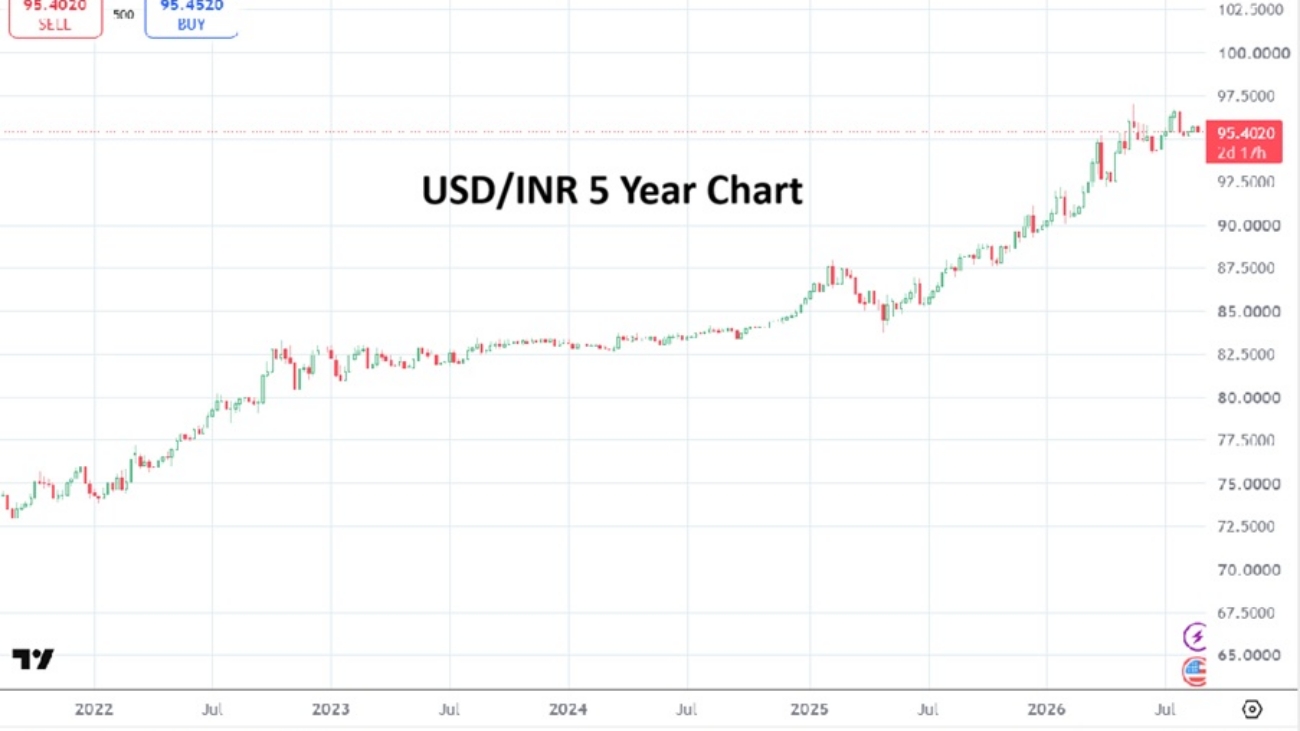
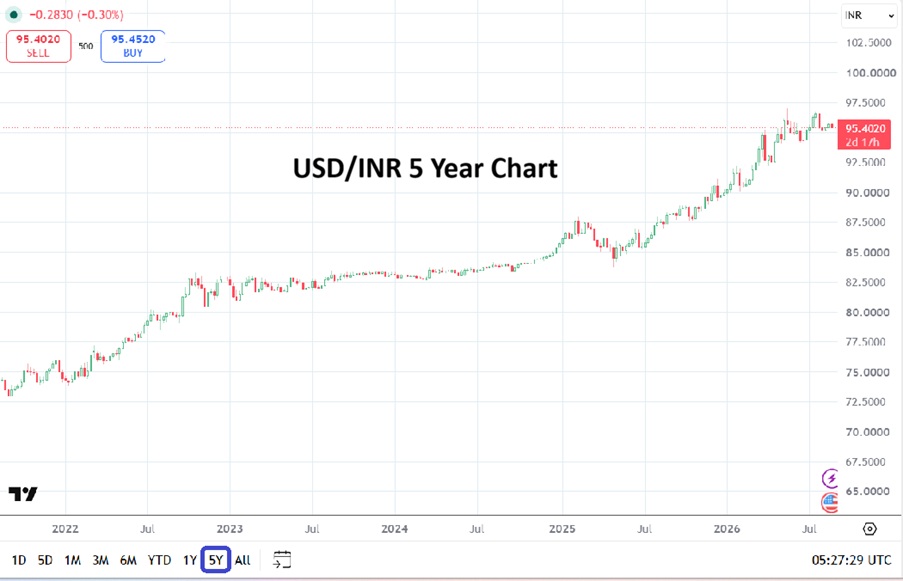
USD/INR Five Year Chart as of 26 August 2026

Despite the Foreign Currency Non-Resident (Bank) deposits coming from overseas investors increasing, which are leveraged products structured by banks and helped to attract more than $50 Billion USD since June, the Rupee’s reaction to this set of recent inflows has been muted. The Indian Rupee is traversing near 95.55 levels as of this writing, notably as other Asian currencies like Korean Won and Singapore Dollar are trading at stronger levels.

India’s Forex reserves climbed to $716.9 billion boosted by these inflows, along with USD related external borrowings by corporate and commercial banks. Nevertheless, the fundamental problems for the Rupee’s prolonged weakness remains unresolved.

Reasons for Rupee’s Weakness Structurally

The Indian Rupee has depreciated around 28% against USD since 2022. Irrespective of this, the merchandise tradable exports have been stagnant, rising a mere 5.7% – from $417 billion to $441.8 billion USD. While on the other hand, merchandise imports have risen 26% from $610 billion to $774.80 billion USD in the period between 2021-2025.

However, India’s balance of payments is not at immediate risk, because even as higher importing needs (especially with Crude Oil and LNG) and lower tradable exports, the total merchandise deficit of around $350 billion USD as of 2025 is being offset by healthy IT exports and foreign remittances.

The fundamental question is why hasn’t the Indian Rupee depreciation expanded merchandise exports in the last few years? As Carlos Dias Alejandro depicts in his seminal work Exchange-rates Devaluations in a Semi-industrialized Country: The Experience of Argentina 1955-1961, throughout Argentina’s history rural producers who supplied most of the exported commodities traditionally advocated a policy of devaluation.

Argentine exporters expected Peso prices for their outputs to rise faster than the Peso prices for their imports, including the wages that they paid for their employees in current prices. In other words, exporters stand to gain from a currency devaluation because it can make their products more competitive in global markets and encourage resources to move towards export production.

Argentina’s experience after Juan Peron who was overthrown in 1955 provides an important context to this argument. The economic policies pursued during the Peron years had already left Argentina with serious inflation , weak agricultural incentives, low investment and balance of payments pressures. The devaluation and stabilization policies that followed were therefore part of a broader attempt to correct the distortions that had built up during the previous period.

Interestingly, the Rupee depreciation has so far not shifted resources from producing goods for foreign products as it is apparently clear via merchandise trade data. The IT sector has been one of the few sectors that has been able to use this shift positively.

It is also important to understand that devaluation does not produce only positive outcomes. A devaluation that increases the overall level of prices can cause a redistribution of income among different social groups, in much the same way as inflation does in a closed economy. Unwieldy redistribution becomes inevitable when the prices of outputs and inputs do not change proportionally.

For instance, wages are central to this process. If prices of food, fuel and other essential goods rise quickly after a devaluation, but nominal wages adjust slowly, workers experience a decline in real wages and purchasing power. Their incomes may remain unchanged in Rupee terms, yet they can afford fewer goods and services. This effectively transfers income from wage earners to firms and producers whose prices or profits adjust more rapidly.

The impact can also differ across workers. Employees in organized sectors may negotiate higher wages or receive inflation linked adjustments, while informal workers, agricultural laborers and those dependent on fixed incomes often have less bargaining power and face a sharper fall in real earnings. At the same time, exporters may benefit if the prices of their products rise faster than their wage and other input costs.

However, if workers eventually demand compensation for the higher cost of living, wage increases can raise production costs and reduce part of the initial competitiveness gained through devaluation. Thus the effect of devaluation depends not only on the exchange rate, bit also on how quickly wages, prices and productivity respond.

In that sense, Argentina’s experience in the 1950s offers a warning for semi industrialized countries like India. A devaluation of the Rupee can make some exports competitive, but it cannot create more productive capacity on its own. Without addressing deeper structural problems, a weaker currency can instead push up prices and reduce households real purchasing power.

Rupee Effects Absorbed and Felt by Those Who Earn Low Wages

Prices of goods and services have increased in the last few years due to the depreciation of the Rupee, especially for imported goods. Since India not only imports oil and gas for consumption, but also imports machinery and intermediate goods for production it has forced households to spend a higher share of their income on the consumption of needed goods.

When households do not earn they need to borrow or hope that their wages increase. In India real wages don’t always go up with inflation. This is due to India having a higher supply of available labor which makes negotiating for higher wages difficult for workers. If employers can find another worker relatively easily as a replacement, the employed worker has limited power.

The ILO (International Labor Organization) notes that India remains characterized by extensive informality and low pay employment, it also estimates that 62 million workers earn below the minimum wage. India’s workers are not necessarily competing in the global market. Manufacturing as a percent of GDP has stayed around 15% over a decade. And irrespective of the fact that India is a major agricultural producer and exporting nation and over 46% of its labor force engages in the sector, total Agri-Exports stayed within a band of $48-$53 billion for the last few years.

The government says that India is growing because services as a percent of GDP is 55%, but the nation employs around one-third of the labor force in the informal economy. While IT employees earn higher wages comparatively because their wages are connected with global demand and have an advantage because they are export services, those who work in construction, domestic help, shops, agriculture and the service sector are earning substantially less. The wages of these people won’t go up until changes are made. 

The vast numbers and informality of employment within a significant amount of India’s labor force prevents low wage costs from translating into solid competitiveness, particularly as inflation is seen and depreciation of the INR continues. Economies like China, Vietnam and Korea have created industrial strength by transferring household savings through lower costs for goods and subsidizing businesses.

India’s decade long reluctance to invest in necessary infrastructure, not preventing or fixing regulatory problems, a lack of commitment to invest in skill based education, and not creating conditions for businesses to compete with overseas markets have created conditions that result in low consumption and low wages. The devaluation of the INR hits households who are acting as shock absorbers in the absence of streamlined government policy.

Copy and paste the text from AMT that you want to share

Share:
30Y Treausry Yields 20260826

How Warsh Can Solve the US Debt Crisis With Just a Few Words at Jackson Hole!

A Roadmap for Fed Chairman Kevin Warsh to Rescue U.S Debt

Many think the market decides interest rates.

Wrong!

The Fed – and only the Fed – has full control over interest rates, all over the curve!

We just need to have the right person on board.

During the European crisis in 2011, speculators all around the world were betting that the Eurozone would explode and that the EUR would collapse under the weight of government debt that had started with Greece and spread to other countries that were shamelessly labelled “PIGS,” adding insult to the speculative attack.

Trichet, at that time chair of the ECB, seemed totally clueless, afraid to take any “unconventional” step, even at the risk of seeing the entire European financial system go bust.

The crisis seemed unstoppable… until Mario Draghi stepped in, replacing Trichet.

With just one magical statement (“the ECB will do whatever it takes to save the Euro. And believe me, it will be enough”) Draghi implied that he was ready to buy government bonds from European countries, even though such action was considered at the time to be “against the ECB’s statutes” and outside its mandate.

By going against the prevailing market narrative, and knowing very well the economic strength of the Eurozone, Draghi forced the market to follow him.

The speculation against the Eurozone stopped almost instantly, and European government bond prices recovered without the ECB even being forced to intervene!

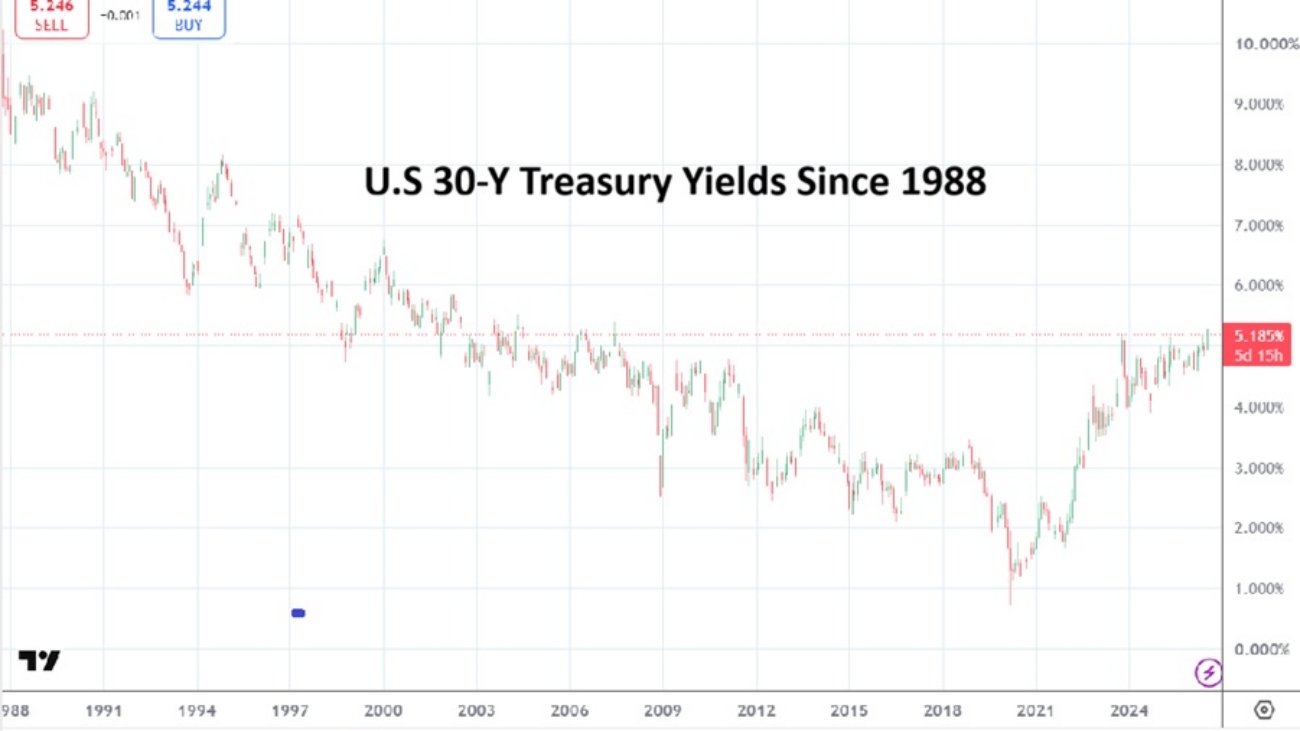
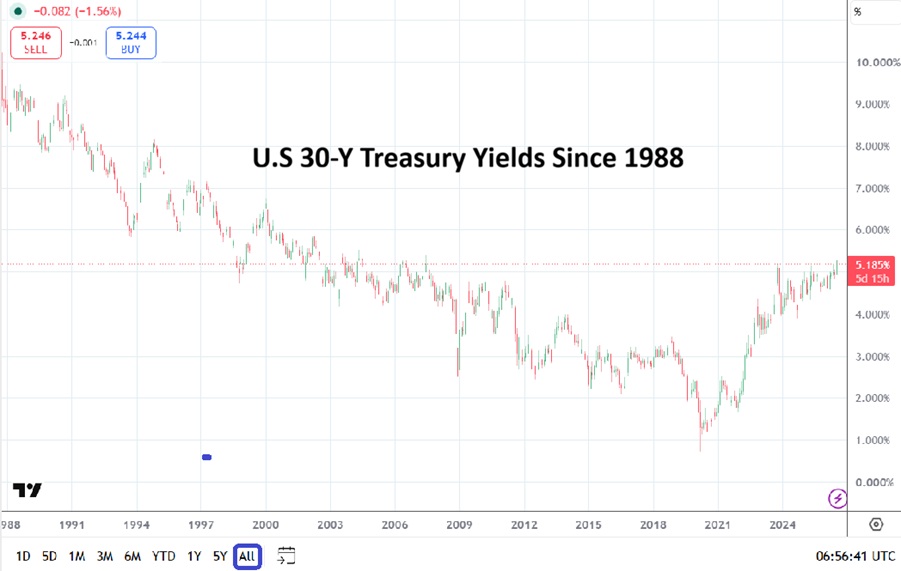
U.S 30-Year Treasury Yields Chart From 1988 until 26 August 2026

Today, the U.S is in exactly the same position!

A massive speculative attack is being waged against U.S debt (probably led in part by the crypto industry in an attempt to justify the “value” of its virtual tokens), with “inflation” suddenly becoming the ultimate beast.

Like Trichet at the time, the weak Powell got driven into the trap of raising rates abruptly on his own government, forcing it to pay more than $1 trillion in yearly interest, a massive and unnecessary injection of liquidity that is itself… inflationary!

In today’s world, driven by massive debt, raising interest rates on governments is INFLATIONARY!

Now that Powell is almost gone, all hopes lie on Warsh’s shoulders.

He can save the U.S from the current debt crisis with just a few words, exactly as Draghi did for Europe.

Warsh completely missed his first intervention a month ago. Instead of showing the market who’s boss, he showed total febrility.

Fearing being labelled a “Trump puppet,” he insisted on the 2% inflation target – an absurd threshold that nobody really knows where it came from – and claimed that “the economy is robust”… while we all know it is not!

Then he totally capitulated to the market by saying that he would “listen to the market” to determine where rates should go. The worst thing any Governor could ever say!

That’s how long-term yields exploded to levels not seen since 2007, and forcing Bessent to intervene to limit the damage.

We are now just one day away from the Jackson Hole Symposium.

Warsh can now either save the U.S or send it into Armageddon!

Every word he says could change the entire picture.

He simply has to focus on the right narrative:

  • Current inflation is geopolitical and driven by supply shocks. Raising interest rates has zero impact on such inflation.
  • The 2% inflation target is NOT an absolute figure. A 3% inflation rate should be acceptable when the economy is at risk.
  • Signs of recession are looming, with the labor market under pressure, rising bankruptcies, and record rates of defaults on credit cards and car loans.
  • Forcing the government to inject more than $1 trillion through interest payments is itself inflationary. Raising interest rates to fight inflation is counterproductive at such a high level of government debt.

If Warsh is capable of highlighting these arguments, yields will drop instantly without any intervention from Bessent.

Then the Fed can start decreasing interest rates gradually, with the market accepting whatever rate it sets.

What if Warsh deliberately gave a disastrous speech a month ago, taking a tough position against what Trump appointed him to do and allowing the market to drive rates to extreme levels… only to radically change his position following the recommendations of the task force he appointed?

This way, he would have absolved himself from being labelled Trump’s puppet while executing exactly the plan of reducing interest rates.

We can therefore suspect that he will take the opportunity at Jackson Hole to present the first findings of this task force, which could include, among other things:

  • A questioning of the 2% inflation threshold, especially when the economy is at risk of entering a deep recession.
  • Stressing that inflation comes mainly from geopolitical issues and supply shock. Fighting such inflation with high interest rates is totally inefficient.
  • A highlight of the absurdity of raising interest rates on the U.S government and forcing it to inject $1 trillion in interest payments – an unnecessary injection of liquidity that is itself inflationary.
  • The necessity of coordinating with the Treasury Department to fight inflation where it hurts the most, through subsidies, tax relief, and other targeted measures, while primarily fighting “greedflation” through higher profit taxes on specific industries.
  • A warning about the increasing risk of recession, with record numbers of corporate bankruptcies, credit-card defaults, and a deteriorating job market.

Warsh has a unique chance to prove that he is the right person for the job by rescuing the U.S from the massive speculation against its debt, exactly like “Super Mario” did when he saved Europe from collapse in 2012.

Copy and paste the text from AMT that you want to share

Share:
New Zealand Dollar 20260825a

NZD/USD: Elevated Value for Kiwi Coming Within Sight of Mid-Term Prices

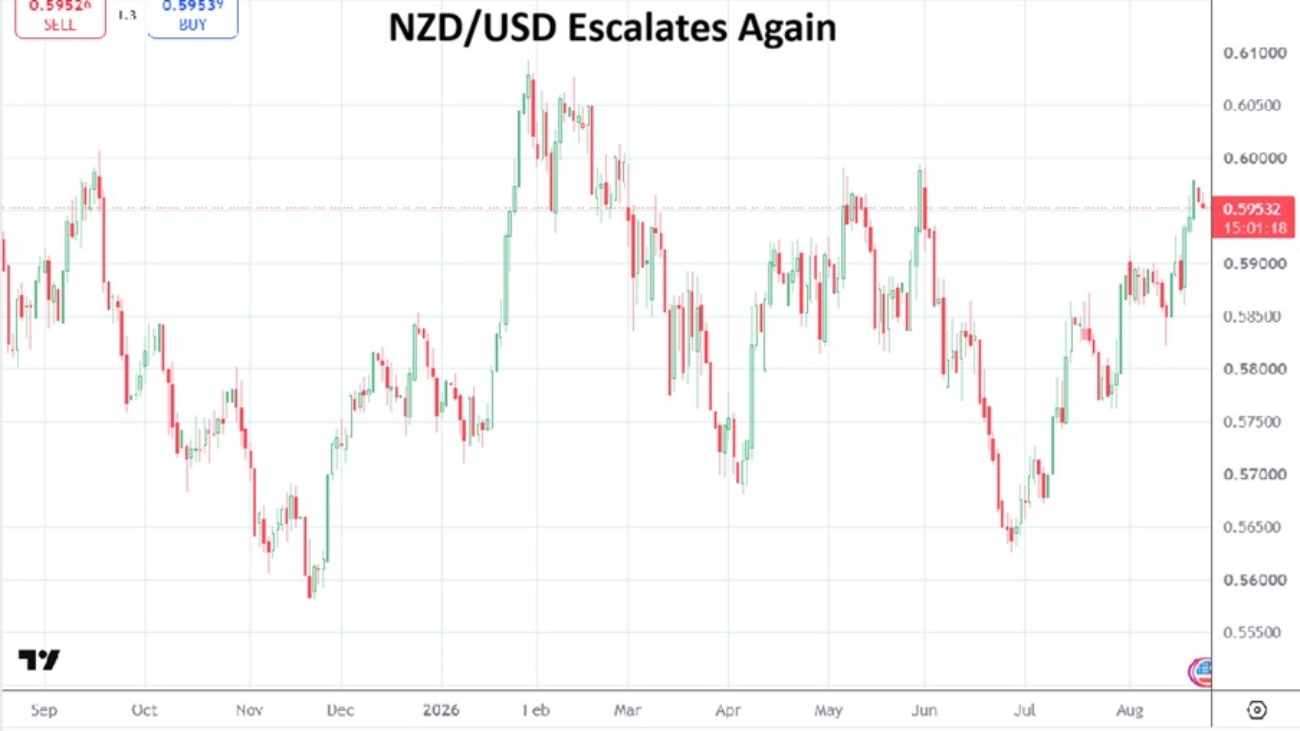
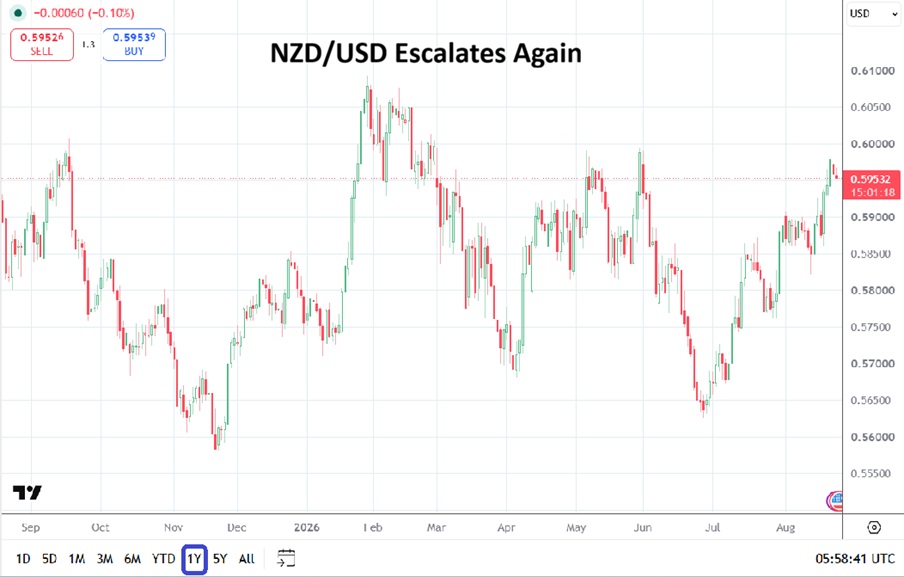
The NZD/USD is around 0.59550, last Friday’s highs near 0.59885 vicinity flirted with mid-term highs

The NZD/USD remains a speculative currency pair that offers fast results and velocity. The relatively low liquidity of the NZD/USD compared to the upper tier of major currency pairs allows for sudden bursts of movements which experienced traders may find tempting and inexperienced retail folks wagering could find exhausting and costly. The NZD/USD ranks typically around 7th per the size of its volume in Forex. Ahead of it at number six is the AUD/USD.

New Zealand’s growth rate of near 1.5% has been holding steady for the past half year. On the 8th of July the Reserve Bank of New Zealand raised its Official Cash Rate by 0.25% and the next decision from the RBNZ is next week on the 2nd of September. Because of inflation concerns some analysts believe another quarter of a basis point will be added. The current price of WTI Crude Oil is over $85.00, but it needs to be noted that New Zealand imports refined petroleum product most of which comes from Asia – like South Korea and Singapore. The current rate of inflation in New Zealand is around 4.1%.

NZD/USD One Year Chart as of 25 August 2026

What will the RBNZ Do Next Wednesday

The Reserve Bank of New Zealand like other global central banks has a dilemma because of the sticky higher costs of energy due to the Iran and U.S conflict. The situation in the Middle East is unlikely to be resolved in the coming month. The conservative led New Zealand government would likely prefer not having to raise the Official Cash Rate, but the central bank may feel like it has no other choice. The U.S Jackson Hole Symposium led by the Federal Reserve starts this Thursday and a key speech will be delivered by Fed Chair Kevin Warsh this Friday, New Zealand officials will be a participant.

If the Official Cash Rate is raised in New Zealand by 0.25% to 2.75% it may supply the NZD/USD some additional reasons for greater Kiwi strength. However, what should concern day traders is the suspicion that part of the interest rate hike has already been baked into the value of the currency pair. Psychological support for the NZD/USD is easy to see at the 0.59500 mark for near-term traders. Those looking for upside may want to use slight moves lower to wager on potential reversals that they believe could ignite upwards if they are conservative.

Near-Term Wagers on the NZD/USD and Risk Management

The NZD/USD is a favorite for many Forex traders because of its volatility and often its ability to produce rather intriguing trends. The currency pair has seen upwards value since last Wednesday and has shown an ability to sustain it elevated status while correlating to the broad Forex market. On Wednesday the 29th of July the NZD/USD was near the 0.57650 ratio. The currency pair was flirting with 0.60000 rather consistently in February before the Iran and U.S conflict escalated into military action. 

Day traders tempted to look for additional upside in the NZD/USD cannot be faulted. If Fed Chairman Kevin Warsh somehow sounds dovish regarding U.S interest rates this coming Friday and talks about a strong U.S economy, and the RBNZ were to raise the Official Cash Rate next Wednesday this could bolster the value of the New Zealand Dollar. Risk management for retail traders is essential because sentiment shifts within the current higher terrain of the NZD/USD could attract more bullish perspectives that also include USD centric weakness, but if a sudden headwind blows – velocity in another direction could create volatility downwards if those leaning into a stronger NZD/USD were to become concerned about their outlooks and abandon ship.

Copy and paste the text from AMT that you want to share

Share:
30 Year Govt Bonds 20260820

Bond Yields: The Wheel Has Not Been Rediscovered

Unintended Consequences: USD and Gold will now get their turn in the casino because of Scott Bessent's QA

Treasury Secretary Scott Bessent’s decision to begin injecting money into U.S Treasuries needs to be looked at by Forex traders. There is reason to suspect USD centric weakness may prevail moving forward. 

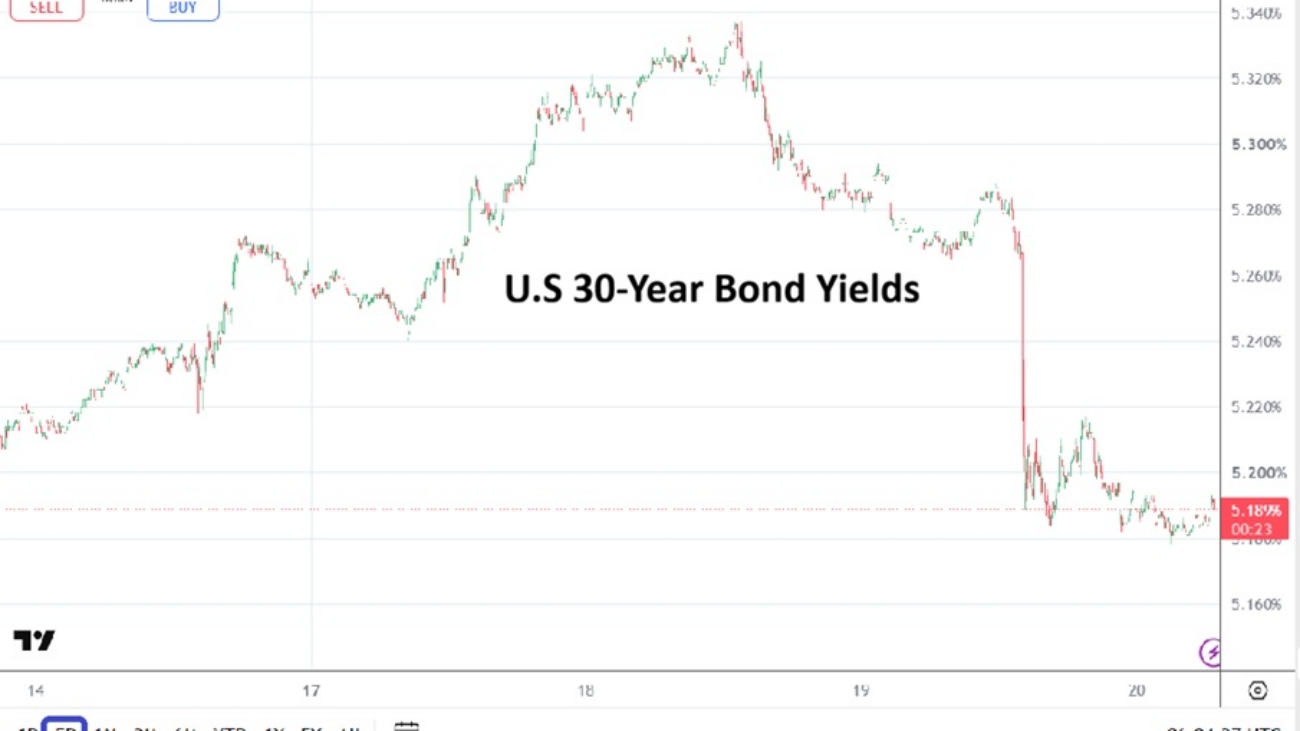
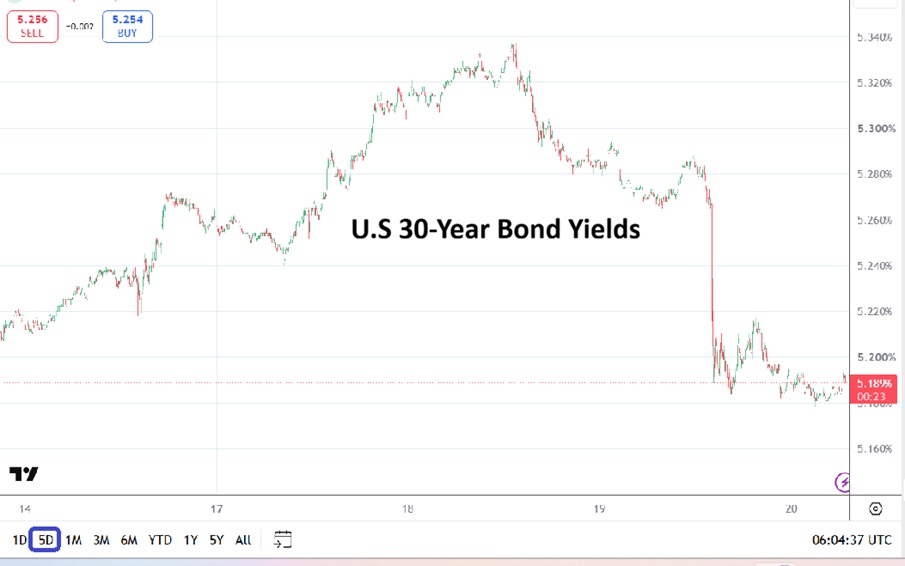
Yesterday’s bond news regarding Bessent’s actions to fight the higher yields in U.S 30-Year Bonds has brought rates down from almost 5.28% to nearly 5.18% as of this morning. 

U.S 30-Year Bond Yields 5 Day Chart as of 20 August 2026

Perhaps market results and dynamics can be quantified as math within a game, but at the end of the day it is behavioral sentiment that drives market forces and the way financial institutions react. Psychology can be looked at as the reaction via the marketing/influence of policy positions and presentation.

We have been down this road before. The decision to announce a round of quantitative easing yesterday via Treasury/Fed intervention should be compared to what the same team did a couple of weeks ago regarding its powerplay with the Bank of Japan in order to make the JPY stronger. We are now in a definite cycle in which government institutions are battling investors to stop momentum in certain assets when policies have gone bad.

The wheel has not been reinvented. It may seem like an unfair advantage to traders betting against government policies that are interpreted (correctly) as being misguided or unwise, but these are the rules of the game. Large players who have been betting on U.S Treasury yields to increase were likely not happy yesterday, but they should have known the U.S government would not sit idly and simply allow an implosion of the financial system to occur.

Having said the above, now we can look towards the realm of unintended consequences. The U.S Dollar Index dove yesterday with USD centric weakness and gold soared. And as long as folks refuse to buy U.S long-term Treasuries on the cheap and demand higher interest rates to protect their investments the potential of further unintended consequences will occur. 

Scott Bessent handled the situation perhaps correctly yesterday, but he is dealing with symptoms and not the cause of the virus. A lack of clarity clouds global central banks and monetary policies connected to their interest rates. Inflation concerns persists and so does the debate regarding how to battle this illness.

The U.S Fed and Chair Kevin Warsh have a major task ahead regarding interest rate policy.  And government’s – particularly the U.S – have to decide if they can actually stop the bleeding. For the moment this appears to be a tall order because by injecting digital money into U.S long-term bonds the U.S is spending money that it really doesn’t have, except to say that this is a game of chicken in some respects and financial institutions could be faced with the dilemma of cutting off their nose to spite their face. Where are Friedrich Hayek and Milton Friedman when you need them?

Copy and paste the text from AMT that you want to share

Share:
Singapore Dollar 20260818

Forex: Compressed Tight Realms Signaling Nervous Reactions

Sentiment Storms as Financial Institutions Remain Unsure about Outlooks

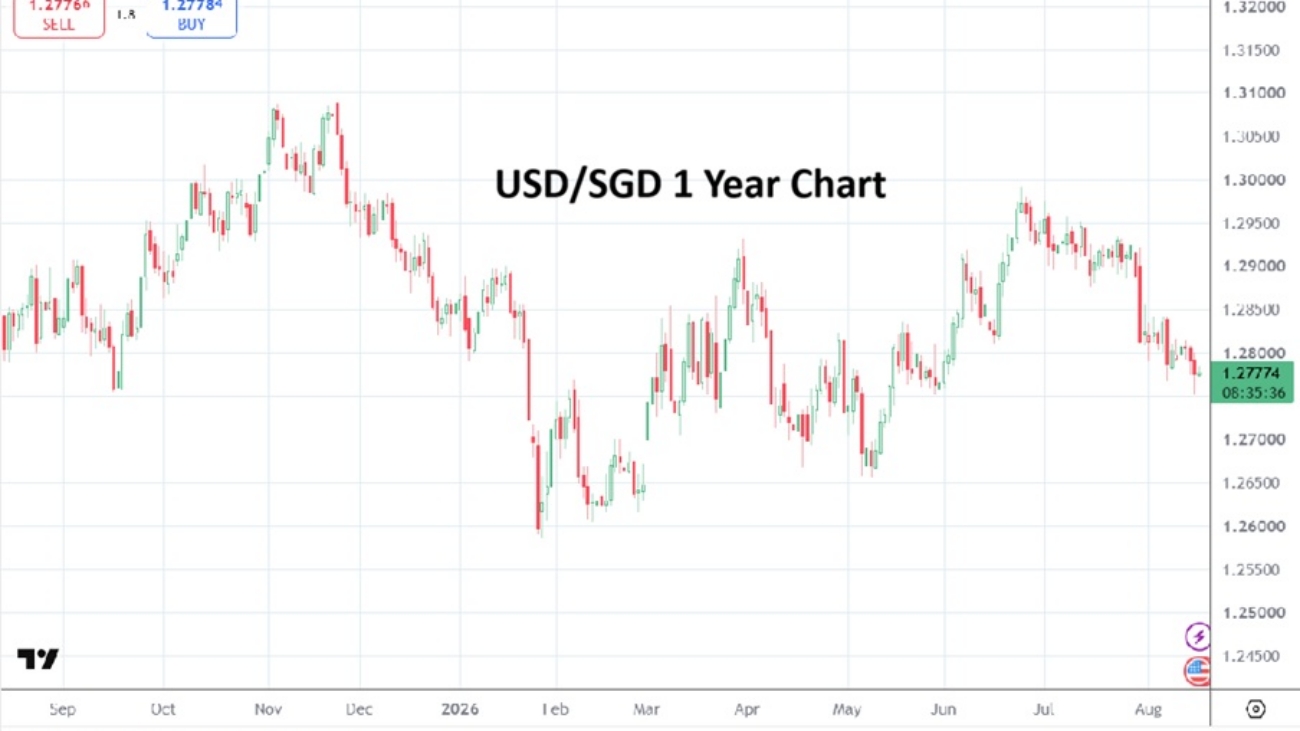
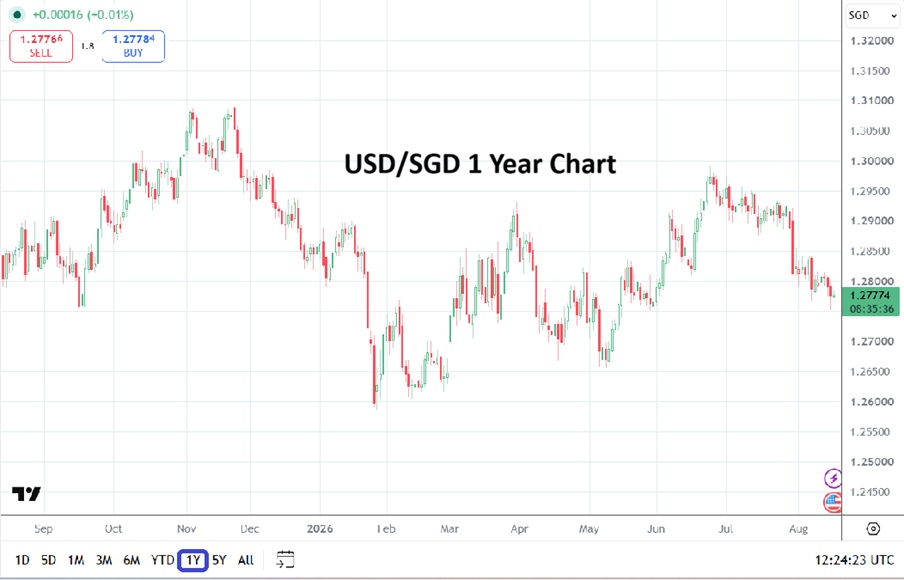
Price action in the USD/SGD has continued to demonstrate a rather significant turn downwards since the last week of June. The price of the currency pair is near 1.27800 as of this writing and is traversing near values seen the 1st of June and towards the end of the first week of March. Importantly, the USD/SGD has also seen recent lower depths and was below 1.27000 in the second week of May.

The USD/SGD traversed deeper ratios in late January when the 1.26000 vicinity was challenged and these levels were sustained until the middle of February. On the 26th of February the USD/SGD was near the 1.26500 mark. Now that the above numbers have been established, let’s discuss why this is potentially important for Forex traders as developing trends surface.

The past few years of trading have seen a compression of Forex deviations, in other words the FX market has grown more tame. However, the Bank of International Settlements (BIS) now reports that over 9.6 trillion USD in value is traded daily. This is a stark increase compared to 2022 when Forex saw an average daily market around 7.5 trillion – meaning there has been a 28% increase over the past four years.

USD/SGD One Year Chart as of 18 August 2026

The scope of volume is presented not to cause fear, but to show Forex traders what is at stake and the size of the marketplace and its potential for sudden jolts of volatility if it is established. 

Turning our attention to the new Fed Chairman Kevin Warsh and his preference to not give concrete forward guidance is important. U.S Treasury yields are dangerously high (the 30-Y yield is near 5.31%), and the military conflict between Iran and the U.S  continues to fester. Threats remain on the horizon which need observation, insights that prove correct regarding how these bits of information will influence the Fed Chair and the impact on the USD could prove significant for financial institutions.

Large players have reasons to be critical about a lack of clarity and this might spark more choppiness in Forex – even though value realms are said to be in a compressed state. This opens the door for technical traders who may have a better gauge on existing behavioral sentiment of the Forex markets compared to fundamental traders who have too many tea leaves to interpret which are moving rapidly as the cup gets shifted. Technical traders may have a good sense of where algo trading is directing its velocity per current Forex sentiment. 

While some analysts make a case for an increase to the Federal Funds Rate because of inflation concerns, what happens if they are wrong? And what if large players are now discounting their initial fears regarding higher interest rates and are actually starting to position themselves for the Fed Funds Rate to remain the same or be lowered in the mid-term? Is this one of the reasons why the USD has become weaker recently?

What if the new Fed Chairman Kevin Warsh proves stronger than people believe and has the ability to talk lower interest rates into reality? The U.S Treasury faces a huge and expensive task trying to pay off the yields of the high flying 10-Year and 30-Year bonds. What if Treasury Secretary Scott Bessent who has a solid relationship with Fed Chair Warsh proves influential? Read AMT’s Charles Najjar’s article on his thoughts about why the Fed should aim for a 2% Fund Rate: https://www.angrymetatraders.com/why-the-us-fed-should-lower-interest-rates-to-2/

Yes, the Middle East situation remains troubling from a mid-term economic viewpoint regarding the implications on WTI Crude Oil prices and ancillary energy costs globally. Inflation must be battled, but is raising the Federal Funds Rate going to help decrease the cost of energy or lessen its demand? Mostly likely no.

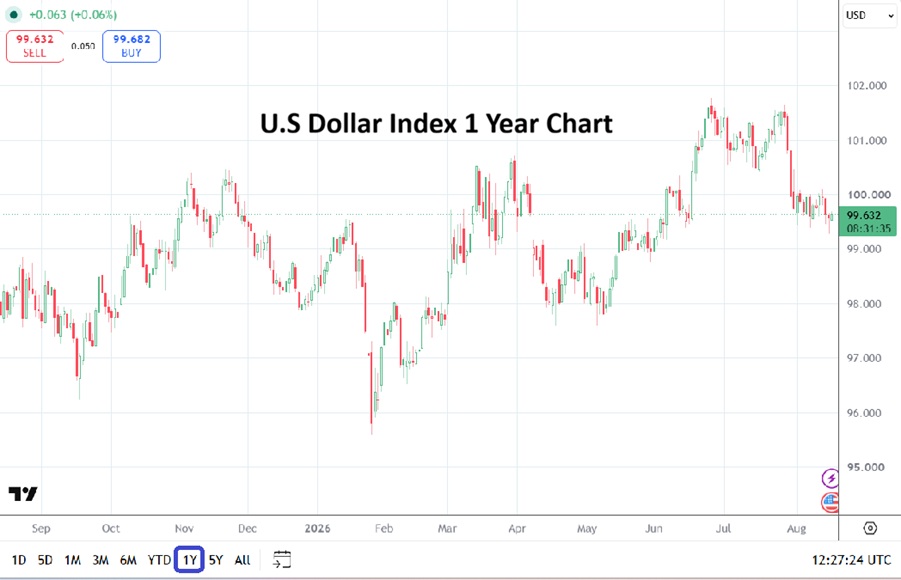
U.S Dollar Index One Year Chart as of 18 August 2026

The gold market has started to show signs of price velocity the past couple of weeks. The precious metal is trading near $4,395.00 as of this writing. Investors with a long-term window and troubled perspectives about the health of the USD have plenty of reasons to be more comfortable holding gold compared to staying in cash. 

U.S equities have been doing well via indices, but nervous shadows are hovering (maybe they always are). And this is why diversification is always important via long-term investment. Equities, bonds, gold and a small proportion for speculative purposes – this for those who want to try and increase their wealth while maintaining a status quo regarding preservation of wealth.

However, from a speculative standpoint, the Forex market is starting to show signs of alarming behavior, some may even call it a lack of correlation caused by storms forming. Yes, we know the USD/JPY is within its own environment as the BoJ and U.S Treasury/Fed play tag team trying to scare folks away from buying the currency pair. However, putting the JPY to the side for the moment, USD centric weaker positions are showing ability to sustain trends. 

The USD/SGD is a prime example of this momentum. The Fed’s Jackson Hole Symposium begins on the 27th of August and ends on the 29th  and all the major central banks will be attendance. Financial institutions will be keen to hear discussions about U.S bond yields, U.S and Japan currency interventions, but importantly will also want to monitor what Kevin Warsh and his cast of FOMC officers have to say about U.S interest rates. And it has to be known given the past two months from the new Fed Chair, he may remain rather quiet regarding outlook. 

And that might be good for the Forex market and spark some opportunities for traders to find an advantage. Because if nothing new or convincing comes out of the Jackson Hole meetings that financial institutions can decipher regarding their mid-term outlooks, perhaps the near-term will produce more volatility.  The next Federal Reserve FOMC meeting decision will be on the 16th of September. Do not expect interest rates to be raised.

Copy and paste the text from AMT that you want to share

Share:
Western Leaders 20260814

Standing on the Precipice: Western Leaders Continue to Fiddle

Will The West Stay Awake and Become Alert?

Opinion: The following article is commentary and its views are solely those of the author. This article was first published the 14th of August via The Angry Demagogue.

In February 2022 the Russian member of the Axis invaded Ukraine. In October 2023, less than two years later, the Iranian proxy Hamas invaded Israel and their proxy Hezbollah joined the fight the next day. North Korea and China the other members of the axis did not, probably, coordinate either attack, but nor did they discourage it or help to end it. In the period of less than two years, the free countries of the world were given a wake-up call to what historians may end up writing was the start of a new world war.

Sweden and Finland were spooked enough to take a bold move and join NATO and the existing European members of NATO seem to realize that they need to start worrying about their own defense – at least against Russia, if not the rest of the Axis. In Ukraine, they put together a bold defense and created a drone force that is, if not winning, at least is not losing the war of attrition that the conflict has “settled” into. Ukraine may have convinced itself that it can win this war on the battlefield and Russia is counting on its Axis allies to help it overcome their own military incompetence. North Korean troops are dying in Ukraine and there are rumors that 50,000 more North Korean troops are on the way. Iran and China are supplying weapons. The Axis is not only keeping the war going for Russia, it is arguably, along with its nuclear weapons, a path to victory.

Standing on the Precipice: Western Leaders Continue to Fiddle

Europe and parts of the United States did not take the hint that in October 2023 that the Putin’s Russia is not the only country threatening their security. The Iranian piece of the Axis also aims to dismantle Western freedoms and religion via direct military threats, terrorism and unchecked immigration.

Has the Middle East changed after the Ukraine invasion and more specifically, October 7? Asking different people will get you different answers. For Israeli PM Netanyahu it has been a strategic victory for Israel as both Hezbollah and Hamas are on their heals and Iran’s nuclear and missile forces have been severely damaged. For Israel’s opposition, the last three years have brought no positive change for Israel in the Middle East since Hamas, Hezbollah and the Islamic Republic of Iran still exist.

For Iranian Islamists it has changed by showing that they can stand up to their own people and to the United States so that any attempt to topple them will end in failure. For the Islamic Republic, a non-total-defeat shows the world that they can continue their quest for regional and global control despite the hiccups caused by Israel and the United States. The same holds for Hamas and Hezbollah who believe that Israel has been isolated in the world and that the UN, the Hague and the EU – along with America’s DSA – will make being Jewish and Israeli so illegitimate that they will soon be able to chose their apartments in Tel Aviv and Jerusalem.

According to Erdogan’s Turkey, the Middle East is their playground as they have managed to maintain positive relations with both Hamas and the United States. They have troops in Qatar, a new alignment with Saudi Arabia and Pakistan and have so many forces in northern and sub-Saharan Africa that an expanded Ottoman Empire lies in the not too distant future. Greece will be overcome and where Iran failed to destroy Israel, they will succeed.

President Trump believes, or states, that the United States has scored a decisive victory over Iran, is bringing peace to Lebanon and Gaza via Israeli concessions and the disarmament of Hamas and Hezbollah and the future in the middle east goes through Washington. The President also states that the Abraham Accords will be expanded and that Israel, Turkey, Qatar, Saudi Arabia are all strong and reliable allies of the United States and that all these countries are moving towards a more peaceful and economically vibrant Middle East.

Back in the 1960’s and 1970’s when there were two regional Moslem states that were friendly to Israel, Turkey and Iran. During that cold war period, the only Gulf state that counted was Saudi Arabia. Syria and Egypt were Israel’s existential enemies and the Hashemites of Jordan were more concerned with survival than fighting (at least after 1967). Lebanon was a non-threat to Israel (as a matter of fact Israel supplied arms to the Shiite villagers in the south during the civil war of the late 1970’s at the request of the Shah of Iran).

Currently Iran is Israel’s main enemy, although Turkey is pushing to move ahead of them as the main existential threat to Israel. Israel faces a “Sunni Vise” that includes Turkey and Syria in the north and Egypt in the South. We can add to that Saudi Arabia and Pakistan although that alliance (which now includes Turkey) seems to be more a showpiece than a defense treaty. Or, in the words of Hussein Aboubakr Mansour, “In the Middle East, the vocabulary of collective defense is often detached from the activity of defending. The announcement is the whole of the content”.

Regarding the United States presence in the Middle East, only the details have changed. The Cold War is over but the U.S still has the challenge of controlling oil flow out of the region as its new main enemy, China, depends on it. As for the United States and Israel, that relationship has moved from dependent to almost partner on defense and technology but Israel is still the same steady, reliable, democratic presence it has been for the past few decades. The U.S is certainly closer to the other Gulf states, notably Qatar, but their money has simply replaced (or actually supplemented) Saudi money, although they are much more cynical and effective with it.

The Arab world has barely changed even though the UAE and others have jointed the Abaraham Accords and have a relatively strong relationship with Israel. However, the real issue in the middle east has never been Israel-Palestine but has been and still is the intra-Arab and intra-Moslem rivalry and mistrust. Even when ostensibly on the same side, like the Saudis and UAE are in Yemen, there are separate armies fighting and last month the Saudis bombed the UAE forces – even though both were fighting the Houthis.

Egypt and Turkey, the two largest Sunni states in the region by population and military force are at opposite ends of the Moslem Brotherhood fight. Egypt is more suspicious of Turkey’s support for the Brotherhood, arch enemies of the Al-Sisi government, than they are of Israel’s moves in Gaza. Syria too, while pretending to act as a unified country is at war with the Kurd citizens in the north, Druze in the south and Alawites in the northwest. Their inclusion of ISIS and al-Qaeda fighters in their army – even foreign fighters – means that even within the Sunni majority, there is distrust and fighting.

And Libya is a proxy war if there ever was one with Turkey, Egypt, Iran and Russia involved.

So where do we stand in Europe and the Middle East today?

On the one hand, everyone is correct – Israel is in a better spot strategically, yet has not finished the job. The United States has, with Israel, set back Iran’s plans for regional domination but that gain is one “agreement” away from being overturned. Turkey is extending its influence but does not have the wherewithal to create a new Ottoman Empire as not only Israel stands in the way but so too does Egypt and the rest of the Sunni-Arab world as they do not have fond memories of Ottoman control of Arab lands. The Arab countries, large and small, are fighting the same tribal wars they have fought for the past decades and even centuries. Israel has strong internal unity and morale while its leaders re-arrange their parliamentary chairs.

In Europe, Ukraine has stopped an army three times its size while Russia, against most predictions is able to absorb massive casualties and economic sanctions due to the help of its allies .

Before the invasions of Ukraine and Israel by members of the Axis in 2022 and 2023 the geopolitical situation consisted of four revisionist powers united only in their opposition to the international status quo and the free countries united in their wish to maintain the status quo and to concentrate on comfort to the neglect of all else -including freedom. The Western European powers had no real military power to speak of (with the possible exception of France) as even the UK’s glorious navy was reduced to the minimum number of ships necessary to still call it an ocean going Navy. Ukraine ignored Russian threats and Israel was convinced it could outsmart, deter and bribe its sworn enemies to give up all for a life of comfort.

In the United States, the military was organized as a Walmart or Target warehouse with “just in time inventory”, no long term armaments contracts and with nothing much done to create what won WWII and the Cold War – a strong economic and industrial base. Looking for cheap labor and products and piling debt upon debt, the America;s industrial and fiscal situations mirrored its military un-readiness into a game of catch up – which it is doing neither fiscally nor militarily. Although the current administration is pushing to increase its manufacturing might, the fact that the American shipbuilding industry is able to produce only 3 military ships a year means, one, two or three administrations won’t be enough to complete the task. It requires a seriousness of purpose lacking in a Democratic party fearful of the DSA and a Republican party not serious enough to create a national consensus that will require some sacrifice from citizens.

Although there is a lot of talk, the current leadership in all free countries are the same leaders that led us down this path where they are not ready to meet and defeat middling powers let alone powerful ones.

Just four years ago the late Henry Kissinger published a book called “Leadership” which focused on six leaders he thought were consequential to their countries and the world. You might disagree with his choice but one thing running through each of these leaders (Germany’s Adenauer, France’s de Gaulle, Sadat of Egypt, UK’s Thatcher, Singapore’s Lee Kuan Yew and Richard Nixon) is that they were patriots and they were willing to take risks to push their countries forward. We don’t seem to see Western leaders who are dedicated first and foremost to their country and its citizens and who recognize the ongoing (the never ending!) threat from tyrants.

Putin, Xi, Khamenei (or whomever is in charge) and Kim are tyrants who don’t need to concern themselves with their citizens and that is the one thing our uncreative and cowardly leaders do not seem to understand. The obsession of today’s western leaders with negotiations and deals and false human rights claims just feeds the tyrannical rule of its enemies and pushes their defeat further and further away. Eisenhauer famously refused to shake hands with the Nazi general who surrendered to him in spite of military custom because he realized that this was not a war of one country against another but a war by his country and their allies against evil.

This is not a call for war against all evil or perpetual conflict of power against power but rather a recognition that if one is not ready to face what tyrants want – your destruction – eventually they will defeat you. America was not prepared to fight WWII but it had an industrial and managerial base that could be transformed into a wartime asset no one has ever had. It also had the luxury of two oceans protecting their manufacturing plants from enemy attack. Finally, it had, admittedly only after Pearl Harbor, the understanding that the moral imperative was defeating the evil that was Nazism as well as Japanese militaristic barbarism and not in coming to some rapprochement with it.

The geopolitical situation has not changed even if there are small tactical advantages that one side has over the other in localized theatres. We are still in the same position where the Axis of revisionist states is using all its force and all the weaknesses of the western world to its advantage and a western world that is continuing to ignore that reality. The internal and external threats in free countries are now at crisis levels.

When it comes down to it, as much as we like to blame our leaders (and we certainly do), it is up to the citizens to demand and to choose brave, creative leaders who are not locked into what has brought us to the precipice of defeat. The leadership since the end of the Cold War has been lacking any sense of urgency no matter what happens. The disaster that was Afghanistan should have been a wake up call – instead it was ignored. The invasion of Ukraine should have put free countries on a war footing for the manufacture and supply of military hardware but instead of was treated as if no other wars would be fought until this one was over. October 7 and the subsequent fighting in Gaza, Lebanon, Yemen, Iran, Iraq, Syria, the entire Persian Gulf should have told the west that terrorism and the immigration of real and potential terrorists into its borders will destroy what it loves best.

So far, the Axis leaders have not waited for the west to wake up, re-arm, control its borders and stop shooting itself in the foot and there is no reason to think it will wait before its next adventure.

Disclaimer: the views expressed in this opinion article are solely those of the author, and not necessarily the opinions reflected by angrymetatraders.com or its associated parties.

Follow Ira Slomowitz via The Angry Demagogue on Substack https://iraslomowitz.substack.com/

Copy and paste the text from AMT that you want to share

Share:
USDJPY 20260813

Sentiment Matters: Speculative Narrative and the False Promise of Data

Do Retail Traders Understand They Are Being Misled?

As day traders ponder what they should do next via their speculative wagers in the broad marketplace, now is a good time to remind small speculators stepping into the casino of global assets that a lot of the production value they are offered is part of a show. Entertainment is literally being produced to entice people to trade. A large amount of retail traders are constantly being misled. Your adrenaline high is being counted upon to keep you a participant. The thrill you get when you are trading should not be more important than the outcome of your trade.

Large money machines like the Nasdaq 100, S&P 500, U.S Treasury yields, Forex, commodities and even the cryptocurrencies have plenty of descriptive words and definitions trying to interpret and predict values, trends and outlook, but quite frankly a lot of the words are nonsense created to entice and fool. Making retail traders willing participants in the circus is important because it keeps a lot of the the entertainers employed. 

It should be remembered that a lot of the folks on the institutional side of financial markets do not care about day traders except as an example of what not to do. They use day traders as a touchstone to point to failures and convince you why you are out of your element, while hoping you will stick around to create volumes that are often needed in some speculative assets. Are you being taken advantage of as a small speculator? 

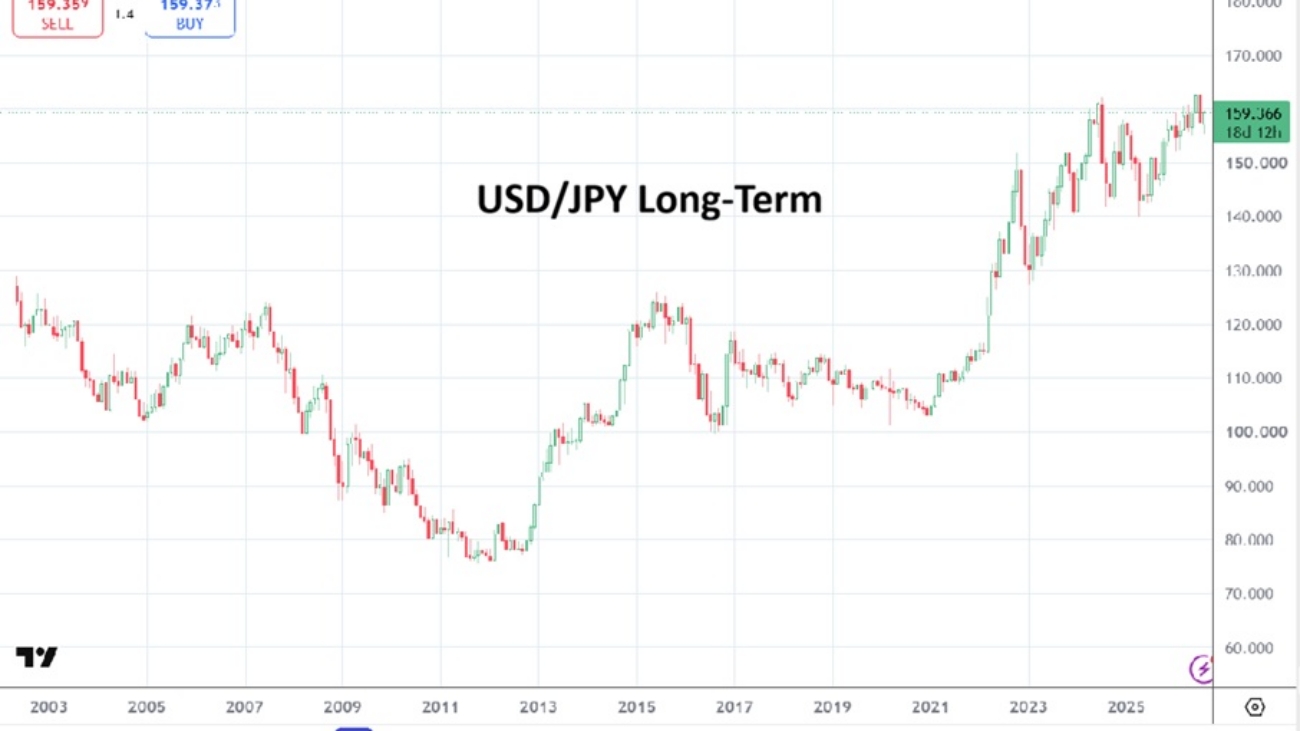
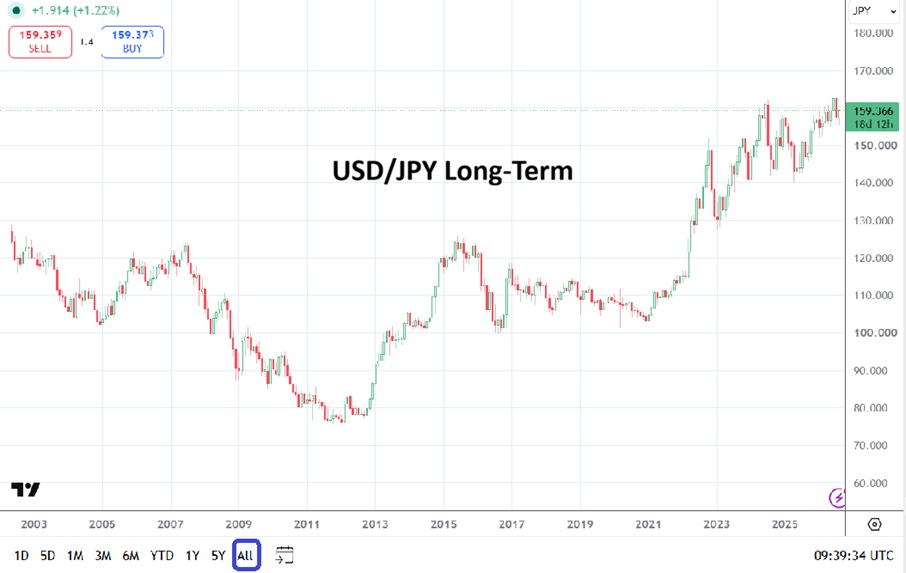
USD/JPY Long-Term Charts as of 13 August 2026

It is Much Better to be the Bank

A lot of people in the institutional financial industry know one thing for certain, while some make money investing by themselves or produce outstanding results for funds, many do not. There is an old saying among veterans in the arena, “it is much better to be the bank”. Transactional costs from commissions, carrying charges, exchange fees and taxes make money for the institutions and government regulators.

Many folks are involved in the financial markets because it provides a solid pay check, it remains a good career path for those who want the comforts of modern society. However, being a day trader while working another job as a blue collar employee, or business owner, or while being a professional in another endeavor and dreaming about wealth creation via speculation is alluring, but it frequently does not produce steady profits like it does for the people working in financial institutions collecting a paycheck. 

Confirmation Bias and Investment Outcomes

Economists for instance are relied upon to decipher inflation and decode data for devoted audiences. The believers are told why certain assets are reacting and what might happen in the future by the influencers. But this also can manifest into self-fulfilling prophesy that may not actually be connected to real economic outcomes, except that outlooks get fulfilled because of emerging behavioral sentiment.

For instance when yesterday’s U.S Core CPI was released and hit its expectation, what did markets do exactly, what were investors reacting to? The markets reacted to what the perception of mid-term outlooks will now do, based on how they think the Federal Reserve will act in September and the coming months. Reactions to anticipated results are a key factor in market dynamics. Large positions are shifted by financial institutions which have the ability to to absorb short and near-term losses of capital while they wait for their mid-term outlooks to be confirmed. Confirmation bias remains important in the marketplace as results get generated via intraday results as big players thrash violently with massive piles of cash causing technical perspectives to drive algo trading.

Inflation is Not a Joke

Btw, why did god create economists? To make weathermen look good. While that may fray the feelings of economists, the joke holds water. Because observable data and printed results often do not correlate. Just ask global consumers in various nations what they think about their government’s stated inflation data compared to what they are spending on a monthly basis and rising costs. People on the street often feel their national currencies feel like they are losing money no matter what central banks are proclaiming.

Inflation is an important measurement for consumers and investors. But real inflation is often not a desirable talking point for many governments. Often excluded data includes products like food, energy, and mandated medical and pension costs via payments to government social programs. Increasing rent or mortgages via rising interest rates inside of certain government inflation reports are frequently avoided too and would look atrocious. Central banks are supposed to fight inflation, but which inflation exactly? I am digressing I know, this may have nothing to do supposedly with everyday speculating in the marketplace, but actually it does.

Because the Forex market, gold, equity indices are reacting to sentiment generated by the second based on what outlooks will be in vogue in a few months and inflation effects. Our age of social media and fast communication makes the markets vulnerable to fear and optimism equally. Speed matters even if it sometimes causes pain for day traders via lightning quick results in the marketplace as outlooks change constantly.

Make no mistake, market forces are always in play as investors look for value. Sentiment caused by folks like central banks and their policies play consistently important and volatile roles as large players and financial institutions react to tea leaves being read. The USD/JPY is a case in point, the Japanese Yen has been dramatically weak and losing value long-term. 

The intervention by the BoJ and U.S Treasury which was coordinated a couple of weeks ago didn’t fix the problem that Japan has poor monetary and fiscal policy. What it did was serve as a warning to day traders and large players (including banks) not to bet too strongly against the JPY too consistently even if their perceptions tell them otherwise, because the Japanese and U.S government can wreck havoc and create unforgiving momentum which can kill the infectious trend upwards when they desire. 

The BoJ and U.S Treasury definitively put on a show for traders to watch and contemplate before they consider stepping into the casino again. Sometimes it is better to watch the entertainment instead of being an actor within the drama.

Thrill of Risks and Solid Tactical Strategy 

Why do speculators insists on chasing markets without having proper guidance? Why don’t these same smaller traders just let professionals manage their assets and put some money away when they can and accept the returns? Maybe because many speculators are skeptical about the real returns and know they are being made to endure a magic show of sorts. 

Day traders should only risk what they can afford to lose via a speculative allotment of cash. Fund managers for financial institutions, pension funds for example, are often mandated to put 2 to 3% of holdings into speculative assets in order to seek bolder returns. This is one of the reasons why hedge funds and speculative assets flourish in a cyclical manner. Large financial institutions allow for wagering on asset classes they know are dangerous in an extremely limited manner, but with a huge amount of money. Can you say Bitcoin? And it is widely accepted that these speculative positions can be wiped out and destroy capital. Institutions often do not mind losing on limited speculative positions, the same cannot be said for retail traders.

Smaller retail traders should not view themselves engaged in a battle against financial institutions which are filled to the rim with employees who are often unsympathetic about the outcomes produced. The world of speculative betting by retail traders is not about to change. Day traders should study momentum and behavioral sentiment.

Traders need to understand how to manage risks and emotions. While speculators can dream about making illustrious profits to impress friends and partners, if they do not take into the consideration the costs of the risks they are likely going to fall into a deep hole. Strategic tactics are necessary. Retail trading doesn’t have to be a game if it is conducted wisely.

Copy and paste the text from AMT that you want to share

AI Economic Flywheel 20260811

Anatomy of the AI Economy: Mapping Capital, Infrastructure and Value

Interlocking Parts of the AI Flywheel and Understanding the Multi-Trillion Dollar Engine

We are living through the largest, most aggressive capital deployment cycle in technological history. What began as a gold rush for silicon chips has rapidly evolved into a multi-trillion-dollar macroeconomic engine. 

The AI Economy operates as a tightly integrated flywheel: hyperscale physical capital flows directly into compute infrastructure, which powers foundation models, which are then distributed via cloud platforms to power end-user productivity. 

For investors navigating this shift, capturing durable value requires looking past individual stock picks and understanding this multi-trillion-dollar supply chain requires examining how capital moves across hardware, cloud orchestration, model intelligence, and commercial monetization.

Anatomy of the AI Economy: Mapping Capital, Infrastructure and Value 

A: Data Center & Physical Infrastructure Layer

The physical foundation represents the largest capital expenditure cycle in tech history, with combined hyperscaler CapEx projected to exceed $700 billion annually.

  • Space & Power Real Estate: AI workloads demand unprecedented power density (scaling from 10–15 kW/rack up to 100+ kW/rack).
    • Key Metrics: Global hyperscaler CapEx allocation to AI infrastructure is ~75%.
    • Key Players: Digital Realty, Equinix, CyrusOne, Compass Datacenters.
  • Machines & Systems: Custom server racks engineered for intense compute densities.
    • Key Players: Supermicro, Dell Technologies, Hewlett Packard Enterprise (HPE), Foxconn, Wiwynn.
  • GPUs & Accelerators: The core engine of AI compute, transitioning from pure GPU training dominance to custom inference ASICs.
    • Key Players: Nvidia (80%+ market share), AMD, Intel, Google (TPU), Amazon (Trainium/Inferentia), Meta (MTIA).
  • Networking & Interconnects: High-speed fabric connecting tens of thousands of clustered GPUs, required to prevent bandwidth bottlenecks.
    • Key Metrics: Rapid transition to 800G and 1.6T optical transceivers and Ultra Ethernet Consortium standards.
    • Key Players: Broadcom, Arista Networks, Cisco, Marvell, Nvidia (Mellanox InfiniBand/Spectrum-X).
  • Memory & Storage: Ultra-fast memory architectures and storage required for multi-terabyte dataset ingestion during training runs.
    • Key Metrics: High Bandwidth Memory (HBM3e/HBM4) consumes over 20% of global DRAM wafer capacity.
    • Key Players: SK Hynix, Micron Technology, Samsung, Western Digital (Solidigm), Seagate.
  • Liquid & Advanced Cooling: Air cooling reaches physical constraints past 40 kW per rack, making liquid cooling mandatory for next-gen clusters.
    • Key Players: Vertiv, Schneider Electric, CoolIT Systems, Submer.

B: Cloud & Model Software Layer

Cloud providers act as the primary monetization pipeline, renting the underlying physical infrastructure as a service (IaaS/PaaS) and serve as primary distributors for top-tier foundation models.

  • Cloud Providers (Hyperscalers & AI Cloud Specialists):
    • Overview: Hyperscalers host foundation models and partner directly with AI labs. The Big Three manage over 65% of global cloud infrastructure, with AI workloads serving as their fastest-growing revenue driver.
    • Key Players: Amazon Web Services, Microsoft Azure (OpenAI host), Google Cloud (multi-model distribution), Oracle Cloud (OCI), CoreWeave, Lambda Labs.

Cloud Provider

Market Share

YoY Growth (Q1)

Key AI Advantage / Differentiation

Amazon Web Services (AWS)

~31%

+28%

Scale lead, custom Trainium chips, Bedrock multi-model ecosystem.

Microsoft Azure

~23–25%

+40%

Strategic OpenAI integration, deep enterprise software lock-in.

Google Cloud (GCP)

~11–12%

+63%

First-party TPU infrastructure, native Gemini model integration.

Neoclouds / GPU Cloud

< 5%

100%+

Specialized bare-metal GPU clusters (e.g., CoreWeave, Lambda) renting raw compute to AI labs.

  • AI Models (Foundation & Frontier): High-cost capital investments in model weights that serve as the operating system for generative AI application buildouts.
    • Key Players: OpenAI (Chat GPT), Anthropic (Claude), Google (Gemini), Meta (LLaMA – open source), Mistral, xAI.
  • Software Platforms & Tools: Application layers that wrap foundation models into enterprise workflows via Agentic frameworks and Retrieval-Augmented Generation (RAG).
    • Key Players: Microsoft (Copilot), Salesforce (Agentforce), Databricks, Snowflake, ServiceNow, Palantir, GitHub.

C: End Users & Value Capture

The ultimate ROI of the entire $700B+ infrastructure buildout hinges on end-user monetization and operational productivity gains across three core tiers:

  • Commercial Users (Enterprise): Corporations deploying AI for automated software engineering, compliance auditing, automated customer operations, real-time analytics, and supply chain optimization.
    • Investor Value Capture: Margin expansion and labor productivity leverage (e.g., JPMorgan Chase, Accenture, Klarna, Walmart, Pfizer, Bridgewater Associates).
  • Government & Sovereign AI: Nation-states building localized cloud capacity and defense/intelligence models to secure technological sovereignty and data residency.
    • Key Initiatives: US Department of Defense contracts, sovereign AI funds in the UAE/Saudi Arabia, and regional EU sovereign clouds.
  • Retail Users (Consumers): Individual subscribers paying recurring SaaS fees for conversational AI, real-time search, personal assistants, and creative media generation.
    • Key Players: Anthropic (Claude), OpenAI (ChatGPT Plus), Google (Gemini Advanced), Perplexity, Apple (Apple Intelligence), Midjourney.

The Macro Narrative: How the Flywheel Interlocks

  1. User Demand Drives Cloud Revenue: Retail subscriptions, enterprise API calls, and government deployments generate recurring revenue for cloud providers and software vendors.
  2. Cloud Revenues Fund CapEx Expansion: Hyperscalers reinvest cloud cash flows back into physical infrastructure, purchasing GPUs, high-speed networking, and custom data center real estate.
  3. Hardware Scale Lowers Inference Costs: Manufacturing efficiencies in silicon/chip, cooling, and memory drive down the compute cost per token, making high-reasoning workloads economically viable.
  4. Lower Token Costs Unlock Mass Adoption: Cheaper, faster compute enables software providers to build more complex AI agent workflows, driving deeper enterprise adoption and restarting the economic cycle.

The Bottom Line: The AI economy is not a series of isolated technology bets; it is a self-reinforcing flywheel where raw compute and commercial utility endlessly feed each other. For investors, the winning strategy isn’t simply picking a single winner in hardware, cloud, or models but it’s identifying the key bottlenecks and value capture points as this multi-trillion-dollar cycle continues to accelerate.

Copy and paste the text from AMT that you want to share

Share:
SpaceX 20260810

With SpaceX IPO, Elon Musk’s New Problem is the End of Easy Money

Private Companies Can Raise Capital at Negotiated Valuations, Public Companies Have to Raise Capital at Market Valuations

For years, Elon Musk benefited from something most corporate leaders can only dream of: easy access to practically unlimited private funding at hefty valuations determined by himself. All he had to do was build the proper narrative and convince a few large investors that his own valuation was the right one.

The SpaceX IPO fundamentally changed the process. It doesn’t mean Musk can no longer raise money. Surely, he can. But what changes is the ease, flexibility, and discretion with which he can do so.

When SpaceX was private, raising billions of dollars was relatively straightforward. Musk could approach a small group of investors, give a valuation, issue new shares, and obtain fresh capital without having to expose every detail of the transaction. He didn’t even have to convince all of them. If only a few believed his narrative, the company could raise money at an enormous valuation even while showing continuously negative operating cash flow.

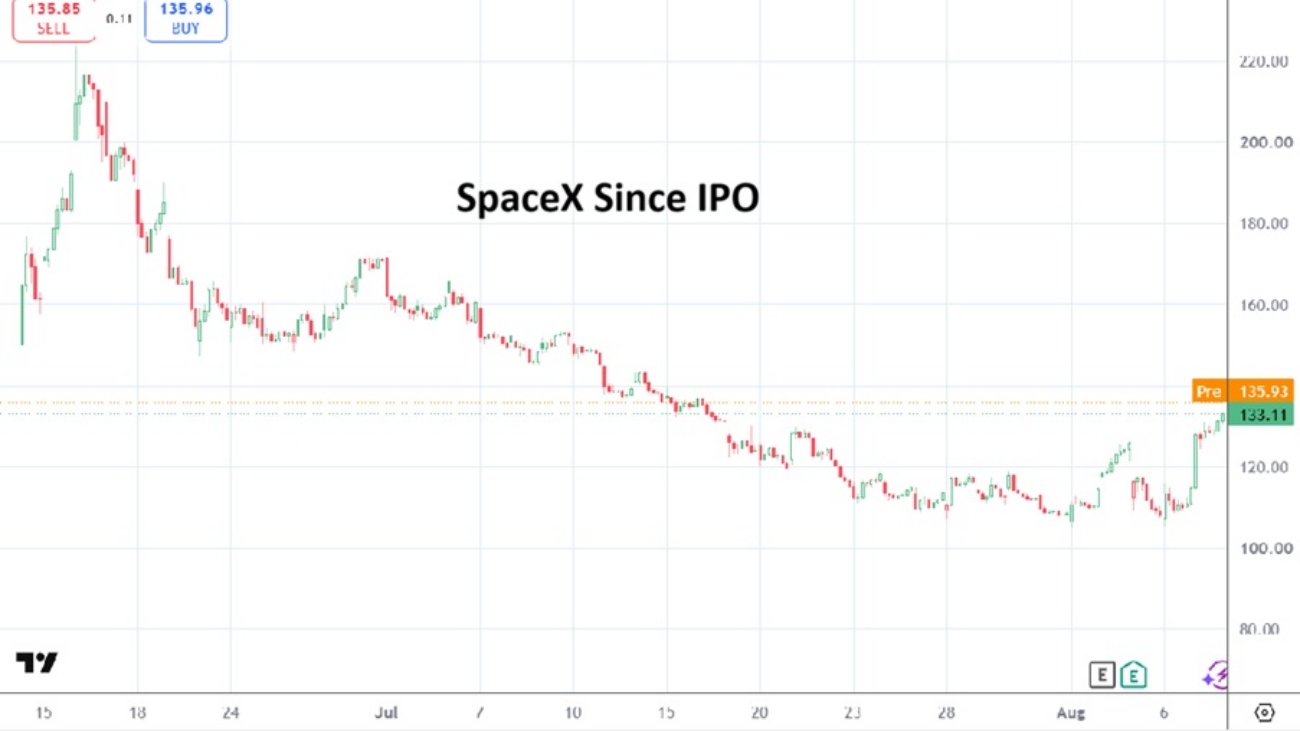
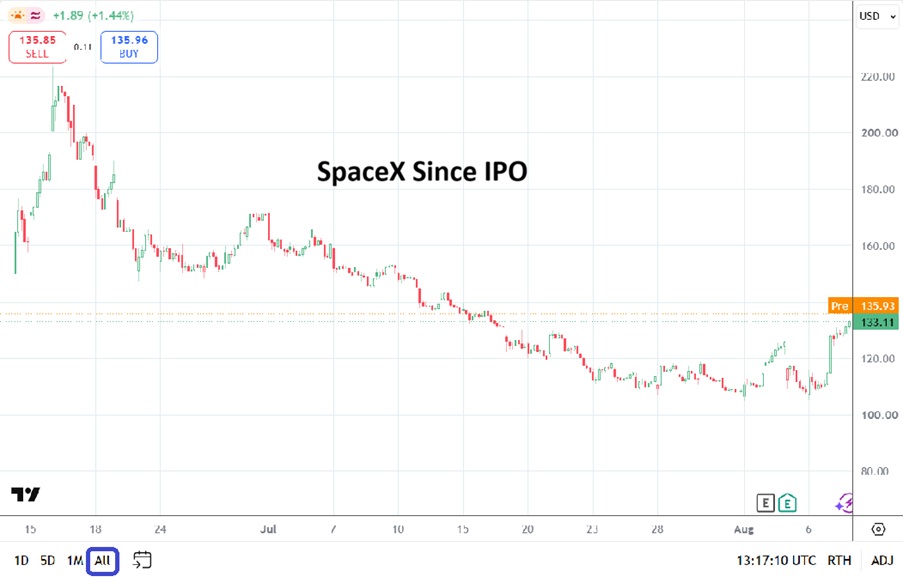
SpaceX (SPCX) Chart Since IPO as of 10 August 2026

That mechanism becomes much more difficult now that SPCX is publicly traded.

A public company has a market price every second of every trading day. Any new equity issuance is immediately visible. Investors know exactly how many shares are being created, at what price, and why the company needs the money. If the market suspects a company is raising capital because its existing operations cannot finance its ambitions, the stock can fall dramatically. And that creates a fundamental difference.

A private company can raise capital at a negotiated valuation. A public company has to raise capital at a market valuation.

The pressure on Musk is mounting. Every quarter he needs to deliver. Every quarter he needs to find a new narrative to prevent the stock price from collapsing.

Let’s imagine SpaceX needs $10 billion funding. When it was private, Musk could potentially raise the money from institutional investors at a valuation agreed upon with those investors. The transaction itself could even reinforce the perception that SpaceX is worth more.

As a public company, however, the calculation is completely different. If SpaceX is trading at a $1.5 trillion valuation and announces a $10 billion equity offering, investors immediately ask why the company needs the money, whether its cash flow is sufficient, and whether further dilution is coming. And if the stock falls 20% following the announcement, the company would have made its financing problem much worse than before.

This problem is particularly critical because SpaceX is a highly capital-intensive business. Its only profit comes from Starlink. But Starlink cannot finance all the other negative-cash-flow businesses by itself, mainly Starship launches and AI ambitions.

Starlink is the only cash-generating asset inside the group, and it cannot become the piggy bank for the entire group, including Tesla.

How can we forget that, earlier this year, SpaceX came to the rescue of Tesla by buying up all the unsold Cybertruck inventory, at hefty margins for Tesla, which then “beat expectations” thanks to the trick?

Would such a move be accepted by the market now that SpaceX is publicly traded?

When SpaceX was private, the boundaries between Musk’s various ventures were much less visible to the public markets. Capital could move through a relatively complicated ecosystem of private companies and investors.

Now that SPCX is public, the shareholders would question every move, knowing that they are not necessarily willing to see their company become a financing vehicle for every project associated with Elon Musk.

With the SpaceX IPO, Elon Musk played his last Ace card. Now he’s left with a handful of weak cards to try to win the game. He can still bluff that he’s got another Ace hidden in his sleeve, but it’s not clear the market will believe him this time.

Private markets gave Musk something extraordinarily valuable: financial flexibility. Public markets are now forcing him to operate without it.

But Elon Musk’s financing problems aren’t limited to the SpaceX IPO. Like any capital-intensive venture, he also has to contend with the Fed’s ill-considered policy of keeping interest rates high, supposedly to fight inflation that stems from supply shocks.

Because of the Fed, every additional percentage point of interest represents billions of dollars transferred from productive investment to debt servicing. Money that could finance AI chips, data centers, engineers, research laboratories, or new factories instead goes to creditors!

The Fed might believe it is fighting inflation, but it is in fact raising the cost of winning the AI race for companies like SpaceX. 

It’s surprising that Elon Musk isn’t openly denouncing the Fed’s absurdity of keeping interest rates high, when his own companies are among those suffering most from it.

SpaceX’s recent $25 billion bond offering is a perfect illustration. The company issued five tranches, including $3.5 billion of senior notes carrying a 6.65% coupon and maturing in 2056. If the Fed’s rate were closer to 2%, the company’s borrowing costs would be at least half their current level. This bond offering is costing SpaceX somewhere around $1.5 billion a year in interest expense, that could have been slashed by half had the Fed acted quickly in reducing interest rates.

And this is precisely where the Fed’s policy becomes relevant to Musk’s financing problem.

High interest rates make borrowing far more expensive for Musk. At the same time, restrictive monetary policy makes investors more demanding about equity valuations and makes long-duration growth stories more vulnerable to changes in discount rates. They also make car loans much more expensive for potential buyers, which significantly affects Tesla sales.

Musk therefore faces a particularly uncomfortable combination: Equity financing is more visible and potentially dilutive. Debt financing is expensive. Private financing is no longer available on the same scale.

The SpaceX IPO, on top of the Fed’s mistake of keeping interest rates high, is putting significant financial stress on the “richest man in the world” as he urgently needs to find new imaginative ways to fund his highly capital-intensive ventures.

And this is without even considering the probability of a 2008-like financial crash triggered by the bursting of the AI bubble. How would Elon Musk manage to sort himself out this time in case of such financial collapse?

Copy and paste the text from AMT that you want to share

Share:
Gold 20260805

Gold Looks Oversold in What Appears to be a Vulnerable Global Market

Quick Thoughts on Why Gold Should Remain a Friend

Did you stop paying attention to Gold after it stumbled from its record highs in late January? Was it no longer interesting because it wasn’t churning like an invincible machine upwards? Is Gold boring because it has produced sluggish results the past half year that doesn’t deliver the daily excitement craved to get you to wager in the marketplace? No, Gold isn’t WTI Crude Oil which has seen increased volume since late February due to the Iranian war and it might be a while before the precious metal regains a full fanbase.

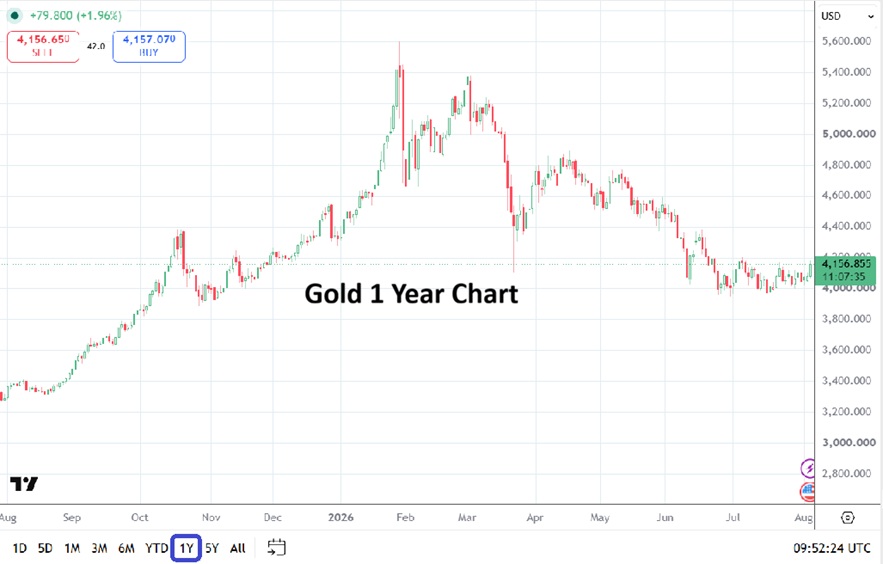
However, Gold still looks to be in oversold territory. Yes, Gold is near $4,150.00 as of this writing and in the middle of July was below $4,000.00. However, given the fragile behavioral sentiment that is being displayed in the global markets, there is a case for Gold being valued higher. Is the momentum produced upwards the past couple of days a signal that large players are starting to eye the commodity again?

Gold touched a high of nearly $5,610.00 on the 29th of January this year. Speculative fever was certainly ripe. Silver was near $120.00 too. Silver is now priced slightly above $61.00. I am not going to make a case for Silver here, so if you are looking for optimistic or speculative guidelines for ‘Argent’ you will not find it here. If you want to see a positive outlook for Gold please read on, and if you decide this means Silver may find another dose of increased pursuit that is your choice. 

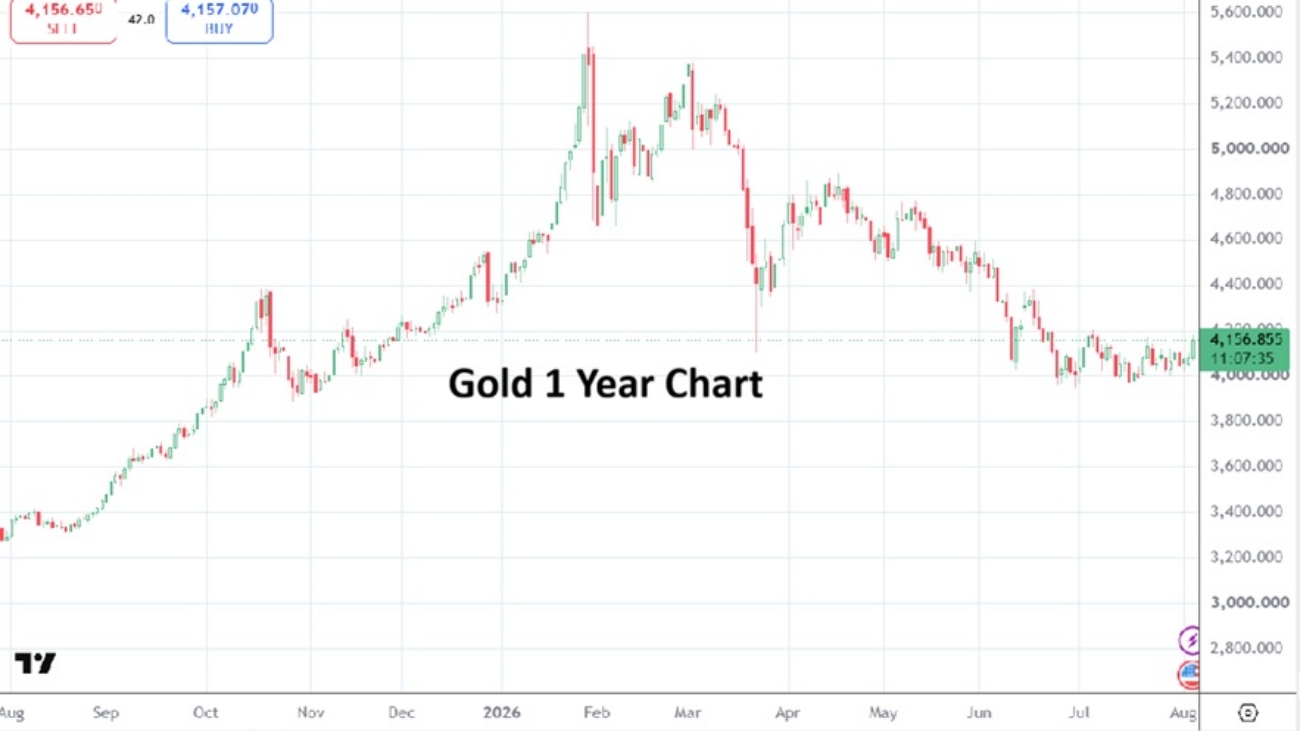
Gold One Year Chart as of 5 August 2026

Via a one year chart Gold has lost plenty of value the past six months, but conditions may be turning favorable for the precious metal. Vulnerable sentiment in bonds, equity indices and Forex has grown loud and it might not vanish soon. 

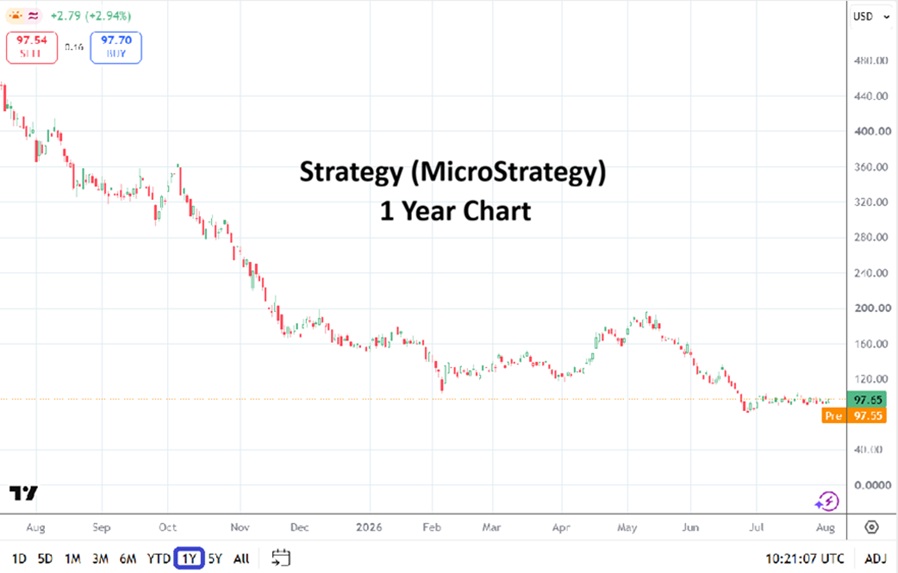
Yes, the Nasdaq 100 is once again back in its higher elements near 29,733.00, and has the 30,000 target lighting up again, but how long will it be before questions about the high cost of data centers, worries about AI revenues come back into vogue? What if interest rate worries continue to cause financial institutions to fear an increase in borrowing costs? What is going to happen if Bitcoin and Strategy (MSTR) implode completely? 

Allow me to say I am not saying Gold will go higher just because BTC/USD and MSTR are imploding, but it will not hurt the case for the precious metal either. Gold looks good because the over all health and sentiment of the marketplace doesn’t look particularly bright. 

If the price of WTI Crude Oil remains within sight of $74.00 and below that will be a positive development regarding inflation concerns, but will it be enough to generate a positive global economy? How will investors react if the Trump administration loses control in the House of Representatives in early November via the mid-term elections?

Strategy (MicroStrategy) One Year Chart as of 5 August 2026

The Case for Gold

Over the past year Gold has turned in a rather remarkable run from a speculative point of view and investment framework. One things stands out, Gold is not going anywhere. It will not disappear suddenly, meaning within the next 100 years and it will still be seen as a store of value. Gold remains a steady unit of secured capital for long-term investors having established a track record the past 3,500 years. Speculators who pursued the run higher, including hedge funds and large players likely lost money as values decreased the past six months, but let’s also note Gold has found rather tight support around its current price point since the middle of June.

Yes, gold lost value after the speculative storm subsided and people turned their wagering attention elsewhere, but the commodities loss of value in the past six months was froth being wiped away from a speculative market in which bulls ran wild.

The Fed may find itself in an increasingly difficult spot with the U.S Treasury reminding the U.S central bank about higher yield provisions. Japan is likely to continue to find it difficult to extricate doubts within financial institutions regarding the JPY. And if investment wheels struggle to produce gains steadily in the asset machines of the stock markets, some folks will turn their mid-term outlooks elsewhere for stability and potential profits.

Gold will continue to shine as it has always done. Fools Gold attracts the ignorant, real Gold attracts those looking to sustain value. I am not saying Gold needs to be $5,000, but Gold looks to be oversold in what feels like an increasingly nervous global market. 

Perhaps that is the risk manager in me taking on the psychological sentiment of nervous investors who do not feel comfortable with the higher yields being seen in U.S Treasuries, the weakness in the USD because of a Fed that many feel lacks clarity or proper policy guidelines, shadows from the Middle East which are unlikely to suddenly disappear even if there is a formal agreement achieved in the near-term…and yes even as Gold has gained the past few days in the midst of the sudden USD slump.

Gold back to the $4,500.00 mark might seem like a farflung wager perhaps, but from a mid-term outlook, one that I wouldn’t be surprised with if it occurs. From a perspective of where things will be within 3 to 6 months I would venture to say Gold should not be lower than it is now. I would be genuinely surprised if it was below $4,000 in November of this year, but would not be surprised if it is touching $4,500 or higher.

Copy and paste the text from AMT that you want to share

Share:
US Dollar Index 20260804

Apologia: Confronting Market Opinions and Pointing Out Wrongs

The Markets Can and Will Harm You, Can You Survive?

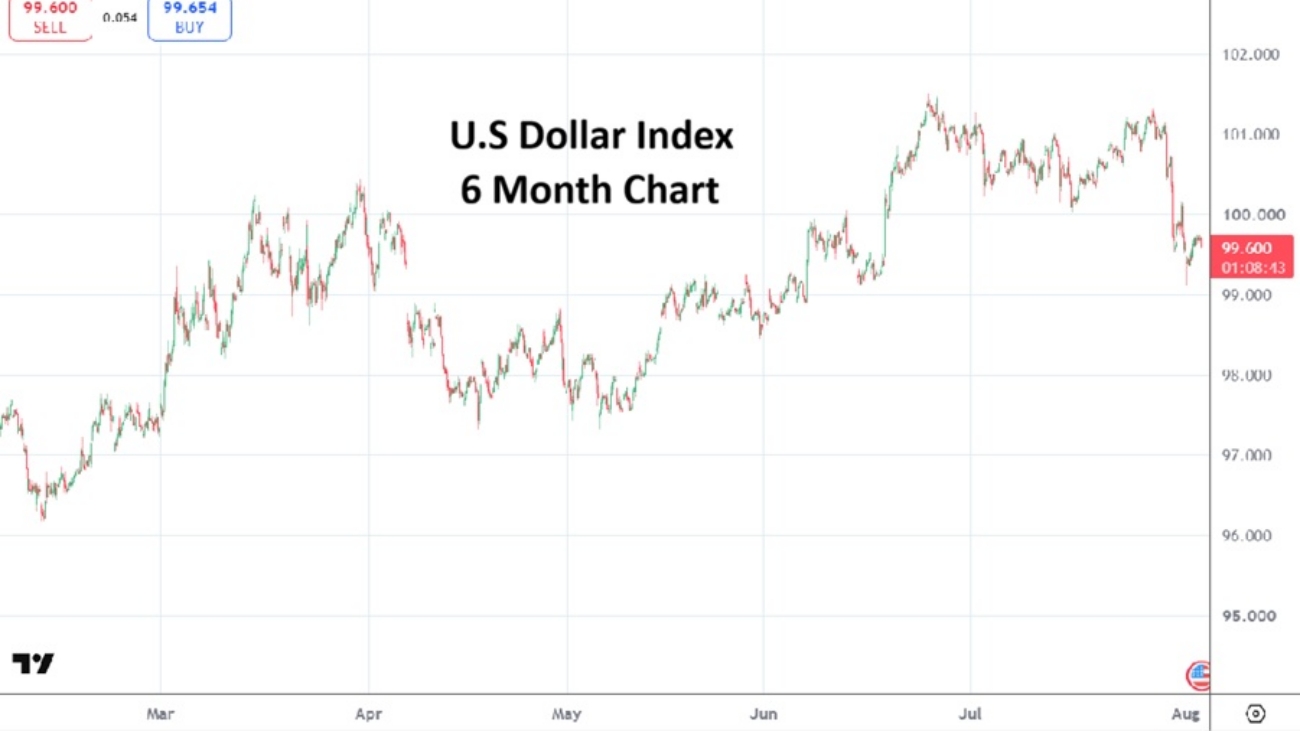
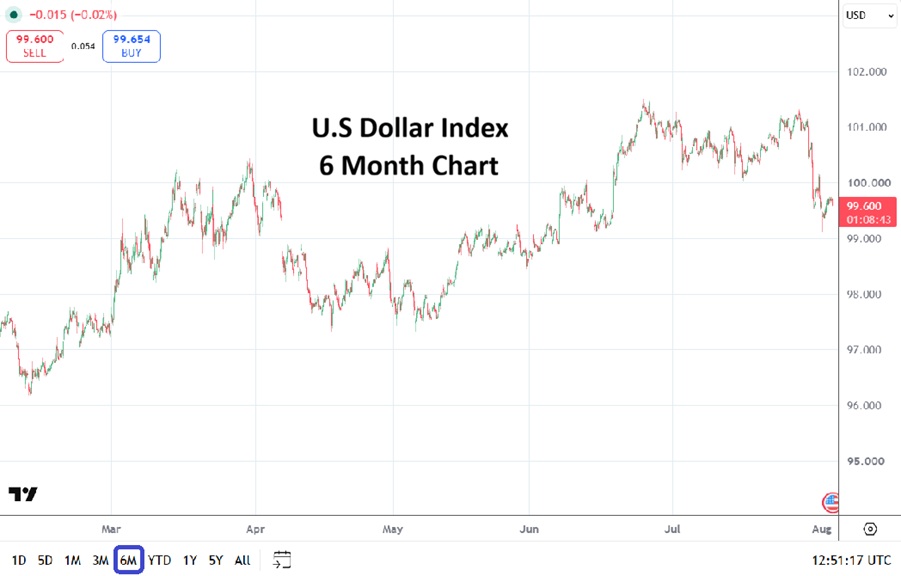
The U.S Dollar Index is back to where it was trading on Friday the 13th of March. (Yes, a Friday the 13th). Literally a week and half after the Iranian war started from a trading perspective. We are almost half a year into the war and many are still acting surprised by surges which churn on a daily basis in WTI Crude Oil and a host of other assets including bonds, equities – indices, and Forex. 

A large group of people are acting as if the USD selloff sparked across the Forex board on Friday was doomsday and had evil intentions. But what if the Trump administration actually wants a weaker USD? What if all they need to do is to get Wall Street to kick into gear and create higher values to change behavioral sentiment in Treasury yields? It is not so easy to fool professionals is it?

The narrative that the N.Y Fed via orders from the U.S Treasury was selling USD to strengthen the JPY became a conspiracy masterclass in over-reaction. Particularly because the BoJ had intervened twice already this year prior to Friday’s action – why is nobody pointing to that? It doesn’t mean, by the way, that the BoJ suddenly knows what they are doing, but it doesn’t mean that the financial end of the world is near. We need to get over our own fears.

Fed Chairman Kevin Warsh may be new on the job, he may be nervous, but he is not a schoolboy, and likely has a plan of action. I agree it sometimes is not easy to discern what Warsh wants exactly, but the USD is now weaker and maybe Scott Bessent and Donald Trump do not mind. I didn’t call Bessent and Trump the Fed Chair’s boss please note – he is independent after all. Cough, cough.

Everyone Has An Opinion, Many of Them Are Wrong

I have a good friend who constantly tells me to make sure I give an opinion, he will know who he is when I say he has proven to be the worst trader I have ever known. Hello there, Mr. Bad Trader if you are reading. Part of the reason he is so bad at trading is because he has never understood who he is as an individual participant in the marketplace.

U.S Dollar Index Six Month Chart as of 4 August 2026

His ego will not let him admit to himself he is wrong. This is not an easy thing to do for anyone. When is the last time you were able to admit you were wrong about a market position and turn around on a dime and be willing to take a loss? 

My friend doesn’t seem capable of understanding he is not an investor, he is a trader. While his outlooks about the market often prove correct, his timeframes constantly complicate matters. He has never had the temprament to be an investor, he is too impatient. He always used too much exposure via leverage and he remained unwilling to change his sails even when the winds clearly told him he was about to get wrecked. My friend no longer trades.

I am certain he would be willing to trade someone else’s money, but he has no funds to risk on his own. And I kid you not when I say he has attempted to prove the marketplace wrong more times then can be counted and still thinks he will eventually be proven correct. 

So when was the last time you were able to change your mind about an opinion you held? When was the last time you said to yourself and aloud, “I am wrong and I misunderstood the circumstances.” And do you know why you were wrong?

We listen to analysts tell us why the marketplace is going to sink, we also pay attention when they say an asset is going to the moon. Analysts are never held accountable because they are able to say things like past results do not guarantee future results. They also get to point to risk disclaimers, have a look at ours angrymetatraders.com/risk-disclaimer, protecting their opinions about the markets put forth. So why should you pay attention to someone who has no skin in your game? Because it is important to get other viewpoints, once in a while you may actually be able to allow yourself to admit that your perspective is only one of many.

The broad markets have been unkind the last six months in many ways to retail speculators. Investors have gotten hurt, but they will likely survive or at least find a job elsewhere if they cannot improve their results in the coming months to hide their failures at their current firms. This is not a polite game you are playing as a retail trader. Your brokers’ no doubt love you and talk to you about the markets and your participation like it is a sporting event. ‘Even the great ones fail once in while,” have you heard this one? 

Yesterday I stumbled upon someone’s post on LinkedIn discussing a theory and ability to only aim for a half a percent of gain everyday as if that small target somehow made it achievable – all the time. Like compound interest they subtly suggested, half a percent gained everyday would show the level of control you would have in the marketplace and allow you to make millions of dollars within a few years. Good news, isn’t it?

However, many of us know, it just isn’t that easy. While it is a great notion to remain focused and not be too ambitious while trading, buying someone else’s system for a lot of money or being charged their management fee is a little like being chewed on slowly by a vulture. 

Where is the optimism? Where is the golden secret that will allow you to become a better trader? I don’t have any, except to say diligence, determination and knowing when you are wrong and need to get out of a position is vital. We all want to find the big wave and ride momentum in order to profit. 

Sometimes the markets look like they offer riches for the brave, but sometimes they turn into a pile of ashes. No matter how hard influencers want to praise certain assets they cannot shine a turd into gold. Sometimes the turds are merely garbage and need to be treated like fertilizer, allowing for something else to grow its in its place. Maybe that is replacement theory. Maybe it is meaningless. But this is a game with hard rules, risk management and knowing when you are wrong are among some of the more important early lessons that should be sustained.

A lot of smaller players are angry at larger players in the marketplace, the reason for this has a lot to do with survivability. Small traders like my friend are no longer able to speculate, big players who are frequently part of larger financial institutions simply go home and wait for another day. Those are my opinions, take them or leave them. Tomorrow is a new day and may offer more clarity, for the moment I suggest being careful in the broad markets.

Copy and paste the text from AMT that you want to share

Share: