post309

India Insider: Nifty Defense Index Surges in 2025 Rearmament

India Insider: Nifty Defense Index Surges in 2025 Rearmament

2025 has marked a defining moment for defense equities, both globally and in India. The Nifty India Defence (Defense) Index, which tracks the country’s leading defense manufacturers, has surged sharply on the back of robust order flows, a structural policy shift, and increasingly volatile geopolitical conditions. This rise is not an isolated event but part of a broader global rearmament cycle that is reshaping the defense industrial landscape.

Nifty India Defence (Defense) Index One Year Chart as of 20th November 2025

India’s defense sector has been one of the standout performers in the domestic equity market. By mid-2025, the Nifty Defense Index had risen more than 25% year to date, outperforming most sectoral indices. This rally is primarily anchored in strong capital expenditure by the Government of India, which continues to accelerate indigenous military modernization. The Defense Ministry’s approvals which is running into tens of thousands of crores have expanded visibility for companies such as HAL, Bharat Electronics, Bharat Dynamics, and shipbuilding PSUs (Public Sector Undertakings). For investors, the nature of long durations within defense order books has provided earnings stability at a time when other manufacturing sectors have been grappling with cyclical softness.

The second driver has been a multi-year strategic shift toward import substitution. India’s reliance on foreign weapons systems has long strained its current accounts and created operational vulnerabilities. However, the ongoing indigenization push, reinforced by Production Linked Incentive schemes, procurement embargoes on foreign systems, and export incentives, has fundamentally realigned the sector. Defense exports have crossed record levels, and Indian firms are increasingly integrated into global supply chains for electronics, avionics, and ammunition.

Global Industrial Defense Rebirth

But the domestic story is tightly interconnected with developments abroad. The global defense market is undergoing its most significant expansion since the post 9/11 decade. Russia’s war in Ukraine, the Red Sea shipping crisis, conflict in the Middle East, and a renewed great power rivalry in the Indo-Pacific have pushed countries to reassess defense readiness. NATO’s decision in 2025 to raise defense spending targets from 2% of GDP to 5% by 2035 has far reaching implications. This commitment translates into trillions of dollars in additional defense outlays over the coming decade, making Europe one of the fastest-growing defense markets.

Companies such as Rheinmetall, BAE Systems, Lockheed Martin, and Northrop Grumman are already reporting record order inflows. Rheinmetall, Germany’s largest defense company, expects its revenues to quintuple by 2030, reflecting unprecedented demand for advanced artillery, ammunition, and combat vehicles. The United States, meanwhile, continues to channel significant funding into hypersonic, missile defense, and drone systems as competition with China intensifies.

India’s Edge in Rearmaments and Technology

This global rearmament wave has a direct spillover effect on India. International supply chain shortages particularly for semiconductors, propulsion systems, and munitions have created opportunities for Indian firms to plug capability gaps. With a cheaper cost base and growing technological sophistication, Indian defense manufacturers are emerging as viable exporters in segments such as UAVs, naval platforms, and electronic warfare systems.

In this environment, the rally in the Nifty Defense Index is not merely speculative exuberance, but a significant reflection of structural and synchronized global demand. As defense has evolved from a low beta sector to a strategic growth industry, India’s integration into the global defense economy positions its companies for sustained earnings expansion over the next decade.
307

India Insider: The Need for Quality Jobs and Improved Safety

India Insider: The Need for Quality Jobs and Improved Safety

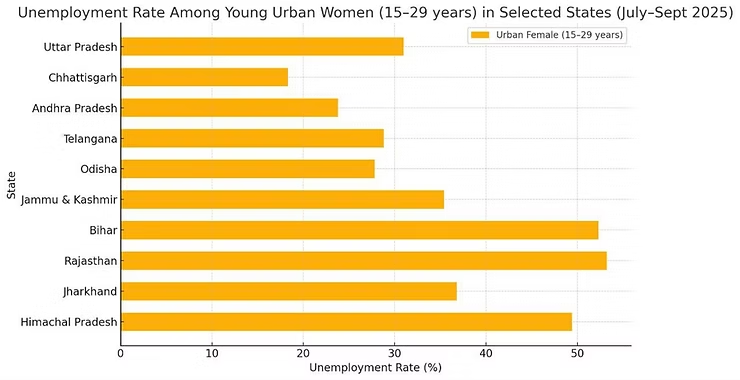
Recent data released from the Ministry of Labor Statistics depicts a worrying aspect of India’s labor market. Every second urban young woman in Bihar and Rajasthan is unemployed. Nationally, one in four young women remains without work. This reflects deep structural issues in India’s workforce and the job market’s inability to provide high-quality employment.

Industries in urban India are not generating enough decent jobs to absorb educated youth, especially women. Even when jobs exist, they are often of poor quality, lacking social safety standards and sometimes damaging workers’ health and well being.

Via the National Statistics Office of India Unemployment Data

A recent piece in The Diplomat, a magazine covering the Asia-Pacific region with current affairs, highlighted how workers trade off their health and welfare well-being for the opportunity of precarious living. If an economist like Robert Gordon, who wrote “The Rise and Fall of American Growth“, were to look at their lives, it would remind him of the 19th-century United States.

Migrant workers from Bihar and Uttar Pradesh toil in textile recycling plants under hazardous conditions for just ₹5,000 ($58.00) a month. Women form a significant share of this workforce, often assigned trivial tasks in unsafe factories. Many have developed asthma and tuberculosis after prolonged exposure to dust and poor ventilation.

The Rise of the Informal Sector

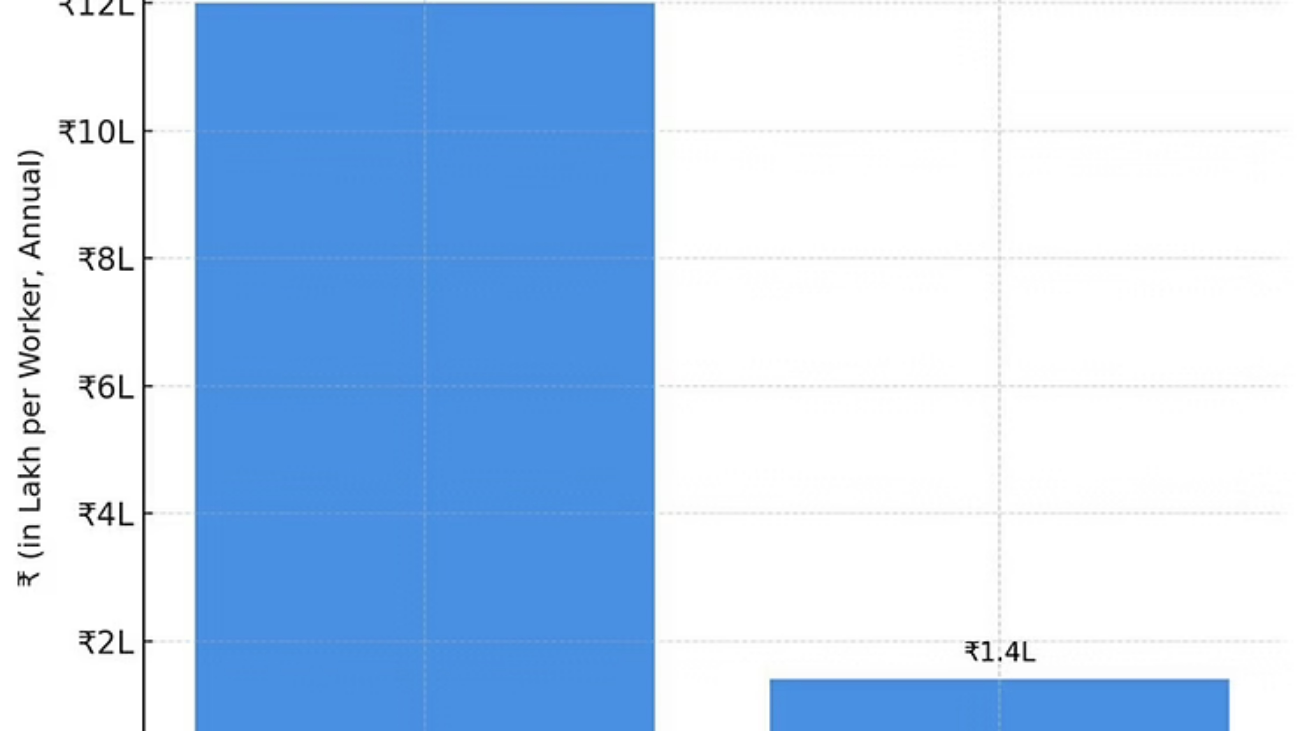
Formal workers generate an annual GVA (Gross Value Added) of ₹12 lakh, while informal workers produce just ₹1.4 lakh, according to the Annual Survey of Industries (ASI) and the Annual Survey of Unincorporated Sector Enterprises (ASUSE) 2022–23.

Neoclassical economics says wages reflect a worker’s productivity. But this logic collapses in economies like India’s, where a vast army like reserve of labor, keeps wages low – even when productivity rises.

Excess labor supply depresses pay across sectors, from private school teachers to gig workers. Many gig workers spend long hours to earn a modest income, without access to provident funds, health insurance, or paid leave. This precarity extends from India to the United States and Indonesia.

Statistics via Kuntala Karkun & Samriddhi Prakash, Pahle India Foundation

The Gap Between Law and Reality

India has strong labor codes, streamlined in 2020, yet they remain largely unenforced. Companies often ignore them due to cost pressures, effective lobbying, or weak state monitoring.

Economic growth without wage growth widens inequality and breeds social tension. For growth to be inclusive, wages must rise with GDP.

This demands more than redistribution. It requires the transformation of raising workers’ productivity, ensuring labor rights, and giving every worker their fair share of India’s prosperity.

Post306

India Insider: Reserve Bank of India Intervention is Limited

India Insider: Reserve Bank of India Intervention is Limited

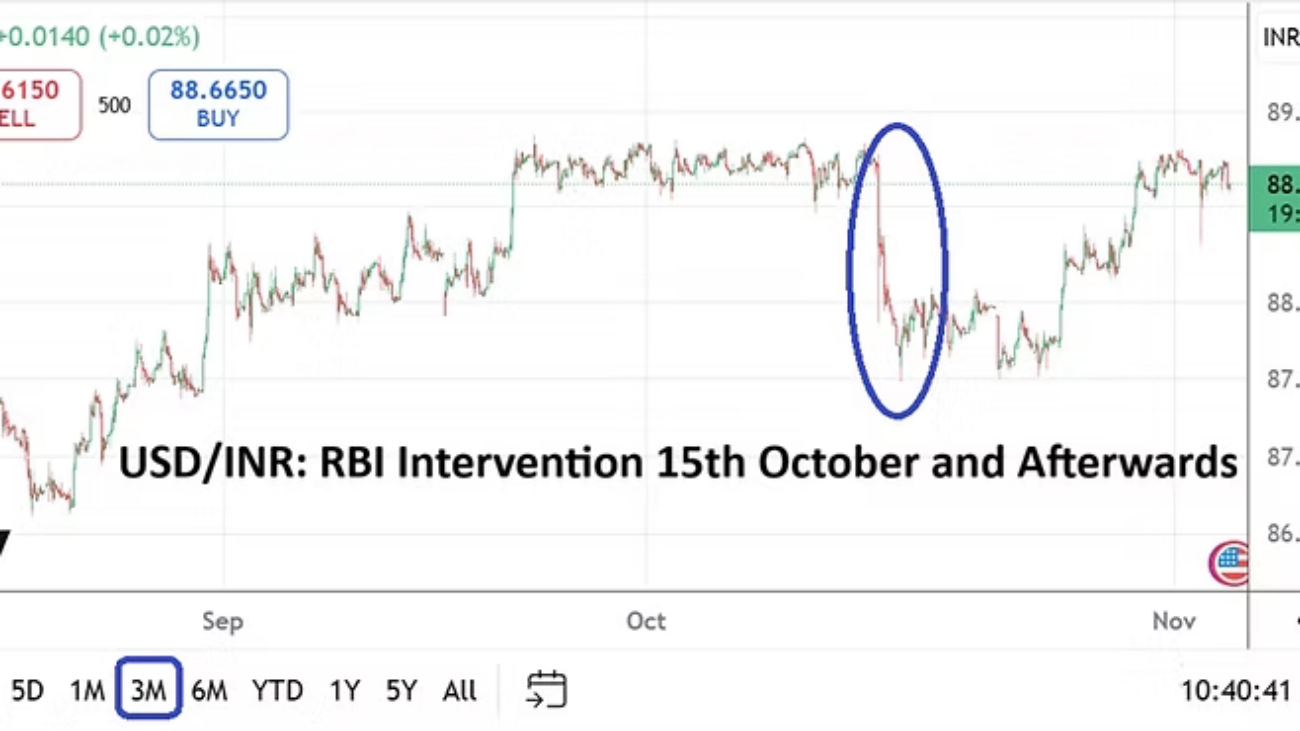
After weeks of steady appreciation due to Reserve Bank of India intervention on the 15th of October, the Indian Rupee has now returned to the same 88.72 levels against the USD before the policy action was enacted. The RBI’s recent offensive against speculators may have calmed the market temporarily, but it reflects a reactionary and short-term approach to deeper structural pressures facing India’s external administrative policies regarding the USD/INR.

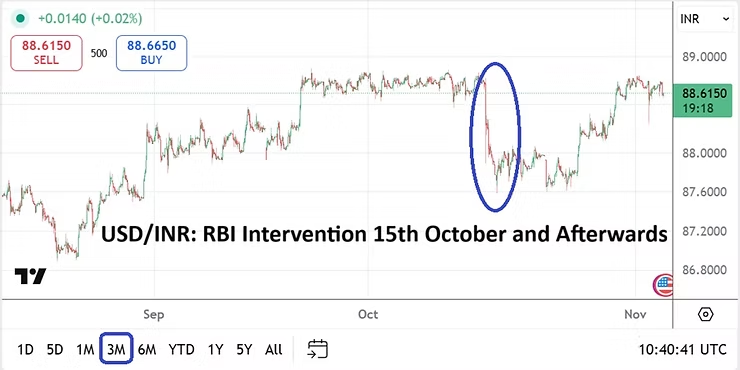
USD/INR Three Month Chart as of 5th November 2025

Despite the Reserve Bank of India’s efforts to influence the cash forward market, where Dollar shorts rose by 6 billion USD in September to $59 billion, fundamentals suggest that Rupee weakness is not purely speculative. It is a rational market adjustment due to rising trade barriers amid U.S tariffs on India’s merchandise exports. The added uncertainty regarding trade caused the Rupee to naturally absorb external shocks. Merchandise exports to the U.S fell 12% in September year on year, according to official India data, prompting some calls for government relief.

India’s Foreign Remittances & H1-B Visa Fee Hike

According to World Bank data, India received about 137.7 billion USD in personal remittances from abroad in 2024. From that amount, around $40 billion is coming from the United States. The Trump administration raised the cost of H1-B visa fees from below 10,000 USD to nearly $100,000. And there is now also an increased likelihood of measures aimed at limiting digitally delivered software services to the U.S from India. These combined measures would substantially reduce Dollar receipts via exports of technology driven software and IT services, as well as remittances from a reduction of workers on temporary U.S visas providing on site services to U.S clients. USD inflow has been crucial for India’s balance of payment’s stability.

Reduction of USD reserves when the trade deficit is already rising because of hikes caused by tariffs on India’s exports would widen the current account deficit. Concerns about a decrease in remittances leading to a potentially significant decline of India’s USD reserve ability is possibly discouraging the India Reserve Bank to voluntarily expend reserves to support the Rupee.

Service Exports Cushion India’s Balance of Payments:

India’s total service exports touched 400 Billion USD over the past year with a predominant amount coming from the U.S. In other words, India has had a $202 billion in services trade surplus over the last 12 months, which covered almost 114% of India’s merchandise trade deficit in 2024-25.

India’s goods trade deficit is matched by a services surplus, plus net foreign personal remittances. This USD equation is under threat because of prolonged paralysis from stubborn US and India trade negotiations debating Russian Oil usage and the U.S demand to allow agricultural products into India.

Foreign Investors Selling Indian Equities

In addition, the Indian Rupee is not getting support from investment portfolio inflows. A shortfall of AI related avenues in the nation’s tech sector, and perhaps because of valuations considered too rich, foreign Investors have pulled 17 billion USD so far this year. This sum is more than any other emerging market, which is eating away at the Reserve Bank of India’s FX reserves too.

Global and India-specific uncertainties spurred by the Trump administration’s actions are setting off a retreat of footloose portfolio capital invested into India’s equity and bond markets. If the Reserve Bank of India was confident that inflows of foreign capital would replenish reserves it would likely help the Indian Rupee, and thus investor confidence coming from abroad.

Policy Irony and the Limits of Intervention

The U.S. remains India’s largest export market, but new levies of 50% tariffs are hurting labor-intensive sectors such as textiles, leather, footwear, and gems & jewelry.

While concerns about imported inflation are valid, the benefits of a weaker Rupee should not be overlooked. A mild depreciation could boost India’s service exports, improve the balance of payments, and partly offset the effects of U.S. tariffs on merchandise exports.

A material improvement in U.S and India trade relations is needed. Until a restoration is achieved in relations and a merchandise surplus is possible, alongside healthy services and remittance inflows occurring again, the Rupee’s weakness is likely to persist. In the meantime, Reserve Bank of India interventions could prove to be a short term tactic that proves vulnerable mid-term to the influence of market forces known and unexpected.