AI Aluminium 20260624

The Great Compression Part 2: The Intelligence Trap

AI Aluminum

On June 17th, the U.S. Air Force handed Anduril Industries a contract for its FQ-44 autonomous combat drone, making it the first new entrant to win a U.S. fighter aircraft program since the 1970s. The Silicon Valley startup beat Lockheed Martin, Northrop Grumman, and Boeing – companies that between them have defined American air power for generations – to the target. Anduril, a defense technology firm founded in 2017, did not win on relationship or on legacy: it won on AI-native architecture.

The shift this represents is psychological as much as commercial. Defense procurement is arguably the most bureaucratic, relationship-driven, clearance-protected industry on earth. If AI-native vertical integration can break this barrier, anything is now open for re-negotiation.

The Great Compression Part Two: The Intelligence Trap

The compression of the human intermediary layer across the economy – the subject of this series’ opening piece – raises a question that is both philosophical and financial: if the old middlemen are disappearing, and if the AI models replacing them are themselves becoming commodities, where does value go?

What made the Air Force announcement structurally significant was a detail that went largely unnoticed: the service deliberately separated the drone hardware from its AI software, specifying that the intelligence layer could be upgraded or replaced independently of the platform. By doing so, the Air Force drew a line that the market is still catching up to – and then immediately complicated it. The aircraft is the delivery vehicle. The intelligence tier is what matters, except that intelligence is also commoditizing fast.

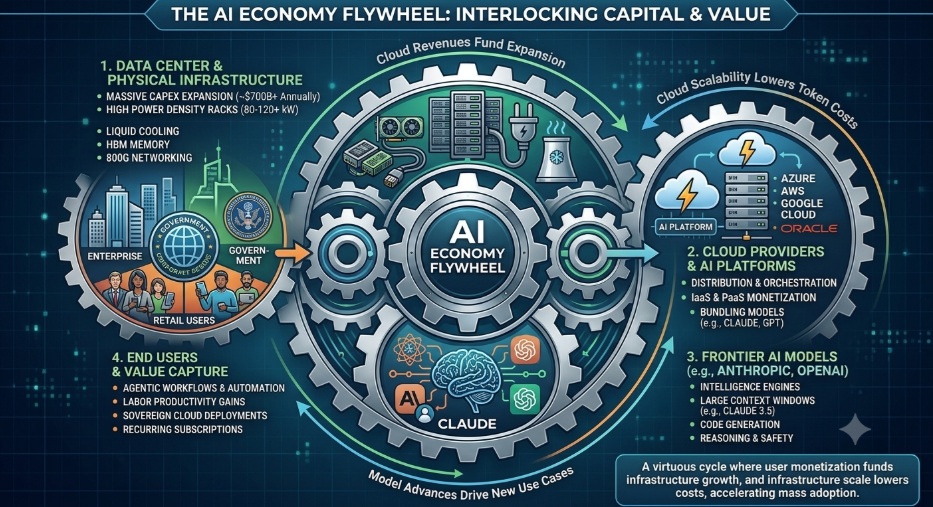
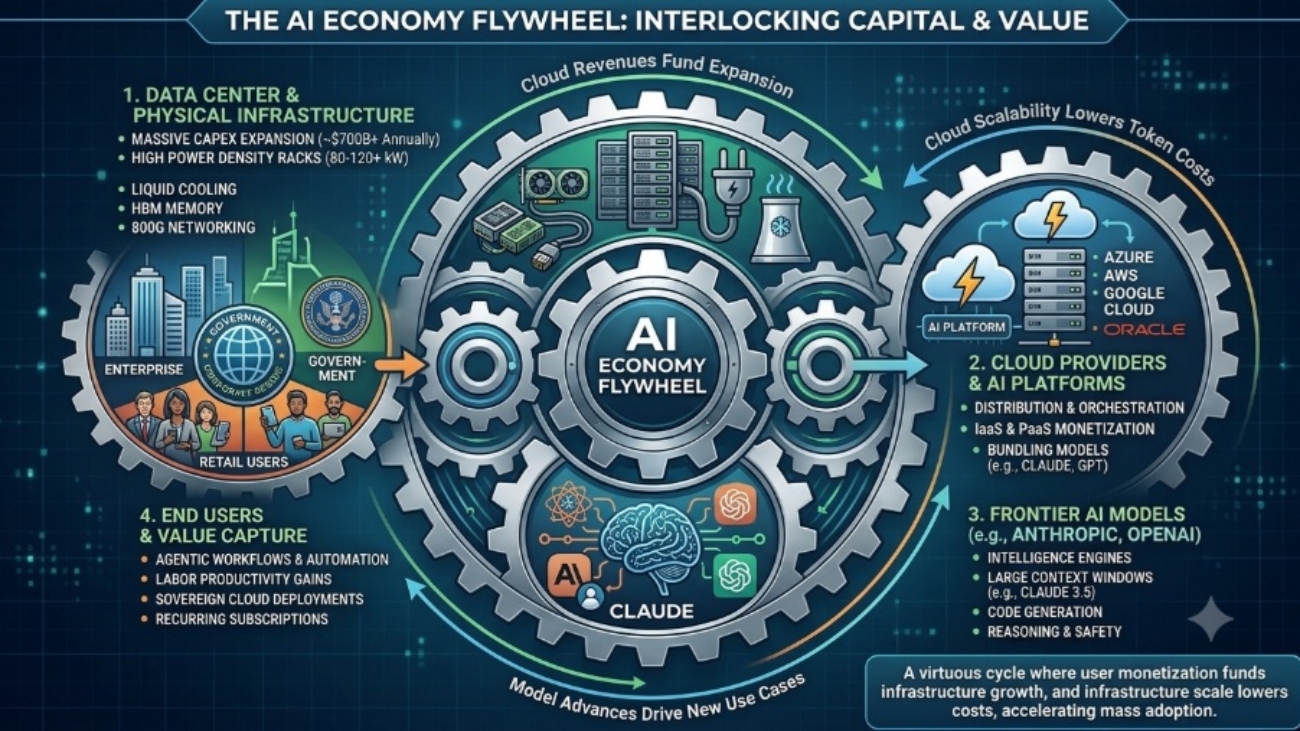
The commoditization signal had already arrived earlier this month, when Google cut the price of its AI plan by nearly 40% overnight. OpenAI is reportedly considering steep token-price cuts as competition with Anthropic intensifies. The models themselves are beginning to resemble a capital-intensive utility more than a premium software business. As intelligence becomes cheaper, the investment question shifts to what models cannot easily access: proprietary data, regulated workflows, institutional trust, and the systems that turn AI output into real-world action.

The answer, in the most durable cases, is proprietary domain data combined with deep sector integration. Anduril is not a defense company that adopted technology: it’s a technology company that chose defense as its vertical. Palmer Luckey, who sold Oculus to Meta when he was just 21, founded Anduril alongside veterans of Palantir with a specific thesis: Silicon Valley had abandoned defense, leaving a widening gap between what the military needed and what the traditional primes could deliver.

Where Lockheed and Boeing run bid-led organizations optimized for cost-plus contracting cycles measured in decades, Anduril built a product-first company that moves at software speed, focused on cheap, autonomous, attritable systems designed to be deployed and lost without catastrophic cost. The competitive edge that results has nothing to do with which model runs underneath it. It is purpose-built architecture, mission-specific design, and the kind of deep operational embedding that no generalist technology company can shortcut and no traditional prime can easily imitate.

Palantir built the same competitive edge a decade earlier, at the intelligence level. Their forward-deployed engineers embedded themselves inside classified environments, building proprietary data structures around defense and intelligence that competitors cannot access, let alone replicate. The model is almost beside the point. What matters is the institutional trust above it and the data structure underneath it.

The same logic plays out in banking, and the psyche shift there is equally striking. JPMorgan Chase is not an obvious candidate for AI leadership – a 150-year-old Wall Street institution steeped in regulatory obligation and institutional conservatism. Yet it has become arguably the most digitally aggressive major bank outside the fintech world, spending north of $17 billion annually on technology and deploying AI across trading, risk, legal document review, and client services. JPMorgan’s AI advantage over any fintech competitor is not compute – it is 150 years of proprietary transaction data, credit history, and market intelligence, combined with the institutional will to deploy it at scale. Many large banks sit on comparable reserves; few have built the machine to turn them into a competitive weapon. The model commoditizes; the data does not – but only in the hands of someone with the commitment to exploit it.

The pattern across defense, banking, and every sector where this is playing out is consistent: the prize migrates to whoever owns the scarce position that generic models cannot substitute for. Right now the prize sits with domain data and deep sector integration. What’s forming above it is agentic orchestration – systems that coordinate networks of specialized AI agents across high-stakes workflows: routing battlefield targeting decisions, flagging fraud across millions of simultaneous transactions, managing the exception-handling that no single model can resolve alone. Palantir’s AIP platform is the most mature example of this emerging tier, and it is no coincidence that the same company that mastered domain-specific data is now positioning for that orchestration tier. Salesforce’s Agentforce is building toward the same position from the enterprise side. The race for this trophy is not yet decided, but the companies that already own those domain data advantages are the natural favorites to own the control plane above them.

The stack, in other words, keeps moving upward. Value migrates to the next bottleneck, then the next. And below all of it – the models, the sectors, the orchestration layer – something has to hold the weight. Every control plane needs a floor. What that floor looks like, who owns it, and why it may be the most durable investment thesis of the AI era is the subject of the next piece.

Copy and paste the text from AMT that you want to share

post220

Nasdaq 100: U.S Exceptionalism and Competition from China

Nasdaq 100: U.S Exceptionalism and Competition from China

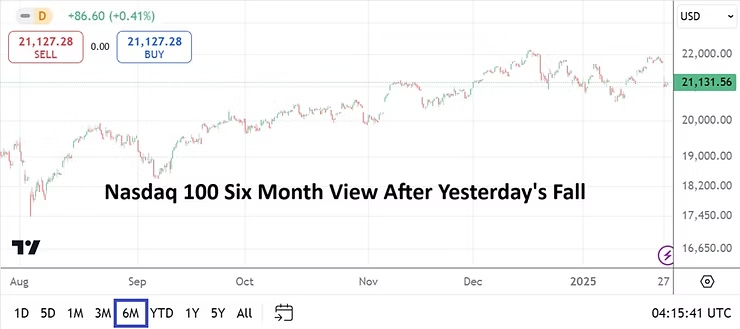
Nasdaq 100 Six Month Chart as of 28th January 2025

The losses on the Nasdaq 100 yesterday were bad. Wall Street participants were reminded that technology is and always has been a competitive landscape. It is rather remarkable that the lesson being given to capitalists came from China which is led by a Communist government. U.S Exceptionalism which has been spoken about in loud tones the past week because of President Trump’s return to the White House has been put on notice.

There will be additional bad days on Wall Street, but the idea that the Nasdaq 100 now faces an existential threat from DeepSeek is farfetched. Traders must take a healthful breath and remember yesterday’s loses while bad were not catastrophic. Premium froth from Nvidia and other companies saw some of their likely overvalued worth selloff on Monday. Perhaps more will follow today, but tech and innovation companies have always faced a competitive landscape.

Was yesterday an indication there is a crack in U.S Exceptionalism via technology that is going to be long lasting? Companies must always compete to be the best, if DeepSeek’s entry into the news cycle was a ‘sputnik’ moment as some claim, folks need to remember the U.S bounced back rather nicely and eventually outpaced the Russians – who still remain a tech competitor regarding rockets and space.

This weekend’s news from China has provided another moment the world realizes technological gains are often hard fought. While many media pundits act with hyperbolic noise and state vivid concerns about the future of the technological competition between China and companies around the globe, the race for innovation has and always will exist.

AI for the moment is grabbing the headlines, but Artificial Intelligence is also a buzzword – it is marketing usage by those who are trying to entice investors with big promises, except machine learning has been around for decades. Progress the last few years has been significant, but AI isn’t ready to make humans into a new species. Competitive battles in equity markets centering on innovation via semiconductors, quantum computing, robotics, IoT, biotech, transportation, and other sectors have been relevant and will remain this way.

Monday’s results on the Nasdaq 100 and harsh falls for some tech giants like Nvidia is a reminder that while speculating and investing in one company is a potential way to make solid returns, investing in indices and a large group of diverse companies often produces steadier yields. Yes, yesterday’s losses on the Nasdaq 100 were bad, but they were less critical compared to the losses Nvidia suffered. And let’s remember Nvidia will survive yesterday’s declines.

After Monday’s Nasdaq 100 decline, today will prove a another test of sentiment. Premium froth in companies such as Nvidia that sold off, will now cause people to question fundamental analysis of tech and innovation. Bubbles sometimes burst. The remainder of this week will be a solid test of behavioral sentiment. A battle between large speculators and investors will also be seen. Those who plan on cashing out of the market near-term to book profits may find that investors with long-term ambitions still win the race.

Perceptions are constantly being shaped, we should always be questioning the ability of technology which is proven versus marketing mayhem that is hot air. Artificial Intelligence has had a gravitational pull on the investment landscape. The froth created by investment into the AI sphere is important, but it only one part of many combined technologies constantly developing.

Many companies claiming they are AI centric have no real basis to make the statement. Semiconductor companies have led a lot of the gains in Nasdaq’s run higher because they are the ones supplying micro processing to companies that need the technology to build machine learning capabilities, China has always been a competitor and yesterday provided a wake up call for those who forgot. A dose of reality has been delivered once again to Wall Street.

postR196

AMT Top Ten Miscellaneous Tastings for the 10th of May 2024

AMT Top Ten Miscellaneous Tastings for the 10th of May 2024

10. Word of the day: Ultracrepidarian is a person who speaks assertively about subjects that are beyond their level of knowledge. The world is full of many suspects ladies and gentlemen.

9. Steve Albini: The musician and production sound engineer passed away earlier this week in Chicago. Albini was a pioneer and leader in ‘alternative’ music and battled homogenized corporate music for nearly 40 years. Nirvana, Fugazi, Jimmy Page, the Pixies, P.J Harvey are some of the many that worked with Albini.

8. Bitcoin: BTC/USD continues to hover around the 63,000.00 realm per a three month technical chart perspective. Bitcoin’s higher values via one year results are being maintained. BNB/USD is lurking near 600.00 per a three month glance.

7. Commodities: Cocoa and Coffee prices remain elevated. After touching a low around the 7,250.00 USD mark last week per metric ton, Cocoa is now within sight of 9,000.00 USD again. Retail speculators who like to wager via CFDs on commodities need to remember their bets have no influence on the markets, which are in complete control by the largest players in the commodities sector.

6. Wayve Technologies: A U.K based company specializing in autonomous driving software has announced they have raised more than 1 billion USD in investments recently via the likes of Softbank, Nvidia and Microsoft. The U.K government has highlighted Wayve, proclaiming it shows Britain will be a major force in AI development. Wayve was established in 2017 and is still a privately held company.

5. U.S Foreign Policy: Election concerns appear to be a prime motivator for the U.S executive branch as its attempts to walk a fine line regarding diplomacy and saber-rattling in the Middle East. Polling from a variety of sources indicate Joe Biden is in jeopardy of not being reelected.

4. USD/CNY: China will release its Consumer Price Index and Producer Price Index numbers early on Saturday. The USD/CNY is trading around the 7.2245 mark as of this writing. Some analysts have expressed concerns about the China Yuan weakening via attempts by the Chinese government to boost exports. The USD/CNY certainly remains within the higher elements of its range, but is below marks seen in early September 2023 which were around the 7.3425 ratio.

3. Data Warning: While day traders may be inclined to look at the University of Michigan’s Consumer Sentiment reading today, they should remember to pay attention to the Inflation Expectations statistics. Last month’s inflation report produced a result of 3.2%, which delivered a solid dose of volatility to financial assets.
2. Forex: Behavioral sentiment appears to be leaning towards a weaker outlook for the USD as major currencies like the EUR, GBP (solid GDP numbers also helped this morning in Britain) and others have gained. However, its should be pointed out that the USD/JPY has seen an incremental climb since touching a low of nearly 151.880 last Friday. As of this writing the USD/JPY is around the 155.650 level.

1. Equity Indices: Bullish optimism has been seen in the S&P 500, Dow 30 and Nasdaq as all three major indices are ready to start the day near highs for the week. The burst of upwards momentum which started last Thursday, has ignited the major U.S indices within sight of their apex realms achieved in late March and early April.

post204

AMT Top Ten Miscellaneous Tastings for the 10th of May 2024

AMT Top Ten Miscellaneous Tastings for the 10th of May 2024

10. Word of the day: Ultracrepidarian is a person who speaks assertively about subjects that are beyond their level of knowledge. The world is full of many suspects ladies and gentlemen.

9. Steve Albini: The musician and production sound engineer passed away earlier this week in Chicago. Albini was a pioneer and leader in ‘alternative’ music and battled homogenized corporate music for nearly 40 years. Nirvana, Fugazi, Jimmy Page, the Pixies, P.J Harvey are some of the many that worked with Albini.

8. Bitcoin: BTC/USD continues to hover around the 63,000.00 realm per a three month technical chart perspective. Bitcoin’s higher values via one year results are being maintained. BNB/USD is lurking near 600.00 per a three month glance.

7. Commodities: Cocoa and Coffee prices remain elevated. After touching a low around the 7,250.00 USD mark last week per metric ton, Cocoa is now within sight of 9,000.00 USD again. Retail speculators who like to wager via CFDs on commodities need to remember their bets have no influence on the markets, which are in complete control by the largest players in the commodities sector.

6. Wayve Technologies: A U.K based company specializing in autonomous driving software has announced they have raised more than 1 billion USD in investments recently via the likes of Softbank, Nvidia and Microsoft. The U.K government has highlighted Wayve, proclaiming it shows Britain will be a major force in AI development. Wayve was established in 2017 and is still a privately held company.

5. U.S Foreign Policy: Election concerns appear to be a prime motivator for the U.S executive branch as its attempts to walk a fine line regarding diplomacy and saber-rattling in the Middle East. Polling from a variety of sources indicate Joe Biden is in jeopardy of not being reelected.

4. USD/CNY: China will release its Consumer Price Index and Producer Price Index numbers early on Saturday. The USD/CNY is trading around the 7.2245 mark as of this writing. Some analysts have expressed concerns about the China Yuan weakening via attempts by the Chinese government to boost exports. The USD/CNY certainly remains within the higher elements of its range, but is below marks seen in early September 2023 which were around the 7.3425 ratio.

3. Data Warning: While day traders may be inclined to look at the University of Michigan’s Consumer Sentiment reading today, they should remember to pay attention to the Inflation Expectations statistics. Last month’s inflation report produced a result of 3.2%, which delivered a solid dose of volatility to financial assets.

2. Forex: Behavioral sentiment appears to be leaning towards a weaker outlook for the USD as major currencies like the EUR, GBP (solid GDP numbers also helped this morning in Britain) and others have gained. However, its should be pointed out that the USD/JPY has seen an incremental climb since touching a low of nearly 151.880 last Friday. As of this writing the USD/JPY is around the 155.650 level.

1. Equity Indices: Bullish optimism has been seen in the S&P 500, Dow 30 and Nasdaq as all three major indices are ready to start the day near highs for the week. The burst of upwards momentum which started last Thursday, has ignited the major U.S indices within sight of their apex realms achieved in late March and early April.

post39

AI Noise and Manipulation Feared as a Potential Threat

AI Noise and Manipulation Feared as a Potential Threat

Yesterday’s AI generated graphic which claimed an explosion had happened around the Pentagon in Washington D.C. sent equity indices into a brief selloff mode. However, the graphic was soon proven to be false news as people in Washington confirmed there had been no explosion.

AI has the capacity to cause surprise storms if some people try to trigger manipulation in the financial world and elsewhere by using ‘false’ data and graphics. ‘Bad actors’ within A.I will likely be compared to ‘ransomware’ folks in the world of high-tech, and people and institutions will have to react quickly to distinguish between fact and fiction. The ability of AI to manipulate the markets yesterday is only the beginning and we need to be prepared for more stories like the Washington D.C fake.

AI Mania is Building in the Media and People are Concerned about Wrong ‘Facts’

AI machine learning is coded by people and some of them are prone to bias, which raises the specter of bad input being used in systems that serve the public and clients in an ill-fated manner. Putting all of our trust into an AI system is wrong minded, just as we do not put all of our trust into Wikipedia information, and are aware facts should be checked on within a variety of sources.

Yesterday’s deep fake AI graphic highlights the need for financial markets to discern in a timely fashion attempts to manipulate narrative. Certainly some traders got hurt during yesterday’s reaction to the false report of an explosion in Washington. The dishonest graphic made instant news globally, and social media gadflies raced to report ‘the explosion’ and then had to quickly say they had been tricked. Data bias in AI is just as problematic and perhaps more dangerous, because what is presented as facts will always have to be given critical consideration by its users.

The prospect of bias producing arrogant AI systems ‘tools’ full of hubris as they assert ‘truth’ could develop and create self-perpetuating machines full of wrong details. This could happen as AI searches the internet for information and relies on data that is poor, and uses statistics from its own system posted elsewhere which could manifest falsehoods. The prospect of AI using its own potentially bad coding, and previous input distributed into other information networks in theory could lead to stubborn ecosystems which insists that they are correct, when they are actually not accurate.

Middle of the Road Results will make Users Choose Direction Sometimes

Public AI systems tend to frequently deliver ‘middle of the road’ result aggregates so they do not offend, leaving the users with mixed insights and without a firm stance. Perhaps if users understand this circumstance it can be perceived as a good outcome, because the person will have to do their own critical thinking while choosing direction. There is a danger that politically correct thinking which is coded into AI could lead to more vanilla and less flavor. The fear of offending people with facts may become a danger for AI, and coders will have to decide how to program searches as they produce objective and subjective outcomes.

Learning has changed as the internet has grown more robust with ‘facts’. Students often do not feel it is necessary to master particulars by reading a range of books. Instead they tend to rely on their mobile phones and laptops for their knowledge, avoiding in depth study on their own which would offer more insights and create critical thinking. This can and does lead to the use of ‘expertise’ produced by the internet which is incorrect.

Let’s also consider the notion that public use of artificial intelligence has won a large amount of publicity in the past year, but machine learning capabilities have in fact been used for a long time. The media has done a fairly good job of stirring the masses into a furor, and solid marketing has led to AI being the center of conversation the past handful of months.

AI is far from perfect because it is being built by flawed humans. In 1952 IBM via Arthur Samuel built a program allowing a computer to play checkers and learn how to improve its outcomes through ‘play’. In 1997 an IBM system called Deep Blue beat world chess champion Gary Kasparov in a six game match. The 45 year gap should be noted as we contemplate how AI will develop in the future.