India Needs Sustainable Water Security With Improved Infrastructure
India’s population has been expanding at a rapid pace and stands at 1.4 billion. Due to the urbanization process, industrialization in cities like Chennai, Mumbai and Delhi must continue to emphasize improving public infrastructures in order to maintain vital growth.
The growing population and urbanization adds noteworthy stress to the nation’s water bodies. With more people living in increasingly congested areas and pumping large amounts of water via borewells, groundwater levels are rapidly diminishing.
For instance, India consumes roughly 761 billion cubic meters of water per year, making it the largest water consumer in the world, ahead of China and the United States. 85% of rural India is dependent on ground water for agriculture and consumption, this because lake and pond water are not accessible. Rural India suffers from a lack of maintenance and sewage water that often contaminates these important sources.

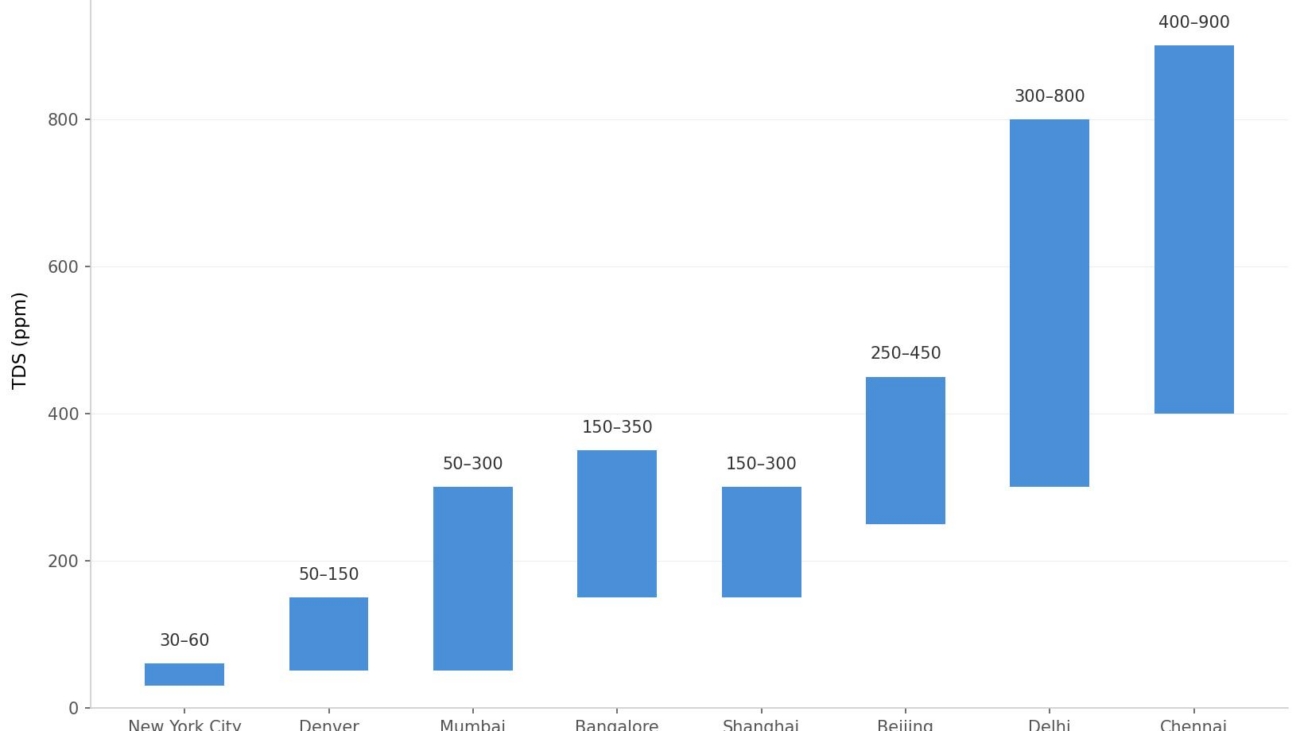
Tap Water via Total Dissolved Solids Comparison in Various Cities Worldwide
Only a few years ago, water facilities provided by municipalities and urban systems were relatively accessible in India. Low and middle income households relied on pipelines, wells and tap water for their daily usage. However, with sharp rises in population, government capital expenditures on water pipelines and sanitation has not kept pace and often fails to meet needs.
For example, rainfall in Chennai City always ends up staying on roads and platforms in the last few years, this despite the city’s infrastructure which has expanded multifold. In many parts of Chennai, water contamination has become severe with high levels of iron, hardness, turbidity and nitrate levels visible. The government has been inefficient when addressing the contamination. As I witnessed in 2019, many parts of Chennai cannot use ground water due to inadequate rainfall, storage and lack of proper municipal supplies.
And due to excessive extraction of ground water and an inability to channel rain water into the ground, many parts of Tamil Nadu now report total dissolved solids (TDS) ranging from 500 to 1000 parts per million, reaching extreme levels of 3000–5000 ppm in some areas. The World Health Organization recommends much lower levels for safe and palatable drinking water.
Water treatment for households using reverse osmosis plants, which were not normal a few years back have become essential for people seeking safe drinking water. Despite being a coastal region , cities like Chennai cannot rely solely on seawater desalination to meet their drinking water needs. While desalination plants contribute to supply, they account for only a fraction of total demand.
Desalination is an energy intensive and expensive process, making it difficult to scale for universal, affordable access. More importantly, producing water is only one part of the solution and delivering it efficiently remains a major challenge.
India endures 3 to 4 crore (30–40 million) waterborne disease cases every year, mostly from contaminated drinking water. As borewells go deeper, they draw water containing high concentrations of fluoride, arsenic, nitrates, and heavy metals. This creates significant health risks, especially for low income households that cannot afford advanced purification systems. The depletion crisis and contamination crisis are increasingly converging.
Due to rapid urbanization and high population with inefficient audits, many water bodies such as lakes and ponds have been encroached upon by the real estate sector or contaminated by waste disposal by surrounding settlements. This is quite visible in Chennai.
Experts claim that many water officials do not have a clear understanding of how pipeline networks are laid out across cities. As Frontline magazine columnist Vedaant Lakhera wrote in April 2026, India’s water crisis stems less from hydrological scarcity and more from a failure of governance.
The absence of water sensitive designs have allowed cities to expand unchecked, almost freely, contaminating local water sources such as lakes and ponds. This has led to a significant depletion of groundwater availability, which were supposed to act as reserve water reserves.
Addressing this crisis requires a multi-dimensional approach. Rainwater harvesting must be scaled to improve groundwater recharge and long-term availability, while modern purification systems remain essential to ensure safe consumption in the short term. At the same time, systemic reforms such as regular pipeline audits, mandatory replacement of ageing infrastructure, and better urban water management are critical to prevent contamination at its source.
Without such integrated efforts, cities will continue to face a paradox of water scarcity amid abundance. Sustainable water security in India does not depend only on how much water is available, but on how effectively it is managed, protected and delivered.