Gordons Bay Sunset 20260514

The Great Compression Part 1: The End of the Middlemen

Elevator Boys of GenAI

In the 1920s, every office building had an elevator boy. Although automated elevators already existed, people found the idea of riding in a driverless box dangling by steel cables terrifying, and delegated the role to a uniformed human they trusted, accepting the necessity to pay for the privilege. Over the years, people got used to elevator buttons, but the force of habit and the preference for human touch kept the profession flourishing for years.

The operators were so confident in their indispensability that they went one step too far: in 1945, a New York strike brought the city to a grinding halt, costing it hundreds of millions of dollars. That was the final straw, leading to a massive push to upgrade to automated systems. Within a short while, the job ceased to exist, entering the history books as the only major job category to be completely wiped out from the U.S. Census purely due to automation. The only one so far, that is.

Elevator boys were the cleanest definition of a middleman: someone who exists not because they create value, but because of information asymmetry or transaction friction. The history of modern commerce is largely a history of those “toll booth” trades, and of the technologies that remove them one by one.

Newspapers were once the only viable printed information channel, using their middleman position to bundle content with ads and classifieds, fattening their revenues. People accepted it because nothing else existed – but then the Internet broke their business model. Craigslist alone did more damage to newspaper economics than any editorial failure ever could; Twitter and Facebook finished the job. Today the newspaper is a diminished thing, sustained largely by institutional inertia and nostalgia.

Real estate agents had an informational moat – access to listings, knowledge of comparable sales, relationships with buyers – which was valuable in a world without Zillow. Once that information became freely available, their commission became very hard to justify. The agent survived by clinging to the execution layer, but that too is shrinking.

Here is where the story gets interesting. The companies that dismantled the old middlemen wasted no time building new ones. Uber eliminated the taxi dispatcher and the phone-in booking system, then inserted itself between driver and passenger for a fat slice of every fare. DoorDash did the same between restaurant and customer. Expedia aggregated what travel agents used to know and charged airlines and hotels for access to their own customers. These were genuine technological improvements, but the business model was identical to what they replaced: find a friction point, own it, and extract rent from both sides. The market rewarded them handsomely for this, for a while. Then the next wave arrived.

Generative AI is driving a change of extraordinary scale and speed. We cannot assess the impact of the tsunami from inside it, but we can see the fish floating belly-up, and extrapolate. The agentic economy is eliminating many roles that just a couple of years ago seemed staple of our service-based economy. AI agents will (if they haven’t yet) replace secretaries, clerks of all kinds, brokers, advisors, recruiters, customer service representatives, paralegals – and the buck won’t stop there.

What is happening now to companies like Capgemini, Accenture, and McKinsey is structurally identical to what happened to newspaper classified departments and taxi dispatchers. AI agents do not merely reduce friction – they eliminate the information asymmetry that made the intermediary necessary in the first place. A system embedded inside an enterprise does not need a consultant to explain what it is doing. It does it, iterates, and reports back.

OpenAI and Anthropic understood this early, which is why both recently announced joint ventures – in a parade lockstep – to deploy engineers directly inside corporate clients. OpenAI has built an elite, highly technical consulting wing – a multi-billion dollar venture backed by TPG, Brookfield, Bain Capital and others. Anthropic teamed up with alternative asset titans like Blackstone, Hellman & Friedman, and Goldman Sachs to form a dedicated AI services company. AI labs are moving fast into services and deployment because model commoditization is a risk, and because adoption bottlenecks hurt revenue growth.

The Big Four are seemingly fine for now, touting alliances with the AI leaders, helping them scale AI implementation across their enterprise clients. However, professional consultants are clearly the next elevator boys, hanging by the thread of the “human in the loop” habit. The only chunk of the consulting business that is accelerating involves embedding the AI revolution into enterprises – and very soon, Anthropic and OpenAI will not require the help of PwC or Deloitte for that. They are the owners of the technology: why would they pay a toll for a booth on their own road?

The irony is pointed: the companies building the technology that makes middlemen obsolete are inserting themselves as the new middlemen between the AI model and the enterprise. But even this layer is temporary. Once AI agents can deploy themselves, even that layer compresses. The OpenAI and Anthropic JV story is the last gasp of the middleman era.

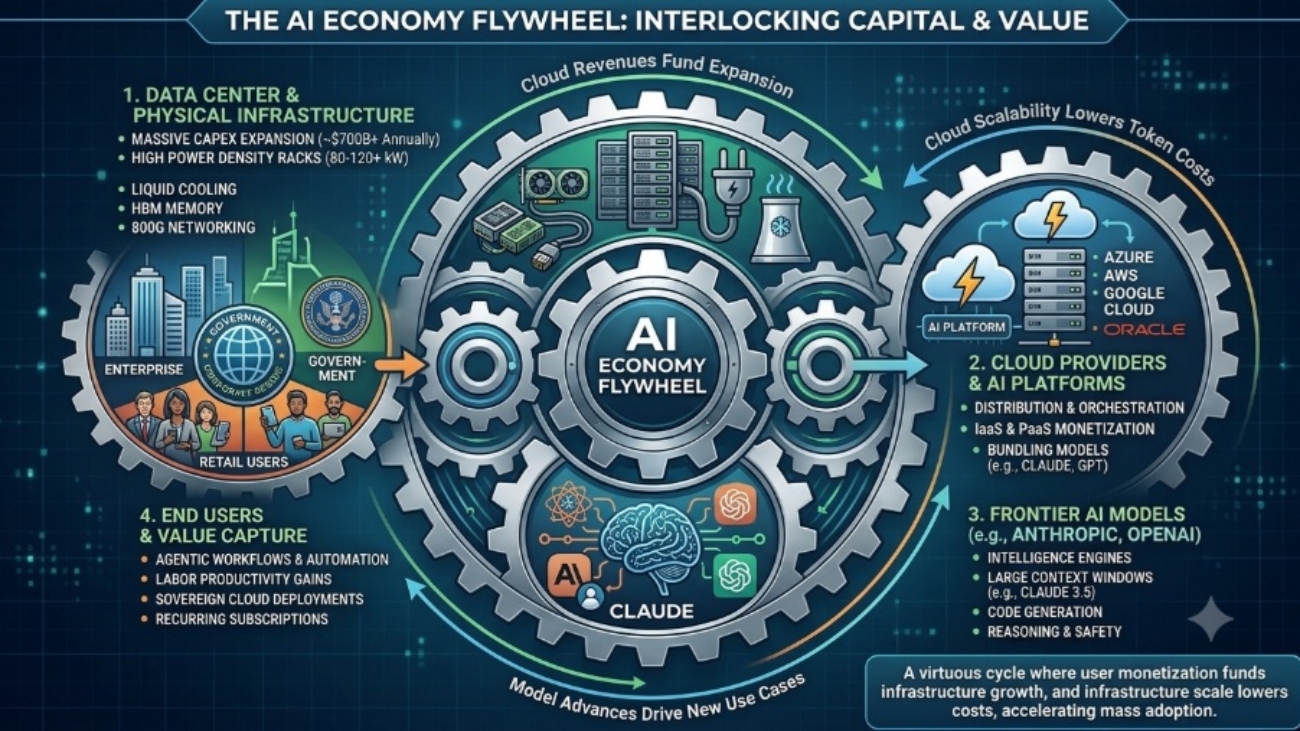
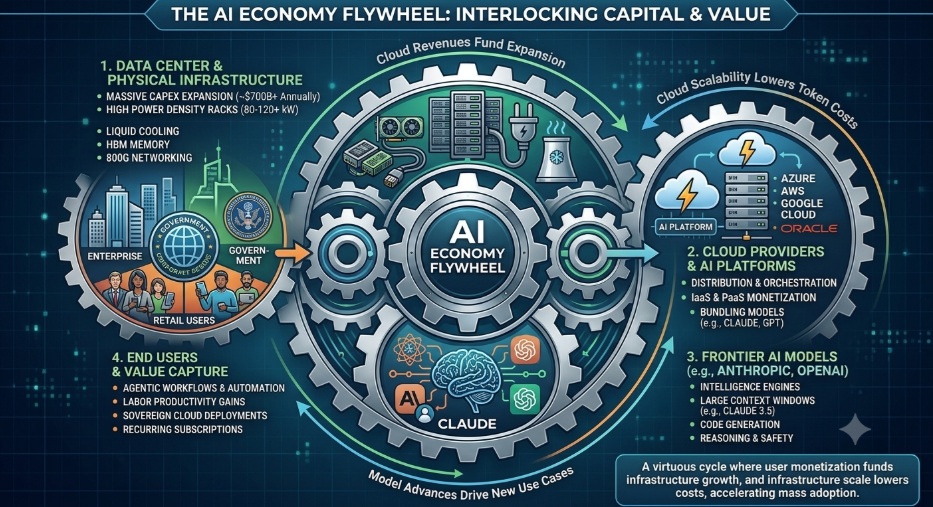
The real and durable beneficiaries of the AI economy are not the model builders. Raw intelligence, reasoning, and pattern-matching are no longer rare, expensive breakthroughs – they are becoming cheap, standardized, and universally accessible. Core AI technology is turning into a commodity, just like electricity once did – and the value moves both up and down the stack.

“Up the stack” is a constantly moving target. Right now, it sits in hyper-specific vertical applications – defense, aerospace, finance, and medicine – where proprietary data, regulatory compliance, and domain expertise create durable moats. It also lives in the integration layer: the software plumbing that turns raw AI reasoning into auditable, legally compliant enterprise actions.

In the near term, value will shift further to agentic orchestration – the “Agent Overlords” that coordinate swarms of specialized AI agents, manage workflows, handle exceptions, and maintain oversight across complex business processes. These control planes will become the new scarce and valuable layer, much as operating systems and databases once did. What comes after that is harder to predict, but the pattern is clear: as each layer commoditizes, the economic prize moves to the next bottleneck.

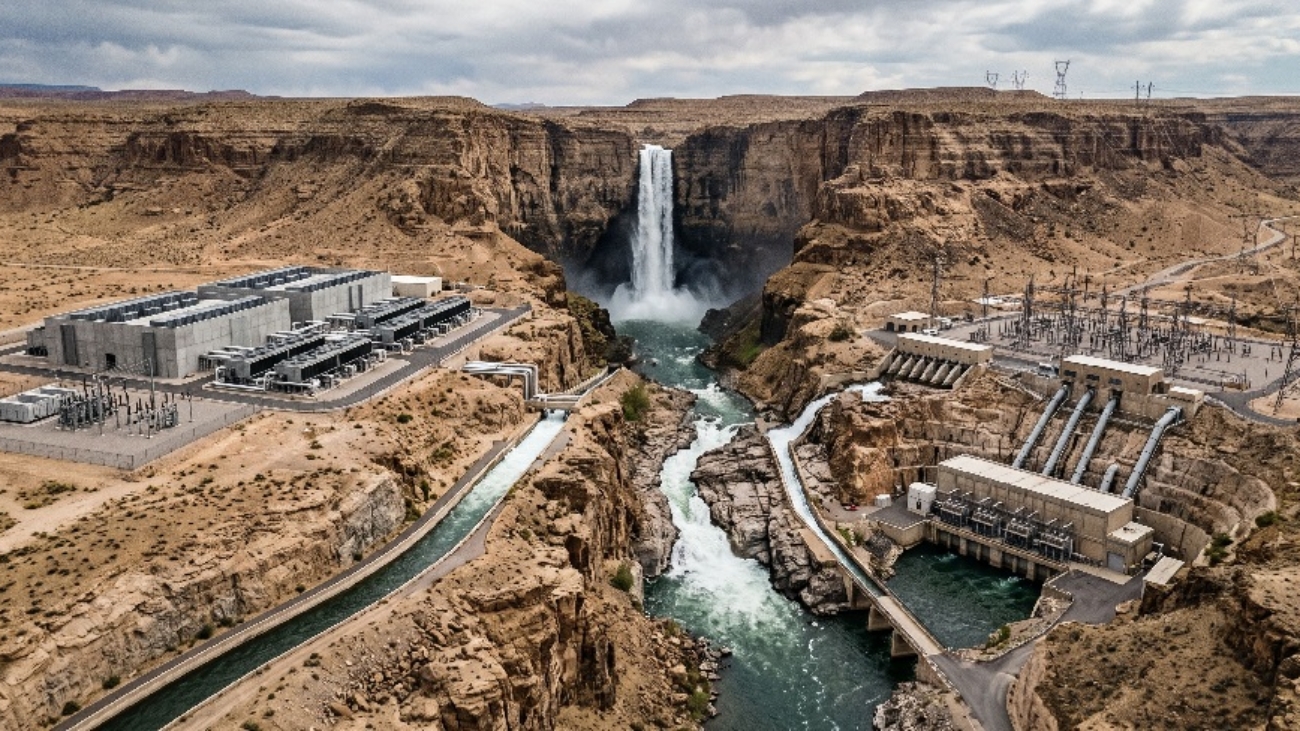
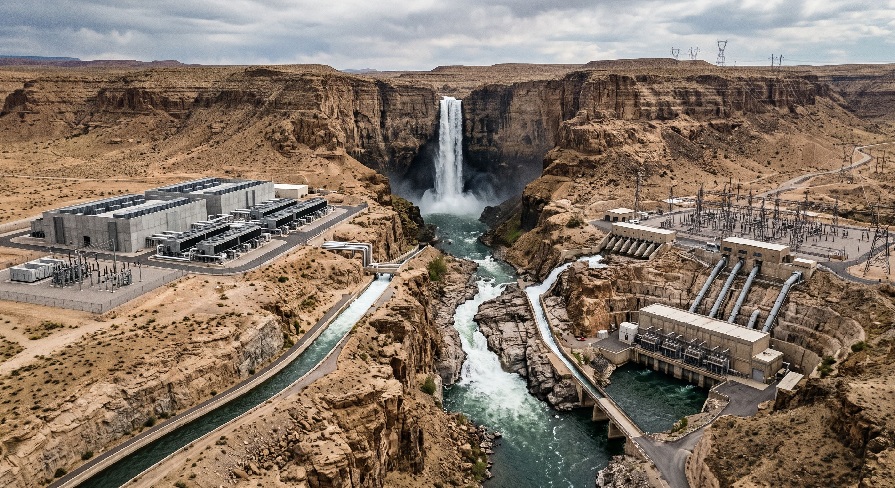
“Down the stack” is the physical layer underpinning everything, and that’s where the true moat is. Every agentic transaction, every automated workflow, every AI-mediated business relationship runs on cloud compute, which runs on power, which runs on tangible assets unlikely to be replaceable for at least the next decade. After a century of disruption, humanity has come full circle: the “boring” material world – acres, bricks, pipes, wires, water, and power – has once again become the real source of scarcity and enduring value.

OpenAI and Anthropic are the last of the middlemen: brilliant, richly capitalized, yet ultimately dependent on infrastructure they do not own. What sits beneath them is not a new intermediary – it is bedrock.

Copy and paste the text from AMT that you want to share

Water India Graph 20260430

India Insider: Water Crisis Has Turned From Severe to Critical

India Needs Sustainable Water Security With Improved Infrastructure

India’s population has been expanding at a rapid pace and stands at 1.4 billion. Due to the urbanization process, industrialization in cities like Chennai, Mumbai and Delhi must continue to emphasize improving public infrastructures in order to maintain vital growth.

The growing population and urbanization adds noteworthy stress to the nation’s water bodies. With more people living in increasingly congested areas and pumping large amounts of water via borewells, groundwater levels are rapidly diminishing.

For instance, India consumes roughly 761 billion cubic meters of water per year, making it the largest water consumer in the world, ahead of China and the United States. 85% of rural India is dependent on ground water for agriculture and consumption, this because lake and pond water are not accessible. Rural India suffers from a lack of maintenance and sewage water that often contaminates these important sources.

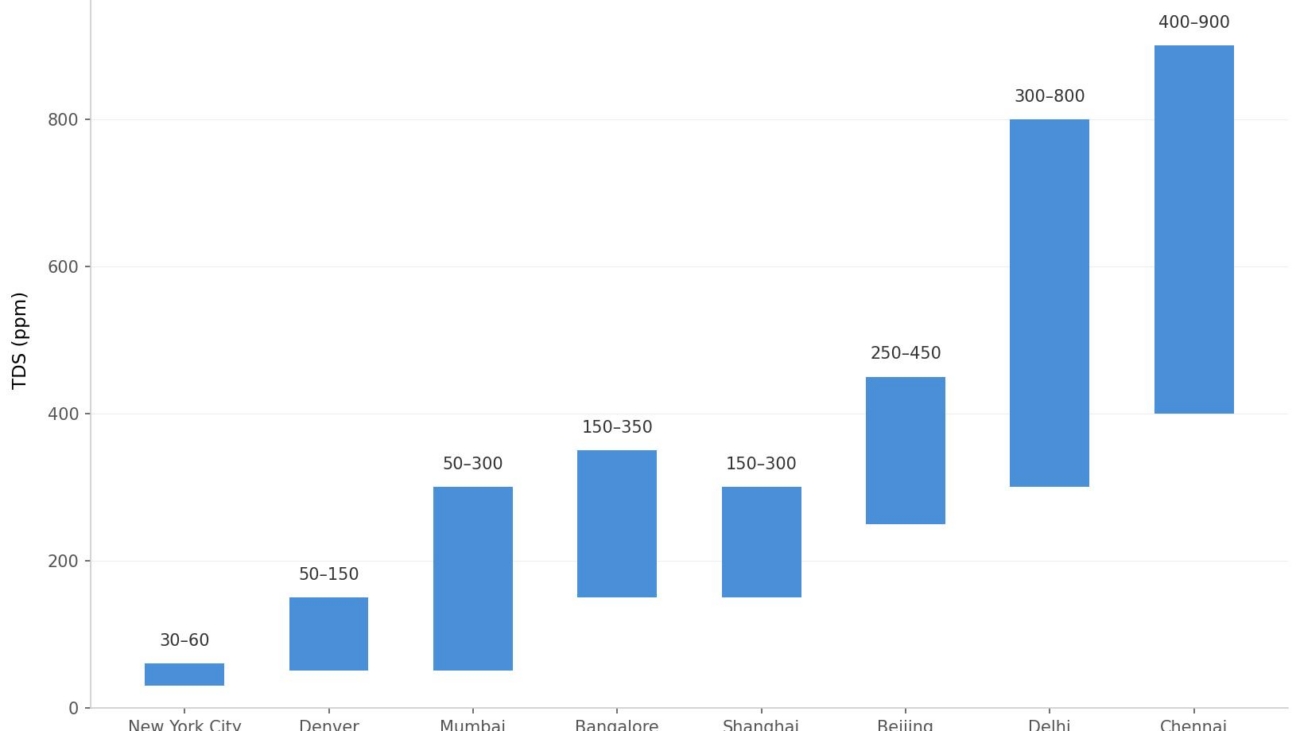
Tap Water via Total Dissolved Solids Comparison in Various Cities Worldwide 

Only a few years ago, water facilities provided by municipalities and urban systems were relatively accessible in India. Low and middle income households relied on pipelines, wells and tap water for their daily usage. However, with sharp rises in population, government capital expenditures on water pipelines and sanitation has not kept pace and often fails to meet needs.

For example, rainfall in Chennai City always ends up staying on roads and platforms in the last few years, this despite the city’s infrastructure which has expanded multifold. In many parts of Chennai, water contamination has become severe with high levels of iron, hardness, turbidity and nitrate levels visible. The government has been inefficient when addressing the contamination. As I witnessed in 2019, many parts of Chennai cannot use ground water due to inadequate rainfall, storage and lack of proper municipal supplies.

And due to excessive extraction of ground water and an inability to channel rain water into the ground, many parts of Tamil Nadu now report total dissolved solids (TDS) ranging from 500 to 1000 parts per million, reaching extreme levels of 3000–5000 ppm in some areas. The World Health Organization recommends much lower levels for safe and palatable drinking water.

Water treatment for households using reverse osmosis plants, which were not normal a few years back have become essential for people seeking safe drinking water. Despite being a coastal region , cities like Chennai cannot rely solely on seawater desalination to meet their drinking water needs. While desalination plants contribute to supply, they account for only a fraction of total demand.

Desalination is an energy intensive and expensive process, making it difficult to scale for universal, affordable access. More importantly, producing water is only one part of the solution and delivering it efficiently remains a major challenge.

India endures 3 to 4 crore (30–40 million) waterborne disease cases every year, mostly from contaminated drinking water. As borewells go deeper, they draw water containing high concentrations of fluoride, arsenic, nitrates, and heavy metals. This creates significant health risks, especially for low income households that cannot afford advanced purification systems. The depletion crisis and contamination crisis are increasingly converging.

Due to rapid urbanization and high population with inefficient audits, many water bodies such as lakes and ponds have been encroached upon by the real estate sector or contaminated by waste disposal by surrounding settlements. This is quite visible in Chennai.

Experts claim that many water officials do not have a clear understanding of how pipeline networks are laid out across cities. As Frontline magazine columnist Vedaant Lakhera wrote in April 2026, India’s water crisis stems less from hydrological scarcity and more from a failure of governance.

The absence of water sensitive designs have allowed cities to expand unchecked, almost freely, contaminating local water sources such as lakes and ponds. This has led to a significant depletion of groundwater availability, which were supposed to act as reserve water reserves.

Addressing this crisis requires a multi-dimensional approach. Rainwater harvesting must be scaled to improve groundwater recharge and long-term availability, while modern purification systems remain essential to ensure safe consumption in the short term. At the same time, systemic reforms such as regular pipeline audits, mandatory replacement of ageing infrastructure, and better urban water management are critical to prevent contamination at its source.

Without such integrated efforts, cities will continue to face a paradox of water scarcity amid abundance. Sustainable water security in India does not depend only on how much water is available, but on how effectively it is managed, protected and delivered.

Copy and paste the text from AMT that you want to share

Universe 20260409

Foreign Exchange and Reading Through the Noise

Brief Clarity, Constantly Interrupted: What Does Copernicus Have To Do With FX?

This article was first published the 7th of April on LinkedIn by the author.

I have spent most of my professional life in foreign exchange markets – an environment that rewards the ability to read signal through noise. And yet the older I get, the more I find myself drawn to a question that no Reuters terminal can answer: why do intelligent, well-resourced people, working inside some of the most information-rich institutions ever created, still systematically misread reality?

I think the answer has less to do with the quality of our data, and more to do with the nature of our frameworks.

The Ptolemaic Trading Floor

In the sixteenth century, Copernicus did not discover new stars. He did not build a better telescope. He simply stood in a different place and looked at the same sky – and from that different vantage point, the complexity that had been accumulating for centuries suddenly resolved into something simpler and more true.

The philosopher Thomas Kuhn, writing about this in The Structure of Scientific Revolutions, made a point that has stayed with me. The Ptolemaic astronomers were not stupid. They were brilliant people doing extraordinarily sophisticated work, and their model of the universe – with its epicycles and equants – was genuinely good at predicting where the planets would be. By their own measures, they were succeeding. But the framework was self-sealing. Every anomaly became a problem to be patched rather than a signal that the whole edifice needed replacing. The epicycles kept accumulating.

I recognise that trading floor.

The VAR models, the correlation assumptions, the ratings frameworks that failed simultaneously in 2008 did not fail because the mathematics was wrong within the model. They failed because the model had pre-decided what reality looked like, and reality declined to cooperate. The framework had accumulated its own epicycles – its own patches and exceptions and special cases – and nobody had stood back to ask whether the whole structure still made sense.

This is what the economist Herbert Simon called bounded rationality – the idea that we make decisions within limits of information, time, and cognitive capacity. But I think there is a deeper form of boundedness that Simon’s original formulation didn’t fully capture. It is not just that we lack information within a given framework. It is that the framework itself determines what counts as information in the first place. The boundary is not cognitive – it is epistemological. The frame has pre-decided what reality looks like, and we optimize furiously within it, never suspecting there is anything outside.

This is framework-induced bounded rationality. And financial markets are one of its purest expressions.

The Filmiest of Screens

William James, writing in 1902, described something that has always struck me as one of the most quietly radical observations in the history of psychology:

“Our normal waking consciousness, rational consciousness as we call it, is but one special type of consciousness, whilst all about it, parted from it by the filmiest of screens, there lie potential forms of consciousness entirely different. We may go through life without suspecting their existence; but apply the requisite stimulus, and at a touch they are there in all their completeness.”

James was writing about mystical experience. But I think he was also describing something that every trader knows intuitively – that there are moments of genuine clarity, where the market’s structure becomes briefly, luminously obvious, and then the noise closes back in. Not constant confusion, but brief clarity, constantly interrupted.

What interrupts it? I think James gives us a clue, though the fuller answer comes from a tradition he was only beginning to encounter.

The Deluded Self and the Distracted Market

The Yogācāra school of Buddhist philosophy, developed in the fourth and fifth centuries, offers one of the most sophisticated maps of consciousness ever produced. It describes eight layers of awareness, from the basic sense consciousnesses up through something far more interesting – the seventh consciousness, called kliṣa-manas.

Kliṣṭa-manas is the layer of mind whose function is to construct and defend a sense of self. But the Yogācāra tradition makes a more precise and more troubling point than simply calling it deluded. By the time information reaches the seventh consciousness, it has already passed through the sense consciousnesses and the discriminating mind – each stage filtering, selecting, and coloring what gets through. The seventh consciousness is not distorting clean data. It is working with inputs that are already biased, and it has no way of knowing this. It constructs its picture of reality from pre-processed material, and then defends that picture as if it were direct perception. Try telling a QANON follower to get a vaccine jab.

The parallel to institutional behavior in markets is uncomfortable in its precision. Risk committees, house views, investment mandates – these are the kliṣṭa-manas of the trading floor. They exist, at least in part, to protect the institution’s sense of itself. The risk manager who cannot recommend a position that contradicts last quarter’s framework. The economist whose forecast must remain defensible to the committee. The trader who holds a losing position because admitting the loss means admitting the thesis was wrong. These are not failures of analysis. They are the seventh consciousness doing exactly what it was built to do.

And into this environment, the attention economy arrives as accelerant. Social media does not simply distract – it feeds kliṣṭa-manas directly. Likes, outrage, identity, tribal affiliation – all of it strengthens the self-constructing layer and weakens the capacity for clear perception. The signal-to-noise ratio in markets was already difficult. We have now built an entire industrial infrastructure for generating noise that feels like signal, because it flatters the self that is doing the perceiving.

Standing in a Different Place

The Yogācāra tradition does not stop at the seventh consciousness. Beneath it lies the ālaya-vijñāna — the storehouse awareness, a kind of ground-level consciousness before the self-construction begins. It is not a mystical concept, or not only that. It is a description of what perception might be like before the defending ego has finished processing it.

The best risk-takers I have encountered in markets seem to access something like this, in their better moments. A capacity to see the position as it actually is, without the framework that produced it colouring the perception. To hold a view lightly enough to abandon it when the evidence changes. Copernicus looking at the same sky and seeing something different – not because he had more data, but because he had momentarily freed himself from the inherited frame.

James was right that these states are parted from ordinary consciousness by the filmiest of screens. The Eastern traditions – Buddhist and Vedantic – have spent two and a half millennia developing systematic methods for thinning that screen. Western psychology, for all its extraordinary achievements, has been slower to take this seriously, often treating consciousness itself as a problem that better neuroscience will eventually dissolve. It may be that, in this respect, we are in the position of the medieval scholars encountering Arabic science – not lacking intelligence, but working within a framework that makes certain questions difficult to even formulate.

What This Has To Do With FX

Markets are reflexive. The moment enough participants adopt the same model, the model changes the thing it was measuring. The framework that produced clarity attracts capital, the capital erodes the edge, and you need a new framework. Brief clarity, constantly interrupted – not as a pathology, but as the structural condition of the thing itself.

The question is not how to achieve permanent clarity, which is probably neither possible nor desirable. The question is whether we can develop the capacity to notice when we are inside a framework rather than seeing through it – to feel the epicycles accumulating before the model breaks.

That capacity, I suspect, is less a matter of better data or faster processing, and more a matter of the quality of attention we bring to the screen. Which means the most important professional development available to a markets practitioner might not be in a CFA curriculum.

I am aware of the irony of writing this on LinkedIn, which is itself a highly effective delivery mechanism for kliṣṭa-manas. The seventh consciousness is nothing if not adaptive.

Note: The author works in foreign exchange markets and thinks too much.

Copy and paste the text from AMT that you want to share