
The Fed Should Not Raise Rates But It Will
What and who you believe will play an important part in today’s market for speculators. While investors who are looking at long-term prisms can comfortably wait on the decision from the Fed’s FOMC regarding interest rates later today, retail traders who are trying to profit on near-term wagers via momentum and are seeking to gain an advantage by knowing which way the wind is blowing have a difficult task ahead. Via results in the Forex market it appears many financial institutions have braced already for an interest rate hike of a quarter basis point.
However, what if the financial institutions and many analysts are wrong? What if Fed Chair Kevin Warsh and other FOMC voting members believe the White House and think that inflation will erode as price pressures ease when there is a remedy to the Iranian conflict. That would mean that they could debate with other Fed officials for no interest rate hike. Because if the Fed were to raise interest rates later today, thus making borrowing costlier for businesses and consumers – and potentially putting more strain on the U.S debt payments because of increasing Treasury yields, it would still not solve the higher costs of energy. (There is an argument below which negates this possible yield problem and one that is likely to be heard from some economists).
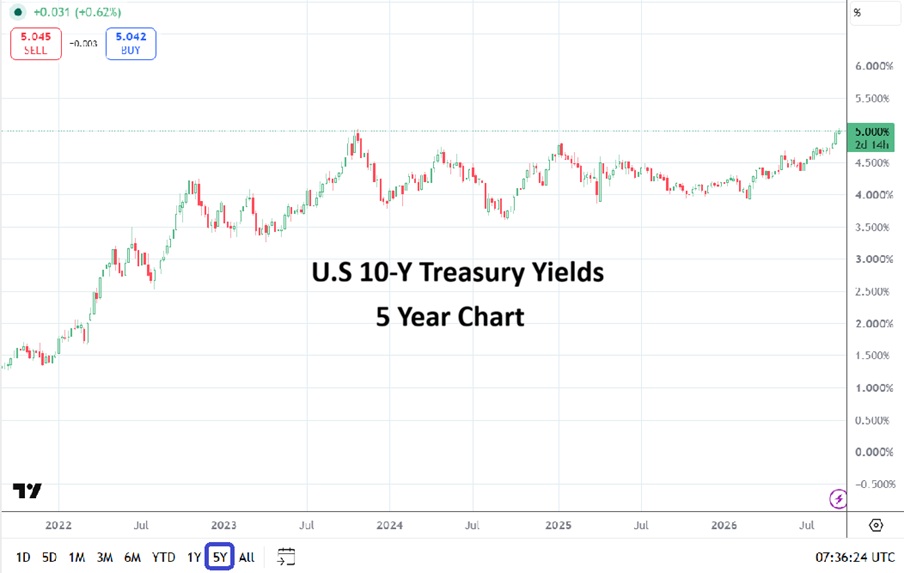
U.S 10-Y Treasury Yields Five Year Chart as of 16th September 2026
Yes, there is demand for fuel globally, but the demand for energy is not going to decrease because the U.S Federal Reserve may raise interest rates. In fact, it could make costs more expensive for businesses who are likely burning money via increased credit lines already created, this to transact their currently higher costs to guarantee effective supply of fuel to fund their logistics and manufacturing which they had not planned for while making their initial 2026 budget estimates prior to the Iranian war. In other words, a higher Federal Funds Rate will equate into higher costs for businesses.
$100.00+ WTI Crude Oil is Not A Friend
Per the other side of the coin, WTI Crude Oil has turned more expensive and volatile since March of this year. For a moment it looked like relief would be delivered via the supposed MoU between Iran and the U.S. WTI Crude Oil went below $80.00 periodically when optimism was peaked by White House rhetoric and calm waters in the Hormuz Strait were reported. Hopes for a return to WTI Crude Oil below $70.00 were viewed as legitimate.
However, the tranquility sought has vanished in the past couple of weeks and has grown more anxious as Saudi Arabia has become an important actor in the Middle East conflict as the Houthis and Iraqi militias cause havoc for the Saudi Arabian government. The price of WTI Crude Oil is now stubbornly above $100.00 and rumors about how Saudi Arabia is dealing with its own military confrontation and the way it is able to supply its own Crude Oil are confounding.
Which brings us back to the initial question regarding the Federal Reserve and Kevin Warsh, who will the Fed Chair listen to? Does he and other voting members of the FOMC believe there will be a quick fix to what has become stubbornly higher costs for WTI Crude Oil which is creating inflation? Or do they now have to objectively consider what may have been perceived as a temporary blip of elevated expenditures for the U.S economy as a potentially long-term problem? If Warsh and his cohorts believe the Iranian situation is going to find a remedy within the next four to five months, they should NOT raise interest rates today.
Again, while higher fuels costs are problematic, raising interest rates is not going to lower demand for WTI Crude Oil which is the chief instigator of higher inflation globally. It is not a question of who believes President Trump’s tantrums, it is a question concerning viability of a real end game to the Iranian situation. Plenty of Crude Oil exists, its production capabilities are strong, it is Middle East supply to Asia, Europe and Africa that is causing a problem and the higher cash and futures pricing for WTI Crude Oil. Thus, the lynchpin remains Iran. If their government capitulates and bends a knee, opening up the Hormuz Strait and stops plying its influence on the Houthis of Yemen and other militia groups in Iraq that are now causing problems for Saudi Arabia the price of WTI Crude Oil will drop dramatically.
If the situation is not rectified and the price of WTI Crude Oil remains elevated and Saudi Arabia doesn’t handle their confrontation which is turning increasingly militaristic, then it will not solve a higher interest rate initiative from the U.S Federal Reserve – unless the Fed is merely looking to decrease Treasury yields by increasing global demand for the bonds – thus hoping to increase their desirability.
Old School vs. New School
Today’s decision from the Fed comes down to old text books and failed central bank policies versus new economic considerations. An interest rate hike from the Fed may actually make circumstance more difficult for governments around the world trying to balance their own books.
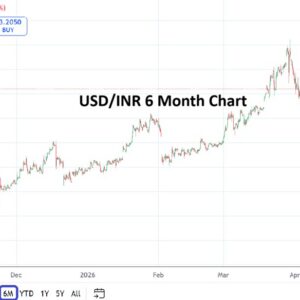
For instance, higher yields on U.S debt are causing problems in India where some investors are shedding Indian Rupee assets and seeking the high yielding U.S Treasuries not only because of a ‘guaranteed’ bond yield, but the fact that their assets are stored in USD which is likely going to remain stronger than the INR over the next few years if a historical track record is looked upon. This is a saga that will play out in other emerging market nations too as financial institutions chase ‘secure’ profits.
5 is a Dangerous Number
So not only does the Fed face a problem regarding an interest rate hike that will not solve inflation problems caused by a war that is effecting prices because there is a fear of supply logistics, but there could be a knock-on effect regarding debt. U.S 10-Y Treasury yields near and above 5% is a clear warning side that investors are uncomfortable, this no mere speculative gain achieved by bond vigilantes.
Another point, if the Fed were to raise interest rates today, it could in theory cause greater demand for U.S Treasuries from abroad and thus lower the Treasury yields for the moment – thus making the argument for a higher interest rate more dignified for those who want to raise rates. However, if the Fed were to say no to interest rate increases for now and point to a belief the U.S conflict with Iran is going to conclude sooner rather than later and said the U.S economy faces distress because of the higher fuels costs alone, this could also solve confidence problems.
U.S debt stands above 40 USD trillion, lower yields are a desire, but lower borrowing costs for businesses and consumers are wanted too. So what will the Fed do today………..drumroll please…………the Fed will raise interest rates – making a mistake. And will show it fears a long-term risk scenario between Iran and the U.S and problems for Saudi Arabia. The USD will see plenty of volatility. Confidence will not be shown by the Federal Reserve today and this will be problematic.
Stage presence from Fed Chair Kevin Warsh is going to be extremely important today. He has failed in his previous two FOMC Press Conferences to look confident while speaking and answering questions. His speech at Jackson Hole in late August also proved lackluster.
And this is where is gets more dangerous for Warsh and the U.S White House, because of President Trump’s ability to change his tactics quickly – there is a lack of confidence among investors who are trying to gauge their outlooks for the mid-term and beyond.
Kevin Warsh will find it difficult to pull a rabbit out of a hat. Many folks will walk away disgruntled if an interest rate is introduced and no clear guideline is mentioned regarding what is next regarding other potential rate hikes – or a plan to actually lower the Federal Funds Rate. The U.S economy while strong could easily be sent into a recession with an interest rate hike and sustained higher WTI Crude Oil costs.
Behavioral sentiment is going to remain on a toxic tightrope unless confidence is delivered. While individual perceptions about what should be done are important, understanding the mindset of the U.S Federal Reserve is crucial. Eliminating our own personal beliefs and bias from trading decisions and acting on what realities may be demonstrated are vital to profit.
Copy and paste the text from AMT that you want to share
Like this? Get the next one in your inbox.
Independent commentary on global markets, geopolitics, and the forces shaping capital flows. Two to three articles per week.
Related posts:
 AMT Top Ten Miscellaneous Post-Labor Day Notes and Tantrums
 Thoughts on Kevin Warsh, the Fed and USD, Energy, Nasdaq 100, USD/JPY and Bitcoin
 Bad Timing for President Trump May Equal Good Trading Opportunities
 Conflicted Trading: Singapore Dollar and Federal Reserve Considerations
 Progression Upwards for Indian Rupee and Catalysts