Indian Rupee 20260515

India Insider: Rupee Under Pressure as Oil Prices Surge and Import Bills Rise

Iranian War and Implications for India as Energy Prices Cause Vulnerability

India is currently facing mounting external economic pressures as rising global crude oil prices weaken the Rupee, widen the current account deficit, and increase the risk of imported inflation. As one of the world’s largest energy importing nations, India remains highly vulnerable to fluctuations in global oil markets. The recent surge in energy prices, combined with geopolitical tensions and volatility in currency markets, has intensified concerns among policymakers, economists and investors.

The Reserve Bank of India (RBI) has stepped up its intervention in the foreign exchange market to stabilize the Rupee, while the government is evaluating measures to reduce pressure on import billing. Rising fuel prices, weakening currency conditions and growing external imbalances have combined to create a challenging macroeconomic environment that may test India’s economic resilience in the coming years.

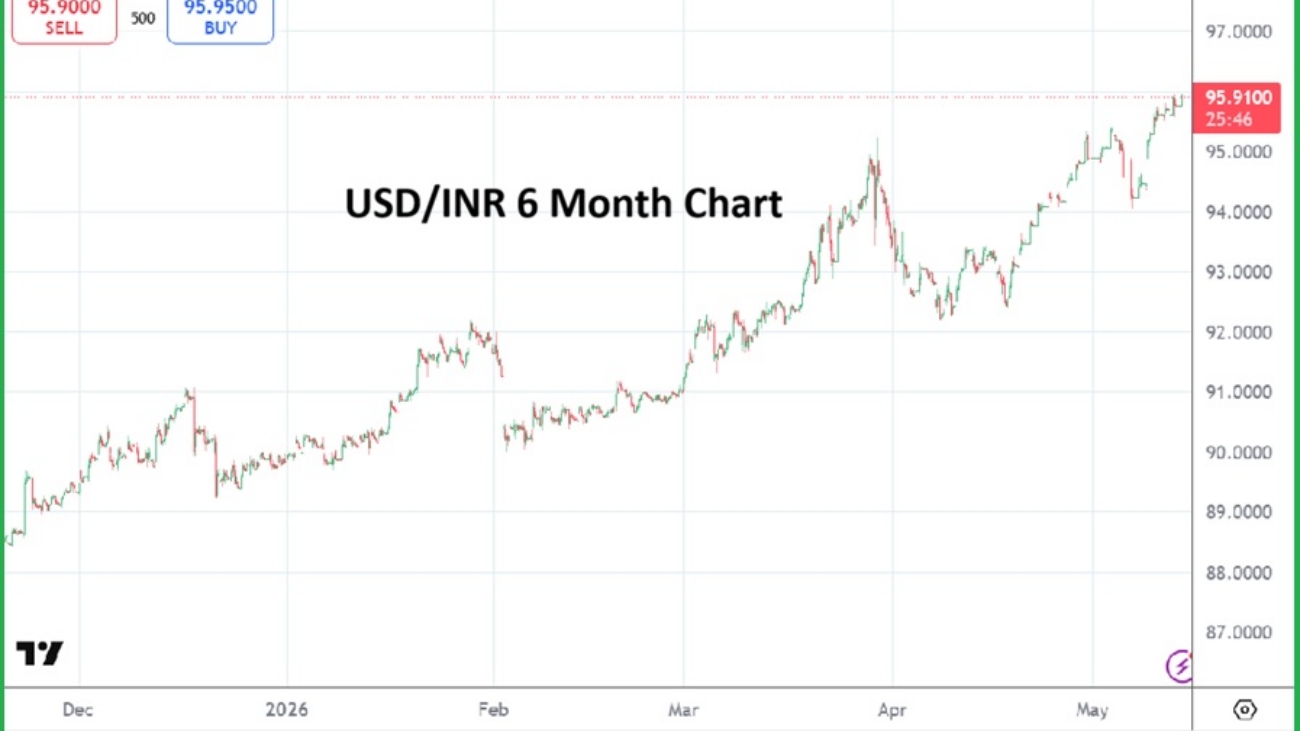
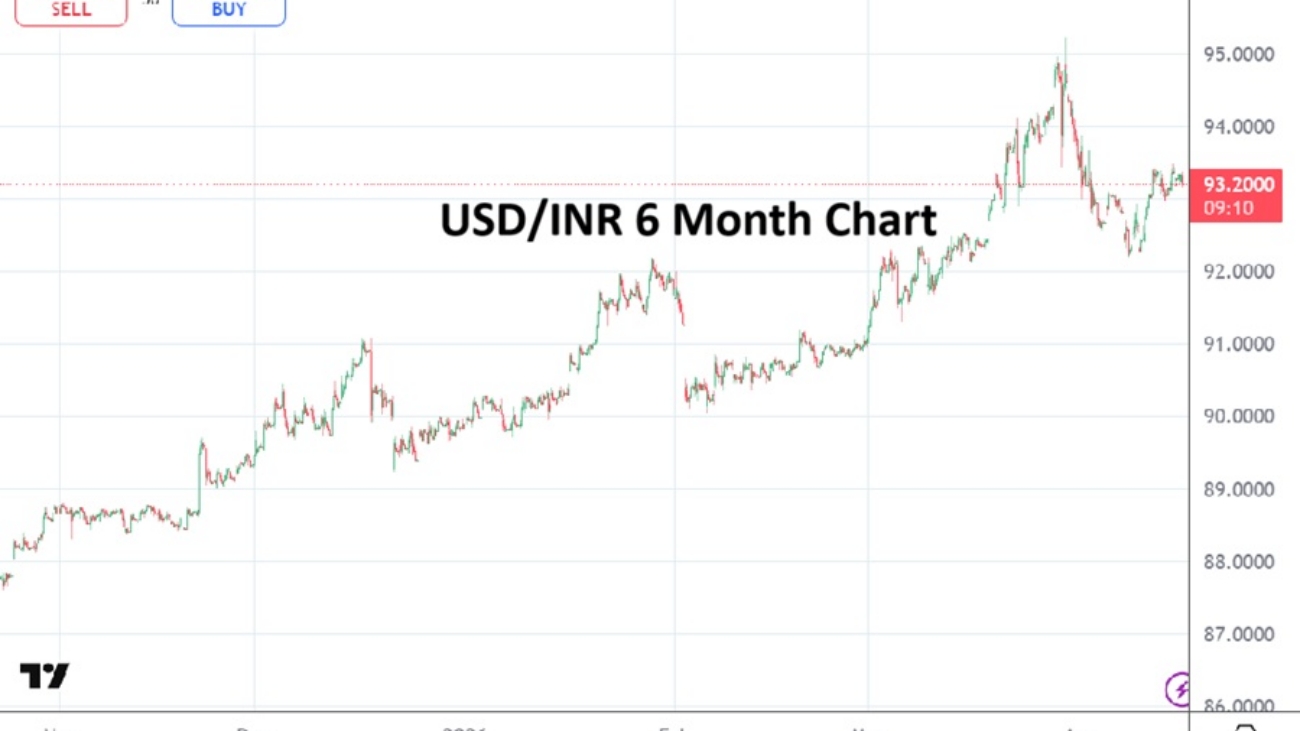
USD/INR Six Month Chart as of 15th March 2026

Gold and consumer electronics imports are increasingly being viewed as non-essential imports, and policymakers may consider restricting these categories in order to reduce stress on the current account deficit. Officials are concerned that a widening trade imbalance could place further downward pressure on the Rupee and increase dependence on foreign capital inflows.

The Rupee on Thursday fell to a record low near ₹95.95 per USD, making it one of Asia’s weakest performing currencies this year. The currency has erased most of the gains achieved following earlier RBI intervention measures aimed at curbing speculation in the Forex market. Analysts expect the Rupee to remain under pressure through 2026, especially if global crude oil prices continue to rise and significantly increase India’s import billings.

The impact of rising crude oil prices is becoming increasingly visible across the Indian economy. Private fuel retailers have either reduced diesel sales or raised prices in response to the rally in global oil markets, leaving state owned refiners to absorb a larger share of domestic demand. Long queues at fuel stations and rising transportation costs have intensified concerns over inflationary pressures.

Earlier today, State-owned fuel retailers raised fuel prices for the first time in nearly four years as New Delhi adjusted domestic pricing to reflect higher international crude prices following escalating tensions in Western Asia. Diesel and gasoline prices increased by more than 3%, even though Brent crude prices had risen by nearly 50% over the same period.

In New Delhi, diesel prices climbed to around ₹90.67 per litre, while gasoline prices rose to approximately ₹97.77 per litre. These are among the highest levels recorded since 2022 and reflect the growing burden of imported energy costs on the Indian economy.

Economists argue that the rise in fuel prices signals a gradual shift toward market based pricing rather than extensive government controls. Policymakers increasingly recognize that artificially suppressing fuel prices could worsen fiscal pressures and create larger external imbalances over time.

Currency Weakness and Monetary Policy Challenges

RBI Governor Sanjay Malhotra recently remarked at an event in Switzerland that continued currency weakness may be “only a matter of time” if global energy prices remain elevated and capital flows become increasingly volatile.

Foreign outflows during the year have already exceeded previous levels, while a sustained rise in crude oil prices above $100 per barrel could significantly widen the trade deficit and push India towards another period of pressure on balance of payments.

In this climate, attracting foreign capital via various tax cuts or raising the interest rates is paramount to reduce the pressure on the currency. It’s already been seen that New Delhi is working on reducing taxes for foreigners investing in Indian bonds.

Rise of Inflationary Pressures

Although India’s headline inflation remains relatively contained and below the RBI’s 4% medium term target, imported inflation risks are steadily increasing.

Economists also believe the RBI may eventually be forced to maintain tighter monetary conditions or raise interest rates further if energy prices continue to accelerate.

The central bank has already raised interest rates to around 5.25% this year, but several economists argue that further tightening may still become necessary.

Historical Perspective and Structural Risks

Economic historians often compare the current situation with the oil shocks of the 1970s. During that period, the United States was heavily dependent on imported oil. The oil crises of 1973 and again in 1979 contributed to inflationary pressures, balance of payments stress, and periods of USD weakness.

However, economists note that today’s global environment is significantly different. The United States has become one of the world’s largest oil and gas producers, reducing its dependence on imported energy. As a result, rising oil prices no longer weaken the U.S Dollar in the same way they did during earlier oil shocks.

For countries like India, the impact remains severe. India imports the majority of its crude oil requirements. Higher global oil prices directly increase India’s import billing and create additional demands for USD.

As Economist Philip Verleger was quoted by Bloomberg, “when you are a major oil importing nation, you are not only paying more for crude itself, you are also paying more for the dollars required to purchase it.” India is now facing this realization again.

Copy and paste the text from AMT that you want to share

WTI Crude Oil 20260428

Shift To Economic War Against Iran to Deprive Funds to Regime and IRGC

What If Everyone Is Looking At The Wrong Things About Iran?

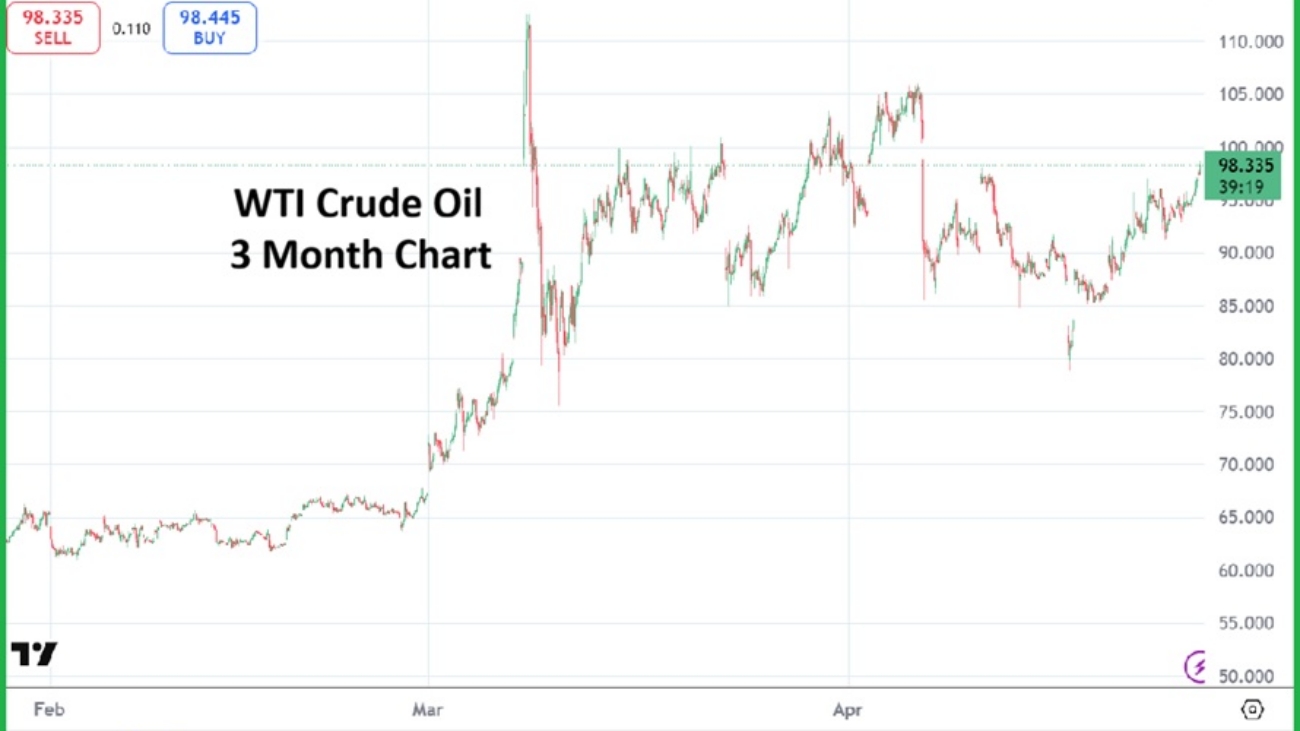
The current futures price for WTI Crude Oil is above $98.00. The cash price for the commodity is above $103.00. While many people continue to fret about what endgame strategy the U.S White House is conducting, what if we are seeing it play out in real time via the price of Crude Oil? Is it possible that President Trump has a coordinated plan to starve the Iranian regime and the IRGC of its much loved and needed money? It appears this is the case.

WTI Crude Oil Futures Three Months Chart on the 28th of April

Simply put, the Iranian Revolutionary Guard Corps is a mafia. They stay in power using the tool of fear brought upon by their ability to be ruthless to the Iranian citizens. They are a terrorist organization in the truest sense. If you disagree with that assessment, you are free to do so. However, facts when they are studied point to the conclusion Iran is a terrorist state led by its regime and the IRGC. 

Iran has made massive amounts of money via its energy products for decades. The shutdown of the Hormuz Strait, or at least the inability to export Crude Oil freely, is putting a strain on global energy prices, and it is causing a major fracture in the main financial export of Iran. 

The U.S has not only shut down easy navigation in the Hormuz Strait, but it is also going after Iran’s cryptocurrency operations. The ability to receive and transfer digital money by Iran is being strangled. What if President Trump is not only listening to the opinions of his military officers, and Secretary of State Rubio and Vice-President Vance, but also Treasury Secretary Scott Bessent who has an abundance of financial knowledge about how money flows internationally and how to create obstacles.

If the IRGC is not able to pay its own members, and other adherents to the Iranian regime are only slowly reimbursed, the apparatus of the IRGC will certainly lose its influence. The inability to pay allies that exists merely because they are employed or corrupted by the IRGC likely is starting to cause fractures regarding loyalties. 

China needs Iranian oil too. And evidence is starting to be speculated upon that China is facing tough decisions about acquiring Crude Oil from other sources. China will not be happy about having to pay higher costs, this because discounted Iranian oil that has abundantly been used is no longer available. 

Equities via the major U.S indices have done incredibly well since the end of March. The Nasdaq 100 has seemingly forgotten about AI overbought concerns, the S&P 500 is within apex territory and the VIX is acting as if sunny days are in the forecast. Forex has been volatile, but the value of the USD is within known realms.  However, the price of WTI Crude Oil is high and it has gotten higher since the 17th of April when futures prices briefly flirted with the $80.00 realm – this before going into a weekend. And this is a clue that something is afoot, beside larger players speculating on what their outlooks are for WTI Crude Oil in the mid-term.

The weekend of the 18th and 19th of April witnessed talk of an end to the Iranian war fall short; and heard President Trump essentially declare the ceasefire is still on but with the caveat that the U.S would create a blockade in the Hormuz Strait. While the semantics of a blockade can be debated, the U.S has caused shipping problems for tankers that were supposed to ship Iranian Crude Oil. The U.S clearly decided to create economic distress for Iran.

The Iranian regime still stands, but its leadership is rather shaken. The IRGC is controlling a lot of the decision making for the time being, and it appears the U.S White House is trying to make the IRGC weaker by ending their financial lifelines. It appears that it has been figured out that an economic war which includes starving Iran of cash is the most certain way to create revolts inside of the nation. When the influence of money is eroded, and temptations via other spheres of power suddenly sound tempting and can be joined, this is when shifts in authority and leadership can occur. 

While many analysts wonder about the lack of an obvious endgame being announced by the Trump administration, maybe it is already being played out. President Trump has a large ego and he is happy to extoll the virtues of his ‘tremendous’ policies frequently, but he also has shown the ability to remain quiet when it comes to plans of action and carrying them out. Yes, this can be argued into the late hours by pro-Trump and anti-Trump people. But maybe Trump is simply telling the truth when it comes to the U.S having time on its side regarding the Iranian ceasefire and the Strait of Hormuz. Maybe the clock is ticking on the eroding cash pile the Iranian regime and IRGC has within its grasp.

Copy and paste the text from AMT that you want to share

India Rupee 20260416

Progression Upwards for Indian Rupee and Catalysts

USD/INR Persistent Trajectory Remains in Force and Mid-Term Concerns

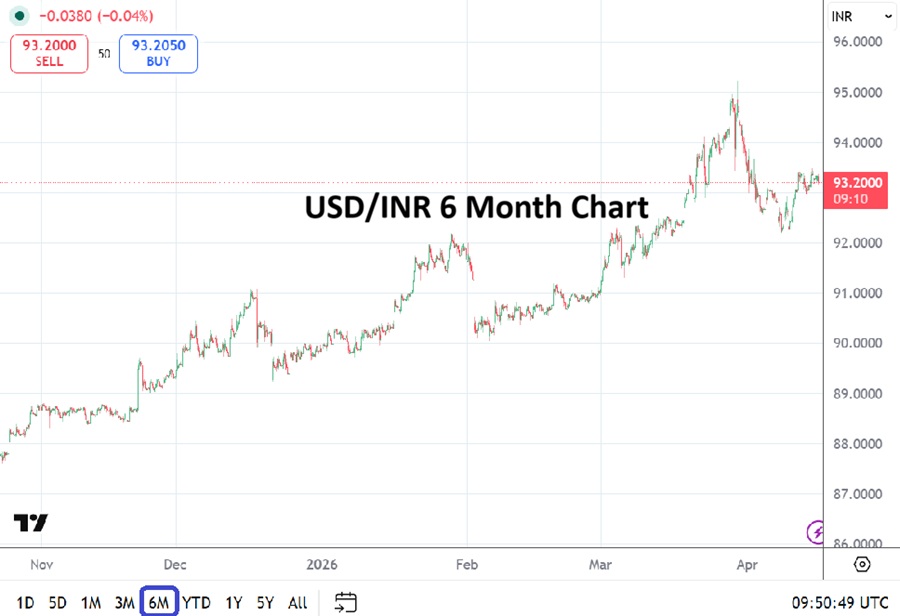
As of this writing the USD/INR is within the 93.2000 vicinity. The price of Gold is around $4,810.00 and Silver close to 79.50. Importantly, WTI Crude Oil is trading around $89.25. Global markets have turned in solid performances the past two weeks, this has been a two step progression for most investors. 

Indian financial institutions began to digest their worries regarding the Iranian war late in March – perhaps acknowledging the risks and ramifications, while adjusting outlooks. Then on Tuesday the 7th of April the establishment of a ceasefire was announced. However, after hitting a low of around the 92.2200 realm on the 8th of April, the USD/INR is back within higher ratios.

USD/INR Six Month Price Chart as of 16th April 2026

Yes, the USD/INR had been traversing above the 95.0000 ratio late in March, so it can be said the Indian Rupee has gotten stronger. Yet, there will not be many willing participants who will join a parade with the belief this lower trend can be sustained. The bullish trajectory of the USD/INR is not going to vanish.

On the 24th of October 2025, the USD/INR was near 87.7500. At this time last year the currency pair was close to 85.5000. A persistent and long-term move higher has been the theme in the USD/INR. Weakness in the Indian Rupee has been part of India’s economic story rather consistently for a handful of years. 

Narendra Modi has been in power since 2014, he is serving his third term as Prime Minister. His political party the BJP clearly has its chosen people within the Reserve Bank of India.

The government’s position of allowing the Indian Rupee to be weaker is not something they will want to state out loud as part of their mandate, but it is clearly not bothering them.

The pursuit of creating a stronger industrial and manufacturing base for India, including IT and software via good exchange rates for international clients is seen as a cornerstone to build demand. The quality of work and technology provided by the Indian workforce is good and this allows global clients to foster solid relationships with Indian companies.

However, the rise of the USD/INR to above the 95.0000 level in late March was a warning sign, that sometimes price velocity in Forex can become dangerous. And the Iranian war although enjoying a week and half of less noise, still could escalate into a problematic scenario for India that could cause additional concerns in Indian financial institutions who are trying to gauge their mid-term outlooks.

The USD/INR is an important part of this economic math and the prospect that higher energy costs, or in a worst case scenario – shortages incur hardship for Indian citizens and companies is an actual concern.

The current situation in the Hormuz Strait and availability of Crude Oil is significantly important for India. So is supply of LNG (liquefied natural gas) which Qatar, Oman and the UAE play a role. The supply of energy presents a glaring dark shadow for the prospects of the Indian economy should there be shortfalls. 

The 93.5000 resistance level has been durable since early April in the USD/INR. Stability of the exchange rate is crucial for a wide range of business in India, including banking and financial institutions active in the Bombay stock market – particularly since a weaker India Rupee opens the door to Forex concerns for foreign investors who do not have the ability to hedge if they are exposed via the INR too much. Foreign investors are needed in the Nifty indices to help values.

The near-term is likely going to remain a difficult path for the USD/INR and its outlook. The positive sentiment which has prevailed the past couple of weeks has been welcome and certainly stable conditions are hoped for so equilibrium can be kept. However, if the Iranian situation manifests into open military conflict again, or if there is a disruption of supply of energy that cannot be easily solved by India – then the USD/INR could once again face price velocity upwards that is uncomfortable.

While China may be getting the headlines regarding potential ramifications of its Crude Oil supply being threatened, India is estimated to have consumption that is ranked as the 3rd biggest globally. India’s ability to get a supply of energy from a diversified stable of sources is a key for the nation moving forward. 

The USD/INR will continue to move higher, the question is how fast? A slow steady rise in the currency pair – again, this will not be a spoken mandate by the Indian government – will continue. The fear of a rapid debasement is a concern. Financial institutions in India need steady emotions and are certainly hoping for the Iranian war to conclude with a sliver of optimism. 

Copy and paste the text from AMT that you want to share

Negotiation 20260415

Checkmate: Who is Afraid of Negotiations?

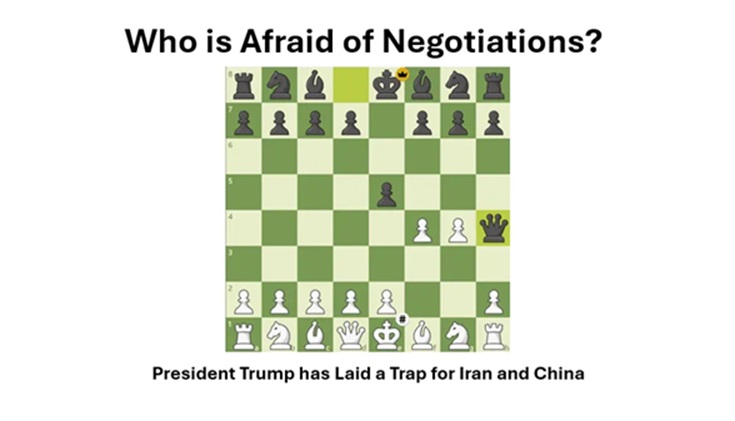
President Trump has Laid a Trap for Iran and China

Opinion: The following article is commentary and its views are solely those of the author. This article was first published the 15th of April via The Angry Demagogue.

Both the defeatist camp and the “victory now” group see the advent of negotiations between the United States and Iran as a defeat for the United States and Israel. The argument by the defeatists is that victory was supposed to be quick and now we are stuck and looking for a way out since no one saw Iranian use of the Straits of Hormuz coming. The defeatists claim that only negotiations can end the conflict and anyway, Iran never should have been considered an enemy so the United States and Israel have overemphasized Iranian danger. The defeatists do not want a military victory and assume defeat as the moral choice.

For the victory now group, negotiations are seen as a weakness by the United States and Israel since a further pummeling of Iranian military and civil assets is the only thing that will guarantee a non-nuclear Iran incapable of threatening their neighbors – and the Straits of Hormuz. If there is no regime change, this group says, then there is nothing left to do except continue fighting until the regime falls or until there is nothing left for them to fight with.

A third group sees tactical victory and strategic defeat – or at least strategic stalemate which has forced both sides to the negotiating table meaning for the United States and Israel it is at least a temporary defeat since a stalemate is not victory.

Which if any of these assessments are correct? Or is there a third explanation that says that the negotiations themselves are a victory even if the absolute goals of the war, removing Iran from the Chinese-Russian axis has yet to be accomplished. We won’t retread the arguments about how much punishment the Islamic Republic has endured nor will we agree that as long as they have one missile launcher and enough Kalashnikov’s to stay in power there is no victory.

However, we do agree as we argued in The Art of the (Middle Eastern) Deal, that negotiations done incorrectly will be a precursor to defeat. Each time there is a rumor of continued negotiations there is panic from the victory now crowd, assuming that this time, President Trump will cave into Iranian demands. The defeatists on the other hand assume that the fact of negotiations is a good thing since military defeat is assured. The Macron-Starmer wing of the defeatists are trying to pretend to be the grownups in the room, as they want to be part of the opening of Hormuz but not be on “either side”. Their attempt to insert themselves into the situation but not on “either side” puts them a step or two below Pakistan but maybe one level above Sanchez’s Spain in influence.

Back to the real world. While the negotiations are between two countries and hosted or mediated by a third, there are two other countries involved on the Iranian side – China and Russia, and four on the American side – Saudi Arabia, Qatar, UAE and Israel. Each has its own interests and in general most of those mesh with the main participants in the talks. American allies need a non-nuclear Iran that is weak enough that it can’t threaten those countries and America has the same interests. Although a non-Islamist regime would be the best guarantor of that, it is not something that can be done only from the outside.

Russia and China need an American defeat more than anything especially after the world has witnessed the poor performance of their weaponry. They will try to re-arm Iran in order to create a war of attrition with the United States that America will be forced to end. This is where the interests of Russia and China clash. Russia would love the damage if not the destruction of Persian Gulf oil fields and refineries but the subsequent rise in oil prices would further damage China’s increasingly fragile economy. If Putin’s Russia has a goal of survival, self-enrichment and embarrassing the west (one seems to go with the other for Putin) and China’s goal is to dominate the Indo-Pacific, then the survival of Iran is a nice to have for Russia but a need to have for China.

China does not have the will and/or ability to do what is necessary to defend their Iranian ally, so they are really in a no win situation without a nuclear Iran. The American insistence on a complete end to the Iranian nuclear program is a shot right at the Chinese global strategy. Without the Iranian nuclear umbrella, China will depend on the United States for the flow of oil to their country.

As for Iran, they have one goal in this war and that is to survive with enough firepower intact to continue their quest to destroy Israel, rid the middle east of the United States and eventually to bring the Sunni Arab states in the Gulf under their thumb. As opposed to a dictatorship that is “only” corrupt and can be bought, they also need their theological goals met – and that starts with the destruction of Israel and genocide of the Jews. That, like Hitler’s Germany is an aim greater than the goal of winning the war.

They have come to the negotiating table because they felt that a continued bombing attack by the U.S and Israel and possibly the Gulf states risks their goals more than negotiating. This is the same reason that Hamas agreed to release the hostages as they saw the needed respite from the IDF in order to retain control of at least part of Gaza. This could be seen as Iran’s last ditch effort to survive and are using the cease fire to reconstitute their industry, re-arm and most important – to dig out and reach their underground missile cities

So why has the United States come to the negotiating table? Is it a show of weakness? An attempt to re-arm and bring more troops to the region? Is there a regime change plan that needs time to take share?

As for the last of these, over that last two days there have been car bombs and shootings at Basij checkpoints and the commander of Basij forces of Teheran has been assassinated. There is clearly something going on inside of Teheran and the head of the Mossad, David Barnea stated yesterday that the Iran mission will not end until there is regime change. Not only are the IRGC using the cease fire to regroup, so, it seems, is the opposition.

In addition to continued operations in Iran, the blockade of the Straits of Hormuz, an act of war in itself, tells Iran not to see negotiations as a sign of weakness by the United States, but rather as an opportunity for the US to widen their attacks beyond bombs and missiles.

The move from bombing to negotiations have trapped both Iran and China in a place where neither can win unless the U.S, against all statements by the President, VP, Secretary of State and Secretary of War, decides to fold.

Iran is trapped in a place where if they starts to shoot they will have their economy in worse shape than it is now and they no longer are lords of the Straits of Hormuz – THE trump card (no pun intended) that the defeatists have been gloating about.

China is trapped in a place where they need the United States to guarantee their flow of oil and their ally is no longer able to sell it to them on the cheap.

Negotiations have taken away the two things that were pressuring America and its allies – Iran’s daily missile attacks and their veto over the Straits of Hormuz. While they are using the time to try and rebuild what has been destroyed, that will take so long that, assuming no surrender by the United States, will be irrelevant to this war and the next -if there is one.

President Trump and the United States have set a trap for Iran and China and there does not seem to be a good way out. That doesn’t mean Iran will recognize it and end their genocidal quests, but it does mean that their path to victory has been shut down.

Checkmate?

Disclaimer: the views expressed in this opinion article are solely those of the author, and not necessarily the opinions reflected by angrymetatraders.com or its associated parties.

You can follow Ira Slomowitz via The Angry Demagogue on Substack https://iraslomowitz.substack.com/

Copy and paste the text from AMT that you want to share

postN87

AMT Top Ten Miscellaneous Missiles and Missives for the 29th of March, 2026

The Iranian War Dominates our Lack of Humor

10. Final Four: The Men’s NCAA Basketball Championship will be set after today’s games. The Arizona Wildcats, our pick, advanced to the Final 4 by beating Purdue last night. Michigan is favored to beat Tennessee and the Duke vs. UConn game is anticipated to be close. The University of Illinois advanced by beating Iowa on Saturday and maybe the biggest underdog – if the Volunteers lose to the Wolverines today.

AMT Top Ten for the 29th of March 2026

9. Jobs Data: U.S Non-Farm Employment Change numbers will be published during a banking holiday on the 3rd of April, this as the Iranian war shadows investment sentiment. Will potential jobs numbers results create nervousness on Thursday, and side effects Monday the 6th of April? 

8. Private Equity: Outflows remain a problem for BlackRock and other firms as deal making comes under a bright light. Investors are questioning valuations, lack of exits and money that sits in ‘zombie’ funds. Imposed limits on redemptions by some firms have created nervous indicators. Is the private equity problem correlated to lackluster momentum on Wall Street, this as desire for the next big thing runs out of marketing hyperbole?

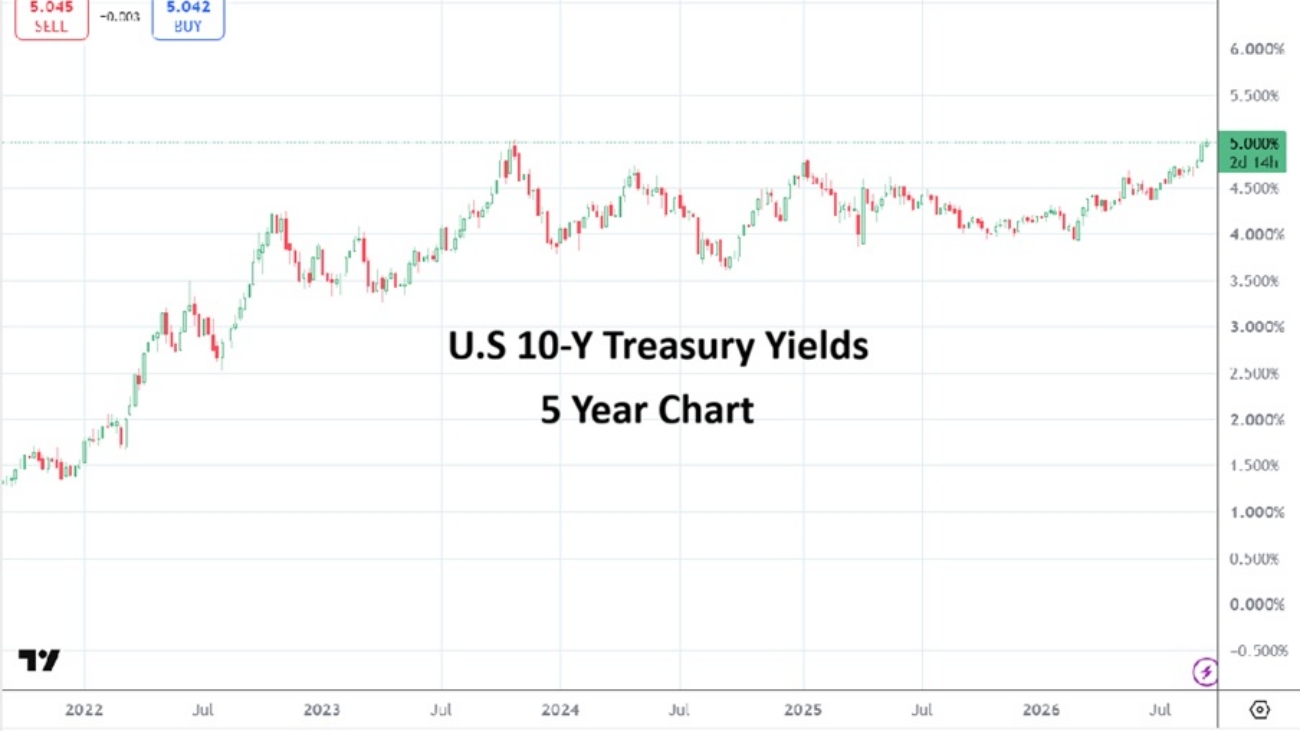
7. 10-Y Notes: U.S 10-Year Treasury yields finished the week near 4.43%, Friday’s price action saw an apex around the 4.48% vicinity, highlighting nervousness. On Friday the 27th of February 10-Y yields were close to 3.94%,

6. Forex: USD/JPY ended this past Friday around 160.250, making it cheaper for tourists to visit Japan as cherry blossom season starts this week and lasts into early May. However, the Bank of Japan and Japanese citizens are not amused by the weakening Yen. USD centric strength continues to resonate loudly. 

5. Fed: Potential drama surrounding the U.S central bank and the replacement of Fed Chairman Jerome Powell has taken a backseat to the Middle East conflict. Concerns about inflation are legitimate. The Federal Reserve will be hard pressed to defend an interest rate cut in the mid-term.

4. President Trump: Speaking from both sides of his mouth (and his opponents might say another area of the body) may be strategic genius from the White House regarding Iran or prove to be a lack of focus. However, it certainly keeps everyone guessing what is going to happen next in the Middle East.

3. $100.00: WTI Crude Oil prices have remained below the one-hundred level for the most part during the Iranian war, yes – there have been outliers above. Will we begin to see sustained prices above the century mark this week? Short-term reactions to the U.S military potentially seizing Iran’s Kharg island would certainly cause price chaos, but could it also soothe some large players in the energy sector via mid-term outlooks? 

2. Good Friday: The holiday at the end of this week will be effected by anxious behavioral sentiment. The potential of a long weekend with plenty of noisy chatter could make for nervous investors this coming Thursday as they position themselves ahead of possible escalating storms.

1. Fear: The S&P 500 and Nasdaq 100 have entered corrective depths. Who will be brave enough to start looking for bottoms as the Iranian war rages with no end in sight? Will a reversal upwards emerge this week?

Copy and paste the text from AMT that you want to share

South African Rand 20260327

G7 Snub for South Africa and other Troubles for the South African Rand

USD Centric Strength and Global Anxiety Weighing on Value of Rand

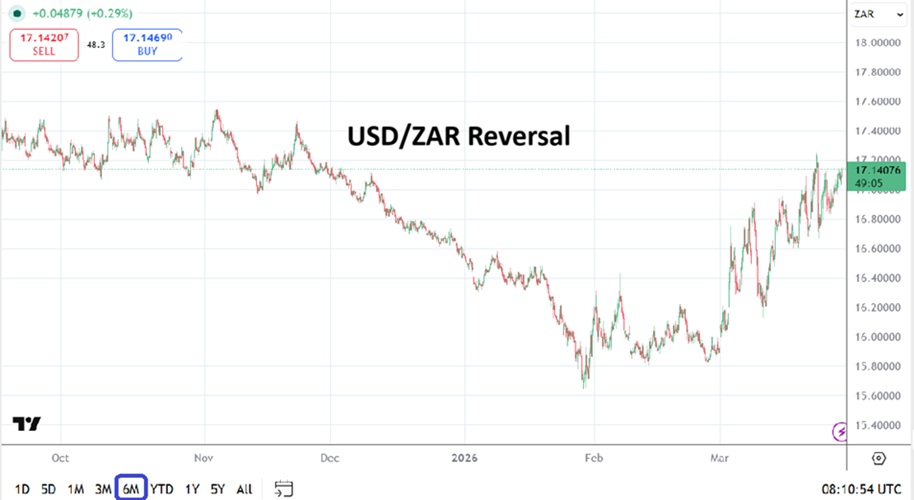
The USD/ZAR is still above 17.00000 in early trading this morning, this as USD centric strength manifests globally due to anxiety which clearly exudes because of the ongoing Iranian war. The USD/ZAR is near the 17.11000 realm, with wide spreads via bids and asks.

The price of Gold is close to $4,450.00 and Palladium is around $1,395.00 – this after touching apex marks in late January when the $2,100.00 level was breached.

USDZAR Six Month Chart as of 27th March 2026

These metals are important for South Africa, but their daily values do not effect the USD/ZAR like they did in the past because of other complexities. The USD/ZAR which had enjoyed a stellar bearish trend and touched lows of 15.68000, late in January, could be correlated to the decrease in value to the precious metals by some, but this is likely false narrative.

When the larger picture of pure behavioral sentiment within the Forex broad market is looked upon other factors are a certainty. The South African Rand, in a rather healthy manner, is largely dependent on financial institutions outlooks regarding the USD, 10-Year U.S Treasury yields, and what the U.S Federal Reserve outlook projects.

The U.S central bank, which many people including myself, was thought to be in position in which the Federal Funds Rate would be lowered in the coming months, now faces complications due to what may become chronic higher energy costs through the mid-term if the war in the Middle East persists and inflation due to logistics, manufacturing and agriculture are effected.

The USD/ZAR near the 17.0000 is a good barometer of South African financial institutional attitudes. Yesterday’s news that South Africa will be excluded from the G7 meetings in France, which will be held in June, will not make folks in South African financial spheres content. However, these same people within the machines of corporate finance in South Africa have grown used to the vagaries of mismanagement, corruption and perceptions these cause for the nation. While some South African government officials initially said France had been pressured by the U.S to disinvite South Africa from the G7 summit, they have changed their tune this morning and are trying to downplay the exclusion as insignificant.

Thus, we return back to the USD/ZAR and near-term considerations. While the currency pair has shown the tendency to reverse lower when marks above 17.10000 have been challenged the past few weeks in March, this morning’s early trading which is sustaining higher values is troubling. The consideration that nervousness among global investors remains skittish at best is unsettling. Those who are making short and near-term wagers on the USD/ZAR are likely concerning themselves with the upcoming weekend and its unknowns. From a trading perspective, folks are usually cautious about taking speculative positions over the weekend when they fear there is a possibility of bad news.

The USD/ZAR is touching important resistance above, if calm doesn’t return to the broad markets across various international assets today, the currency pair may find itself testing higher realms as next week begins.

Looking for downside in the USD/ZAR may prove difficult to attain later today. Traders should keep their eyes on other gauges and watch the U.S 10-Year Treasury yields which are near 4.45% (highs that haven’t been seen since July of 2025), WTI Crude Oil prices and the major U.S equity indices which are in correction territories.

From a betting perspective, if U.S 10-Year yields escalate and the price of energy ebbs upwards today in commodity markets, and there is more trouble on the Nasdaq 100 and S&P 500, this will be problematic. The USD has been volatile, but has certainly shown a tendency to get stronger in recent weeks. A higher USD/ZAR above the 17.20000 is not out of the question.

Copy and paste the text from AMT that you want to share