Singapore Dollar 20260818

Forex: Compressed Tight Realms Signaling Nervous Reactions

Sentiment Storms as Financial Institutions Remain Unsure about Outlooks

Price action in the USD/SGD has continued to demonstrate a rather significant turn downwards since the last week of June. The price of the currency pair is near 1.27800 as of this writing and is traversing near values seen the 1st of June and towards the end of the first week of March. Importantly, the USD/SGD has also seen recent lower depths and was below 1.27000 in the second week of May.

The USD/SGD traversed deeper ratios in late January when the 1.26000 vicinity was challenged and these levels were sustained until the middle of February. On the 26th of February the USD/SGD was near the 1.26500 mark. Now that the above numbers have been established, let’s discuss why this is potentially important for Forex traders as developing trends surface.

The past few years of trading have seen a compression of Forex deviations, in other words the FX market has grown more tame. However, the Bank of International Settlements (BIS) now reports that over 9.6 trillion USD in value is traded daily. This is a stark increase compared to 2022 when Forex saw an average daily market around 7.5 trillion – meaning there has been a 28% increase over the past four years.

USD/SGD One Year Chart as of 18 August 2026

The scope of volume is presented not to cause fear, but to show Forex traders what is at stake and the size of the marketplace and its potential for sudden jolts of volatility if it is established. 

Turning our attention to the new Fed Chairman Kevin Warsh and his preference to not give concrete forward guidance is important. U.S Treasury yields are dangerously high (the 30-Y yield is near 5.31%), and the military conflict between Iran and the U.S  continues to fester. Threats remain on the horizon which need observation, insights that prove correct regarding how these bits of information will influence the Fed Chair and the impact on the USD could prove significant for financial institutions.

Large players have reasons to be critical about a lack of clarity and this might spark more choppiness in Forex – even though value realms are said to be in a compressed state. This opens the door for technical traders who may have a better gauge on existing behavioral sentiment of the Forex markets compared to fundamental traders who have too many tea leaves to interpret which are moving rapidly as the cup gets shifted. Technical traders may have a good sense of where algo trading is directing its velocity per current Forex sentiment. 

While some analysts make a case for an increase to the Federal Funds Rate because of inflation concerns, what happens if they are wrong? And what if large players are now discounting their initial fears regarding higher interest rates and are actually starting to position themselves for the Fed Funds Rate to remain the same or be lowered in the mid-term? Is this one of the reasons why the USD has become weaker recently?

What if the new Fed Chairman Kevin Warsh proves stronger than people believe and has the ability to talk lower interest rates into reality? The U.S Treasury faces a huge and expensive task trying to pay off the yields of the high flying 10-Year and 30-Year bonds. What if Treasury Secretary Scott Bessent who has a solid relationship with Fed Chair Warsh proves influential? Read AMT’s Charles Najjar’s article on his thoughts about why the Fed should aim for a 2% Fund Rate: https://www.angrymetatraders.com/why-the-us-fed-should-lower-interest-rates-to-2/

Yes, the Middle East situation remains troubling from a mid-term economic viewpoint regarding the implications on WTI Crude Oil prices and ancillary energy costs globally. Inflation must be battled, but is raising the Federal Funds Rate going to help decrease the cost of energy or lessen its demand? Mostly likely no.

U.S Dollar Index One Year Chart as of 18 August 2026

The gold market has started to show signs of price velocity the past couple of weeks. The precious metal is trading near $4,395.00 as of this writing. Investors with a long-term window and troubled perspectives about the health of the USD have plenty of reasons to be more comfortable holding gold compared to staying in cash. 

U.S equities have been doing well via indices, but nervous shadows are hovering (maybe they always are). And this is why diversification is always important via long-term investment. Equities, bonds, gold and a small proportion for speculative purposes – this for those who want to try and increase their wealth while maintaining a status quo regarding preservation of wealth.

However, from a speculative standpoint, the Forex market is starting to show signs of alarming behavior, some may even call it a lack of correlation caused by storms forming. Yes, we know the USD/JPY is within its own environment as the BoJ and U.S Treasury/Fed play tag team trying to scare folks away from buying the currency pair. However, putting the JPY to the side for the moment, USD centric weaker positions are showing ability to sustain trends. 

The USD/SGD is a prime example of this momentum. The Fed’s Jackson Hole Symposium begins on the 27th of August and ends on the 29th  and all the major central banks will be attendance. Financial institutions will be keen to hear discussions about U.S bond yields, U.S and Japan currency interventions, but importantly will also want to monitor what Kevin Warsh and his cast of FOMC officers have to say about U.S interest rates. And it has to be known given the past two months from the new Fed Chair, he may remain rather quiet regarding outlook. 

And that might be good for the Forex market and spark some opportunities for traders to find an advantage. Because if nothing new or convincing comes out of the Jackson Hole meetings that financial institutions can decipher regarding their mid-term outlooks, perhaps the near-term will produce more volatility.  The next Federal Reserve FOMC meeting decision will be on the 16th of September. Do not expect interest rates to be raised.

Copy and paste the text from AMT that you want to share

Share:
10Y Treasury Yields 20260728

Thoughts on Kevin Warsh, the Fed and USD, Energy, Nasdaq 100, USD/JPY and Bitcoin

Fed’s Rate Announcement Tomorrow and Underlying Market Conditions as Folks Talk

Tomorrow’s FOMC rate decision from the Federal Reserve continues to cause some angst in the investment community as folks try to decipher Fed Chairman Kevin Warsh’s disdain for tea leaf reading. What is being missed by seemingly a lot of the crowd is the open signal from Warsh that he prefers to keep his outlooks rather muted, this because he appears to be focused on the mid and long-term economic picture.

Simply put, I do not think the Federal Reserve is going to raise interest rates tomorrow, nor will the Fed Chair give too much indication about his thoughts for mid-September. It might be stated in the Fed Press Conference afterwards that the costs of energy is being watched, but that is too obvious. Count on it being recorded that the Federal Reserve will watch data and react accordingly. In the meantime, financial institutions may demonstrate volatile overplayed USD centric positions which look overbought looking into the mid-term, as they still worry about the near-term.

10-Year U.S Treasury Yields Five Year Chart as of 28 July 2026

Political Questions and the Cost of Energy as the Fed Reacts

Let’s for a moment dive into politics. Does anyone think that Kevin Warsh doesn’t speak to Treasury Secretary Scott Bessent who has been a long-time associate? And does anyone think Bessent doesn’t have the constant voice of President Donald Trump in his ear? 

The mid-term elections are nearing ladies and gentlemen. The de-escalation in the Iranian situation certainly has something to do with nations expressing wishes for less military action to the White House. Israel, the UAE, Kuwait, Bahrain, Iraq, Qatar, Saudi Arabia, Pakistan and Turkey are trying to influence positions as President Trump considers his next moves regarding alliances and resources. However, the situation may have something to do with the price of WTI Crude Oil too and its effect on U.S manufacturing and surprise, surprise the Federal Reserve. 

Does anyone else remember that the last de-escalation also started just before the Federal Reserve’s last FOMC meeting in June? I am not being a conspiracy fanatic, just pointing out that lower WTI Crude Oil prices do help the case for a Fed outlook which looks at the costs of energy in a pro-active manner, one which might include the U.S economy and internal White House discussions with politicians who represent voters who have the power of creating a backlash. Lower interest rates equate into lower borrowing costs for consumers.

The Fed’s Impact on Equities and Forex (and the USD/JPY)

So if the Fed does not raise tomorrow, nor gives an indication of what it will do in September and offers a stance of ‘we are vigilant and will watch the economy’ will that help sentiment on the Nasdaq 100 which is starting to have the look of a patient with a bad cold who can’t quite seem to get rid of a cough? Microsoft and Meta step into the limelight tomorrow with earnings reports, Amazon and Apple follow on Thursday.  The combination of the Fed and important quarterly earnings will impact Nasdaq sentiment and other equity indices.

It appears analysts of financial institutions are starting to discuss CAPEX – capital and expenditures – openly. And this is creating shadows as investors weigh the costs of energy and infrastructure against stated profit projections. However, let’s not throw the baby out with the bath water, the Nasdaq 100 has a gain of 20%+ over the past year (July to July), and since March the index has still gained 12%+. The war in Iran (excuse me, conflict) has not had a meaningful impact it appears on the outcome of the Nasdaq 100 via sentiment generated. But the shadow of expenditures, debt and revenue is getting louder bandwidth and speculators need to remain cautious in the indices.

Back to the Fed and Forex, the USD has been strong, you are allowed to say extremely strong if you have been betting on downside incorrectly. The USD/JPY is almost in nosebleed terrain, currently 163.830. The Bank of Japan will announce their interest rate policy very early Friday (for those of us not in Asia) and let’s see if the ‘independent’ Bank of Japan is taking a cue from their government which is clearly interested in continuing to build stronger export ratios. Has the Bank of Japan given up the so-called stated fight to keep the JPY within a solid stance? This is doubtful externally, and Japan is certainly not going to allow the USD/JPY to traverse wildly higher, but it may not consider the 165.000 mark as the end of the world. Beware of saber-rattling from the BoJ in the coming days.

Bitcoin Five Year Chart as of 28 July 2026

Doubts and Remarks Regarding Bitcoin Below $64K

On a last note, the world of cryptocurrency remains interesting and stormy. It appears from watching the awkward statements from influencers and crypto (including Bitcoin) media outlets the past couple of months, as they attempt to explain their pain and convince others that everyone should buy at these lower values that more troubles are coming. 

What are the influencers, crypto media’s and importantly financial institutions’ actual skin in the game relative to those who have lost interest in Bitcoin and the digital market worth? Are influencers and large institutions like BlackRock hoping to pawn off their suffering ‘asset’ holdings to the public, while trying to convince us that today’s cheap prices represent buying opportunities? Is the wave of slanted influence and panic-like banner waving a hope to save themselves in order to cash out of a sinking market, this while hoping someone else takes their place in lifeboats that face a difficult voyage to safe harbors? 

BTC/USD is near $63,4000 now. Yes, we know, we have been told plenty of times before that all the Bitcoin winters eventually turn into summer again. Blossoms will create the sweet scent of profit we are assured, but what if the winter becomes an ice age? What if Michael Saylor and his ability to produce complex financial statements and instruments for MicroStrategy and Strategy equity shares continue to make little mathematical sense? What if all the investors into Bitcoin and cryptocurrencies are left holding the bag and find themselves covered by permafrost? The tundra currently looks harsh. Will the Bitcoin crowd who has been so adamant about being free of regulatory controls and mismanaged central banks cry openly for bailouts from the U.S Treasury with USD? Now that would be entertaining.

Copy and paste the text from AMT that you want to share

WTI Crude Oil 20260701

What Am I Missing About USD Centric Strength?

Being Wrong About USD Direction and Betting Against the Trend

Help me out here folks, I am perplexed. I seem to be missing something about the USD centric strength, it looks very overbought to me. Where is all the buying sentiment coming from? The FOMC meeting outcome on the 17th of June has certainly sparked USD centric buying stamina as financial institutions seem to have fallen into a strict line and priced in a Federal Reserve interest rate hike this year.

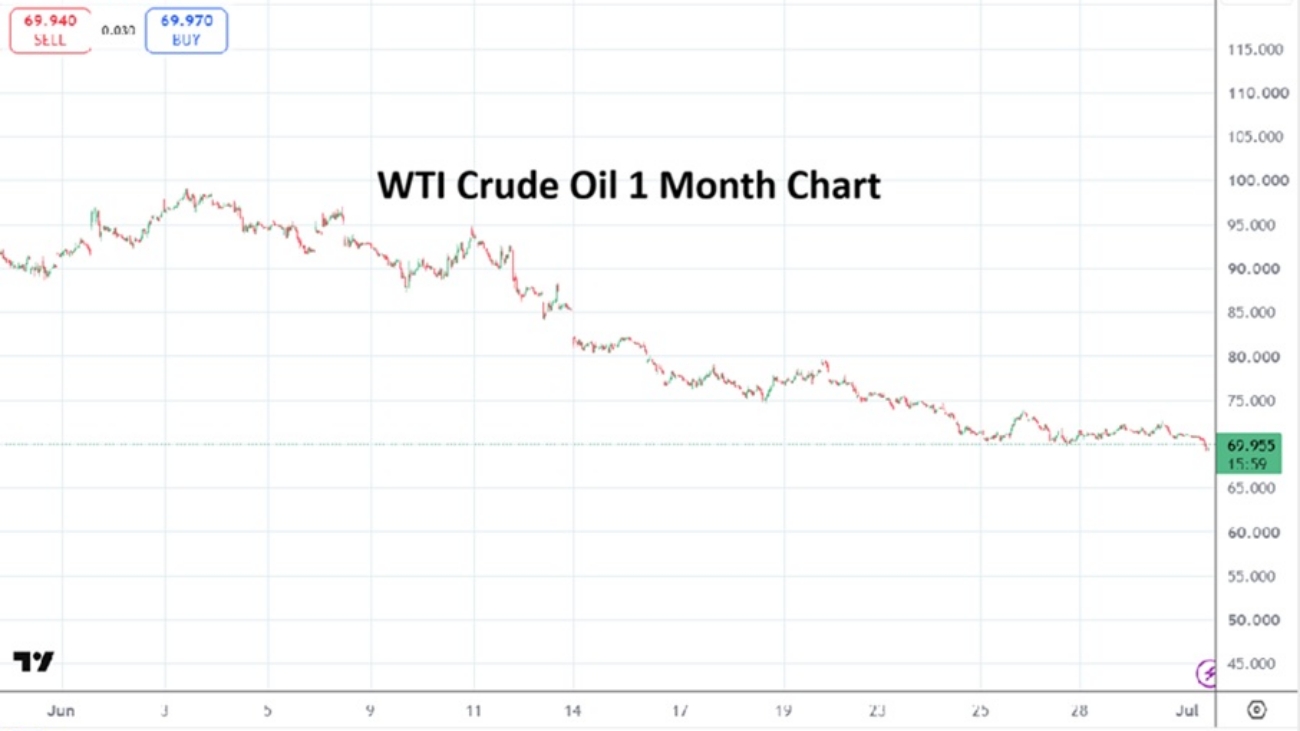
However, the price of WTI Crude Oil was near $80.00 on the 17th of June. And on the 3rd of June the price of WTI Crude Oil was within sight of $100.00. Meaning that we have seen the price of energy trend lower. The agreement between the U.S and Iran, although fragile, has held and the current price of WTI Crude Oil is close to $69.70.
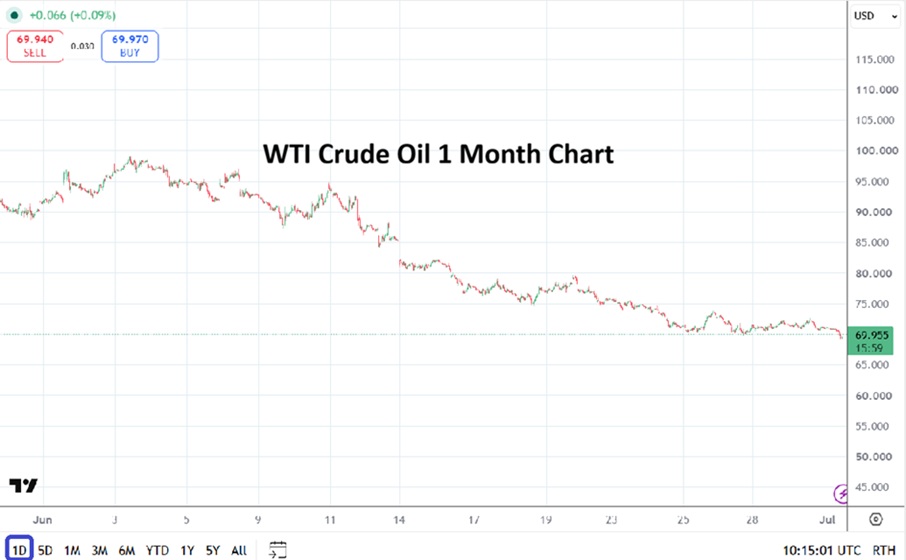
WTI Crude Oil One Month Chart as of 1st July 2026

While concerns about inflation certainly remain, costs should actually start to erode for logistics, fertilizers for agriculture, and manufacturing. Job numbers are solid, growth has been rather steady and shown signs of improvement. If inflation starts to behave and financial institutions change their thinking about interest rates to come, perhaps they will ease off on their borrowing costs.

Also, let’s note that as expected the new Fed Chairman Kevin Warsh has made it clear he will take a more proactive stance regarding interest rates. Evidence for this comes via Warsh’s decision not to participate in the dot forecast that FOMC members use, his absence from the Fed’s ‘prediction market’ game was notable, but many analysts seem to have missed the importance.

In my opinion, Warsh’s decision not to participate in the Fed’s dot plot quarterly signal chart shows the new Chairman wants to create the capability of changing his mind regarding the Federal Funds Rate as needed. The decision not to ‘anonymously’ show what his beliefs are looking forward will allow him to steer the Federal Reserve per forward looking economic data points instead of being held accountable – and possibly blamed – for changing his mind if a shift of opinion is needed.

So again, why is the USD so strong across the Forex board? The USD/JPY is trading well above 162.660+, the EUR/USD is near 1.13900, the GBP/USD around 1.13247 and the USD/SGD is sustaining value at mid-term highs close to 1.29660. While financial institutions appear to have priced in an interest rate, and may also be nervous about volatility in U.S equity indices, the cautious approach has created in my opinion an overbought USD.

As the Independence Day holiday approaches, Forex traders should be careful. If ever there was a time for the Bank of Japan to intervene and cause chaos it might be when USD Forex volume is minimal. Large USD traders may start vanishing in the coming days before the long holiday weekend, and the absence of U.S banks this coming Monday will also factor into the markets.

Selling the USD looks like a speculative bet certainly, particularly because its trend has proven rather strong the past few weeks. Let’s see what happens, but I suspect some downside pressure via USD centric price action is going to be generated.
Copy and paste the text from AMT that you want to share

Nasdaq 100 20260608

Nasdaq 100: Terrible Friday Being Confronted by Manic Monday

Fear of the Middle East Not the Main Motivator for the Nasdaq 100

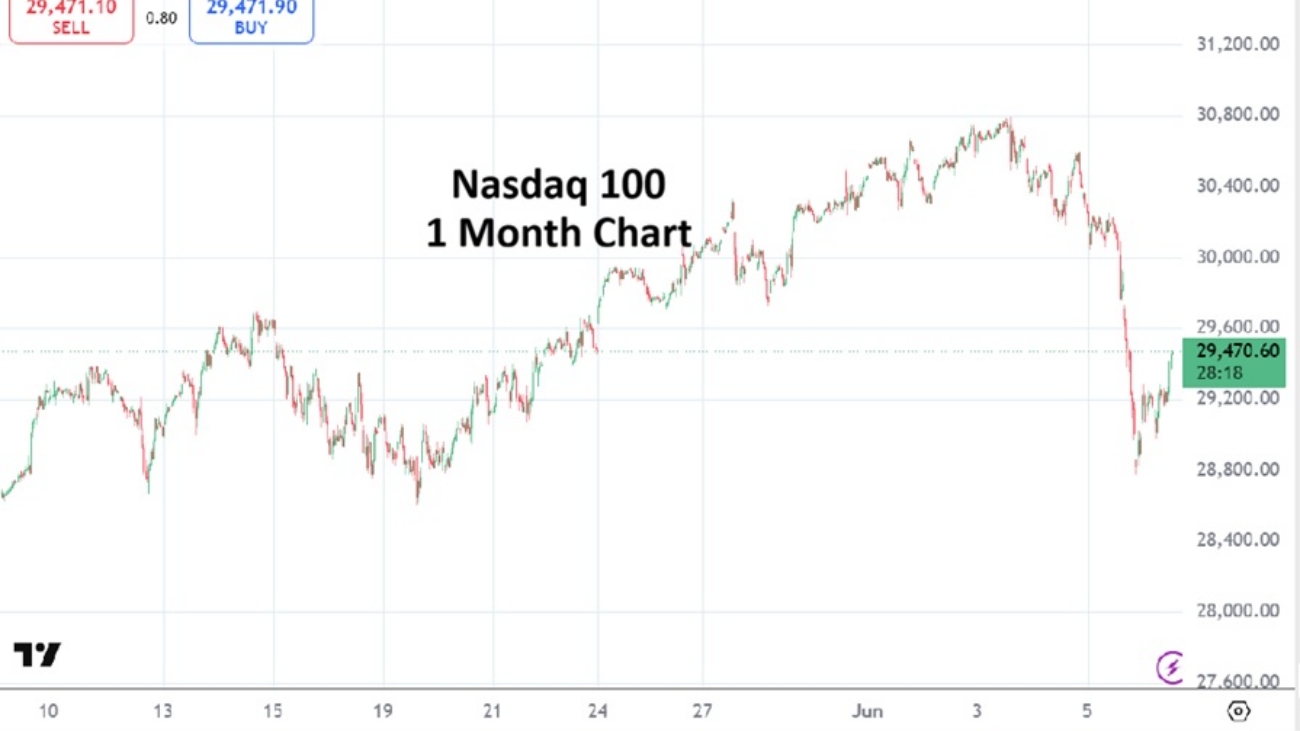
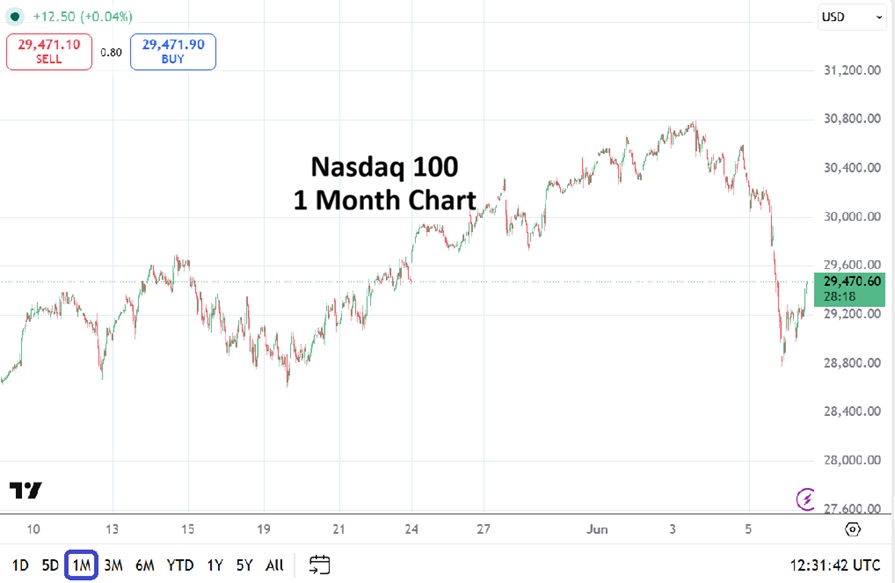
After Friday’s selling surge and a fall of -4.77% with a close of 28,957.60, the Nasdaq 100 futures trading this morning has actually seen an increase and is near the 29,479.00 mark as of this writing before the cash Nasdaq 100 market opens.

Friday’s selling nightmare for traders who found themselves stubbornly locked into what were to be short-term buying positions and saw the Nasdaq 100 plummet -4.77%, probably woke this morning believing ugly conditions may not stop. An escalation in military action via proclaimed retaliatory moves between Israel and Iran started today’s trading with a high degree of more anxiousness. USD centric strength in Forex was demonstrated early.

Nasdaq 100 Futures Value 1 Month Chart as of the 8th of June 2026

However, in the past couple of hours calmer heads have prevailed among financial institutions and USD centric buying in the broad Forex market has run out of steam – at least momentarily. For instance the USD/JPY is near 159.927 currently, opposed to earlier highs seen this morning which challenged the 160.400 vicinity. What does this have to do with the Nasdaq 100 and its current status? 

It appears via futures trading that large players may also have taken a sedative and looked at the index as having been oversold on Friday. The Nasdaq 100 has actually gained early today and signs that a de-escalation of military force between Israel and Iran is being reported. However, that still leaves day traders wondering what will happen as the cash market opens soon and volumes increase.

Let’s Say Quiet Prevails the Remainder of the Day

Not because of a utopian outlook, but a geopolitical perspective, let’s try to image Iran’s stated intentions of no more retaliatory strikes being launched towards Israel as true. The past couple of hours have been more tranquil as a signal in case you are wondering. Then investors and financial institutions will have to digest the Middle East concerns as they have done over the past couple of months in U.S equities, and decide to operate again on the Nasdaq 100 with near and mid-term outlooks.

Friday’s huge selling was blamed by some on the likelihood of a ‘potential’ U.S Federal Reserve interest rate taking place on the 17th of June. This because better than expected jobs numbers showed to some that the U.S economy was running hot once again. 

Additionally expressed fears, which are legitimate, about higher energy costs sparking sticky inflation have been discussed and worried about aloud. Yet, again let’s decide to say even if U.S inflation numbers via the Consumer Price Index come in higher than expected this Wednesday via the coming CPI data, that doesn’t shut the door on the possibility the new Fed Chair Kevin Warsh won’t fight against an interest rate hike during the FOMC meeting next week. In other words it still seems rather unlikely – to me – that the new Federal Reserve Chairman is going to want to initiate higher interest rates the first month on the job. So what if there was another reason for the steep selling on the Nasdaq 100?

Not Paradise but Purgatory

The Nasdaq 100 actually has other questions which have been raised as possible fodder for its large selling this past Friday. Was it spawned because of profit taking by those who took advantage of the index’s fabulous rise knowing that many institutions had been front running the IPO of SpaceX which is scheduled to happen on the 12th of June – this Friday? 

Did large players who rode the wave of frontrunning by financial institutions up in the Nasdaq 100 since late March, decide to cash in profits. There is plenty of nervousness surrounding what will take place with SpaceX in the coming months and long-term via outlooks because of its rather inflated valuation which looks like it will be around 1.7+ Trillion plus at share values of $135.00 per share this coming Friday. 

Questions surrounding SpaceX’s price per sales rhetoric, this instead of price per earnings (because SpaceX is not making a net profit) is just one example. While denying Elon Musk’s genius and ability to create clamor for his companies has proven to be a losing proposition for many, doubters still remain. 

Folks might have cashed out winnings on Friday and decided to now wait on the sidelines to see where behavioral sentiment takes the Nasdaq 100. After two full months of paradise for the Nasdaq 100, a few days of purgatory and seeing which direction U.S indices go may be the right decision by folks who rely on clarity; this as the Middle East gets untangled (or becomes more complicated), the Federal Reserve offers insights on the 17th of June, and large financial institutions lead the way regarding investment decisions.

Copy and paste the text from AMT that you want to share