Gordons Bay Sunset 20260514

The Great Compression Part 1: The End of the Middlemen

Elevator Boys of GenAI

In the 1920s, every office building had an elevator boy. Although automated elevators already existed, people found the idea of riding in a driverless box dangling by steel cables terrifying, and delegated the role to a uniformed human they trusted, accepting the necessity to pay for the privilege. Over the years, people got used to elevator buttons, but the force of habit and the preference for human touch kept the profession flourishing for years.

The operators were so confident in their indispensability that they went one step too far: in 1945, a New York strike brought the city to a grinding halt, costing it hundreds of millions of dollars. That was the final straw, leading to a massive push to upgrade to automated systems. Within a short while, the job ceased to exist, entering the history books as the only major job category to be completely wiped out from the U.S. Census purely due to automation. The only one so far, that is.

Elevator boys were the cleanest definition of a middleman: someone who exists not because they create value, but because of information asymmetry or transaction friction. The history of modern commerce is largely a history of those “toll booth” trades, and of the technologies that remove them one by one.

Newspapers were once the only viable printed information channel, using their middleman position to bundle content with ads and classifieds, fattening their revenues. People accepted it because nothing else existed – but then the Internet broke their business model. Craigslist alone did more damage to newspaper economics than any editorial failure ever could; Twitter and Facebook finished the job. Today the newspaper is a diminished thing, sustained largely by institutional inertia and nostalgia.

Real estate agents had an informational moat – access to listings, knowledge of comparable sales, relationships with buyers – which was valuable in a world without Zillow. Once that information became freely available, their commission became very hard to justify. The agent survived by clinging to the execution layer, but that too is shrinking.

Here is where the story gets interesting. The companies that dismantled the old middlemen wasted no time building new ones. Uber eliminated the taxi dispatcher and the phone-in booking system, then inserted itself between driver and passenger for a fat slice of every fare. DoorDash did the same between restaurant and customer. Expedia aggregated what travel agents used to know and charged airlines and hotels for access to their own customers. These were genuine technological improvements, but the business model was identical to what they replaced: find a friction point, own it, and extract rent from both sides. The market rewarded them handsomely for this, for a while. Then the next wave arrived.

Generative AI is driving a change of extraordinary scale and speed. We cannot assess the impact of the tsunami from inside it, but we can see the fish floating belly-up, and extrapolate. The agentic economy is eliminating many roles that just a couple of years ago seemed staple of our service-based economy. AI agents will (if they haven’t yet) replace secretaries, clerks of all kinds, brokers, advisors, recruiters, customer service representatives, paralegals – and the buck won’t stop there.

What is happening now to companies like Capgemini, Accenture, and McKinsey is structurally identical to what happened to newspaper classified departments and taxi dispatchers. AI agents do not merely reduce friction – they eliminate the information asymmetry that made the intermediary necessary in the first place. A system embedded inside an enterprise does not need a consultant to explain what it is doing. It does it, iterates, and reports back.

OpenAI and Anthropic understood this early, which is why both recently announced joint ventures – in a parade lockstep – to deploy engineers directly inside corporate clients. OpenAI has built an elite, highly technical consulting wing – a multi-billion dollar venture backed by TPG, Brookfield, Bain Capital and others. Anthropic teamed up with alternative asset titans like Blackstone, Hellman & Friedman, and Goldman Sachs to form a dedicated AI services company. AI labs are moving fast into services and deployment because model commoditization is a risk, and because adoption bottlenecks hurt revenue growth.

The Big Four are seemingly fine for now, touting alliances with the AI leaders, helping them scale AI implementation across their enterprise clients. However, professional consultants are clearly the next elevator boys, hanging by the thread of the “human in the loop” habit. The only chunk of the consulting business that is accelerating involves embedding the AI revolution into enterprises – and very soon, Anthropic and OpenAI will not require the help of PwC or Deloitte for that. They are the owners of the technology: why would they pay a toll for a booth on their own road?

The irony is pointed: the companies building the technology that makes middlemen obsolete are inserting themselves as the new middlemen between the AI model and the enterprise. But even this layer is temporary. Once AI agents can deploy themselves, even that layer compresses. The OpenAI and Anthropic JV story is the last gasp of the middleman era.

The real and durable beneficiaries of the AI economy are not the model builders. Raw intelligence, reasoning, and pattern-matching are no longer rare, expensive breakthroughs – they are becoming cheap, standardized, and universally accessible. Core AI technology is turning into a commodity, just like electricity once did – and the value moves both up and down the stack.

“Up the stack” is a constantly moving target. Right now, it sits in hyper-specific vertical applications – defense, aerospace, finance, and medicine – where proprietary data, regulatory compliance, and domain expertise create durable moats. It also lives in the integration layer: the software plumbing that turns raw AI reasoning into auditable, legally compliant enterprise actions.

In the near term, value will shift further to agentic orchestration – the “Agent Overlords” that coordinate swarms of specialized AI agents, manage workflows, handle exceptions, and maintain oversight across complex business processes. These control planes will become the new scarce and valuable layer, much as operating systems and databases once did. What comes after that is harder to predict, but the pattern is clear: as each layer commoditizes, the economic prize moves to the next bottleneck.

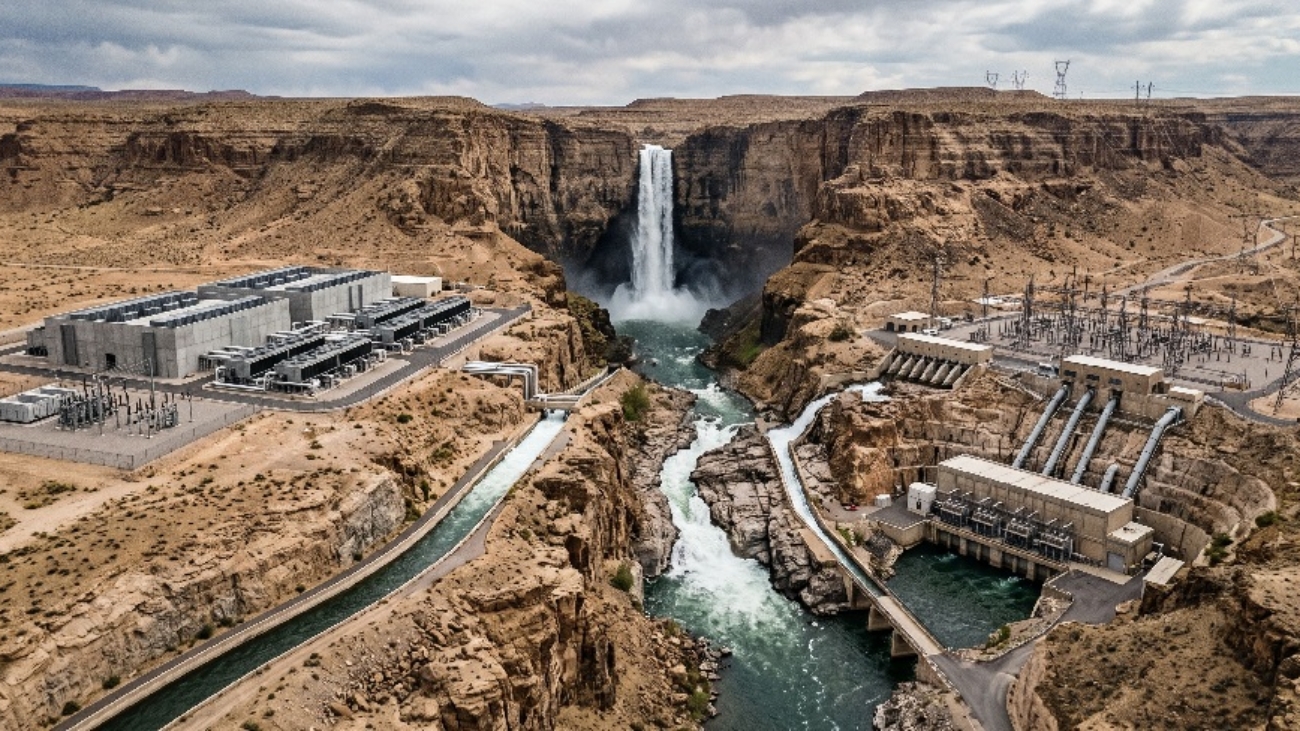
“Down the stack” is the physical layer underpinning everything, and that’s where the true moat is. Every agentic transaction, every automated workflow, every AI-mediated business relationship runs on cloud compute, which runs on power, which runs on tangible assets unlikely to be replaceable for at least the next decade. After a century of disruption, humanity has come full circle: the “boring” material world – acres, bricks, pipes, wires, water, and power – has once again become the real source of scarcity and enduring value.

OpenAI and Anthropic are the last of the middlemen: brilliant, richly capitalized, yet ultimately dependent on infrastructure they do not own. What sits beneath them is not a new intermediary – it is bedrock.

Copy and paste the text from AMT that you want to share

Gold 20260622

Gold: Intriguing Technical Support and Curious Sentiment Shift

Mid-Term Technical Support and Lower Price Make Gold Interesting

Gold has faced difficult speculative circumstances for traders with a bullish perspective since early February, this as the price of the commodity has fallen from highs. The price of the commodity is around $4,5220.00 for the moment, with its typical fast price action flourishing. Importantly, the precious metal is also traversing slightly above rather intriguing technical support when a mid-term perspective is used.

On the 29th of January Gold challenged the $5,600.00 vicinity, this as metal commodities soared including Silver and Platinum. Silver in late January touched the $120.00+ mark, Platinum in the last week of that month hit and penetrated $2800.00. Silver as of this morning is near $75.00 and Platinum is around $1937.00. The speculative momentum that drove the metals higher had a lot to do with fever pitched buying as large players feasted and smaller retail traders tried to ride the upwards wave.

Gold One Year Chart as of 22nd May 2026

Silver, Platinum and Gold Lost Their Appeal

For the moment it appears hedge funds have turned their attention away from the metals as a speculative playground. Fast profits are likely coming from other arenas, WTI Crude Oil and other energy resources are big betting areas as the Iranian situation remains at the forefront of attention.

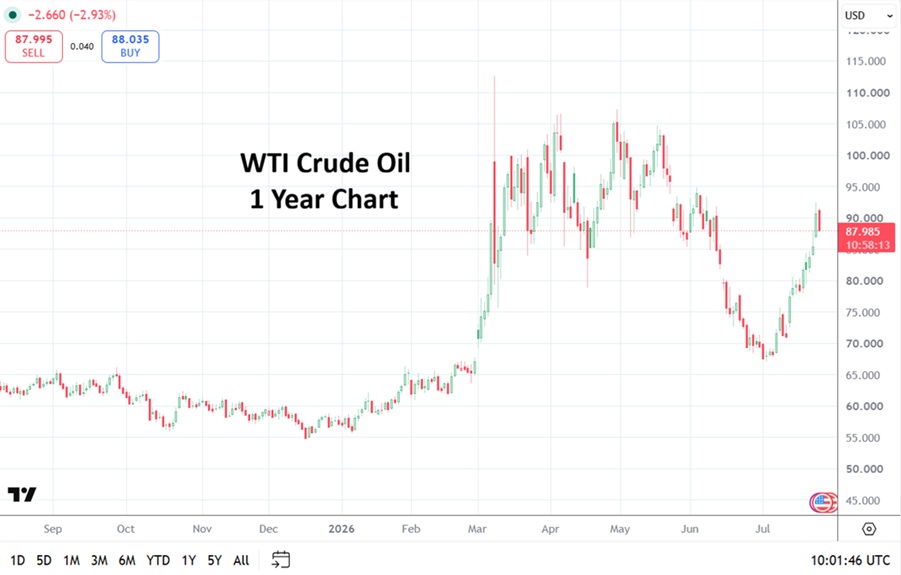
Since the start of the military escalation in Iran all three metals have essentially lost value. Silver was around $94.00, Platinum close to $2,370 and Gold near $5,280.00 on the 27th of February. The price of WTI Crude Oil is trading with the $100.00 level acting as a technical magnet now, on the 27th of February WTI was near $67.00. It doesn’t take a brain surgeon to figure out where all of the price action has moved to as folks trading Crude Oil are certainly getting their kicks and maybe even profiting as they take advantage of support and resistance levels as rhetoric and saber-rattling flares about Iran.

Buying Gold with a Mid-Term Outlook

However, as Gold swims near the $4,522.00 mark it raises curious questions regarding its current value and how sentiment may develop within the precious metal over the mid-term. Putting to the side Silver and Platinum, Gold is intriguing because the specter of inflation is causing nervousness. The U.S Federal Reserve is now in a position in which it may have to start increasing the Federal Funds Rate again. 

President Trump wants lower borrowing costs, but because of the escalation in fuel costs effecting manufacturing, logistics and agricultural are all suffering. It will be hard for the new Fed Chair Kevin Warsh to simply wave off rising prices in the U.S as a short-term murmur. The mid-term now appears capable of sustaining inflationary winds. Gold may start to receive attention from investors again who are not looking to speculate on the precious metal, but to hold the commodity as a hedge.

  • Day traders as always will face intraday volatility with Gold if they are trying to capture a reversal higher.
  • However, if investors start to believe Gold needs to be looked at again via portfolio accumulation, and hedge funds make it a speculative party, the precious metal may start to see not only more attention but a buying surge develop again over the mid-term.
  • Gold around the $4,500.00 mark looks relatively secure as an investment plateau for folks looking for a long-term buying opportunity.
  • Day traders may start thinking about trying to take advantage of potential incremental shifts that might start to develop in Gold to the upside in the near-term and coming weeks.

Copy and paste the text from AMT that you want to share

India Tamil Nadu State 20260521

India Insider: Capital Formation in Rural Areas and Distress Hill Terrain

Income Comparison via Two Distinct Districts: Tiruvannamlai and Madurai

India is a vastly developing economy, but its national accounting frequently relies on formal sector performance to extrapolate the conditions of the informal economy. Despite official statistics continuing to rise, the economic reality of rural India remains largely unchanged.

Recently, I was travelling extensively across villages in the Tiruvannamalai district of Tamil Nadu State in South India, trying to understand how capital formation works in rural and semi-rural areas.

For more than 50 kilometers, there were barely any shops related to consumption activity. There is no absolute poverty in these areas, but income levels are clearly not standard enough to support strong consumption patterns.

Many people in Tiruvannamalai district villages work in neighboring cities liken Tiruppur, Bengaluru or Chennai and send cash back to their families. Apart from these remittances, agriculture and related seasonal income add to household earnings.

The second observation based on my extensive survey with about 55 women, was that I hardly saw anyone wearing gold chains or ornaments in villages. In other words, household income is often not sufficient enough for families to consistently accumulate gold or jewelry, which traditionally act as a form of savings in Tamil Nadu households.

Evidence suggests the reason for weak savings and low capital formation in Tiruvannamalai is due to low household income generation. And the reason for low household income can be attributed to a lack of local opportunities which offer weak wage growth, plus dependence on migration and the seasonal nature of agriculture sector. Education also plays a decisive role, but the broader issue demonstrates inadequacy of stable income generation.

We do not have sufficient recent district level data to fully validate many of these observations. Tamil Nadu State GDDP data (Gross District Domestic Product) exists, but it often lags. RBI remittance data does helps, but that is largely available at the State level rather than district level.

However, these observations do find relevance in prior surveys conducted by the Tamil Nadu Government before COVID-19.  Districts such as Tiruvannamalai were often catagorized as relatively backward compared to more industralized districts where consumption pattern improved dramatically through manufacturing and urbanization.

Instability via MNREGA’s Distress Hills Data

One interesting way to study this phenomenon is from Mahatma Gandhi National Rural Employment Guarantee Act (MGNREGA) employment data. MGNREGA data is measured in lakh person-days. (A lakh equals 100,000). In simple terms, it measures the amount of labor generated through a combination of workers and days worked under the scheme. 

Say for example, if 100,000 people work for 10 days, or 50,000 people work for 20 days, then: lakh person-days per 100,000*10 equals 10 lakhs person-days. And conversely 50,000*20 equals 10 lakhs person-days.

Sometimes, fewer workers, often work for many days or many workers work for fewer days. Thus, economists use person-days instead of counting only people.

In Tiruvannamalai the pattern of MGNREGA demand reveals a strikingly seasonal and distress driven rural labor cycle. Person-days generated surged to nearly 19.8 lakhs during May, before falling sharply toward November as agricultural activity resumed. The peak compared to it low variation is close to 5:1, creating what can be described as a steep “distress hill” in rural employment demand. 

Such a dramatic fluctuation suggests that a large share of rural households rely on MGNREGA not as supplementary employment, but as an emergency income stabilizer during periods of agricultural inactivity and cash flow stress. The intensity of the spike indicates the absence of diversified rural income sources, exposing the structural vulnerability of the local informal economy.

Tiruvannamalai District: FY monthly 2024-2025, from MGNREGA person-days shows sharp seasonal distress, peaking near 19.8 lakh person-days during May before collapsing toward November.

In contrast, the Madurai district in Tamil Nadu State presents a far more stable rural employment profile under MGNREGA. Peak demand was comparatively lower, reaching around 11.4 lakh person-days, while the decline across the year was considerably less severe than in Tiruvannamalai. The peak to low ratio was closer to 3:1, indicating significantly lower seasonal volatility in rural wage dependence.

Madurai District: FY monthly 2024-2025 displays a smoother MGNREGA employment curve with lower seasonal volatility, indicating stronger economic continuity and more diversified income generation.

Rather than exhibiting a sharp distress hill, Madurai’s smoother employment curve suggests a more diversified local economy. This because households may have greater access to non-farm income sources including urban linkages or more stable agricultural activity. The reduced fluctuation implies that MGNREGA functions more as a supplementary employment buffer than as a critical survival mechanism in Madurai compared to Tiruvannamalai.

Seemingly it is evident that consumption oriented businesses may struggle to scale in districts such as Tiruvannamalai, where disposable income growth and household surplus remain weak.

Industrialisation changes this dynamic because stable wage growth improves consumption depth and household savings. Without stable income growth, retail expansion and capital formation remain structurally weak.

The distress hill therefore represents far more than a simple employment fluctuation. The steep seasonal dependence on MGNREGA highlights how large sections of the rural economy remain vulnerable to agricultural cycles, with insufficient diversification, weak consumption resilience, and limited avenues for sustained wealth creation.

Notes:

Chart Sources: Ministry of Rural Development, Government of India, MGNREGA Dashboard (District level monthly person-days generated data).

Distress hills refers to my analysis of seasonal MGNREGA employment patterns to measure rural income instability and economic vulnerability. When plotted month-by-month, districts experiencing severe seasonal stress tend to exhibit a steep hill shape, characterized by sharp spikes in person-days generated during agricultural lean periods, followed by rapid declines once farm employment resumes. The steeper the hill, the greater the dependence of rural households on emergency wage employment for income stabilization.

Copy and paste the text from AMT that you want to share

SouthAfrican Rand 20260520

South Africa Outsider: Thoughts on the Rand and Guest Observations

USD/ZAR Considerations as Water Flows and Political Concerns are Compared

As a guest of South Africa (because of a personal relationship) and having been coming here frequently during the past four plus years it is easy to love the nation. Early last week a severe storm which brought high winds and plenty of rain hit a lot of the Western Cape knocking out electricity and water in a variety of towns. Having experienced hurricanes in the past, the wind was not quite comparable, but the consistency of the gusts over two days caused major damage.

Electricity and water have been restored to most people now. Wifi remains a problem for some, but folks are surviving. The damage to homes, infrastructure in towns and agriculture will keep individuals busy for a while. However, the Western Cape because of good political leadership and the stoic mannerisms of the people have worked together to move forward. So what does this all have to do with the South African Rand?

USD/ZAR Five Year Chart as of 20th May 2026

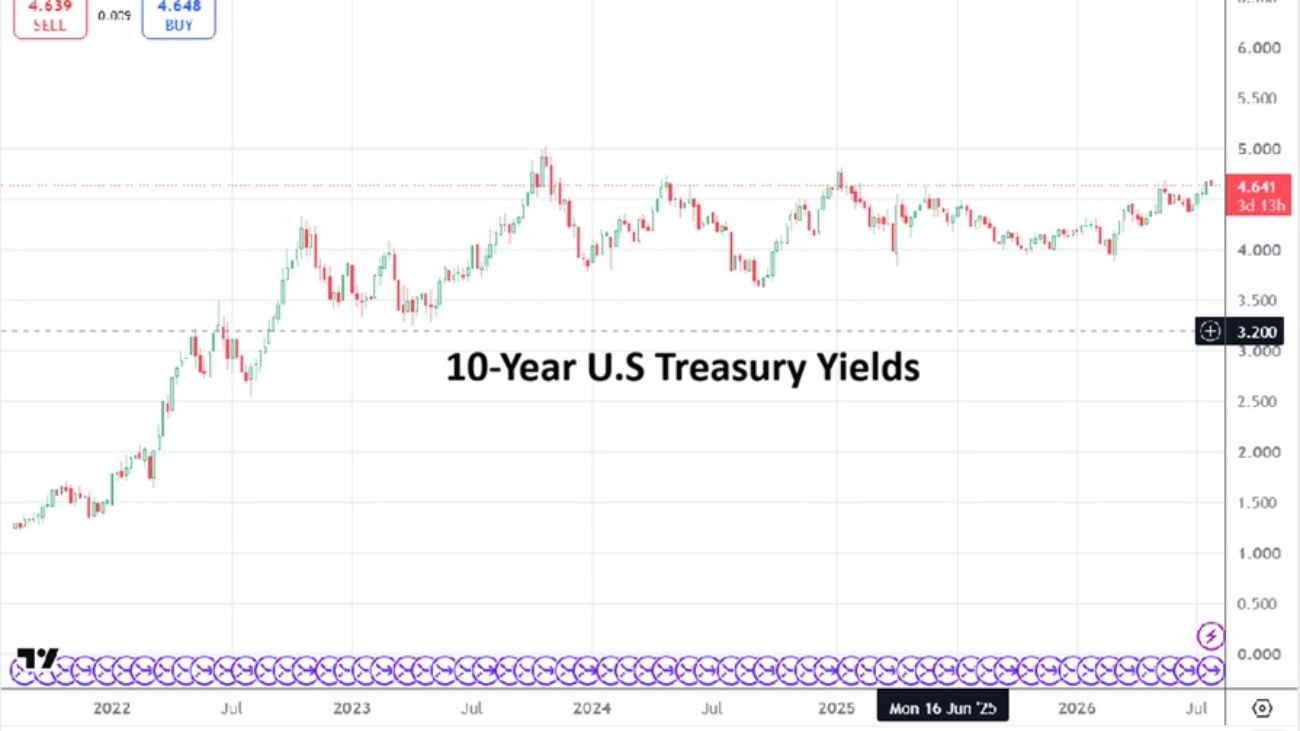
The USD/ZAR is traversing within a higher price realm since the start of March because of the Iranian conflict. The currency pair flirted with depths below 16.00000 in the middle of February. The value of the USD/ZAR at this time is close to 16.70000 depending on bids and asks. The Rand is correlating to the broad Forex market as USD centric strength has emerged recently, this as U.S 10 Year Treasury yields increase and threaten to become sustained. The U.S Federal Reserve is suddenly dealing with threats of inflation becoming sticky over the mid-term because of escalating energy costs. The U.S has plenty of WTI Crude Oil, but nations which had counted on energy from the Middle East are suddenly U.S customers and increased demand is going to cause WTI to remain elevated until the Iranian situation resolves. 

The USD/ZAR was in a bearish trend since early August 2025 when values were above 18.00000. The highs in early August of last year were caused by concerns the U.S White House sparked because of tariffs. South Africa is still facing tirades from the Trump administration about some policies being practiced in South Africa, but financial institutions have looked elsewhere regarding impetus for the Rand and its correlation to global Forex is the chief influencer.

While South Africa and its people and culture are easy to embrace, there are issues that remain problematic in the nation. Politics around the world often appear to be a complex myriad because certain people and partisanship are transfixed on power. Corruption globally is an issue in many nations that causes not only fiscal problems but inflation. South Africa suffers from these complications too. These matters can only be fixed with transparency and patience, and importantly – for citizens to demand better. 

Politically the current coalition government on the surface appears to be working. Yet, the potential for fractures to grow over the next handful of months as municipal elections approach –  the Johannesburg mayoral and city council results will prove fascinating, will be crucial for South Africa. Johannesburg has been facing a water supply crisis for a while and its consequences are a stark contrast to the Western Cape’s ability to repair and replace infrastructure in a matter of days after the recent storm.

The USD/ZAR is likely to correlate to USD centric price action near and mid-term, but there is a chance heightened political rhetoric and voting outcomes in a handful of months could shift impetus for a short while. Higher energy costs in South Africa now and into the mid-term will cause inflation. Food costs do appear to be incrementally rising in supermarkets. 

Yes, gold and platinum values will be looked at by some analysts and pointed to as reasons for the stronger South African Rand, and this influence may be real – to a degree. However for the moment, the USD/ZAR remains transfixed within the lower realms of its long-term price range mostly because the coalition government here is viewed positively, and the USD was weaker globally. 

The U.S Fed does have inflation concerns arising. As much as President Trump would like the new Fed Chairman, Kevin Warsh, to be dovish the reality for the U.S central bank and financial institutions judging outlooks lacks clarity for the moment. Sideways choppy price action in Forex and for the USD/ZAR may prevail in the coming days and weeks. And if the Iranian situation grows more boisterous, USD centric strength could grow.

Copy and paste the text from AMT that you want to share

AMT Top 10

AMT Top Ten Miscellaneous Insights on the 18th of May, 2026

Valuations and Drinking, Bad Storms and Politics Amidst the Resilient Nature of People

10. Resilience: The Western Cape of South Africa endured strong storm conditions last week. One of the hardest hit areas was the Cape Winelands District, but electricity and water have been widely restored. And a collective of people have proven working together can produce solid results when needed. 

9. Spencer Who: The Los Angeles mayor race is growing intriguing. A reality star turned social influencer threatens to become an influenza for his opponents. This as Spencer Pratt’s campaign gets noticed for its entertaining social media videos. This has caused many folks to ask what has happened to the state of politics and meaningful policy. But if NYC can elect a socialist, why can’t L.A elect an influencer and make some people feel sick?

AMT Top 10 Miscellaneous Insights for the 18th of May, 2026

8. Two Trillion: SpaceX early investors have agreed to allow a five for one stock split, meaning the company (and Elon Musk) are now aiming for a potential doubling of its worth when its IPO is initiated – on Nasdaq – in the second week of June. Some very serious accountants will be kept busy trying to show how SpaceX will produce enough revenue over the next twenty years in order to make a 2 trillion USD valuation palpable to future investors.

7. Drunk: Brown-Forman Corporation will begin its trading near $26.28 on the NYSE today. The company is the majority owner of Jack Daniels and other alcohol related enterprises. The value of Brown-Forman Inc. in June of 2021 was around 80.00 per share. The sobering phase of the public – particularly among young drinkers – to avoid bars and clubs, and instead stay on their mobile phones has hurt share values in many alcohol related companies. There are also concerns that too many drink companies now exists. Before Brown-Forman becomes the life of the party again, it appears some competition will have to go dry.

6. Deals: Prime Minister Modi visited Abu Dhabi a few days ago, and one of the results was an agreement to purchase and store energy reserves on a large scale in the United Arab Emirates. Modi also confirmed India’s strong connection to the UAE politically. While always trying to maintain a non-aligned stature, India appears to be moving closer to an increasingly important alliance with the UAE – which has also aligned with Israel strategically. The potential of these three nations acting together will ruffle feathers in a few noteworthy Middle Eastern and Asian countries.

5. Populists: President Trump’s tendency to say outlandish things and then suddenly turn around and show a willingness to negotiate terms has always been part of his art of the deal composite. However, saying what people want to hear and then turning on a dime and not delivering is also a symptom of populism. Trump isn’t the only politician suffering from this flaw. What do politicians really think, and how differently would they act if a they didn’t need votes for themselves or backers to remain in power?

4. Wall Street: After attaining apex highs early last week, the three major indices have taken a step backwards. Near-term concerns are effecting outlook as financial institutions balance risk averse tactics to long-term belief that sunnier days will prevail. While the Dow 30 didn’t set a record last week, the ability of the index to climb above 50,000 was noticeable. Equity markets appear tentative as this week begins and folks seemingly wait for more thunder and its potential effects.

3. Emirates: The UAE was attacked by drones yet again yesterday, this time at the Barakah nuclear facility. The hit has been downplayed, but highlights that military conflict with Iran remains very possible across the region. It is doubtful conversations are being conducted with polite undertones behind closed doors. The U.S, Israel and other nations are watching Iran – and Iran is watching them. The price of WTI Crude Oil remains a key barometer regarding the markets and concerns about the war igniting in full once more. Prices of oil remain sustained above $101.00 per barrel in the futures markets. The UAE might not want to be a focal point, but it isn’t backing down either.

2. Hawkish: The U.S Federal Reserve may have to actually consider raising interest rates before they can realistically discuss the notion of cutting borrowing costs, particularly if energy prices remain elevated and spark a sustained inflation threat over the mid-term. The USD started to show renewed strength the past few trading sessions in Forex, this as financial institutions compare their near-term anxiousness to growing concerns about mid-term ramifications regarding higher fuel costs.

1. Ego vs. Hubris: The U.S and China summit held largely in Beijing this past Thursday and Friday matched competing politicians and ideologies. In one corner U.S President Trump spoke with a rather inflated sense of himself while he detailed policy objectives and his perspectives. In the other corner Xi Jinping, the President of China, might have displayed some hubris as he warned the U.S about the Thucydides Trap. Xi expressed his belief that China is the emerging super power and that the U.S is a declining nation. However, China’s economy is known to be suffering because of a myriad of complex reasons, and could face more headwinds if energy prices and supplies remain hard-pressed.

Copy and paste the text from AMT that you want to share

Indian Rupee 20260515

India Insider: Rupee Under Pressure as Oil Prices Surge and Import Bills Rise

Iranian War and Implications for India as Energy Prices Cause Vulnerability

India is currently facing mounting external economic pressures as rising global crude oil prices weaken the Rupee, widen the current account deficit, and increase the risk of imported inflation. As one of the world’s largest energy importing nations, India remains highly vulnerable to fluctuations in global oil markets. The recent surge in energy prices, combined with geopolitical tensions and volatility in currency markets, has intensified concerns among policymakers, economists and investors.

The Reserve Bank of India (RBI) has stepped up its intervention in the foreign exchange market to stabilize the Rupee, while the government is evaluating measures to reduce pressure on import billing. Rising fuel prices, weakening currency conditions and growing external imbalances have combined to create a challenging macroeconomic environment that may test India’s economic resilience in the coming years.

USD/INR Six Month Chart as of 15th March 2026

Gold and consumer electronics imports are increasingly being viewed as non-essential imports, and policymakers may consider restricting these categories in order to reduce stress on the current account deficit. Officials are concerned that a widening trade imbalance could place further downward pressure on the Rupee and increase dependence on foreign capital inflows.

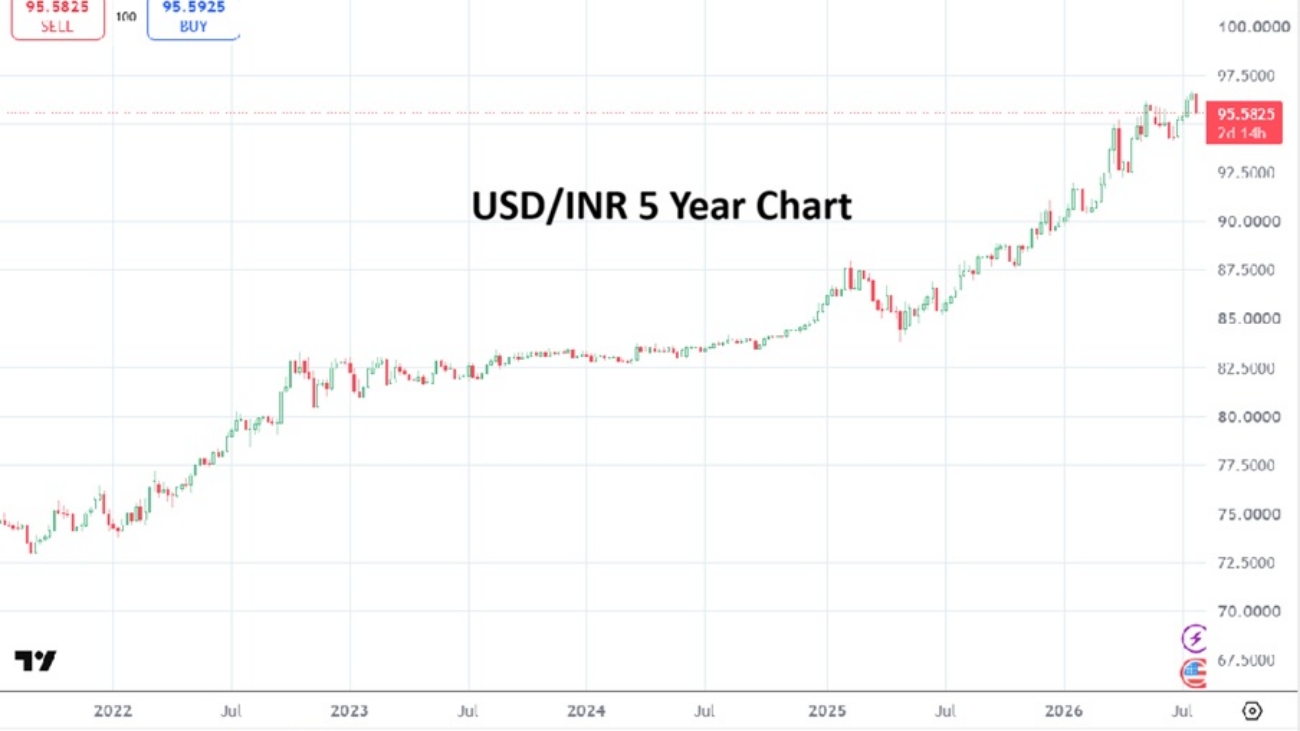
The Rupee on Thursday fell to a record low near ₹95.95 per USD, making it one of Asia’s weakest performing currencies this year. The currency has erased most of the gains achieved following earlier RBI intervention measures aimed at curbing speculation in the Forex market. Analysts expect the Rupee to remain under pressure through 2026, especially if global crude oil prices continue to rise and significantly increase India’s import billings.

The impact of rising crude oil prices is becoming increasingly visible across the Indian economy. Private fuel retailers have either reduced diesel sales or raised prices in response to the rally in global oil markets, leaving state owned refiners to absorb a larger share of domestic demand. Long queues at fuel stations and rising transportation costs have intensified concerns over inflationary pressures.

Earlier today, State-owned fuel retailers raised fuel prices for the first time in nearly four years as New Delhi adjusted domestic pricing to reflect higher international crude prices following escalating tensions in Western Asia. Diesel and gasoline prices increased by more than 3%, even though Brent crude prices had risen by nearly 50% over the same period.

In New Delhi, diesel prices climbed to around ₹90.67 per litre, while gasoline prices rose to approximately ₹97.77 per litre. These are among the highest levels recorded since 2022 and reflect the growing burden of imported energy costs on the Indian economy.

Economists argue that the rise in fuel prices signals a gradual shift toward market based pricing rather than extensive government controls. Policymakers increasingly recognize that artificially suppressing fuel prices could worsen fiscal pressures and create larger external imbalances over time.

Currency Weakness and Monetary Policy Challenges

RBI Governor Sanjay Malhotra recently remarked at an event in Switzerland that continued currency weakness may be “only a matter of time” if global energy prices remain elevated and capital flows become increasingly volatile.

Foreign outflows during the year have already exceeded previous levels, while a sustained rise in crude oil prices above $100 per barrel could significantly widen the trade deficit and push India towards another period of pressure on balance of payments.

In this climate, attracting foreign capital via various tax cuts or raising the interest rates is paramount to reduce the pressure on the currency. It’s already been seen that New Delhi is working on reducing taxes for foreigners investing in Indian bonds.

Rise of Inflationary Pressures

Although India’s headline inflation remains relatively contained and below the RBI’s 4% medium term target, imported inflation risks are steadily increasing.

Economists also believe the RBI may eventually be forced to maintain tighter monetary conditions or raise interest rates further if energy prices continue to accelerate.

The central bank has already raised interest rates to around 5.25% this year, but several economists argue that further tightening may still become necessary.

Historical Perspective and Structural Risks

Economic historians often compare the current situation with the oil shocks of the 1970s. During that period, the United States was heavily dependent on imported oil. The oil crises of 1973 and again in 1979 contributed to inflationary pressures, balance of payments stress, and periods of USD weakness.

However, economists note that today’s global environment is significantly different. The United States has become one of the world’s largest oil and gas producers, reducing its dependence on imported energy. As a result, rising oil prices no longer weaken the U.S Dollar in the same way they did during earlier oil shocks.

For countries like India, the impact remains severe. India imports the majority of its crude oil requirements. Higher global oil prices directly increase India’s import billing and create additional demands for USD.

As Economist Philip Verleger was quoted by Bloomberg, “when you are a major oil importing nation, you are not only paying more for crude itself, you are also paying more for the dollars required to purchase it.” India is now facing this realization again.

Copy and paste the text from AMT that you want to share

Gordons Bay Sunset 20260514

Investing and Sunshine: Positive Momentum While Guarding Against Worst Scenarios

The Reliability of Optimism in the Marketplace

Once again the world has not ended. The sun continues to rise and set on a daily basis and the world’s investment outlook remains towards an optimistic approach. Day traders should take this notion to heart and actually repeat it as a mantra when they consider pursuing the marketplace based on notions of fear.

Solid risk management equally needs solid risk taking tactics. And speculators need to always remember long-term investors are not basing their decisions on what will happen near-term, they are looking towards the future. While this may seem like a reminder a father would say to his children as a life lesson, day traders should not be offended, but use this as a keepsake and understand the world of investing is made up of elements that have proven durable.

Sunset over Gordon’s Bay, South Africa

While the price of energy, namely WTI Crude Oil, remains in elevated realms, corporations are still producing, and financial institutions have not shuttered their offices. There are some nervous types that speak about $200.00 a barrel Crude Oil, yet the higher price of the commodity remains perched near $100.00. This value is high compared to where the price of oil has traded the past few years, but the reality is that the current values of Crude Oil have been within these realms before and the economic world has survived. The price of Crude Oil is not going to hit $200.00 anytime soon.

Inflation is certainly an unwelcome specter, but there is the added fact that part of the long-term outlook is – if and when the Iran saga ends the price of WTI Crude Oil is likely to drop significantly. Yes, that is not going to happen near-term, but it is part of an optimistic view looking forward. In the meantime, commodity pricing has become a focus for large players who are taking advantage of fears and an ever flowing river of optimism which creates dynamic prices in agricultural resources. Logistics via fuel costs are certainly effected as is manufacturing and farming, but again let’s soothe ourselves with the knowledge most of those involved in these industries have dealt with high costs before and will constructively deal with the vagaries of mid-term uncertainty.

Almost needless to say, the U.S stock markets are doing extremely well per the results of the big indices. The S&P and Nasdaq have all gained in exquisite fashion since the end of March. Who had that on their bingo card? While financial institutions pouring money into equities likely didn’t count on double digits gains in one month’s time, that is what has happened and they will not complain. Perceptions about the sun continuing to show up even in the midst of rainstorms gets investors through whirlwinds. The U.S and China summit taking place now will also add a dose of optimism for equity investors who gear their visions towards results over a three to five years span.

Nasdaq 100 One Year Chart as of 13th May 2026

Different Show and Outcomes for Day Traders

Day traders who are pursuing intraday results are not participating in the same environment as long-term investors. A casino like experience is the best comparison for many retail traders, but the option of trying to catch momentum and using techniques that can accomplish better results are available for those who try to ride the waves caused by big players. 

Some may view money as a game, but it is actually more aligned with the concept of a tool. If a retail trader – or institutional investor – participates in a particular asset, they must have an understanding of how it works. 

Trying to gauge behavioral sentiment is a key ingredient for speculators when trying to deduce what will happen in the marketplace. Predicting what will happen within an intraday framework is difficult at best. However, there is something to be said for understanding how the emotions of investors and large players work while they make their decisions – particularly when day traders are using these notions as a barometer. The trading in the USD/JPY is a prime example of how trading/investing and outlooks work:

Our Friend the Japanese Yen and Forex Opportunities


It is recommended that day traders do not try to tackle too many speculative sectors at the same time. It is urged that they get familiar with one part of the financial market and make it a specialty. 

No one can know everything. Experts in one area – like an academic field – often believe this entitles them to speak on a variety of subjects they have no expertise within and this often leads to catastrophe. Day traders need to make sure they are getting information from sources that are reliable. Because sure as heck the sun will rise and set, no matter what dire predictions are made by those who prefer to focus on the worst.

Copy and paste the text from AMT that you want to share

India Vote 20260507

India Insider: How a Film Star is Reshaping Politics in Tamil Nadu

Vijay: A Stunning Victory by an Actor Turned Politician in India

When the Tamil Nadu state election results were announced this Monday, many people were stunned that a party with barely two years of political existence had managed to unseat parties that had dominated the state for more than 75 and 50 years respectively.

TVK (Tamizhaga Vetri Kazhagam), founded by actor turned politician Vijay, used his charismatic presence in Tamil cinema along with the power of social media to attract Gen Z voters and women.

This came despite the incumbent DMK (Dravida Munnetra Kazhagam) government under Chief Minister M.K. Stalin being widely credited for stable governance and helping Tamil Nadu remain one of India’s fastest growing state economies, with a GSDP( Gross State Domestic Product) growth rate of 11.9%.

Voting Results in Tamil Nadu and TVK Topping the Results

The two major Dravidian parties – DMK and AIADMK (All India Anna Dravida Munnetra Kalagam) were originally built on the foundations of social justice, welfare, and development. For decades, they shaped Tamil Nadu’s political identity and succeeded in winning the trust of the people.

However, despite the DMK government’s governance record, allegations of corruption, nepotism, and cash for votes politics continued to surround both DMK and ADMK. These criticisms have become deeply embedded in public perception over the years.

Today’s Gen Z voters appear to want change. Many were looking for a fresh political face capable of reshaping Tamil Nadu’s political landscape.

Vijay’s party reportedly secured around 1.67 crore votes, or approximately 34.3% of the total vote share, one of the strongest performances ever recorded by a newly formed political party contesting its first major election.

India’s political landscape has also been evolving rapidly in recent years. Prime Minister Narendra Modi and the BJP have successfully consolidated much of North India politically and are now working aggressively to expand their influence in southern states such as Telangana, Karnataka, and Tamil Nadu.

For Modi, strong regional opposition leaders such as M.K. Stalin in Tamil Nadu and Mamata Banerjee in West Bengal have remained major political challenges. Any significant political shifts in states like Tamil Nadu and West Bengal could reshape India’s national political dynamics in the years ahead.

While corruption, nepotism, and vote buying are important issues to consider, it is also necessary to distinguish between political allegations and governance outcomes.

In many ways, the DMK government performed better during the last five years than several previous ADMK and DMK administrations. Social indicators are impressive while Tamil Nadu State has attracted billions of USD investment for iPhone and automobile manufacturing.

During the election results, I was driving through Tiruvannamalai in northern Tamil Nadu and noticed that the streets were unusually silent. There were hardly any people celebrating openly.

If another traditional Dravidian party had won, the roads would likely have been filled with supporters distributing sweets and celebrating publicly.

For the first time, it felt as though a major electoral victory had been shaped more by social media influence and public perception than by traditional ground level welfare based political desires.

On my way back home on Monday, I saw an elderly man sitting at a bus stop equipped with fans that helped ease the intense summer heat.

That moment made me wonder: in the next five years, will political change alone truly improve the lives of ordinary people?

Or will charisma and digital influence matter more than governance, infrastructure, and social-welfare in the long run?

Copy and paste the text from AMT that you want to share

USDJPY 20260505

Our Friend the Japanese Yen and Forex Opportunities

Bank of Japan's 'Do As We Say' A USD/JPY FX Advantage Technically

Forex traders who have been keen on trying to venture wagers on the USD/JPY certainly cannot be faulted. As of this writing the USD/JPY is near the 157.720 vicinity, this after falling to lows around the 155.750 mark and below momentarily last Thursday, Friday and briefly yesterday. 

The Bank of Japan let it be known in the middle of last week that speculators should not be buying the USD/JPY because they – the BoJ – could and would intervene with strong selling to kill off the momentum higher. The ‘do as we say’ approach from the BoJ is a contrarian trader’s dream, but one that needs as always a strong dose of risk analysis.

USD/JPY Five Year Chart on the 5th of May 2026

And this is where it gets properly intriguing for USD/JPY traders, because the Bank of Japan is literally setting the table for two different types of Forex trades when they threaten or actually intercede with interventions. One is a selling notion per the warnings, the second is a buying excursion for the emotionally stable after they think the intervention has run out of power.

A five year chart shows the immense pressure the Japanese Yen has been under as it has lost value against the USD. However, it is all about perspective depending on how a trader wants to chase momentum shifts. 

Technical traders can easily see that when higher vicinities are approached the USD/JPY is sometimes met with spikes downward. And then technically it is rather evident that support levels tend to spur on buying. The problem for buyers seeking support levels after Bank of Japan selling is to know when it is safe to become a buyer again.

If a trader has courage and wants to bet against the large players and financial institutions leaning into long positions of the USD/JPY, a selling position at higher marks is a solid choice. Yet, the other question then arises – where is resistance going to actually translate into a warning sounded by the BoJ in order to create the desired landslides lower in the USD/JPY?

Bank of Japan policy regarding interest rates has only been in question for over 3 decades now from outside observers who like to be critical. Yet, the conservative (and questionable) policies of the Japanese government via fiscal and monetary policy is a looking glass into practicalities for Forex traders. 

10-Year Japanese bond yields are now at twenty-nine year highs. The rate as of this writing is above the 2.50% level. The Bank of Japan Policy Rate remains low at 0.75%. While many analysts believe borrowing costs from the BoJ should be higher, what some might be missing is that the Japanese people are already being penalized via a weaker Japanese Yen. Higher borrowing costs and a weak Yen would likely not go over well with many Japanese citizens.

The Bank of Japan is in a difficult place regarding outlook as it tries to help keep exports strong, while also having to consider the higher costs of energy which is certain to hit Japanese industries over the mid-term. These considerations may cause some financial institutions to continue leaning into a buying outlook regarding the JPY, but near-term considerations must also be weighed as nervous sentiment cascades throughout the broad Forex market shifting abruptly. 

USD centric price action has been choppy, but overall the USD has also been weaker against many major currencies and even emerging market currencies. Yet, the USD/JPY remains within its higher realm. All of the Bank of Japan warnings to speculators telling them not to pursue buying the USD/JPY continues to make the BoJ sound weak and this doesn’t help sentiment surrounding the JPY. While the Bank of Japan can certainly intervene with massive amounts of buying the Japanese Yen – selling the USD/JPY – the central bank also is probably quite keen on making sure the JPY doesn’t get too strong. 

And this is where confusion must be put to the side, economics are wonderful when studied in a textbook, but the reality of trading the USD/JPY lives in the real world. Fiscal and monetary policies do not always work out the way governments intend.

The BoJ probably has a polite trading range they would like to see for the USD/JPY between 154.000 to 158.000 currently, but getting financial institutions to help achieve this realm remains difficult. The range between 156.000 to 159.000 likely remains a practical area for the BoJ as of now, one in which they believe their policies can work properly. 

Opportunities need to be viewed with a proper lens by day traders. Participating in the USD/JPY is a dangerous place because the currency pair has massive volume and the BoJ and U.S Federal Reserve often work together to gear valuations – even if they frequently disagree on techniques. Price velocity in the USD/JPY will continue to prove dynamic in the near-term and speculators need to practice patience and keep their risk taking tactics strict.

Copy and paste the text from AMT that you want to share

AMT Top 10

AMT Top Ten Miscellaneous Early May Reflections

May Day Parades and Wishing on Santa Claus

10. NBA Playoffs: Basketball has now entered its serious season, one in which rest days are no longer done in order to gain better draft day lottery odds, nor appease star players who feel the need to take a day off. There have been a couple of upsets already during these playoffs with Houston, Denver and Boston all of whom were favored to win their first round competitions going down in flames. Semi-conference championship contests will begin tonight. Basketball fans are now getting the NBA product they want.

9. May Day: Parades and protests were seen throughout the United States this past Friday. The once treated contemptuous flag of communists was held aloft and portrayed as a viable ideology at many demonstrations. Protestors marched and chanted their displeasure about free enterprise. A lack of historical knowledge about the massacres ignited by Joseph Stalin, Mao Zedong and Pol Pot while paying homage to iconic Che Guevara images was evident. However, their longing for a Santa Claus like figure to come bearing free gifts did not appear. 

AMT Top 10 Miscellaneous Early May Reflections on the 4th of May 2026

8. $80,000.00: Bitcoin has been traversing higher and continues to flirt with the eighty thousand USD realm in its sights. Strategy (MSTR) finished last week above the $177.00 ratio. Are the new higher avenues a sign momentum will continue to endure for these two highly flammable speculative wagers, or will profit taking douse them again when suspicious caution reemerges?

7. NYC: Mayor Mamdani has made it known the city is not going to be able to meet his budget requirements and has postponed the publication of New York City expenditures until the second week of May. Mamdani has called on the State of New York to change is financial arrangements with NYC in order to facilitate his wishes. In the meantime, the Mayor has decided to pick a battle with hedge fund manager Ken Griffin, the primary owner of Citadel, which if unresolved is likely to cost NYC vital jobs and income. Charm and ignorance are likely to get Mayor Zohran Mamdani only so far.

6. Warning: USD/JPY is traversing near 156.900 as if this writing. Last week the USD/JPY was over the 160.000 ratio and sustaining values. But official murmurs from the Bank of Japan proclaiming readiness to intervene sent the Forex pair tumbling. Japanese Yen speculators betting against the BoJ should remain alert and understand that quick profits and escaping before an actual intervention strikes is a very dangerous game to play. The USD/JPY is the domain of large players and financial institutions. Yields on Japanese bonds have escalated, which is a sign that belief in Japanese fiscal policy remains lukewarm, but participating in the USD/JPY via wagers needs to be done with extreme care.

5. Hormuz Strait: WTI Crude Oil values continues to effect behavioral sentiment amongst investors and speculators. The price for spot Crude Oil is above $106.00, while futures are challenging the $100.00 realm. Inflation concerns are turning from whispers into fact. Airlines are being impacted, and logistics for large companies like Unilever are becoming higher costs for global consumers.

4. Reality Shock: Escalating electricity costs for the giant data centers that Artificial Intelligence infrastructure needs are starting to not only be realized, but causing investors to understand genuine profits for the mega-sized ambitions of many companies may prove fleeting. Hyper-scaling companies seeking to build bigger electrical capacity include Microsoft, Alphabet, Meta, Amazon Web Services and Equinix and it will not be easy. Potential and real electricity shortages are causing some nations, states and cities to plead for help due to too much demand on their overwhelmed power grids.

3. Voting: Jerome Powell has decided that he will remain as one of the seven Federal Reserve Governors, which allows him to vote fully on interest rate (FOMC) policy. Powell’s action is highly irregular and one that certainly doesn’t please the Trump administration. Treasury Secretary Scott Bessent has expressed his exasperation regarding Powell’s non-departure from the FOMC. Powell will step down as the Chairman of the Fed on the 15th of May, but his position as Governor doesn’t end until the close of January 2028. Because the Fed is an independent entity in theory, President Trump and those aligned with Trump’s economic outlooks will have to deal with Powell who will clearly not bend to White House desires. 

2. Apex Peaks: The official start to the Middle East conflict – this time – began on the 28th of February. Since deciding the Nasdaq 100 and S&P 500 were vastly oversold in late March, a parade upwards bearing gifts has developed and both indices attained record heights this past week. The Dow Jones 30 is still below its all-time levels produced in the second week of February when it scorched above the 50,000 level, but the granddaddy of U.S indices also did remarkably well in April. 

1. Exit West: The decision to officially leave OPEC by the United Arab Emirates is a clear sign that the Iranian war has turned into a philosophical realism regarding existential outlook. The UAE’s has aligned itself with the West and has said no to radicalization. The United Arab Emirates desire to become a Singapore like model in the Middle East that practices free enterprise and provides a worldwide hub for commerce is clear. Many people are not connecting the dots regarding the UAE’s choice, a realignment of the Middle East is underway and it will have a profound economic effect globally.

Copy and paste the text from AMT that you want to share

Water India Graph 20260430

India Insider: Water Crisis Has Turned From Severe to Critical

India Needs Sustainable Water Security With Improved Infrastructure

India’s population has been expanding at a rapid pace and stands at 1.4 billion. Due to the urbanization process, industrialization in cities like Chennai, Mumbai and Delhi must continue to emphasize improving public infrastructures in order to maintain vital growth.

The growing population and urbanization adds noteworthy stress to the nation’s water bodies. With more people living in increasingly congested areas and pumping large amounts of water via borewells, groundwater levels are rapidly diminishing.

For instance, India consumes roughly 761 billion cubic meters of water per year, making it the largest water consumer in the world, ahead of China and the United States. 85% of rural India is dependent on ground water for agriculture and consumption, this because lake and pond water are not accessible. Rural India suffers from a lack of maintenance and sewage water that often contaminates these important sources.

Tap Water via Total Dissolved Solids Comparison in Various Cities Worldwide 

Only a few years ago, water facilities provided by municipalities and urban systems were relatively accessible in India. Low and middle income households relied on pipelines, wells and tap water for their daily usage. However, with sharp rises in population, government capital expenditures on water pipelines and sanitation has not kept pace and often fails to meet needs.

For example, rainfall in Chennai City always ends up staying on roads and platforms in the last few years, this despite the city’s infrastructure which has expanded multifold. In many parts of Chennai, water contamination has become severe with high levels of iron, hardness, turbidity and nitrate levels visible. The government has been inefficient when addressing the contamination. As I witnessed in 2019, many parts of Chennai cannot use ground water due to inadequate rainfall, storage and lack of proper municipal supplies.

And due to excessive extraction of ground water and an inability to channel rain water into the ground, many parts of Tamil Nadu now report total dissolved solids (TDS) ranging from 500 to 1000 parts per million, reaching extreme levels of 3000–5000 ppm in some areas. The World Health Organization recommends much lower levels for safe and palatable drinking water.

Water treatment for households using reverse osmosis plants, which were not normal a few years back have become essential for people seeking safe drinking water. Despite being a coastal region , cities like Chennai cannot rely solely on seawater desalination to meet their drinking water needs. While desalination plants contribute to supply, they account for only a fraction of total demand.

Desalination is an energy intensive and expensive process, making it difficult to scale for universal, affordable access. More importantly, producing water is only one part of the solution and delivering it efficiently remains a major challenge.

India endures 3 to 4 crore (30–40 million) waterborne disease cases every year, mostly from contaminated drinking water. As borewells go deeper, they draw water containing high concentrations of fluoride, arsenic, nitrates, and heavy metals. This creates significant health risks, especially for low income households that cannot afford advanced purification systems. The depletion crisis and contamination crisis are increasingly converging.

Due to rapid urbanization and high population with inefficient audits, many water bodies such as lakes and ponds have been encroached upon by the real estate sector or contaminated by waste disposal by surrounding settlements. This is quite visible in Chennai.

Experts claim that many water officials do not have a clear understanding of how pipeline networks are laid out across cities. As Frontline magazine columnist Vedaant Lakhera wrote in April 2026, India’s water crisis stems less from hydrological scarcity and more from a failure of governance.

The absence of water sensitive designs have allowed cities to expand unchecked, almost freely, contaminating local water sources such as lakes and ponds. This has led to a significant depletion of groundwater availability, which were supposed to act as reserve water reserves.

Addressing this crisis requires a multi-dimensional approach. Rainwater harvesting must be scaled to improve groundwater recharge and long-term availability, while modern purification systems remain essential to ensure safe consumption in the short term. At the same time, systemic reforms such as regular pipeline audits, mandatory replacement of ageing infrastructure, and better urban water management are critical to prevent contamination at its source.

Without such integrated efforts, cities will continue to face a paradox of water scarcity amid abundance. Sustainable water security in India does not depend only on how much water is available, but on how effectively it is managed, protected and delivered.

Copy and paste the text from AMT that you want to share