
Improving India's Education Strategy to Help Prosperity
Indian government officials, policy makers and journalists have all applauded the GDP April-June quarter data that came in 7.8%, compared to last year’s 6.9% growth. Although, the growth metrics are essential for understanding the results achieved in the broad economy, improved metrics should be applied towards the quality and conditions of life for citizens throughout India while comparing prosperity inequality.
Reading economic statistics without political or sociological factors becomes irrelevant. International trade agreements are often examined between capital and trade statistics, but in reality they are dominated by corporate lobbying and geopolitical powers behind the scenes calling into question results and assumptions.
Economists frequently discuss marginal propensity and disposable income elasticity, but in reality labour laws, union suppression and offshore workforce capabilities determine the wages paid to local employees. India like other Western countries, judges economic growth via headline statistics, without explaining the qualitative factors that determine a nation’s prosperity.
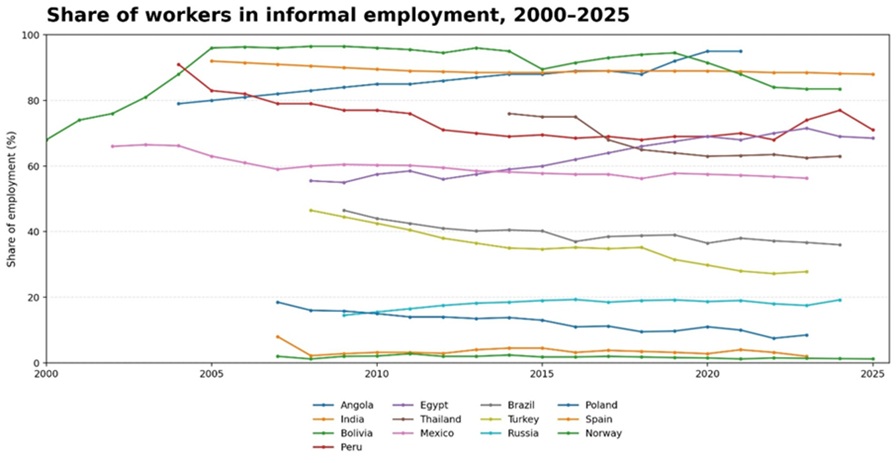
Share of Informal Employment Comparison 2005 – 2025
Human development concerns via good housing, better roads, access to quality education for every child, and secure hospitalization in government run facilities are not covered in GDP data. India calculates GDP data with a production and expenditure approach. Meaning the production of goods and services in a given time must match the underlying expenditures of the overall economy. Since the Indian statistical office calculates expenditures from with a limited number of household surveys and proxies, it’s not prudent to conclude that all GDP data is correct.
Some analysts prefer to look at Gross Value Added, GVA, to determine the overall value created by the nation’s producers. However, this data observes the organized sector via corporate filings, GST (Good and Services Tax) data, industrial production indices, but leaves the contribution of India’s vast unorganized employment sector in the dark.
Informality in the Job Sector
Over the last few years, non-farm jobs which are crucial for diversifying the economy and providing stability are not growing as needed. The formal job sector which offers security, benefits and fair wages is also stagnant. This lack of job creation is pushing more people into unpaid or informal work (the latter constitutes around 90% of the work force) where people struggle to make ends meet.
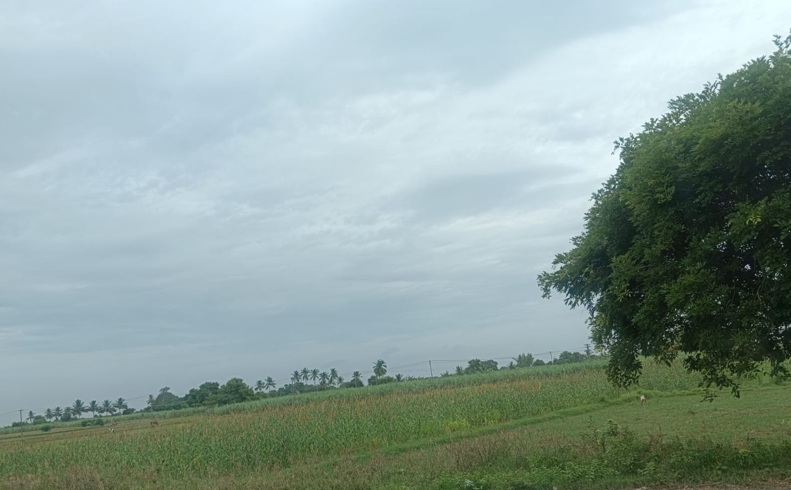
Kallakurichi District in Tamil Nadu State
The National Statistical Office ( NSO) under the Ministry of Statistics and Programme Implementation (MoSPI), performs periodic labour force studies, including household consumption and annual questionnaires of the unorganized sector, but they are sample based surveys and taken only as a proxy due to a lack of available data.
However, these sample based household surveys allow observations of the unorganized sector via snap shots. The agricultural sector traditionally seen as a last resort for employment in rural areas, witnessed a resurgence after the Covid-19 pandemic. Unbelievably, about 80 million people rejoined this sector (including women in rural areas who had exited agriculture jobs after 2004, as a periodic labour force quarterly survey shows) between mid 2020 and mid 2024. This increase in employment continued into 2025, not because of farm growth and modernization, but due to stagnation in the industrial and services sectors.
India’s major challenge in the coming decade is to create enough adequate non-farm jobs in order to accommodate new entrants and for those who are want to leave agricultural employment. Meanwhile, India has one of the lowest rates of work participation of women in the world. Yet, some studies argue that there is a close link between the female labour force participation rate and manufacturing employment. To help GDP growth rates move qualitatively upwards, India must absorb more women from farm work and into manufacturing.
Population size matters and because of India’s large numbers if rising labour productivity is accomplished the nation will not only continue to become one of the largest economies, but will have the the capacity to influence the world’s GDP growth rate positively. The impact of one policy (for instance to promote economic growth) on another (i.e: income poverty reduction) crucially depends on the level of a third variable like the improvement of human capital via better skills, knowledge and health. In other words, growth will be more successful in reducing income poverty if economic value is well developed and more equitably distributed for individuals.
Increasing the capabilities for those who want to be employed and form the base of a country would facilitate the creation of improved formal jobs, labour productivity and real wages. However, the reality is complex. During the Covid-19 pandemic and in its aftermath workers who had earlier left agriculture for better earnings in the first half of the noughties shifted back to agriculture instead of moving to more productive or formal jobs in non-farm activities. In other words, India has seen an odd reversal of structured change that normally characterizes economic development.
Education for the Entire Population
The only upward mobility for Indians predominately is to educate their children, so that they can get comfortable jobs and lift their families out of poverty. For decades especially after the post independence period, India’s higher education remained an elusive dream for millions of historically marginalized people from Schedule Tribes, Schedule Castes and many struggling communities.
Unfortunately, the gates of universities and colleges were mainly opened to only privileged students belonging to the upper caste elites. Young ST or Dalit students in remote villages faced layers of disadvantages regarding poor schooling – including financial strains, social stigmas, etc. This is in contrast to students from the privileged social groups who often inherited aspirations and the access to higher quality education that comes with an expensive price tag.
While the door for higher education opportunities has been opened for all, it was much wider for those privileged groups, and it remained relatively narrower for the marginalized communities. As the data suggests, In 2023-2024, only about 6.8% of STs and 8.6% of SCs aged 24 and above had attained education up to the graduation level and above, while 12.5% from the OBCs and a striking 23% “others category attained the same”. This hierarchy pattern suggests that STs are the most disadvantaged, followed by SCs, and then OBCs with others at the top, suggesting structural barriers based on caste and historical exclusion.
Aspirations and Sustainable Quality Growth
With a large segment of population stuck in informal or low skilled work, their purchasing power remains soft, weakening aggregate demand. India doesn’t value GDP using an income based approach, because of the same informality. Therefore the failure to ensure equitable access to higher education does not simply reflect social injustice, it also directly weakens India’s growth aspirations, inclusiveness and sustainability.
Inequality in classrooms today becomes inequality in income tomorrow and eventually a drag on the nation’s economic growth. Instead of rejoicing over the quarter to quarter GDP growth comparing to last year, India must sincerely look into real problems that need to be solved and use its demographic dividend to create better results for all. A sociological and political lens is important to devise policies and strategies for next decade’s growth.
Copy and paste the text from AMT that you want to share
Like this? Get the next one in your inbox.
Independent commentary on global markets, geopolitics, and the forces shaping capital flows. Two to three articles per week.
Related posts:
 India Insider: Growth without Prosperity, Thoughts and Comparisons
 India Insider: Education, GDP and Personalized Growth a Difficult Balancing Act
 India Insider: Growth Matters, Development Matters Even More
 India Insider: Foreign Investors and Their Selective Choices
 India Insider: A Giant Bureaucracy Needs an Urgent Reset