post277

India Insider: Women in Agriculture Need Manufacturing Power

India Insider: Women in Agriculture Need Manufacturing Power

India has long been a society that has neglected Women’s Empowerment. While various states pursue proactive policies to enhance the role of women in society, their inclusion in the job market and ability to have financial independence is still lacking.

Small Scale Farm in Tiruvannamalai, India

In the suburbs of Tiruvannamalai City, in Tamil Nadu, Mrs. Revathi runs an agricultural farm where she grows rice, flowers, and vegetables. She sells them to local commission agents or directly to customers from her farm. Mrs. Revathi, who lost her husband in 2019, has two daughters, both of whom are educated and working. One of the daughters is getting married. She said that although agriculture helps her family earn money, it does not lift them out of the poverty trap because of uneven flower cultivation. The land is becoming less and less suitable for irrigation – a matter that worries her greatly too. Flowers are one of the major sources of income for many farming families in Tiruvannamalai City in Tamil Nadu.

This is just a small example of the challenges faced by women working in agriculture.
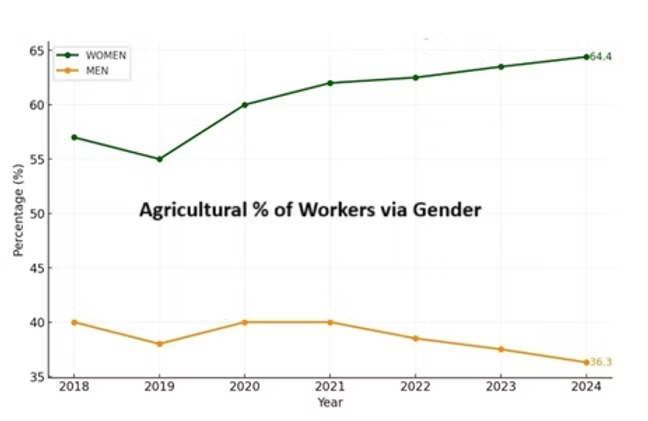
According to recent Periodic Labor Force Surveys, 64.4% of women in India work in agriculture, compared to only 36.3% of men.

Labor Workforce Percentage in India per Gender

Self employment and Access to Credit is not the Solution:

Many argue that self-employment and steady access to credit via microfinance institutions will help women become entrepreneurs and create movement up the social ladder. This is true in some cases, but many women struggle with raising families in their husband’s absence, and when working on farms where agricultural productivity is lopsided or unfit for growing vegetables or corn, times remain difficult.

First of all, why do women choose agriculture and remain small-time sellers? Because they are not able to find employment easily in formal sectors like manufacturing or other service oriented businesses.

Even within related agricultural sectors, women employed in vegetable processing plants, or value-added goods like masala manufacturing and tomato sauce production companies earn higher wages.

Unfortunately, low productivity and long spells of inactivity render agricultural workers significantly underemployed periodically. They are stuck, with nowhere else to go. Unlike in East Asian nations, which created mass employment through dynamic exports of manufactured goods, the Indian manufacturing sector’s low productivity makes it globally uncompetitive.

Manufacturing as a Solution for Women Empowerment:

Across Asia manufacturing has proven to be a powerful driver for upwards mobility. Incomes have risen, poverty has declined, and women are central parts of this transformation. In Vietnam, where a factory boom has been especially momentous, more than 68 percent of women and girls over 15 years of age are working for pay in some capacity, this according to data compiled by the World Bank. In China the rate is 63 percent, in Thailand 59 percent, and in Indonesia 53 percent of workers in manufacturing are women. Yet in India, less than 33 percent of women account for the workforce in recorded in official surveys.

In a pattern demonstrated in many industrializing societies, when more women gain jobs, families promptly invest further in education for girls. Manufacturing also lifts household spending power, fueling economic expansion that encourages investors to build more factories, providing additional jobs and reciprocal wealth creation. India is missing out on this dynamic manufacturing growth and is failing to broadly participate in the spread of improved industrialization which has helped bolster fortunes in many Asian economies and benefitted families. A vital component for a stronger Indian economy necessitates the empowerment of women.

postN17

AMT Warning: Many Brokers Do Not Care if you Lose your Money

AMT Warning: Many Brokers Do Not Care if you Lose your Money

Sounds like the title has been written wrong doesn’t it? Reads as if the editor clearly doesn’t understand the nature of the financial markets and how they work. Certainly anyone who offers their services to you would like to see you make money, or so you would like to think if you are an idealist who remains innocent and trusts all people.

Unfortunately, the title of this artcle which has lured you into reading this WARNING is not wrong. It has been written as cautionary advice for new and even experienced speculators. Many of the ‘financial’ websites and people you are considering to engage with via their day trading platforms and ‘expert’ systems are not worthy. Many do not care if you make money and some in fact are planning on ripping you off.

Blackjack Betting and Sitting at the Table with Too Much Leverage

Volatility is in the eye of the beholder, brokers like when day traders without deep pockets use leverage, because they expect their ‘clients’ to get wiped out. Yes, brokers are not your friends in many cases, in fact they are rooting against you in the back rooms of their trading operations. Why? Because they are not actually putting your trade into the cash markets, they are allowing you to trade virtuallly. Think of it as entering a casino.

The casino wants you to bet outrageous sums of money, because they know statistically most gamblers will lose. Again, you have been warned. Your use of leverage is music to the ears of your broker, because they know the volatility of the market will knock you out of a trade if your margin trading is too high and the slightest of technical reversals will produce a losing position for you. Then they will ask you if you want to make another wager. You can continue to sit at the ‘blackjack’ table or walk away.

Learn To Trade Without Getting Ripped Off

The first thing you might want to ask and acknowledge when you begin to trade is how much money can be lost? The answer is all of your money. If the answer being given to you is that there is minimal risk and that you are guaranteed profits – immediately close the website you are looking at and find another. Guaranteed profits equates into assured losses for unsophisticated traders most of the time.

If you are speaking to someone on the phone and the person keeps asking you how much money you want to make, please hang up the phone and speak to someone else. Self proclaimed gurus should be shunned. As someone once said, people tend to use the word guru, because the word charlatan takes too long to spell.

Yes, even in the most reputable and best of companies who provide trading platforms, you are going to lose money sometimes. The art of speculating and successsful trading is a delicate balance between losing money and making money. It is probable if you are a new trader, that unfortunately you are going to lose money and you will become uncomfortable. Sure you could get lucky or be a prodigy who is supremely talented, but you should understand many folks lose money in the beginning. There is a learning curve for day traders and you need good teachers. You also need a calm emotional state of mind.

Finding a Pro to Trade for You

You might want to consider letting someone that you trust and who has a proven track record with verifiable clients you can authenticate to invest your money. However to have a pro trade for you, the amount of money as a minimum you will need for them to consider trading your cash is likely sizeable. It doesn’t seem like a fair question from a social perspective, but are you wealthy enough to allow someone to trade for you?

If you find a person that is reputable to trade for you, make sure they have explained their modus operandi and you agree with their outline. In other words have them discuss their plan of attack and how they perceive complexities within the markets. What sectors do they invest in, what is the break down via percentages regarding the amounts of money they put into various financial assets? Asking questions may seem a bit impolite, but reputable fund managers and family offices should not get flustered by your questions, and they should have answers that are easy to understand. Do not let them talk over your head with fancy words and equations. Clear and concise language is necessary.

You shoud ask how often they rebalance their portfolios and if they issue a quartertly report. Importantly, ask for an example of transparent accounting which shows transaction fees that will be charged in full, including services they are charged by other financial providers within your account. Commission and banking fees can add up quickly. And then ask the magic question regarding drawdowns, and what are the allowable losses in a trade and in an account that can happen before they have to stop trading. You should get clear explanations regarding all of your inquiries.

But You Likely Still Want to Trade for Yourself

If your emotions do not let you take into consideration that there are going to be negative days, perhaps declines for weeks and bad months – simply put, trading isn’t for you. Learning to handle your money and investing should not be a speculative adventure, this is not about having fun. Oh you will certainly experience thrills, but you should try your best to limit crises. Risk management is a way to curb the elements of gambling which every day trader is undertaking.

Will you become a professional investor? What is a professional investor? Nothing like semantics and flattery to get the juices of a prospective investor going. Do not be fooled by flattery. Do not be fooled by the fact that you have a degree. There are folks who do not have high school graduation certificates looking to take advantage of you, some of them are great traders and will eat you alive. Education at the best of colleges or universities is no guarantee you will become a good trader. There is a difference between paper trading and having skin in the game.

The marketplace is waiting for you to enter and anticipates taking your money. Brokers are trying to get you to come to their trading platforms because they want to make money from your transactions and wagers if they are not reputable. These brokers actually do not believe you will make money. Until you prove you know what you are doing you will be treated like a ‘mark’. When you do prove you know what you are doing you will be treated differently in more ways than one, and it might prove difficult to withdraw your winnings.

Trust is Important, but Facts and Regulations Help

You must deal with people and companies you trust. Make sure to do a deep examination of the folks you are about to forge a trading association. Trading virtually via digitalized CFD and Forex houses that are not regulated can lead to financial disaster. And ask where your broker is regulated, and then check on the mandates of the entity and government which has written the rules for brokers – are they legitimate supervisors and who do the regulations favor? There is a lot of work involved before you trade, you must practice due diligence.

AngryMetaTraders wants you to understand the game of trading. We talk about sports often because the world of trading can be closely compared. If you are good and lucky, perhaps the world of investing awaits your success. If you suffer a learning curve like many, you can compare yourself to an athlete that must train to beat the best. You will need patience and dedication. Surround yourself with reputable firms and people to asssociate your speculative endeavors with in order to get solid results long-term.

postN22

The Intended Goal is to Make Money, but in an Honest Manner

The Intended Goal is to Make Money, but in an Honest Manner

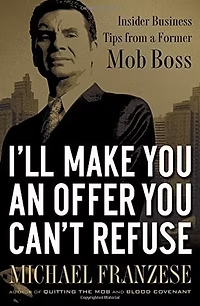
Book Corner: I’ll Make You An Offer You Can’t Refuse, written by Michael Franzese

Who says gangsters have marketable skills? Michael Franzese says so. Brooklyn-born Franzese, a former caporegime (which is a mobster who is second in line under a Mafia capo) and made-man in New York’s Colombo crime family, went legit following a religious awakening during an early ‘90s prison stretch. Franzese left behind a life of crime and became a motivational speaker, Mafia analyst for the media, writer, commentator, and even actor.

In this book – one out of seven that he’s written – Franzese argues that despite the criminality that he now abhors, gangsters have skills in running businesses that if copied, can put the average business or corporation ahead of the pack. I’ll Make You an Offer You Can’t Refuse is divided into eleven standalone sections, or rather lessons. In contrast to his former life, Franzese discusses running your business with honesty, transparency, and integrity.

He stresses the importance of choosing a good crew and surrounding yourself with capable people, starting your day as early as possible, proper planning, eliminating clutter, seeking counsel only from the wise, customer service, listening more than talking, learning from failures, etc. For example, one interesting section deals with the importance of effective negotiations – the famed “sit-down” as known to anyone who has seen The Sopranos and most other gangster portrayals in TV shows and movies.

Franzese informs us that unlike the sensationalist portrayal of crowded rooms, and long meetings with tempers flaring, sit-downs are short, sober, curt meetings attended by very few where the intended goal is to reach a mutually-acceptable compromise as soon as possible. After all, time wasted in long meetings is time better served making money, right?

At 160 pages, this book is relatively compact, nor does the author re-invent the wheel. Franzese’s skill is not only taking material that might be part of stuffy business textbooks and delivering it to the readers as filtered by his experience, but peppering the book with illustrative examples that keep them within a known cultural framework. As a result, the book comes out easy to digest.

Overall, we may not agree with how Franzese gained his business knowledge, but the lessons in I’ll Make You an Offer You Can’t Refuse are valid. His former crew would probably agree.

postN12

The Despair of Ice and Ability to Lead People through Storms.

The Despair of Ice and Ability to Lead People through Storms.

Book Corner: Shackleton’s Way: Leadership Lessons from the Great Antarctic Explorer, written by Margot Morrell and Stephanie Capparel

There is a vast library on offer for readers who want to study leadership books from historical figures. Shackleton’s Way adds to the fray and our knowledge by analyzing the famous 1915 Antarctic Endurance expedition of legendary explorer Sir Ernest Shackleton (1874-1922) for his leadership skills.

A word about Shackleton. Born in Ireland and raised in London, he cut his teeth on the Discovery expedition with Captain Robert Falcon Scott that explored the Antarctic regions in 1901 – 1904, one of the most brutal and inhospitable places on the planet. Later while leading on his own, he garnered international fame for a further series of Antarctic expeditions where he set distance records. Although in his lifetime he was considered a key figure in what is today known as the Heroic Age of Antarctic Exploration, he died in debt and fell out of the public eye for many years.

In the late 1950s, a series of books began to appear around Shackleton’s exploits, and his achievements began to be celebrated by a whole new generation of enthusiasts, leading to documentaries plus biographical TV miniseries (1983 and again in 2002, the latter featuring Kenneth Branagh). He has been acknowledged by the US Navy, and major universities have given management courses where his unique leadership style has been analyzed and promoted.

Shackleton’s Way tells the story of the Endurance expedition with an odd, but interesting, spin. For some background, the ship got stuck in ice and Shackleton was forced to abort and then lead his men to safety, with dwindling supplies, in the frigid wilderness. Morrell and Capparel analyze the expedition not as a success – which it wasn’t – but how Shackleton’s excellent leadership abilities saved his men and brought them all back alive and relatively unharmed (one man, however, lost his foot).

The Endurance story is told chronologically through eight sections, each highlighting a different leadership skill and how Shackleton embodied it, such as Creating a Spirit of Camaraderie and Leading Effectively in a Crisis. Each section concludes by focusing on a modern leader – from such diverse fields as business, education, and government – and how they in turn have been influenced by Shackleton and embody his style in their respective fields.

Shackleton was calm under pressure, led from the front, broke down the rigid hierarchies that were the norm on these expeditions, created cohesive and bonded teams, and was a master motivator. His crew respected and worked hard for him, and had full faith in his abilities. He had uncanny interviewing skills, creating a tight, professional team out of thousands of applicants with seemingly unconventional questions.

Shackleton was a fascinating man, and the lessons contained within this book are pure wisdom. The story itself is really an exciting adventure and you’ll get hooked after a few pages.