postN104

India Insider: Weakening the MNREGA Employment Guarantees

India Insider: Weakening the MNREGA Employment Guarantees

When the Mahatma Gandhi National Rural Employment Guarantee Act was enacted in 2005, it was conceived as more than a poverty-alleviation program. It was a direct intervention in India’s rural labor market. By guaranteeing employment on demand at a statutory wage, MNREGA established what the agrarian economy had long lacked – a credible wage floor.

For India, where nearly half the workforce remains trapped in agriculture and align activities often involuntarily, this mattered enormously. Rural labor markets are structurally weak in India. They are seasonal, informal, and dominated by excess labor. In such conditions, wages do not rise organically. MNREGA altered that balance by providing an outside option. A worker who could demand public employment could also refuse exploitative private wages. That is why rural real wages rose meaningfully during the first decade of MNREGA’s implementation.
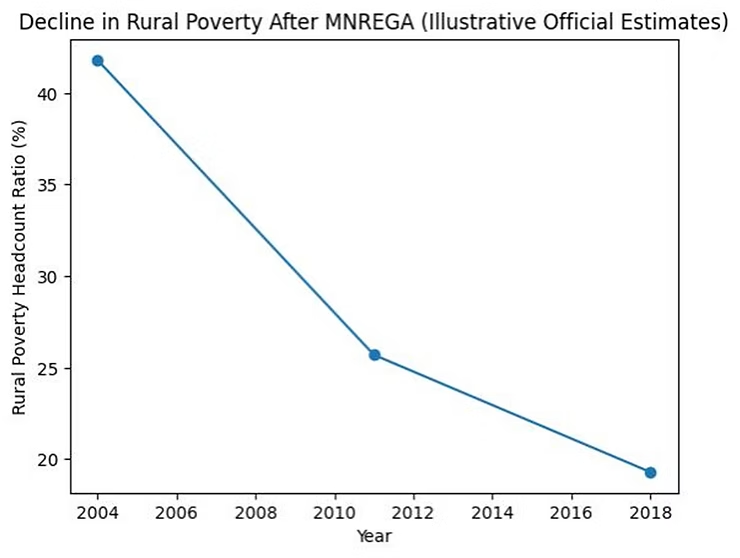
MNREGA Rural Poverty Data from 2005 to 2018

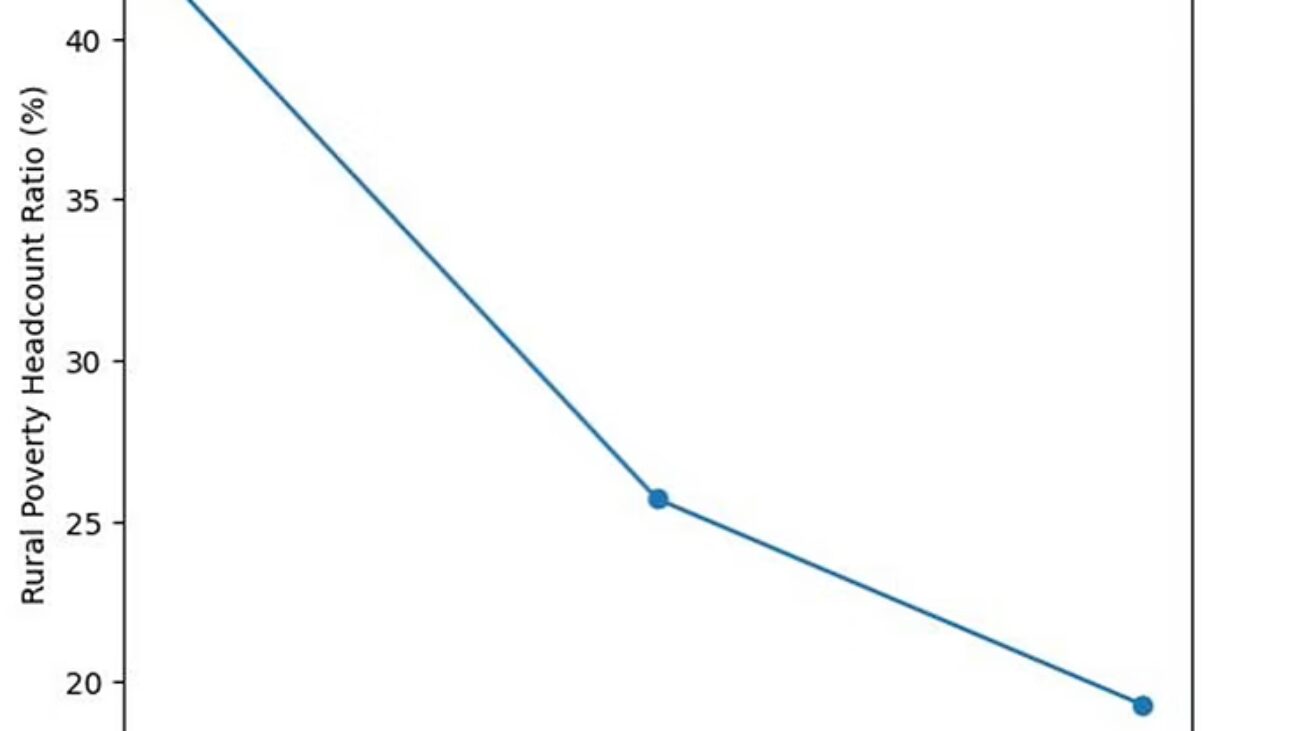
The figure above illustrates the broader context in which MNREGA operated. Rural poverty declined sharply after 2005, falling from over 40 per cent in the mid 2000s to below 20 per cent by the late 2010s. While this decline reflects multiple forces like overall growth, structural change, and social programs, micro-level studies consistently find that districts and households with higher exposure to MNREGA experienced significantly larger gains in consumption and poverty reduction compared to areas where the program was weakly implemented.

The scheme also acted as a counter cyclical stabilizer. During droughts, agrarian distress, or macro slowdowns, MNREGA expanded automatically, injecting purchasing power into rural areas. This supported consumption, reduced distress migration, and softened downturns. In macroeconomic terms, MNREGA transferred income to households with the highest marginal propensity to consume, precisely where fiscal multipliers are strongest.

Despite its strong design, MNREGA has long suffered from implementation weaknesses. Chronic delays in wage payments undermined its credibility as a reliable source of income. Corruption has generated fake muster rolls, ghost workers, inflated material bills, and substandard asset creation. Social audits which meant to be the backbone of accountability were uneven across states while effective in some.

Technological reforms such as Aadhaar linked payments, and digital attendance reduced certain leakages but introduced new problems, including worker exclusion, authentication failures, and further payment delays. The result was not only fiscal leakage, but a weakening of MNREGA’s core economic function which had promised a dependable wage floor.

Yet instead of fixing these implementation failures, a new policy chose to change the promise itself. In December 2025, this shift became explicit with the passage of the VB-G RAM G Act, 2025 in Parliament, replacing the Mahatma Gandhi National Rural Employment Guarantee Act with a redesigned rural jobs framework.

Under MNREGA, employment was a legal right, if work was demanded, it had to be provided. The new framework reverses this logic altogether. Employment now depends on budget limits, administrative approvals, and notifications from the center, not on demand. What was once automatic is now conditional.

This change also quietly shifts risk onto States. With limited revenue powers and tight borrowing limits, States responded by rationing work and delaying payments. As a result, the employment guarantee weakens, rural workers lose bargaining power, and wages come under pressure. What appears as fiscal control for the central government to rein on capital expenditures on paper thus becomes wage suppression in practice for rural workers.

Almost half of India’s workforce, around 46 per cent, still depends on agriculture and allied rural activities for employment, even though agriculture produces a much smaller share of the country’s total output. This gap between employment and output signals very low productivity in rural work and a large pool of surplus labor. For most of these workers, moving out of agriculture is difficult. They face barriers because of a lack of skills, weak urban job absorption, high migration costs, and social constraints. As a result, the ability to bargain for higher wages is structurally limited.

In such an economy, rural labor markets tend not to be competitive. Employers often face many workers competing for few jobs, while workers have few alternative sources of income. This creates conditions close to monopsony, where employers have disproportionate power in setting wages. In the absence of an institutional counterweight, wages tend to settle near subsistence levels rather than reflecting productivity or broader economic growth.

The consequences are visible in wage outcomes. Daily wages in rural areas stagnate or decline in real terms, failing to keep pace with inflation. Over time, this suppresses labor incomes relative to profits and rents, leading to a further decline in labor’s share of national income. In effect, weakening the employment guarantee shifts income distribution away from workers and back toward employers, reinforcing existing structural inequalities in the economy.

Post306

India Insider: Reserve Bank of India Intervention is Limited

India Insider: Reserve Bank of India Intervention is Limited

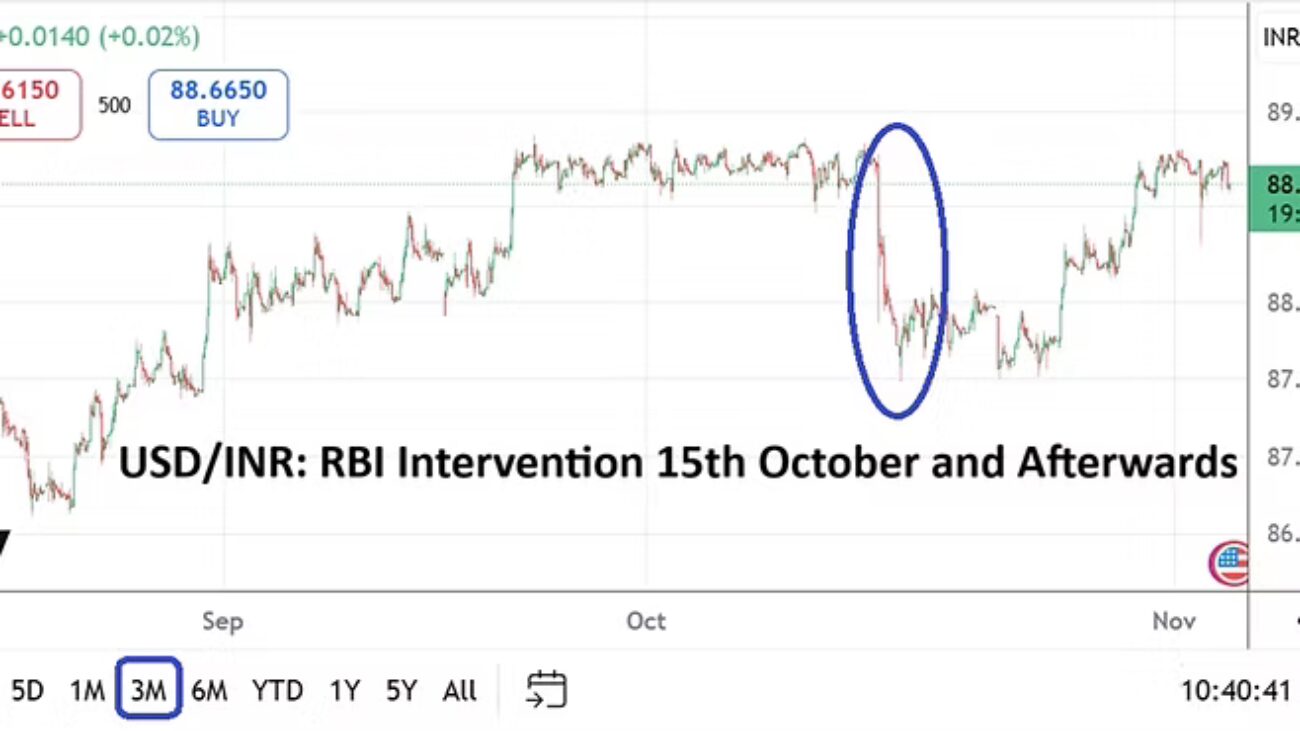
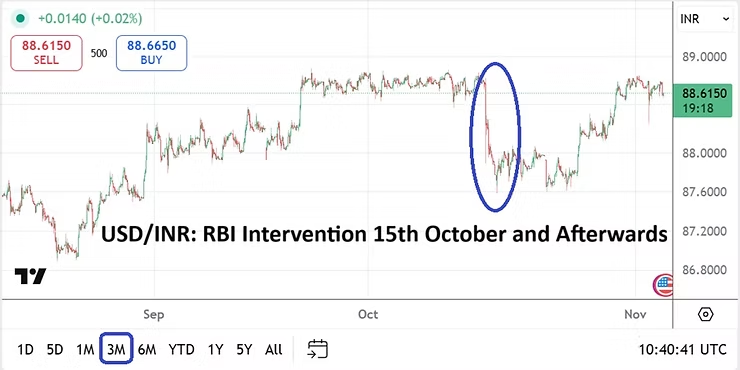
After weeks of steady appreciation due to Reserve Bank of India intervention on the 15th of October, the Indian Rupee has now returned to the same 88.72 levels against the USD before the policy action was enacted. The RBI’s recent offensive against speculators may have calmed the market temporarily, but it reflects a reactionary and short-term approach to deeper structural pressures facing India’s external administrative policies regarding the USD/INR.

USD/INR Three Month Chart as of 5th November 2025

Despite the Reserve Bank of India’s efforts to influence the cash forward market, where Dollar shorts rose by 6 billion USD in September to $59 billion, fundamentals suggest that Rupee weakness is not purely speculative. It is a rational market adjustment due to rising trade barriers amid U.S tariffs on India’s merchandise exports. The added uncertainty regarding trade caused the Rupee to naturally absorb external shocks. Merchandise exports to the U.S fell 12% in September year on year, according to official India data, prompting some calls for government relief.

India’s Foreign Remittances & H1-B Visa Fee Hike

According to World Bank data, India received about 137.7 billion USD in personal remittances from abroad in 2024. From that amount, around $40 billion is coming from the United States. The Trump administration raised the cost of H1-B visa fees from below 10,000 USD to nearly $100,000. And there is now also an increased likelihood of measures aimed at limiting digitally delivered software services to the U.S from India. These combined measures would substantially reduce Dollar receipts via exports of technology driven software and IT services, as well as remittances from a reduction of workers on temporary U.S visas providing on site services to U.S clients. USD inflow has been crucial for India’s balance of payment’s stability.

Reduction of USD reserves when the trade deficit is already rising because of hikes caused by tariffs on India’s exports would widen the current account deficit. Concerns about a decrease in remittances leading to a potentially significant decline of India’s USD reserve ability is possibly discouraging the India Reserve Bank to voluntarily expend reserves to support the Rupee.

Service Exports Cushion India’s Balance of Payments:

India’s total service exports touched 400 Billion USD over the past year with a predominant amount coming from the U.S. In other words, India has had a $202 billion in services trade surplus over the last 12 months, which covered almost 114% of India’s merchandise trade deficit in 2024-25.

India’s goods trade deficit is matched by a services surplus, plus net foreign personal remittances. This USD equation is under threat because of prolonged paralysis from stubborn US and India trade negotiations debating Russian Oil usage and the U.S demand to allow agricultural products into India.

Foreign Investors Selling Indian Equities

In addition, the Indian Rupee is not getting support from investment portfolio inflows. A shortfall of AI related avenues in the nation’s tech sector, and perhaps because of valuations considered too rich, foreign Investors have pulled 17 billion USD so far this year. This sum is more than any other emerging market, which is eating away at the Reserve Bank of India’s FX reserves too.

Global and India-specific uncertainties spurred by the Trump administration’s actions are setting off a retreat of footloose portfolio capital invested into India’s equity and bond markets. If the Reserve Bank of India was confident that inflows of foreign capital would replenish reserves it would likely help the Indian Rupee, and thus investor confidence coming from abroad.

Policy Irony and the Limits of Intervention

The U.S. remains India’s largest export market, but new levies of 50% tariffs are hurting labor-intensive sectors such as textiles, leather, footwear, and gems & jewelry.

While concerns about imported inflation are valid, the benefits of a weaker Rupee should not be overlooked. A mild depreciation could boost India’s service exports, improve the balance of payments, and partly offset the effects of U.S. tariffs on merchandise exports.

A material improvement in U.S and India trade relations is needed. Until a restoration is achieved in relations and a merchandise surplus is possible, alongside healthy services and remittance inflows occurring again, the Rupee’s weakness is likely to persist. In the meantime, Reserve Bank of India interventions could prove to be a short term tactic that proves vulnerable mid-term to the influence of market forces known and unexpected.

postN55

ICC Men’s Cricket World Cup 2023 – Thoughts and Predictions

ICC Men’s Cricket World Cup 2023 – Thoughts and Predictions

The 13th edition of the ICC Men’s Cricket World Cup is scheduled to commence in October 2023, featuring a total of 48 thrilling matches. This tournament holds the prestigious title of being the “flagship event of the international cricket calendar,” according to the International Cricket Council (ICC). India has the honor of hosting this edition, a choice that aligns well with India’s global prominence. This decision gains added significance in a year when India became the world’s most populous nation, and its GDP growth rate ranks among the fastest of any major economy.

The sport of cricket has expanded its footprint across the globe, being embraced by numerous countries. However, in this edition, only 10 teams will participate, a deliberate choice to maintain the intensity of the matches. Eight out of these 10 teams earned their spots through the super league performance, while the final two, Sri Lanka and Netherlands, secured their places via a “world cup qualifier tournament.” It’s important to note that there are no newcomers in this edition; all participating teams have previous experience at this level.

Based on performance rankings, four teams stand out as strong contenders for a spot in the semifinals: India (ranked 1), England (2), Pakistan (3), and New Zealand (4). However, it’s crucial to remember the disclaimer from financial investment products: past performance is no guarantee of future results. The eventual World Cup winner will likely be a team that doesn’t rely solely on star players, but boasts a balanced composition with multiple match-winners. In another analogy with the financial world, it’s akin to maintaining a diversified investment portfolio, a prudent allocation strategy that can weather various market conditions and risks.

India currently holds the top ranking and demonstrated their prowess by convincingly defeating Sri Lanka in the recent Asia Cup. Throughout the Asia Cup, diverse Indian players showcased their talents in different games, highlighting the team’s depth of match-winners and individuals capable of thriving under pressure. These qualities are pivotal during major tournaments, making India a favorite to claim the World Cup. Additionally, as the host nation, India enjoys the advantage of playing on home soil, further boosting their prospects in the tournament.

England enters the competition as defending champions, having triumphed in the thrilling 2019 World Cup finals against New Zealand, a match that ended in a tie. Ultimately, England secured victory based on a technicality. It’s essential to note that this outcome in no way diminishes England’s deserving win, as the result could have swung in either direction. Since then, England has maintained their dominant form, boasting a squad teeming with players capable of leading their team to victory. On paper, this team is arguably the most well-balanced, featuring a batting lineup that combines power hitters and run accumulators, as well as a versatile bowling attack capable of delivering both pace and swing or employing a slow, stifling approach.

Pakistan’s performance often oscillates, creating a roller-coaster of emotions for their dedicated fan base. On their best days, Pakistan can outclass the favorites, but they also exhibit a tendency to falter in tight contests. In the recent Asia Cup, despite being favored, they fell short of reaching the finals due to injuries to key players and lapses during critical moments. Pakistan’s success frequently hinges on the prolific scoring by their captain, Babar Azam, and the batting prowess of Mohammed Rizwan. In the bowling department, their reliance on superstars like Shaheen Shah Afridi and Haris Rauf is evident. This dependency on specific players presents a challenge to their World Cup aspirations.

New Zealand is somewhat of a statistical anomaly, consistently producing a remarkable number of world-class players from a relatively small population. They excel in identifying promising talent and nurturing it to create high-performance athletes. Furthermore, the New Zealand team is affectionately known as the ‘nice guys’ of cricket, celebrated for their amiable nature. Like Pakistan, the New Zealand team places considerable reliance on specific players, with the batting finesse of Kane Williamson and Tom Latham, combined with the lethal fast bowling of

Trent Boult, serving as a cornerstone of their success. The success of the team will depend on these star players maintaining their form throughout the tournament.

Two teams with contrasting World Cup histories deserve attention: Australia, a five-time champion, and South Africa, a team that has never reached the finals despite its quality. Australia, while not as dominant as in the past, continues to display a solid brand of cricket. The team is currently undergoing a transition, with younger players assuming leadership roles. Recent performances may not indicate peak form, so Australia lifting the cup would underscore their commitment to process and mental training.

South Africa finds itself in a similar situation to Australia, boasting numerous talented players but struggling to maintain consistent performance. Both Australia and South Africa appear to have individual excellence, but face challenges in cohesively functioning as a team.

In conclusion, India and England emerge as the front-runners for a coveted spot in the World Cup final. These two teams showcase a balanced roster with game-changing abilities. However, the question looms: can Pakistan’s star-studded lineup carry them to the summit, or will New Zealand’s proficient athletes secure another final berth? Could Australia recreate history, or will South Africa, long awaiting their breakthrough in a World Cup tournament, finally shine on the global stage? Alternatively, could an underdog team spring a remarkable surprise? Only time will tell. One certainty remains, though: winning a high-pressure World Cup tournament requires more than just physical fitness and mental resilience; it demands unwavering heart and determination.