postN104

India Insider: Weakening the MNREGA Employment Guarantees

India Insider: Weakening the MNREGA Employment Guarantees

When the Mahatma Gandhi National Rural Employment Guarantee Act was enacted in 2005, it was conceived as more than a poverty-alleviation program. It was a direct intervention in India’s rural labor market. By guaranteeing employment on demand at a statutory wage, MNREGA established what the agrarian economy had long lacked – a credible wage floor.

For India, where nearly half the workforce remains trapped in agriculture and align activities often involuntarily, this mattered enormously. Rural labor markets are structurally weak in India. They are seasonal, informal, and dominated by excess labor. In such conditions, wages do not rise organically. MNREGA altered that balance by providing an outside option. A worker who could demand public employment could also refuse exploitative private wages. That is why rural real wages rose meaningfully during the first decade of MNREGA’s implementation.
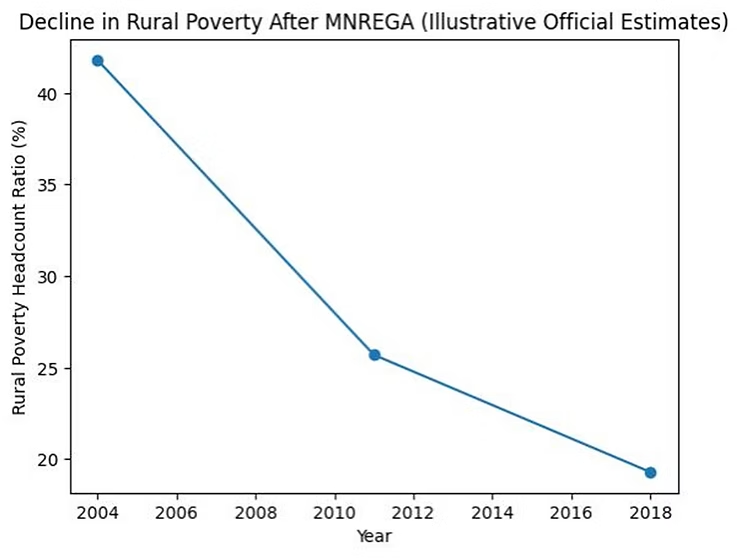
MNREGA Rural Poverty Data from 2005 to 2018

The figure above illustrates the broader context in which MNREGA operated. Rural poverty declined sharply after 2005, falling from over 40 per cent in the mid 2000s to below 20 per cent by the late 2010s. While this decline reflects multiple forces like overall growth, structural change, and social programs, micro-level studies consistently find that districts and households with higher exposure to MNREGA experienced significantly larger gains in consumption and poverty reduction compared to areas where the program was weakly implemented.

The scheme also acted as a counter cyclical stabilizer. During droughts, agrarian distress, or macro slowdowns, MNREGA expanded automatically, injecting purchasing power into rural areas. This supported consumption, reduced distress migration, and softened downturns. In macroeconomic terms, MNREGA transferred income to households with the highest marginal propensity to consume, precisely where fiscal multipliers are strongest.

Despite its strong design, MNREGA has long suffered from implementation weaknesses. Chronic delays in wage payments undermined its credibility as a reliable source of income. Corruption has generated fake muster rolls, ghost workers, inflated material bills, and substandard asset creation. Social audits which meant to be the backbone of accountability were uneven across states while effective in some.

Technological reforms such as Aadhaar linked payments, and digital attendance reduced certain leakages but introduced new problems, including worker exclusion, authentication failures, and further payment delays. The result was not only fiscal leakage, but a weakening of MNREGA’s core economic function which had promised a dependable wage floor.

Yet instead of fixing these implementation failures, a new policy chose to change the promise itself. In December 2025, this shift became explicit with the passage of the VB-G RAM G Act, 2025 in Parliament, replacing the Mahatma Gandhi National Rural Employment Guarantee Act with a redesigned rural jobs framework.

Under MNREGA, employment was a legal right, if work was demanded, it had to be provided. The new framework reverses this logic altogether. Employment now depends on budget limits, administrative approvals, and notifications from the center, not on demand. What was once automatic is now conditional.

This change also quietly shifts risk onto States. With limited revenue powers and tight borrowing limits, States responded by rationing work and delaying payments. As a result, the employment guarantee weakens, rural workers lose bargaining power, and wages come under pressure. What appears as fiscal control for the central government to rein on capital expenditures on paper thus becomes wage suppression in practice for rural workers.

Almost half of India’s workforce, around 46 per cent, still depends on agriculture and allied rural activities for employment, even though agriculture produces a much smaller share of the country’s total output. This gap between employment and output signals very low productivity in rural work and a large pool of surplus labor. For most of these workers, moving out of agriculture is difficult. They face barriers because of a lack of skills, weak urban job absorption, high migration costs, and social constraints. As a result, the ability to bargain for higher wages is structurally limited.

In such an economy, rural labor markets tend not to be competitive. Employers often face many workers competing for few jobs, while workers have few alternative sources of income. This creates conditions close to monopsony, where employers have disproportionate power in setting wages. In the absence of an institutional counterweight, wages tend to settle near subsistence levels rather than reflecting productivity or broader economic growth.

The consequences are visible in wage outcomes. Daily wages in rural areas stagnate or decline in real terms, failing to keep pace with inflation. Over time, this suppresses labor incomes relative to profits and rents, leading to a further decline in labor’s share of national income. In effect, weakening the employment guarantee shifts income distribution away from workers and back toward employers, reinforcing existing structural inequalities in the economy.

post277

India Insider: Women in Agriculture Need Manufacturing Power

India Insider: Women in Agriculture Need Manufacturing Power

India has long been a society that has neglected Women’s Empowerment. While various states pursue proactive policies to enhance the role of women in society, their inclusion in the job market and ability to have financial independence is still lacking.

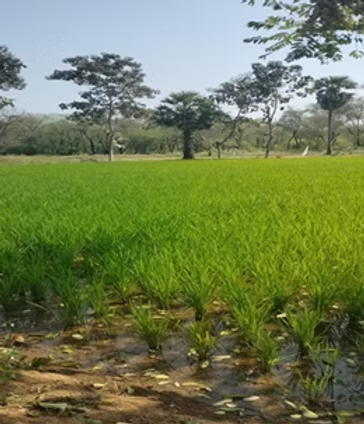
Small Scale Farm in Tiruvannamalai, India

In the suburbs of Tiruvannamalai City, in Tamil Nadu, Mrs. Revathi runs an agricultural farm where she grows rice, flowers, and vegetables. She sells them to local commission agents or directly to customers from her farm. Mrs. Revathi, who lost her husband in 2019, has two daughters, both of whom are educated and working. One of the daughters is getting married. She said that although agriculture helps her family earn money, it does not lift them out of the poverty trap because of uneven flower cultivation. The land is becoming less and less suitable for irrigation – a matter that worries her greatly too. Flowers are one of the major sources of income for many farming families in Tiruvannamalai City in Tamil Nadu.

This is just a small example of the challenges faced by women working in agriculture.
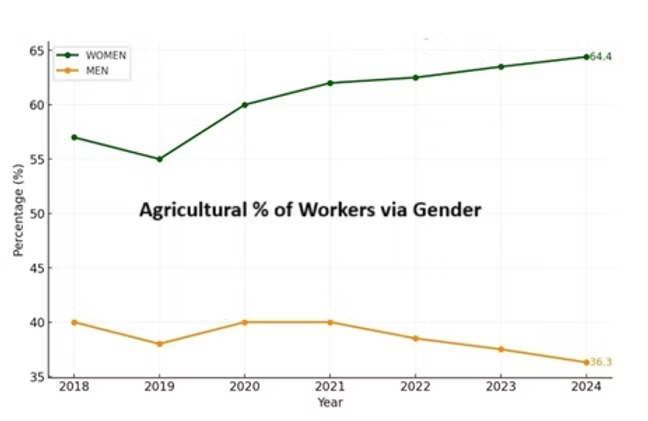
According to recent Periodic Labor Force Surveys, 64.4% of women in India work in agriculture, compared to only 36.3% of men.

Labor Workforce Percentage in India per Gender

Self employment and Access to Credit is not the Solution:

Many argue that self-employment and steady access to credit via microfinance institutions will help women become entrepreneurs and create movement up the social ladder. This is true in some cases, but many women struggle with raising families in their husband’s absence, and when working on farms where agricultural productivity is lopsided or unfit for growing vegetables or corn, times remain difficult.

First of all, why do women choose agriculture and remain small-time sellers? Because they are not able to find employment easily in formal sectors like manufacturing or other service oriented businesses.

Even within related agricultural sectors, women employed in vegetable processing plants, or value-added goods like masala manufacturing and tomato sauce production companies earn higher wages.

Unfortunately, low productivity and long spells of inactivity render agricultural workers significantly underemployed periodically. They are stuck, with nowhere else to go. Unlike in East Asian nations, which created mass employment through dynamic exports of manufactured goods, the Indian manufacturing sector’s low productivity makes it globally uncompetitive.

Manufacturing as a Solution for Women Empowerment:

Across Asia manufacturing has proven to be a powerful driver for upwards mobility. Incomes have risen, poverty has declined, and women are central parts of this transformation. In Vietnam, where a factory boom has been especially momentous, more than 68 percent of women and girls over 15 years of age are working for pay in some capacity, this according to data compiled by the World Bank. In China the rate is 63 percent, in Thailand 59 percent, and in Indonesia 53 percent of workers in manufacturing are women. Yet in India, less than 33 percent of women account for the workforce in recorded in official surveys.

In a pattern demonstrated in many industrializing societies, when more women gain jobs, families promptly invest further in education for girls. Manufacturing also lifts household spending power, fueling economic expansion that encourages investors to build more factories, providing additional jobs and reciprocal wealth creation. India is missing out on this dynamic manufacturing growth and is failing to broadly participate in the spread of improved industrialization which has helped bolster fortunes in many Asian economies and benefitted families. A vital component for a stronger Indian economy necessitates the empowerment of women.

postN8

Determination and Success: Integrity of the Catcher’s Mitt

Determination and Success: Integrity of the Catcher's Mitt

In the Long Run’ mused Maynard Keynes ‘we are all dead’ or as someone else once said, ‘Don’t go through life with a catcher’s mitt on both hands, throw something back’. The author of that line is unknown but we can assume that he knew something about baseball and the cut and thrust of business and life. It seems to me that the two are inseparable… In the consumer society of the developed world in which we live, the lifestyle we enjoy is largely shaped by the extent to which we buy and sell.

A market without anything to sell will be just as ineffective as a market full of merchandise with no one to buy. When we have real financial wealth, we are able to indulge many of our fantasies or dreams. That’s one of the reasons for aspiring to wealth and the independence it brings. For example once you have travelled around the globe staying in the world’s most luxurious hotels it’s not necessary to have the 5 star penthouse suite, something more modest will do. Once you’ve tasted the grape it’s not necessary to taste it with every meal.

Success in anything comes at a price and business is no exception. The ability to be disciplined and to persevere no matter what, is possibly the single greatest attribute to be successful in business. As Calvin Coolidge put it ‘Nothing in the world can take the place of persistence. Talent will not. Nothing is more common than unsuccessful men and women with talent. Genius will not. Unrewarded genius is almost a proverb. Education will not. The world is full of educated derelicts. Persistence and determination alone are omnipotent’.

But perhaps there is another price to which, in a sense, it is not obvious until it hurts and that is the price of integrity. The lack of ability for individual companies and institutions to police themselves, has led to a plethora of regulatory bodies for professions and businesses. We have created a “blame and shame” culture in which so often we prefer to abrogate responsibility and seek litigation, rather than facing up to the challenge ourselves. Integrity perhaps is best summed up as acting in a responsible, honest and fair way no matter what the cost to the individual or company.

We have been given a shocking example by many in authority on how to be economical with the truth, once a civil offence now a well-­honed practice is to ‘spin’ the facts to suit a particular agenda of self interest.

Philanthropy, no longer the preserve of the rich and famous, often anonymous, through centuries has made a contribution to the good of many of the underprivileged, as well as aiding education research and science, from which we all have benefited in some way. Many of the wealthy have historically helped the poor and those needier than themselves. Two of the world’s current incurable illnesses are AIDS and cancer, the major problem facing the developing nations is AIDS. Hardest hit are the children with an increasing numbers of orphans born with AIDS. In contrast, the problem facing the developed nations, is one of cancer, and in particular breast cancer. Drug addiction and alcoholism, particularly amongst the young is increasing at an alarming rate in both the most affluent areas of society and amongst the desperately poor, like the street children on Seventh Avenue in Guatemala City.

Huge wealth has been created over the past two decades, not least amongst City of London financiers, many of whom became millionaires on the strength of their bonus payments alone. That we should try and help those less fortunate than ourselves is a desire common to most people. We also know that charity begins at home. The stock market is the barometer of the economy, and the economy is driven by business, and business is the powerhouse that can make a real difference by making a positive contribution to the society in which we all find ourselves. Working with integrity is perhaps not just about the way we treat our employees, colleagues and competitors but also about how we use the wealth that we create. Whilst financial wealth will mean different things to different people, having more than we need gives us an opportunity to make a difference for others, however small we may think the contribution is, and speaks more about us than the what we are able to give.

Taking off the catcher’s mitt and throwing something back is at the heart of charitable giving and philanthropy and in doing so helping the weakest and most vulnerable in society. ‘ For it is more blessed to give than to receive’. After all, in the long run, we are dead.