post260

Risk Events Horizon, Fireworks and a Tranquil Marketplace

Risk Events Horizon, Fireworks and a Tranquil Marketplace

Financial narrative as always remains important and depends on who is sharing their viewpoints. As of today the U.S Senate is still discussing spending legislation which President Trump is selling as the Big Beautiful Bill. Even some Republicans don’t quite agree and it has caused political turmoil already, North Carolina Senator Thom Tillis has announced he will not seek reelection in 2026, but the markets remain stable. An agreement on the budget bill looks like it will take longer than hoped. However, day traders should remain calm.

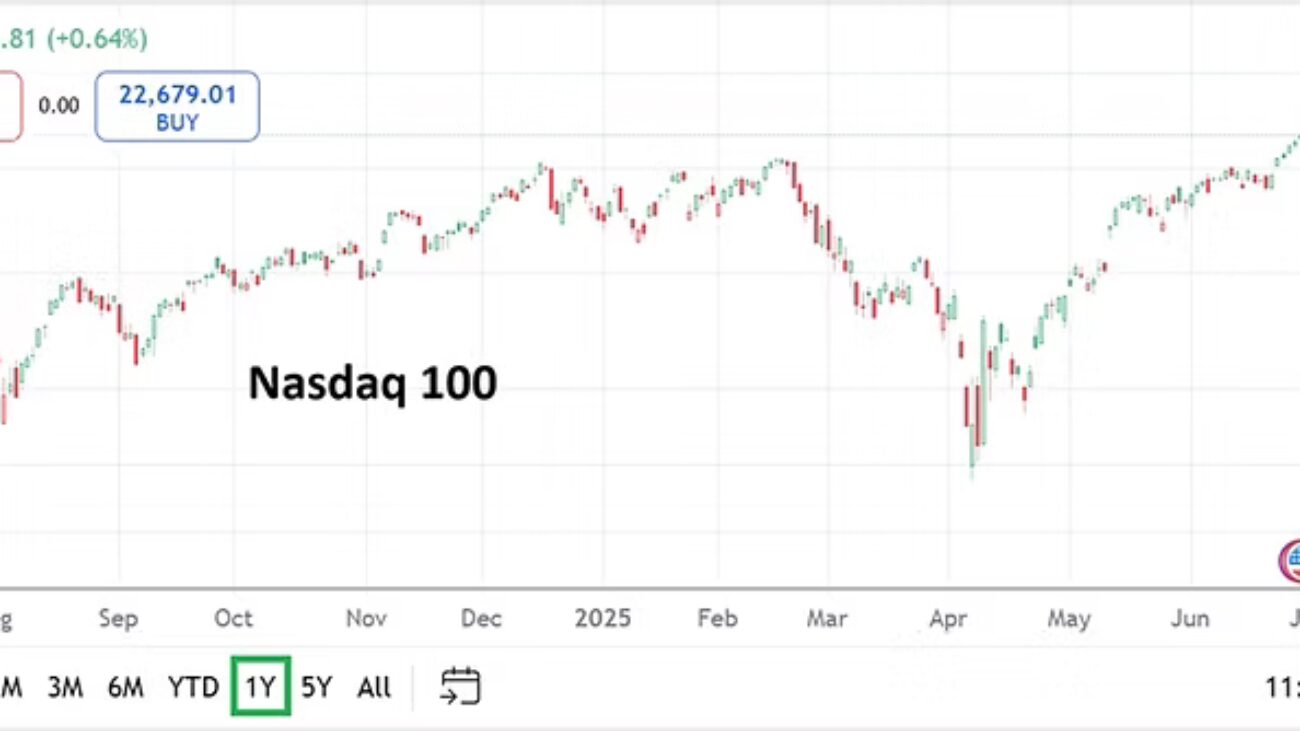
Nasdaq 100 One Year Chart as of 1st July 2025

The words scramble and race are being used by some in the media as the Senate tries to pass the legislation. If the Senate is able to approve a budget it will still have to be voted on by the House of Representatives. The deadline of July 4th is political theatre orchestrated by President Trump largely because of Independence Day symbolism. Early fireworks are ready to be sounded by some market analysts in Washington D.C if there is a legislative failure. There is a risk of irritating the White House and a danger of political backlash for certain politicians if hurdles are not jumped.

Elon Musk apparently hasn’t bought into the White House threats and has once again started to express criticism of the bill. But Musk’s condemnation seems to be falling on deaf ears the past couple of days as the work of market participants have achieved rather serene outcomes. Musk remains an important voice globally, but he has been sidelined rather effectively by President Trump in the past month. The media seemingly doesn’t have a taste for another round of Musk versus Trump recriminations and the public appears bored.

The coming Independence Day holiday means the Non Farm Employment Change numbers will be published this Thursday. The employment data may not get much fanfare if the U.S Senate is still dancing with the Big Beautiful Bill. The long holiday weekend could be made rather volatile if the legislation deadline is not met. If there is no conclusion to the Big Beautiful Bill going into the July 4th celebrations, financial institutions may preposition for the long weekend in a cautious manner, but panic doesn’t appear anticipated.
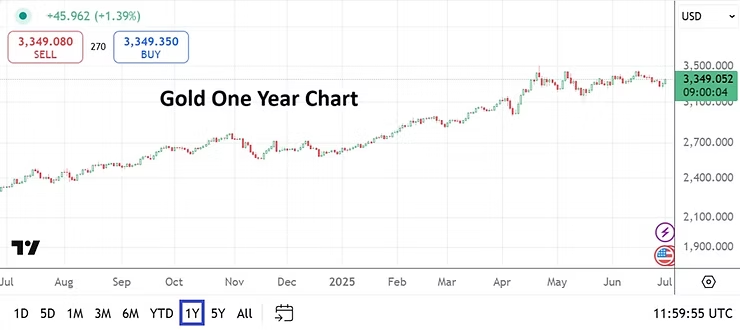
Gold One Year Chart as of 1st July 2025

Adding to the risk events horizon with dynamic ingredients are the 9th of July tariff negotiations and results which will be announced by the White House. Countries such as India are hoping for a positive outcome or at least a pronouncement of optimism that progress has been made. And this is possibly the most important role for the Big Beautiful Bill and the Tariff deadline, it is all self imposed dramatics by President Trump. The double feature for investors may be rather dull because many have seen this film before.

There is pressure on the U.S Senate to pass the spending bill, and on nations trying to negotiate new trading terms. However, many have the likely notion, that as long as the promise of solid developments are predictably claimed by the White House that global markets will stay calm.

Experienced traders in financial institutions have proven tranquil the past week, excluding the recently seen Middle East conflict – which also became a buying opportunity. The solid results seen recently might be evidence that players in equities, commodities, bonds and Forex may be viewing the anticipated fireworks with a lack of fear. While President Trump has a substantial amount of power, he also has shown the ability to take a step backwards and allow for extensions of dialogue.

The broad markets have learned to practice patience with President Trump over the past handful of months, and perhaps aren’t focused on short-term volatility, while continuing to be optimistic about mid-term harmony. The strong selling in U.S equity indices this past winter and into April has turned into bullish dreams and record values being challenged.

Yes, there will be bursts of noise from various corners that beg for attention, but financial institutions may simply go into the weekend unperturbed and feel as if they know the coming political and economic script. Day traders as always need to remain alert to risks, but keeping undisturbed if an uproar begins to reach fever pitch over the coming days may provide the best results. Market bedlam may stay rather muted much to the dismay of headlines proclaiming coming catastrophe.


postR196

AMT Top Ten Miscellaneous Frights for the 28th of October

AMT Top Ten Miscellaneous Frights for the 28th of October

10. MLB Concern: Baseball executives are hoping the Yankees can start to make the World Series more competitive this evening. The Los Angeles Dodgers have won the first two games of the championship battle. Significant hopes for a drama filled, seven game World Series would be dampened badly if the Yankees do not win tonight. Television ratings which were expected to be high could suffer appreciably if the Yankees go down three games to none. A non-competitive championship would mean a loss of revenue.

9. Israel and Iran: The Middle East saga is at number nine, and hopefully doesn’t become number one. A dangerous game of poker is being played by the participants. If Iran decides to up the ante once again, it would be a dangerous decision, because it appears Israel has positioned itself via this weekend’s retaliation to be more aggressive if need be.

8. WTI Crude Oil: The ability of the energy to move below 70.00 USD upon this morning’s trading is a sign the Middle East conflict remains tranquil in the minds of large participants in the oil sector. However, if Iran decides to test Israel again directly, Iran may find that its oil infrastructure is vulnerable. As the price hovers below 68.00 USD during this writing, it appears buyers who bought speculative positions the past few weeks might be capitulating.

7. BRICS: The inclusion of 13 additional nations as Partner States to the international organization led by Russia, China and India shows the entity sees itself as a growing alternative geo-political force and trading sphere with real power. The West should be paying attention, but often seems like it is not concerned about the potential strength of BRICS, and instead makes believe the group is a fallacy and much ado about nothing – this is a mistake by the West.

6. North Korea: The potential of North Korean combat troops entering the Ukraine – Russia war is a dangerous notion. However, it opens the door for Ukraine and South Korea to offer surrendering deserters the possibility of being allowed into South Korea, if soldiers can prove they are not spies. Unfortunately, the temptation of desertion by enemy troops could prove to be wishful thinking because North Korean soldiers will have intense supervision at all times; the threat of being shot as a liable traitor is a likely constant menace.

5. Gold: Record values continue to be seen, the price of the precious metal as of this writing is near 2,732.00. Noted as a store of value, gold is also seen as a safe haven by its buyers. Now may be the time to consider behavioral sentiment as a main driver because of anxiousness in the global marketplace. Speculative forces are certainly involved in the move higher too. With so many risk events shadowing, it may be very unwise for day traders to bet against the rise of gold near-term.

4. U.S Data and the Fed: Advance GDP numbers will be published this Wednesday, the Core Personal Consumption Expenditures Price Index will be seen this Thursday, and on Friday the Non-Farm Employment Change statistics will be presented. Fireworks should be anticipated by day traders. The combination of these reports, the approaching U.S election, and the Federal Reserve’s FOMC Meeting decision on the 7th of November will be enough to make most analysts hearts beat faster.

3. USD/JPY: Japan’s election results today now require a coalition government because the ruling Liberal Democratic Party has lost its majority. The Bank of Japan has a meeting this Thursday and is expected to hold its BoJ Policy Rate in place. The Japanese Yen has returned to values above the 153.000 level as of this writing. While many major currencies have lost value against the USD since the end of September, the USD/JPY needs to be watched as a dynamic combination of risks abound. Political gridlock, inflation, and lackluster economic data in Japan are not ingredients which will provide financial institutions with optimism in the near-term. The historically cautious attitude of the Bank of Japan will be severely tested in the coming weeks.

2. U.S Election: There is a little more than one week to go before the Presidential vote begins. While many folks are focused on the White House, the race for the Senate looks to be a stiff competition too. Republicans are hoping to regain the majority in the Senate and retain their power in the House of Representatives. Financial institutions are apprehensive about the outcomes for Congress, which will have an important role in fiscal and regulatory management. The Democrats appear to be nervous. Noise from the campaign trail and media will become heightened over the next seven days. Top bureaucrats in offices like the SEC, CFTC, FCC and other agencies know their jobs are on the line.

1. Market Volatility: U.S economic data, the coming election, and the Fed means the next week and a half of trading in the global markets are going to be packed with violent firework displays. Day traders who do not have experience should watch from afar, because the coming price action can cause fast losses for those caught on the wrong side. Trading sentiment is fragile, this is evident via the choppy results seen in equities, Forex, many commodities, and rising U.S Treasury yields. Over stating the obvious for the moment about risk management is a public service.

postR174

Implications of a 48th President on the 20th January 2025

Implications of a 48th President on the 20th January 2025

Presidential news and questions are moving fast, but the coming weeks and months may become a political nightmare if challenges are not handled pragmatically. Financial markets opened this morning with risk appetite reduced, as cautious trading swept through financial assets on the news President Joe Biden would not seek re-election in November of this year. Hyperbole is dangerous and noise can cause unwanted nervous reactions in financial markets when there are unknowns.

Taking into account possible risk factors is important for mid and long-term outlooks. Financial institutions and traders should consider the potential of a rather dangerous political situation developing in the United States over the next few months. First off, will Kamala Harris now get the nomination from the Democrats to run for President in November? There are no certainties and Democratic power brokers may have other potential candidates in mind, which will create less clarity for investors.

Worse, what if there is a 48th President being sworn into office on the 20th of January 2025? Joe Biden, the 46th President, has in no uncertain terms publicly admitted he does not have the capacity to run for the Presidency in the coming U.S election. Does this also mean that he does not have the ability to run the nation until another President takes over following the November election and January inauguration? What would happen if the 25th Amendment of the U.S Constitution dealing with presidential succession and disability comes into force? If Biden is seen as unfit to rule now, he would have to be replaced and Vice President Harris would assume power.

What happens if Harris is forced to take control and becomes the 47th President of the United States before the U.S election is held or even afterwards? The 25th Amendment will become a talking point by political foes of President Biden, and maybe even by those who admire him. The question about Biden’s ability to make correct cognitive decisions between now and the inauguration in January is not a far fetched conspiratorial concern anymore.

How would financial markets react to Biden being replaced by Harris as President in the coming weeks or months? What would happen to U.S foreign policy? The U.S is not set up like Parliamentary political systems to have caretaker governments simply help guide a nation until a new government can be formed. The 25th Amendment and its use could be demanded in order to remove Joe Biden if he is currently unfit to serve, and this opens the door to chaotic U.S executive administration developments and decisions in the months ahead.

The fact that Biden has not been able to make a public announcement regarding his decision not to seek re-election, and will only speak to the U.S public later this week per his letter yesterday is troubling. Is Biden’s health so bad that he cannot perform the job of U.S President today? Section three of the 25th Amendment allows for the Vice President to be transferred power if the current President is unable to discharge their duties until fit again.

However, section four of the 25th Amendment allows the Vice President and cabinet to declare the current President incapable of performing their duties. The Vice President and the current President’s cabinet allows them to decide and issue a statement to the Senate and House leaders declaring the President is unable to govern and is unfit to voluntarily transfer power to the Vice President. Yes, there are timetables involved regarding the President’s capacity to be judged again and reconsidered for the resumption of power, but the U.S Constitution does open the door for a President to be removed permanently if they cannot perform their jobs by the President’s cabinet.

So again, what will happen over the coming weeks and months? Critics of Joe Biden will certainly claim he is not capable of governing and demand proof of his ability in the coming days. A growing chorus is likely to emerge expressing doubts about Biden’s ability to lead. Politics will be a factor in the potential game which will get loud. Republicans will certainly claim if Biden cannot run for President in November, that he likely cannot run the country until a new President is elected.

Politics have delivered a lot of noise this past weekend, but investors should expect the turmoil to grow in sound as people question the leadership of the U.S and ask for proof that Biden is in charge. The U.S elected Joe Biden to be President, not his appointed cabinet. If Biden is not able to prove he can do the job, there are legitimate reasons to consider a transfer of power to Kamala Harris.

At this juncture it appears the Republicans are in the drivers seat politically regarding the November elections. The Republicans may take control of the Senate, remain in charge of the House and attain the White House. Will Kamala Harris have to perform a caretaker government until the 20th of January 2025? Investors and day traders should keep these risk scenarios in mind.

postN16.1

Week Ahead: Summer Begins with Questions Lurking for Traders

Week Ahead: Summer Begins with Questions Lurking for Traders

Monday, the 19th of June, China Foreign Direct Investment – data from China has been lackluster and last week’s announcement of a stimulus program from the government underscores economic concerns regarding growth.

Monday, the 19th of June, U.S banking holiday – for commemoration of Juneteenth.

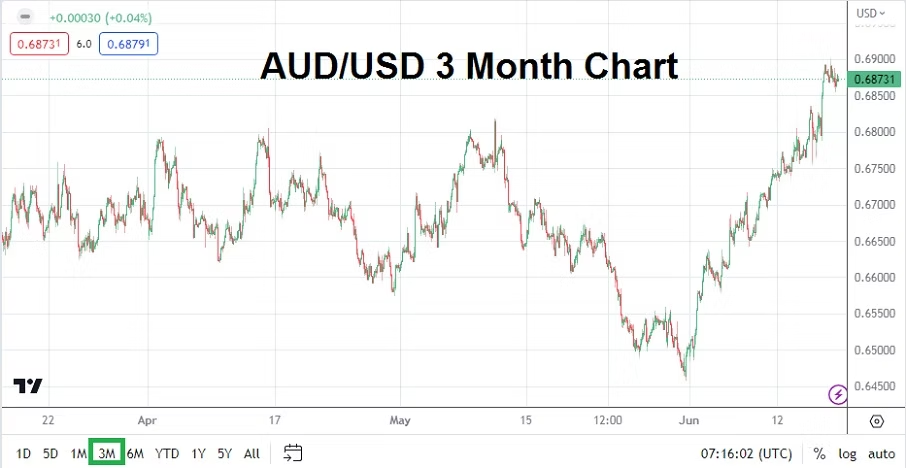
AUD/USD Three Month Chart as of 18th June 2023

Tuesday, the 20th of June, Australia Monetary Policy Meeting Minutes – report from the Reserve Bank of Australia will interest AUD traders and those with an interest in Asian Pacific economics.

Tuesday, the 20th of June, U.S FOMC member John Willliams – as the President of the New York Federal Reserve, Williams, is a key member regarding policy. Taking into consideration last week’s pause, traders may want to pay attention to the New York Fed Presidents’s remarks to see if the pause in Federal Funds Rates seen last week is looked upon as a halt or a ‘skip’ by Williams. The difference between a pause and a skip may appear to be semantics, but a skip would mean an interest rate hike is coming in July. Williams is not going to say what is going to happen at the next Federal Reserve meeting, but he may give a hint regarding his opinion on what should be done.

GBP/USD Three Month Chart as of 18th June 2023

Wednesday, the 21st of June, U.K Consumer Price Index – the data will be important regarding inflation insights for Britain. The Bank of England is expected to raise their Official Bank Rate on Thursday by 0.25%. Another report showing stubborn inflation could set the table for a rather hawkish Monetary Policy Statement from the BoE.

Wednesday, the 21st of June, U.S Federal Reserve Chairman Powell testimony – the Fed Chairman will begin two days of speaking and taking questions. The first day will be before the House of Representatives and the second day in front of the Senate. Because a major election is coming in the U.S in 2024, this will be an opportunity for politicians from both sides of the aisle to get airtime and take a ‘stance’ while bludgeoning Jerome Powell. The Fed Chairman’s remarks could stir the markets slightly, but Powell will be as careful as possible not to put a scare into the financial sector.

Thursday, the 22nd of June, U.K Bank of England – the Official Bank Rate, Monetary Policy Summary and vote count from the Monetary Policy Committee will be released. A hike has been widely expected by GBP traders and has been factored into the British Pound already.

Thursday, the 22nd of June, U.S Existing Home Sales – the housing report will cause a few murmurs in the marketplace because it is seen as an extension of consumer health and interest rate policy in the U.S regarding behavioral sentiment. Existing home sales numbers have been dropping as people with homes have decided to stay put in their current residences. ‘Locked in’ interest rates are more attractive, instead of taking on a higher rate via a new purchase due to costlier mortgages because of more expensive borrowing fees.

Friday, the 23rd of June, E.U Manufacturing and Services PMI – the flash reports from the likes of Germany, France and the U.K should be watched. Manufacturing readings have been producing recessionary readings while Services data is expected to show incremental decreases too.

Friday, the 23rd of June, U.S Manufacturing and Services PMI – the flash reports via the Purchasing Managers Index data need to be monitored too from the States. The readings give a rather good insight regarding outlook of U.S business sentiment.

post17

Angry Voters and the Federal Reserve

Angry Voters and the Federal Reserve

Federal Reserve Chairman Jerome Powell is scheduled to testify before the U.S Senate tomorrow. Certainly we are going to hear the words inflation and growth mentioned, this as the Fed Chairman speaks about monetary policy and the trajectory for the U.S central bank to continue raising interest rates over the mid-term.

Via prices in the Forex market since the start of February, financial houses have likely priced in two additional interest rate hikes from the U.S central bank into the USD, one of them being a quarter of a point increase coming on the 22nd of March. The USD has been mostly stronger across the board the past four weeks. This week’s coming Non-Farm Employment Change numbers and Average Hourly Earnings data results should be monitored on Friday.

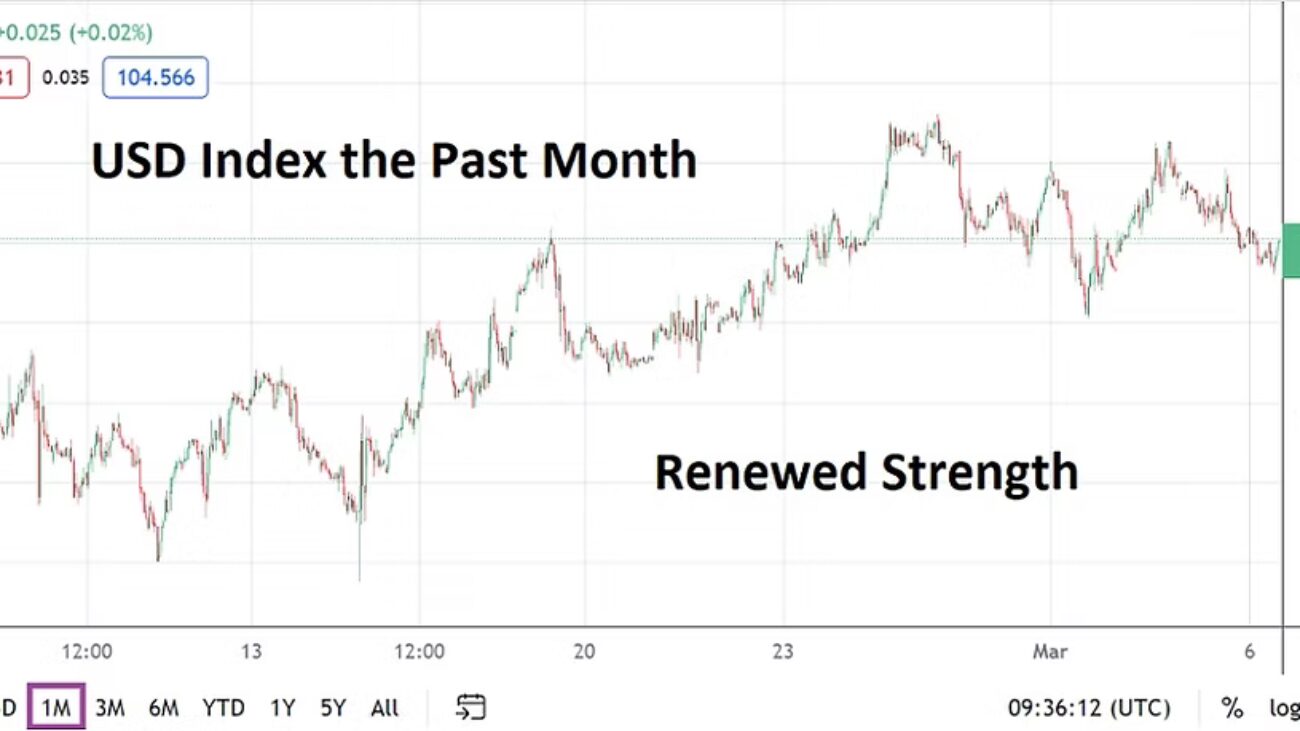
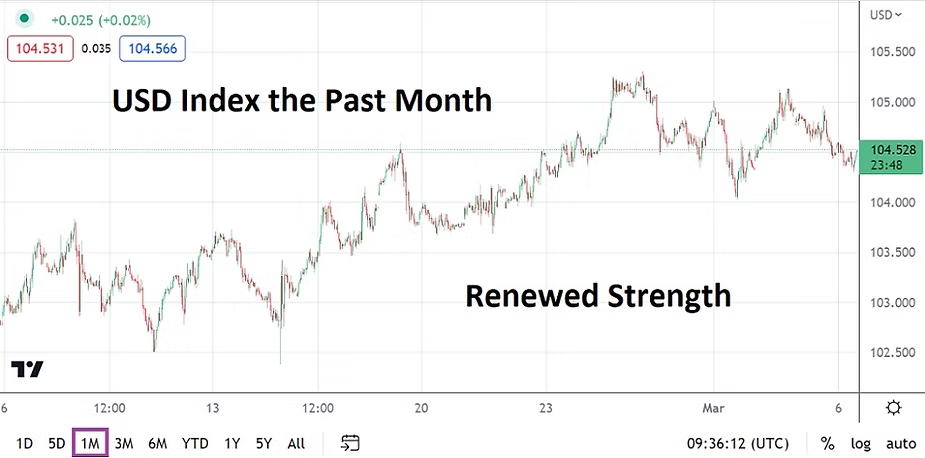
USD Index One Month Chart

While financial houses may have accepted the interest rates to come, this doesn’t change the rather complex economic data in the U.S which is demonstrating rather stubborn inflation, while also showing growth is not slowing down as much as has been anticipated. GDP numbers reported recently from the States showed only a slight decrease.

  • How much more can the U.S Federal Reserve increase interest rates over the next six months without making the USD too strong?

  • At what point will the Fed become less aggressive?

  • While an additional .50% has been ‘accepted’ by financial institutions, will the Fed bring the lending rate to 5.50%?

  • High inflation and limited growth could result in political quicksand for many elected officials.

The U.S Federal Reserve is going to get pressure from both sides of the aisle in Washington D.C.. Traders should not discount their perceptions that elected officials are starting to consider the ramifications of the coming elections in a year and half, because this will affect behavioral sentiment in the markets. Neither Democrats or Republicans will be happy if inflation remains a problem going into the vote. Rising costs equal less money in the bank accounts of American voters.

The U.S public has a history of voting via sentiment generated from their wallets and the power to consume. Prices that feel like they are out of control will win no friends. While energy prices seem to have calmed down in the headlines, energy costs remain a risk and concern for manufacturers worldwide. The inability to save money for individuals, and lack of profits for corporations makes for potentially angry voting results.

There is an additional problem lurking. The strong USD driven by the Federal Reserve’s increased borrowing costs, the Federal Funds Rate, has weakened currencies across the world. Vulnerable currencies have spurred inflation in many nations which are producers of goods that global consumers buy, these rising prices are being imported into the U.S economy.

As much as international economic integration helps the world, the rise of coronavirus and its knock-on affects via costs were not anticipated enough, causing weaknesses to be exposed. The U.S attempted to save its skin economically by creating a massive amount of stimulus, which certainly fueled domestic inflation. The U.S might have saved the American public in the short-term, but the government faces a long climb upwards to fix the problems overspending has caused.

The rising costs of logistics and the spotty supply of commodities internationally generated higher prices in the aftermath of coronavirus. Commodity prices have become more tranquil, but the costs of production has not eased because weaker currencies globally are hurting producers who need to use the USD to purchase resources. The U.S Federal Reserve’s attempt to tackle inflation with higher interest rates, has fueled ‘import’ inflation. This is not an easy problem to solve.

The Fed will not say in public they want the U.S economy to slow down, this acknowledgement would costs jobs which rely on political backing. The White House certainly doesn’t want the economy to suffer as it prepares for an election within a year and a half, but quietly officials likely accept slower growth and perhaps recession may become inevitable. Both the Fed and elected officials are performing a delicate dance that may be interrupted any moment.

The Fed doesn’t want us to remember they said inflation would prove transitory almost two years ago. The Fed needs to fight rising costs certainly, but very carefully. The desire to weaken inflation is correct but a dangerous balancing act, because the USD remains the global reserve currency.