postN88

Iran, Oil and The Crumbling of a Criminal Dictatorial Wall

Iran, Oil and The Crumbling of a Criminal Dictatorial Wall

Step aside for a moment from the conspiracy theorists and let’s consider that the U.S did not take out Maduro of Venezuela in order to facilitate more supply of oil. Let’s consider the possibility that Maduro was removed because he did not facilitate free enterprise and ran a criminal enterprise that did not favor the U.S.
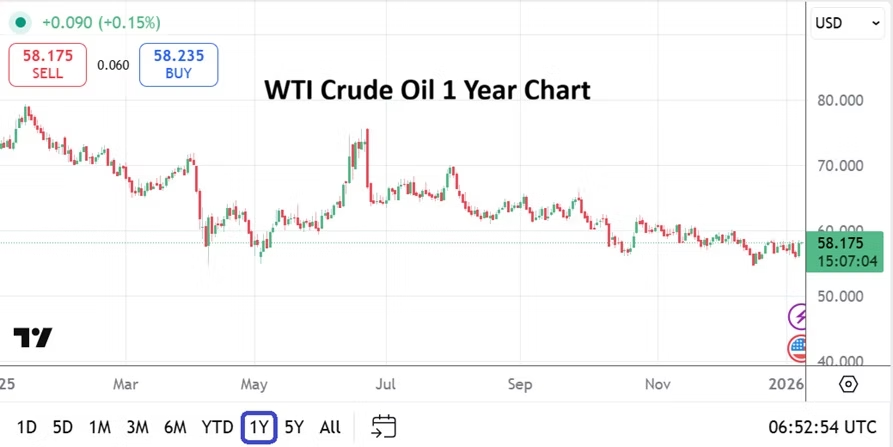
WTI Crude Oil One Year Chart as of 9th January 2026

Venezuela has the largest demonstrated oil reserves in the world, but the U.S has done rather well without it for years. The Trump administration’s move to take over Venezuela deters China and Russia’s influence in the Americas, while also putting another nail in the coffin of the Cuban regime. The word regime is used implicitly to point out that Venezuela, Russia, China and Cuba are all regimes of one sort via their one party ruling systems. Yes, you can argue the United State has returned to an imperialist philosophy, but that doesn’t mean it has dictatorial rule. Some will argue that point, I understand. But let’s step away from the complexity of political biases – including my own – and insights and discuss oil for a moment.

The takeover of the Venezuelan oil infrastructure, which has not happened in full yet via the U.S military action, does not mean U.S oil companies will make trillions of dollars from the adventure immediately. In fact a glut of oil is one of the potential consequences if Venezuela were to return to an open market system with its energy supply. Yes, the price of oil would in theory likely get cheaper. While it can be argued that this will help the U.S consumers, however many U.S producers of the shale oil industry would be put in a difficult spot. Producing oil from shale deposits requires hydraulic fracturing – known as fracking – and is an expensive endeavor. Cheaper oil from Venezuela in other words could put small and medium producers in the U.S out of business if supply becomes too ample

Now let’s turn our attention to Iran and the attempted revolution that is fomenting a reaction from the regime of that nation. Oil supply is certainly at stake for the world, but there is the overwhelmingly important possibility of allowing 90 million plus people to live in a system without repression. As of last night internet and telephone lines have been shuttered by the dictatorial government. There is a legitimate fear that many people protesting for their rights to be free now face the risk of violence and some have already begun to pay with their lives. Freedom is more important than oil for the people of Iran and Venezuela. It should also be pointed out that Venezuela and Iran are members of OPEC and this is likely not going to change.

The Trump administration is threatening military action against the Iranian rulers, but it is questionable how the regime of Iran could be overthrown by outside forces if there are not active combat boots the ground. While it may be possible to attempt a Venezuela like mission in Iran, that would be difficult at best considering the regime is already paranoid and on high alert. The civilians of Iran will have to do a lot of the work by themselves. Which means the populace of Iran will need to be able to organize and collectively topple a dictatorship, and this is unlikely to be done by handing out flowers. The regular army of Iran must disobey orders and the police must decide not to participate in violence against the protesters, allowing a seizure of power by the people.

At this juncture it remains difficult to say what will happen in Iran, except to say that there is likely going to be blood spilled. The Berlin Wall fell after decades of Cold War between the West and East. The wall of the Islamic Republic of Iran which was declared in the first week of April 1979 has nearly been running its dictatorship as long as the communists controlled Eastern Europe.

If and it is a big if, the Iranian people are able to topple the Islamic Republic of Iran it would be a game changer the world over. The complexity of the mafia style state that the current dictatorship has controlled not only in the Middle East, but throughout South America and elsewhere via influence with its proxies like Hezbollah is enormous. The dismantling of this network would take longer than the toppling of the Iranian regime. The world is unlikely to ever know in full detail the criminal activity of the current Iranian government and its proxies worldwide.

This is not about oil, it is about freedom. However, if the oil of Iran suddenly came under the control of a Western looking Iran that was unshackled, yes it would add to a vast amount of energy that the world already enjoys, but OPEC would find a way to manage the supply.

If Iran were to join the ranks of free nations and castoff its current leadership the world would benefit greatly. Only nations and proxies that gain from the exploitation of the Iranian dictatorship would worry. If the Iranian dictatorship falls there will not be paradise, but the event would be significant and transform the current state of global affairs.
Copy and paste the text from AMT that you want to share

postN76.1

India Insider: Strategic Memory and Why Unilateral Power is Resisted

India Insider: Strategic Memory and Why Unilateral Power is Resisted

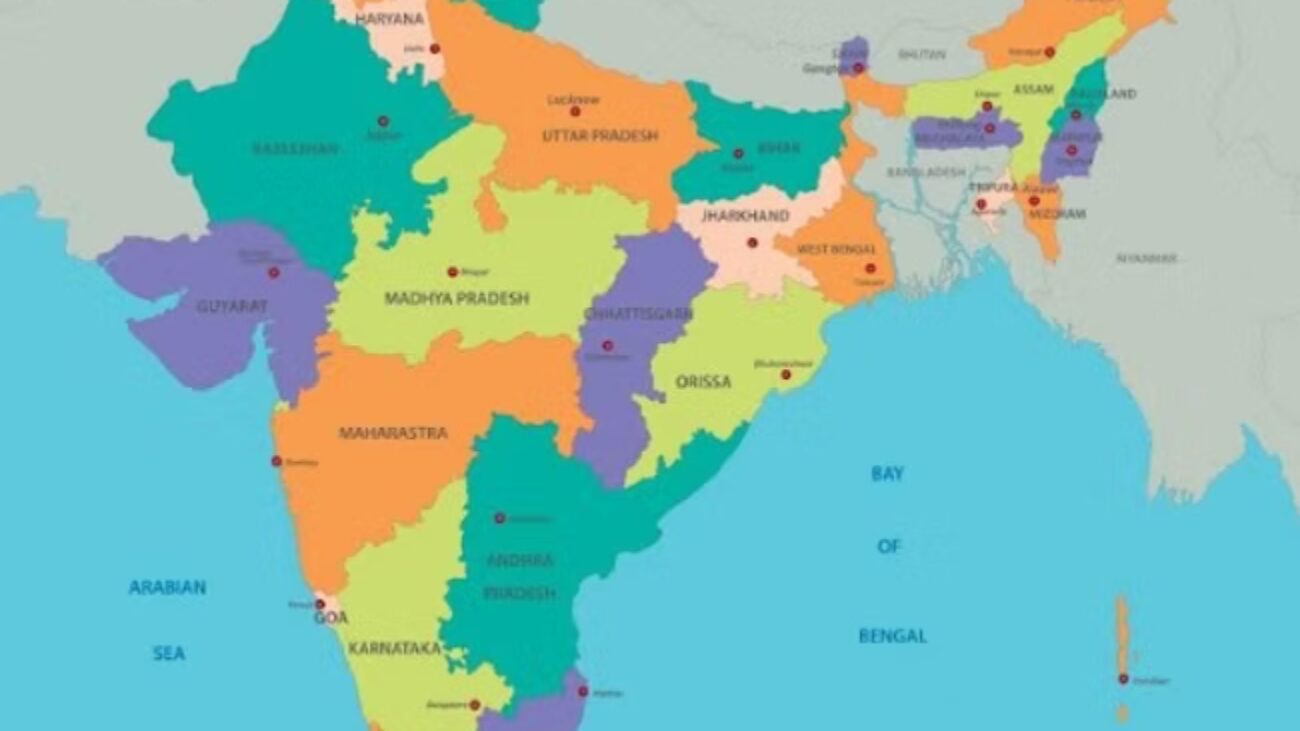
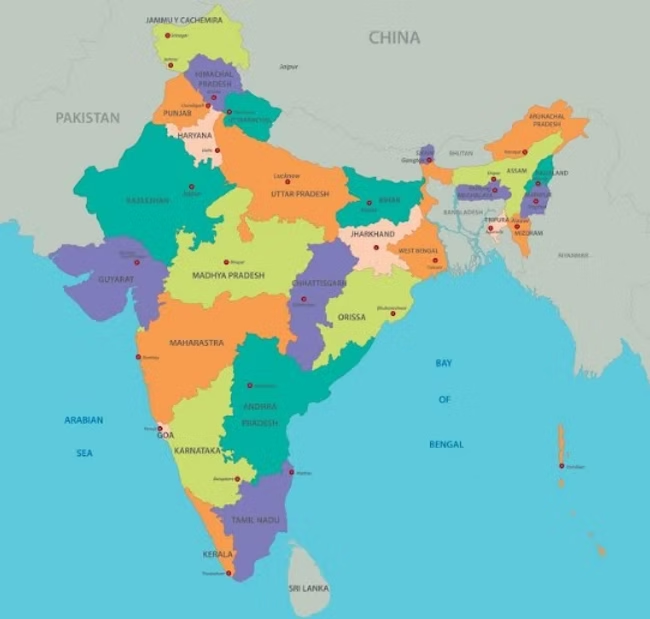
After Independence, India was often described as “tilting” toward the Soviet Union. In reality, this was the outcome of India’s pursuit of Non-Alignment at a time when the United States was actively backing perceived rogue actors in South Asia, most notably Pakistan. What appeared as ideological preference was, in fact, strategic necessity born of hard experience.

The Soviet Union supported India on core security concerns when few others would. The first major Soviet defense deal was not merely a weapons sale. It included licensed production in India through Hindustan Aeronautics Limited, full technology transfer, and made India the first non-Communist country to receive the MiG-21. This distinction mattered. India was treated as a sovereign partner capable of absorbing technology, not as a dependent client expected to align unquestioningly.

By contrast, Washington’s alignment with Pakistan was driven by Cold War geopolitics rather than South Asian stability. Despite repeated military coups, wars with India, and regional destabilization, the United States armed Pakistan, provided diplomatic cover during conflicts, and sustained the relationship through military rule and nuclear proliferation. These experiences deeply shaped India’s strategic culture and explain its enduring emphasis on autonomy, redundancy, and diversified partnerships rather than alliance dependency.

This history is one of the central reasons India resists Washington dictating regional dynamics. South Asia, in New Delhi’s view, is not a chessboard for external powers to reorder at will.

Democratic Republic of the Congo Example

The same pattern is visible beyond Asia. Take the Democratic Republic of Congo. After decades of horrific colonial exploitation, the Belgians realized by the mid-20th century that they could not hold on indefinitely and exited abruptly, having never prepared the country for self-rule. What they left behind was not independence, but a political vacuum. The United States and the United Nations intervened, but their actions were shaped less by concern for Congolese society than by geopolitical rivalry, ideological competition, and racial hierarchy.

The assassination of Patrice Lumumba destroyed the Republic of the Congo’s (as it was known then) only credible attempt at building a unified nationalist state at independence. The dictatorship of Mobutu Sese Seko that followed did not merely fail to develop institutions; it actively hollowed them out. Corruption became a governing principle, loyalty replaced competence, and the state turned into a vehicle for extraction. Today’s instability in the Democratic Republic of the Congo is not a governance failure in isolation—it is the predictable outcome of a political system designed to rule without building state capacity. For countries like India, this is not ancient history, it is a warning.

Washington’s unilateralism reinforces this mistrust:

The recent military operation to remove Venezuelan President Nicolás Maduro without U.S Congress authorization, international legal justification, or an imminent threat would have been unthinkable as recently as the first Trump administration. It became possible in 2026 only because of congressional capitulation, judicial immunity, and the transformation of an apolitical defense establishment into a politicized instrument of executive power. To much of the world, this signals that restraint is no longer embedded in American decision making.

Europe exposes another contradiction. The post war order was built on liberal democracy and collective security through NATO. When that order is weakened by unilateral action, trust erodes, even among allies expected to align automatically.

Even before Trump, the U.S – India relationship remained cordial rather than fully strategic. Before 9/11, India was the most natural regional ally against Al-Qaeda, yet Washington lacked patience and local understanding to navigate India’s complex democracy and nationalism. That failure was not tactical, it was conceptual.

India’s neutrality today is deliberate:

It prioritizes diplomacy over military actions that violate international law. India sees a multipolar world emerging, not as disorder, but as the end of unchecked unilateral supremacy. This is not ambiguity. It is a strategic memory.

postR196

AMT Top Ten Miscellaneous Battlefronts for the 7th of Sept

AMT Top Ten Miscellaneous Battlefronts for the 7th of Sept

10. Cape Town: Springboks take on the All Blacks in Round Four of the Rugby Championship later this afternoon. South Africa won last week’s test. Roster changes have been made to both starting squads. Springboks Captain Siya Kolisi will start, this after he had been listed as questionable earlier this week because of a nose fracture he suffered in last Saturday’s game, which will be dealt with surgically in the near future. The All Blacks are extremely difficult to beat two games in a row, today’s match could be a firecracker.

9. Spy Games: Alleged China spy Linda Sun is accused of trying to influence policy while working in New York Governor Kathy Hochul’s office as an aide. The alleged spy also worked in the previous New York administration under Andrew Cuomo. Sun and her husband, Chris Hu, have been charged by the U.S government to be in violation of the Foreign Agents Registration Act amidst a litany of alleged illegal activities.

8. VPN Wanted: Brazilian Supreme Court Justice Alexandre de Moraes has suspended X because of claims the social media service, previously known as Twitter, is allowing ‘misinformation’. Justice Alexandre de Moraes has broad powers and is permitting Brazil’s ruling government led by Lula da Silva to walk a perilous line that does not allow for free expression. Brazil has not heard the last of Elon Musk.

7. Boeing: Starliner returned to earth last night touching down in New Mexico, but without the astronauts it delivered to space in early June. The mission was supposed to take 8 days, but instead stranded the two astronauts on the International Space Station. NASA has stated it was potentially dangerous for the astronauts to return in Starliner. The astronauts are now scheduled to return in February 2025 with SpaceX. Starliner is owned by Boeing. This time last year Boeing’s share value was near 219.00, as of yesterday it is 157.62 USD.

6. Xmas in October: Nicolas Maduro, the Venezuelan President (dictator), has announced the Christmas holiday will be celebrated on the 1st of October, allowing Venezuelan citizens an early celebration in order to forget the troubles imposed on the nation by foes who are working against the socialist government. Maduro joins a well established line of totalitarian leadership who have historically moved or canceled religious holidays to manipulate the population.

5. Harris vs. Trump: A debate between the two candidates will take place this coming Tuesday on the 10th of September. Because of murky outlooks among many financial institutions, this televised ‘exchange of views’ will not only get the attention of U.S voters and an interested worldwide populace, but global investors as well. The last Presidential debate effectively ended Joe Biden’s hopes of being re-elected. Will this event proceed without biased moderators?

4. Wobbly High-Wire: WTI Crude Oil finished the week around 68.52 per barrel as traders appear to be worried about a U.S economic slowdown. Gold closed Friday near the 2,497.00 realm per ounce, as investors fret over the USD and Federal Reserve. BTC/USD is trading around 54,230 at the time of this writing, Bitcoin was valued around 65,000 early on the 26th of August. Cocoa closed near 8,300.00 USD per ton yesterday after flirting with lows touching 7,900.00 on Wednesday. Day traders trying to wager this past week within commodities likely found they were not immune to nervous sentiment.

3. Negative: U.S jobs data was bad. While some say the numbers were mixed the Non-Farm Employment Change came in significantly lower than its estimate, and the previous month’s statistics were revised downwards. The higher Average Hourly Earnings report provided no favors via its outcome of 0.4% compared to the expected result of 0.3%, it wasn’t too far from the estimate and should not change inflation perspectives. Simply put, the jobs numbers are causing concerns in many financial institutions who believe the Federal Reserve is being too cautious.

2. Nervous Investors: U.S equity indices finished yesterday’s trading at their lows for the week. In fact the Nasdaq 100, Dow 30 and S&P 500 are all traversing values they last saw on the 13th of August. The major indices are fragile. Equities on the 13th of August were still recovering from losses seen the week before when previous Fed and BoJ policy chaos triggered overreactive selling on the 5th of August. On Friday the 2nd of August negative Non-Farm Employment Change data was published. What will happen to indices, Forex and Treasury yields on Monday the 9th of September?

1. Fed Fail: John Williams the New York Federal Reserve President said after the jobs numbers were reported, that the Federal Funds Rate is in a position to be cut. However, Williams continued to lean into the widespread notion the Fed will only impose a 0.25% decrease. He did say he would look at the jobs numbers closely, but he believed the Fed is well positioned. Behavioral sentiment among financial institutions appeared to react poorly to Williams remarks, producing a strong selloff as Friday progressed. The dream of orchestrating a soft economic landing in the U.S by the Federal Reserve allowing inflation to erode, the jobs market to soften, and GDP to remain above recessionary pressure remains the lofty goal. However financial institutions do not like the convoluted mid-term economic outlook, they now want to hear a dovish sounding Federal Reserve and appear ready to cause more short-term chaos in the markets this coming week.