post235

Predicting the Federal Reserve and President Trump’s Rhetoric

Predicting the Federal Reserve and President Trump's Rhetoric

Financial institutions have grown accustomed to the rather fierce rhetoric from President Trump in the early days of his second term. Financial institutions have also become quite used to the recent overly cautious statements from the Federal Reserve. This Wednesday the Fed’s FOMC Statement will be delivered and there will be no change to the Federal Funds Rate. The current ‘main’ borrowing rate offered by the Fed is 4.50%.
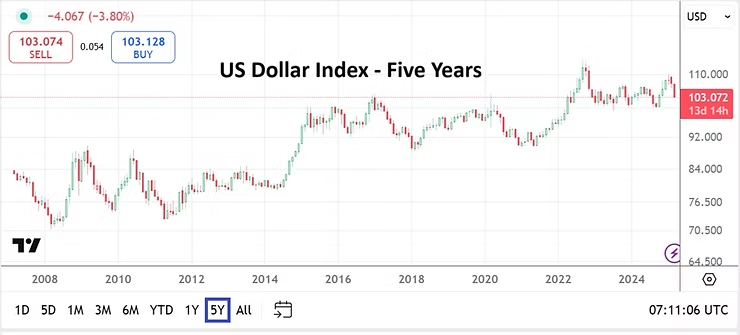
US Dollar Index Five Year Chart as of 18th March 2025

This Wednesday Fed Chairman Jerome Powell will speak about the recent CPI and PPI numbers which came in below expectations. This typically would be a good signal regarding weaker inflation. And Powell might also mention that energy prices in the U.S have started to erode. WTI Crude Oil is now trading in a sustained manner below the 70.00 USD threshold, and this will influence the potential of less inflation. It is a good development for the U.S and Federal Reserve.

However, Powell is unlikely to express the unease and anxiousness the Federal Reserve has regarding President Trump, this because the Fed certainly doesn’t want to get into an open confrontation with the White House.

The U.S Treasury is now being run Scott Bessent who was selected by President Trump. Bessent ran the Key Square Group and is well respected in financial circles, which includes vast experience in top financial institutions. Powell though perceived as pragmatic by many analysts, may not be within President Trump’s trusted inner circle like Bessent and Commerce Secretary Howard Lutnick, the former Chairman and CEO of Cantor Fitzgerald. Lutnick is perceived as a workhorse who get things done and is smart.

The Fed’s likely cautious FOMC Statement will not be enough to appease President Trump this week. While some may think Trump’s attention will be elsewhere, those who have come to understand Trump know his capability to react quickly to events should be taken seriously.

What will Bessent and Lutnick think about the Fed’s FOMC Statement and stance? Powell is not a trained economist, do Bessent and Lutnick trust Powell? One thing for certain is that Janet Yellen who served as the Fed Chairwoman before Powell, and the Treasury Secretary before Bessent is not part of the inner circle in the White House.

Powell’s loyalties may be questioned, and eyes should be kept on Trump later this week to see how the President responds to the rather cautious Federal Reserve. The Fed will certainly not want to say aloud it is waiting like everyone else regarding the effects of tariff negotiations and their implications. Powell wants to keep his job. Trump certainly wants lower interest rates. Bessent and Lutnick certainly want lower interest rates too, but like Powell these two may prove pragmatic and know inflation needs to erode further. The Treasury and Commerce secretaries may want to test chicken and egg questions. Will these two gentlemen push Trump to proactively push for lower interest rates in a louder fashion?

Day traders will have to wait to see how financial institutions react to tomorrow’s FOMC Statement – which has already been accepted as being a ‘no interest rate cut event’. And it is probably being discussed in the White House that the Fed may want to wait until early this summer – June? – to consider another interest rate cut. Which means the Fed may not be cutting interest rates mid-term, while the ECB and BoE may have to be more dovish and remain active via interest rate cuts if their economies continue to show recessionary trends.

Meaning that risk premium which was factored into the stronger USD centric buying since the Trump election on the 5th of November until the peaks in mid-January and early February, and have now reversed lower – needs to be watched technically and weighed in combination with behavioral sentiment.

Intriguingly the US Dollar Index is around levels it stood at on the 5th of November (Election Day 2024). It is also near values seen on the 15th of October. (Did financial institutions start to bet on a stronger USD around this time because of a more cautious Fed outlook and the potential Trump was going to win the election?) Raising the question, if financial institutions envision the USD can technically be weaker and attain values seen in late September and early October when the US Dollar Index was testing support levels which have held since April of 2022. The US Cash Index which stands around the 103.070 level now, was trading near 90.00 in the spring of 2021.

Trump wants lower interest rates, the Fed wants to wait on cutting the Federal Funds Rate until they have clarity regarding the results of tariff negotiations. There will be a collision between Jerome Powell and Donald Trump, the only question is when it will happen. The US Dollar Index has been lower historically. Trump, Bessent and Lutnick may not want to say it out loud, but a weaker USD in the global economy would help U.S exporters. A weaker USD may not convey the strong populist rhetoric of MAGA, but it may be economic hardware the Trump administration actually seeks. To sustain a weaker USD, inflation levels will have to erode, and interest rates will have to be lower (and another myriad of complex events have to happen), until then rhetoric and risk premium will factor into USD Forex trading for financial institutions and speculators.
postR172.1

Risks: Powell and Inflation Data will Generate Market Reactions

Risks: Powell and Inflation Data will Generate Market Reactions

Traders returning to their desks after a long holiday weekend can see the USD has become weaker the past couple of sessions as behavioral sentiment has shown signs of shifting again. Yet the trends experienced in Forex have not been clear cut, this as questions and concerns regarding what governments and central banks are thinking remains problematic. Investors who take a long-term approach to the markets will likely have an easier time in the coming days because their comfort levels are set to different metrics compared to large traders and the retail crowd. Noise doesn’t effect investors as much as traders.

Politics clearly remain on the minds of many as President Joe Biden has his ability to effectively lead the U.S questioned with growing doubts. However, it is unlikely that there will be a change in the immediate future from the Democrats as they decide on a path regarding their nominee for the November Presidential election. Financial institutions would certainly react to a decision to eliminate Biden as a candidate, but the President remains steadfast that he will move forward. It is very conceivable that Biden may be forced to vacate against his wishes, but until then the broad markets will not react too much to worries about the White House. For the moment U.S politics remain hyperbole.

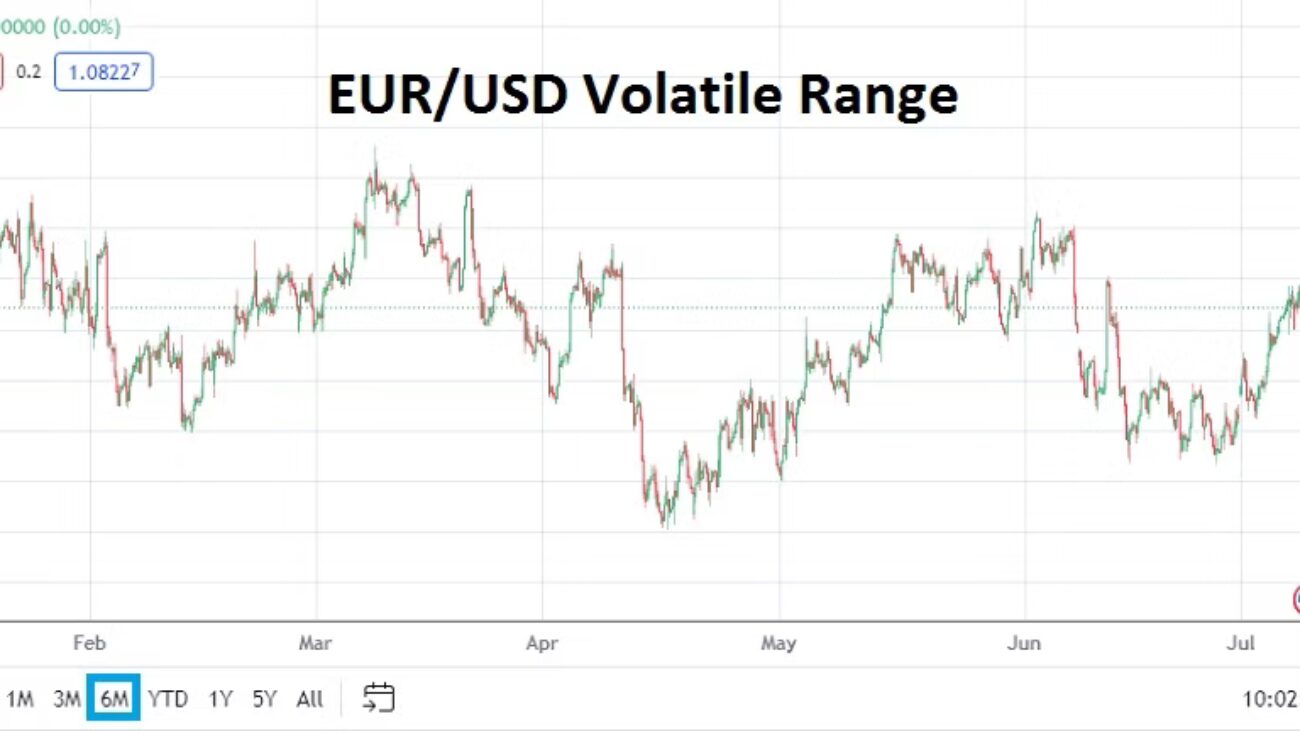
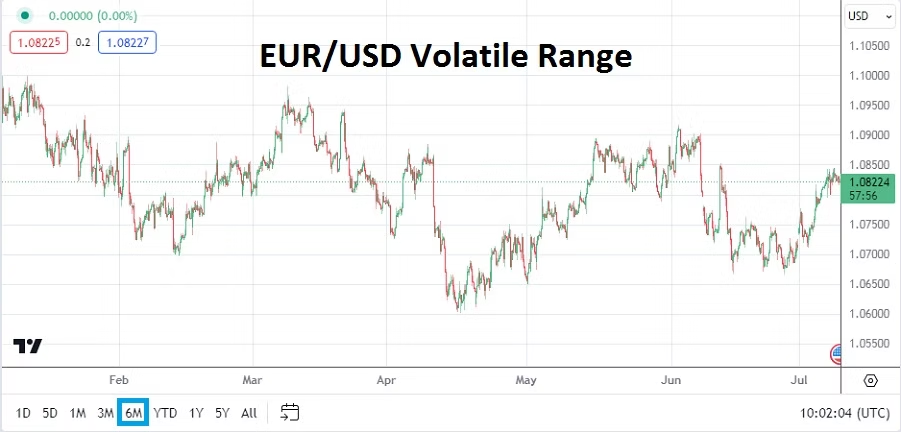
EUR/USD Six Month Chart on the 9th of July 2024

France held its Parliamentary second round elections on Sunday, and while the votes have been counted, the results in many ways are not yet clear. Coalitions are being rumored and EUR/USD traders may react to the developments and within French bonds, but the murky political conditions within Paris remain hard to predict regarding outcome as a whirlwind of deal making takes place in an assortment of offices.

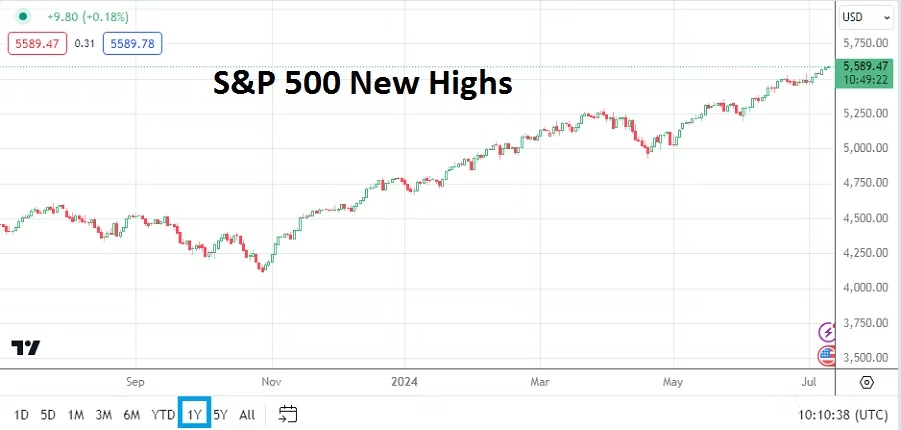
S&P 500 One Year Chart on the 9th of July 2024

The lack of total volume last week in Forex and equity indices did not stop trends from being seen and technical perceptions being formed. U.S stocks remain highly valued and U.S Treasury yields have produced a downwards slope.

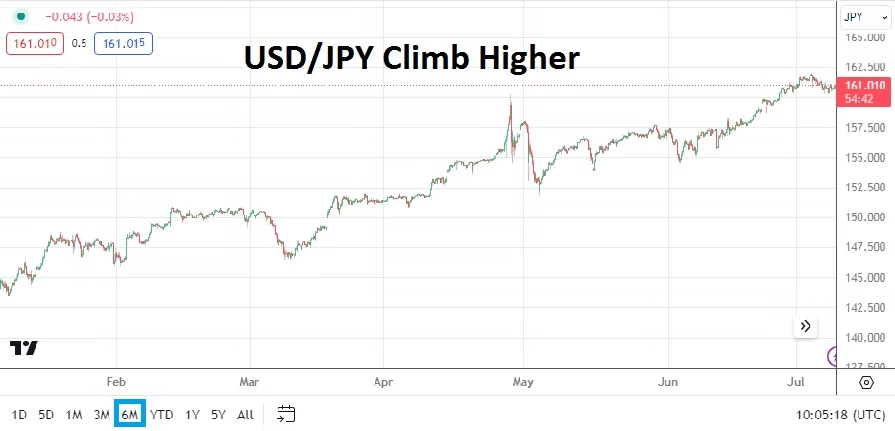
USD/JPY Six Month Chart on the 9th of July 2024

Today will prove interesting as Jerome Powell and Janet Yellen speak in Washington D.C, later this week inflation data will certainly cause a stir. While Biden remains a concern, France tries to form a working government, and the Bank of Japan is being viewed with deep suspicion, day traders have reasons to monitor news, but they should also remember financial institutions have been positioning for potential sentiment shifts and may not react with volatility if their outlooks are confirmed.

This week of trading is laden with risk events, some of which are listed below, but speculators need to understand behavioral sentiment is showing signs of optimism within many financial assets, and the prevailing mood of financial institutions appears to be leaning towards risk appetite.

Monday, 8th of July, Japan Average Cash Earnings – real wages continued to fall via data reported yesterday. The USD/JPY is traversing dangerous heights and speculators are likely still testing their bullish perspectives even as the 161.000 sees values tested above. Traders should stay cautious and not bet wildly on more upside, but lower valued speculative viewpoints are also problematic for the time being. Simply put, beware of the BoJ as it looms in the shadows.

Tuesday, 9th of July, U.S Federal Reserve Chairman Powell – the central bank chief will testify before the Senate. U.S economic data has weakened via Gross Domestic Product, and Manufacturing and Services readings. However, inflation remains troublesome and Powell will have to speak about these issues in conjunction via his Monetary Policy Report. He will certainly try to sound cautious. If Powell hints at a potential rate cut in September this would spark USD selling. At the same time the Fed Chairman is talking, Treasury Secretary Yellen will be speaking to the House Financial Services Committee. Traders can be assured that Powell and Yellen will mirror each other. And Powell will speak to the House on Wednesday.

Wednesday, 10th of July, China CPI and PPI – the Consumer Price Index is expected to have a gain of 0.4%, while the Producer Price Index is anticipating a result of minus -0.8%. Deflation in China is a concern. Economic statistics continue to produce lackluster results, while this a partially due to the collapse of the real estate bubble in China, it also has to do with less demand for products from abroad as Europe and America suffer from economic declines too. The USD/CNY has produced a bullish trend since the start of 2024 and is traversing near 7.2714 as of this writing. Traders should look at the inflation reports and examine them for revisions downward in previous months.

GBP/USD Six Month Chart on the 9th of July 2024

Thursday, 11th of July, U.K Gross Domestic Product – the newly elected Labour government will get their first taste of big economic data challenges as they now guide Britain. A lackluster gain of 0.2% is expected. While this may move the GBP/USD a bit based on the result, the currency pair will likely react more to the U.S inflation data later in the day. The July bounce higher in the GBP/USD has been healthy and value above the 1.28000 has provided bullish traders with some optimism.

Thursday, 11th of July, U.S Consumer Price Index – the core CPI report is projected to match last month’s number of 0.2%. If this result can be attained and the CPI annual data comes in with the anticipated 3.1% mark compared to last month’s figure of 3.3%, this could create dynamic bearish activity for the USD. However, traders should remain cautious and note that even though recent U.S economic data has tumbled, inflation reports have been stubborn. Betting on the outcome of these reports before they are published is akin to gambling for day traders.

Friday, 12th of July, U.S PPI and Preliminary University of Michigan Consumer Sentiment – the Producer Price Index reports are expecting slightly higher ratios. The Consumer Sentiment report should be looked at too, because the readings have been coming in weaker the past handful of months. If consumer behavioral sentiment is weaker the USD could sustain a negative stance.