postR177.1

Central Banks and Summer Storms for Traders as Actors Change

Central Banks and Summer Storms for Traders as Actors Change

Yesterday’s rather quiet start to the week regarding economic data allowed for traders to look over the financial markets before the onslaught of central bank mayhem hits on Wednesday. The Forex market has seen rather interesting results the past few weeks as behavioral sentiment has clearly shifted (for seemingly the tenth or so time) towards a more dovish outlook regarding the U.S Federal Reserve. Expect stormy waters this week in currency markets.

The usual lazy summer of the markets has had to deal with political winds in June and July as Britain, France and the U.S have delivered rather intriguing mischief via election results and changes of leadership. However, the world has survived and this is a lesson new day traders need to understand quickly. While tomorrow may not be known, experienced market players have seen these dramas before, they might be new episodes with different actors, but the theme remains the same for veterans of the markets.

Although powers shift, a focus on outlooks is often what matters. People and institutions are in pursuit of profit. This week central banks will be heard from and the rhetoric delivered will affect assets.

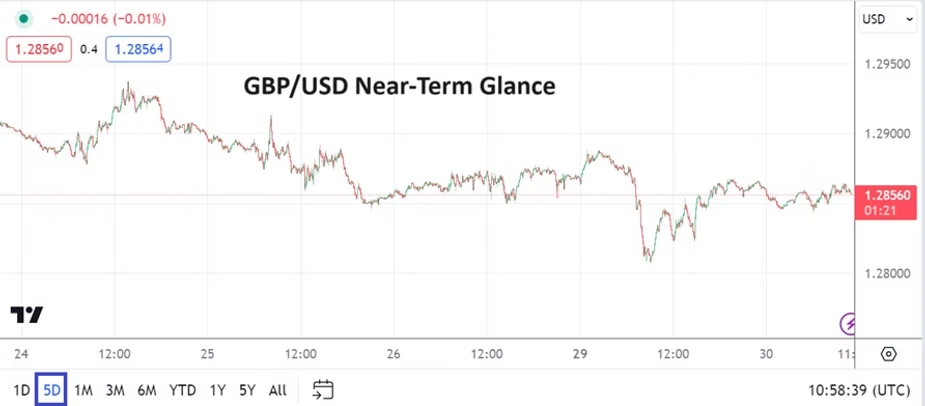
GBP/USD Five Day Chart on the 30th of July 2024

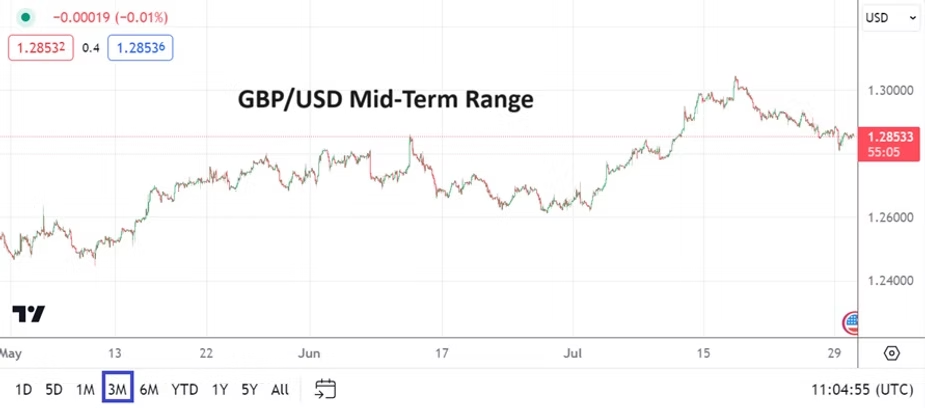
Monday, 29th July, U.K assorted data – Mortgage Approvals, Net Lending to Individuals and M4 Money Supply data was released to various fanfare yesterday and did not shake the GBP/USD dramatically. However, making more important news perhaps was the public statement by Rachel Reeves, who is the new Chancellor of the Exchequer, saying there is an existing 22 GBP billion ‘black hole’ within the U.K government finances that was not accounted for by the Conservatives. In other words the blame game between the new Labour bosses and now banished Tories has begun. While the GBP/USD dropped a bit on this development, it did not crush the currency pair as it returned to the lower depths of its higher three month technical chart.

GBP/USD Three Month Chart on the 30th of July 2024

Tuesday, 30th July, E.U Gross Domestic Product – a variety of GDP reports came from across the continent this morning, including France which recorded a slight gain of 0.3% and the German numbers which recorded a minus -0.1% result. The numbers show the E.U remains in trouble for the larger economic nations. Spain did show an improvement, but it is nothing that should start parades of celebration.

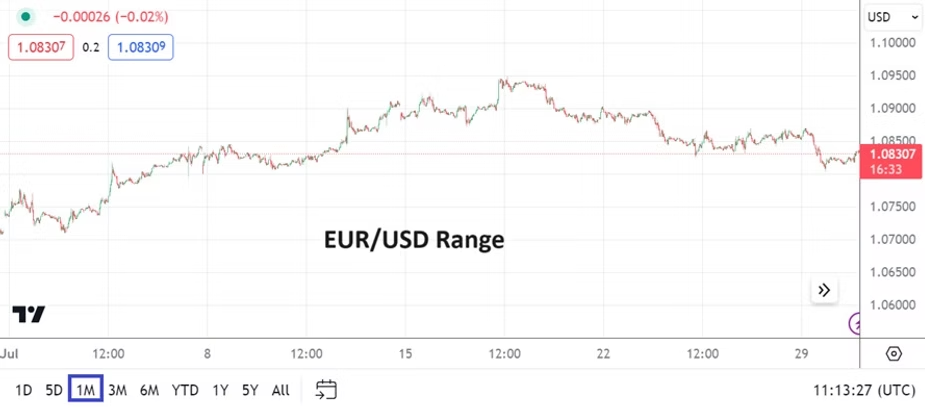
EUR/USD One Month Chart on the 30th of July 2024

Tuesday, 30th July, U.S CB Consumer Confidence – this sentiment report for the U.S consumers will get some notice today, but financial institutions are largely braced for tomorrow’s U.S Fed rhetoric. The trading of Forex, gold, equities and their indices will likely remain choppy today as folks take on cautious tones.

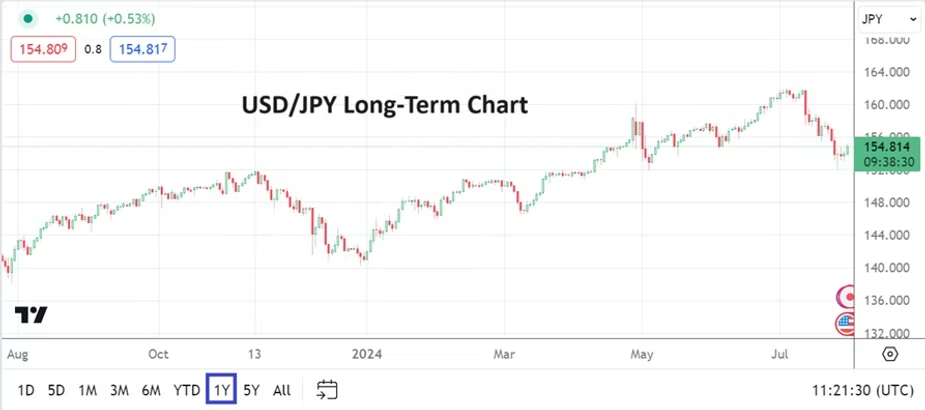
Wednesday, 31st July, Bank of Japan Policy Rate – and here we go ladies and gentlemen. The BoJ can never be counted on to do what is logical in the eyes of many analysts outside of the central bank’s inner circle. Japan has pursued a soft devaluation of the Yen this year. The Bank of Japan should consider an interest rate hike to the 0.20% level from the 0.10% ratio, but will they? Speculators need to be extra careful with the USD/JPY over the next 30 hours. If the BoJ somehow decides to raise and the U.S Fed makes it known they will consider more than one interest rate cut this calendar year, the USD/JPY could see swift price velocity lower. Perhaps the BoJ will stay muted and cautious, allowing for the currency pair to go higher again. However, there have been some signs large players suspect a slight interest rate hike could come tomorrow from the Bank of Japan. Day traders are advised to be extraordinarily careful.

Wednesday, 31st July, U.S Federal Reserve FOMC Statement – the Fed is not going to lower their Federal Funds Rate during this meeting. But what they are expected to do via their FOMC policy rhetoric is to say a cut is likely in September considering the current economic data, and that if inflation continues to show signs of erosion another cut will be considered in November. Recent economic data in the U.S has been mixed. GDP numbers jumped higher, but importantly the GDP Price Index was lower than anticipated last Thursday, and the PCE Price Index on last Friday matched expectations (and importantly didn’t rise). If the Fed sounds optimistic about an interest rate cut in September this will match the expectations of many financial institutions. If they sound cautious about a possible second rate cut later this year, this could cause a hiccup for those with weaker USD centric outlooks over the mid-term.

Thursday, 1st August, U.K Bank of England Official Bank Rate – the BoE is expected to lower the borrowing rate by 0.25% to 5.00%. The GBP/USD has been trading higher in July based on a cocktail of a weaker USD stance. There is plenty of reason to believe the less than sterling economic data from the U.K will help deliver the lower interest rate from the BoE this week. The BoE is likely to have spoken with the Fed and ECB to correlate a gameplan. The Bank of England Monetary Policy Summary should be given attention. GBP/USD traders will have responded to the Fed’s outlook from Wednesday, opening the door to plenty of volatility after the BoE speaks. Meaning that Forex speculators should be extremely cautious if they are pursuing short-term wagers which will be akin to surfing a violent storm.

Friday, 2nd August, U.S Non-Farm Employment Change and Average Hourly Earnings – this data will be anti-climatic. The results from Wednesday through Thursday from the central banks will take a lot of the bang out of these reports. The earnings report should be given some attention, but the financial markets will likely be trading on behavioral sentiment generated over the prior days.

postR176

Make Common Sense Great Again: On Moving Away from Nuance

Make Common Sense Great Again: On Moving Away from Nuance

Opinion: The following article is commentary and its views are solely those of the author. This article was first published the 23rd of July 2024 via The Angry Demagogue.

Has there been a total breakdown of readiness in the West? When we look at seemingly unrelated events we see that people in responsible positions in governments around the Western world have missed signs that are obvious – and not only after the fact. The attempted Trump assassination just got me thinking how no one seems to react to the obvious anymore. It seems that both the local police and the Secret Service knew that this young man was on a roof with a rifle and no one took the most elementary actions of delaying Trump’s appearance or trying to stop the shooter or even ascertain his motives all of which was obvious to everyone else. We are not talking about someone missing a shot at him or even forgetting to check a specific place, but an active decision was made – to do nothing.

On October 6 and 7 the IDF Chief of Staff and his senior advisors on the General Staff heard of possible Hamas plans to attack, knew of previous intelligence that detailed the exact attack that happened and even refused a request of the head of the Southern Command to move 4 helicopters closer to Gaza. Instead of doing even the minimum, they just did nothing. They ignored the obvious and ruled purposely against common sense and in favor of their own preconceived notions.

As Russia was massing troops on the border and as Putin’s talk was becoming more and more belligerent the US administration did nothing that might have at least hinted to Putin that this could only lead to disaster. Putting US troops on a higher alert, inviting the Ukrainian ambassador to the White House as a show of support – anything really, might have given Putin food for thought. As Iran moves closer and closer to attaining a nuclear weapon and taking control of the middle east, the West just does nothing. Destroying Houthi assets (as the Israelis have just done), sending B52’s into the sky for training missions to destroy Islamic Republic assets – all that might have made the Iranian rulers wonder what was in store for them and limiting the war to Gaza. But again, against common sense, nothing was done because …. Wishful thinking.

If those responsible were acting like boys in the school playground (are boys still allowed to play in the playground?) they would have done more than they did in all these cases. 

Since the end of the Cold War we have seen the abandonment of common sense in favor of sophisticated analyses where nuance trumps simplicity and bias dominates the analysis of data and where cliches overtake serious policy. In classical Jewish biblical exegesis, there is one rule which nearly all (non-mystical) commentators hold and that is that the exegesis cannot contradict the simple meaning of the words of the Bible.  True enough, that is stretched to points of wonder sometimes – but they still cling to the rule. 

Common sense is underrated in policy analysis and often in business, but those who ignore it now will be challenged later. Common sense means the acceptance of what people say and looking at data without bias. Common sense means that you have to understand the person you are talking to and don’t assume they think like you. 

Back in my university days I read a lot of Hannah Arendt, who, in spite of the banality of her banality of evil theory had a lot to say. In her book “The Human Condition” she speaks of common sense – or as she often puts it “the sense of the common”.

I would like to quote her here, even though I tend to think she would not have thought that it was the rulers, the policy makers and the writers who are ignoring common sense:

“The only character of the world by which to gauge its reality is its being common to us all, and common sense occupies such a high rank in the hierarchy of political qualities because it is the one sense that fits into reality as a whole our five strictly individual senses and the strictly particular data they perceive.  It is by virtue of common sense that the other sense perceptions are known to disclose reality …. A noticeable decrease in common sense in any given community and a noticeable increase in superstition and gullibility are therefore almost infallible signs of alienation from the world.”

Arendt of course assumed that the lower or working classes were susceptible to superstition and gullibility but in these times it is the ruling classes that have abandoned common sense in favor of superstition and gullibility. It is they who are alienated from the world. Preconceived notions that contradict the plain meaning of the world is today’s superstition – and it is no less dangerous and irrational than the superstitions of times past.

Let’s take a brief look at these policy decisions by nearly all western countries, regardless of their geographical location or economic outlooks, their demographic trends or the overall culture of their people and their neighbors resulting directly or indirectly of the perilous situation the free world is now in.

Defense Spending and Force Size

The post-cold war “peace dividend” became an idol of western policy makers.  Massive cuts in defense spending even in things that were very necessary to the maintenance of said “peace dividend” – like naval power – was the preferred way of dealing with the end of the Soviet Union. The “End of History” was read simplistically instead of realizing that other ideologies and other powers might very soon challenge the victorious west. Some thinkers, I think of a professor of mine (Elie Krakowski) who back in 1979-80, before the collapse of the Soviet Union, spoke of Islam as the third force which will challenge the West and the East. I studied in a small university and if we were discussing it back then how are policy makers in Washington, London, Tel Aviv and Paris not speaking of it today?

While Edward Said’s “Orientalism” was the talk of the town, Bernard Lewis and Fouad Ajami were, despite their posts at Princeton and Johns Hopkins, not taken seriously enough. If they were, the US Navy would not have gone from 594 ships in 1987 to 275 in 2016. The British Navy  went from about 170 ships in 1970 to well under 50 in 2017. The rest of Western Europe we all know about. But at least countries like Netherlands, Belgium and Denmark don’t face hostile neighbors and were never meant to have forces that would do more than assist in minor operations.

Israel on the other hand has always faced neighbors who have desired to destroy it.  Even the countries with which it signed peace treaters, Jordan and Egypt, have never been able to translate these treaties into popular support and are always a coup away from belligerence. The history of dictatorships in general and of the Middle East in particular ought to have given the Israeli high command at least a hint as to what they might be facing. With the advent of Iran as a major regional power with the means and desire to spread its theo-revolutionary ideology, Israel ought to have realized that the era of wars was not over. Yet, since 2000 Israel has cut 6 divisions and decommissioned 2,000 tanks from its forces. It has cut military service for men from 36 to 32 months, even as it has not increased the mandatory service for woman from 24 months even though it has increased the amount of women in combat and combat support roles. The ultra-orthodox still don’t serve (they are about 16% of the draft class) zero even after October 7 and the number of youth who have received exemptions due to “psychological” reasons has skyrocketed to nearly 13% of the draft class. I don’t mean to belittle those with true psychological issues but rather the high numbers signify that many if not most are of a class that allows them to afford to pay psychologists for convenient diagnoses.

In other words – the IDF, the Finance Ministry and the political class all found it convenient to reduce the size of the army – both manpower and equipment – and used the excuse that there will be no more ground wars to justify the move.

The Ukraine conflict revealed to the world that US arms production of even the most basic arms is not enough for the US itself to maintain minimal levels during wartime.   The current Middle East conflict has magnified this disaster.

Common sense readiness has been ignored throughout the Western world due to sophisticated thinking more wishful than realistic. This is nothing less than a messianic and superstitious belief in the end of wars.

Immigration and Assimilation

If there is one issue that common sense has missed it is immigration. The reactions of average citizens to unlimited immigration in Western democratic countries has been uniform – NO! In some countries the yelling is louder but in all western countries there is significant opposition, on common sense grounds often, to the establishment immigration policies.

I am an immigrant to Israel and my grandparents were immigrants to the United States. Immigration, the movement of peoples from place to place has been going on since people left Africa – and before. But there is no separating immigration from assimilation unless your immigration is due to imperialism and conquest.  The Romans, Greeks, Chinese and Persians of ancient times, the Arabs of late antiquity were all imperialists. There was of course the age of imperialism that ended in WWI. But 21st century immigration is not of national conquest but of individual movement of people and families. One by definition must adapt to the local cultures – in the widest sense of the word. If a cotton farmer from Arizona wants to move to Iowa, he better adapt to the climate and figure out how to grow wheat or soybeans instead of cotton. If an aristocrat from England decides to move to the United States, he needs to know that his family heritage and titles won’t get him much. If a Spanish or Chinese speaker moves to Germany, the expectation is that he will learn to speak German.

An immigrant who does not respect the local culture in all its manifestations needs to get permission in order to stay in the new country. That is the way of the nation-state that has protected freedom in the western world so well (if not always so well). We can’t compare the 21st century to the pre-WWI world where borders were porous and people that survived the trip across a continent or an ocean could settle in that new land. Some more successfully than others. 

Common sense dictates that an immigrant that does not respect the laws of his new home has no right to live there. Yet, time and again, immigration policy has been separated from the law and being law abiding has no bearing on future citizenship.  Therefore, there is no demand from the immigrant and no opportunity for the immigrant to assimilate and be part of the social fabric of his new country. That being said, the mass Islamic immigration into Europe could be said to be imperialistic as the leaders of these communities have discouraged any type of rapprochement with Western values and law. That, along with the demographic collapse of indigenous Europe has put Europe on the brink of either a civil war or a peaceful surrender to Islamic imperial forces.  

Free Trade and Social Peace

There is no doubting that free trade brings prosperity and that economic growth better than any other global trading system. Free trade  is also the best way to lift the global poor out of poverty. The U.S constitution understood the importance of free trade, as states were prohibited from starting trade wars with each other.   This has also been the “good” in the E.U and has produced much prosperity in that Union.

Yet, free trade with allies needs to be differentiated between free trade with enemies  – meaning those that oppose our system. Free trade that allows your enemies to defeat you militarily is not free trade but suicide. So too, trade policies need to have social issues taken into consideration. This is not a call for tariffs or against free trade pacts, especially with neighbors, but rather they need to be adjusted with common sense solutions to employment and other problems that will arise from any economic change. 

Social peace is the second half of this section because, besides immigration, the erosion, not to say destruction of physically intensive jobs can and often does lead to social violence for reasons obvious to those with common sense.

Energy and Food Supply

For the most part, you would think that after national defense, it is a government’s first responsibility to its citizens to guarantee the food and energy supply of its citizens. Before we get to luxury and access to travel, the ready supply of food and energy seems to be the minimum that a government ought to do. And yet, when we speak of issues related to climate change (and lets not get into the “is it or isn’t it real” argument) the solutions first mandated to the problem have to do with limiting both of these items without which we cannot live. In California, farmer’s access to water is limited even after the drought due to concerns about some fish and climate, and in the Netherlands they want to pay farmers to stop producing food so that the Earth will not suffer. 

What is the plan here? Regarding energy supply, one would think that shoring up access to alternative energy would take priority over banning current ways of producing energy. In California, they have been having rolling blackouts in the summer for years and they are looking to ban gas stoves and ovens and gasoline powered cars. Private jets and yachts though are off limits for obvious reasons. What is the plan there? Is there any real preparation?

As for food supply, is the  plan to reduce population or to reduce calory intake? To what levels? Is there an expectation that people will starve themselves to “save the planet”? Again – I am not arguing for or against human causes of climate change but rather, for the common sense understanding that securing the world’s food supply takes priority over closing farms or turning them into organic utopias.

A perfect example is Sri Lanka where those in power bought into the organic farming ideology of Western aristocrats and they ended all non-organic farming causing a famine and a depression. People who worked hard their whole lives lost all their savings as they were unwilling participants in a cruel experiment to see if organic farming can feed a small island nation.  

In sum – a bit less nuance and a bit more common sense – a bit more sensing what is “common to us all” would be welcome in political and policy matters. Maybe if we pursued more common sense policies and a lot less superstition and bias there would be less yelling and screaming in the public square. 

Disclaimer: the views expressed in this opinion article are solely those of the author, and not necessarily the opinions reflected by angrymetatraders.com or its associated parties.

You can follow Ira Slomowitz via The Angry Demagogue on Substack https://iraslomowitz.substack.com/ 

postR175.1

U.S Growth (Lack of it) and Inflation Report Key to End of Week

U.S Growth (Lack of it) and Inflation Report Key to End of Week

Day traders may believe they are being confronted by another wave of data and news which is going to make their endeavors more difficult. The announcement by Joe Biden that he will not run for re-election in November however was not a major surprise. The handwriting on the proverbial wall has been clear for nearly a month that Biden was under immense pressure to step aside. It appears Kamala Harris will get the Democratic nomination per reports that delegates are starting to pledge their loyalty.

Financial markets which may have been interpreted yesterday as cautious due to the Biden and Harris news may actually not have had a tremendous effect. It is quite possible investors and traders have started to position their assets for a Trump victory. Love him or hate him, the polling numbers appear to suggest the Republicans are potentially going to win big in November. Except the word November is the key, there are still over 100 days for things to go wrong for the Republicans. Nothing is settled and day traders need to understand that a lot can change. Economic data from the U.S will be plentiful in the coming days. Also, China has lowered key borrowing costs in an effort to try and fuel spending in the nation as consumers remain hesitant and a sign the nation is battling a troubling economy.

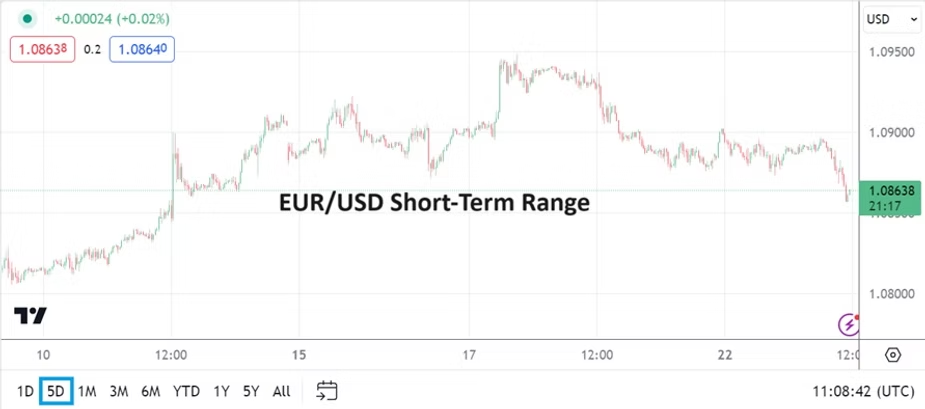
EUR/USD Five Day Chart on the 23rd July 2024

Traders who have been trying their hand in Forex have seen the EUR/USD and GBP/USD sink in value via short-term price changes. While retail speculators may look at the moves over the past day as vicious, they should note that since Wednesday of last week the USD has been stronger in Forex. It is doubtful financial institutions were betting on Biden to drop out of the race last week or for China to lower their interest rates. What in fact might be playing out is the possibility that most financial institutions believe the USD had been oversold and now want to position for the economic statistics coming this week. Results this week will help motivate notions the Federal Reserve will have to become dovish in September and proclaim a weaker U.S economic outlook through the end of this year, or for more idle chatter as the Fed undertakes a soundtrack which pleads for caution if inflation numbers remain stubborn.

USD/CNY One Year Chart on the 23rd July 2024

Monday, 22nd July, China One and Five Year Loan Prime Rates – borrowing costs were cut officially yesterday. The interest rate reductions of 0.10% were small, but China hopes this change helps propel stimulus for its struggling economy. It may not. But before folks sell China short, the nation continues to be a dynamic economic and political force and this power is not going to abate soon. The USD/CNY has incrementally risen since the start of 2024, but it is still below the higher values seen from August into early November of last year. It seems possible the Chinese government will continue to allow the Yuan to lose value in an attempt to reignite export.

Tuesday, 23rd July, U.S Existing Home Sales – the past few months have seen a decrease in the housing data. However, last month’s outcome was stronger than anticipated. These numbers tend to get a lot of fanfare, because they are a solid barometer of U.S outlook regarding interest rates and potential inflation. If folks feel like they should not sell their homes because their current payments are cheaper via their existing mortgages compared to taking on higher costs which are being offered now due to more expensive interest rates, this causes existing home sales to often fall. This because those with homes are not looking to move and simply want to stay in place, also making the potential of finding a house for folks who want to enter the market a more expensive proposition. Again, the outcome of this data is more of a barometer and doesn’t tend to affect financial markets like equities or Forex too much.

Wednesday, 24th July, Europe Manufacturing and Services PMI – E.U nations and the U.K will publish their readings. Last week the ECB kept their key lending rate in place. Political questions still linger in France which is more of a thorn in the side of the E.U than the potential outcome of these data reports. France and Germany expect better results from the Manufacturing and Services numbers. The broad E.U estimate also is optimistic about better results. Great Britain too is expecting better numbers. However, Forex traders will likely be more focused on coming U.S data and stay in a USD centric mindset the remainder of the week when making their forward considerations. And it should be noted the E.U and U.K economies are still struggling.

Wednesday, 24th July, U.S Manufacturing and Services PMI – these reports will be important certainly regarding the sentiment of Purchasing Managers, but the index reading may not be the biggest thing on investors minds. U.S data statistics on Thursday and Friday will be the outcomes that are being prepared for regarding potential affects. The Manufacturing number is expected to match the previous result, the Services figure is anticipated to be weaker.

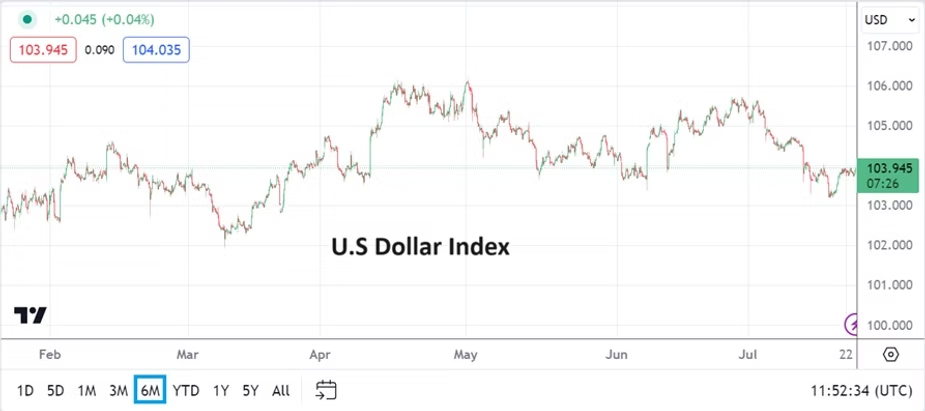
U.S Dollar Index Six Month Chart on the 23rd July 2024

Thursday, 25th July, U.S Advance GDP and Advance GDP Price Index – last month’s growth number came in below expectations, this GDP number is anticipated to produce slightly better numbers. The U.S economy via data has been showing signs of slowing the past few months and this Gross Domestic Product number is going to get a lot of airplay not only because of investors who will use it as an outlook because they believe the Fed will be paying attention, but also because the GDP result will start to become a political football for the Republicans and Democrats. If the growth numbers are weaker than anticipated this could propel USD centric weakness. However, day traders need to keep their eyes on the GDP Price Index stats too – if the inflation report comes in below expectations this could also fuel USD selling. Day traders need to pay attention to the USD Index charts later this week. While the short-term has seen some bullishness, the range of the USD remains near important support levels via a six month perspective and as the Fed comes under more scrutiny, traders should expect more tests in the near-term.

Friday, 26th July, U.S Core PCE Price Index – last month’s report matched expectations. If this inflation number meets the anticipated outcome, or comes in below the estimate this could sustain USD centric bearish momentum into the weekend and early next week.

postR174

Implications of a 48th President on the 20th January 2025

Implications of a 48th President on the 20th January 2025

Presidential news and questions are moving fast, but the coming weeks and months may become a political nightmare if challenges are not handled pragmatically. Financial markets opened this morning with risk appetite reduced, as cautious trading swept through financial assets on the news President Joe Biden would not seek re-election in November of this year. Hyperbole is dangerous and noise can cause unwanted nervous reactions in financial markets when there are unknowns.

Taking into account possible risk factors is important for mid and long-term outlooks. Financial institutions and traders should consider the potential of a rather dangerous political situation developing in the United States over the next few months. First off, will Kamala Harris now get the nomination from the Democrats to run for President in November? There are no certainties and Democratic power brokers may have other potential candidates in mind, which will create less clarity for investors.

Worse, what if there is a 48th President being sworn into office on the 20th of January 2025? Joe Biden, the 46th President, has in no uncertain terms publicly admitted he does not have the capacity to run for the Presidency in the coming U.S election. Does this also mean that he does not have the ability to run the nation until another President takes over following the November election and January inauguration? What would happen if the 25th Amendment of the U.S Constitution dealing with presidential succession and disability comes into force? If Biden is seen as unfit to rule now, he would have to be replaced and Vice President Harris would assume power.

What happens if Harris is forced to take control and becomes the 47th President of the United States before the U.S election is held or even afterwards? The 25th Amendment will become a talking point by political foes of President Biden, and maybe even by those who admire him. The question about Biden’s ability to make correct cognitive decisions between now and the inauguration in January is not a far fetched conspiratorial concern anymore.

How would financial markets react to Biden being replaced by Harris as President in the coming weeks or months? What would happen to U.S foreign policy? The U.S is not set up like Parliamentary political systems to have caretaker governments simply help guide a nation until a new government can be formed. The 25th Amendment and its use could be demanded in order to remove Joe Biden if he is currently unfit to serve, and this opens the door to chaotic U.S executive administration developments and decisions in the months ahead.

The fact that Biden has not been able to make a public announcement regarding his decision not to seek re-election, and will only speak to the U.S public later this week per his letter yesterday is troubling. Is Biden’s health so bad that he cannot perform the job of U.S President today? Section three of the 25th Amendment allows for the Vice President to be transferred power if the current President is unable to discharge their duties until fit again.

However, section four of the 25th Amendment allows the Vice President and cabinet to declare the current President incapable of performing their duties. The Vice President and the current President’s cabinet allows them to decide and issue a statement to the Senate and House leaders declaring the President is unable to govern and is unfit to voluntarily transfer power to the Vice President. Yes, there are timetables involved regarding the President’s capacity to be judged again and reconsidered for the resumption of power, but the U.S Constitution does open the door for a President to be removed permanently if they cannot perform their jobs by the President’s cabinet.

So again, what will happen over the coming weeks and months? Critics of Joe Biden will certainly claim he is not capable of governing and demand proof of his ability in the coming days. A growing chorus is likely to emerge expressing doubts about Biden’s ability to lead. Politics will be a factor in the potential game which will get loud. Republicans will certainly claim if Biden cannot run for President in November, that he likely cannot run the country until a new President is elected.

Politics have delivered a lot of noise this past weekend, but investors should expect the turmoil to grow in sound as people question the leadership of the U.S and ask for proof that Biden is in charge. The U.S elected Joe Biden to be President, not his appointed cabinet. If Biden is not able to prove he can do the job, there are legitimate reasons to consider a transfer of power to Kamala Harris.

At this juncture it appears the Republicans are in the drivers seat politically regarding the November elections. The Republicans may take control of the Senate, remain in charge of the House and attain the White House. Will Kamala Harris have to perform a caretaker government until the 20th of January 2025? Investors and day traders should keep these risk scenarios in mind.

postR173

Rich Dad, Poor Dad: What the Rich Teach Their Kids About Money

Rich Dad, Poor Dad: What the Rich Teach Their Kids About Money

Book corner: Rich Dad, Poor Dad: What the Rich Teach Their Kids About Money That the Poor and Middle Class Do Not! by Robert T. Kiyosaki

Every now and then a book comes along which leads to a major shift in how Americans think. Uncle Tom’s Cabin changed perceptions about slavery. The Jungle woke the nation to the horrific labor and sanitary practices in factories. The Feminine Mystique shed new light on feminism and women’s roles in society. All those books struck deep into society’s conscious and led to major changes.

Robert Kiyosaki’s Rich Dad Poor Dad: What the Rich Teach Their Kids About Money That the Poor and Middle Class Do Not! might not echo the social justice that his revolutionary predecessors strived for. But this 1997 best-seller packed no less of a wallop. Hitting the bookstores just as the twentieth century was coming to a close, Kiyosaki’s book changed how Americans – and others around the world – think about personal finance.

Rich Dad Poor Dad is not an instructional book as one would expect in a college course, with Kiyosaki running through facts, charts and figures. A Japanese-American born and raised in Hawaii, Kiyosaki uses his own life and background to tell a simple, almost fable-like story. The “Poor Dad” in the title refers to Kiyosaki’s biological father, Ralph Kiyosaki, who worked as a educator most of his life. By all accounts a good father and an honest man, he was a big believer in standard, traditional education, wanting the younger Kiyosaki to be a good student and then go to college in order to get a good job – in other words, as Kiyosaki puts it, to be an employee. But he had little financial education, which is what Kiyosaki explains is knowledge of business, investing, accounting, entrepreneurship, real estate and all other related subjects whose knowledge one can use to make money and be financially independent – to be an employer in contrast to an employee. Kiyosaki explains that although his Poor Dad made a decent salary, he was able to save little of it due to his lack of financial education and poor career decisions later left him broke.

The ”Rich Dad” in the title is the father of Kiyosaki’s buddy Mike, a man of limited standard education but excellent and well-developed financial education. A savvy entrepreneur with his hand in many businesses, he was approached by the two pre-teens for lessons on getting rich. Rich Dad put them to work in his general store for little money, but provided something more valuable – lessons on business and entrepreneurship that would form the foundation of Kiyosaki’s life and career. The book is structured around the conversations he had with his Rich Dad and the advice he was given, and the contrast in mentality to his Poor Dad.

As Kiyosaki explains, the drive for financial education consumed him and drove his decisions well into adulthood. A mediocre student, he nonetheless graduated from the Merchant Marine Academy, and then as a US Marine, served honorably in Vietnam as a helicopter pilot. Kiyosaki was eligible to work in the maritime industry after the war, a job that would bring excellent pay, conditions, steady work and several months of vacation a year. But he instead enrolled at Xerox’s sales school – considered the best of its kind in the country – seeing it as a major key in his financial education. His need for independence was so strong that in later years, during hard times, he and his then-wife Kim slept in their car rather than the accept the charity of friends’ guest rooms.

Besides the lack of financial education in the school system – an issue that Kiyosaki raises several times throughout the book – Kiyosaki challenges conventional beliefs. He rails against purchases that are liabilities instead of assets, even arguing against home ownership. He discusses the mindset of money and wealth creation and how ordinary people – due to society’s conditioning to be employees – are held back by limiting beliefs. To be successful in wealth creation and to take control of your financial destiny, Kiyosaki argues, one must take calculated risks; inspired by his Rich Dad, he says that one must not think I can’t afford this but instead What do I need to do to be able to afford this?

In one of the few diagrams in the book, Kiyosaki introduces the cash flow quadrant (of which he would later base an entire book), which categorizes individuals as employees, self-employed, business owners, or investors. He discusses the advantages and/or disadvantages of each quadrant.

Kiyosaki hit a raw nerve in the personal finance-hungry public, turning him into an international finance guru. It has to this date sold anywhere from thirty to forty million copies and is noted as the bestselling personal finance book of all time. He – and Kim, who has a series of similarly-themed books intended for women – have subsequently published an entire series of finance books, each with its own spin, such as real estate, investing, gold/silver, multi-level marketing, etc. These include two collaborations with Donald Trump, Why We Want You to Be Rich and Midas Touch: Why Some Entrepreneurs Get Rich — And Why Most Don’t. Kiyosaki also markets a board game, Cashflow, that attempts to teach the basics of financial education and how to exit what he calls the “rat race”, which is his description of the sometimes grueling life of dependency that employers place upon their employees and the financial mediocrity that ensues.

Rich Dad Poor Dad is not without controversy. Two of Kiyosaki’s businesses prior to his turning full-time to financial education went bankrupt, fueling claims that he is not as savvy as his image projects. Some experts and competing finance writers claim that he gives poor, substandard – even dangerous – advice. Another claim regards the identity of the “Rich Dad”. His name is not revealed in this book nor the follow-ups in the series and Kiyosaki was silent about this issue for several years, leading to accusations that the book is complete fiction. He has since revealed the identity of the man, plus his friend referred to as “Mike”. Kiyosaki explained that many years ago, upon the book’s initial publishing, the family requested anonymity, to which he respectfully complied.

Another claim, not without merit, is that this book gives little advice in general beyond the series of anecdotes and soundbites. Kiyosaki has not refuted that, and has claimed that it is the intention of the book to raise these issues and to simply convince people of the need – and to direct them onto – the path of financial education.

The book is worth reading. You won’t come away with the knowledge to pick stocks, examine real estate, understand tax laws or read a financial statement. But you’ll be immediately reaching for books that do – and that, according to Kiyosaki, is the intention.

If you want to read another Book Corner article, please visit this review by Evan Rothfeld: https://www.angrymetatraders.com/post/dangerous-and-unpredictable-duties-during-the-vietnam-war

postR196

AMT Top Ten Miscellaneous Remarks for the 14th of July 2024

AMT Top Ten Miscellaneous Remarks for the 14th of July 2024

10. Words of the Day: Political rhetoric is using platitudes and subterfuge camouflaging verbal nonsense, masking a vacuum of non-results and causing fatigue of populist promises.

9. Harris Prediction: After the NATO press conference in which Biden was more lucid but still made mistakes, it is beginning to feel like Kamala Harris is being given room to audition for the Presidency by the Democratic machine. If her polling numbers show improvement over the next couple of weeks, look for Harris to replace Biden at the DNC in Chicago, if her polling numbers are not good enough in the eyes of the elite power brokers, it is possible Biden may be asked to give up his delegates, allowing for an open convention.

8: Zombie Inflation: Data results via the U.S CPI caused a reaction in the broad markets, and volatility in Forex. While the broad monthly Consumer Price Index number on Thursday was minus -0.1%, the PPI numbers on Friday came in higher than expected causing some to feel that inflation remains a plague. However, if the Producer Price Index was interpreted as being higher because rising prices are coming via more expensive employee costs (which might see an end to the cycle sooner rather than later if jobs data continues to weaken) this is why there might not have been a violent Forex reversal on Friday. And Consumer Sentiment numbers from the University of Michigan came in below expectations again, and inflation expectations via the consumer survey showed some erosion.

7. Federal Fund Rates: Financial institutions have clearly begun to factor in the belief an interest rate cut will occur in September. The Fed which has been cautious consistently the past seven months may now have enough ammunition to consider becoming more dovish. A September interest rate cut has certainly been factored into Forex and Treasury yields, and there is a growing tide of sentiment which believes the weaker GDP numbers combined with the potential of less inflation could spark additional Federal Funds Rate cuts this calendar year. Outlook fueled by optimism regarding a more dovish Fed could be a factor in the markets the remainder of July.

6. Gold and Silver: Commodity prices are soaring as speculators pursue bullish trends. Gold finished this week above 2,410.00 USD. Silver is traversing above 30.00 USD per ounce for the first time since 2011 and 2012. These two metals are not always correlated, and day traders should remember Silver remains a rather easily mined commodity which sometimes influences downwards pressure because supply can be increased. Having said that, Gold and Silver have had solid bullish trends since February of this year.

5. Thaw: Bitcoin is near 60,000 as of this writing. The crypto winter has seemingly ended and many folks are standing in the sunlight and proclaiming long-term projections of Bitcoin as it maintains a higher price range. It should be remembered the most significant percentage of trading volumes within cryptos reside heavily within the top tier, and the ‘assets’ ranked lower remain in wagering cesspools. Cryptocurrency remains speculatively dangerous, and largely a place to move illicit cash with the perception the money can be kept ‘dark’.

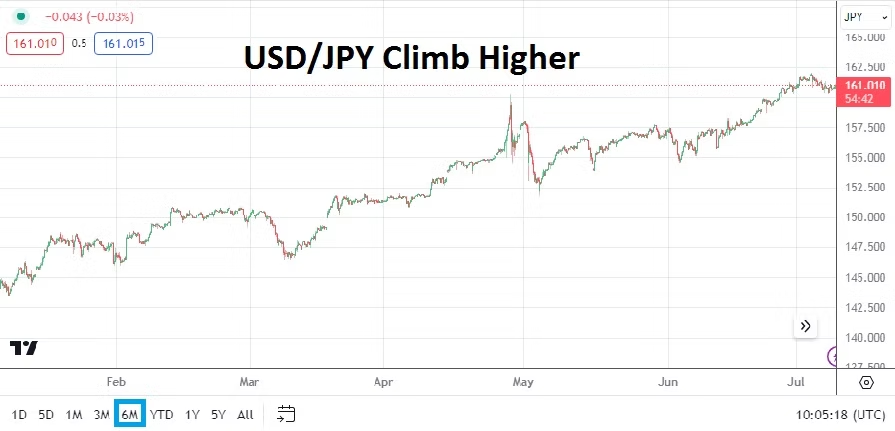
4. USD/JPY: The Bank of Japan won last week’s game of fire. The U.S Consumer Price Index numbers dealt a blow to the blind fury of speculative buying in the USD/JPY, and there is also a belief among many that the BoJ added onto the selling momentum of the currency pair too with a well timed intervention. The currency pair which was near the 161.640 juncture suddenly dived to nearly 157.420. The USD/JPY has gone into this weekend near the 157.900 ratio. The USD/JPY saga is not finished yet, and froth via bullish endeavors remains dangerous. Day traders here have been warned.

3. China: Friday’s Trade Balance numbers were good, compared to the rather weak CPI results seen on the 10th of July which were negative. China’s Communist Central Committee begins a Plenary Session tomorrow until the 18th. Will they speak in platitudes? The USD/CNY has certainly seen a ‘soft’ devaluation since February of this year, but the currency pair did go into the weekend near the 7.2500 mark which is off the high of 7.2765 seen this past Thursday. China still must improve consumer sentiment domestically and this remains a difficult struggle as ramifications from the implosion in China housing values mires the landscape. GDP numbers will come from the nation on Monday.

2. Behavioral Sentiment: Equities and indices, Forex, and commodities are all experiencing risk appetite permutations. While it might be tempting for retail traders to bet on lower reversals of trends, sometimes its much easier to simply ride optimistic waves. Certainly there will be days when financial assets struggle, but the apex heights of the Dow Jones 30, S&P 500, Nasdaq 100 should be treated with respect. Treasury yields are at mid-term depths and appear ready to traverse lower.

1. Trump: The attempted assassination of Donald Trump on Saturday in Pennsylvania will galvanize his supporters and likely push many people towards voting for him November. The amount of vitriol Trump has endured from his political opponents including the highest echelons of the Democrats and many in the media needs to be contemplated and quieted. Opposition to political ideology is fine, but the use of hyperbolic musings has led the U.S to a dangerous place. It would be wise for pragmatic adults to rejoin political discourse. Traders should watch the financial markets early this week to see if the U.S political front causes a reaction.

postR171

Triumphant Victory Marks End of Era for Indian Cricket Greats

Triumphant Victory Marks End of Era for Indian Cricket Greats

A Farewell to Legends: Kohli, Sharma, and Jadeja Retire from T20 Internationals

In a significant shift for Indian cricket, three stalwarts have announced their retirement from T20 internationals following the conclusion of the recent T20 World Cup. Virat Kohli, Rohit Sharma, and Ravindra Jadeja, each a pillar, have decided to step back from the shortest format of the game. Their retirements mark the end of an era and leave an indelible void in the Indian cricket team.

The Impact of Kohli, Sharma, and Jadeja

These three players have been instrumental in countless victories for India, bringing their unique talents and personalities to the field. Kohli, with his exceptional fitness and fiery passion, has been a cornerstone of the Indian batting lineup. Sharma, renowned for his elegant stroke play and ability to anchor innings, has often been the linchpin in crucial matches. Jadeja, with his all-round prowess and agility, has contributed significantly with both bat and ball, not to mention his spectacular fielding.

Their departure from T20 internationals is not just a loss of talent but a great shift in the team’s dynamics. Kohli’s fervent celebrations and on-field energy, Sharma’s cool-headed leadership, and Jadeja’s versatility will be sorely missed by fans and teammates alike.

The Perfect Farewell

For Kohli, Sharma, and Jadeja, winning the T20 World Cup was a dream and they achieved that in 2024 edition. Their commitment to this goal was unwavering, and with India’s triumphant win, they decided that retiring on the high note of a World Cup victory was the perfect way to bow out. This victory, fulfilling a long-held aspiration, was the ultimate peak of their careers, making it a fitting moment to conclude their illustrious journeys in T20 cricket.

The Kohli Phenomenon

Among the trio, perhaps the most striking figure is Virat Kohli. His presence on the field has been synonymous with passion and intensity. Kohli’s fitness standards have set a benchmark in modern cricket, inspiring countless young athletes. His emotional celebrations, especially after pivotal moments, have captured the hearts of fans worldwide.

Kohli’s relationship with the media and fans has been a rollercoaster, reflective of the intense scrutiny Indian cricketers face. Loved and critiqued with equal intensity, he has navigated the ups and downs with poise. Off the field, Kohli has also emerged as a social media powerhouse, engaging millions of followers with his dynamic presence. He is not just a cricketer; he is a brand, masterfully managed and perpetuated, resonating with fans far beyond the cricketing sphere.

The Future of Indian Cricket

As Kohli, Sharma, and Jadeja bow out of T20s, the Indian team stands on the brink of a new chapter. There is no shortage of emerging talent ready to fill their shoes in terms of runs and wickets. However, replicating the aura and legacy of these veterans is another challenge altogether.

The question now is whether the next generation can cultivate the same level of charisma and connection with fans that Kohli has achieved. Will there be a new player who can stir the same depth of emotion, embodying both the love and critique that Kohli so adeptly managed?

As Indian cricket moves forward, the legacies of Kohli, Sharma, and Jadeja will undoubtedly continue to inspire. Their contributions have not just been in numbers but in the very spirit of the game, setting standards and creating moments that will be treasured by cricket enthusiasts for years to come.

postR172.1

Risks: Powell and Inflation Data will Generate Market Reactions

Risks: Powell and Inflation Data will Generate Market Reactions

Traders returning to their desks after a long holiday weekend can see the USD has become weaker the past couple of sessions as behavioral sentiment has shown signs of shifting again. Yet the trends experienced in Forex have not been clear cut, this as questions and concerns regarding what governments and central banks are thinking remains problematic. Investors who take a long-term approach to the markets will likely have an easier time in the coming days because their comfort levels are set to different metrics compared to large traders and the retail crowd. Noise doesn’t effect investors as much as traders.

Politics clearly remain on the minds of many as President Joe Biden has his ability to effectively lead the U.S questioned with growing doubts. However, it is unlikely that there will be a change in the immediate future from the Democrats as they decide on a path regarding their nominee for the November Presidential election. Financial institutions would certainly react to a decision to eliminate Biden as a candidate, but the President remains steadfast that he will move forward. It is very conceivable that Biden may be forced to vacate against his wishes, but until then the broad markets will not react too much to worries about the White House. For the moment U.S politics remain hyperbole.

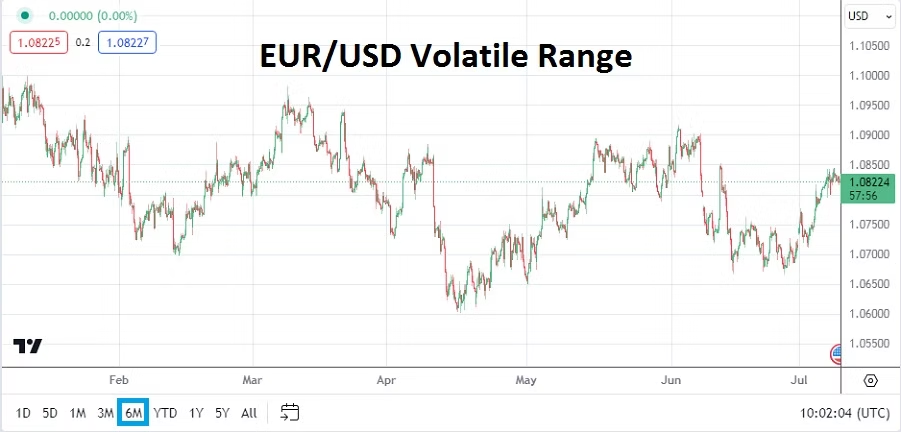
EUR/USD Six Month Chart on the 9th of July 2024

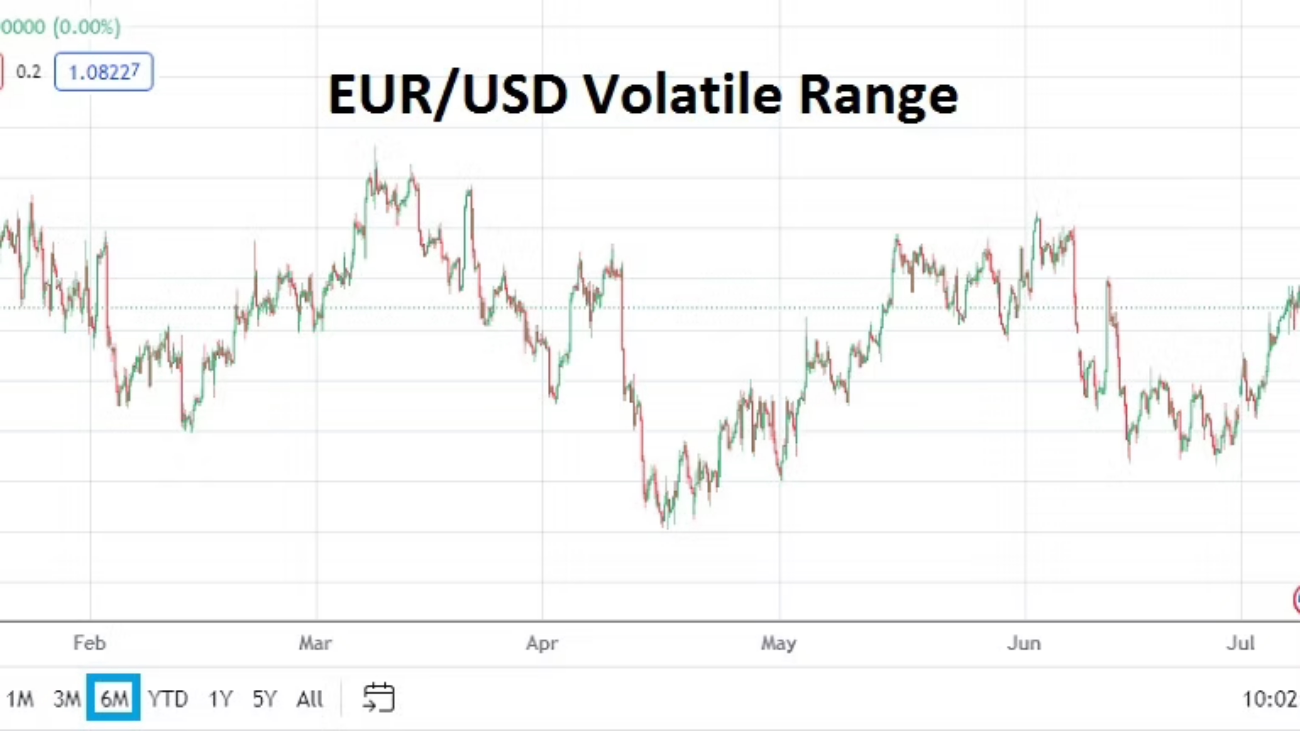
France held its Parliamentary second round elections on Sunday, and while the votes have been counted, the results in many ways are not yet clear. Coalitions are being rumored and EUR/USD traders may react to the developments and within French bonds, but the murky political conditions within Paris remain hard to predict regarding outcome as a whirlwind of deal making takes place in an assortment of offices.

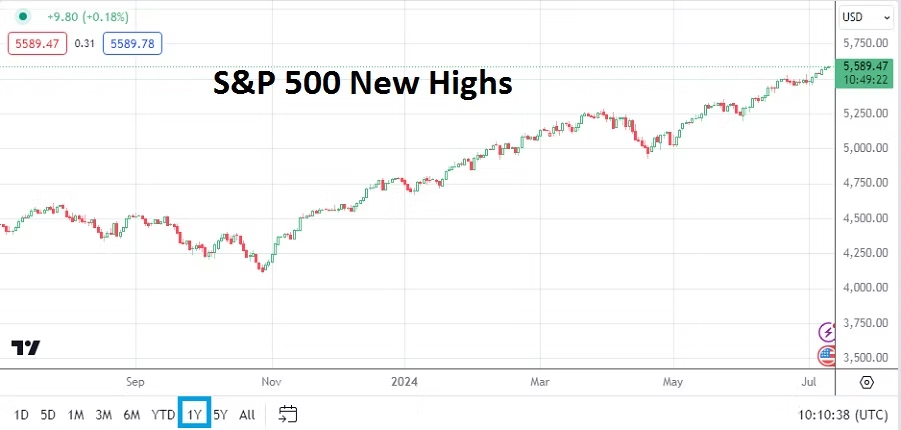
S&P 500 One Year Chart on the 9th of July 2024

The lack of total volume last week in Forex and equity indices did not stop trends from being seen and technical perceptions being formed. U.S stocks remain highly valued and U.S Treasury yields have produced a downwards slope.

USD/JPY Six Month Chart on the 9th of July 2024

Today will prove interesting as Jerome Powell and Janet Yellen speak in Washington D.C, later this week inflation data will certainly cause a stir. While Biden remains a concern, France tries to form a working government, and the Bank of Japan is being viewed with deep suspicion, day traders have reasons to monitor news, but they should also remember financial institutions have been positioning for potential sentiment shifts and may not react with volatility if their outlooks are confirmed.

This week of trading is laden with risk events, some of which are listed below, but speculators need to understand behavioral sentiment is showing signs of optimism within many financial assets, and the prevailing mood of financial institutions appears to be leaning towards risk appetite.

Monday, 8th of July, Japan Average Cash Earnings – real wages continued to fall via data reported yesterday. The USD/JPY is traversing dangerous heights and speculators are likely still testing their bullish perspectives even as the 161.000 sees values tested above. Traders should stay cautious and not bet wildly on more upside, but lower valued speculative viewpoints are also problematic for the time being. Simply put, beware of the BoJ as it looms in the shadows.

Tuesday, 9th of July, U.S Federal Reserve Chairman Powell – the central bank chief will testify before the Senate. U.S economic data has weakened via Gross Domestic Product, and Manufacturing and Services readings. However, inflation remains troublesome and Powell will have to speak about these issues in conjunction via his Monetary Policy Report. He will certainly try to sound cautious. If Powell hints at a potential rate cut in September this would spark USD selling. At the same time the Fed Chairman is talking, Treasury Secretary Yellen will be speaking to the House Financial Services Committee. Traders can be assured that Powell and Yellen will mirror each other. And Powell will speak to the House on Wednesday.

Wednesday, 10th of July, China CPI and PPI – the Consumer Price Index is expected to have a gain of 0.4%, while the Producer Price Index is anticipating a result of minus -0.8%. Deflation in China is a concern. Economic statistics continue to produce lackluster results, while this a partially due to the collapse of the real estate bubble in China, it also has to do with less demand for products from abroad as Europe and America suffer from economic declines too. The USD/CNY has produced a bullish trend since the start of 2024 and is traversing near 7.2714 as of this writing. Traders should look at the inflation reports and examine them for revisions downward in previous months.

GBP/USD Six Month Chart on the 9th of July 2024

Thursday, 11th of July, U.K Gross Domestic Product – the newly elected Labour government will get their first taste of big economic data challenges as they now guide Britain. A lackluster gain of 0.2% is expected. While this may move the GBP/USD a bit based on the result, the currency pair will likely react more to the U.S inflation data later in the day. The July bounce higher in the GBP/USD has been healthy and value above the 1.28000 has provided bullish traders with some optimism.

Thursday, 11th of July, U.S Consumer Price Index – the core CPI report is projected to match last month’s number of 0.2%. If this result can be attained and the CPI annual data comes in with the anticipated 3.1% mark compared to last month’s figure of 3.3%, this could create dynamic bearish activity for the USD. However, traders should remain cautious and note that even though recent U.S economic data has tumbled, inflation reports have been stubborn. Betting on the outcome of these reports before they are published is akin to gambling for day traders.

Friday, 12th of July, U.S PPI and Preliminary University of Michigan Consumer Sentiment – the Producer Price Index reports are expecting slightly higher ratios. The Consumer Sentiment report should be looked at too, because the readings have been coming in weaker the past handful of months. If consumer behavioral sentiment is weaker the USD could sustain a negative stance.

postR170

Middle East is Proving to be a New Playground for the Axis

Middle East is Proving to be a New Playground for the Axis

Opinion: The following article is commentary and its views are solely those of the author. This article was first published the 4th of July with an addendum on the 5th via The Angry Demagogue.

Blinken Gets Pushed to the Back of the Line

While the Biden-Blinken Administration is obsessing on “non-escalation” and telling allies they are on their own if they attack an Axis member that attacks the ally,  or that they will help the ally “defend itself” but not take the offensive (how you do that is a mystery) the Axis itself is establishing itself all over the Middle East.

Let’s start with a statement, quoted in Israel, by Alexander Dugin who is Putin’s ideological advisor advising the Russian leadership to arm Hezbollah and the Houthis in their fight against Israel. Earlier this week, Newsweek reported that Russia is considering arming the Houthis with cruise missiles. These could be used against Israel and against Saudi Arabia – or maybe U.S bases in the area. As Russia seeks to cement its ties with anti-Western countries and forces around the world, it seems to be partnering with Iran so as to increase the potency of Iran’s proxies and press their goal to rid the region of U.S forces. Toward this goal Iran and even Russia are manufacturing tanks together in Iran.

The Houthis themselves, under with the guidance of Iran, are attempting to expand their sea blockade from Bab al Mandab straits connecting the Gulf of Aden with the Red Sea, to the east African coast by cooperating with the Sunni and al-Qaeda based Somali terrorist group al-Shabaab al-Mujahadin. Reports in Israel quoting U.S intelligence sources claim that the two groups are cooperating and that the Houthis will supply weapons to al-Shabaab in order to interdict global shipping off the Somali coast and in order to harass U.S forces stationed in the area.

The anti-U.S alliance seem to be able to cross religious and ideological boundaries in ways that western intelligence thought impossible. That is because western (and Israeli) intelligence mis-categorize all of these groups and countries. The issue is not who is Sunni and who is Shiite, who is Russian Orthodox and who is Communist, but rather, who is for keeping the international status-quo and who’s for, to use a phrase meant for different times – a “new global order”.  

The Houthis, feeling confident in having defeated the U.S Navy in the Red Sea are now threatening Saudi Arabia for saying no to a Russian negotiated deal (under the auspices of the U.N and opposed by the U.S) which would bring an end to the embargo against the Houthis including their export of oil as well as Saudi financing of the Houthi civil government in the part of Yemen they occupy (they learned from Hamas and Qatar/PA/Israel that you really can have your enemies pay your salaries) amongst other goodies. They blame Saudi Arabia for allowing U.S jets to bomb Houthi sites from airbases inside Saudi Arabia – with no U.S carriers in the Red Sea that certainly could be true. In their threat they included videos of their bombing of Saudi oil fields in 2019 just in case the Saudis forgot. 

The Houthis, with their experience stopping shipping, have, according to a JCPA report been the point men for Iran’s plan to extend the sea embargo against Israel to the Mediterranean. This would not only hurt Israeli shipping but also the ability of its Air Force to operate properly. We wrote recently about Iran’s possible plans for Cyprus, including Hezbollah’s open threat to them, and this fits nicely with their plan to ring Israel with fire on all sides. We already know that Russian intelligence vessels are in the Mediterranean tracking Israeli submarines and that the Russian naval base in Syria is a safe haven for Iranian shipping. 

Just this week an Iranian vessel filled with arms for Hezbollah anchored in the Syrian port of Latakia (why did Israel not sink this??!!) which is 100kms (60 miles) north of the Russian naval base in Tartus, Syria – was it escorted in by the Russian Navy? Is that why?  

The U.S now has three main allies in the Middle East – Israel, Saudi Arabia and UAE, and with the exception that the UAE administration has a habit of criticizing and threatening these allies. 

It boggles the mind that Blinken does not see what the entire world sees – a so far successful effort rid the Middle East of the U.S and its allies. For Israel that means annihilation and for Saudi Arabia it means probably surrender to the Iranians while its royal family is allowed to enjoy their money (best case scenario). For the UAE it means it will be used even more than it currently is as an Axis financial center. For the U.S it means a withdrawal, not to the Western Hemisphere – but to the northern half of it. 

The Middle East is slowly becoming the playground of the Axis and it is just a matter of time before the West won’t be able to get a turn on the swings.

Addendum: A short follow regarding the Houthi ultimatum to Saudi Arabia

The Houthi’s gave the Saudis 72 hours to respond and respond they did. The Saudis have agreed to all the demands of the Houthis as they realized that the United States will not defend them from attack and are unwilling or unable to deter, let alone to destroy the Houthis offensive capabilities.

Amongst the Houthi demands that the Saudis agreed to are:

1. The re-opening of the airport in Sana’a, Yemen.  They will allow direct flights to bring pilgrims to Mecca, flights to Jordan and soon flights to everywhere. This will allow the Houthis to be re-armed by the Iranians via air transport.

2. Payment, by Saudi Arabia of Houthi government employees.

3. Allowing the Houthis to sell oil – ending the embargo.

This is a plan, as stated, sponsored by Russia and not opposed by the United States. It is a further move by the Axis into pushing the U.S out of the region. It is not clear if part of this agreement is for the Saudis to disallow U.S use of the Prince Sultan Ari Base for attacks on the Houthis.  

As an aside, the UAE has suggested that the U.S setup a base in Somaliland – a breakaway country in the horn of Africa on the coast of the Gulf of Aden and bordered by Djibouti and Ethiopia (and of course Somalia). This seems to be an attempt to rid the Gulf States of the responsibility to host U.S forces that attack Iranian proxies.  Could Biden’s “you are on your own if you attack Iran” (back in April after the 300 projectile attack on Israel) have influenced their decision?

Russia and Iran are on the rise in the region as the U.S administration preaches de-escalation and appeasement. 

Disclaimer: the views expressed in this opinion article are solely those of the author, and not necessarily the opinions reflected by angrymetatraders.com or its associated parties.
You can follow Ira Slomowitz via The Angry Demagogue on Substack https://iraslomowitz.substack.com/

postR192

AMT Top Ten Miscellaneous Fireworks for the 5th of July 2024

AMT Top Ten Miscellaneous Fireworks for the 5th of July 2024

10. Grudge: Ireland and the Springboks begin their rugby two match competition this Saturday in Loftus Stadium, Pretoria. Anticipation is palpable in South Africa. The weather is forecast to be good and the game is expected to be better. The battle between the Green Machines is real. The second game will be played on the 13th of July in Durban.

9. Digital Jitters: Bitcoin is trading near 54,300.00 USD as of this writing. As analysis filters in to explain this particular downturn which essentially began on the 7th of June, the fact is that BTC/USD has become a playground for institutional gamblers while many in the public remain dubious. Excuses such as the U.S election potential outcome and Fed monetary policy are all likely false narratives. Speculation is your answer.

8. Correlations: The USD/ZAR is near the 18.20500 mark, and the USD/MXN is around 18.06000 as of this morning. The South African Rand and Mexican Peso are not correlated, except as currencies that are witnessing a strong amount of political sentiment generate trading behavior in financial institutions which are trying to judge their long-term outlooks. The coalition National Unity Government of South Africa, and the Morena political party of Mexico are in the spotlights and are being watched by anxious investors.

7. National Security: The race for quantum supremacy is real as nations issue significant controls over the export of computing mechanisms to unfriendly competitors as reported by the New Scientist website recently. And the smuggling of semiconductors which are ‘forbidden’ to China who are using organized underground operations in order that Nvidia AI processors can be obtained, was reported on by the Wall Street Journal two days ago.

6. Commodities: WTI Crude Oil is trading above 84.00 USD, the energy has sustained prices above $80.00 since the 17th of June and is approaching mid-term highs, the slight rise in price earlier this week may have been because of hurricane concerns, but buyers have remained strong this morning. Cocoa is still traversing around 8,456.00 USD per metric ton, as it bounces along mid-term technical support levels. In early January of this year Cocoa was trading at half its current value.

5. Jobs Numbers: One of the favorite tools used by salespeople to get day traders geared towards speculating blindly are the monthly U.S Non-Farm Employment Change numbers which will be published today. But because of the U.S Independence Day yesterday, many financial institutions are celebrating a long holiday weekend and will be mostly inactive. Data has become increasingly lackluster from the U.S the past two months with rather pessimistic GDP, PMI manufacturing and services outcomes. Traders considering a dip of their toes into the markets today should be aware that volumes are going to be low which opens the door for volatility. Who will be paying attention to the Average Hourly Earnings report?

4. Markets: U.S Treasury yields are within sight of three month lows, this as the major stock indices via the S&P 500 and Nasdaq 100 make noise at record highs. The Dow 30 is not at a high but within a healthy territory as bullish behavioral sentiment remains rather abundant. When full trading volumes return next week, there is reason to believe the summer rally may continue.

3. Bank of Japan: The USD/JPY is trading below the 161.000 level. Some analysts suspect the BoJ engaged in a limited intervention earlier this week when the currency pair approached the 162.000 vicinity. The Bank of Japan is playing a dangerous game with speculators. The next BoJ Outlook Report is not due until the 31st of July. Until then the USD/JPY apparently is going to traverse in a higher price range with the threat of a potentially engaged Bank of Japan lurking which can punish speculators if they get too comfortable betting on the bullish trend. The price of Gold should be watched as it traverses around 2,365.00 USD, which remains in sight of record highs that touched the 2,425.00 vicinity on the 20th of May. Retail purchasing of gold in Asia is strong as citizens of some nations try to hedge against inflation.

2. Fallout: The Presidency of Joe Biden remains vulnerable as media pundits who have long supported him lurch towards public criticism, and question Biden’s inability to handle unscripted situations. Talk of replacing Biden with another candidate to face Donald Trump remains fever pitched, but there are strong obstacles which will not allow an easy path to unseat the current President. Biden owns his delegates won via Primary voting. He would have to officially relinquish his delegates at the Democratic National Convention in order to allow for a new candidate. The Democratic political party also knows that Vice President Kamala Harris is not particularly well liked, but if Biden were pushed to the side it would open the door for a potentially messy challenge by Harris who would certainly want the Presidency. Getting her to bow out of the race could be another potential disaster for the Democrats, and help create a level of disdain which could trigger a huge landslide for the Republicans in November.

1. Trouncing: Political incompetence is not only a stronghold in the U.S, this as the U.K and France are proving. The GBP/USD is near 1.27685 as of this writing, the EUR/USD is around 1.08230. Both currency pairs have gained this week. The massive defeat of the Conservatives in the U.K last night, and Macron’s political weakness which may increase after the 2nd round of voting this coming Sunday in France has been digested by financial institutions. The GBP/USD and EUR/USD were punished over the past few weeks due to knowledge that the Tories in Britain would suffer a resounding humiliation, and the belief that Macron opened the door for a loss of clout. Financial institutions have proven they are keen observers of politics and are accustomed to shifts of direction via new forces. Some may also say that financial institutions are comfortable as long as they know where power resides in the ‘deep state’ bureaucracies of every nation.