postN88

Iran, Oil and The Crumbling of a Criminal Dictatorial Wall

Iran, Oil and The Crumbling of a Criminal Dictatorial Wall

Step aside for a moment from the conspiracy theorists and let’s consider that the U.S did not take out Maduro of Venezuela in order to facilitate more supply of oil. Let’s consider the possibility that Maduro was removed because he did not facilitate free enterprise and ran a criminal enterprise that did not favor the U.S.
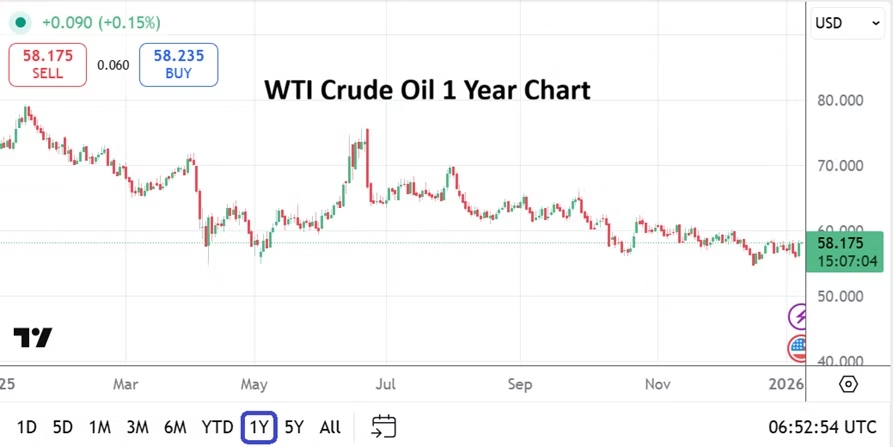
WTI Crude Oil One Year Chart as of 9th January 2026

Venezuela has the largest demonstrated oil reserves in the world, but the U.S has done rather well without it for years. The Trump administration’s move to take over Venezuela deters China and Russia’s influence in the Americas, while also putting another nail in the coffin of the Cuban regime. The word regime is used implicitly to point out that Venezuela, Russia, China and Cuba are all regimes of one sort via their one party ruling systems. Yes, you can argue the United State has returned to an imperialist philosophy, but that doesn’t mean it has dictatorial rule. Some will argue that point, I understand. But let’s step away from the complexity of political biases – including my own – and insights and discuss oil for a moment.

The takeover of the Venezuelan oil infrastructure, which has not happened in full yet via the U.S military action, does not mean U.S oil companies will make trillions of dollars from the adventure immediately. In fact a glut of oil is one of the potential consequences if Venezuela were to return to an open market system with its energy supply. Yes, the price of oil would in theory likely get cheaper. While it can be argued that this will help the U.S consumers, however many U.S producers of the shale oil industry would be put in a difficult spot. Producing oil from shale deposits requires hydraulic fracturing – known as fracking – and is an expensive endeavor. Cheaper oil from Venezuela in other words could put small and medium producers in the U.S out of business if supply becomes too ample

Now let’s turn our attention to Iran and the attempted revolution that is fomenting a reaction from the regime of that nation. Oil supply is certainly at stake for the world, but there is the overwhelmingly important possibility of allowing 90 million plus people to live in a system without repression. As of last night internet and telephone lines have been shuttered by the dictatorial government. There is a legitimate fear that many people protesting for their rights to be free now face the risk of violence and some have already begun to pay with their lives. Freedom is more important than oil for the people of Iran and Venezuela. It should also be pointed out that Venezuela and Iran are members of OPEC and this is likely not going to change.

The Trump administration is threatening military action against the Iranian rulers, but it is questionable how the regime of Iran could be overthrown by outside forces if there are not active combat boots the ground. While it may be possible to attempt a Venezuela like mission in Iran, that would be difficult at best considering the regime is already paranoid and on high alert. The civilians of Iran will have to do a lot of the work by themselves. Which means the populace of Iran will need to be able to organize and collectively topple a dictatorship, and this is unlikely to be done by handing out flowers. The regular army of Iran must disobey orders and the police must decide not to participate in violence against the protesters, allowing a seizure of power by the people.

At this juncture it remains difficult to say what will happen in Iran, except to say that there is likely going to be blood spilled. The Berlin Wall fell after decades of Cold War between the West and East. The wall of the Islamic Republic of Iran which was declared in the first week of April 1979 has nearly been running its dictatorship as long as the communists controlled Eastern Europe.

If and it is a big if, the Iranian people are able to topple the Islamic Republic of Iran it would be a game changer the world over. The complexity of the mafia style state that the current dictatorship has controlled not only in the Middle East, but throughout South America and elsewhere via influence with its proxies like Hezbollah is enormous. The dismantling of this network would take longer than the toppling of the Iranian regime. The world is unlikely to ever know in full detail the criminal activity of the current Iranian government and its proxies worldwide.

This is not about oil, it is about freedom. However, if the oil of Iran suddenly came under the control of a Western looking Iran that was unshackled, yes it would add to a vast amount of energy that the world already enjoys, but OPEC would find a way to manage the supply.

If Iran were to join the ranks of free nations and castoff its current leadership the world would benefit greatly. Only nations and proxies that gain from the exploitation of the Iranian dictatorship would worry. If the Iranian dictatorship falls there will not be paradise, but the event would be significant and transform the current state of global affairs.


Copy and paste the text from AMT that you want to share

postN75

U.S National Security, Part 3: Don’t Underemphasize Freedom

U.S National Security, Part 3: Don't Underemphasize Freedom

Opinion: The following article is commentary and its views are solely those of the author. This article was first published the 30th of December via The Angry Demagogue.


Conclusion

The post-Cold War world that the Strategy Paper tries to figure out is much more than the collapse of the Soviet Union and the rise of China. One of the main goals of the Trump administration is to turn the clock back on “globalization”, be it via tariffs, other economic ways or even, military means.

While the world is panicking over AI’s destruction of good white collar jobs, it has, paradoxically, created a world where the auto industry can’t find enough qualified mechanics at nice six figure salaries. Not even ten years ago the journalists were haranguing out of work blue collar workers with “go learn to code”, the beer guzzling crew can now tell the tearful journalists and Hollywood “writers” who can’t write better than AI to “go learn how to weld” (or at least handle a screwdriver). But the strategic issues we are facing go beyond manufacturing jobs.

The challenge to the United States and to other free countries is how to handle a new reality where massive debt threatens the diminution, if not the destruction, of the life style we have all come to take for granted and where revanchist regimes don’t quite understand that their power and “prestige” is a result of what has been built in those free countries they want to replace. China, like Russia, Iran, Turkey, Qatar and the non-state actors like Hamas, Hezbollah, the Moslem Brotherhood and others don’t quite understand that while they can use, and even sometimes improve on what freedom has provided them, they will stagnate once they attain their goal of defeating and destroying the free world.

As advanced as China becomes and even if it flies to the moon, overtakes the United States in AI and quantum computing and manages to make the United States into only the breadbasket of the world, they will stagnate as only free markets and free people can move the world to the next step. Growth can only be accomplished by free people. True enough, the economy often grows in ways that we don’t always like, the alternative is stagnation and a return to the pre-scientific age. For all the talk of “new man” and “progress” and everything else that the Soviet Union strived to create, they produced no medicines, no medical devices and no medical treatments.

Therefore, the defeat of the revanchist world and the preservation of freedom needs to be the paramount goal of American foreign policy. This does not mean the creation of democracies where none have ever existed and it does not mean sending troops in every time a political prisoner is arrested or even a plan to militarily defeat the CCP, but it does mean always supporting free countries against the unfree even when the United States is also “friends” with the unfree one.

This means that it will also give free countries leeway when their interests do not align perfectly with America’s (non-core) interests. America as sole protector of the free world has leverage that America as midwife to a set of regional alliances does not. This is a choice that America can make and a correct reading of the Strategy Paper tells us that the United States no longer wants to or can be the main power in every region in the world. This means that there needs to be a change in attitude in America so that it cannot force its will on its allies just because there is another contract to be had or another “cause” that has caught the eye of the country’s establishment.

Encouraging regional alliances of free countries such as the new Eastern-Med Alliance that has already been established between Greece, Cyprus and Israel is a prime example. In addition to the economic cooperation there has been joint defense training and there are agreements that will lead to a defense cooperation pact if not a NATO-like security treaty. Turkey is the common competitor, or enemy, of these three countries. Turkey claims certain Greek islands, occupies parts of Cyprus and has designs on Israel as it strives to be the Islamic “liberator” of Jerusalem. There are gas exploration agreements and cooperation and there would have been a pipeline to Europe if the Biden administration had not stopped it (while they approved the Russian-German pipeline).

Italy ought to be a natural member of the East-Med Alliance and maybe the dissolution of NATO will make them realize that they have more in common with Israel and Greece than they think they do. If Italy were to join then that would create a powerful naval and air deterrence of free countries against aggressors in the eastern Mediterranean. The addition of Malta, a small but strategically important country south of Sicily would provide naval bases that could control the sea lanes between north Africa and Europe helping to stem illegal migration and Turkish attempts to control those same lanes. Malta also brings with it a history of defeating Suleiman the Magnificent in a four month siege when the Ottomans tried to conquer this important island. As we stated before, the United States as a “midwife” to alliances cannot instruct countries on their own national interests. That means that allies of the United States will clash but America must always come down on the side of the free countries and not the revanchist power – in this case, Turkey.

There are of course other regional alliances that can come into being and a remake of the post-WWII world is in order. The end of the cold war created economic booms across the globe raising hundreds of millions of people out of poverty, but recent decades have seen an increase in terror and tyranny and that itself needs to be dealt with. If not by the United States alone then by the US along with the regional alliances that the Strategy Paper has highlighted and we have demarcated (partially) here. But concepts like “territorial integrity” (see Syria, Somalia and the rest of Africa) and “sovereignty” have lost their moral imperative as they are used as excuses by tyrants (and their enablers at the UN) to further their cruelty. One of the faults of the old “liberal international order” has been allowing tyrannies the same rights and respect as free countries. During the Cold War, when nuclear war loomed, this might have made sense but after the fall of the Soviet Union these “principles” have created more harm than good.

In the National Security Strategy of the administration, the words “free” and “freedom” appear twenty times, but never in the context of an alliance of free countries. While it speaks of freedom of religion and speech and free markets it never speaks of the need to put allies that are free ahead of friends that are not free. Allies are those countries that share values and will come to your aid because of that. Friends, in international affairs, are those that look to short-term gain and have no desire to further your values or interests. There is no reason that the United States, in its current fiscal condition needs to fight the fight of freedom around the world alone, but neither can it abandon that fight in the pursuit of short-term contracts or frivolous causes.

Disclaimer: the views expressed in this opinion article are solely those of the author, and not necessarily the opinions reflected by angrymetatraders.com or its associated parties.

You can follow Ira Slomowitz via The Angry Demagogue on Substack https://iraslomowitz.substack.com/ 

postN72

U.S National Security: USD Reserve Currency Importance

U.S National Security: USD Reserve Currency Importance

Opinion: The following article is commentary and its views are solely those of the author. This article was first published the 23rd of December via The Angry Demagogue.

We would like to start going through the U.S administration’s National Security Strategy released last month. There is a lot in there – much of it the same as in past administrations and much of it different. The tone of course is full Trump and while the introductory parts try to make it into a revolutionary document it does in fact build upon much of what has been American foreign policy for decades. One thing it most certainly gets right is that American foreign policy since the end of the Cold War has not found its compass. From a unitary world to one dependent upon global organizations, from a sharing of goals with western Europe to a pivot to Asia, from the war on terror and the middle east to Russia-Ukraine, the United States has struggled to find its way in the post-Cold War world.

We however will concentrate today on one aspect of the strategy, the third bullet in part III – “What Are America’s Available Means to Get What We Want?”. The third bullet point speaks of America having “The world’s leading financial system and capital markets, including the Dollar’s global reserve currency status” – a point that no one with any knowledge of global capital markets can not accept. The end of the bullet point – the Dollar’s global reserve currency status – is the most important because it underscores America’s leadership and essentially allows the United States of America to finance its military and its welfare state. The U.S Dollar as the “reserve currency” means that nearly all the world’s goods are quoted and therefore sold in Dollars.

Why is that important to the United States? Because the U.S government depends on its ability to issue Treasury bonds and bills at will – something no other government can do. It can do this because for another country to buy oil or copper or titanium or corn or soybeans from a country that is not their own– they need access to Dollars. Saudi Arabia and the other gulf states quote the price of oil in U.S Dollars and demand payment in U.S Dollars. The Saudis can deposit those Dollars in American banks or in what is called Eurodollar deposits in foreign banks (there are some 13 trillion Dollars in Eurodollar accounts globally). The Eurodollar accounts are essentially promises by the bank to give U.S Dollars to the holder when he makes a withdrawal. This strengthens the U.S capital markets and allows investors to have better and more investment choices. It is not only America’s often superior companies that bring profits to 401k’s and pension funds but the liquidity and vastness of America’s capital markets that can list domestic and foreign corporations. The reserve currency leading to the advanced capital markets allows the world – and America – to do this.

The U.S Treasury market is so liquid because every country needs Dollars in order to trade. They need to have enough dollar reserves since no one actually wants their own currency. In Israel, for example, local gas companies cannot buy oil with Israeli Shekels, since what will Azerbaijan, for example, do with them? There are only so many products that Israel can sell them. They need Dollars so that they are free to buy other commodities or other products.

The U.S Dollar as a reserve currency also is a break on inflation since the price of oil and other commodities is always in U.S Dollars. A weak or strong U.S Dollar influences the inflation rate in non-USD countries. A weak Israeli Shekel, South African Rand or Chinese Yuan does not influence the price of gasoline in the United States.

In short – as the Trump Administration understands well, the dollar as a reserve currency is a luxury the U.S cannot give up. The lack of the USD as a reserve currency could cause the Dollar to collapse and along with it the price of U.S Treasuries. As UST prices drop, their yields will rise and the cost of financing the U.S government will make interest payments on debt to rise well beyond its already absurd figure of over 4% of GDP – while debt itself is 120% of GDP. The U.S government currently pays over $1 trillion in debt service (interest payments on its bonds and bills). By contrast, the U.S defense budget for 2024 was $836 billion (about 3.3% of GDP).

We need to ask ourselves what can challenge the USD as the reserve currency and what could happen that would encourage the world to change? While the E.U had dreams of making the Euro an alternative reserve currency, the lack of growth in the E.U’s economy and population have put that dream to rest. The only other country that could theoretically replace the United States as the global economic go to country could be China. While in the long run, China’s lack of openness would probably mean that the Yuan would not last long as the reserve currency, that does not mean that they couldn’t jolt the global economy just enough to force it to use the Yuan to buy oil and other commodities.

China is already cornering the market on rare earth minerals and it making inroads in Africa where it mines all sorts of commodities from gold to copper to platinum and so many others (Africa has about 30% of global mineral reserves). That in itself is not enough to rock the global markets and cause a change in how the world does business.

Oil though, is that one thing that could allow China to challenge the USD as the reserve currency, even if it just presents the Yuan as an alternative.

How could that happen?

A Chinese takeover of Taiwan, by whatever means it uses would give the Chinese Communist Party control not only of the South China Sea but also allow its noisier and inferior (to America’s) submarine fleet to enter the Pacific and patrol it freely. The Chinese Navy, with a base on the “other” side of Taiwan would give it control of the north-south sea lanes that Japan and South Korea are dependent upon. Essentially, Chinese control of Taiwan would put Japan, South Korea, Vietnam and the Philippines at the mercy of the Chinese Navy. China could blockade these countries but that would be an act of war and then involve the navies of those countries and possibly the United States. It would affect the global economy negatively but it would not cause a change in world’s reserve currency. But, what if China works out a deal with Saudi Arabia to quote and sell their oil in Yuan (or the Chinese Petro-Yuan it wants to create) and then tells these countries, especially industrial powerhouses and energy poor Japan and South Korea that it will allow the passage of oil as long as they purchase the oil in Yuan?

Russia is already trying to get India to pay it for its oil in Yuan, to some success. Adding economies the size of Japan and South Korea would mean that any country that wants to buy oil could buy it in Yuan instead of Dollars. Once in Yuan, these countries would need to use the Yuan to buy Chinese products, deposit cash there and buy Chinese treasury bills. If China were to combine that with demands that all chips made in Taiwan also be sold in Yuan, the U.S Dollar would suddenly and forcefully no longer be the only reserve currency in the world.

Obviously, the way to stop this from happening is by stating outright that the United States will not tolerate a Chinese takeover of Taiwan. It is true, that the Strategy claims that the US “will also maintain our longstanding declaratory policy on Taiwan, meaning that the United States does not support any unilateral change to the status quo in the Taiwan Strait” but in practice the administration has criticized Japan’s tough talk on China instead of leaving it be. A strong silence on Prime Minister Takaichi’s remarks on China would have served the purpose of keeping the status quo more than telling her to tone down her rhetoric. There is a strong “no intervention ever” strain in the country and the President must make the case that that is not an option if the United States wants to maintain its leadership position, way of life and general prosperity.

In short, the threat to the Dollar as the reserve currency heads right through Taiwan. For those who think that the investment the U.S makes in keeping the Dollar where it is, is too expensive, just think of going on vacation and having the change to Yuan before you leave the country, wondering how much to change because of currency fluctuation and how much fun it is to return with hundreds of dollars in banknotes that you can’t use. Imagine your credit card bill on such travels and wondering how you went 15% over budget but didn’t get anything extra for it. Now imagine the national economy working that way.

Disclaimer: the views expressed in this opinion article are solely those of the author, and not necessarily the opinions reflected by angrymetatraders.com or its associated parties.

You can follow Ira Slomowitz via The Angry Demagogue on Substack https://iraslomowitz.substack.com/ 

postN71

India Insider: The 8.2% Growth Mirage Needs a Reality Check

India Insider: The 8.2% Growth Mirage Needs a Reality Check

India is celebrating the 8.2% real GDP growth result for Q2 FY26, as if it has entered a new economic orbit. Politicians are claiming victory and media is packaging optimism. The narrative is simple: India cannot be stopped. But once we move beyond the headline, the number loses credibility. It rests on a broken deflator, a statistical gap that no one can trace, and data architecture that doesn’t consider half the economy. This is not a story of unstoppable growth. This is a story of statistical convenience.

The Production–Expenditure Divide

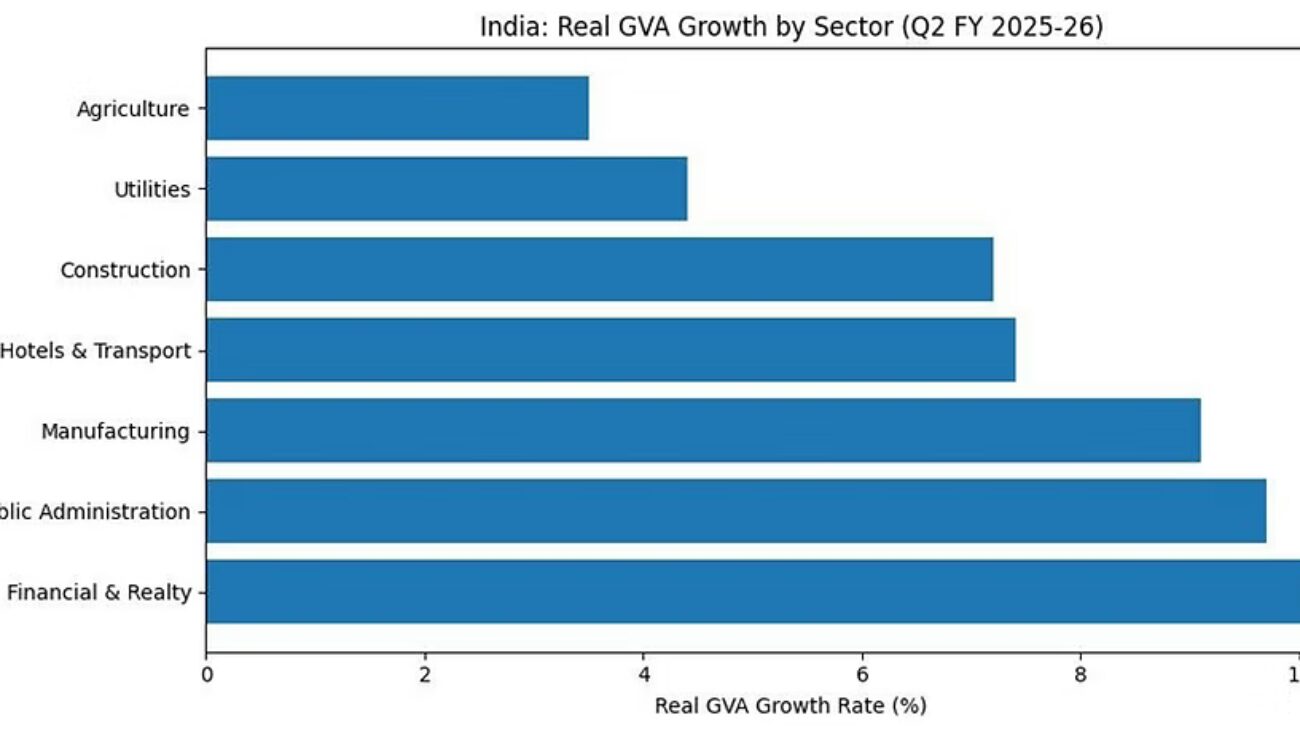
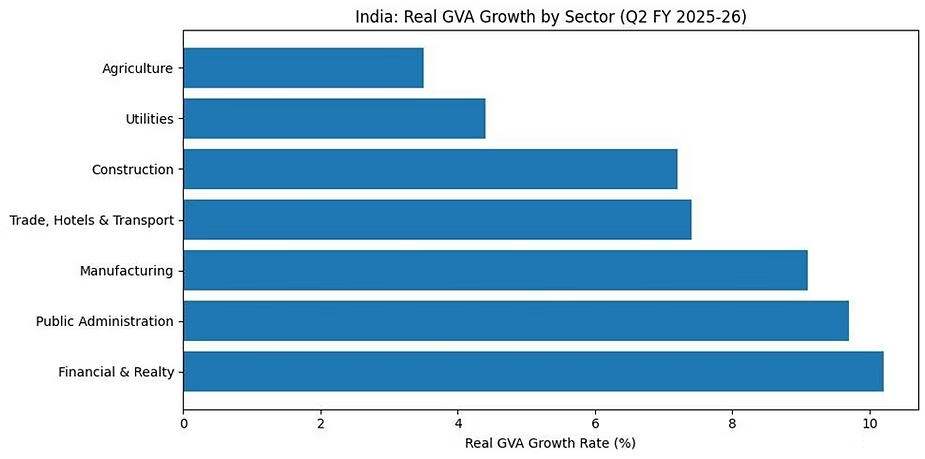
On the production side, the numbers look heroic. Manufacturing allegedly grew 9.1%, and financial and professional services posted more than 10% growth. Corporate India looks like it is flying. But when the same activity is measured from the expenditure side – who actually spends this income – the story weakens.

Private consumption at 7.9% is respectable, not outstanding. The real shock is government consumption, which contracted by 2.7%. A shrinking government should normally mute growth, not accelerate it. Yet the GDP shoots up. How does that make sense? It doesn’t unless the number is being propped up somewhere else – and this is the case.

₹1.63 Lakh Crore of ‘Unknown Growth’

GDP includes a category called ‘discrepancy’. It exists because the two methods – production and expenditure – never perfectly align. The discrepancy stands at ₹1.63 lakh crore ($18.2 Billion USD) which equates into roughly 3.3% of real GDP. That means a chunk of this 8.2% growth has no identifiable spender: No households. No firms. No government.

It is income without absorption. A statistical plug. When a number this large is called ‘discrepancy’, the headline becomes unreliable – suspicious. You cannot claim world beating growth when your own data admits it cannot explain where that growth came from.

Chart via the National Statistical Office

The Deflator Illusion

The next distortion is the nominal vs real GDP gap. Nominal GDP is growing at 8.7% and real GDP at 8.2%. A gap of 0.5 percentage points implies inflation has almost vanished. Every Indian knows this is not true. Costs did not collapse. Food inflation has not disappeared.

The explanation is mechanical: India still uses the Wholesale Price Index (WPI) to deflate nominal output. Global commodity prices fell, WPI softened sharply, and that flattening pushed up the real number. In other words, GDP grew because the denominator fell, not because production surged.

This creates a fiscal problem. The Union Budget assumed 10.1% nominal growth. At 8.7%, tax buoyancy will weaken, deficit targets become more difficult, and next year’s fiscal capability shrinks. Real GDP does not pay the bills, Nominal GDP does.

The Informal Blind Spot

India still cannot measure its informal economy accurately. Nearly half of GDP and employment sits outside the formal system, yet the NSO uses formal sector proxies such as corporate balance sheets, GST data, and financial flows to estimate the rest of the economy. If a small business collapses and a corporate giant expands, the data shows a net gain, erasing distress at the bottom which means real economic circumstances are not portrayed accurately for Indian citizens.

Agriculture grew at 3.5%, but it still supports 46% of India’s workforce. That means growth is concentrated in capital intensive and balance-sheet heavy sectors, not into areas that put cash into rural hands. A booming Nifty Index via the stock market does not translate into household prosperity.

An Economy Measured with Old Tools

India continues to measure GDP using a 2011–12 base year, an era before UPI (Unified Payments Interface), before fintech credit, before e-commerce, before gig workforces, before the pandemic rewired supply chains and consumption patterns. India is living in a digital economy, but measuring activity with analog instruments.

A shift to a 2022–23 base year, plus replacing WPI with a Producer Price Index, may finally align the numbers realistically. But until then, headlines are running ahead of bona-fide measurements.

India’s 8.2% print is impressive, but growth estimates that don’t reflect grounded realities produce illusionary optics rather than useful insights. For India to strengthen fiscal and economic credibility, measurements must capture households, labor markets, and productivity, not solely corporate outputs. Policy cannot be shaped by statistical ambiguity, it requires transparency and trusted data.

post315

India Insider: Why a Deep Corporate Bond Market is Needed

India Insider: Why a Deep Corporate Bond Market is Needed

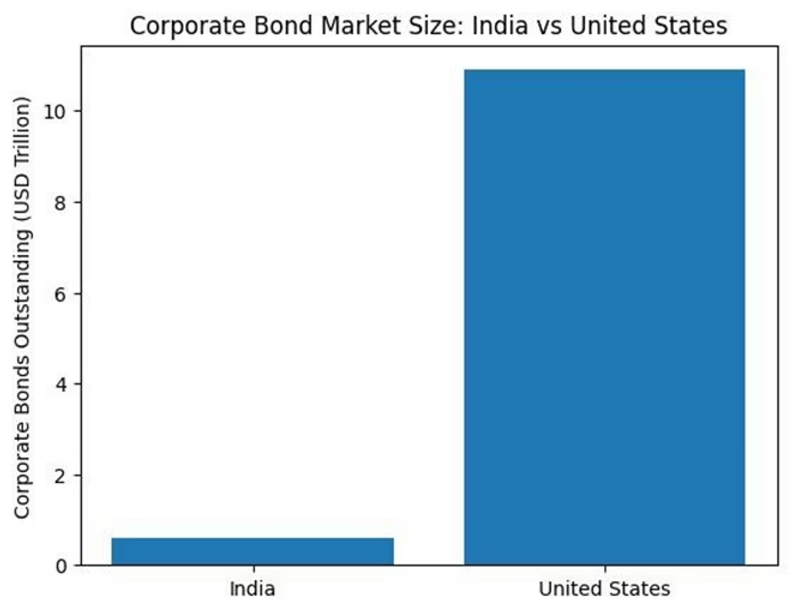
India’s corporate bond market remains small relative to the size and ambitions of its economy. This is often described as a regulatory shortcoming. In reality, it reflects a deeper structural choice: India’s financial system was built to channel savings through banks, not markets. That choice now imposes visible constraints on capital formation, governance, and risk pricing.

During the Covid-19 pandemic, several Indian companies including firms such as Arvind Fashions were forced to raise capital by diluting their equity in public markets. Equity issuance is not inherently wrong, especially during a crisis. However, businesses built on consumer brands, distribution networks, and long gestation cycles require patient, long term capital. Financing such models primarily through short term bank loans or repeated equity dilution creates a mismatch between the nature of the business and the nature of the capital supporting it.

India Corporate Bond Comparison to the U.S 2024-25 Approximated Totals

In countries like the U.S, this gap is filled by intermediate forms of capital. Private equity firms often provide long duration funding through instruments such as mezzanine debt, while deep corporate bond markets allow companies to raise long term money aligned with their operating horizons. In India, the absence of such markets make corporate choose to either raise capital via short term debt that strains cash flows or equity dilution at unfavorable points in the cycle.

A corporate bond market also serves a broader purpose: governance and accountability. A Parliamentary Standing Committee report in 2022 noted that nearly ₹10 lakh crore ($110 Billion USD) of corporate bank loans were written off over the preceding five years. While write-offs do not automatically imply wrongdoing, they highlight a system in which credit losses are repeatedly absorbed by public sector balance sheets where the capital is often infused by taxpayers money. In bank dominated systems, credit assessment is periodic and opaque. Market discipline remains weak.

Traded securities impose a different standard. Michael Milken once observed that bond markets re-evaluate credit daily, not every six months. Prices respond immediately to new information. If sellers suddenly outnumber buyers, the market forces a reassessment of risk in real time. In effect, every trading day becomes a fresh credit decision.

This discipline is missing when loans remain locked within banks. A vibrant corporate bond market which is supported by securitization, secondary-market liquidity, and institutional investors would allow credit risk to be priced, transferred, and monitored continuously. It would expose stress early, rather than after losses have already been socialized.

Today, banks account for nearly 70 percent of financial intermediation in India. Fintech has begun to challenge this dominance, but largely in consumer and personal finance. For corporate and MSME (Micro, Small and Medium Enterprises) financing, long-term capital cannot come from apps or short duration loans, it must come from markets designed to price risk over time.

India’s corporate bond market will not look like America’s, nor does it need to. But without deeper liquidity, institutional participation, and price discovery, India will continue to build long term businesses on short-term money ,and bear the consequences when cycles turn.

(Notes: 1 USD = 90.58)

postre2

Fed Today, Tmrw and Mid-Term with Changing of Guard

Fed Today, Tmrw and Mid-Term with Changing of Guard

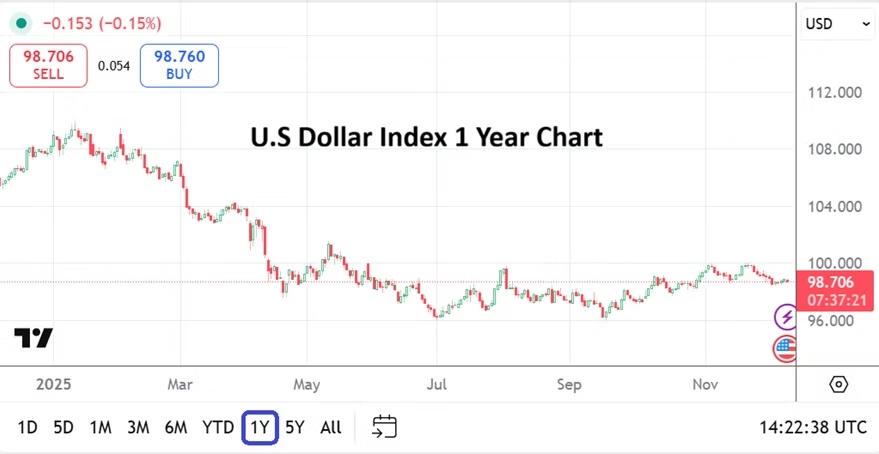
The Federal Reserve will cut its Federal Funds Rate by 25 basis points in a handful of hours, that is unless they want to cause a major selling attack on Wall Street and pandemonium in Forex and gold. The Fed which spoke about uncertainty in last month’s FOMC Statement and utterly refused to give guidance about today’s decision, has had the ignition regarding an interest rate cut delivered with nearly 100% certainty because inflation for the moment remains tame.

U.S Dollar Index One Year Chart as of 12th December 2025

Fed Chairman Jerome Powell will leave the Fed in May of 2026. This isn’t a subjective opinion, he is leaving because he is not going to be reappointed by the White House. President Trump has made it clear he wants a lower interest rate and that he believes the Fed has failed to be proactive. Given Trump’s propensity for saying outlandish things, he is not wrong about Powell’s overtly cautious posture. The Fed could have cut the Federal Funds Rate in the early summer and refused to initiate.

Financial institutions have factored the 25 basis point interest rate cut into Forex already. Again, unless if for some reason they want to initiate a massive selloff in the equity indices and cause the 10 Year Treasuries yields to rise like a wildfire, the Fed needs to cut today. Day traders need to understand the first couple of reactions following the FOMC Statement tonight should not be wagered upon without deep pockets and steel stomachs.

There are three more FOMC meetings scheduled for the Fed after today’s decision while Fed Chairman Jerome Powell remains in office. The 28th of January, the 18th of March and 29th of April are the listed FOMC Statement announcement dates, this before the June meeting which Jerome Powell will not helm. While some analysts strongly believe the Fed will find it difficult to cut interest rates early in 2026, the potential for a shift in sentiment and open disagreement regarding the Federal Funds Rate could turn intriguing in late January. If inflation remains steady via the Core PCE Price Index it would not be a shock to see another interest rate cut next month.

Caution has prevailed in Forex the past couple of months. Major currencies like the EUR and GBP have lingered within known ranges. Yes, the JPY has incrementally lost value due to BoJ policy. President Trump cannot make the Fed decide what to do, but he can certainly keep appointing folks who agree with his policies and approach to enterprise. If Powell does not outright say an interest rate cut is impossible for next month’s FOMC decision, U.S economic data that will be generated over the next handful of weeks could deliver enough impetus. Let’s keep in mind ladies and gentlemen that holiday trading will come into full force after next week’s price action.

The Fed’s borrowing rate essentially stands at 4.00% for the moment. After today’s rate decision the Fed Fund Rate should be at 3.75%. And for the moment there is little justification to not make the borrowing rate 3.50% in late January. As economic data presents itself now via the PCE Price index and CPI and PPI statistics, there is reason to believe a more proactive Fed is on the horizon as the pressure is turned up on Jerome Powell.

Perhaps nothing will happen in January, but if inflation remains tame not only will Jerome Powell be criticized by the White House, but he may also face a rather public debate from Fed members who do not agree with his cautious approach to interest rate policy. A weaker USD in Forex against many major currencies mid-term appears to be a real possibility. The ability of the EUR/USD to linger within a cautious middling range may be an indicator that financial institutions have built a mechanism which will allow them to become stronger buyers. Dangerous as it is to predict a timetable, the EUR/USD over 1.17000 would not be a surprise in the weeks to come – at least to me. Let’s see where behavioral sentiment takes us.

postre1

India Insider: Why Russian Oil Should Be Treated Skeptically

India Insider: Why Russian Oil Should Be Treated Skeptically

As Russian President Vladimir Putin arrives in New Delhi for a bilateral summit, the mood in India’s capital is one of profound strategic tension. The core of the problem is India’s massive appetite for discounted Russian Crude Oil, which has shielded the economy from high energy prices but is now causing significant financial and geopolitical risks. This move comes at a time when India’s most important trade surpluses lies with the West, raising anxieties about U.S sanctions and shrinking strategic space.

Trapped Rupee Problem

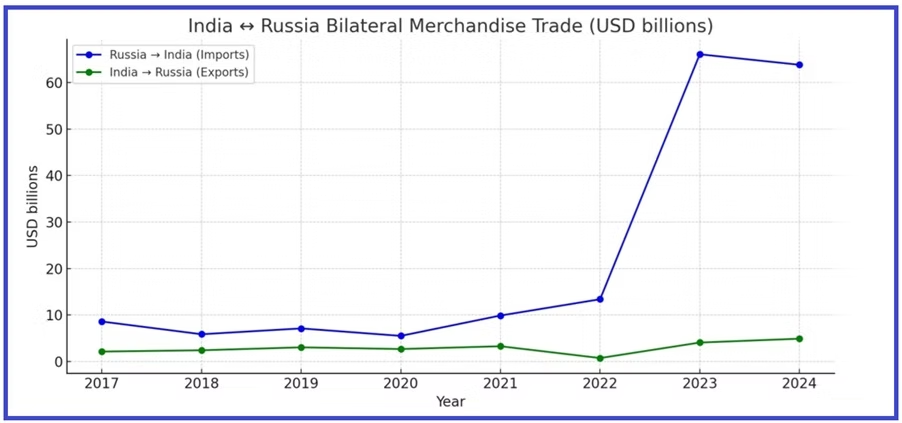
Since the Ukraine war, Russia’s share of India’s Crude Oil imports has surged from under 2% to nearly 40%. This has simultaneously inflated India’s trade deficit with Russia to nearly $59 billion.

The transactions are largely settled in Indian Rupees (INR). Moscow has accumulated billions of Rupees in Indian banks. However, because the Rupee is not fully convertible on the global market, Russia has very limited ways to use this huge surplus within India. These billions of Rupees are essentially ‘trapped liquidity’ – a problem neither country can easily solve.

India – Russia Bilateral Merchandise Trade Chart from 2017 – 2024

The Kremlin, meanwhile, is shifting its financial allegiance. It is preparing to issue Yuan denominated sovereign bonds, a decisive step that deepens its reliance on Beijing’s financial system amid a cut off from the Western financial system. This financial trajectory clearly signals the next logical step: Russia will inevitably demand that India begin paying for its oil shipments in Chinese Yuan (CNY).

Structural Risk of Holding Chinese Yuan

India has never been comfortable holding Chinese Yuan or settling trades in the currency. That’s partly strategic as New Delhi wants to protect its geopolitical autonomy and position itself as the democratic anchor of the Global South while staying closely aligned with the West.

But Russia’s financial plumbing is now increasingly routed through China. As the Kremlin becomes more deeply integrated into China’s banking and payments system, its dependence on the Yuan becomes structural. Moscow needs Yuan not only to service Chinese creditors, but also to pay for its expanding list of manufactured imports from China. The Ruble, being a largely non-convertible currency, simply cannot support this scale of trade.

For now, Russia-China trade is balanced enough because Beijing still buys large quantities of Russian energy. But this equilibrium can shift quickly. As the Ukraine war drags on and Moscow’s defense spending rises, the Kremlin will be forced to rely even more heavily on Chinese financing, Chinese goods, and ultimately the Yuan itself, tightening its economic dependency on Beijing.

When that moment arrives, the Reserve Bank of India (RBI) will be forced to accumulate Yuan as part of its Forex reserves to ensure the continued flow of oil. This decision, born of necessity, introduces a structural vulnerability into India’s financial system as the adoption of Yuan as a reserve currency subject to China’s capital controls.

Risks of Holding the Yuan

China may have both the onshore (CNY) and offshore (CNH) Yuan, but the currency is ultimately controlled by the PBOC, which makes it a risky reserve asset for India. In a crisis, Beijing’s capital controls could restrict liquidity and prevent the RBI from freely converting yuan into hard currency like the USD, effectively trapping India’s capital.

Beyond this financial rigidity, large Yuan holdings also expose India to CCP driven political risk, tying its external stability to China’s domestic decisions. And unlike the Dollar which can be deployed anywhere, Yuan reserves are usable mainly for transactions with China or countries in its financial orbit, sharply limiting India’s strategic and financial flexibility.

Strategic Win for Beijing

For Beijing, this shift delivers a double strategic win, cementing the Yuan as the dominant settlement currency across Eurasia especially among countries squeezed by Western sanctions and it allows the yuan to slip into India’s financial system indirectly, not through Chinese pressure but through Russia’s growing dependence on Chinese finance and India’s reliance on discounted Russian oil.

For Moscow, this is a reluctant compromise: giving up some monetary autonomy in exchange for necessary financial support from China.

For India, however, it introduces a new long term structural risk with a slow but steady Yuan encroachment into its trade and reserve system, operating alongside the dominant U.S Dollar. The oil corridor that was meant to offer an independent strategic opportunity for India is now becoming a channel which Beijing can strengthen its monetary footprint. In this complex triangle, India risks paying a dangerous tactical long-term price for its energy security.

post310

Digesting Holiday and Markets to Come as Fed Looms Next Week

Digesting Holiday and Markets to Come as Fed Looms Next Week

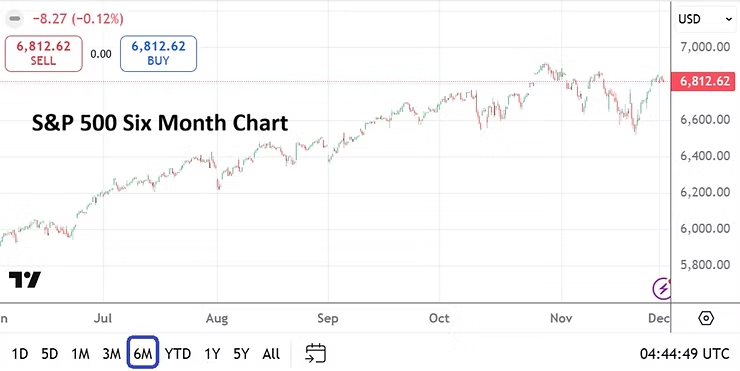
Day traders trying to gauge markets may be feeling a bit of angst for the moment. Always wanting to participate when record highs are being made in the stock markets, the S&P 500 and Nasdaq 100 remain under their respective apexes from late October and early November. Though the markets have produced gains recently, they have not come particularly easily for those who like to ride momentum waves. As always timeframes matter, it is often easier to make mistakes and be impatient when short-term wagers factor into decision making.

S&P 500 Index Six Month Chart as of 2nd December 2025

Gold has done well the past couple of weeks, regaining its upwards traction, but also remains under its apex values. The Federal Reserve will release its FOMC interest rate decision on the 10th of December, and this is what many in the markets may be waiting for in order to make their last big bets for the year per speculative plays.

The Forex market like equities and commodities continue to provide choppy behavior. The ISM Manufacturing numbers from the U.S came in below expectations yesterday. Retail Sales data and Consumer Confidence numbers last week from the States came in below expectations too. There will be jobs statistics via the ADP report on Wednesday and an ISM Services figure. Thursday will see U.S weekly Unemployment Claims. Friday will provide a rather interesting clue for Forex traders and likely influence bond yields when the Core PCE Price Index reading is provided – which the Federal Reserve pays quite a bit of attention regarding their interest rate decisions. The Consumer Sentiment Preliminary University of Michigan data will also be seen on Friday.

As Tuesday starts, day traders should also beware that full market volumes will emerge, this after last week’s Thanksgiving holiday in the States and perhaps a slow return to offices yesterday. The markets will provide plenty of action over the next couple of weeks, before the inevitable Christmas and New Year’s trading doldrums begin.

307

India Insider: The Need for Quality Jobs and Improved Safety

India Insider: The Need for Quality Jobs and Improved Safety

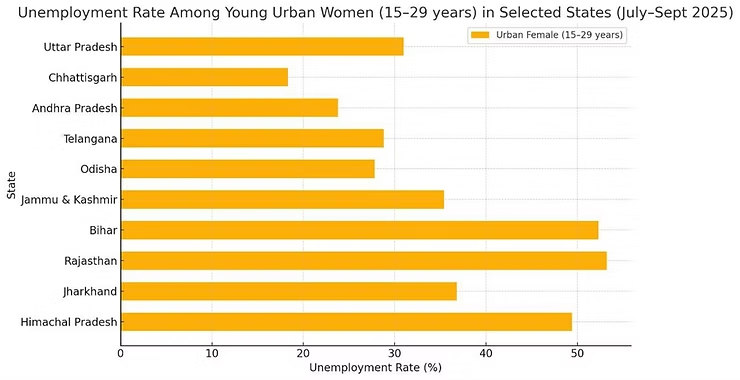
Recent data released from the Ministry of Labor Statistics depicts a worrying aspect of India’s labor market. Every second urban young woman in Bihar and Rajasthan is unemployed. Nationally, one in four young women remains without work. This reflects deep structural issues in India’s workforce and the job market’s inability to provide high-quality employment.

Industries in urban India are not generating enough decent jobs to absorb educated youth, especially women. Even when jobs exist, they are often of poor quality, lacking social safety standards and sometimes damaging workers’ health and well being.

Via the National Statistics Office of India Unemployment Data

A recent piece in The Diplomat, a magazine covering the Asia-Pacific region with current affairs, highlighted how workers trade off their health and welfare well-being for the opportunity of precarious living. If an economist like Robert Gordon, who wrote “The Rise and Fall of American Growth“, were to look at their lives, it would remind him of the 19th-century United States.

Migrant workers from Bihar and Uttar Pradesh toil in textile recycling plants under hazardous conditions for just ₹5,000 ($58.00) a month. Women form a significant share of this workforce, often assigned trivial tasks in unsafe factories. Many have developed asthma and tuberculosis after prolonged exposure to dust and poor ventilation.

The Rise of the Informal Sector

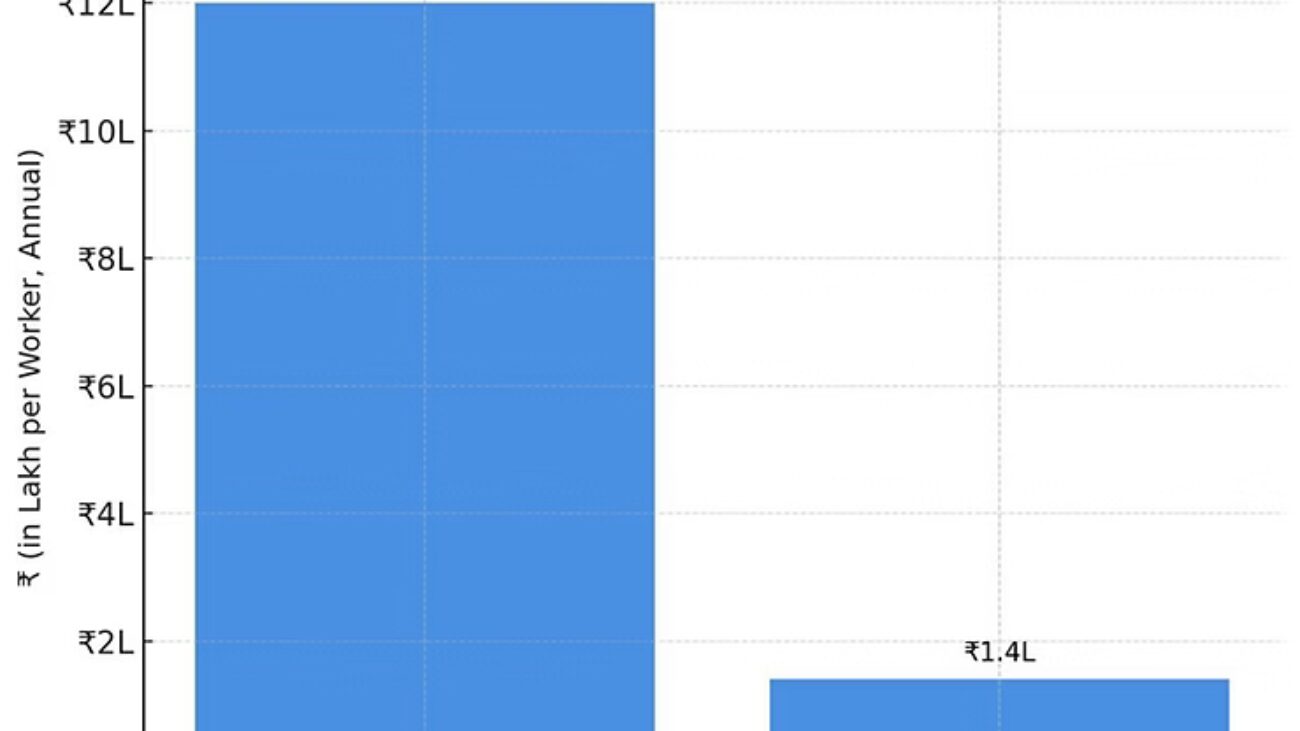
Formal workers generate an annual GVA (Gross Value Added) of ₹12 lakh, while informal workers produce just ₹1.4 lakh, according to the Annual Survey of Industries (ASI) and the Annual Survey of Unincorporated Sector Enterprises (ASUSE) 2022–23.

Neoclassical economics says wages reflect a worker’s productivity. But this logic collapses in economies like India’s, where a vast army like reserve of labor, keeps wages low – even when productivity rises.

Excess labor supply depresses pay across sectors, from private school teachers to gig workers. Many gig workers spend long hours to earn a modest income, without access to provident funds, health insurance, or paid leave. This precarity extends from India to the United States and Indonesia.

Statistics via Kuntala Karkun & Samriddhi Prakash, Pahle India Foundation

The Gap Between Law and Reality

India has strong labor codes, streamlined in 2020, yet they remain largely unenforced. Companies often ignore them due to cost pressures, effective lobbying, or weak state monitoring.

Economic growth without wage growth widens inequality and breeds social tension. For growth to be inclusive, wages must rise with GDP.

This demands more than redistribution. It requires the transformation of raising workers’ productivity, ensuring labor rights, and giving every worker their fair share of India’s prosperity.

Post306

India Insider: Reserve Bank of India Intervention is Limited

India Insider: Reserve Bank of India Intervention is Limited

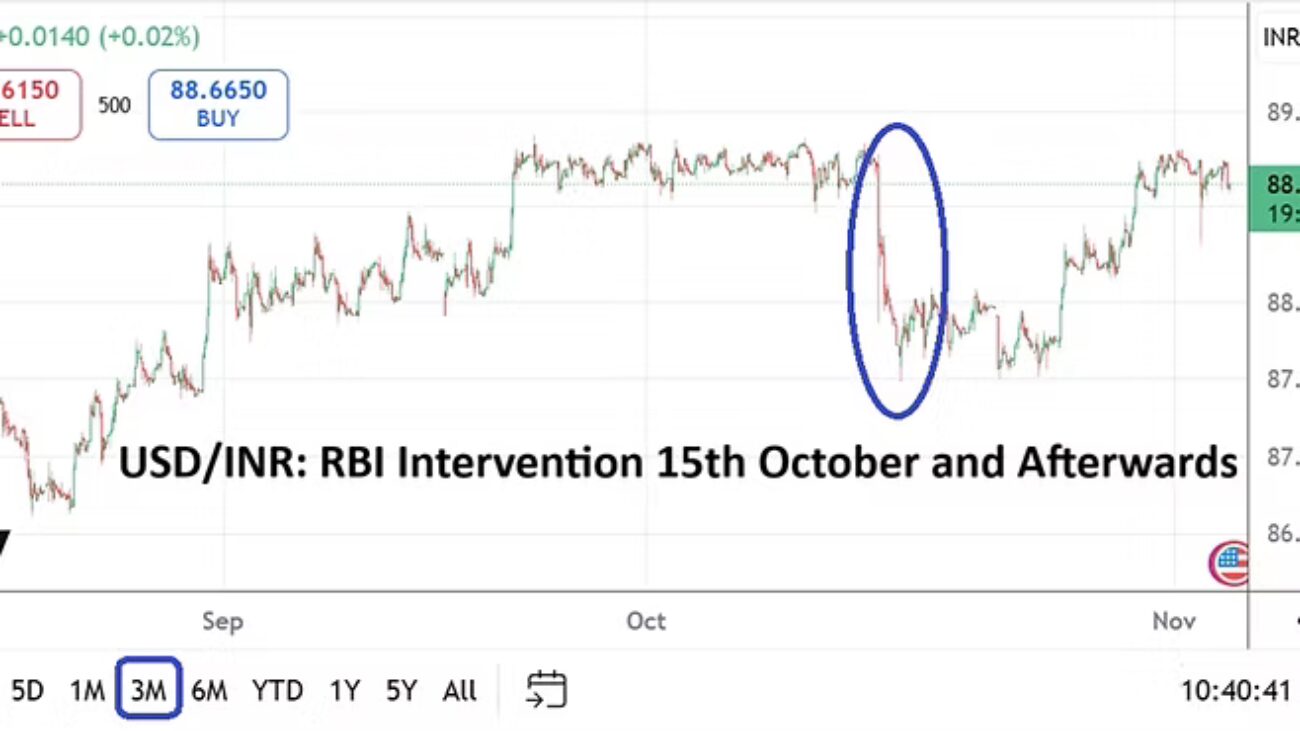
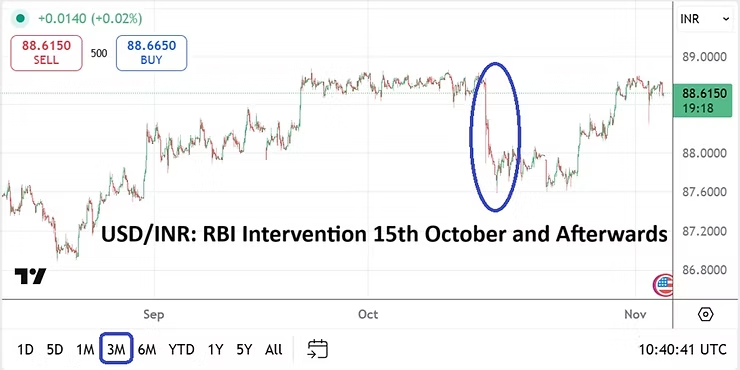
After weeks of steady appreciation due to Reserve Bank of India intervention on the 15th of October, the Indian Rupee has now returned to the same 88.72 levels against the USD before the policy action was enacted. The RBI’s recent offensive against speculators may have calmed the market temporarily, but it reflects a reactionary and short-term approach to deeper structural pressures facing India’s external administrative policies regarding the USD/INR.

USD/INR Three Month Chart as of 5th November 2025

Despite the Reserve Bank of India’s efforts to influence the cash forward market, where Dollar shorts rose by 6 billion USD in September to $59 billion, fundamentals suggest that Rupee weakness is not purely speculative. It is a rational market adjustment due to rising trade barriers amid U.S tariffs on India’s merchandise exports. The added uncertainty regarding trade caused the Rupee to naturally absorb external shocks. Merchandise exports to the U.S fell 12% in September year on year, according to official India data, prompting some calls for government relief.

India’s Foreign Remittances & H1-B Visa Fee Hike

According to World Bank data, India received about 137.7 billion USD in personal remittances from abroad in 2024. From that amount, around $40 billion is coming from the United States. The Trump administration raised the cost of H1-B visa fees from below 10,000 USD to nearly $100,000. And there is now also an increased likelihood of measures aimed at limiting digitally delivered software services to the U.S from India. These combined measures would substantially reduce Dollar receipts via exports of technology driven software and IT services, as well as remittances from a reduction of workers on temporary U.S visas providing on site services to U.S clients. USD inflow has been crucial for India’s balance of payment’s stability.

Reduction of USD reserves when the trade deficit is already rising because of hikes caused by tariffs on India’s exports would widen the current account deficit. Concerns about a decrease in remittances leading to a potentially significant decline of India’s USD reserve ability is possibly discouraging the India Reserve Bank to voluntarily expend reserves to support the Rupee.

Service Exports Cushion India’s Balance of Payments:

India’s total service exports touched 400 Billion USD over the past year with a predominant amount coming from the U.S. In other words, India has had a $202 billion in services trade surplus over the last 12 months, which covered almost 114% of India’s merchandise trade deficit in 2024-25.

India’s goods trade deficit is matched by a services surplus, plus net foreign personal remittances. This USD equation is under threat because of prolonged paralysis from stubborn US and India trade negotiations debating Russian Oil usage and the U.S demand to allow agricultural products into India.

Foreign Investors Selling Indian Equities

In addition, the Indian Rupee is not getting support from investment portfolio inflows. A shortfall of AI related avenues in the nation’s tech sector, and perhaps because of valuations considered too rich, foreign Investors have pulled 17 billion USD so far this year. This sum is more than any other emerging market, which is eating away at the Reserve Bank of India’s FX reserves too.

Global and India-specific uncertainties spurred by the Trump administration’s actions are setting off a retreat of footloose portfolio capital invested into India’s equity and bond markets. If the Reserve Bank of India was confident that inflows of foreign capital would replenish reserves it would likely help the Indian Rupee, and thus investor confidence coming from abroad.

Policy Irony and the Limits of Intervention

The U.S. remains India’s largest export market, but new levies of 50% tariffs are hurting labor-intensive sectors such as textiles, leather, footwear, and gems & jewelry.

While concerns about imported inflation are valid, the benefits of a weaker Rupee should not be overlooked. A mild depreciation could boost India’s service exports, improve the balance of payments, and partly offset the effects of U.S. tariffs on merchandise exports.

A material improvement in U.S and India trade relations is needed. Until a restoration is achieved in relations and a merchandise surplus is possible, alongside healthy services and remittance inflows occurring again, the Rupee’s weakness is likely to persist. In the meantime, Reserve Bank of India interventions could prove to be a short term tactic that proves vulnerable mid-term to the influence of market forces known and unexpected.

post305

India Insider: Affluence Among the Few, Aspirations for Many

India Insider: Affluence Among the Few, Aspirations for Many

A recent report by Franklin Templeton highlighted that India’s per capita income will penetrate the $5,000.00 USD level by 2031, pushing the country into what some analysts consider an affluence trigger zone. Their article celebrates the consumer boom showing the rising sales of premium detergents, growing green tea consumption, and a surge in discretionary spending, as if prosperity has finally crossed over into a mainstream phenomena.

But a closer look reveals something else and a worthwhile critique of Franklin Templeton’s optimistic portrayal.

Who Actually Spends this Money ?

The Franklin Templeton report confidently attributes the wealth effect to rising equities, real estate and gold. Yet, with only 13 crore (130 million) demat accounts in a country of 143 crore people, how can equities be driving broad affluence? Even within those attributed accounts, activity is heavily concentrated in the top decile of income earners like urban professionals in finance, IT and export linked sectors; and over 70% of mutual fund assets under management come from the top ten cities.

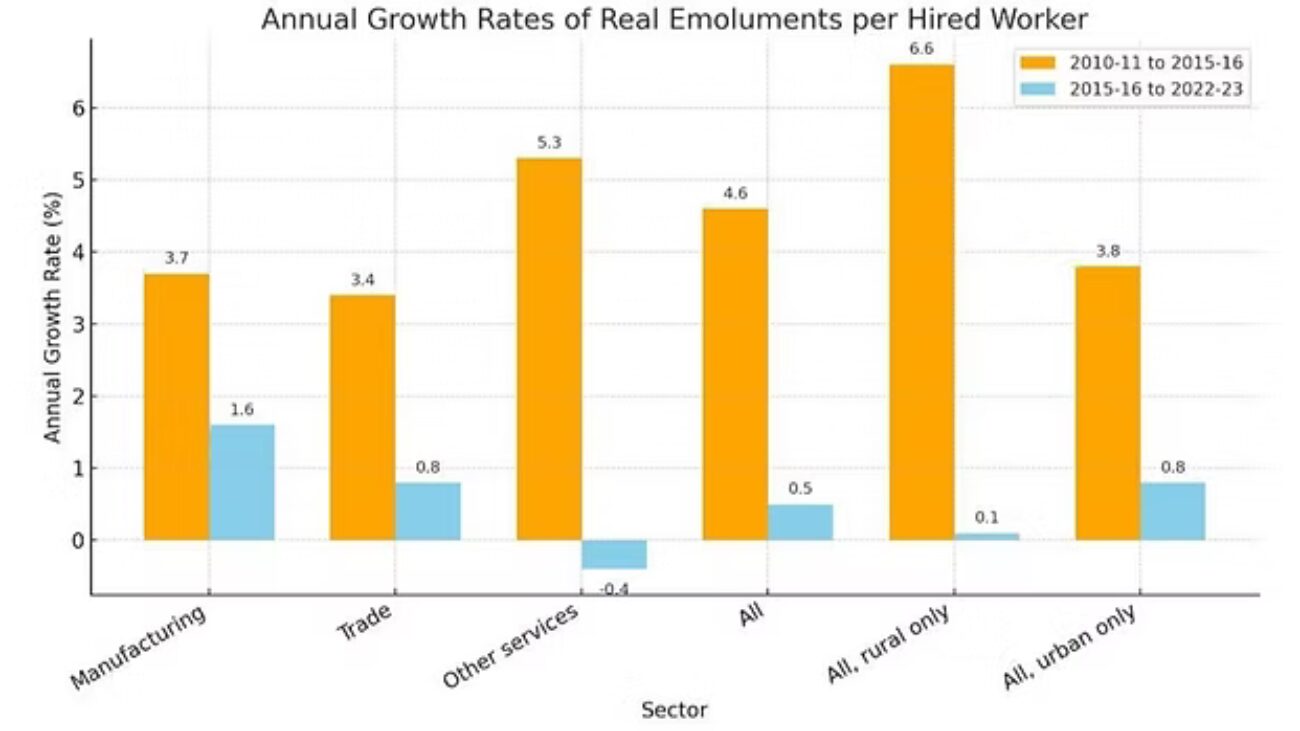
The so called upper middle class that fuels premium consumption largely works in these sectors. For the rest of India – especially the 42% still dependent on agriculture – wages have barely kept pace with inflation. Several national surveys and analyses show real wage stagnation since 2015-2016. Data from the Labor Bureau and the National Sample Survey (NSSO) indicates that real wages for rural laborers had near zero growth between 2015-2016 and 2022-2023. In contrast, the period before 2015-16 showed much faster wage growth.

NSSO Survey data compiled by Idea India Magazine

The Concentration of Savings and Spending Power

The report itself concedes that the top 20% of households hold around 85% of India’s total savings. That’s roughly 26 crore people (260 million) driving most of the premium consumption, while the remaining 104 crore (1.04 billion) share only 15% of savings – a stark reminder that aggregate growth often hides skewed realities. And this is why rural households and lower-income urban families, meanwhile, are facing tighter budgets and are actually cutting back on discretionary spending.

Gold as a Survival Cushion

The report romanticizes gold as a symbol of wealth, but in rural India, the precious metal plays a very different role. Gold is not an indicator of luxury and status, but a financial safety net. In villages around Tiruvannamalai City of Tamil Nadu State. Where I have surveyed about 50 families, average holdings are often below 40 grams. When harvests fail or cash flows tighten, this gold is pledged or sold to fund essentials like health expenses, education or seeds for the next planting season.

Yes, some towns in India have higher gold holdings and savings, sharply due to offshore remittances especially in States like Kerala and Gujarat. This remittance led prosperity fuels local real estate and pushes up rents, but it’s a localized story, not a national one. Most rural communities still depend on seasonal income and informal borrowing.

The Uneven Reality Behind Growth

Premium brands are growing faster, but this signals income polarization, not inclusive growth. The per capita income maybe rising, but it’s an average skewed by the top 10-20% who hold multiple assets. For most, consumption is fueled by rising debt. Until wage growth broadens and rural incomes strengthen, India’s  consumption boom will remain the affluence of a few – not the prosperity of the many.

post303

India and the U.S Govt Shutdown: Quick Market Thoughts

India and the U.S Govt Shutdown: Quick Market Thoughts

President Trump has been ramping up his claims that India is no longer going to buy Russian oil, he made a statement regarding this belief yesterday once again. As the White House threatened to initiate tougher sanctions against India, there seems to have been some movement towards a reconciliation between the two powerful nations.

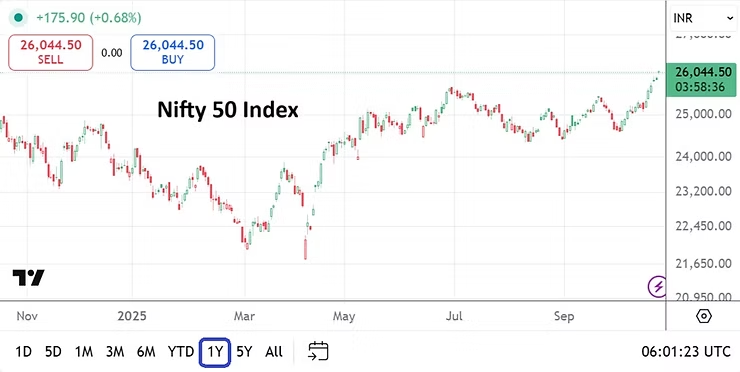
The Trump administration is clearly trying to limit the amount of purchases of Russian oil by India to increase economic pressures on Russia, and reportedly India may be starting to actually buy less oil. India has certainly not stopped buying Russian oil in a maximum ‘fait accompli’, but if the nation continues to show a willingness to purchase less energy resources from Russia, this will go a long way in preserving a good U.S and India association. A stronger relationship between the U.S and India can achieve a vital economic and military correlation for the both nations. Improved friendlier tones from New Delhi and Washington D.C appear to have reassured investors in the Indian equity markets via highs currently being seen on Nifty 50, which are now within sight of apex values from late September last year.

Nifty 50 One Year Chart as of 23rd October 2025

India is a vital and important part of U.S policy as it attempts to also create pressure on China too. By maintaining political and business dealings with India, the U.S can and should look upon this joint relationship as a vast long-term strategic interest. India understands this as well. The ability of India and the U.S to remain ‘friendly’ allies, and the prospect of creating a vigorous economic and military partnership should be one of the U.S government’s essential missions.

India does have strong connections to Russia the past handful of decades politically and economically via its non-aligned status. India will certainly maintain its dialogue and sometimes cooperative dealings with Russia. However, if India and the U.S maintain a solid relationship with the prospect of increasing their economic and political ties this could substantially change dynamics on the Asian continent.

U.S Government Shutdown Since the 1st of October

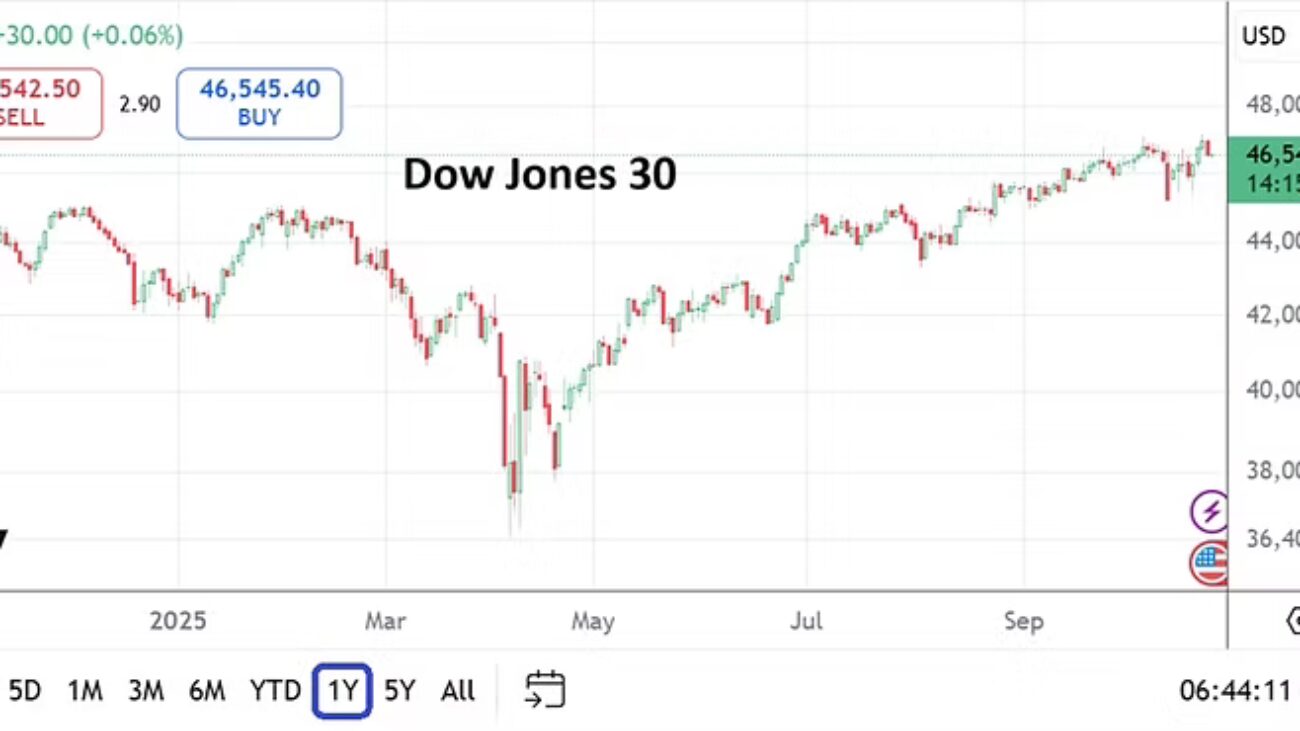
The U.S government has now been shutdown for over three weeks as Republicans and Democrats remain stubborn about compromise. Both sides have made the shutdown a political game. While each party claims they are doing what is best for the nation and preach to their collective voting bases, the stalemate could start to have uglier effects regarding wages not paid for many U.S employees on the 1st of November.

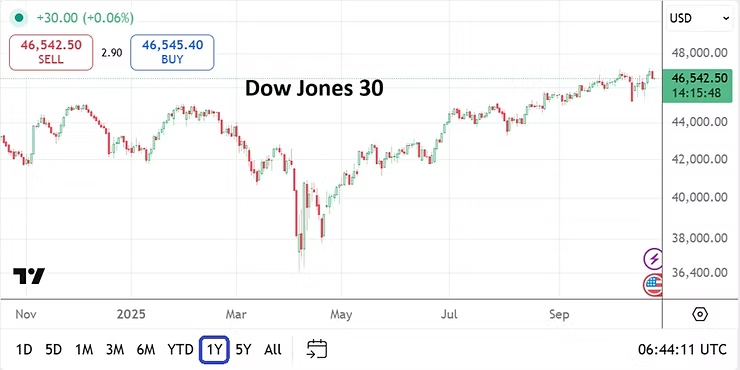
Dow Jones 30 One Year Chart as of 23rd October 2025

A lack of government salaries not being dispersed will cause an economic hit via consumer spending and create at a minimum some temporary damage for GDP numbers. Remarkably, and to be clear about this potential impact, Wall Street hasn’t seemed to care yet, but this could start to change. As the U.S economy rumbles powerfully forward without a major downturn in the major equity indices, politicians appear to be comfortable acting like spoiled children on both sides of the aisles engaged in accusing the other side of misdeeds.

Likely to start changing attitudes among Republicans and Democrats in the next two weeks are the coming Federal Reserve’s FOMC Statement during the end of October, and voting results via key political races in the first week of November.

Wall Street wants clarity regarding interest rate outlooks for November, December and early next year. Investors might not get a clear picture from the Fed next week, taking into consideration the Federal Reserve will not have up to date official U.S economic data because of the government shutdown. Meaning the Fed will likely issue a 25 basis point rate cut on the 29th of October and say it is uncertain about the coming few months because it does not have enough inflation, employment and GDP information to form a concrete opinion. The joke of coarse being the Fed seldom seems to have a strong opinion, but now can use the government shutdown as an excuse.

And now for contemplation, let’s look at the election in NYC for Mayor. A bona fide socialist may get elected in New York City who carries the historically misguided and dangerous wisdom of a Marxist. The economic and social practices of Marxism have proven utter failures for over one hundred years consistently. If NYC suffers a victory from the socialist candidate running as a Democrat, Wall Street and many financial institutions based in the city will not react favorably.

In the meantime, U.S equity indices remain elevated, cautious and within sight of record highs. The Nasdaq, Dow Jones and S&P along with other financial assets are producing choppy dangerous conditions for day traders who are attempting to wager on daily changes and suffering from the cautious behavioral sentiment being generated. Investors who look towards the mid and long-term are likely more comfortable, but are certainly keeping an eye on what is going to transpire over the next two weeks. Gold and Silver have come off their speculative highs. Forex continues to create volatile conditions as financial institutions appear unready to make bold predictions about what the Federal Reserve will do into January 2026.