postR196

AMT Top Ten Miscellaneous Battlefronts for the 7th of Sept

AMT Top Ten Miscellaneous Battlefronts for the 7th of Sept

10. Cape Town: Springboks take on the All Blacks in Round Four of the Rugby Championship later this afternoon. South Africa won last week’s test. Roster changes have been made to both starting squads. Springboks Captain Siya Kolisi will start, this after he had been listed as questionable earlier this week because of a nose fracture he suffered in last Saturday’s game, which will be dealt with surgically in the near future. The All Blacks are extremely difficult to beat two games in a row, today’s match could be a firecracker.

9. Spy Games: Alleged China spy Linda Sun is accused of trying to influence policy while working in New York Governor Kathy Hochul’s office as an aide. The alleged spy also worked in the previous New York administration under Andrew Cuomo. Sun and her husband, Chris Hu, have been charged by the U.S government to be in violation of the Foreign Agents Registration Act amidst a litany of alleged illegal activities.

8. VPN Wanted: Brazilian Supreme Court Justice Alexandre de Moraes has suspended X because of claims the social media service, previously known as Twitter, is allowing ‘misinformation’. Justice Alexandre de Moraes has broad powers and is permitting Brazil’s ruling government led by Lula da Silva to walk a perilous line that does not allow for free expression. Brazil has not heard the last of Elon Musk.

7. Boeing: Starliner returned to earth last night touching down in New Mexico, but without the astronauts it delivered to space in early June. The mission was supposed to take 8 days, but instead stranded the two astronauts on the International Space Station. NASA has stated it was potentially dangerous for the astronauts to return in Starliner. The astronauts are now scheduled to return in February 2025 with SpaceX. Starliner is owned by Boeing. This time last year Boeing’s share value was near 219.00, as of yesterday it is 157.62 USD.

6. Xmas in October: Nicolas Maduro, the Venezuelan President (dictator), has announced the Christmas holiday will be celebrated on the 1st of October, allowing Venezuelan citizens an early celebration in order to forget the troubles imposed on the nation by foes who are working against the socialist government. Maduro joins a well established line of totalitarian leadership who have historically moved or canceled religious holidays to manipulate the population.

5. Harris vs. Trump: A debate between the two candidates will take place this coming Tuesday on the 10th of September. Because of murky outlooks among many financial institutions, this televised ‘exchange of views’ will not only get the attention of U.S voters and an interested worldwide populace, but global investors as well. The last Presidential debate effectively ended Joe Biden’s hopes of being re-elected. Will this event proceed without biased moderators?

4. Wobbly High-Wire: WTI Crude Oil finished the week around 68.52 per barrel as traders appear to be worried about a U.S economic slowdown. Gold closed Friday near the 2,497.00 realm per ounce, as investors fret over the USD and Federal Reserve. BTC/USD is trading around 54,230 at the time of this writing, Bitcoin was valued around 65,000 early on the 26th of August. Cocoa closed near 8,300.00 USD per ton yesterday after flirting with lows touching 7,900.00 on Wednesday. Day traders trying to wager this past week within commodities likely found they were not immune to nervous sentiment.

3. Negative: U.S jobs data was bad. While some say the numbers were mixed the Non-Farm Employment Change came in significantly lower than its estimate, and the previous month’s statistics were revised downwards. The higher Average Hourly Earnings report provided no favors via its outcome of 0.4% compared to the expected result of 0.3%, it wasn’t too far from the estimate and should not change inflation perspectives. Simply put, the jobs numbers are causing concerns in many financial institutions who believe the Federal Reserve is being too cautious.

2. Nervous Investors: U.S equity indices finished yesterday’s trading at their lows for the week. In fact the Nasdaq 100, Dow 30 and S&P 500 are all traversing values they last saw on the 13th of August. The major indices are fragile. Equities on the 13th of August were still recovering from losses seen the week before when previous Fed and BoJ policy chaos triggered overreactive selling on the 5th of August. On Friday the 2nd of August negative Non-Farm Employment Change data was published. What will happen to indices, Forex and Treasury yields on Monday the 9th of September?

1. Fed Fail: John Williams the New York Federal Reserve President said after the jobs numbers were reported, that the Federal Funds Rate is in a position to be cut. However, Williams continued to lean into the widespread notion the Fed will only impose a 0.25% decrease. He did say he would look at the jobs numbers closely, but he believed the Fed is well positioned. Behavioral sentiment among financial institutions appeared to react poorly to Williams remarks, producing a strong selloff as Friday progressed. The dream of orchestrating a soft economic landing in the U.S by the Federal Reserve allowing inflation to erode, the jobs market to soften, and GDP to remain above recessionary pressure remains the lofty goal. However financial institutions do not like the convoluted mid-term economic outlook, they now want to hear a dovish sounding Federal Reserve and appear ready to cause more short-term chaos in the markets this coming week.


postR182

Risk Analysis Review: Warning about Coronavirus in Feb. 2020

Risk Analysis Review: Warning about Coronavirus in Feb. 2020

Below is a risk analysis note written in February of 2020 regarding the risks and potential implications of coronavirus as seen by Robert Petrucci on financial markets. The letter was sent to a senior associate who was a Chief Investment Officer for a firm. After speaking to the senior associate on the phone, feeling as if his thoughts were dismissed without heed and told he was too concerned about coronavirus, Mr. Petrucci sent the following to the CIO:

Thanks for asking about my thoughts.

What worries me is the opportunity for the virus to be a catalyst. The reactions in the E.U by government talking heads reminds me a lot of the financial crisis in 2007 when people publicly disregarded the potential domino effect which was becoming apparent. 

The Coronavirus imo is a potential domino which could take down the remainder of a fragile architecture. Meaning the ill-conceived philosophy and work of central banks in Asia and Europe have left them with little regarding ammunition should they need to fire an economic gun. If Europe and Asia buckle the US will be left limping too.

Psychologically the markets appear vulnerable, but as you rightly point out the higher realms of the Indices have been waiting for a bit of a sell off for a long time and the selling underway may be more of a reaction and mere trigger which has been long overdue. 

However, I wonder about the ‘clever’ algorithms which have been developed and trade also due to human bias. What concerns me more than what is taking place in China is what is happening in Italy right now. 

Italian governments have a long political history of ineptitude and disregard of reality regarding numbers which are staring them in the face, particularly with budgets and a long tradition of corruption and its destructive force on transparency. If Italy continues to spike higher infection numbers and continue to escalate then I believe the E.U is in for trouble. The inaction of Italy and its reliance on the tourism business will make it hard for them to accept shutting down major airports and cities which enjoy the fruits of international visitors year round. 

Also, I must add and circling back to China that it is not known yet if another outbreak may suddenly appear in another zone if someone dealing with this asymmetrical virus is unaware of their affliction. 

Which brings me back to the springboard, worst case scenario I fear is a major outbreak in the E.U including Germany. If we see signs of spikes statistically across Europe the next two weeks it will be devastating economically for the next quarter financially. 

As you say, things will certainly bounce back, they always do, we must look at the long term. Investors need to keep a stiff upper lip and protect themselves as you have done in many regards with Indices, US ten year bonds and some gold. 

The question for me now is what happens the next ten business days across the U.S and Europe and how the world handles this virus. Worst case is pandemic and bad Central Bank formula, which have been in place the past twelve years with cheap money. The desire to keep everything steady may in fact lead to miscalculations which have not been planned for and cause reactions in the markets which cannot be checked this time around. I do not believe we are at a Black Swan point yet, but it does worry me that the E.U politicians and even some U.S politicians seem to have their head in the sand or look like deer stuck in the headlights.

Robert Petrucci 26 Feb 2020

postR196

AMT Top Ten Miscellaneous Notions for the 30th of August 2024

AMT Top Ten Miscellaneous Notions for the 30th of August 2024

10. Ellis Park, Johannesburg: The Springboks will face the All Blacks on Saturday in round three of the Rugby Championship. One of the greatest rivalries in sports will match South Africa who is looking to cement their current team’s legacy as one of the best rugby squads ever, versus New Zealand who is looking for revenge having lost to the Springboks in the World Cup Final in October 2023.

9. Labor Day: Short-term speculators should be mindful that today’s volumes may be thin due to U.S financial institutions allowing employees to leave early for a long weekend. While all the major U.S exchanges will be operating, transaction volumes will become lackluster as the day progresses with the last U.S summer holiday approaching.

8. Precious Future: Gold is traversing around 2,520.00 USD per ounce this morning, as Bitcoin is near 59,500 USD as of this writing. The precious metal was around 2,000.00 much of February, while Bitcoin began flirting with 59,000 and 60,000 in late February after starting that month near 43,000 USD. While influencers proclaim the future is digital with Bitcoin, Gold continues to shine and has a historical track record as a store of value.

7. Pavel Durov: The CEO of Telegram was released on Wednesday after posting 5 million EUR as bail, he must stay in France and faces a handful of charges. Russia, the UAE and high profile people, including Elon Musk, have publicly criticized France for Durov’s arrest last Saturday. Free speech advocates are largely against the arrest of Durov, while France contends Durov has not been forthcoming about data which has been shared on Telegram to conduct criminal enterprises. Julian Assange was arrested in 2019 in Britain and was only released in June of this year, promptly leaving for Australia.

6. Commodities: The price of WTI Crude Oil is near 76.00 USD and remains in a fairly stable range, Cocoa remains within sight of 9,000.00 as it trades around 8,950.00 this morning. And the prices for Coffee via Robusta and Arabica continue to flirt with apex highs. Day trading wagers on these commodities should be done carefully before the U.S holiday.

5. Art of Speaking: Kamala Harris is being criticized for her reliance on teleprompters as some pundits wonder loudly when she will sit for an unscripted interview. Donald Trump faces continued scrutiny for speaking extemporaneously, and everyone knows this characteristic is not going to change. The race for the White House appears tight. The televised debate between the candidates remains on the schedule for the 10th of September and its format may present the opportunity for verbal fireworks.

4. Eastern Europe: The Russian-Ukrainian war has been escalating the past few weeks as both sides appear to be working with the belief they need to create facts on the ground over the next few months. The potential of a victory by Donald Trump in the U.S may be pushing Russia and the Ukraine into a mode which hopes they can bolster their respective negotiating positions, this if the newly elected U.S President can get the warring sides to discuss an endgame.

3. China: The nation faces difficult economic circumstances and tries to maintain stability via Yuan and bonds interventions. Also, the foreign policy stance of China is growing tensions with the Philippines. The long standing disagreement about Taiwan’s sovereignty is well documented, but Chinese naval activity in the South China Sea is raising alarm bells among some political analysts. Manufacturing PMI results will be published by China early on Saturday. Economic data from the nation is being inspected by foreign investors carefully who are looking for long-term yields, but are troubled about transparency and the potential of sudden policy changes.

As an aside, APEC will conduct its annual meeting in November from the 10th until the 16th in Peru. Both Joe Biden and Xi Jinping will attend. Depending on Biden’s health and the outcome of the U.S Presidential Election on the 5th of November, this Asian-Pacific Economic Cooperation Forum will prove important.

2. U.S Data: Jerome Powell’s capitulation last Friday via his public statement that the Fed needs to cut interest rates fueled a weaker USD. Forex has seemingly priced in a combined 0.50% basis cut via the Fed for September and November. Yesterday’s stronger than anticipated U.S GDP growth and inflation reports however created headwinds, which caused outlook jitters. Today’s Core Personal Consumption Expenditures Price Index monthly gauge is expected to come in with a gain of 0.2%. If the inflation report can match the anticipated result this may calm Forex, equity indices, and Treasury yields before going into the long holiday weekend. Next Friday U.S Non-Farm Employment Change numbers will be published. Today’s trading may be muted because of thin volumes, but day traders should expect volatility to increase starting next Tuesday.

1. Competition: Nvidia was valued around 47.50 USD per share this time last year, as of today the price is near 117.60. Intel’s value was approximately 34.50 USD this time last year, as of today the price is about 20.13 per share. Intel appears to be valued as a commodity supply company nowadays by some investors, while Nvidia’s outlook remains within the auspices of a highly anticipated technological future. Where will both companies values be this time next year?

postR180.1

Summer Optimism as Forex and Equities Focus on Fall Outlooks

Summer Optimism as Forex and Equities Focus on Fall Outlooks

Fed Chairman Jerome Powell admitted the obvious at the Kansas City’s Fed’s Jackson Hole Symposium last Friday. The realization the U.S Federal Reserve is going to cut interest rates confirmed what many financial institutions had positioned their trading desks for via forward cash Forex contracts over the past month.

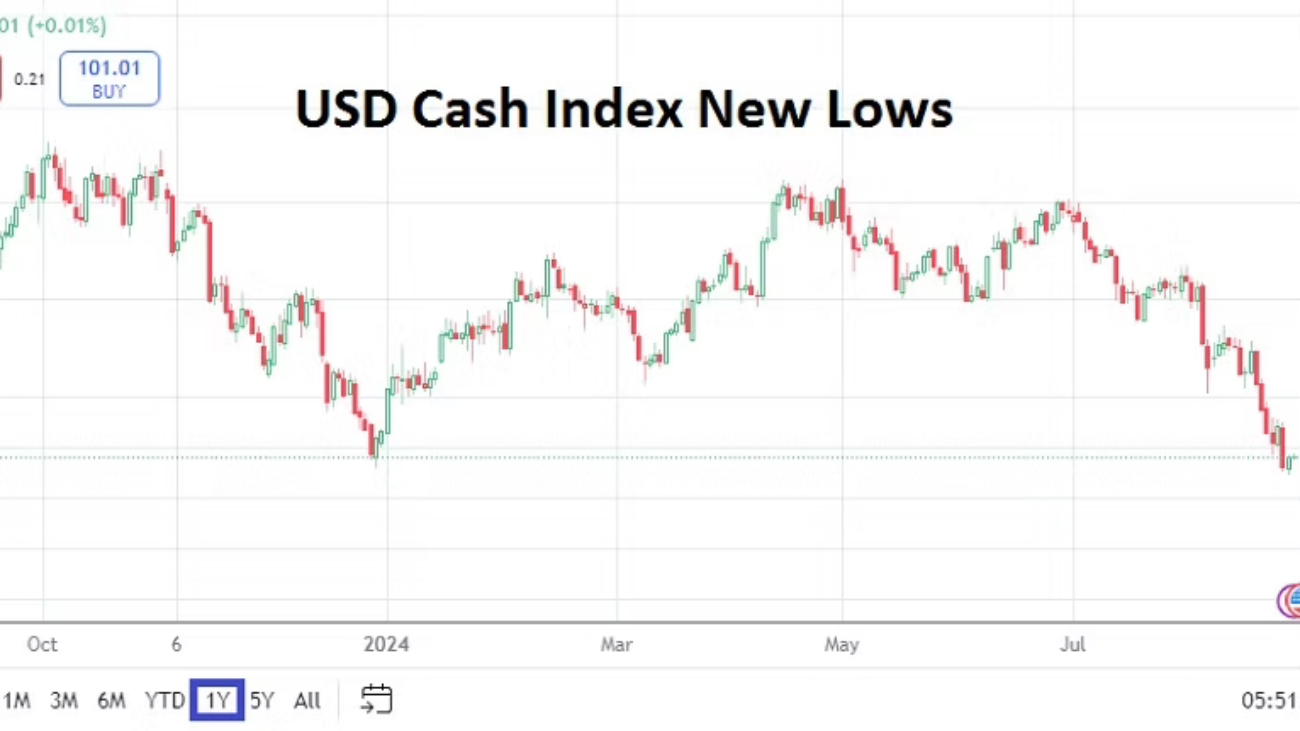
USD Cash Index One Year Chart on the 27th August 2024

The USD has been expected to grow weaker by many people because most knew the Fed would have to state a September rate cut would be delivered. The question that was also somewhat answered is the notion if the Fed will also cut in November. Though Powell certainly did not say a rate cut would happen in November, his rhetoric made it clear the Federal Reserve is considering a dovish perspective which could translate into additional cuts down the road.

The Fed has been criticized for being too passive and while Powell can be congratulated for his rather unemotional Federal Reserve leadership, he and the Fed can certainly be faulted for not reacting quickly enough to ‘transitory’ inflation and then not responding until this past weekend to the need for cutting interest rates with dovish rhetoric. Let’s also remember the U.S Treasury (government) is on the line to pay exorbitant costs for debt repayments because of bad U.S fiscal policy.

As an interesting related side note, the head of the Brazilian Central Bank, Roberto Campos Neto, made a strong appeal for governments to be fiscally responsible while speaking at the Jackson Hole Symposium this past weekend. While he could have been talking to any number of nations regarding spending, his points were obviously meant to highlight his disagreements with the Brazilian government led by Lula da Silva and the Workers Party. Roberto Campos-Neto stated that approximately 50,000,000 (yes, million) people in Brazil receive government allowances, while only about 43,000,000 people are earning money via employment and business enterprises. Traders who want to keep an eye on the USD/BRL this week may be entertained by the potential volatility within the currency pair which is trading a hair below 5.5000 before it opens today. The USD/BRL has certainly not been correlating to broad Forex USD centric weakness, and demonstrates the internal domestic fight between Lula da Silva and the Brazilian Central Bank regarding fiscal policy.

Jobs data from the U.S has continued to turn negative, particularly via revised reports which are being published rather ‘quietly’ as election season approaches. Yet, financial institutions have been aware of the weaker jobs numbers. While the poor jobs numbers combined with eroding inflation is good for USD centric weakness due to the knowledge the Fed will have to reverse from its rather high interest rates, the question becomes how much per the financial institutions selling of the USD has been acted upon in Forex. Is the USD oversold for the time being? It depends on trading timeframes certainly.

Weaker USD centric positions will need more impetus for further bearish trajectories to be seen near-term. Financial institutions may believe equilibrium is being approached, this because it appears interest rate cuts equaling a 0.50% decline seem to have been factored into Forex. Will the Federal Reserve be put into a position in which they will be able to cut by a full basis point (-1.00%) over the next six months?

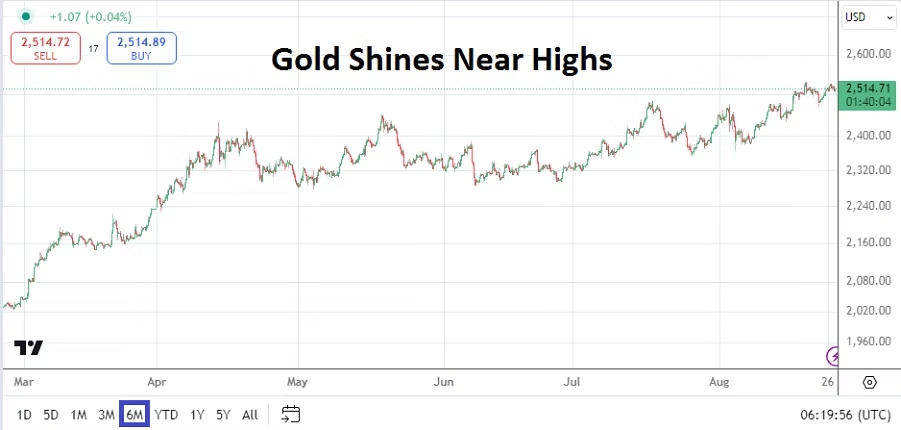
Gold Six Month Chart on the 27th of August 2024

Gold is trading near 2,500.00 plus at the time of this writing. Gold has touched higher levels in the past week and is getting a round of applause from its throngs of believers who proclaim the precious metal the ultimate safe haven against inflation and erosion fears via fiat currencies – including the USD. As a reminder, Bitcoin is highly speculative and doesn’t have the historical (thousands of years) track record that gold has acquired.

GBP/USD Five Year Chart on the 27th of August 2024

The EUR and GBP are traversing higher territories not seen in a while. The EUR/USD is near the 1.11700 level, which was last traded in July of 2023, and it has been since 2022 that sustained prices above this current realm have been traded. The GBP/USD is near 1.32000 and is within a value ratio last seen in March of 2022. Central banks will remain in focus as summer ends and the fall trading season gets underway. The ECB will release their Main Refinancing Rate on the 12th of September, the Fed will present the Federal Funds Rate on the 18th, and the BoE will follow suit with the Official Bank Rate on the 19th.

However, those September dates are still a few weeks away and financial institutions do have data this week which could stir Forex, equity indices and U.S Treasuries in the near-term. Day traders often do not have the ability to rely upon mid and long-term outlooks, and instead have to be content with trying to ride the momentum trends being caused by larger players. While the USD weaker outlook is tempting to rely upon, speculators who are looking for quick hitting wagers need to judge technical charts and try to grasp existing behavioral sentiment which can shift rapidly depending on lengths of time.

Traders should remember the U.S will celebrate its Labor Day holiday next Monday, which sets the stage for potential sudden volatility to flourish before big financial institutions in the States leave for their long weekend. The last week of August should be rather tranquil. Certainly most long-term investors feel as if they have more clarity regarding interest rates and will be able to relax. The hope is that the current calm is not the quiet before the storm due to lingering political issues in the U.S, France and elsewhere. And that escalation of the Ukrainian and Russia war, and the Middle East conflict do not cause sudden surges of bedlam.

Economic data events the remainder of this week that should be given consideration includes the U.S CB Consumer Sentiment reading today. Yesterday’s U.S Durable Goods Orders came in with mixed results as the Core number fell by minus -0.2%, but the broad number came in with a substantial gain of 9.9%.

USD/JPY Three Month Chart on the 27th of August 2024

The Bank of Japan has published their Core CPI data today and the outcome came in below expectations with a gain of 1.8% compared to the estimate of 2.1%. The USD/JPY is trading near 144.790 at the time of this writing as it continues to show bearish tendencies. The Bank of Japan which was heavily criticized in many circles may actually be achieving what they have planned, this as they have tried to stimulate stronger export and confront inflation. Their battle is not over yet.

Australian CPI data will be published on Wednesday. And on Thursday, German Preliminary Consumer Price Index numbers will be released. The EUR/USD could react to this report, but the European Single Currency remains highly USD centric. Which sets the table for the U.S Prelim Gross Domestic Product report also on Thursday. The growth number from the U.S could diminish selling considerations for the USD if the report comes in stronger than expected. However, the GDP Price Index and weekly Unemployment Claims from the U.S could also impact short-term behavioral sentiment and cause a bit of turbulence if negative results are published.

Friday will see more CPI numbers from Japan, CPI and GDP numbers from France, and GDP data from Canada. But before going into the long holiday weekend the U.S will present one more major report with its Core PCE Price Index and the monthly statistic is expected to show a slight gain of 0.2%.

China watchers will get Manufacturing PMI numbers early on Saturday. Recent China data continues to show signs of economic stress regarding foreign investment, domestic consumer spending, and deflationary results. Buyers beware.

postN38.1

Reactions and Risks as Trading Clarity Remains Hard to Grasp

Reactions and Risks as Trading Clarity Remains Hard to Grasp

While many U.S government officials try to shrug off the downgrade of U.S Treasuries by Fitch Ratings last week, a warning shot has been fired regarding U.S spending and the nation’s growing deficit. Janet Yellen and others may believe the downgrade should not have happened, but the prospect that the U.S golden goose is going to stop eventually producing enough eggs is a realistic viewpoint from Fitch. Risk adverse trading on the news was seemingly sparked from the U.S Treasuries downgrade, while many prominent figures including Warren Buffet have claimed they are not worried. However, one thing that the downgrade did was certainly create more clouds for financial institutions which have already been suffering from a lack of clarity the past three weeks.

U.S economic policy remains troubling regarding its spending, and while the government believes its bonds will remain the best in the world for the foreseeable future, it would certainly help matters if responsible ‘adults’ would be allowed a voice regarding stimulus, expenditures and debt ceiling concerns. The U.S has been warned, but with a major presidential campaign approaching on the horizon, more promises to the U.S public will likely carry greater long-term costs.

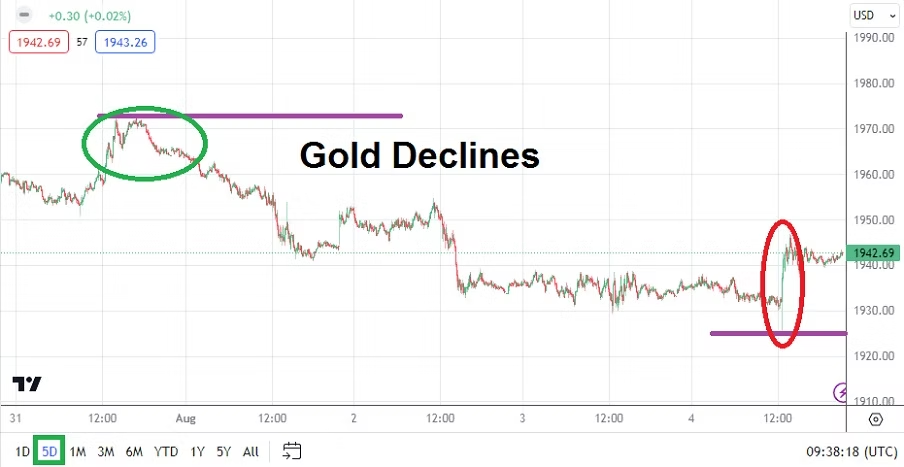
Gold One Week Chart as of 8th August 2023

While the USD did get stronger across Forex and gold finished last week near lows, some major currencies finished Friday with slight reversals higher against the USD before going into the weekend, based on the weaker than anticipated Non-Farm Employment Change outcome. However, Average Hourly Earnings came in slightly higher. The rise in wages for employees wasn’t expected, but the gains via the inflation number may not have been considered significant enough to cause a panic.

Day traders trying to navigate through the news of the ratings downgrade and the mixed jobs numbers from the U.S may have gotten ripped apart from the volatility late last week. Forex brokers likely had a good week if the majority of their speculators were ‘B’ book – virtual – traders. Survivors of last week’s dynamic price action should be aware that financial institutions do not have the best of outlooks for global central banks. This week’s coming data may help a bit, but trading could also remain rather dangerous and churn volatility.

Global Outside Influence to Give Attention:

Although Niger may seem like a world far away for most day traders, they should keep an eye on the developments of the African nation. A military coup has gotten the attention of global powers and there are threats of military intervention rattling. France, the U.S and Nigeria and other ‘Western’ leaning nations have a stake in the Niger drama, on the other side is Russia and its Wagner affiliated mercenaries. The potential for a war to to start in this landlocked northern African nation appears to be growing. A conflict in Niger could include a wide range of competing sides and create loud rhetoric and hyperbole. It could also cause uncomfortable feelings at the BRICS summit scheduled to begin on the 22nd of August in Johannesburg, South Africa.

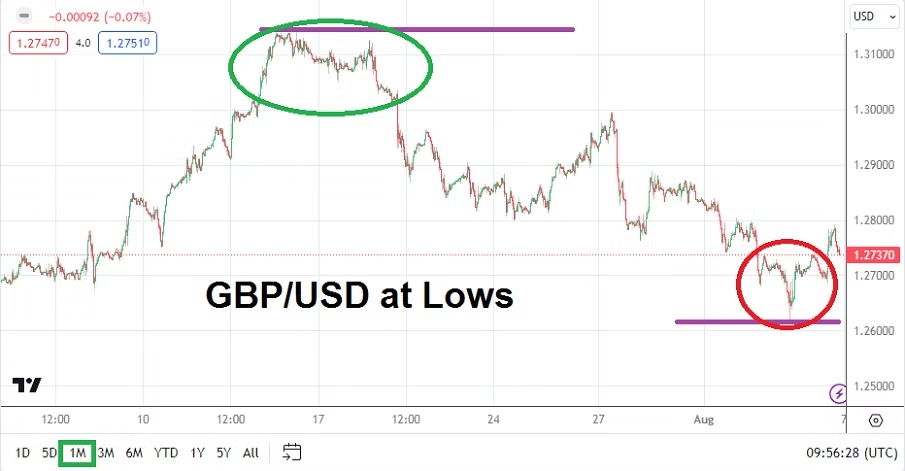
GBP/USD One Month Chart as of 8th August 2023

Monday, 7th of July, U.K Halifax Home Price Index – this data is expected to remain rather stable, but the past three results have been negative. Mortgages are getting expensive in the U.K and the pressure added from higher interest rates is not helping. The GBP/USD could react briefly to this outcome.

Monday, 7th of July, E.U Sentix Investor Confidence – the reading is anticipated to be worse than last month’s outcome regarding investor outlook. The past three months have been negative. The E.U is certainly facing recessionary pressure. Oddly enough, a poor outcome could spur on the belief the ECB may have to become less aggressive regarding their higher interest rates. The EUR/USD may see a flurry of reactions from this report.

Tuesday, 8th of July, China Trade Balance – the results will get plenty of attention because recent economic data from the nation has been troubling. Export demand is important for China’s economy.

Tuesday, 8th of July, Germany Final Consumer Price Index – the result is expected to match the forecast of a 0.3% gain. This inflation report will be watched by EUR/USD, but if expectations are met this could create rather consolidated trading until Thursday for the currency pair.

Wednesday, 9th of July, China CPI – the inflation data from the nation will be watched by global investors. Recent statistics from China have signaled concerns about ‘deflation’. An outcome of minus -0.5% is expected. Economic issues are shadowing China, this as it remains active in global affairs.

Last week Argentina announced China helped facilitate a ‘bridge loan’ for the South American nation so it could make a repayment to the IMF. Rising economic concerns in China could start to squeeze its ‘cash power’ as it tries to gain influence globally by pumping Yuan (CNY) into international finance. China has certainly been bold and is playing a ‘long game’, because its choice of Argentina as a nation to help can certainly not expect to produce short-term financial gains.

Thursday, 10th of July, U.S CPI – Consumer Price Index results from the States will cause potentially dynamic broad market movement. Inflation is expected to match last month’s rise of 0.2% via the broad and core numbers. However, traders should note that some analysts have voiced concerns rising energy prices the past month will hit the inflation numbers, if this occurs it could spark a volatile USD. Higher Crude Oil prices combined with a streak of U.S hot weather may create an intriguing outcome. Risk management should be used by day traders who are wagering in the markets as the CPI readings are released.

Friday, 11th of July, U.K GDP – the Gross Domestic Product numbers will be important immediately for the GBP/USD. Although last month’s outcome was slightly stronger than anticipated it was still negative with a minus -0.1% reading. The growth number this time around is expected to gain 0.2% per the monthly report.

Friday, 11th of July, U.S Producer Price Index – economic numbers from the States have been mixed recently. These inflation numbers are expected to show a slight rise, if the outcome meets expectations – the broad markets may remain calm. However, if inflation is stronger than expected, the result could set off fireworks if the outcome sets off fears about the U.S Fed maintaining it hawkish rhetoric.

postR175.1

U.S Growth (Lack of it) and Inflation Report Key to End of Week

U.S Growth (Lack of it) and Inflation Report Key to End of Week

Day traders may believe they are being confronted by another wave of data and news which is going to make their endeavors more difficult. The announcement by Joe Biden that he will not run for re-election in November however was not a major surprise. The handwriting on the proverbial wall has been clear for nearly a month that Biden was under immense pressure to step aside. It appears Kamala Harris will get the Democratic nomination per reports that delegates are starting to pledge their loyalty.

Financial markets which may have been interpreted yesterday as cautious due to the Biden and Harris news may actually not have had a tremendous effect. It is quite possible investors and traders have started to position their assets for a Trump victory. Love him or hate him, the polling numbers appear to suggest the Republicans are potentially going to win big in November. Except the word November is the key, there are still over 100 days for things to go wrong for the Republicans. Nothing is settled and day traders need to understand that a lot can change. Economic data from the U.S will be plentiful in the coming days. Also, China has lowered key borrowing costs in an effort to try and fuel spending in the nation as consumers remain hesitant and a sign the nation is battling a troubling economy.

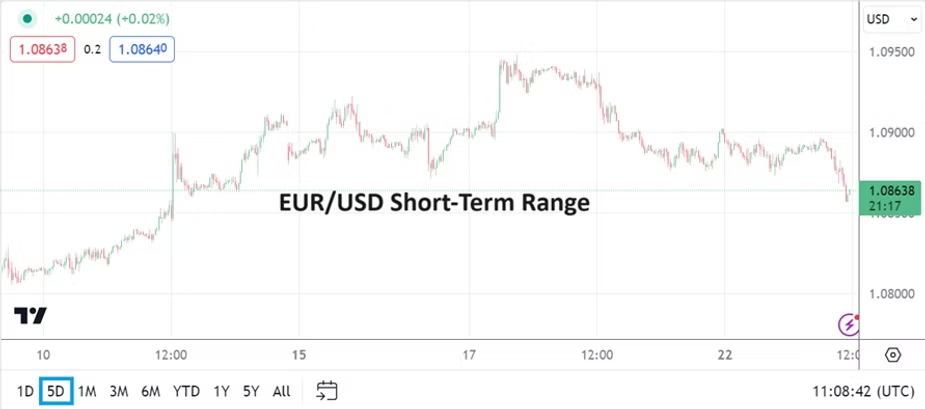
EUR/USD Five Day Chart on the 23rd July 2024

Traders who have been trying their hand in Forex have seen the EUR/USD and GBP/USD sink in value via short-term price changes. While retail speculators may look at the moves over the past day as vicious, they should note that since Wednesday of last week the USD has been stronger in Forex. It is doubtful financial institutions were betting on Biden to drop out of the race last week or for China to lower their interest rates. What in fact might be playing out is the possibility that most financial institutions believe the USD had been oversold and now want to position for the economic statistics coming this week. Results this week will help motivate notions the Federal Reserve will have to become dovish in September and proclaim a weaker U.S economic outlook through the end of this year, or for more idle chatter as the Fed undertakes a soundtrack which pleads for caution if inflation numbers remain stubborn.

USD/CNY One Year Chart on the 23rd July 2024

Monday, 22nd July, China One and Five Year Loan Prime Rates – borrowing costs were cut officially yesterday. The interest rate reductions of 0.10% were small, but China hopes this change helps propel stimulus for its struggling economy. It may not. But before folks sell China short, the nation continues to be a dynamic economic and political force and this power is not going to abate soon. The USD/CNY has incrementally risen since the start of 2024, but it is still below the higher values seen from August into early November of last year. It seems possible the Chinese government will continue to allow the Yuan to lose value in an attempt to reignite export.

Tuesday, 23rd July, U.S Existing Home Sales – the past few months have seen a decrease in the housing data. However, last month’s outcome was stronger than anticipated. These numbers tend to get a lot of fanfare, because they are a solid barometer of U.S outlook regarding interest rates and potential inflation. If folks feel like they should not sell their homes because their current payments are cheaper via their existing mortgages compared to taking on higher costs which are being offered now due to more expensive interest rates, this causes existing home sales to often fall. This because those with homes are not looking to move and simply want to stay in place, also making the potential of finding a house for folks who want to enter the market a more expensive proposition. Again, the outcome of this data is more of a barometer and doesn’t tend to affect financial markets like equities or Forex too much.

Wednesday, 24th July, Europe Manufacturing and Services PMI – E.U nations and the U.K will publish their readings. Last week the ECB kept their key lending rate in place. Political questions still linger in France which is more of a thorn in the side of the E.U than the potential outcome of these data reports. France and Germany expect better results from the Manufacturing and Services numbers. The broad E.U estimate also is optimistic about better results. Great Britain too is expecting better numbers. However, Forex traders will likely be more focused on coming U.S data and stay in a USD centric mindset the remainder of the week when making their forward considerations. And it should be noted the E.U and U.K economies are still struggling.

Wednesday, 24th July, U.S Manufacturing and Services PMI – these reports will be important certainly regarding the sentiment of Purchasing Managers, but the index reading may not be the biggest thing on investors minds. U.S data statistics on Thursday and Friday will be the outcomes that are being prepared for regarding potential affects. The Manufacturing number is expected to match the previous result, the Services figure is anticipated to be weaker.

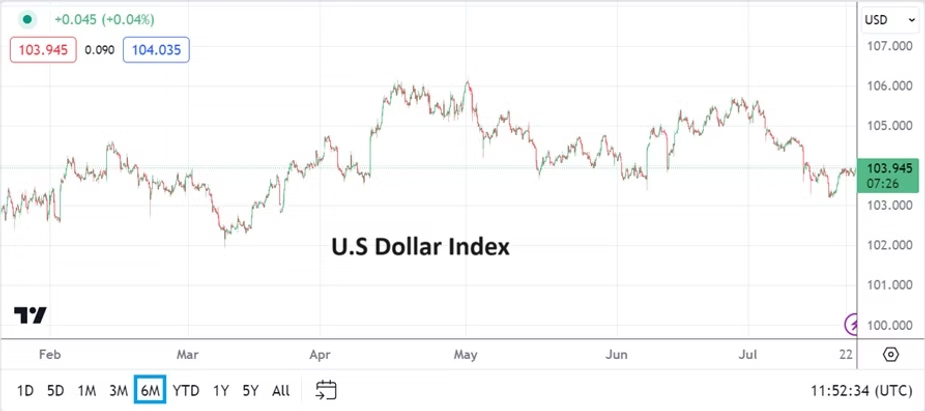
U.S Dollar Index Six Month Chart on the 23rd July 2024

Thursday, 25th July, U.S Advance GDP and Advance GDP Price Index – last month’s growth number came in below expectations, this GDP number is anticipated to produce slightly better numbers. The U.S economy via data has been showing signs of slowing the past few months and this Gross Domestic Product number is going to get a lot of airplay not only because of investors who will use it as an outlook because they believe the Fed will be paying attention, but also because the GDP result will start to become a political football for the Republicans and Democrats. If the growth numbers are weaker than anticipated this could propel USD centric weakness. However, day traders need to keep their eyes on the GDP Price Index stats too – if the inflation report comes in below expectations this could also fuel USD selling. Day traders need to pay attention to the USD Index charts later this week. While the short-term has seen some bullishness, the range of the USD remains near important support levels via a six month perspective and as the Fed comes under more scrutiny, traders should expect more tests in the near-term.

Friday, 26th July, U.S Core PCE Price Index – last month’s report matched expectations. If this inflation number meets the anticipated outcome, or comes in below the estimate this could sustain USD centric bearish momentum into the weekend and early next week.

postR174

Implications of a 48th President on the 20th January 2025

Implications of a 48th President on the 20th January 2025

Presidential news and questions are moving fast, but the coming weeks and months may become a political nightmare if challenges are not handled pragmatically. Financial markets opened this morning with risk appetite reduced, as cautious trading swept through financial assets on the news President Joe Biden would not seek re-election in November of this year. Hyperbole is dangerous and noise can cause unwanted nervous reactions in financial markets when there are unknowns.

Taking into account possible risk factors is important for mid and long-term outlooks. Financial institutions and traders should consider the potential of a rather dangerous political situation developing in the United States over the next few months. First off, will Kamala Harris now get the nomination from the Democrats to run for President in November? There are no certainties and Democratic power brokers may have other potential candidates in mind, which will create less clarity for investors.

Worse, what if there is a 48th President being sworn into office on the 20th of January 2025? Joe Biden, the 46th President, has in no uncertain terms publicly admitted he does not have the capacity to run for the Presidency in the coming U.S election. Does this also mean that he does not have the ability to run the nation until another President takes over following the November election and January inauguration? What would happen if the 25th Amendment of the U.S Constitution dealing with presidential succession and disability comes into force? If Biden is seen as unfit to rule now, he would have to be replaced and Vice President Harris would assume power.

What happens if Harris is forced to take control and becomes the 47th President of the United States before the U.S election is held or even afterwards? The 25th Amendment will become a talking point by political foes of President Biden, and maybe even by those who admire him. The question about Biden’s ability to make correct cognitive decisions between now and the inauguration in January is not a far fetched conspiratorial concern anymore.

How would financial markets react to Biden being replaced by Harris as President in the coming weeks or months? What would happen to U.S foreign policy? The U.S is not set up like Parliamentary political systems to have caretaker governments simply help guide a nation until a new government can be formed. The 25th Amendment and its use could be demanded in order to remove Joe Biden if he is currently unfit to serve, and this opens the door to chaotic U.S executive administration developments and decisions in the months ahead.

The fact that Biden has not been able to make a public announcement regarding his decision not to seek re-election, and will only speak to the U.S public later this week per his letter yesterday is troubling. Is Biden’s health so bad that he cannot perform the job of U.S President today? Section three of the 25th Amendment allows for the Vice President to be transferred power if the current President is unable to discharge their duties until fit again.

However, section four of the 25th Amendment allows the Vice President and cabinet to declare the current President incapable of performing their duties. The Vice President and the current President’s cabinet allows them to decide and issue a statement to the Senate and House leaders declaring the President is unable to govern and is unfit to voluntarily transfer power to the Vice President. Yes, there are timetables involved regarding the President’s capacity to be judged again and reconsidered for the resumption of power, but the U.S Constitution does open the door for a President to be removed permanently if they cannot perform their jobs by the President’s cabinet.

So again, what will happen over the coming weeks and months? Critics of Joe Biden will certainly claim he is not capable of governing and demand proof of his ability in the coming days. A growing chorus is likely to emerge expressing doubts about Biden’s ability to lead. Politics will be a factor in the potential game which will get loud. Republicans will certainly claim if Biden cannot run for President in November, that he likely cannot run the country until a new President is elected.

Politics have delivered a lot of noise this past weekend, but investors should expect the turmoil to grow in sound as people question the leadership of the U.S and ask for proof that Biden is in charge. The U.S elected Joe Biden to be President, not his appointed cabinet. If Biden is not able to prove he can do the job, there are legitimate reasons to consider a transfer of power to Kamala Harris.

At this juncture it appears the Republicans are in the drivers seat politically regarding the November elections. The Republicans may take control of the Senate, remain in charge of the House and attain the White House. Will Kamala Harris have to perform a caretaker government until the 20th of January 2025? Investors and day traders should keep these risk scenarios in mind.

postR173

Rich Dad, Poor Dad: What the Rich Teach Their Kids About Money

Rich Dad, Poor Dad: What the Rich Teach Their Kids About Money

Book corner: Rich Dad, Poor Dad: What the Rich Teach Their Kids About Money That the Poor and Middle Class Do Not! by Robert T. Kiyosaki

Every now and then a book comes along which leads to a major shift in how Americans think. Uncle Tom’s Cabin changed perceptions about slavery. The Jungle woke the nation to the horrific labor and sanitary practices in factories. The Feminine Mystique shed new light on feminism and women’s roles in society. All those books struck deep into society’s conscious and led to major changes.

Robert Kiyosaki’s Rich Dad Poor Dad: What the Rich Teach Their Kids About Money That the Poor and Middle Class Do Not! might not echo the social justice that his revolutionary predecessors strived for. But this 1997 best-seller packed no less of a wallop. Hitting the bookstores just as the twentieth century was coming to a close, Kiyosaki’s book changed how Americans – and others around the world – think about personal finance.

Rich Dad Poor Dad is not an instructional book as one would expect in a college course, with Kiyosaki running through facts, charts and figures. A Japanese-American born and raised in Hawaii, Kiyosaki uses his own life and background to tell a simple, almost fable-like story. The “Poor Dad” in the title refers to Kiyosaki’s biological father, Ralph Kiyosaki, who worked as a educator most of his life. By all accounts a good father and an honest man, he was a big believer in standard, traditional education, wanting the younger Kiyosaki to be a good student and then go to college in order to get a good job – in other words, as Kiyosaki puts it, to be an employee. But he had little financial education, which is what Kiyosaki explains is knowledge of business, investing, accounting, entrepreneurship, real estate and all other related subjects whose knowledge one can use to make money and be financially independent – to be an employer in contrast to an employee. Kiyosaki explains that although his Poor Dad made a decent salary, he was able to save little of it due to his lack of financial education and poor career decisions later left him broke.

The ”Rich Dad” in the title is the father of Kiyosaki’s buddy Mike, a man of limited standard education but excellent and well-developed financial education. A savvy entrepreneur with his hand in many businesses, he was approached by the two pre-teens for lessons on getting rich. Rich Dad put them to work in his general store for little money, but provided something more valuable – lessons on business and entrepreneurship that would form the foundation of Kiyosaki’s life and career. The book is structured around the conversations he had with his Rich Dad and the advice he was given, and the contrast in mentality to his Poor Dad.

As Kiyosaki explains, the drive for financial education consumed him and drove his decisions well into adulthood. A mediocre student, he nonetheless graduated from the Merchant Marine Academy, and then as a US Marine, served honorably in Vietnam as a helicopter pilot. Kiyosaki was eligible to work in the maritime industry after the war, a job that would bring excellent pay, conditions, steady work and several months of vacation a year. But he instead enrolled at Xerox’s sales school – considered the best of its kind in the country – seeing it as a major key in his financial education. His need for independence was so strong that in later years, during hard times, he and his then-wife Kim slept in their car rather than the accept the charity of friends’ guest rooms.

Besides the lack of financial education in the school system – an issue that Kiyosaki raises several times throughout the book – Kiyosaki challenges conventional beliefs. He rails against purchases that are liabilities instead of assets, even arguing against home ownership. He discusses the mindset of money and wealth creation and how ordinary people – due to society’s conditioning to be employees – are held back by limiting beliefs. To be successful in wealth creation and to take control of your financial destiny, Kiyosaki argues, one must take calculated risks; inspired by his Rich Dad, he says that one must not think I can’t afford this but instead What do I need to do to be able to afford this?

In one of the few diagrams in the book, Kiyosaki introduces the cash flow quadrant (of which he would later base an entire book), which categorizes individuals as employees, self-employed, business owners, or investors. He discusses the advantages and/or disadvantages of each quadrant.

Kiyosaki hit a raw nerve in the personal finance-hungry public, turning him into an international finance guru. It has to this date sold anywhere from thirty to forty million copies and is noted as the bestselling personal finance book of all time. He – and Kim, who has a series of similarly-themed books intended for women – have subsequently published an entire series of finance books, each with its own spin, such as real estate, investing, gold/silver, multi-level marketing, etc. These include two collaborations with Donald Trump, Why We Want You to Be Rich and Midas Touch: Why Some Entrepreneurs Get Rich — And Why Most Don’t. Kiyosaki also markets a board game, Cashflow, that attempts to teach the basics of financial education and how to exit what he calls the “rat race”, which is his description of the sometimes grueling life of dependency that employers place upon their employees and the financial mediocrity that ensues.

Rich Dad Poor Dad is not without controversy. Two of Kiyosaki’s businesses prior to his turning full-time to financial education went bankrupt, fueling claims that he is not as savvy as his image projects. Some experts and competing finance writers claim that he gives poor, substandard – even dangerous – advice. Another claim regards the identity of the “Rich Dad”. His name is not revealed in this book nor the follow-ups in the series and Kiyosaki was silent about this issue for several years, leading to accusations that the book is complete fiction. He has since revealed the identity of the man, plus his friend referred to as “Mike”. Kiyosaki explained that many years ago, upon the book’s initial publishing, the family requested anonymity, to which he respectfully complied.

Another claim, not without merit, is that this book gives little advice in general beyond the series of anecdotes and soundbites. Kiyosaki has not refuted that, and has claimed that it is the intention of the book to raise these issues and to simply convince people of the need – and to direct them onto – the path of financial education.

The book is worth reading. You won’t come away with the knowledge to pick stocks, examine real estate, understand tax laws or read a financial statement. But you’ll be immediately reaching for books that do – and that, according to Kiyosaki, is the intention.

If you want to read another Book Corner article, please visit this review by Evan Rothfeld: https://www.angrymetatraders.com/post/dangerous-and-unpredictable-duties-during-the-vietnam-war

postR196

AMT Top Ten Miscellaneous Remarks for the 14th of July 2024

AMT Top Ten Miscellaneous Remarks for the 14th of July 2024

10. Words of the Day: Political rhetoric is using platitudes and subterfuge camouflaging verbal nonsense, masking a vacuum of non-results and causing fatigue of populist promises.

9. Harris Prediction: After the NATO press conference in which Biden was more lucid but still made mistakes, it is beginning to feel like Kamala Harris is being given room to audition for the Presidency by the Democratic machine. If her polling numbers show improvement over the next couple of weeks, look for Harris to replace Biden at the DNC in Chicago, if her polling numbers are not good enough in the eyes of the elite power brokers, it is possible Biden may be asked to give up his delegates, allowing for an open convention.

8: Zombie Inflation: Data results via the U.S CPI caused a reaction in the broad markets, and volatility in Forex. While the broad monthly Consumer Price Index number on Thursday was minus -0.1%, the PPI numbers on Friday came in higher than expected causing some to feel that inflation remains a plague. However, if the Producer Price Index was interpreted as being higher because rising prices are coming via more expensive employee costs (which might see an end to the cycle sooner rather than later if jobs data continues to weaken) this is why there might not have been a violent Forex reversal on Friday. And Consumer Sentiment numbers from the University of Michigan came in below expectations again, and inflation expectations via the consumer survey showed some erosion.

7. Federal Fund Rates: Financial institutions have clearly begun to factor in the belief an interest rate cut will occur in September. The Fed which has been cautious consistently the past seven months may now have enough ammunition to consider becoming more dovish. A September interest rate cut has certainly been factored into Forex and Treasury yields, and there is a growing tide of sentiment which believes the weaker GDP numbers combined with the potential of less inflation could spark additional Federal Funds Rate cuts this calendar year. Outlook fueled by optimism regarding a more dovish Fed could be a factor in the markets the remainder of July.

6. Gold and Silver: Commodity prices are soaring as speculators pursue bullish trends. Gold finished this week above 2,410.00 USD. Silver is traversing above 30.00 USD per ounce for the first time since 2011 and 2012. These two metals are not always correlated, and day traders should remember Silver remains a rather easily mined commodity which sometimes influences downwards pressure because supply can be increased. Having said that, Gold and Silver have had solid bullish trends since February of this year.

5. Thaw: Bitcoin is near 60,000 as of this writing. The crypto winter has seemingly ended and many folks are standing in the sunlight and proclaiming long-term projections of Bitcoin as it maintains a higher price range. It should be remembered the most significant percentage of trading volumes within cryptos reside heavily within the top tier, and the ‘assets’ ranked lower remain in wagering cesspools. Cryptocurrency remains speculatively dangerous, and largely a place to move illicit cash with the perception the money can be kept ‘dark’.

4. USD/JPY: The Bank of Japan won last week’s game of fire. The U.S Consumer Price Index numbers dealt a blow to the blind fury of speculative buying in the USD/JPY, and there is also a belief among many that the BoJ added onto the selling momentum of the currency pair too with a well timed intervention. The currency pair which was near the 161.640 juncture suddenly dived to nearly 157.420. The USD/JPY has gone into this weekend near the 157.900 ratio. The USD/JPY saga is not finished yet, and froth via bullish endeavors remains dangerous. Day traders here have been warned.

3. China: Friday’s Trade Balance numbers were good, compared to the rather weak CPI results seen on the 10th of July which were negative. China’s Communist Central Committee begins a Plenary Session tomorrow until the 18th. Will they speak in platitudes? The USD/CNY has certainly seen a ‘soft’ devaluation since February of this year, but the currency pair did go into the weekend near the 7.2500 mark which is off the high of 7.2765 seen this past Thursday. China still must improve consumer sentiment domestically and this remains a difficult struggle as ramifications from the implosion in China housing values mires the landscape. GDP numbers will come from the nation on Monday.

2. Behavioral Sentiment: Equities and indices, Forex, and commodities are all experiencing risk appetite permutations. While it might be tempting for retail traders to bet on lower reversals of trends, sometimes its much easier to simply ride optimistic waves. Certainly there will be days when financial assets struggle, but the apex heights of the Dow Jones 30, S&P 500, Nasdaq 100 should be treated with respect. Treasury yields are at mid-term depths and appear ready to traverse lower.

1. Trump: The attempted assassination of Donald Trump on Saturday in Pennsylvania will galvanize his supporters and likely push many people towards voting for him November. The amount of vitriol Trump has endured from his political opponents including the highest echelons of the Democrats and many in the media needs to be contemplated and quieted. Opposition to political ideology is fine, but the use of hyperbolic musings has led the U.S to a dangerous place. It would be wise for pragmatic adults to rejoin political discourse. Traders should watch the financial markets early this week to see if the U.S political front causes a reaction.

postR172.1

Risks: Powell and Inflation Data will Generate Market Reactions

Risks: Powell and Inflation Data will Generate Market Reactions

Traders returning to their desks after a long holiday weekend can see the USD has become weaker the past couple of sessions as behavioral sentiment has shown signs of shifting again. Yet the trends experienced in Forex have not been clear cut, this as questions and concerns regarding what governments and central banks are thinking remains problematic. Investors who take a long-term approach to the markets will likely have an easier time in the coming days because their comfort levels are set to different metrics compared to large traders and the retail crowd. Noise doesn’t effect investors as much as traders.

Politics clearly remain on the minds of many as President Joe Biden has his ability to effectively lead the U.S questioned with growing doubts. However, it is unlikely that there will be a change in the immediate future from the Democrats as they decide on a path regarding their nominee for the November Presidential election. Financial institutions would certainly react to a decision to eliminate Biden as a candidate, but the President remains steadfast that he will move forward. It is very conceivable that Biden may be forced to vacate against his wishes, but until then the broad markets will not react too much to worries about the White House. For the moment U.S politics remain hyperbole.

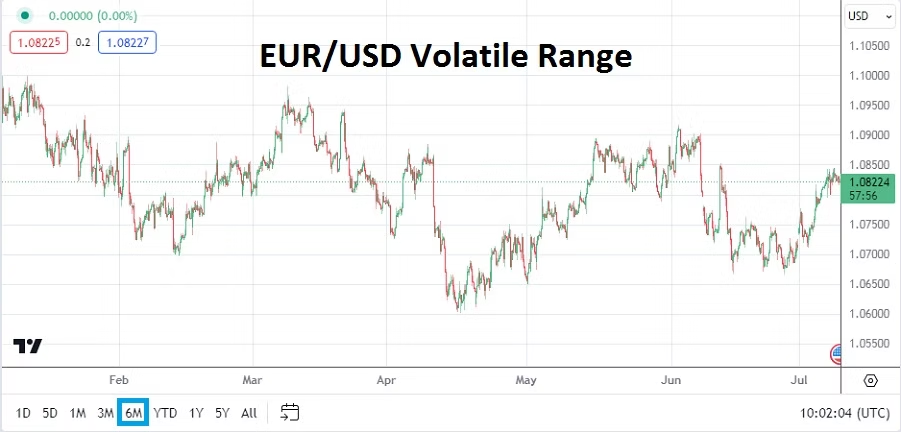
EUR/USD Six Month Chart on the 9th of July 2024

France held its Parliamentary second round elections on Sunday, and while the votes have been counted, the results in many ways are not yet clear. Coalitions are being rumored and EUR/USD traders may react to the developments and within French bonds, but the murky political conditions within Paris remain hard to predict regarding outcome as a whirlwind of deal making takes place in an assortment of offices.

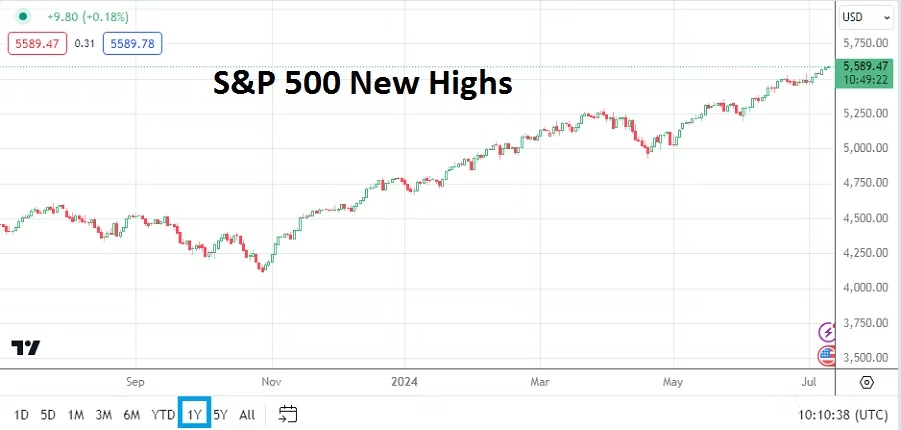
S&P 500 One Year Chart on the 9th of July 2024

The lack of total volume last week in Forex and equity indices did not stop trends from being seen and technical perceptions being formed. U.S stocks remain highly valued and U.S Treasury yields have produced a downwards slope.

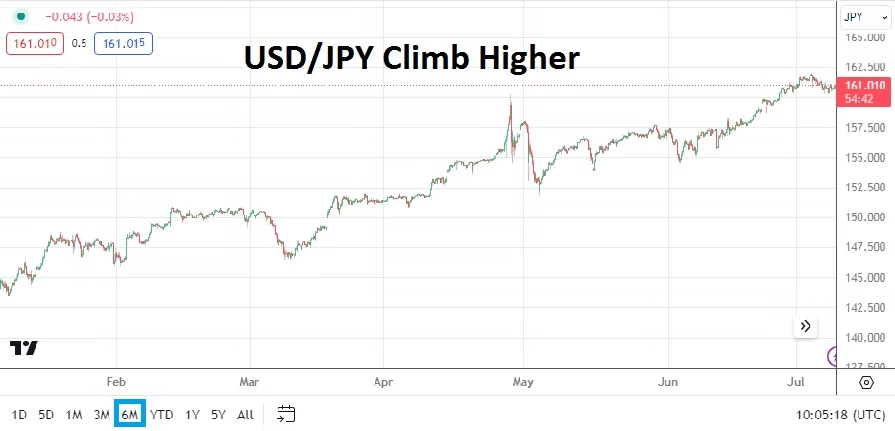
USD/JPY Six Month Chart on the 9th of July 2024

Today will prove interesting as Jerome Powell and Janet Yellen speak in Washington D.C, later this week inflation data will certainly cause a stir. While Biden remains a concern, France tries to form a working government, and the Bank of Japan is being viewed with deep suspicion, day traders have reasons to monitor news, but they should also remember financial institutions have been positioning for potential sentiment shifts and may not react with volatility if their outlooks are confirmed.

This week of trading is laden with risk events, some of which are listed below, but speculators need to understand behavioral sentiment is showing signs of optimism within many financial assets, and the prevailing mood of financial institutions appears to be leaning towards risk appetite.

Monday, 8th of July, Japan Average Cash Earnings – real wages continued to fall via data reported yesterday. The USD/JPY is traversing dangerous heights and speculators are likely still testing their bullish perspectives even as the 161.000 sees values tested above. Traders should stay cautious and not bet wildly on more upside, but lower valued speculative viewpoints are also problematic for the time being. Simply put, beware of the BoJ as it looms in the shadows.

Tuesday, 9th of July, U.S Federal Reserve Chairman Powell – the central bank chief will testify before the Senate. U.S economic data has weakened via Gross Domestic Product, and Manufacturing and Services readings. However, inflation remains troublesome and Powell will have to speak about these issues in conjunction via his Monetary Policy Report. He will certainly try to sound cautious. If Powell hints at a potential rate cut in September this would spark USD selling. At the same time the Fed Chairman is talking, Treasury Secretary Yellen will be speaking to the House Financial Services Committee. Traders can be assured that Powell and Yellen will mirror each other. And Powell will speak to the House on Wednesday.

Wednesday, 10th of July, China CPI and PPI – the Consumer Price Index is expected to have a gain of 0.4%, while the Producer Price Index is anticipating a result of minus -0.8%. Deflation in China is a concern. Economic statistics continue to produce lackluster results, while this a partially due to the collapse of the real estate bubble in China, it also has to do with less demand for products from abroad as Europe and America suffer from economic declines too. The USD/CNY has produced a bullish trend since the start of 2024 and is traversing near 7.2714 as of this writing. Traders should look at the inflation reports and examine them for revisions downward in previous months.

GBP/USD Six Month Chart on the 9th of July 2024

Thursday, 11th of July, U.K Gross Domestic Product – the newly elected Labour government will get their first taste of big economic data challenges as they now guide Britain. A lackluster gain of 0.2% is expected. While this may move the GBP/USD a bit based on the result, the currency pair will likely react more to the U.S inflation data later in the day. The July bounce higher in the GBP/USD has been healthy and value above the 1.28000 has provided bullish traders with some optimism.

Thursday, 11th of July, U.S Consumer Price Index – the core CPI report is projected to match last month’s number of 0.2%. If this result can be attained and the CPI annual data comes in with the anticipated 3.1% mark compared to last month’s figure of 3.3%, this could create dynamic bearish activity for the USD. However, traders should remain cautious and note that even though recent U.S economic data has tumbled, inflation reports have been stubborn. Betting on the outcome of these reports before they are published is akin to gambling for day traders.

Friday, 12th of July, U.S PPI and Preliminary University of Michigan Consumer Sentiment – the Producer Price Index reports are expecting slightly higher ratios. The Consumer Sentiment report should be looked at too, because the readings have been coming in weaker the past handful of months. If consumer behavioral sentiment is weaker the USD could sustain a negative stance.

postR170

Middle East is Proving to be a New Playground for the Axis

Middle East is Proving to be a New Playground for the Axis

Opinion: The following article is commentary and its views are solely those of the author. This article was first published the 4th of July with an addendum on the 5th via The Angry Demagogue.

Blinken Gets Pushed to the Back of the Line

While the Biden-Blinken Administration is obsessing on “non-escalation” and telling allies they are on their own if they attack an Axis member that attacks the ally,  or that they will help the ally “defend itself” but not take the offensive (how you do that is a mystery) the Axis itself is establishing itself all over the Middle East.

Let’s start with a statement, quoted in Israel, by Alexander Dugin who is Putin’s ideological advisor advising the Russian leadership to arm Hezbollah and the Houthis in their fight against Israel. Earlier this week, Newsweek reported that Russia is considering arming the Houthis with cruise missiles. These could be used against Israel and against Saudi Arabia – or maybe U.S bases in the area. As Russia seeks to cement its ties with anti-Western countries and forces around the world, it seems to be partnering with Iran so as to increase the potency of Iran’s proxies and press their goal to rid the region of U.S forces. Toward this goal Iran and even Russia are manufacturing tanks together in Iran.

The Houthis themselves, under with the guidance of Iran, are attempting to expand their sea blockade from Bab al Mandab straits connecting the Gulf of Aden with the Red Sea, to the east African coast by cooperating with the Sunni and al-Qaeda based Somali terrorist group al-Shabaab al-Mujahadin. Reports in Israel quoting U.S intelligence sources claim that the two groups are cooperating and that the Houthis will supply weapons to al-Shabaab in order to interdict global shipping off the Somali coast and in order to harass U.S forces stationed in the area.

The anti-U.S alliance seem to be able to cross religious and ideological boundaries in ways that western intelligence thought impossible. That is because western (and Israeli) intelligence mis-categorize all of these groups and countries. The issue is not who is Sunni and who is Shiite, who is Russian Orthodox and who is Communist, but rather, who is for keeping the international status-quo and who’s for, to use a phrase meant for different times – a “new global order”.  

The Houthis, feeling confident in having defeated the U.S Navy in the Red Sea are now threatening Saudi Arabia for saying no to a Russian negotiated deal (under the auspices of the U.N and opposed by the U.S) which would bring an end to the embargo against the Houthis including their export of oil as well as Saudi financing of the Houthi civil government in the part of Yemen they occupy (they learned from Hamas and Qatar/PA/Israel that you really can have your enemies pay your salaries) amongst other goodies. They blame Saudi Arabia for allowing U.S jets to bomb Houthi sites from airbases inside Saudi Arabia – with no U.S carriers in the Red Sea that certainly could be true. In their threat they included videos of their bombing of Saudi oil fields in 2019 just in case the Saudis forgot. 

The Houthis, with their experience stopping shipping, have, according to a JCPA report been the point men for Iran’s plan to extend the sea embargo against Israel to the Mediterranean. This would not only hurt Israeli shipping but also the ability of its Air Force to operate properly. We wrote recently about Iran’s possible plans for Cyprus, including Hezbollah’s open threat to them, and this fits nicely with their plan to ring Israel with fire on all sides. We already know that Russian intelligence vessels are in the Mediterranean tracking Israeli submarines and that the Russian naval base in Syria is a safe haven for Iranian shipping. 

Just this week an Iranian vessel filled with arms for Hezbollah anchored in the Syrian port of Latakia (why did Israel not sink this??!!) which is 100kms (60 miles) north of the Russian naval base in Tartus, Syria – was it escorted in by the Russian Navy? Is that why?  

The U.S now has three main allies in the Middle East – Israel, Saudi Arabia and UAE, and with the exception that the UAE administration has a habit of criticizing and threatening these allies. 

It boggles the mind that Blinken does not see what the entire world sees – a so far successful effort rid the Middle East of the U.S and its allies. For Israel that means annihilation and for Saudi Arabia it means probably surrender to the Iranians while its royal family is allowed to enjoy their money (best case scenario). For the UAE it means it will be used even more than it currently is as an Axis financial center. For the U.S it means a withdrawal, not to the Western Hemisphere – but to the northern half of it. 

The Middle East is slowly becoming the playground of the Axis and it is just a matter of time before the West won’t be able to get a turn on the swings.

Addendum: A short follow regarding the Houthi ultimatum to Saudi Arabia

The Houthi’s gave the Saudis 72 hours to respond and respond they did. The Saudis have agreed to all the demands of the Houthis as they realized that the United States will not defend them from attack and are unwilling or unable to deter, let alone to destroy the Houthis offensive capabilities.

Amongst the Houthi demands that the Saudis agreed to are:

1. The re-opening of the airport in Sana’a, Yemen.  They will allow direct flights to bring pilgrims to Mecca, flights to Jordan and soon flights to everywhere. This will allow the Houthis to be re-armed by the Iranians via air transport.

2. Payment, by Saudi Arabia of Houthi government employees.

3. Allowing the Houthis to sell oil – ending the embargo.

This is a plan, as stated, sponsored by Russia and not opposed by the United States. It is a further move by the Axis into pushing the U.S out of the region. It is not clear if part of this agreement is for the Saudis to disallow U.S use of the Prince Sultan Ari Base for attacks on the Houthis.  

As an aside, the UAE has suggested that the U.S setup a base in Somaliland – a breakaway country in the horn of Africa on the coast of the Gulf of Aden and bordered by Djibouti and Ethiopia (and of course Somalia). This seems to be an attempt to rid the Gulf States of the responsibility to host U.S forces that attack Iranian proxies.  Could Biden’s “you are on your own if you attack Iran” (back in April after the 300 projectile attack on Israel) have influenced their decision?

Russia and Iran are on the rise in the region as the U.S administration preaches de-escalation and appeasement. 

Disclaimer: the views expressed in this opinion article are solely those of the author, and not necessarily the opinions reflected by angrymetatraders.com or its associated parties.

You can follow Ira Slomowitz via The Angry Demagogue on Substack https://iraslomowitz.substack.com/

postR168

AMT Top Ten Miscellaneous Missiles for the 21st of June 2024

AMT Top Ten Miscellaneous Missiles for the 21st of June 2024

10. Say Hey Kid: Baseball legend Willie Mays passed away earlier this week. He was a beloved player on the New York and San Francisco Giants in the 1950s, 1960s, and early 1970s. He might have been the best five tool baseball player of all-time.

9. AI Apocalypse: Talk about selling Nvidia shares to cash out of the super hot Artificial Intelligence tech boom on Wall Street might be considered the safe thing to do in order to protect profits. However, betting on the existing ‘machine learning’ gold rush in the stock markets to possibly end soon, thus turning into a ‘dot com’ like bubble bursting in the spring of 2000 could be misguided. The ‘dot com’ exuberance essentially started in 1995 and ran for almost five full years. The Artificial Intelligence surge may still have a lot of room to run.

8. Simmering Crypto: Bitcoin, Ethereum, and Binance Coin all remain at lofty prices, but they have lost value since touching highs in the first week of June. Trading volume of cryptos – including BTC/USD – is still below its peak of 2021 and early 2022. While the introduction of ETF products for Bitcoin has gotten institutional money involved, many individual ex-traders remain cautious. Former illustrious speculative plays like Dogecoin and Shiba Inu have turned into niche wagering cesspools.

7. Hezbollah Poker: Hassan Nasrallah delivered a surprise statement earlier this week when he proclaimed if there is an escalation between Hezbollah and Israel, that Cyprus could be attacked by missiles. The U.K still maintains sovereign military bases at Akrotiri and Dhekelia on the island of Cyprus. Direct fire from Hezbollah on an E.U member nation would be a major intensification of the Middle East conflict. Nasrallah may believe the rather limited response by the West to the Houthis attacks in the Red and Arabian seas, makes his threats on Cyprus an objective guise to get the West to pressure Israel to hold their fire.

6. Commodity Watch: WTI Crude Oil price is over 81.00 USD as of this writing and Gold is near 2365.00 per ounce. The price of energy needs to be watched because of its potential impact of inflation. WTI prices have been rather tame the past two and half months, but have climbed the past week. The precious metal remains within sight of highs and has been lingering within an elevated range since the middle of April. Cocoa for those interested is back below 10,000.00 USD per metric ton.

5. Shifting Sentiment: The Mexican Peso and Brazilian Real have lost value as politics in Mexico and Brazil are causing nervousness among financial institutions. The governing political parties in both nations are trying to reach for new powers, and the selloff of the two currencies against the USD have been clear. Morena, the leftist political party governing Mexico, is seeking controversial judicial reform which is seen as an attempt to gain more political influence. Lula da Silva’s Workers’ Party is attempting to take the head of the Central Bank of Brazil, Roberto Campos Neto, to court to try and muzzle his fiscal viewpoints. The USD/MXN is near 18.31650 and the USD/BRL is around 5.4539 as of this writing. Rand traders who have seen a bearish USD/ZAR trend emerge the past week and a half because of renewed optimism in South Africa might find the spats in Mexico and Brazil intriguing.

4. Euro Barometer: The first French election will be held on the 30th of June, the second on the 7th of July. The contest is shaping up as a election between the Left and Right. Political coalitions are being formed rapidly. The attempt to coalesce on the Left is an obvious sign that politicians feel threatened with the prospect of sweeping losses. Media noise is certain to boom and be exaggerated in the coming days as warnings about this election potentially affecting all of humankind litters the airwaves. Macron and other politicians may find tough days ahead as they apologize for policy failures and get punished via the election outcomes. The EUR/USD is close to 1.06931 for the moment.

3. China Woes: Economic data from the housing sector continues to show a downwards trajectory regarding home values in the nation, and it is having an impact on consumers as their net worth suffers and affects spending habits. Not only are property values still dropping at a rapid pace, but recent Factory output data has come in below expectations. China is tentatively scheduled to release Foreign Direct Investment numbers soon.

2. Summer Doldrums: Investor behavioral sentiment appears to be in a wait and see mode as as more impetus is awaited and large players grow cautious. The U.S will issue PMI manufacturing and services data today, but the results will have a limited effect. The U.S Juneteenth holiday which was celebrated on Wednesday and the return of traders yesterday did not rejuvenate optimism. The Nasdaq Composite and S&P 500 lost some ground. While the Dow 30 did gain slightly yesterday, the index has been treading water compared to the Nasdaq and S&P over the past month.

1. Geriatric Debate: Next Thursday the 27th of June, President Biden and former President Trump will debate. The televised event will be watched by American voters and the world. Not only will the debate deliver potential impetus to financial assets if there is a clear winner, but it may provide a large wagering environment for betters who gamble on which Presidential candidate will be the first to go off script. People in the U.S desire a discussion about the economy, foreign policy and immigration, this while hoping for a lack of mishaps, hyperbole and demagoguery which is unfortunately quite likely.