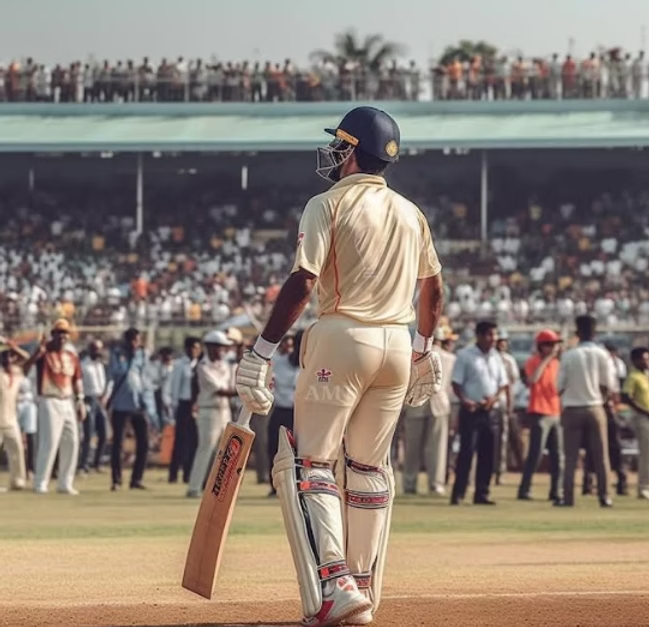
post224

The Greatest Rivalry: India vs Pakistan: Netflix Doc. Review

The Greatest Rivalry: India vs Pakistan: Netflix Doc. Review

The India-Pakistan cricket rivalry is one of the most intense and storied in the history of sports. This 3-part Netflix documentary delves into this historic cricket rivalry, focusing primarily on the 1999 and 2004 tours. While it provides an engaging look at these high-stakes encounters, the series feels somewhat incomplete, as it largely skips over the period before 1999 and rushes through the events post-2004, condensing nearly two decades into the final 10 minutes of the last episode.

The Greatest Rivalry: India vs. Pakistan – A Review of the Netflix Cricket Documentary

One of the more thought-provoking moments comes from Pakistani journalist Osman Samiuddin, who draws a cultural comparison by noting that Pakistan’s savings rate lags India’s. He suggests this reflects differing life philosophies – Pakistanis living more in the present versus Indians planning more for the future. Indian journalist Ayaz Memon describes the 1999-2004 era as a clash between Pakistan’s world-class bowlers and India’s formidable batsmen. However, the reality is that both teams were evenly matched during this period, adding to the intensity and unpredictability of their contests.

The documentary effectively captures the electrifying atmosphere whenever these two nations face off, highlighting the high emotions and record TV ratings. Indian cricket legends like Sunil Gavaskar, Kris Srikanth, and Sourav Ganguly provide insightful commentary, but it’s Virender Sehwag who takes center stage for his pivotal role in the 2004 series. On the Pakistani side, Shoaib Akhtar, at the peak of his career, is a key figure, alongside Javed Miandad, Waqar Younis, and Inzamam-ul-Haq. John Wright, the coach of the Indian team in 2004, also shares some noteworthy behind-the-scenes anecdotes.

The series makes a commendable effort to keep political tensions at bay, but the deep-rooted rivalry between the two nations inevitably influences the narrative and the emotions of fans on both sides.

A brief segment touches on the Indian Premier League (IPL), cricket’s biggest moneymaker, noting that Pakistani players participated in the inaugural 2007 tournament. However, the 2008 Mumbai terror attacks led to a political fallout, resulting in the exclusion of Pakistani players from the IPL. This absence has deprived the league of some exceptional talent and the unique buzz that a cross-border rivalry would have generated. The documentary provocatively suggests that had Pakistani players continued in the IPL, the fierce on-field competition might have evolved into a more sporting rivalry, possibly softening fan perceptions across borders.

The timing of this documentary is particularly relevant, with the 2025 Champions Trophy starting this week (Feb 19) in Pakistan. However, citing player safety concerns, India has opted to play all its matches at a neutral venue in Dubai. This decision underscores the ongoing political tensions that overshadow cricketing ties. The documentary leaves viewers pondering whether a day will come when sports can take precedence over politics, allowing fans in both countries to once again experience the thrill of live, cross-border cricket.

Overall, while the documentary provides a nostalgic and thrilling account of one of cricket’s most storied rivalries, a more balanced historical perspective and deeper exploration of the post-2004 era would have made it even more compelling.

postR171

Triumphant Victory Marks End of Era for Indian Cricket Greats

Triumphant Victory Marks End of Era for Indian Cricket Greats

A Farewell to Legends: Kohli, Sharma, and Jadeja Retire from T20 Internationals

In a significant shift for Indian cricket, three stalwarts have announced their retirement from T20 internationals following the conclusion of the recent T20 World Cup. Virat Kohli, Rohit Sharma, and Ravindra Jadeja, each a pillar, have decided to step back from the shortest format of the game. Their retirements mark the end of an era and leave an indelible void in the Indian cricket team.

The Impact of Kohli, Sharma, and Jadeja

These three players have been instrumental in countless victories for India, bringing their unique talents and personalities to the field. Kohli, with his exceptional fitness and fiery passion, has been a cornerstone of the Indian batting lineup. Sharma, renowned for his elegant stroke play and ability to anchor innings, has often been the linchpin in crucial matches. Jadeja, with his all-round prowess and agility, has contributed significantly with both bat and ball, not to mention his spectacular fielding.

Their departure from T20 internationals is not just a loss of talent but a great shift in the team’s dynamics. Kohli’s fervent celebrations and on-field energy, Sharma’s cool-headed leadership, and Jadeja’s versatility will be sorely missed by fans and teammates alike.

The Perfect Farewell

For Kohli, Sharma, and Jadeja, winning the T20 World Cup was a dream and they achieved that in 2024 edition. Their commitment to this goal was unwavering, and with India’s triumphant win, they decided that retiring on the high note of a World Cup victory was the perfect way to bow out. This victory, fulfilling a long-held aspiration, was the ultimate peak of their careers, making it a fitting moment to conclude their illustrious journeys in T20 cricket.

The Kohli Phenomenon

Among the trio, perhaps the most striking figure is Virat Kohli. His presence on the field has been synonymous with passion and intensity. Kohli’s fitness standards have set a benchmark in modern cricket, inspiring countless young athletes. His emotional celebrations, especially after pivotal moments, have captured the hearts of fans worldwide.

Kohli’s relationship with the media and fans has been a rollercoaster, reflective of the intense scrutiny Indian cricketers face. Loved and critiqued with equal intensity, he has navigated the ups and downs with poise. Off the field, Kohli has also emerged as a social media powerhouse, engaging millions of followers with his dynamic presence. He is not just a cricketer; he is a brand, masterfully managed and perpetuated, resonating with fans far beyond the cricketing sphere.

The Future of Indian Cricket

As Kohli, Sharma, and Jadeja bow out of T20s, the Indian team stands on the brink of a new chapter. There is no shortage of emerging talent ready to fill their shoes in terms of runs and wickets. However, replicating the aura and legacy of these veterans is another challenge altogether.

The question now is whether the next generation can cultivate the same level of charisma and connection with fans that Kohli has achieved. Will there be a new player who can stir the same depth of emotion, embodying both the love and critique that Kohli so adeptly managed?

As Indian cricket moves forward, the legacies of Kohli, Sharma, and Jadeja will undoubtedly continue to inspire. Their contributions have not just been in numbers but in the very spirit of the game, setting standards and creating moments that will be treasured by cricket enthusiasts for years to come.

postN59

Elvis has Left the Building, but his Legend Lives On

Elvis has Left the Building, but his Legend Lives On

Book corner: Elvis: Destined to Die Young by Sally A. Hoedel.

Singer and icon Elvis Presley passed away forty-six years ago at the relatively young age of forty-two. Presley wasn’t the first singer – or celebrity, for that matter – to pass before his time. But the circumstances surrounding his death have garnered as much press as the man himself did for his fame and music during his short life: on August 16, 1977, following several years of increasingly serious health issues, Presley was found dead on his bathroom floor, bloated and in poor health, with staggering levels of drugs in his body.

What exactly happened, how it happened, plus why it happened – all have been the subject of a media feeding frenzy that put his personal physician, Dr. George Nikolopoulos (AKA “Dr. Nick”) on trial and had him stripped of his medical license in the state of Tennessee. Later, a series of biographies were written, none too complimentary, that attempted to put the pieces of the puzzle together.

Journalist Sally A. Hoedel, in her book Elvis: Destined to Die Young, attempts to do just that. The book is an odd spin on the standard rock star bios, which usually dwell on cultural impact and creativity. Hoedel, in a meticulously researched book, focuses on Elvis’ health and makes a bold but credible assertion: the prescription drugs, to which he was addicted in his later years, were not what killed him. He suffered from diseases in nine of eleven bodily systems, five of which were present from birth and as a result, was never going to live a long life.

Hoedel begins with Elvis’ family history and takes the reader back to early twentieth-century backwoods Mississippi, at the time one of the poorest regions in America. She explains that his maternal grandparents were first cousins, something that happened with alarming frequency in that era of the American South before modern medical practices and society’s taboos put a stop to it. Elvis’ maternal grandmother, Doll, suffered from Alpha-1 antitrypsin deficiency (misdiagnosed as tuberculosis), a genetic disorder causing liver and lung issues. The resulting union, she explains, caused medical issues for their progeny. Elvis’ mother, Gladys, died at the age of 46 following liver problems, which Hoedel explains was widespread in her family tree and passed on to Elvis (his autopsy confirmed that he was a carrier). According to Hoedel’s book, it is not a coincidence that the mother and son died at around the same age.

Elvis also suffered asthma as a child, also a possible result of Alpha-1, and frequent bouts of tonsilitis, the latter well until his adult years and way past the age at which this sickness is common. But two ailments appeared in his early years that would plague him his entire life with catastrophic ramifications. He suffered horrible constipation problems, putting him in constant pain and creating additional colon issues, and he was a lifelong insomniac. Regarding the latter, Hoedel explains that in his 1970s performing years, he was unable to sufficiently rest enough between performances and suffered exhaustion, sometimes ending up in the hospital. In fact, the list of hospitalizations is staggering and is by far longer than that of any performer active today.

The second half of the book focuses on Elvis’ final touring years and the prescription drugs on which Elvis would create a dependency in his later years. Hoedel asserts that Elvis did not use drugs for recreational purposes, to escape from reality, or as a means to enhance his creativity, as was (and arguably still is) common to rock stars. As a patriot and religious Christian, he was staunchly against drug and alcohol abuse. Instead, he needed the drugs to manage his health. Hoedel describes in length the eleven bodily systems and the nine that were failing him, and why. A partial glimpse of those health issues includes arthritis, glaucoma (hence those giant-framed sunglasses he wore in the 70s), anemia, hypertension, diabetes, and an enlarged colon and spleen.

One wonders how he even got on stage to perform in that condition. The book deals at length with the grueling performance circuit he endured following his 1968 comeback, due to the Colonel. For example, Elvis would routinely play Las Vegas for weeks at a time, with two shows a night, giving a high-energy performance where he would lose several pounds of sweat per show. Hoedel describes shows in the 70s where he fell down on stage and others in which he had to sit down to catch his breath and rest, asking his backup singers to take over.

The books deals with the question, why? For example, why didn’t he take time off from performing to rest and to undergo proper medical examinations? In the chapters on Elvis’ early life, Hoedel describes the gut-wrenching poverty that Elvis endured as a child, where his parents struggled to provide for him. At one point, for example, his family lived in a shack in an alley. Hoedel explains that Elvis was determined to be a provider for himself and for his family. As the years went on, he added more and more friends and family to his payroll, such as his cousins and stepbrothers, etc., for altruistic purposes. He repeatedly said he was unable to take a break from performing since people were counting on him. This feeling of obligation was also in regards to his fans, too, as he avoided doing anything that would let them down. His need to perform was made worse by irresponsible and impulsive spending habits, creating a severe cash flow problem that routinely forced him to go back on the road.

The book also exonerates Dr. Nikolopoulos, who was skewered in the national press after Elvis’ death for having no regard for Elvis’ health and for being the provider that killed Elvis with an endless supply of drugs. Hoedel provides evidence to the contrary and gives him a fair say. She explains that Elvis would often go behind his back and seek prescriptions from other physicians.

Hoedel is an admitted fan and deals with Elvis with respect, painting him as a decent, though flawed, human being. Some of the stories present him as a sad character, a shock considering he was a man who looked for much of his life vibrant, healthy and handsome and who was worshipped by many as a god. She consulted with scores of experts for medical explanations and tries her best to present them in the book with stripped-down and clarifying terminology.

Elvis may have left the building, but his story lives on. This book proves it.

Purchase here: https://amzn.to/3LN4pEd

postN55

ICC Men’s Cricket World Cup 2023 – Thoughts and Predictions

ICC Men’s Cricket World Cup 2023 – Thoughts and Predictions

The 13th edition of the ICC Men’s Cricket World Cup is scheduled to commence in October 2023, featuring a total of 48 thrilling matches. This tournament holds the prestigious title of being the “flagship event of the international cricket calendar,” according to the International Cricket Council (ICC). India has the honor of hosting this edition, a choice that aligns well with India’s global prominence. This decision gains added significance in a year when India became the world’s most populous nation, and its GDP growth rate ranks among the fastest of any major economy.

The sport of cricket has expanded its footprint across the globe, being embraced by numerous countries. However, in this edition, only 10 teams will participate, a deliberate choice to maintain the intensity of the matches. Eight out of these 10 teams earned their spots through the super league performance, while the final two, Sri Lanka and Netherlands, secured their places via a “world cup qualifier tournament.” It’s important to note that there are no newcomers in this edition; all participating teams have previous experience at this level.

Based on performance rankings, four teams stand out as strong contenders for a spot in the semifinals: India (ranked 1), England (2), Pakistan (3), and New Zealand (4). However, it’s crucial to remember the disclaimer from financial investment products: past performance is no guarantee of future results. The eventual World Cup winner will likely be a team that doesn’t rely solely on star players, but boasts a balanced composition with multiple match-winners. In another analogy with the financial world, it’s akin to maintaining a diversified investment portfolio, a prudent allocation strategy that can weather various market conditions and risks.

India currently holds the top ranking and demonstrated their prowess by convincingly defeating Sri Lanka in the recent Asia Cup. Throughout the Asia Cup, diverse Indian players showcased their talents in different games, highlighting the team’s depth of match-winners and individuals capable of thriving under pressure. These qualities are pivotal during major tournaments, making India a favorite to claim the World Cup. Additionally, as the host nation, India enjoys the advantage of playing on home soil, further boosting their prospects in the tournament.

England enters the competition as defending champions, having triumphed in the thrilling 2019 World Cup finals against New Zealand, a match that ended in a tie. Ultimately, England secured victory based on a technicality. It’s essential to note that this outcome in no way diminishes England’s deserving win, as the result could have swung in either direction. Since then, England has maintained their dominant form, boasting a squad teeming with players capable of leading their team to victory. On paper, this team is arguably the most well-balanced, featuring a batting lineup that combines power hitters and run accumulators, as well as a versatile bowling attack capable of delivering both pace and swing or employing a slow, stifling approach.

Pakistan’s performance often oscillates, creating a roller-coaster of emotions for their dedicated fan base. On their best days, Pakistan can outclass the favorites, but they also exhibit a tendency to falter in tight contests. In the recent Asia Cup, despite being favored, they fell short of reaching the finals due to injuries to key players and lapses during critical moments. Pakistan’s success frequently hinges on the prolific scoring by their captain, Babar Azam, and the batting prowess of Mohammed Rizwan. In the bowling department, their reliance on superstars like Shaheen Shah Afridi and Haris Rauf is evident. This dependency on specific players presents a challenge to their World Cup aspirations.

New Zealand is somewhat of a statistical anomaly, consistently producing a remarkable number of world-class players from a relatively small population. They excel in identifying promising talent and nurturing it to create high-performance athletes. Furthermore, the New Zealand team is affectionately known as the ‘nice guys’ of cricket, celebrated for their amiable nature. Like Pakistan, the New Zealand team places considerable reliance on specific players, with the batting finesse of Kane Williamson and Tom Latham, combined with the lethal fast bowling of

Trent Boult, serving as a cornerstone of their success. The success of the team will depend on these star players maintaining their form throughout the tournament.

Two teams with contrasting World Cup histories deserve attention: Australia, a five-time champion, and South Africa, a team that has never reached the finals despite its quality. Australia, while not as dominant as in the past, continues to display a solid brand of cricket. The team is currently undergoing a transition, with younger players assuming leadership roles. Recent performances may not indicate peak form, so Australia lifting the cup would underscore their commitment to process and mental training.

South Africa finds itself in a similar situation to Australia, boasting numerous talented players but struggling to maintain consistent performance. Both Australia and South Africa appear to have individual excellence, but face challenges in cohesively functioning as a team.

In conclusion, India and England emerge as the front-runners for a coveted spot in the World Cup final. These two teams showcase a balanced roster with game-changing abilities. However, the question looms: can Pakistan’s star-studded lineup carry them to the summit, or will New Zealand’s proficient athletes secure another final berth? Could Australia recreate history, or will South Africa, long awaiting their breakthrough in a World Cup tournament, finally shine on the global stage? Alternatively, could an underdog team spring a remarkable surprise? Only time will tell. One certainty remains, though: winning a high-pressure World Cup tournament requires more than just physical fitness and mental resilience; it demands unwavering heart and determination.

postN35

Fantasy Football Drafts and Finding Key Undervalued Picks

Fantasy Football Drafts and Finding Key Undervalued Picks

Millions of fantasy football team managers will be picking their players this coming weekend and early next week as the NFL gets set to begin. The Detroit Lions will be visiting the Kansas City Chiefs on the 7th of September which will kick off the season. Real football is great, fantasy football, however, is enticing for many because it allows us as fans to ‘participate’ and show what we know, and sometimes unfortunately don’t know. And like day trading it can also cost money or make profits depending on the ability to select assets and use risk management wisely.

Fantasy Football Drafts are Coming

Whether you are playing in a fantasy league that has ‘free’ drafts or need to price players per an allowable budget while selecting your team, you need to consider your options carefully. Many fantasy football leagues mandate rosters that include 15 picks. Over the past few years a growing emphasis has evolved around wide receivers as they have outscored running backs by a wide margin.

Top Tier Wide Receivers Compared to Other Positions

Finding solid wide receivers in the first two rounds of the draft is a tactic many players have started to use, then this is followed by choosing a running back or two to fill in these positions which are needed per your active weekly roster. Nowadays you want a running back who also can catch the ball, yards matter and a lot of them come after a pass has been caught.

Quarterbacks, as worthy as they are in the NFL and fantasy football, have become a commodity that many team managers wait on until the late fourth or fifth round to select. Fantasy football team managers need to remember the game is quantified via points on paper and is completely different than the game being played on the field. Your bias against a certain NFL team and the fact that you have a team you root for can often cause a lot of discomfort if you make your selections with these sentiments clouding your judgement.

Selecting positions and the round they are taken also depends on the amount of players in your league. The above is written with the notion that leagues are 10 teams. If you are participating in a league with 12 teams, then you can count on quarterbacks starting to disappear who are considered tier 1 players in the third round. Yes, you will also find fantasy managers who gamble and take a quarterback earlier. However, seldom do you see a qb taken in the first round.

Patrick Mahomes and Jalen Hurts are causing plenty of early selections and looks this year via mock drafts. But fantasy managers need to be careful and make sure they do not overpay by drafting the quarterbacks too high, and lose out on other key positions in which points are accumulated and can prove costly if you miss out on talent which provides needed active roster value.

A key spot on fantasy football rosters includes the ‘flex’ which allows for wide receivers, running backs or tight ends to be used in this ‘extra active’ position. Yes, some leagues allow for two quarterbacks to play at once also. Not to mention leagues that include defensive players, not including defensive teams. The point being that the flex position and the importance wide receivers have taken on often means wide receivers go fast and hard in fantasy football drafts because of their ability to accumulate value better than most running backs and tight ends.

Finishing Well Based on Undervalued Selections that Over Perform

Your decision in the later rounds are often more important than early selections. This is where you can begin to develop a team that finishes high among your friends and competitors. Deciding on your top tier players within positions is important but it is also crucial to decide on who you think is overvalued and who is undervalued. For instance, it has been noticed in mock drafts that the wide receiver Calvin Ridley is being taken suspiciously high by fantasy managers counting on Trevor Lawrence potentially making him a top receiver this season. Folks are counting on outlooks of what could be, instead of what has happened the past couple of years and this could prove dangerous. Lawrence will try to get the ball to him, but will Ridley be ready.

George Pickens of the Pittsburgh Steelers stands out. He is a second year wide receiver who has incredible talent and via many mock drafts seems to be lasting until the 7th round and sometimes even the 8th. The fact that Pickens plays with a second year quarterback who is not getting a lot of attention early either in Kenny Pickett is intriguing. Pickett in ten team mock drafts appears to be lasting until the last round in many cases, allowing for a potentially solid player to backup your tier 1 or 2 quarterback and to be replaced if your starter gets injured or have a bye week.

Does anyone want to go into what DeShaun Watson did last year after missing extensive playing time the past couple of years before? Real game speed takes a while to get used to even by veteran NFL players if they have been standing on the sidelines too long. Counting on players such as Calvin Ridley to immediately perform like a tier 2 wide receiver may prove to be wishful thinking. Yes, he is playing with a quarterback in Lawrence who has all-world talent, but Ridley will have to prove he is ready for prime-time. By the way, DeShaun Watson may prove to be undervalued as a quarterback, if he regains his form which seemingly vanished upon his return from a suspension last season as he struggled.

So what do you do in theory? Staying away from Calvin Ridley who seems to be a gamble in the 4th round and waiting on another wide receiver you believe will perform solidly, but can draft a little lower may be the route to go with more than a handful of players. Passing on tier 2 players and taking a player at another position who you believe will perform better is an option.

Fantasy football results are largely about fulfilling expectations among top players selected and finding hidden gems others have not considered in later rounds. Team managers also have to weigh positions via their point production expectations, and decide if it is better to overload on wide receivers for instance who are in the top 3 tiers, and then wait and gamble on questionable other positions consisting of second or third tier production which may be around later to select.

The same process needs to be used for drafting defenses and kickers. There are only a few difference makers on defense and among kickers who can be counted on to perform and deliver above average results and make them worth taking in higher rounds than normal. San Francisco, Dallas, Philadelphia and the New York Jets are considered top defensive selections by many. However, San Francisco may be gambled on earlier than expected, because their estimated point production may be above the remaining top tier 3 defense’s listed. Kickers work the same way via worthiness, only a few can reasonable be expected to outperform average results. Many kickers are taken in the last round for this reason.

Finding solid undervalued position players in the later rounds after your first five picks can change the outcome of fantasy football leagues. Production from the top selections is always important, but it is your skill level while drafting later that will likely determine your team’s overall performance.

Before you draft your team you should figure out how many wide receivers you want on your roster, a solid number would be to take 5, yes, out of your 15 player roster. This would allow for 3 running backs, two tight ends, two quarterbacks, 1 defensive team and 1 kicker, and then 1 streaming position which can be used to drop and add for players that have bye weeks and injuries that will certainly arise.

postN46

Cricketing Excellence: Factors Behind a Remarkable Evolution

Cricketing Excellence: Factors Behind a Remarkable Evolution

A recent article in a New York Times article, Studying the Limits of Human Perfection, Through Darts, analyzed how scores in darts, bowling and archery have improved over the past several years. This made me think about how the ability of cricketers has changed over time.

The New York Times article mentioned two things that stayed with me, “Athletes seem to get better, generation by generation.” “Today’s athletes may be more skilled than their predecessors. But they are often playing with better equipment or technology that can boost their scores.”

Cricket has gone through a massive transformation in the past 2 decades. The dexterity of players has undergone a significant change over the past several years. Several key factors have contributed to this remarkable improvement, showcasing the sport’s continuous drive for excellence. Here, we delve into five pivotal elements that have fueled the improvement in cricketers’ abilities:

1. Bat Design and Balance:

The evolution of cricket bats has played a pivotal role in enhancing players’ performance. Modern bat design emphasizes a delicate balance between power and control. Technological advancements have led to the creation of lightweight yet powerful bats, enabling players to deliver explosive shots without compromising precision. The increased sweet spot and improved aerodynamics have revolutionized the game, empowering cricketers to achieve unprecedented batting feats.

2. Targeted Fitness and Training:

The shift towards a more scientific approach to fitness and training has been a game-changer. Cricketers today undergo rigorous training regimens that focus on specific skills, strength, agility, and endurance. Sport science, data analytics, and specialized coaching have combined to provide players with tailored routines that optimize their physical capabilities. This holistic approach ensures that players are not only physically fit, but also capable of sustaining high performance over extended periods.

3. Mindset:

The mental aspect of cricket cannot be underestimated. Players are now equipped with psychological tools to enhance their concentration, resilience, and decision-making under pressure. Mental conditioning has enabled cricketers to overcome challenges and thrive in demanding situations. The shift from a ‘fixed’ mindset to a ‘growth’ mindset has fostered a culture of continuous improvement and adaptability, contributing to enhanced performance on the field.

4. Larger Pool of Players:

The global expansion of franchise cricket has resulted in a more diverse and competitive talent pool. Furthermore, emerging cricketing nations have produced players with unique playing styles and strategies, enriching the sport’s overall dynamics. The influx of fresh talent has spurred healthy competition and pushed established players to refine their skills, contributing to an upward trajectory of comprehensive performance standards.

5. No Fear of Failure:

The modern cricketing landscape encourages players to embrace risk-taking and learn from failures. The removal of punitive consequences for innovative shot-making or aggressive strategies has paved the way for players to express themselves freely on the field. This change in approach has led to more exciting gameplay, with cricketers aiming for higher levels of performance without being burdened by the fear of making mistakes.

The exceptional progress in cricketers’ athletic abilities can be attributed to a convergence of factors. The symbiotic relationship between bat design, targeted fitness and training, a resilient mindset, an expanded talent pool, and an environment that welcomes risk-taking has propelled the sport to new heights. As cricket continues to evolve, these factors will likely continue to synergize, driving players to even greater achievements on the global stage.

postN45

Dangerous and Unpredictable Duties During the Vietnam War

Dangerous and Unpredictable Duties During the Vietnam War

Book Corner: Policing Saigon, written by Loren Christensen.

War stories have always fascinated the public, ranging from Erich Maria Remarque’s

World War One novel All Quiet on the Western Front, to Alistair MacLean’s World War Two thriller The Guns of Navarone, up to the more recent American Sniper,

Chris Kyle’s autobiography of his combat experience in Iraq. Ex-cop and noted martial artist Loren Christensen throws his hat into the ring with Policing Saigon, the story of his

year as a military policeman patrolling the capital city of South Vietnam during the Vietnam War. Told mostly as a series of vignettes, Policing Saigon is at times dark-humored, shocking, sad, grisly, and even touching. (A note about terminology – in 1975 Saigon was renamed Ho Chi Minh City, and in 1976 South Vietnam merged with North Vietnam to become simply Vietnam.)

A cop in Portland, Oregon for 25 years, and a karate practitioner since his teens, Christensen is known mostly for a series of well-regarded policing and martial arts books. In Policing Saigon, he tells his story slowly and methodically. Growing up in suburban Washington state, his goal in college in the late 60’s was to break into radio and theater. Christensen took the initiative of enlisting, viewing the military police as an experience to draw upon for the acting world and incorrectly thinking that MP volunteers don’t receive overseas assignments (he notes that he was lied to by the recruiter).

After basic training, Christensen went through the range of military police courses such as language school and dog training. But after landing in Saigon in 1969, the 23-year old quickly realized that he was unprepared for the tough and thankless job. The MPs worked 12-hour shifts, seven days a week that often went hours into overtime in a sprawling, stifling hot and dirty city, hit hard by the war. The roads were clogged with haphazard and unregulated traffic that resulted in frequent accidents, some of which Christensen witnessed and some in which he was involved. The city was known for wretched poverty and was full of beggars, often children forced by their parents. The pollution was so severe – and the humidity was so brutal – that he developed both respiratory and fungal infections that took months into his discharge to heal.

The job was dangerous and unpredictable. The military police were hated by everyone, especially by those that were sympathetic to the Vietcong. The hate extended even to American GIs, since the MPs were often called in to arrest violent and drunken soldiers letting off steam on leave from the jungle. Christensen and his partners were also frequently called in to arrest AWOL (absent without leave) GIs, who flocked to Saigon in staggering numbers. He writes that in his tenure the number of AWOL soldiers never dipped below eighteen hundred. The American soldiers did not always go quietly and often resisted arrest, sometimes turning the scene into a brawling and bloody mess where the MPs needed backup.

As Christensen writes, the military police were also sitting ducks for all forms of terror, the perpetrators of which were impossible to catch. Snipers were liable to pick at them from nearby rooftops or windows, or bombs could be placed quickly and inconspicuously inside the military jeeps – even by children. Their job sometimes had them chasing thieves down dangerous, narrow, and winding alleys, frazzling their nerves and keeping them on edge. Even worse, as he writes, off-duty MPs were often unable to truly relax. Nighttime brought the sounds of artillery from the war’s front lines, serving as an uneasy and troubling background noise. Other MPs reacted to the stress of the war and their job in a number of ways. One of his early roommates casually kept a live python in a locker, mere meters from Christensen’s bed. Another inexplicably began shooting from the MP barrack’s balcony towards a truck transporting America’s allies, the South Vietnamese soldiers.

Crime against the American soldiers was rampant. Christensen writes that gangs of local thieves devised creative ways to steal from the American supply trucks, fueling the black market. Riding on motorbikes behind and alongside the trucks, they performed gravity-defying gymnastics while in motion as they would grab merchandise off the vehicle and speed off before unsuspecting driver realized what happened. Other crimes involved hookers. Sex-starved soldiers on leave would follow a hooker down an alley for a quick hookup and would instead be robbed. Others would actually engage in the act in the hooker’s room, while under the bed an unseen partner-in-crime (sometimes the girl’s mother) would reach out and pluck a few bills from the unsuspecting soldier’s wallet.

There are touching moments in the book, if one can call it that. Christensen isn’t a touchy-feely guy and his descriptions of these interactions come across as matter-of-fact and straight-forward. He writes of his admiration for the mainstream Saigon residents, mostly decent people trying hard to eke out a living. He notes their survivors’ mentality, and describes as they shrug off hardships and get back on their feet. In another chapter, he writes of meeting a group of cute Vietnamese kids, friendly and smiling to the MPs. But they were basically homeless street urchins living a hard life, sadly sleeping in a nearby cemetery. He writes of saying goodbye to his parents before shipping out to the army, facing an unknown future. And in one of the book’s most touching moments, he writes of his homecoming a year later, sitting quietly in his childhood room, the horrors of the war behind him.

Christensen was discharged in mid-1970 and less than 48 hours later was back home, a transition that was so fast it was jarring. He writes of his difficulty in adjusting to civilian life, suffering from PTSD until the return to martial arts would quiet his soul. He would later draw upon his MP experience for his police career, viewing it at five years’ experience combined into one year. A brown belt in karate at the time of his service, he realized that a more realistic and practical street-fighting style was needed, which he later taught privately and also to the police and military.

Christensen would be the first to admit that this not a book of heroics. This is not Band of Brothers or The Sands of Iwo Jima. But he took his job and his service in an unpopular war very seriously. The book clocks in at over 300 pages but his stories will hook you in. A worthwhile and moving read.

If you want to read another Book Corner article, please visit this review by Evan Rothfeld: https://www.angrymetatraders.com/post/ten-more-ok-now-twenty-finish-thirty-next-run-the-hill.

postN35

Fantasy Football Dark Horse Tight End Key to Better Results

Fantasy Football Dark Horse Tight End Key to Better Results

Last year Atlanta Falcons tight end Kyle Pitts likely hurt many rosters in fantasy football leagues. Pitts had received quite a bit of hype before the season started and this made it tempting for many fantasy managers to try and grab him early in their drafts. Leagues in which Pitts was taken in the third round or higher likely caused those teams to suffer all season long. Many managers who took Pitts last year are likely banishing him from their roster considerations for the upcoming NFL season.

Yes, Pitts did have terrible quarterback play hurting his value, but is this year going to be any better? Anyone taking Pitts before the fifth round of draft action is taking a huge gamble. True, Marcus Mariota is gone from Atlanta as the quarterback and is now fighting for the backup job on the Philadelphia Eagles this summer behind Jalen Hurts. The questionable dynamic of potentially bad quarterback play still shadows the Atlanta Falcons.

As much as we blame poor quarterback play for Pitts terrible results last year at tight end, perhaps offensive schemes via the coaching had something to do with the numbers too. Pitts has plenty of athletic talent, but the question is if the Atlanta Falcons can deliver him the football enough.

Desmond Ritter may be the qb starter for the Falcons when the season begins, and his trajectory is unknown. Ritter will not likely go in the first 20 selections of most fantasy drafts, this should give you a perspective regarding his outlook for this season. Do you want to bet on Kyle Pitts results as a tight end as he plays with an unproven quarterback in Ritter, or someone else like Taylor Heinicke?

Kyle Pitts could produce much better than last year, it would be hard not have improved results. However, Pitts production via fantasy points may not carry enough numbers to reasonably take him over an available wide receiver still remaining in the draft who can be used in the ‘flex’ as point producer within the choice for a WR/ Running Back/TE that is available on many fantasy platforms. If Kyle Pitts is available in a ten team league format in the fifth round of a draft he may be worth the risk, but there are other options. You definitely need a tight end or two on your roster, but it is a question of overall value delivered via points ultimately, and your ‘streaming’ capabilities as the season progresses.

The Value Case: Cole Kmet of the Chicago Bears as a Viable Tight End

The potential of waiting out the first ten rounds before taking a tight end may seem crazy, but the ability of grabbing better producing players from solid wide receivers is tempting. Starting to look for a tight end in rounds nine and ten from the remaining group could deliver solid comparable value, this after Travis Kelce goes in the first or second round, Mark Andrews is taken perhaps in the third round, and perhaps George Kittle is grabbed. The handful of remaining tight ends in the middle rounds may not deliver enough value per their overall draft position for your squad.

Some folks will be uncomfortable with the following notion, but Cole Kmet who plays for the Bears could be a sneaky late pick in most fantasy leagues. Yes, his quarterback Justin Fields is getting plenty of publicity this summer, but Kmet remains somewhat in the shadows as a dark horse candidate as a tight end starter. His numbers however in the last half of the 2022 season improved significantly, this after his initial start was rather slow which make his numbers when averaged look mediocre to many considering tight end values.

Fantasy managers should note in the last handful of games the Bears played in 2022, Kmet produced among the top ten tight ends and higher in most fantasy leagues. As of now on many draft boards, Cole Kmet is finding an overall average number within the 120 range as a potential selection. Kmet finished strong last season and this is a solid indication his numbers could improve in 2023.

Grabbing Kmet in the 10th round of a draft may be viable an option if someone else doesn’t beat you to the pick. If Kmet stays healthy and the Bears offense gets better as expected, because of Justin Fields being more experienced and having better weapons at wide receiver it would not be a surprise to see Cole Kmet deliver much higher value as a tight end. This upcoming coming season should see the field open up for Kmet as defenses have to focus on other dangers the Bears now possess offensively.

postN13.1

Cricket Destined to be a Fountain of Joy & Money in India

Cricket Destined to be a Fountain of Joy & Money in India

Ask any person in India who is young or old, man or woman, city resident or village dweller and you will struggle to find someone who does not understand cricket. Why does the sport have a such a huge following in India? And more importantly, why is the “business of cricket” so lucrative? To put it simply, it was destiny. And to understand this you need to know 4 key events that lined the stars up and destined cricket in India for success.

First the Victory: June 25th, 1983

The sport of cricket was a remnant from the British rule in India which lasted until 1947. Cricket was considered an upper-class pastime, and probably not expected to survive in an independent India which was mostly poor. Yet cricket managed to endure at first, thanks to private clubs which played the sport for the prestige the British attached to it; and secondly with an even bigger thanks to the famous day of June 25th 1983, when India won the Cricket World Cup against all odds by defeating the mighty West Indies team. The icing on the cake was that the finals were held in London. It was at this point that India put the world on notice, that Indians could and would compete at something their colonial rulers of the past adored. The sense of pride created in India was uninhibited, and the first batch of Indian cricket stars were born out of this event. Naturally the interest and following of the game increased.

Second the Economy: Cricket Rules and the Power of Advertising

In the 1990’s the Prime Minister of India, P.V. Narsimha Rao, opened the economy to allow foreign companies to facilitate their business enterprises in India. Lowering the barriers for entry meant a liberal economy, which brought the likes of Honda, Leyland, Suzuki, Sony, and other well-known corporations to come in and partner with local Indian firms. Foreign capital brought jobs and fresh market competition which meant that India waded out of economic lethargy. International media companies were allowed to broadcast news, shows and sports on prime time television. The business impetus helped kick start the growth of television ads, which would be instrumental in pushing cricket popularity to new heights. How? It so happens that the rules of cricket are structured perfectly well to allow TV broadcasters to show ads every 4-6 minutes. No other sport in India (or probably the world) can boast of this unique set of advertising advantages. This meant there was plenty of advertising revenues to be made, which the broadcasters of course loved. The television broadcasters and BCCI realized these powers quickly and turned the sport into the business of cricket. Wait, who is BCCI?

Third the BCCI: Power to Organize and Create Fame

The Board of Cricket Control in India (BCCI) is a private body that manages cricket activities in India. In the mid 1990’s as the economy opened, the BCCI sold the TV rights to broadcast Indian matches to Transworld International (TWI). This broke the monopoly of Doordarshan (a state backed broadcaster which did not pay fees to BCCI). After a bitter legal battle, the Supreme Court of India decided that matches were a commodity the BCCI owned, and broadcasters must pay the BCCI if they wanted to air the matches. From the late 1990s to 2000s the BCCI went from strength to strength and hosted several international cricket events, which were a commercial success leading to high profits for the BCCI itself and the International Cricket Council (ICC), a governing body of cricket. These circumstances turned the BCCI into a very profitable entity, and it helped that the BCCI was organized in a focused manner and run like a free business not harmed by government bureaucracy that other sports in India faced.

As the popularity of cricket and its talented players increased, so did the value of its teams and its players sponsorship deals. During the early 2000’s Indian cricket players began to be featured in adverts for shaving creams, sodas, motorcycles, shoes, credit cards and anything else they could pose with on camera. Indian cricketers were now household names and the business of cricket gained critical velocity regarding valuation. The BCCI had become very influential on the world stage and with their ample funds in the coffers, and ready for use the organization took the step to launch the Indian Premier League (IPL) in 2007.

Fourth the IPL: The World of Cricket Takes Notice

The Indian Premier League is a high-intensity short-format (T20) cricket league, which is held annually and is contested by franchise teams. The league uses the shorter format of cricket to maximize viewer entertainment (including cheerleaders, fireworks and DJs) as opposed to showcasing traditional elements of the game like technique, proper form, and mental resilience.

The strength and stature of the BCCI is such that it negotiated with other international cricket boards to block out an exclusive window where fewer international cricket games happened during the IPL season. This meant that cricketers from all over the world (except Pakistan, for political reasons) were available to participate in the IPL. The Indian Premier League is huge.

Here are some important facts and monetary insights to consider:

· The Indian Premier League is the most influential cricket league in the world and attracts a huge audience because of the size and scope of its Indian fans.

· By the year 2014, the IPL was ranked sixth in average attendance via its games compared to all global sports.

· The Indian Premier League broadcast a game live on YouTube in 2010, becoming the first sports event to be officially shown live on the site.

· The IPL brand was valued at nearly 90,038 ‘crore’ (11 billion USD) already in 2022

· It was estimated in 2015 by the BCCI that the Indian Premier League had added 1,150 ‘crore’ (140 million USD) to the economy of India in Gross Domestic Product.

· The IPL achieved the status as a ‘decacorn’ valued at 10.9 billion USD in December of 2022.

· Thus producing a large statistical growth in USD compared to 2020, when the Indian Premier League had an accepted value of approximately 6.2 billion USD, this according to a report compiled by D & P Advisory, a consultant firm which inspected the IPL’s business.

· Recently the IPL championship final for 2023, became the most streamed live event ever on the internet with an estimated 3.2 ‘crore’ (32 million) viewers.

· The Indian Premier League sold its media rights early this year for the 2023–2027 seasons for a price of 6.4 billion USD to the Viacom18 and Star Sports companies.

· Creating a value for every match in the IPL of nearly 13.4 million USD, proving again the might of the gigantic Indian audience which appears to still be growing in stature.

With growing popularity and its ability to expand its audience, naturally corporations have lined up to advertise during the games. Celebrities have vied to own IPL teams and players have been traded at auctions for ridiculous amounts of money. The need for constant fresh talent has brought players from the small nooks and crannies of India to play alongside the international stars, allowing them to gain experience. This element of new players has added to the excitement of IPL for its viewers, while creating a framework to uncover new faces that could go on to play long-term for the Indian national team.

The synergy of the world’s best players along with the development of new talent from India and beyond is a win-win for the BCCI, and it continues to enjoy the growing fruits of success. No one knows when this high will end for cricket in India, but for the moment and foreseeable future expect cricket in India to generate revenues that other international cricket boards can only dream of, while the nation also contends as a top power in the sport globally.

postN12

The Despair of Ice and Ability to Lead People through Storms.

The Despair of Ice and Ability to Lead People through Storms.

Book Corner: Shackleton’s Way: Leadership Lessons from the Great Antarctic Explorer, written by Margot Morrell and Stephanie Capparel

There is a vast library on offer for readers who want to study leadership books from historical figures. Shackleton’s Way adds to the fray and our knowledge by analyzing the famous 1915 Antarctic Endurance expedition of legendary explorer Sir Ernest Shackleton (1874-1922) for his leadership skills.

A word about Shackleton. Born in Ireland and raised in London, he cut his teeth on the Discovery expedition with Captain Robert Falcon Scott that explored the Antarctic regions in 1901 – 1904, one of the most brutal and inhospitable places on the planet. Later while leading on his own, he garnered international fame for a further series of Antarctic expeditions where he set distance records. Although in his lifetime he was considered a key figure in what is today known as the Heroic Age of Antarctic Exploration, he died in debt and fell out of the public eye for many years.

In the late 1950s, a series of books began to appear around Shackleton’s exploits, and his achievements began to be celebrated by a whole new generation of enthusiasts, leading to documentaries plus biographical TV miniseries (1983 and again in 2002, the latter featuring Kenneth Branagh). He has been acknowledged by the US Navy, and major universities have given management courses where his unique leadership style has been analyzed and promoted.

Shackleton’s Way tells the story of the Endurance expedition with an odd, but interesting, spin. For some background, the ship got stuck in ice and Shackleton was forced to abort and then lead his men to safety, with dwindling supplies, in the frigid wilderness. Morrell and Capparel analyze the expedition not as a success – which it wasn’t – but how Shackleton’s excellent leadership abilities saved his men and brought them all back alive and relatively unharmed (one man, however, lost his foot).

The Endurance story is told chronologically through eight sections, each highlighting a different leadership skill and how Shackleton embodied it, such as Creating a Spirit of Camaraderie and Leading Effectively in a Crisis. Each section concludes by focusing on a modern leader – from such diverse fields as business, education, and government – and how they in turn have been influenced by Shackleton and embody his style in their respective fields.

Shackleton was calm under pressure, led from the front, broke down the rigid hierarchies that were the norm on these expeditions, created cohesive and bonded teams, and was a master motivator. His crew respected and worked hard for him, and had full faith in his abilities. He had uncanny interviewing skills, creating a tight, professional team out of thousands of applicants with seemingly unconventional questions.

Shackleton was a fascinating man, and the lessons contained within this book are pure wisdom. The story itself is really an exciting adventure and you’ll get hooked after a few pages.

postN4

The Ten Commandments of Business and How to Break Them

The Ten Commandments of Business and How to Break Them

Book Corner: Ten Commandments of Business and How to Break Them, written by Bill Fromm

When Fromm wrote this book in the early 1990s, he was the president of Barkley and Evergreen (now Barkley), a Kansas City-based advertising agency and was a known and respected veteran in the advertising field. The book describes his personal philosophy of managing employees and dealing with customers, which, according to this book, breaks the mold of standard – and sometimes stodgy – corporate culture. Fromm provides a quick and interesting read, (the book clocks in at a tight 170 pages) with each “commandment”, or rather lesson, backed up with snippets from his personal experience.

Fromm writes about eliminating the tendency to hide behind memos and reports, calling it the “CYO” (cover your ass) culture. He states that the most effective form of communication is face-to-face. Same for suggestion boxes – he says to get rid of them. If your employees cannot comfortably speak their minds, then your company has a serious communication problem that must be dealt with on its own before you start taking suggestions. Fromm also tackles the modern management culture: when you separate the company into “officers” and “enlisted men” with layers of bureaucracy, perks, privileges (such as reserved parking for management) and physical barriers, you end up instead with an “us vs. them” attitude where the company is two teams, not one. And, as Fromm says, the company must be one team, not two.

Overall, Fromm places a heavy emphasis on treating employees with respect and class, resulting in what he says are happier and more productive workers. The most memorable example is his insistence that business cards be given to everyone, regardless of position – even the custodian. It makes the employees feel special and provides great advertising for the company. He gives the example of summer interns who were given business cards, and when polled later about their experience at the company, all the interns listed the cards as one of the most memorable experiences there. Fromm also stresses the importance of company events and fun meetings as enjoyable means to build and maintain morale.

In addition to culture and morale, Fromm writes about profits, marketing, customers, and more. Not every one of Fromm’s commandments is applicable to every company, and not every company needs to adhere to every commandment to be successful. But in a world where the successful reach their achievements by putting radical spins on standard thinking, Fromm’s book has much food for thought.

post32

NBA Draft Lottery and Victor Wembanyama #1

NBA Draft Lottery and Victor Wembanyama #1

You have likely heard plenty of talk about Victor Wembanyama if you are a basketball fan. Perhaps you still do not believe the potential talent the youngster may bring to the NBA for the 2023-2024 season, but rest assured NBA teams with the capability of landing the ‘definite’ number one pick in this year’s draft are paying attention.

Whoever finishes with the Top Pick in this Year’s Draft will be Celebrating

The NBA lottery will be held on the 16th of May, and there are a handful of teams that have the potential to land VW with reasonable odds. Detroit, Houston, San Antonio, Charlotte and Portland have the best chance of landing the first pick in the lottery due to their respective finishes. There are an additional handful of teams with a very limited chance of miraculously coming out on top and winding up with the number one pick after those teams, but their respective odds are slim.

No one is going to consider trading the rights to this year’s NBA top pick. The team that is lucky enough to land the rights to Victor Wembanyama is going to become a more valuable franchise instantly when the lottery order is known. Likely by an extra half a billion USD, because television, merchandise and advertising rights will increase demand immediately in all facets of business for the lucky team. And Victor Wembanyama knows his financial value too.

The run up to the LeBron James draft in 2003 was special and teams anticipated the results nervously. Somehow and ‘magically’ the Cleveland Cavaliers finished first in the draft lottery. However, the Cavaliers did have a 22.50% chance of landing the top pick, even though conspiracy minded NBA fans still find it more than coincidental that the Ohio native found his way to the Cavaliers so easily while ‘fresh’ out of high school.

This year’s top three teams have a 14.0% chance each, Charlotte the number four team has a 12.5% opportunity, and the Portland Trailblazers have a 10.5% ability. Victor Wembanyama is from France and he has expressed no desire to play for a specific team in the NBA. Outside of the top five teams who could somehow have a ‘lucky star’ strike and land Victor Wembanyama next season are Orlando, Indiana, Washington, Utah, Dallas and a few others with a limited and dwindling chance in the lottery sweepstakes.

Victor Wembanyama’s Draft Rights will Not be Traded to Anyone

If you want hyperbole regarding how good Victor Wembanyama’s NBA ceiling could be, consider that there is likely no NBA player currently playing who could be traded for VW one for one. I am not kidding, this includes Giannis, KD, Steph Curry, Jokic and Joel Embiid. You might scoff and laugh at what has been written with derision, but I am willing to bet the team that lands the top pick for Wembanyama would not be willing to trade his rights, unless not only a Tier 1 top 5 player was offered, but an assortment of draft choices and other players were included too, besides a lot of cash.

Perhaps Wembanyama will fail miserably, perhaps he will get hurt in the future, but his ability to be productive in the NBA is hypothetically off the charts. I believe he will be one of the most productive NBA players of all-time and I have watched a ‘bit’ of basketball. A plausible combination of Kareem Abdul-Jabbar and Kevin Durant as the hybrid is the amount of potential to consider. Wembanyama is a legitimate 7’4″ inches, he can dribble, shoot, run, cut, react quickly – twitch movement, moves his feet well and is balanced. He also plays defense while looking a bit like a praying mantis and possesses a ‘killer’ mentality. There is no doubt Victor Wembanyama will go first in the draft which will be held on the 22nd of June. The real story is who will land his rights next week on Tuesday, the 16th of May. You will hear the city that lands the top pick roar.