postN104

India Insider: Weakening the MNREGA Employment Guarantees

India Insider: Weakening the MNREGA Employment Guarantees

When the Mahatma Gandhi National Rural Employment Guarantee Act was enacted in 2005, it was conceived as more than a poverty-alleviation program. It was a direct intervention in India’s rural labor market. By guaranteeing employment on demand at a statutory wage, MNREGA established what the agrarian economy had long lacked – a credible wage floor.

For India, where nearly half the workforce remains trapped in agriculture and align activities often involuntarily, this mattered enormously. Rural labor markets are structurally weak in India. They are seasonal, informal, and dominated by excess labor. In such conditions, wages do not rise organically. MNREGA altered that balance by providing an outside option. A worker who could demand public employment could also refuse exploitative private wages. That is why rural real wages rose meaningfully during the first decade of MNREGA’s implementation.

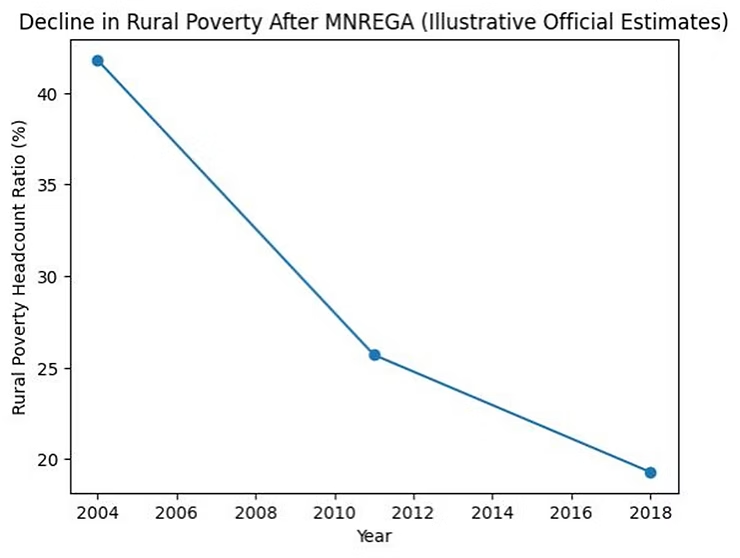
MNREGA Rural Poverty Data from 2005 to 2018

The figure above illustrates the broader context in which MNREGA operated. Rural poverty declined sharply after 2005, falling from over 40 per cent in the mid 2000s to below 20 per cent by the late 2010s. While this decline reflects multiple forces like overall growth, structural change, and social programs, micro-level studies consistently find that districts and households with higher exposure to MNREGA experienced significantly larger gains in consumption and poverty reduction compared to areas where the program was weakly implemented.

The scheme also acted as a counter cyclical stabilizer. During droughts, agrarian distress, or macro slowdowns, MNREGA expanded automatically, injecting purchasing power into rural areas. This supported consumption, reduced distress migration, and softened downturns. In macroeconomic terms, MNREGA transferred income to households with the highest marginal propensity to consume, precisely where fiscal multipliers are strongest.

Despite its strong design, MNREGA has long suffered from implementation weaknesses. Chronic delays in wage payments undermined its credibility as a reliable source of income. Corruption has generated fake muster rolls, ghost workers, inflated material bills, and substandard asset creation. Social audits which meant to be the backbone of accountability were uneven across states while effective in some.

Technological reforms such as Aadhaar linked payments, and digital attendance reduced certain leakages but introduced new problems, including worker exclusion, authentication failures, and further payment delays. The result was not only fiscal leakage, but a weakening of MNREGA’s core economic function which had promised a dependable wage floor.

Yet instead of fixing these implementation failures, a new policy chose to change the promise itself. In December 2025, this shift became explicit with the passage of the VB-G RAM G Act, 2025 in Parliament, replacing the Mahatma Gandhi National Rural Employment Guarantee Act with a redesigned rural jobs framework.

Under MNREGA, employment was a legal right, if work was demanded, it had to be provided. The new framework reverses this logic altogether. Employment now depends on budget limits, administrative approvals, and notifications from the center, not on demand. What was once automatic is now conditional.

This change also quietly shifts risk onto States. With limited revenue powers and tight borrowing limits, States responded by rationing work and delaying payments. As a result, the employment guarantee weakens, rural workers lose bargaining power, and wages come under pressure. What appears as fiscal control for the central government to rein on capital expenditures on paper thus becomes wage suppression in practice for rural workers.

Almost half of India’s workforce, around 46 per cent, still depends on agriculture and allied rural activities for employment, even though agriculture produces a much smaller share of the country’s total output. This gap between employment and output signals very low productivity in rural work and a large pool of surplus labor. For most of these workers, moving out of agriculture is difficult. They face barriers because of a lack of skills, weak urban job absorption, high migration costs, and social constraints. As a result, the ability to bargain for higher wages is structurally limited.

In such an economy, rural labor markets tend not to be competitive. Employers often face many workers competing for few jobs, while workers have few alternative sources of income. This creates conditions close to monopsony, where employers have disproportionate power in setting wages. In the absence of an institutional counterweight, wages tend to settle near subsistence levels rather than reflecting productivity or broader economic growth.

The consequences are visible in wage outcomes. Daily wages in rural areas stagnate or decline in real terms, failing to keep pace with inflation. Over time, this suppresses labor incomes relative to profits and rents, leading to a further decline in labor’s share of national income. In effect, weakening the employment guarantee shifts income distribution away from workers and back toward employers, reinforcing existing structural inequalities in the economy.

post294

India Insider: U.S Credit Crunch vs. Indian Banking Paralysis

India Insider: U.S Credit Crunch vs. Indian Banking Paralysis

When the U.S suffered a severe credit crunch in the early 1990s, the triggers were clear: the collapse of the leveraged buyout (LBO) boom, commercial real estate price corrections, and the failure of Savings and Loans (S&L) Associations, created the need for a $160 billion taxpayer bailout. Regulators, determined to act tough, declared many banks undercapitalized. The result was a nationwide squeeze from 1991 to 1993, where capital shortages – not liquidity, froze credit markets.

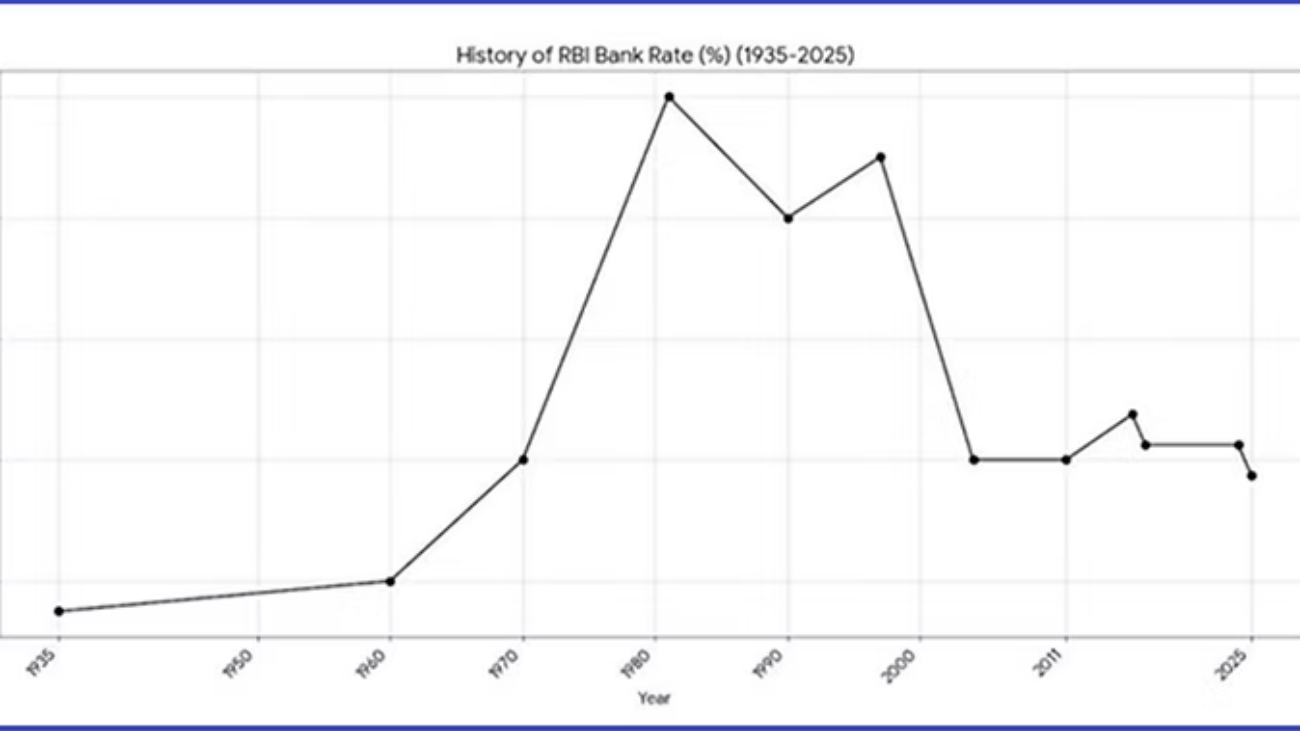
Reserve Bank of India Borrowing Rates 1935 to 2025

Fed Chairman Alan Greenspan slashed the Federal Funds rate to 3%, but banks couldn’t lend without capital. The unique twist was that, even as lending slowed, competition among borrowers pushed prime lending rates to 6%. This gave banks a fat 3–4% spread. Greenspan let this persist for nearly three years, enabling banks to earn profits equal to more than 10% of assets. With capital requirements at 8%, the windfall repaired balance sheets. By 1994, the U.S had exited the crisis and returned to strong growth.

India’s trajectory was very different. For decades, the country ran structurally high interest rates, which in theory should have allowed banks to recapitalize through spreads, just like the U.S. However, the reality was distorted by governance failures. Public sector banks (PSBs) , which dominate the system did not use their spreads to strengthen capital. Instead, politically connected lending to oligarchs and large industrial houses left the banks saddled with non-performing assets (NPAs).

I witnessed the aftermath up close in 2019 while working at Edelweiss Brokerage. Shadow banks were stressed, some private banks were crumbling, and PSBs were finally forced to acknowledge their bad loans. The selloff in the banking stocks were brutal that year, Catholic Syrian Bank’s IPO, one of the prominent South Indian banks went undersubscribed. To counter the slowdown, the government slashed corporate taxes from 30% to 22% to stimulate capital expenditure.

Unlike the U.S, India’s stress was on the asset side. Corporates were dragged into Insolvency and Bankruptcy Code (IBC) proceedings, where assets were monetized through painful restructurings. Piramal Finance bought DHFL at 30 cents on the dollar, and ArcelorMittal acquired Essar Steel at 90 cents. This was the hard clean up the system had avoided for years.

The NDA (National Democratic Alliance) government made the right call in restructuring the banking sector. Weak public sector banks were merged with stronger ones. Yes, it was costly. Households bore the burden via higher taxes, hidden charges, and high borrowing rates. But at least the problem was confronted.

The contrast is striking. The U.S endured a sharp three-year crunch, recapitalized its banks through spreads and market discipline, and bounced back quickly. India endured nearly a decade of paralysis, requiring taxpayer recapitalizations, corporate asset fire-sales, and systemic restructuring. The eventual stability allowed private sector banks to quietly capture market share from their weaker state-owned peers.

The lesson is simple: interest rate spreads can heal banks only if governance is strong. Without accountability, as India’s PSB saga shows, high rates merely tax households and businesses without fixing the system.

postR168

AMT Top Ten Miscellaneous Intrigues for the 17th of May 2024

AMT Top Ten Miscellaneous Intrigues for the 17th of May 2024

10. Georgia and Slovakia: It would we wise to pay attention to Tbilisi demonstrations, and also cast an eye on Bratislava after the assassination attempt of Prime Minister Fico. Russia is certainly paying attention.

9. Superconductivity: Origin Quantum Computing Technology of China is making solid advancements and has announced they are ready to domestically produce a 72 qubit capable microwave module known as ‘Origin Wukong’. The battle to create efficient quantum components and operating systems between China, the U.S and others is real.

8. Secretary of Music: Anthony Blinken’s naive decision to play guitar in a Kiev nightclub this week is comparable to Nero playing music while Rome burned. U.S foreign policy continues to raise concerned eyebrows from friends and foes alike.

7. South African Election: The coming vote on the 29th of May is less than two weeks away. USD/ZAR as of this writing is near 18.22000, where will it be on the 30th of May?

6. Biden and Trump: The potential for debates between the two presidential candidates is growing. One question observers may be wondering is if there is adequate supply of caffeine to keep Joe energetic and ample enough hairspray for Donald to look under control?

5. GameStop: Yet another market manipulation of GME is causing massive losses for day traders. The price for the stock finished near $27.67 yesterday, this after touching a high above $56.00 on the 14th of May. GME was close to $10.00 on the 15th of April. Buyers that get in too late to these betting schemes created by frenzied crowds tend to go bust as the early manipulators cash out their profits.

4. Commodities: Cocoa is near 7560.0 USD per metric ton, and Coffee Arabica is traversing slightly below 200.00 USD. Speculative forces remain powerful in both and while they are likely still overpriced, risk management is imperative for those pursuing lower values.

3. Federal Reserve: After the weaker than anticipated CPI numbers printed this Wednesday, and last week’s eroding GDP growth statistics, financial institutions are increasing their risk appetite as they watch U.S Treasury yields decline and consider a mid-term outlook which is allowing for the contemplation of actual Federal Funds Rate cuts.

2. Forex: The EUR/USD is back above the 1.08000 level comfortably, and the GBP/USD has found sustainable trading beyond the 1.26000 ratio. While the major currencies versus the USD have pulled back slightly from near-term highs, large commercial traders are exhibiting risk appetite. A weaker USD centric notion is coming into vogue again.

1. Apex Equities: The three major U.S indices are all near record territories as solid earnings reports from corporations, amidst hopes the Federal Reserve will be able to cut rates a couple of times this year has combined to allow optimism to grow in the S&P 500, Dow 30 and Nasdaq 100. While the U.S public is starting to show they are losing confidence because of escalating consumer prices, financial institutions are wagering on solid returns via economic outlooks. Day traders looking to join the indices parade should make sure they limit their exposure, particularly if they are using CFDs and relying on short-term climbs which can suffer from sudden reversals lower.

postN5

USD/INR: Stubborn Higher Range and Risky Speculative Wagers

USD/INR: Stubborn Higher Range and Risky Speculative Wagers

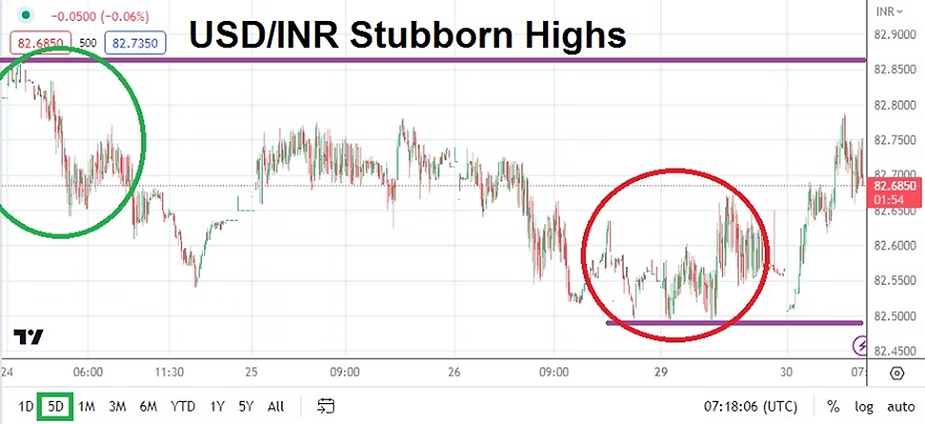
The USD/INR has remained within the higher level of its one month price range as behavioral sentiment remains difficult to gauge. As of this writing the USD/INR is near the 82.7200 ratio, but readers are urged to check this price against live market action as they read to compare conditions.

The Broad Forex Market is Nervous and so is the USD/INR

While many traders of the USD/INR who have been tempted to be sellers of the currency pair might be taking it personally that their perceived price targets have not been accomplished, they should note the broad Forex market has been difficult for most global speculators. The price action the USD/INR is experiencing currently comes from impetus due to nervous behavioral tendencies being generated from conflicting sentiment. The price range between 82.5000 and 82.8500 since the 18th of May has been rather persistent with momentary outliers.

USD/INR Five Day Chart as of 30th May 2023

Fear of the U.S Federal Reserve remains rather strong in Forex, this has affected the USD/INR because of concerns the U.S central bank might increase the Federal Funds Rate on the 14th of June. Inflation remains durable and is showing few signs of vanishing. The higher consumer prices in the U.S are a thorn in the side of the Federal Reserve which is intent on trying to put a dent into rising prices. If U.S data continues to show inflation is pushing ahead a rate increase could happen, and the higher prices in the USD/INR likely reflect this has been priced into the currency pair.

Federal Reserve policy can certainly be debated and fingers pointed at their wrong conclusions and decisions made the past two years. The current circumstances for the Fed has put it in a very difficult position. The lack of a clear outlook for financial institutions is leading to a lot of risk adverse trading since the 9th of May. Also concerns about the U.S debt ceiling did not calm many nerves the past few weeks, although the crisis seemingly has found a compromise which is likely to be approved tomorrow in Washington.

High U.S Interest Rates and More Corporate Banking Woes as a Potential

Higher interest rates are hurting U.S corporate banking particularly in the mid and small sized sectors of the industry. If these banks continue to suffer, their problems will create a credit crunch for many in the U.S middle class, which could have a big effect on consumer spending.

Higher interest rates via the increasing Federal Funds Rate are hurting the corporate banking sector because it makes it harder to lend money, and some clients are taking their money out of deposits to seek better returns elsewhere – like Treasury Bonds. The increased interest rates in the U.S also hurt many global currencies like the USD/INR because global financial institutions sometimes seek the better paying U.S bonds, which are also seen as more trustworthy long-term investment vehicles.

Thus, while the Fed is projecting tough talk about the potential of raising interest rates in June, and warning the mid and long-term outlook is cause for concern as inflation shows its ugly head, financial institutions are demonstrating nervous behavioral sentiment. The strong rhetoric from the U.S Fed and its lack of clarity regarding real direction has left the USD/INR and many other major currency pairs in awkward choppy positions with highs being tested. Until U.S economic data shows inflation is under control and growth is slowing down substantially, the Fed may have to continue to be rather hawkish sounding, which will not help the USD/INR selloff strongly in the near-term. In other words traders considering selling should be conservative with the USD/INR and not be overly ambitious with their targets.

Today the CB Consumer Sentiment reading is coming from the U.S, a lackluster report with negative data would actually help the USD/INR. Also this coming Friday jobs statistics will be published. While many folks will watch the employment outcome from the Non-Farm Employment Change, the Average Hourly Earnings could be more important and provide insights regarding inflation which could prove crucial. A rise in wages is not the outcome the Federal Reserve wants to see.

Warning: Use Entry Price Orders when Trading the USD/INR when Possible

Traders should also note that short-term wagers on the USD/INR should be done with entry price orders to make sure they are not caught and hurt by the large spreads which might be offered by their brokers – the spread is the differential between the ‘bid and ask’ price. Frequently a trader will be given a price fill that leaves them feeling like they have been cheated. Speculators frequently try to target short-term price goals with quick hitting bets, but bad price fills make these types of wagers difficult to get a positive result – when only a handful of pips in either direction can hurt a trader because too much leverage is being used.

USD/INR traders who are buyers should understand they will most likely be given the sell price of the ‘bid and ask’ when seeking upwards direction, and sellers of the currency pair are likely to get the ‘buying’ price of the spread – thus making a chosen wager on direction further away and difficult to achieve profits. Using an entry order which pinpoints a chosen price to enter a trade is vital. A trader should not expect to get a price fill which is ‘geared’ towards their chosen direction. Also, spreads in the USD/INR are wider than many major currency pairs because the amount of volume in the Indian Rupee cash market tends to be thinner, leaving more room for the technological capabilities of Forex brokers to provide less than attractive pricing.

post26.1

BRICS and a Potential New Currency Paradigm

BRICS and a Potential New Currency Paradigm

The BRICS nations are causing alarm in some ‘Western’ financial circles as they seek to strengthen their trading alliance reflecting their ability to be large producers and consumers. BRICS has a common goal of creating better trade and financial conditions for each other, and as a potential byproduct to possibly create an alternative to USD dominance.

While political crisis and global security concerns have grown the past few years and are causing uncertainty and instability, the strength of the USD has also caused inflationary problems for many nations including BRICS members. Cash reserve shortages of USD have become problematic and have been fueled measurably by decisions from the U.S government, Federal Reserve system and U.S Treasury. This has ignited many emerging market nations to seek dialogue about potential BRICS membership.

Alliance intrigue and concerns also shadow BRICS members often, the February 2023 naval exercise held between Russia, China and South Africa within waters near Cape Town raised anger in the United States and the European Union. The fact that the joint military exercise was held during the first anniversary of the Russian invasion of Ukraine did not go unnoticed. While no signed military alliance exists between these nations, it should be noted that Russia, China and South Africa also held a naval exercise in November 2019 also within proximity to Cape Town, South Africa.

USD/ZAR 1 Year Chart as of 28th April 2023

Formation and Agenda as Members Scoff at the ‘King Dollar.

The agenda of the BRICS nations often appears a desire to topple the dominance of the USD to those watching from outside, but is it realistic? Trading alliances are important certainly in order to create better economic stability. The BRICS potential effect on the USD is concerning, although not critically dangerous at this juncture the bloc needs to be monitored. In addition there are worries from some in the West that new military alliances could be formed, but historical and cultural differences within BRICS makes this rather questionable for the time being when contemplated in total.

BRIC was an acronym coined by then Goldman Sachs Chief Economist Jim O’Neill to identify potential opportunities for investors within emerging market nations. Members in this ‘bloc’ are countries that have begun to work in unison. About two months ago, Jim O’Neill reiterated the same refrain and alluded to the BRICS theme of suppressing USD strength and its reliance in global trade. BRIC (Brazil, Russia, India and China) was formed in 2009, and they added South Africa as a member in 2010 formally initiating BRICS. This coalition has met annually to discuss coordinated policies regarding trade, finance and investment opportunities. The next annual meeting will be held in August 2023 in South Africa. Vladimir Putin’s potential attendance at this year’s meeting is being monitored widely.

Plenty of discussions have already been articulated internationally about undermining USD dominance in global trade, but little effect has come to fruit in reality and the USD retains its moniker of ‘King Dollar’. However, countries being affected by the rise of inflation and the strength of the USD are becoming numerous and this has caused a diverse group of nations to seek conversations with BRICS leadership about being able to join the trading alliance. Iran, Algeria, Argentina, Mexico, Nigeria, Saudi Arabia, Indonesia, Pakistan, Egypt, Sudan, Syria, the United Arab Emirates, Bahrain, Turkey, Venezuela, Sri Lanka and Zimbabwe are some of the nations that have expressed interest in BRICS membership.

Impact of Sanctions on Russia and its Ability to Counter via BRICS

Russia has been waging a war with Ukraine for over a year and is currently under many Western sanctions. It’s been kicked out of the SWIFT banking system, which means it has limited opportunity to trade the RUB with Western countries. This in theory also limits the amount of USD that Russia can get its hands on.

Russia last year asked to be paid in Rubles (RUB) for gas and other energy purchases when dealing with E.U countries, trying to play a game of chess which largely failed. This while China too, tries to make the Yuan (CNY), a more significant currency in order to suppress USD dominance. China certainly has plenty of political and economic reasons to have the CNY emerge as a global power.

Russia has supposedly wanted to get out of Western currencies and especially the USD, this to punish the West, but will it work out and is it pragmatic? No. Russia’s attempts are high on rhetoric, but low on quantified changes thus far. The USD is far too dominant within the global banking system, and while incremental challenges to the USD have been tested, chipping away at USD strength remains difficult at best. The Kremlin has tried to inoculate itself from the pain caused to its trade balance because of sanctions, and create problems respectively for countries that oppose its invasion of Ukraine by cutting off gas supplies which were used for heating and to generate power for industrial purposes. Threatening to not allow grain to flow from Ukraine has also been a rather constant noise made by Russia.

Prices were capped on Russian energy via the G7 beginning in 2022 as a retaliatory move to limit revenues for Russia, and alternative gas agreements were sought by many European nations creating a loss of momentum for the Kremlin’s chess game. The Nord Stream pipeline was also damaged via sabotage. Russia used to supply Europe with 50% of its energy until sometime in 2021, it now provides less than 20% after Western sanctions. Russia has moved its eye towards other nations hungry for energy, ones that are not obligated to make transactions in USD, which brings BRICS into focus.


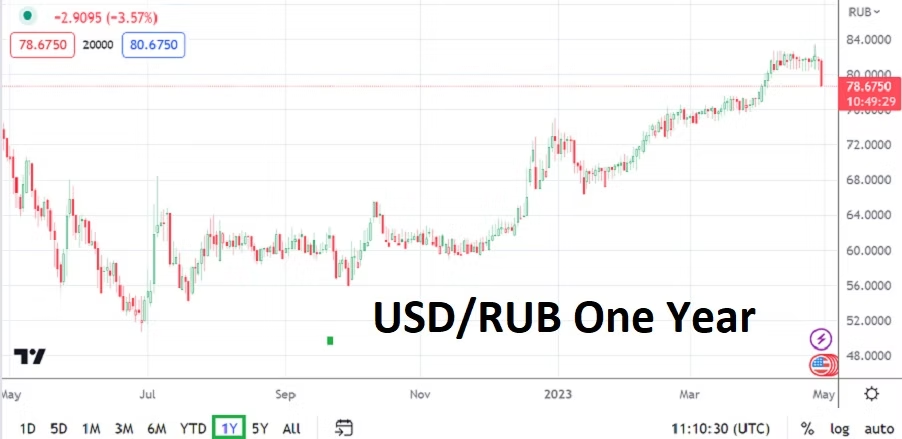
USD/RUB 1 Year Chart as of 28th April 2023

Inflation and a Strong USD have Caused Harm Globally

Inflation has caused problems across the globe following the impact of the coronavirus epidemic. The Federal Reserve, BoE and ECB have raised rates to try and cool inflation in their respective economies. This has made the USD attractive against emerging market currencies and caused capital outflows. An economic nightmare has occurred in Sri Lanka which is suffering from staggering political and economic problems the past two years, and nations like Pakistan and Egypt have been hit hard too by inflation’s impact and debt. USD reserves dwindled in these nations and they found it difficult to service their USD denominated debt in 2022, and troubles persist in 2023. Import without any USD reserves is difficult and sometimes impossible.

Russia and China as Major Players in ‘Their’ Bipolar World with ‘Friends’

Global trade is still dominated by the “King Dollar”. Almost 88% of global trade happens with the USD. The USD accounted for more than 71% of currency reserves at central banks in 2000, but has now declined to slightly below 59%. Oil and gas exports are important for Russia as these revenues constitute nearly 45% of its Federal Budget and it’s already been in deficit since February 2023, because oil revenues have slumped by half. Russia has a growing dependence on BRICS and is actively trying to get other nations to join the trading coalition, this because it has few other places to turn, and there appears to be no end in sight regarding the war with Ukraine.

Trading with other nations and signing currency agreements which would not include USD transactions is a long term goal of Russia and China, this if monetary values via the other nations currencies can remain firm. And then there is a wished for and ‘feared’ long-term dream of creating an alternative ‘super’ currency to compete against the USD.

Even before the escalation of fighting in the Russia and Ukrainian War, Russia was strongly advocating an end to USD dominance in global trade via rhetoric, particularly during previous BRICS Summits. We need to understand the political implications and complexities within BRICS, when talk of a decoupling from USD dominance news flares up. The U.S certainly keeps an eye on BRICS and so do other Western nations. At this moment South Africa has a delegation in Washington, D.C regarding the questionable South African policy behavior, particularly in light of recent military exercises with Russia and China, to try and smooth its U.S relationship. South Africa membership in AGOA, the Africa Growth and Opportunity Act, which grants special trade benefits to the nation and other members is being questioned strongly by U.S politicians. Getting kicked out of AGOA would cost South Africa billions of dollars in aid.

China and Russia seemingly want to create a bipolar power sphere, one in which U.S dominance is not so easy. Chinese President Xi Jinping and Vladimir Putin have met several times recently and are certainly collaborating regarding trade and investments. The developing news regarding the potential of BRICS enlargement shows that China and Russia maybe preaching multi-polarities such as their involvement with South Africa, but may actually be working towards a bipolar constellation of forces in which they would lead a broad alliance of countries in countering the preponderance of Western economies and potentially military might.

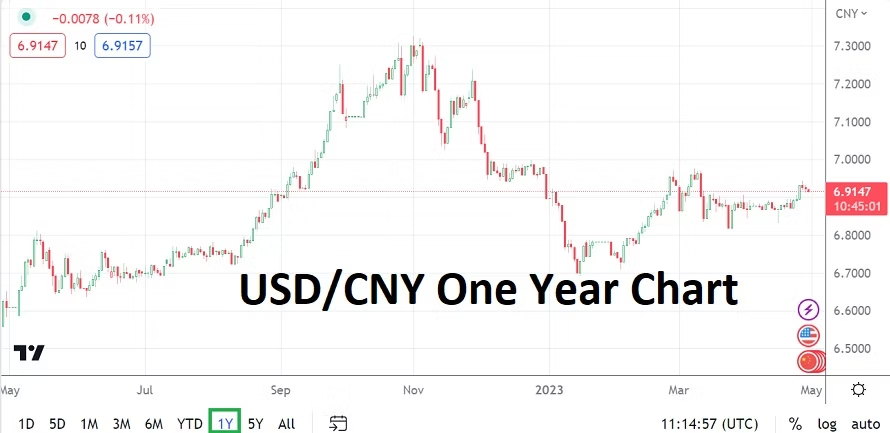
USD/CNY 1 Year Chart as of 28th April 2023


By allowing membership of BRICS to expand, U.S influence and the dominance of the USD would be lessened incrementally. A long game seems to be in play and if that is the case, the game of chess being played by Russia and China together against the West is complex and the U.S and its allies will need to be ready with a response if they want to protect the USD.

From the China point of view, the internationalization of the CNY is a positive. It has recently brokered a peace deal between Saudi Arabia and Iran, long-term arch rivals which surprised many in the West and seemingly caught the U.S unaware. China has also lent close to 1 trillion in USD value to Ghana, Pakistan, Nigeria and other smaller African countries. China is wielding power via trade and investment leverage into these respective nations strategically, pushing its global trade agenda even as Washington quietly threatens to punish China for backing Russia in the war with Ukraine.

Changing Role of China on the World Stage and BRICS

China’s role today is very different than in 2009 when BRIC was founded, this as the nation has become more secure regarding its stature globally. In the initial stages of BRICS there were talks about challenging USD dominance in global trade by member countries, but China vehemently avoided discussing this proposition openly to avoid conflict. The game has changed significantly regarding rhetoric, this as U.S – China relations have worsened as global trade, military security and corporate surveillance issues become more troubling. Political tensions with Taiwan as China rattles swords is a drama that nations are also watching attentively.

For China, the developing alliance with Russia has been a complex and sometimes slowly evolving plan historically, but one that has grown amidst tensions with Washington since the Trump presidency. The Russia and Ukraine war has accelerated the desire to break U.S led global dominance, and that means trying to break the USD internationally when it is possible. It is a long game and BRICS is part of this equation.

China and Russia view themselves at the vanguard in the struggle against Western global predominance, and they are eager to bring others on board. At the last summit of BRICS in June 2022, both Chinese President Xi Jinping and Russian President Vladimir Putin argued in favor of expanding into BRICS Plus. Beijing has become particularly interested with developing BRICS as a counterweight to the G7. While it has been difficult to establish a consensus on expansion among the current BRICS members, it appears to be a certainty that expansion is coming and the summit in South Africa this August will provide insights.

China is promoting the CNY in exchange for getting oil from Russia. The CNY is now ranked fifth regarding global transactions according to many banking sources. From the Kremlin’s point of view accumulating CNY reserves is good for Putin in the short-term; this creates more buying power for goods from countries that are friendly to Russia and China collectively and creates strategic momentum.

Yes, there are long-term historical complexities between Russia and China which will likely prove difficult politically to solve, but for the moment money is helping grease their wheels of diplomacy. Differences of opinion between Russia and China cannot be ruled out in these kinds of power games. Putin is an astute politician and liable to act in a surprising manner, this while trying to help Russia and its place among nations. Russia is certainly not keen on becoming a puppet state of China.

Trust is Almost a Four Letter Word for Some Economically and Politically

In his acclaimed book ‘Trust: The Social Virtues and the Creation of Prosperity’, the political economist Francis Fukuyama illustrates how degrees of trust in a society and indeed in a company can be decisive for prosperity and the ability to compete. In “low-trust” societies such as China, Russia and Italy, you cannot assume that everyone is willing to follow the rules. Members of these societies must frequently renegotiate ‘asserted’ rules, and often have to go to court to decide on matters. Ironically, one can see that this also applies to trading of the CNY.

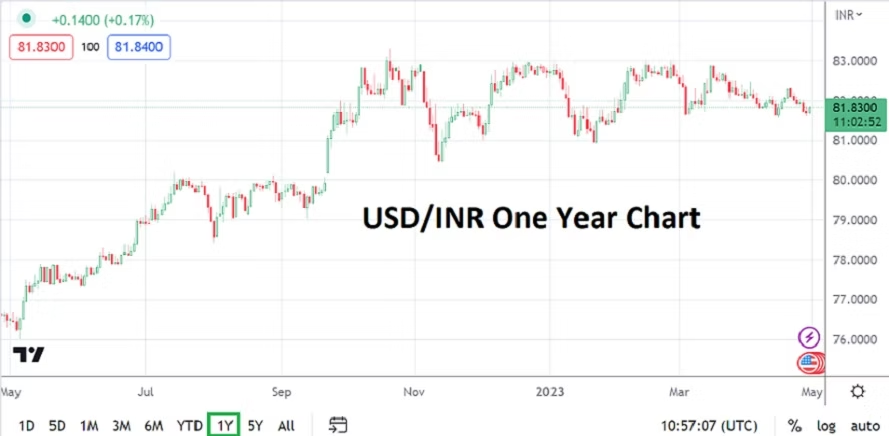
USD/INR 1 Year Chart as of 28th of April 2023

For instance, while China promotes the use of the CNY, countries like India are still using UAE Dirham (AED) for buying oil from Russia. BRICS still needs to sort out which currency they will use extensively for trade, this while many members try not to make enemies of other nations. South Africa exports are significantly more to the E.U, U.S and the U.K compared to Russia. Its share of exports to Russia are minuscule compared to the other three. Not only is South Africa risking free trade agreements with the U.S, E.U and U.K, but membership in key groups like AGOA as it tries to play on both sides of the fence politically is in jeopardy. Western observers are certainly watching South Africa and they will watch any other nation that joins BRICS. How long will the ANC led government of South Africa will be allowed to flirt with Russia and China militarily before it is stopped?

India has a Large Role in BRICS and is Growing in Stature

India is a vital member of BRICS, but also an important member of the QUAD alliance, the Quadrilateral Security Dialogue. Japan, Australia, the U.S and India are members and confer over trade and security. India is the largest democracy in Asia – and the world – and a Western advocate in South East Asia, even as China plays a dominant role in geopolitics. While BRICS wishes may be good for conducting bilateral trade among members, it is not necessarily good for global trade and political understandings. Complications from long-term political and historical disagreements between India and China cannot be discounted either.

Is the Indian Rupee (INR) or CNY more relevant for international trade? Use of the INR and the CNY needs coordination with other countries many times. Australia is a good example regarding the ability to trade INR internationally. If Australia and India agree to make their payments for exports and imports in their respective nation’s currencies, trade can be conducted rather well, but then Australia would have to find another nation for its ‘extra’ INR, because it would likely suffer due to trade imbalances. It would be important for another country outside of India to agree to take INR from Australia for other trades. Potentially some Gulf countries could be open to these types of INR transactions. A bigger group of BRICS nations would help India certainly.

Saudi Arabia has recently agreed to sell oil for CNY, but shoring up CNY in their coffers has long-term implications. This as Saudi Arabia wrangles politically with the U.S occasionally. Saudi Arabia has demonstrated a desire to take on a seemingly more neutral tone and perhaps wants to limit its exposure to the strength of the USD, particularly if the U.S tries to make a weapon of the USD via political policy. Thus, India as the most populated nation in the world and a growing economic sphere of importance, has to make careful considerations moving forward as it positions its economic stature for complexities that will develop. India and Saudi Arabia may have visions of becoming great ‘neutral’ economic powers moving into the next one hundred years.

The Indian Government has made economic deals with Egypt, Sri Lanka and Malaysia for bilateral INR trade, but still no pure INR trades of significance have materialized according to official banking data. There are multiple headwinds for BRICS nations to overcome USD dominance in international finance. Whenever exchanges of INR or CNY to other currencies for trade settlement are needed, they need to first change the base currency to USD to buy RUB or AED. Few exporting countries will accumulate CNY without a total need. Holders of these currencies would likely dump the INR and CNY for USD via Forex.

China Economic Transparency is Lacking and the Future of India in BRICS

China doesn’t make it easy for foreigners to own assets in their nation. The China government does not want massive trade deficits and free capital flows are restricted with force. Who would invest in China and risk having their money being stuck in the nation without guarantees? China continues to ramp up its oversight and aggressive tactics of supervision of foreign owned companies that have operations in the nation.

Now and into the foreseeable future, the Chinese government will control transactions of CNY with an iron fist. The United States will likely remain the predominant place for trade because of its huge economy, and as a nation that allows many other countries and foreign citizens to own and invest their assets within it boundaries. There is still something to be said for transparency. Any new nation or coalition trying to challenge U.S government debt instruments are likely to fail. The U.S continues to be a place where nations can hold ‘safe assets’ with a guaranteed return of interest for the long-term. No country equals the asset size and security of U.S Treasury Bonds. On that basis alone, there will be a no challenge to the USD in the near future.

Liquidity remains an issue for capital flows and convertibility within BRICS. A lot of hard work via transparent trade agreements will have to be signed to get these issues resolved. Plenty of questions exist regarding China’s economic data and its reliability because of a lack of oversight from ‘recognized’ outside agencies which are often forbidden.

India is still having border issues with China and these problems remain unresolved. India’s role of leadership in G20 is hard to ignore despite its alliance with BRICS. The Indian government has advised traders not to speculate in CNY. This shows that strained relationships between China and India remain and a lack of trust regarding clarity continues. In the U.S, New Delhi is considered an important partner, one that can be trusted regarding the growing rivalry between the U.S and China. Prime Minister Narendra Modi, said last year, “this is not an era for wars”, and this shows India wants stability and wants to play a global role in diplomacy.

There is a definite strategy for BRICS to grow with the nations of the Middle East and others. Using their currencies for mutual trade arrangements could eventually work out, but it will take a long time for this to change the dynamics of USD dependence and dominance.

However, we shouldn’t forget that almost 40% of the world’s population lives in Asia. Yet, even if oil producing nations will trade in a BRICS backed currency basket, which has been dreamed about for a long time, China’s leader Xi didn’t highlight this goal while in Moscow or in Saudi Arabia during recent summits. China is certainly playing a long game, but it also shows they remain cautious and vulnerable to the strength of the USD globally. If Xi wanted to cause the greatest pain to the United States, he would liberalize his financial sector and make the CNY a true competitor to the USD with complete economic transparency, but that would take him in the direction of free markets and levels of openness that are likely the opposite of China’s domestic ambitions. A strong due diligence of the Chinese economy, is something Chinese leadership likely wants to avoid for the foreseeable future.

BRICS: A Multi-Polar World and Avoiding Confrontation

Many developing countries will want to avoid a confrontation consisting of China and Russia on one side, and Western powers on the other side. India has overtaken China regarding population numbers, and will likely become the world’s third largest economy before the end of this decade. India will become a strong voice in favor of a multi-polar world. Arguably, ideas of a more multi-polar world are being worked towards in pragmatic ways, but the BRICS coalition will not develop their own asset backed common currency unless they can resolve issues regarding trade and monetary agreements with transparency. It is a matter of trust.