postR192

Impolite Opinion: BRICS Long-Term Plans & Implications Part 1

Impolite Opinion: BRICS Long-Term Plans & Implications Part 1

The global Forex market is spastic and many major currencies are traversing within weaker whipsaw value ranges against the USD. The currency pairs are trading in price bands seen before the Fed cut its Federal Funds Rate by 0.50 basis points on the 18th of September. And there is still one and a half weeks of assured volatility that will be demonstrated. Crucial U.S data is on the schedule in the coming days via the Advance GDP and Non-Farm Employment Change statistics, and the U.S Presidential election is edging closer. Israel and Iran continue to play a game of cat and mouse in the Middle East, which thus far has led to a controlled chaos and not worldwide bedlam. Financial institutions have plenty of reasons to be apprehensive.

Expansion of BRICS Feels Inevitable

Now let’s turn our attention to a tectonic foundational shift building in global trade and geopolitics. Attention on short-term behavioral sentiment which is fragile and has a less than clear mid-term perspective, needs long-term considerations too. Investors are required to contemplate possible dangers that are hiding in open sight and will pose a problem in the future.

The BRICS 2024 Summit was conducted this week in Kazan, Russia. This included the new member nations of Egypt, Ethiopia, Iran and the United Arab Emirates. I am not here to give you a major recap on what took place behind closed doors. I wasn’t invited. But we should look at some of the results and statements made and what they imply strategically.

The BRICS attendees to this year’s conference included powerful dignitaries from approximately 36 nations. One major result of this BRICS conference was to award Partner State status to 13 countries including Algeria, Turkey, Malaysia, Indonesia, Vietnam, Thailand, Nigeria, Uganda, Kazakhstan, Uzbekistan, Belarus, Cuba and Bolivia. Saudi Arabia was invited last year and has not made their full participation official yet, but they attended this year’s conference as an invited guest. The trend appears clear, we are entering a new paradigm in which long-term thinking by the BRICS nations could out maneuver the short-term nonchalance of the West and this has implications for the USD long-term.

There were high level meetings between leaders of BRICS countries including China, India and Russia. Perhaps, more importantly was Vladimir Putin’s bold statement about BRICS desire to start its own grain exchange. Putin also advocated for the creation of a BRICS cartel in other commodities such as metals, including gold. Gemstones such as diamonds and emeralds could develop into a sizeable entity too. This needs to be taken seriously by the West.

Credence must be given because the BRICS nations already are among the largest producers of grains, legumes and oilseeds. The scope of commodity production and supply capabilities by BRICS could certainly turn into a painful thorn in the side of existing large trading companies. And a potentially coordinated energy sector via Iran, Saudi Arabia, Nigeria, Russia and others must be taken into account.

Russia and China as Friends of the Underdogs

Historical entanglements put Western nations like France and others in a vulnerable spot diplomatically as they try to maintain alliances with many BRICS nations. France serves as a good example of diminishing Western influence. France remains on the ground overtly in Africa while dealing with vestiges of a colonial past. But France’s influence in Africa is under stress and their ability to use the continent as a source of power and financial gain is being confronted. France still maintains the Presidential Council for Africa, but France is likely perceived by many of the participants as a wolf dressed in sheep’s clothing. Coups in French influenced African nations have a bloody and present history when political diplomacy does not go well.

Exploiters of the past in many African nations are looked upon with derision and scorn. Russia and China are often viewed as friendly countries who helped fight along the side of certain African nations who sought and achieved independence. The ability to create ascendancy in Africa by Russia and China needs to be looked at within a prism that suggests additional spheres of power will develop in BRICS. Many nations that dealt with colonial statuses in the past are rightfully intent on shaking off the notion of being considered laggards.

The West certainly knows in no uncertain terms it cannot return to colonialism. However, African governments should make sure they are not replacing old masters for new. While some might say it is wishful thinking – and I am still on the fence contemplating the notion – on the part of Russia and China to create powerful commodity cartels, if achieved this actually could prove to be an emphatic first step in attempting to secure a new and powerful currency by backing it with a foundation of intrinsic value. Brazil and South Africa would be a big part of this underpinning too. Russia and China’s foray into Africa via their military and money lending excursions, and the already created organizational and trade structures which exists within BRICS opens the door for the perceived underdogs to battle together against the power of Western riches.

A competition is certainly underway between the West and BRICS. What exactly is the U.S doing in Angola? The planed visit of Joe Biden in the first week of December, which was supposed to take place in mid-October was postponed due to the recent hurricanes. Will the U.S presidential visit be anything more than a sideshow, particularly if the Democrats do not win the election on November the 5th? Angola has a massive amount of Crude Oil and is an OPEC member. American energy companies and other Western corporations are active commercial participants in the African nation. However, China has a firm financial stake in Angola via infrastructure projects too. The political and financial implications between BRICS and the West is a growing dynamic, one that will be further discussed in Part 2.


postR176

Make Common Sense Great Again: On Moving Away from Nuance

Make Common Sense Great Again: On Moving Away from Nuance

Opinion: The following article is commentary and its views are solely those of the author. This article was first published the 23rd of July 2024 via The Angry Demagogue.

Has there been a total breakdown of readiness in the West? When we look at seemingly unrelated events we see that people in responsible positions in governments around the Western world have missed signs that are obvious – and not only after the fact. The attempted Trump assassination just got me thinking how no one seems to react to the obvious anymore. It seems that both the local police and the Secret Service knew that this young man was on a roof with a rifle and no one took the most elementary actions of delaying Trump’s appearance or trying to stop the shooter or even ascertain his motives all of which was obvious to everyone else. We are not talking about someone missing a shot at him or even forgetting to check a specific place, but an active decision was made – to do nothing.

On October 6 and 7 the IDF Chief of Staff and his senior advisors on the General Staff heard of possible Hamas plans to attack, knew of previous intelligence that detailed the exact attack that happened and even refused a request of the head of the Southern Command to move 4 helicopters closer to Gaza. Instead of doing even the minimum, they just did nothing. They ignored the obvious and ruled purposely against common sense and in favor of their own preconceived notions.

As Russia was massing troops on the border and as Putin’s talk was becoming more and more belligerent the US administration did nothing that might have at least hinted to Putin that this could only lead to disaster. Putting US troops on a higher alert, inviting the Ukrainian ambassador to the White House as a show of support – anything really, might have given Putin food for thought. As Iran moves closer and closer to attaining a nuclear weapon and taking control of the middle east, the West just does nothing. Destroying Houthi assets (as the Israelis have just done), sending B52’s into the sky for training missions to destroy Islamic Republic assets – all that might have made the Iranian rulers wonder what was in store for them and limiting the war to Gaza. But again, against common sense, nothing was done because …. Wishful thinking.

If those responsible were acting like boys in the school playground (are boys still allowed to play in the playground?) they would have done more than they did in all these cases. 

Since the end of the Cold War we have seen the abandonment of common sense in favor of sophisticated analyses where nuance trumps simplicity and bias dominates the analysis of data and where cliches overtake serious policy. In classical Jewish biblical exegesis, there is one rule which nearly all (non-mystical) commentators hold and that is that the exegesis cannot contradict the simple meaning of the words of the Bible.  True enough, that is stretched to points of wonder sometimes – but they still cling to the rule. 

Common sense is underrated in policy analysis and often in business, but those who ignore it now will be challenged later. Common sense means the acceptance of what people say and looking at data without bias. Common sense means that you have to understand the person you are talking to and don’t assume they think like you. 

Back in my university days I read a lot of Hannah Arendt, who, in spite of the banality of her banality of evil theory had a lot to say. In her book “The Human Condition” she speaks of common sense – or as she often puts it “the sense of the common”.

I would like to quote her here, even though I tend to think she would not have thought that it was the rulers, the policy makers and the writers who are ignoring common sense:

“The only character of the world by which to gauge its reality is its being common to us all, and common sense occupies such a high rank in the hierarchy of political qualities because it is the one sense that fits into reality as a whole our five strictly individual senses and the strictly particular data they perceive.  It is by virtue of common sense that the other sense perceptions are known to disclose reality …. A noticeable decrease in common sense in any given community and a noticeable increase in superstition and gullibility are therefore almost infallible signs of alienation from the world.”

Arendt of course assumed that the lower or working classes were susceptible to superstition and gullibility but in these times it is the ruling classes that have abandoned common sense in favor of superstition and gullibility. It is they who are alienated from the world. Preconceived notions that contradict the plain meaning of the world is today’s superstition – and it is no less dangerous and irrational than the superstitions of times past.

Let’s take a brief look at these policy decisions by nearly all western countries, regardless of their geographical location or economic outlooks, their demographic trends or the overall culture of their people and their neighbors resulting directly or indirectly of the perilous situation the free world is now in.

Defense Spending and Force Size

The post-cold war “peace dividend” became an idol of western policy makers.  Massive cuts in defense spending even in things that were very necessary to the maintenance of said “peace dividend” – like naval power – was the preferred way of dealing with the end of the Soviet Union. The “End of History” was read simplistically instead of realizing that other ideologies and other powers might very soon challenge the victorious west. Some thinkers, I think of a professor of mine (Elie Krakowski) who back in 1979-80, before the collapse of the Soviet Union, spoke of Islam as the third force which will challenge the West and the East. I studied in a small university and if we were discussing it back then how are policy makers in Washington, London, Tel Aviv and Paris not speaking of it today?

While Edward Said’s “Orientalism” was the talk of the town, Bernard Lewis and Fouad Ajami were, despite their posts at Princeton and Johns Hopkins, not taken seriously enough. If they were, the US Navy would not have gone from 594 ships in 1987 to 275 in 2016. The British Navy  went from about 170 ships in 1970 to well under 50 in 2017. The rest of Western Europe we all know about. But at least countries like Netherlands, Belgium and Denmark don’t face hostile neighbors and were never meant to have forces that would do more than assist in minor operations.

Israel on the other hand has always faced neighbors who have desired to destroy it.  Even the countries with which it signed peace treaters, Jordan and Egypt, have never been able to translate these treaties into popular support and are always a coup away from belligerence. The history of dictatorships in general and of the Middle East in particular ought to have given the Israeli high command at least a hint as to what they might be facing. With the advent of Iran as a major regional power with the means and desire to spread its theo-revolutionary ideology, Israel ought to have realized that the era of wars was not over. Yet, since 2000 Israel has cut 6 divisions and decommissioned 2,000 tanks from its forces. It has cut military service for men from 36 to 32 months, even as it has not increased the mandatory service for woman from 24 months even though it has increased the amount of women in combat and combat support roles. The ultra-orthodox still don’t serve (they are about 16% of the draft class) zero even after October 7 and the number of youth who have received exemptions due to “psychological” reasons has skyrocketed to nearly 13% of the draft class. I don’t mean to belittle those with true psychological issues but rather the high numbers signify that many if not most are of a class that allows them to afford to pay psychologists for convenient diagnoses.

In other words – the IDF, the Finance Ministry and the political class all found it convenient to reduce the size of the army – both manpower and equipment – and used the excuse that there will be no more ground wars to justify the move.

The Ukraine conflict revealed to the world that US arms production of even the most basic arms is not enough for the US itself to maintain minimal levels during wartime.   The current Middle East conflict has magnified this disaster.

Common sense readiness has been ignored throughout the Western world due to sophisticated thinking more wishful than realistic. This is nothing less than a messianic and superstitious belief in the end of wars.

Immigration and Assimilation

If there is one issue that common sense has missed it is immigration. The reactions of average citizens to unlimited immigration in Western democratic countries has been uniform – NO! In some countries the yelling is louder but in all western countries there is significant opposition, on common sense grounds often, to the establishment immigration policies.

I am an immigrant to Israel and my grandparents were immigrants to the United States. Immigration, the movement of peoples from place to place has been going on since people left Africa – and before. But there is no separating immigration from assimilation unless your immigration is due to imperialism and conquest.  The Romans, Greeks, Chinese and Persians of ancient times, the Arabs of late antiquity were all imperialists. There was of course the age of imperialism that ended in WWI. But 21st century immigration is not of national conquest but of individual movement of people and families. One by definition must adapt to the local cultures – in the widest sense of the word. If a cotton farmer from Arizona wants to move to Iowa, he better adapt to the climate and figure out how to grow wheat or soybeans instead of cotton. If an aristocrat from England decides to move to the United States, he needs to know that his family heritage and titles won’t get him much. If a Spanish or Chinese speaker moves to Germany, the expectation is that he will learn to speak German.

An immigrant who does not respect the local culture in all its manifestations needs to get permission in order to stay in the new country. That is the way of the nation-state that has protected freedom in the western world so well (if not always so well). We can’t compare the 21st century to the pre-WWI world where borders were porous and people that survived the trip across a continent or an ocean could settle in that new land. Some more successfully than others. 

Common sense dictates that an immigrant that does not respect the laws of his new home has no right to live there. Yet, time and again, immigration policy has been separated from the law and being law abiding has no bearing on future citizenship.  Therefore, there is no demand from the immigrant and no opportunity for the immigrant to assimilate and be part of the social fabric of his new country. That being said, the mass Islamic immigration into Europe could be said to be imperialistic as the leaders of these communities have discouraged any type of rapprochement with Western values and law. That, along with the demographic collapse of indigenous Europe has put Europe on the brink of either a civil war or a peaceful surrender to Islamic imperial forces.  

Free Trade and Social Peace

There is no doubting that free trade brings prosperity and that economic growth better than any other global trading system. Free trade  is also the best way to lift the global poor out of poverty. The U.S constitution understood the importance of free trade, as states were prohibited from starting trade wars with each other.   This has also been the “good” in the E.U and has produced much prosperity in that Union.

Yet, free trade with allies needs to be differentiated between free trade with enemies  – meaning those that oppose our system. Free trade that allows your enemies to defeat you militarily is not free trade but suicide. So too, trade policies need to have social issues taken into consideration. This is not a call for tariffs or against free trade pacts, especially with neighbors, but rather they need to be adjusted with common sense solutions to employment and other problems that will arise from any economic change. 

Social peace is the second half of this section because, besides immigration, the erosion, not to say destruction of physically intensive jobs can and often does lead to social violence for reasons obvious to those with common sense.

Energy and Food Supply

For the most part, you would think that after national defense, it is a government’s first responsibility to its citizens to guarantee the food and energy supply of its citizens. Before we get to luxury and access to travel, the ready supply of food and energy seems to be the minimum that a government ought to do. And yet, when we speak of issues related to climate change (and lets not get into the “is it or isn’t it real” argument) the solutions first mandated to the problem have to do with limiting both of these items without which we cannot live. In California, farmer’s access to water is limited even after the drought due to concerns about some fish and climate, and in the Netherlands they want to pay farmers to stop producing food so that the Earth will not suffer. 

What is the plan here? Regarding energy supply, one would think that shoring up access to alternative energy would take priority over banning current ways of producing energy. In California, they have been having rolling blackouts in the summer for years and they are looking to ban gas stoves and ovens and gasoline powered cars. Private jets and yachts though are off limits for obvious reasons. What is the plan there? Is there any real preparation?

As for food supply, is the  plan to reduce population or to reduce calory intake? To what levels? Is there an expectation that people will starve themselves to “save the planet”? Again – I am not arguing for or against human causes of climate change but rather, for the common sense understanding that securing the world’s food supply takes priority over closing farms or turning them into organic utopias.

A perfect example is Sri Lanka where those in power bought into the organic farming ideology of Western aristocrats and they ended all non-organic farming causing a famine and a depression. People who worked hard their whole lives lost all their savings as they were unwilling participants in a cruel experiment to see if organic farming can feed a small island nation.  

In sum – a bit less nuance and a bit more common sense – a bit more sensing what is “common to us all” would be welcome in political and policy matters. Maybe if we pursued more common sense policies and a lot less superstition and bias there would be less yelling and screaming in the public square. 

Disclaimer: the views expressed in this opinion article are solely those of the author, and not necessarily the opinions reflected by angrymetatraders.com or its associated parties.

You can follow Ira Slomowitz via The Angry Demagogue on Substack https://iraslomowitz.substack.com/ 

postR170

Middle East is Proving to be a New Playground for the Axis

Middle East is Proving to be a New Playground for the Axis

Opinion: The following article is commentary and its views are solely those of the author. This article was first published the 4th of July with an addendum on the 5th via The Angry Demagogue.

Blinken Gets Pushed to the Back of the Line

While the Biden-Blinken Administration is obsessing on “non-escalation” and telling allies they are on their own if they attack an Axis member that attacks the ally,  or that they will help the ally “defend itself” but not take the offensive (how you do that is a mystery) the Axis itself is establishing itself all over the Middle East.

Let’s start with a statement, quoted in Israel, by Alexander Dugin who is Putin’s ideological advisor advising the Russian leadership to arm Hezbollah and the Houthis in their fight against Israel. Earlier this week, Newsweek reported that Russia is considering arming the Houthis with cruise missiles. These could be used against Israel and against Saudi Arabia – or maybe U.S bases in the area. As Russia seeks to cement its ties with anti-Western countries and forces around the world, it seems to be partnering with Iran so as to increase the potency of Iran’s proxies and press their goal to rid the region of U.S forces. Toward this goal Iran and even Russia are manufacturing tanks together in Iran.

The Houthis themselves, under with the guidance of Iran, are attempting to expand their sea blockade from Bab al Mandab straits connecting the Gulf of Aden with the Red Sea, to the east African coast by cooperating with the Sunni and al-Qaeda based Somali terrorist group al-Shabaab al-Mujahadin. Reports in Israel quoting U.S intelligence sources claim that the two groups are cooperating and that the Houthis will supply weapons to al-Shabaab in order to interdict global shipping off the Somali coast and in order to harass U.S forces stationed in the area.

The anti-U.S alliance seem to be able to cross religious and ideological boundaries in ways that western intelligence thought impossible. That is because western (and Israeli) intelligence mis-categorize all of these groups and countries. The issue is not who is Sunni and who is Shiite, who is Russian Orthodox and who is Communist, but rather, who is for keeping the international status-quo and who’s for, to use a phrase meant for different times – a “new global order”.  

The Houthis, feeling confident in having defeated the U.S Navy in the Red Sea are now threatening Saudi Arabia for saying no to a Russian negotiated deal (under the auspices of the U.N and opposed by the U.S) which would bring an end to the embargo against the Houthis including their export of oil as well as Saudi financing of the Houthi civil government in the part of Yemen they occupy (they learned from Hamas and Qatar/PA/Israel that you really can have your enemies pay your salaries) amongst other goodies. They blame Saudi Arabia for allowing U.S jets to bomb Houthi sites from airbases inside Saudi Arabia – with no U.S carriers in the Red Sea that certainly could be true. In their threat they included videos of their bombing of Saudi oil fields in 2019 just in case the Saudis forgot. 

The Houthis, with their experience stopping shipping, have, according to a JCPA report been the point men for Iran’s plan to extend the sea embargo against Israel to the Mediterranean. This would not only hurt Israeli shipping but also the ability of its Air Force to operate properly. We wrote recently about Iran’s possible plans for Cyprus, including Hezbollah’s open threat to them, and this fits nicely with their plan to ring Israel with fire on all sides. We already know that Russian intelligence vessels are in the Mediterranean tracking Israeli submarines and that the Russian naval base in Syria is a safe haven for Iranian shipping. 

Just this week an Iranian vessel filled with arms for Hezbollah anchored in the Syrian port of Latakia (why did Israel not sink this??!!) which is 100kms (60 miles) north of the Russian naval base in Tartus, Syria – was it escorted in by the Russian Navy? Is that why?  

The U.S now has three main allies in the Middle East – Israel, Saudi Arabia and UAE, and with the exception that the UAE administration has a habit of criticizing and threatening these allies. 

It boggles the mind that Blinken does not see what the entire world sees – a so far successful effort rid the Middle East of the U.S and its allies. For Israel that means annihilation and for Saudi Arabia it means probably surrender to the Iranians while its royal family is allowed to enjoy their money (best case scenario). For the UAE it means it will be used even more than it currently is as an Axis financial center. For the U.S it means a withdrawal, not to the Western Hemisphere – but to the northern half of it. 

The Middle East is slowly becoming the playground of the Axis and it is just a matter of time before the West won’t be able to get a turn on the swings.

Addendum: A short follow regarding the Houthi ultimatum to Saudi Arabia

The Houthi’s gave the Saudis 72 hours to respond and respond they did. The Saudis have agreed to all the demands of the Houthis as they realized that the United States will not defend them from attack and are unwilling or unable to deter, let alone to destroy the Houthis offensive capabilities.

Amongst the Houthi demands that the Saudis agreed to are:

1. The re-opening of the airport in Sana’a, Yemen.  They will allow direct flights to bring pilgrims to Mecca, flights to Jordan and soon flights to everywhere. This will allow the Houthis to be re-armed by the Iranians via air transport.

2. Payment, by Saudi Arabia of Houthi government employees.

3. Allowing the Houthis to sell oil – ending the embargo.

This is a plan, as stated, sponsored by Russia and not opposed by the United States. It is a further move by the Axis into pushing the U.S out of the region. It is not clear if part of this agreement is for the Saudis to disallow U.S use of the Prince Sultan Ari Base for attacks on the Houthis.  

As an aside, the UAE has suggested that the U.S setup a base in Somaliland – a breakaway country in the horn of Africa on the coast of the Gulf of Aden and bordered by Djibouti and Ethiopia (and of course Somalia). This seems to be an attempt to rid the Gulf States of the responsibility to host U.S forces that attack Iranian proxies.  Could Biden’s “you are on your own if you attack Iran” (back in April after the 300 projectile attack on Israel) have influenced their decision?

Russia and Iran are on the rise in the region as the U.S administration preaches de-escalation and appeasement. 

Disclaimer: the views expressed in this opinion article are solely those of the author, and not necessarily the opinions reflected by angrymetatraders.com or its associated parties.

You can follow Ira Slomowitz via The Angry Demagogue on Substack https://iraslomowitz.substack.com/

post197

Iran Front and Center: 60 Tons of Explosives Sent Towards Israel

Iran Front and Center: 60 Tons of Explosives Sent Towards Israel

The Israel-Iran War is soon to enter its 7th month even though last night was the first face to face confrontation between the two countries.

There was much less panic in the air on the “Israeli street” than one would expect after Iranian threats over the last week. I was clearly wrong in my assessment that Iran would not want to start something big with Israel and risk having a chunk of their strategic power degraded but it is hard predicting what fanatics will do. The question is if the utter failure of the attack will bring Iran shame in the Muslim world or if the fact that they sent missiles and drones will be counted as a “victory” even if no damage was done to Israel. Or it could be that Iran was counting on Biden-Blinken holding back Israel from responding and sure enough, NBC is reporting exactly that:

President Joe Biden has privately expressed concern that Israeli Prime Minister Benjamin Netanyahu is trying to drag the U.S. more deeply into a broader conflict, according to three people familiar with his comments.

Last night at about 8:15pm IDF Homefront Command announced that all schools and all educational activity would be cancelled until further notice, angering parents everywhere. A few minutes later they announced that 10’s or hundreds of drones were launched from Iran and on their way to Israel. The news reported that it would take 8-10 hours to arrive, sparking this to make its round on the Whatsapp groups in this very interconnected country:

Google maps also cooperated:

Friends and family in Jerusalem and surrounding areas were awakened by alarms and scurried to the bomb shelters, children in their arms. There were alarms also in the West Bank, the Golan Heights and the Northern Negev dessert. Apparently, the main targets were two air force bases. One was hit by one missile and minor damage was done and the other was untouched. One 7 year old Bedouin girl was critically injured from pieces of a rocket that was shot down. The headline ought to read: Shiite Missile Critically Injures 7 year old Sunni Girl. 

The effectiveness of Israel’s air defense system seems to have surprised even the Israeli Air Force and special thanks has to be given to President Ronald Reagan for ignoring the comics and media (but I repeat myself) and many scientists and engineers (the experts!) as they made fun of his Strategic Defense Initiative and called it “Star Wars” – claiming that it was something undo-able and dangerous even to talk about.

Then Senator Joe Biden, using his favorite word, “provoke”, is quoted in this 1985 NY Times article:

Senator Joseph R. Biden Jr., Democrat of Delaware, pressed hard for reassurance about whether the proposed defensive weapons might be fired by mistake, thus provoking the Soviet Union to launch a real attack.
 

The Biden foreign policy theory for the last 40 years or more is based on not “provoking” your enemy, no matter the cost and appeasing your enemy at any cost.

Special thanks to the U.S armed forces who shot down numerous drones as did the U.K’s air force as well as Jordan’s. There might have been other Middle Eastern countries involved as there is an unofficial regional air defense system set up with Abraham Accord countries and others not part of the Accords. 100% of the suicide drones and 100% of the cruise missiles and 92% of the ballistic missiles were shot down by Israel’s layered “star wars” system. 

If the IRG is honest with themselves, they will understand that they have been defeated. A combination of 300 drones, cruise missiles and ballistic missiles were shot at Israel at once and no drones and no cruise missiles got through. Of the 110 ballistic missiles shot at Israel, 101 were intercepted and only one reached its target. Israeli defense firms closed higher in Tel Aviv Stock Exchange trading today. I imagine Iran’s potential clients are having second thoughts. China too, must be wondering about their own offensive and defensive systems.  

So where does this leave us now?

The War Cabinet assigned to Netanyahu, Gantz and Defense Minister Gallant needs to decide on an Israeli response. I am not sure that Israel has the firepower to destroy Iran’s nuclear sites on its own and there is almost no chance we will see U.S B52’s involved.

So the most obvious target is probably off the table.  It seems that the U.S Administration is pressuring Israel not to respond at all and to leave things as they are. This should not surprise anyone who has been awake for the last six months.

Israel and Iran have been at war for the last 6 months – one could say for the last two decades. This was clear to everyone except Biden-Blinken who could have shortened the war and the suffering by punishing Iran for their attacks on US sailors and soldiers.  Instead, they appeased Iran and released $10 billion to them essentially letting Iran hit Israel with this money.   

 The Scroll is reporting that:

We are now waiting to see how Israel responds. Although an unnamed “senior Israeli official” has been quoted promising a “significant response” to the attacks, Iran appears to have pre-cleared the attacks with the United States via the Oman diplomatic backchannel. And according to Roi Kais of Israel’s Kan News, a U.S. official told Saudi Arabia’s Al-Arabiya on Friday, “the United States will take part in the response to the Iranian response if Tehran escalates the situation inappropriately”—which means that the United States tacitly approved an appropriate level of Iranian escalation, such as, we don’t know, a “symbolic” drone-and-missile attack.

The United States has also, as Barack Ravid reported Friday, demanded to “have a say before decisions are made about any retaliation by Israel.”

If true, that is cynicism taken to the ‘Nth degree’. True enough, the United States needs to watch after its own national interests, but is it possible that the U.S government considers Iran its equal and Israel its vassal? Were Israel faced with a missile attack from China an argument could be made that U.S interests take precedence over Israel’s – but Iran? The Iranian economy is in shambles, the Rial is at record lows, its only economic lifeline comes from China, bankrupt Russia, the $10 billion Biden gave them and illegal activities. As Israel just showed– Iran’s vaunted missile force is worth less than advertised. We have not even spoken about the way it treats women and gays and how it treats opponents to its theocracy, how it spreads terror throughout the Middle East and Africa, how it helps Russia destroy Ukraine, how it is a key player in the global drug trade and money laundering.  

We have also not spoken about its foothold in the Western hemisphere and its attempts to infiltrate the United States itself via the porous southern border. 

Worst of all, if the Scroll story is correct, it shows how Biden-Blinken don’t understand what the office of the Presidency of the United States is. It is not just another head of state or head of government, but rather the President’s warnings ought always to be backed up with actions. Biden’s “Don’t Speech 2.0” was laughed at by Iran in public, for all to see. And the Biden-Blinken response is to tell Israel, “don’t”.

Ignoring Biden-Blinken for the moment, Israel must think deeply about its response. It is clear that any response will be followed by more of the same from Iran. Israel must think a few moves ahead and not just attack for the sake of attacking or it will be in the middle of yet another war of attrition. The end of the multiple rounds of attacks must leave Israel in better strategic shape than it is now and must leave Iran substantially weaker.

Whatever Israel decides to do, it must degrade Iran’s military capability by destroying its weapons and bases and killing as many IRG officers as possible. Israel should not bomb the power stations in Tehran or do other non-military strikes. Air force bases, missile silos and Iran’s navy should be targeted in such a way that degrades capabilities. They could start by sinking the Iranian spy ship that is helping the Houthis in the Red Sea.

Israelis seem to think that by “allowing” Iran to attack them it gives them many diplomatic credits, but we already know that these “credits” do not last long.  Whatever Israel does, it ought not to play the “message” game. Its attacks ought to provide tactical advantages in the coming months and not just “warnings to Iran” and “messages to Hezbollah”.

But let’s not ignore Biden-Blinken for a moment.  What if they decide to threaten Israel that if Israel retaliates the US will sit on their hands? 

This would be the time for Israel to do a little threatening of itself. The worst thing for a sitting President running for re-election is a summer gasoline price spike. Israel could certainly threaten to destroy Iran’s oil facilities and help push the price of oil. High gallon gasoline prices this summer will lose Biden more votes than he can gain in Dearborn, Michigan. In exchange for leaving Iran untouched, Israel can demand a free hand in Gaza, including Rafah as well as in Lebanon.  

Would that be worth letting Iran off the hook? It might. Iran was defeated in this battle, but it still believes it will win the war. Giving Israel free reign to destroy Hamas and then Hezbollah means that Iran will lose the war, too. Without Hezbollah, Iran will lose its most important asset in its overall goal of destroying Israel, chasing the US from the Middle East and establishing Shiite dominance in the region. It would turn October 7th into the day that Iran started on its road to defeat.

Israel needs to be opportunistic and aggressive in its dealings with its allies and its enemies. It has to let its allies know that it too is playing the long game and that it will not only hurt those who hurt it – as Netanyahu loves saying – but that it will destroy all who even try to harm it.

More importantly it needs to show its enemies with actions and not with words that threatening Israel means you will be destroyed. 

The Biden-Blinken team must be told in no uncertain terms that Israel is not a vassal.  The end result of this war cannot only be the destruction of Hamas, it must also be the destruction of the Islamic Republic of Iran as a regional power. By sending over nearly 60 tons of explosives to Israel, they have put themselves front and center.

Disclaimer: the views expressed in this opinion article are solely those of the author, and not necessarily the opinions reflected by angrymetatraders.com or its associated parties.

You can follow Ira Slomowitz via The Angry Demagogue on Substack https://iraslomowitz.substack.com/ 

postN100.1

Forex Volatility as Central Banks, GDP, U.S Equities Shadow

Forex Volatility as Central Banks, GDP, U.S Equities Shadow

Perhaps it is good that today will see a lack of important economic data which will affect the markets. It might give a chance for day traders to relax and to gauge the thinking of financial institutions and investors before Central Banks, and important growth and inflation numbers shift behavioral sentiment later this week. While Forex has remained a minefield, U.S equity indices have soared to record heights. More volatility will come.

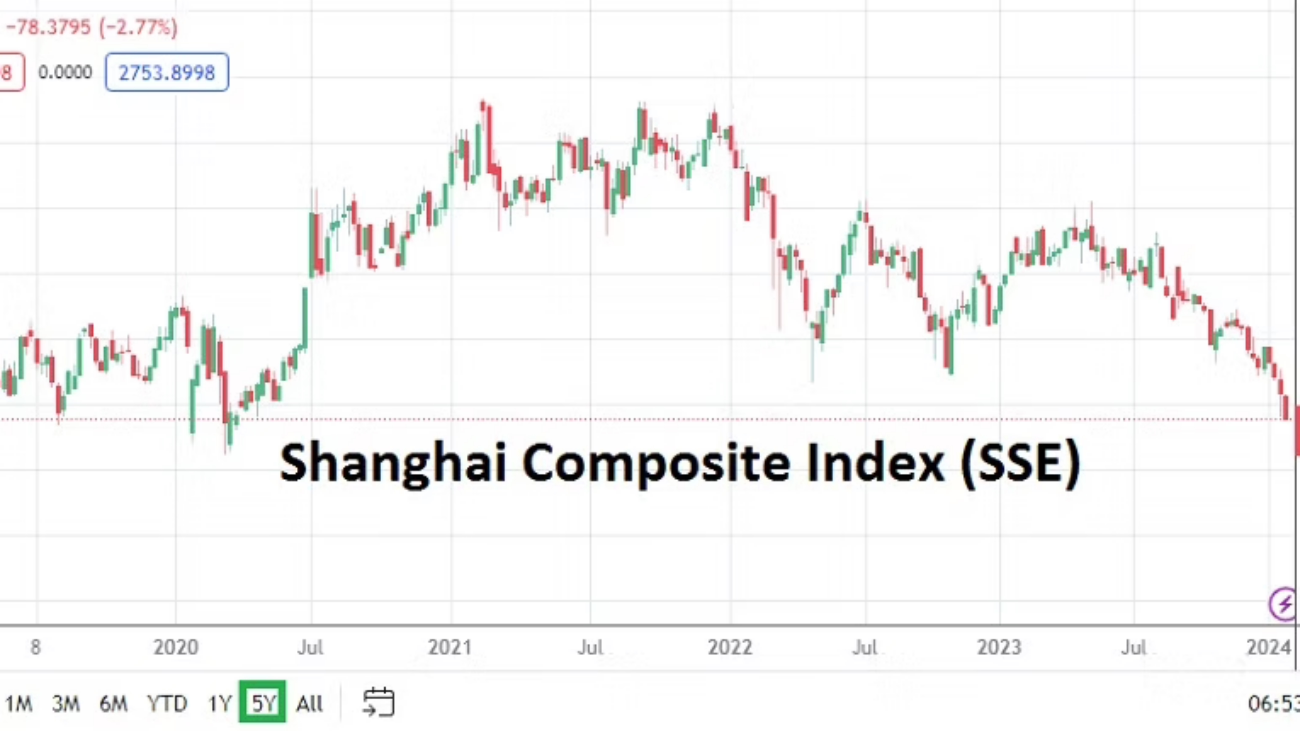
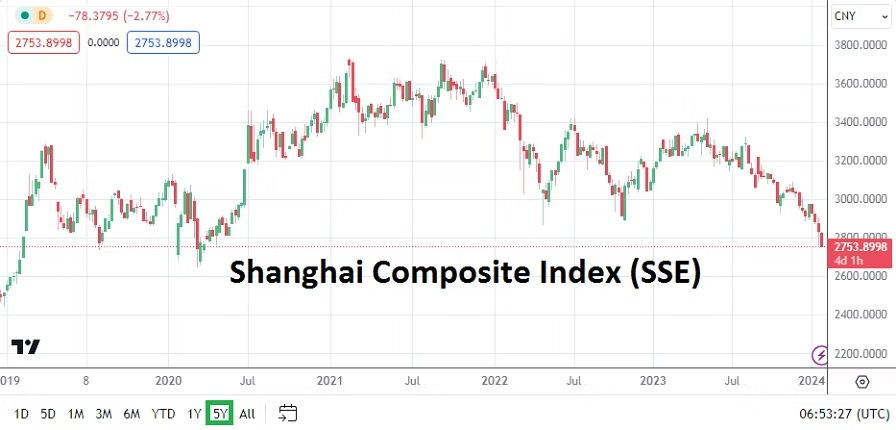
Shanghai Composite Index Five Year Chart as of 22nd January 2024

Risk assessment is always critical, it needs to be mentioned the Shanghai Composite Index is again facing severe selling pressure. This is a direct result of foreign investors losing faith in China’s economic policy and political maneuverings. The slump in Chinese equities is also hitting the Hang Seng Index in Hong Kong badly. Deflation is a legitimate fear in China. The dual consequences of a failing housing sector and crumbling equity values is harming Chinese citizens.

While the strong selloff in Chinese equities would have caused a massive amount of reaction in the global markets a few years ago, the ability to shift assets elsewhere by foreign investors who were active in China has likely reduced potential knock on effects in other global equity markets. It must also be pointed out that China continues to sit on a massive amount of USD holdings. China is a large investor in Africa and their attempt to steer influence there remains abundantly clear.

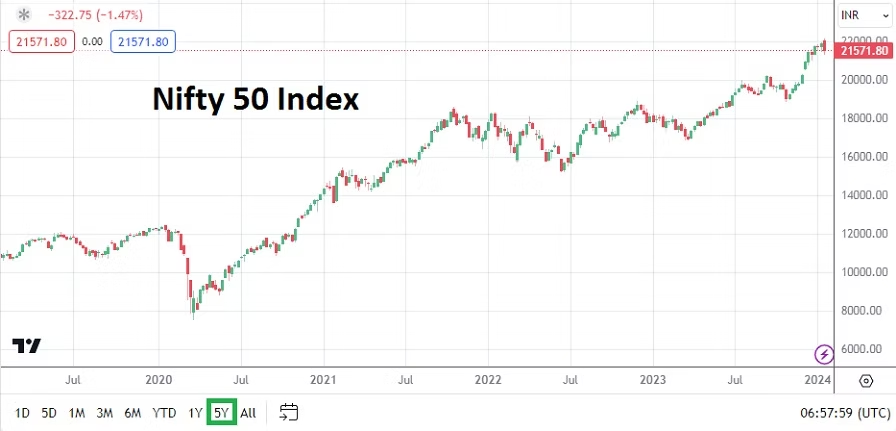
Nifty 50 Index Five Year Chart as of 22nd January 2024

India has directly benefited from the outflow of investments from China. A look at the Nifty 50 Index shows the upwards momentum India’s equity market has enjoyed as it has started to attract more direct foreign investment. The ability of the India stock market to go up while China struggles is a barometer worth studying. Outflow vs. inflow.

Monday, 22nd of January, U.S Conference Board’s Leading Index – the reading is not at the forefront of consideration for investors, they will be watching the results of U.S Treasury yields and stock indices more closely than this report.

Tuesday, 23rd of January, Bank of Japan Monetary Policy Statement and Outlook Report – no major change is expected from the BoJ quite yet. The USD/JPY has been volatile and provided a solid trend upwards since the start of January. Day traders looking for a reversal lower to develop should be extremely cautious. Data from Japan has been mixed and the BoJ is likely to remain conservative. The weaker JPY helps exports from Japan it must be remembered, but it also may factor into inflation creeping into the Japanese economy.

NZD/USD One Month Chart as of 22nd January 2024

Tuesday, 23rd of January, New Zealand Consumer Price Index – the inflation report is expecting a result of 0.5%, which would be below the previous result of 1.8%. The NZD/USD has taken a bearish dive since late December. Like all major currencies the New Zealand Dollar remains USD centric. Volatility in the NZD/USD may occur via the inflation numbers from New Zealand, but like the USD/JPY it may find its biggest impetus coming from afar – U.S data and the Federal Reserve outlook.

Wednesday, 24th of January, E.U and U.K Flash Manufacturing and Services PMI reports – Germany and France are anticipating slightly better Manufacturing Purchasing Managers’ Index numbers. Services numbers are expected to be slightly weaker from Germany. Solid results from these combined publications could help the EUR/USD create a bit of bullish momentum.

The U.K numbers via their Manufacturing PMI is expected to be slightly better than the previous outcome, but the Services number a bit worse. Economic data from Britain remains mixed to lackluster. Higher inflation numbers last week did the Bank of England no favors. The GBP/USD will be affected briefly by the results, but trading in the Forex pair is likely to remain geared towards thoughts about U.S data coming this Thursday and Friday.

Wednesday, 24th of January, Bank of Canada Rate Statement and Monetary Policy Report – the key lending rate from the BoC is expected to remain unchanged. However, Canadian economic numbers have been problematic, and while the BoC may want to wait for the U.S Federal Reserve to move first regarding interest rates, critics of the BoC are becoming louder. The USD/CAD will react to the Bank of Canada’s rhetoric, but unless there is a major surprise the currency pair will remain heavily USD centric.

Thursday, 25th of January, European Central Bank Main Refinancing Rate and Monetary Policy Statement – the ECB is expected to provide no major changes. The 4.50% interest rate is anticipated to stay in place. The ECB will likely ‘sound’ a calm tone and say while improvements are being seen in the E.U, that areas of difficulty remain but are understood and being managed.

Thursday, 25th of January, U.S Advance Gross Domestic Product – the key growth number from the U.S is anticipated to show a gain of 2.0%. This number will get a reaction in Forex, equities and bonds. The Federal Reserve’s FOMC meeting is next week and this GDP result will factor into their monetary policy rhetoric. Because it is an election year in the U.S, this number will also get an additional ‘sounding board’. Day traders should be careful before and after the noise caused by this growth report.

Friday, 26th of January, U.S Core Personal Consumption Expenditures – the vital inflation number carries an estimated gain of 0.2% before its release. As much as the Fed watches the GDP number, the inflation result via the Core PCE is a huge component of the U.S central bank’s thinking. The USD will react to this report and Forex traders should brace for a reaction from financial institutions. If the number is weaker than expected the USD could find selling momentum, if the number is stronger more USD strength could be seen. Folks looking at the GDP and Core PCE reports should also look for potential revisions to previous months results, which could cause another wave of volatility in the markets if they are significant.