postR173

Rich Dad, Poor Dad: What the Rich Teach Their Kids About Money

Rich Dad, Poor Dad: What the Rich Teach Their Kids About Money

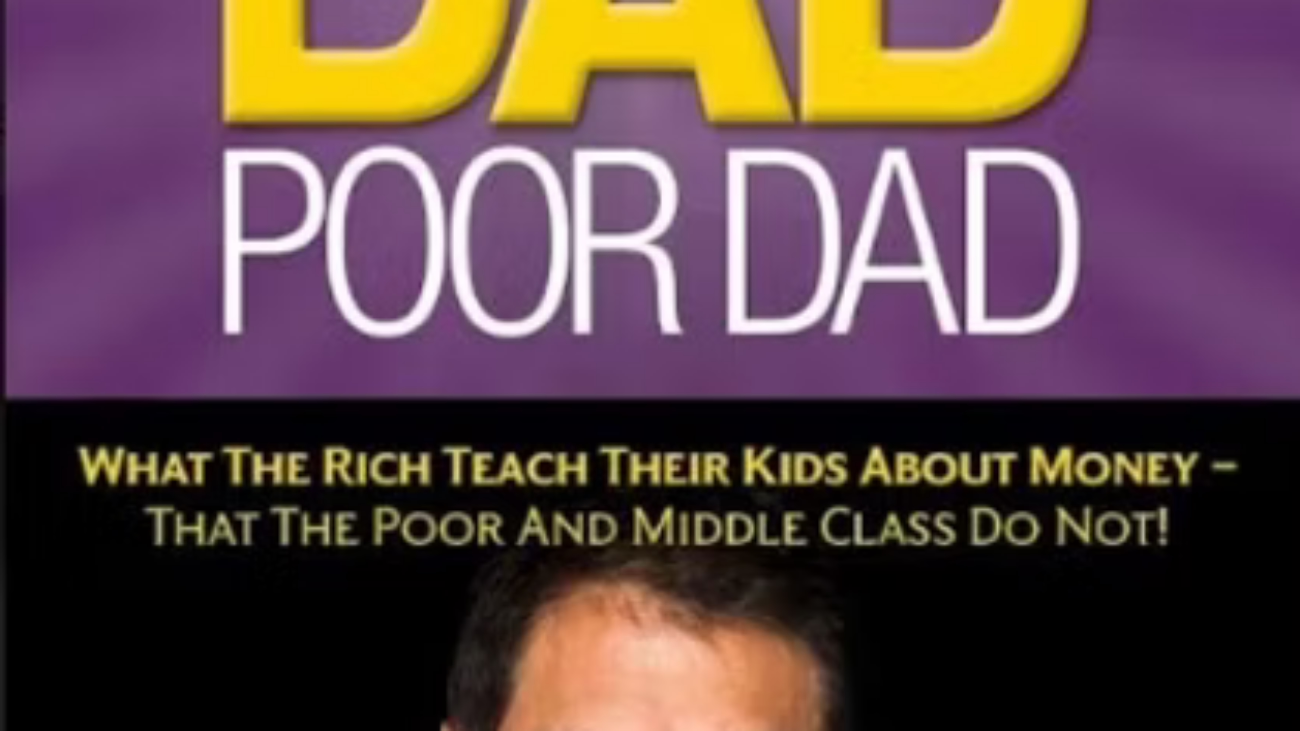
Book corner: Rich Dad, Poor Dad: What the Rich Teach Their Kids About Money That the Poor and Middle Class Do Not! by Robert T. Kiyosaki

Every now and then a book comes along which leads to a major shift in how Americans think. Uncle Tom’s Cabin changed perceptions about slavery. The Jungle woke the nation to the horrific labor and sanitary practices in factories. The Feminine Mystique shed new light on feminism and women’s roles in society. All those books struck deep into society’s conscious and led to major changes.

Robert Kiyosaki’s Rich Dad Poor Dad: What the Rich Teach Their Kids About Money That the Poor and Middle Class Do Not! might not echo the social justice that his revolutionary predecessors strived for. But this 1997 best-seller packed no less of a wallop. Hitting the bookstores just as the twentieth century was coming to a close, Kiyosaki’s book changed how Americans – and others around the world – think about personal finance.

Rich Dad Poor Dad is not an instructional book as one would expect in a college course, with Kiyosaki running through facts, charts and figures. A Japanese-American born and raised in Hawaii, Kiyosaki uses his own life and background to tell a simple, almost fable-like story. The “Poor Dad” in the title refers to Kiyosaki’s biological father, Ralph Kiyosaki, who worked as a educator most of his life. By all accounts a good father and an honest man, he was a big believer in standard, traditional education, wanting the younger Kiyosaki to be a good student and then go to college in order to get a good job – in other words, as Kiyosaki puts it, to be an employee. But he had little financial education, which is what Kiyosaki explains is knowledge of business, investing, accounting, entrepreneurship, real estate and all other related subjects whose knowledge one can use to make money and be financially independent – to be an employer in contrast to an employee. Kiyosaki explains that although his Poor Dad made a decent salary, he was able to save little of it due to his lack of financial education and poor career decisions later left him broke.

The ”Rich Dad” in the title is the father of Kiyosaki’s buddy Mike, a man of limited standard education but excellent and well-developed financial education. A savvy entrepreneur with his hand in many businesses, he was approached by the two pre-teens for lessons on getting rich. Rich Dad put them to work in his general store for little money, but provided something more valuable – lessons on business and entrepreneurship that would form the foundation of Kiyosaki’s life and career. The book is structured around the conversations he had with his Rich Dad and the advice he was given, and the contrast in mentality to his Poor Dad.

As Kiyosaki explains, the drive for financial education consumed him and drove his decisions well into adulthood. A mediocre student, he nonetheless graduated from the Merchant Marine Academy, and then as a US Marine, served honorably in Vietnam as a helicopter pilot. Kiyosaki was eligible to work in the maritime industry after the war, a job that would bring excellent pay, conditions, steady work and several months of vacation a year. But he instead enrolled at Xerox’s sales school – considered the best of its kind in the country – seeing it as a major key in his financial education. His need for independence was so strong that in later years, during hard times, he and his then-wife Kim slept in their car rather than the accept the charity of friends’ guest rooms.

Besides the lack of financial education in the school system – an issue that Kiyosaki raises several times throughout the book – Kiyosaki challenges conventional beliefs. He rails against purchases that are liabilities instead of assets, even arguing against home ownership. He discusses the mindset of money and wealth creation and how ordinary people – due to society’s conditioning to be employees – are held back by limiting beliefs. To be successful in wealth creation and to take control of your financial destiny, Kiyosaki argues, one must take calculated risks; inspired by his Rich Dad, he says that one must not think I can’t afford this but instead What do I need to do to be able to afford this?

In one of the few diagrams in the book, Kiyosaki introduces the cash flow quadrant (of which he would later base an entire book), which categorizes individuals as employees, self-employed, business owners, or investors. He discusses the advantages and/or disadvantages of each quadrant.

Kiyosaki hit a raw nerve in the personal finance-hungry public, turning him into an international finance guru. It has to this date sold anywhere from thirty to forty million copies and is noted as the bestselling personal finance book of all time. He – and Kim, who has a series of similarly-themed books intended for women – have subsequently published an entire series of finance books, each with its own spin, such as real estate, investing, gold/silver, multi-level marketing, etc. These include two collaborations with Donald Trump, Why We Want You to Be Rich and Midas Touch: Why Some Entrepreneurs Get Rich — And Why Most Don’t. Kiyosaki also markets a board game, Cashflow, that attempts to teach the basics of financial education and how to exit what he calls the “rat race”, which is his description of the sometimes grueling life of dependency that employers place upon their employees and the financial mediocrity that ensues.

Rich Dad Poor Dad is not without controversy. Two of Kiyosaki’s businesses prior to his turning full-time to financial education went bankrupt, fueling claims that he is not as savvy as his image projects. Some experts and competing finance writers claim that he gives poor, substandard – even dangerous – advice. Another claim regards the identity of the “Rich Dad”. His name is not revealed in this book nor the follow-ups in the series and Kiyosaki was silent about this issue for several years, leading to accusations that the book is complete fiction. He has since revealed the identity of the man, plus his friend referred to as “Mike”. Kiyosaki explained that many years ago, upon the book’s initial publishing, the family requested anonymity, to which he respectfully complied.

Another claim, not without merit, is that this book gives little advice in general beyond the series of anecdotes and soundbites. Kiyosaki has not refuted that, and has claimed that it is the intention of the book to raise these issues and to simply convince people of the need – and to direct them onto – the path of financial education.

The book is worth reading. You won’t come away with the knowledge to pick stocks, examine real estate, understand tax laws or read a financial statement. But you’ll be immediately reaching for books that do – and that, according to Kiyosaki, is the intention.

If you want to read another Book Corner article, please visit this review by Evan Rothfeld: https://www.angrymetatraders.com/post/dangerous-and-unpredictable-duties-during-the-vietnam-war
postN68

Mets, New York City, and the Most Astounding Baseball Season

Mets, New York City, and the Most Astounding Baseball Season

Book corner: They Said it Couldn’t be Done by Wayne Coffey

In 1969, the Apollo 11 moon landing and the 400,000-strong Woodstock concert weren’t the only miracles in the United States. Wayne Coffey’s They Said it Couldn’t be Done focuses on major league baseball, where the New York Mets – a team with a losing record since its founding and who came in ninth place in the National League the year before – won the World Series to become baseball’s champions. Who says that miracles don’t happen?

Coffey is an experienced sportswriter, having written about hockey (The Boys of Winter: The Untold Story of a Coach, a Dream, and the 1980 U.S. Olympic Hockey Team), plus soccer, football, and basketball. In They Said it Couldn’t be Done, he tells the story of the championship ’69 year.

Coffey describes the history of the team. The Mets grew from the wake that was left in New York baseball when two of its three major league teams – the Brooklyn Dodgers in 1957 and the New York Giants in 1958 – relocated to California (referenced by the line “California baseball” in Billy Joel’s hit We Didn’t Start the Fire), leaving the southern boroughs without a team of their own. Created as one of two National League expansion teams in 1962 (the other being the Houston Colt 45s, later renamed as the Astros), the Mets played in the Giant’s old homestead, the Polo Grounds in upper Manhattan, until moving to Shea Stadium in Flushing, Queens in 1964.

A word about expansion teams. These teams usually comprise older players whose baseball chops have begun to erode, together with lesser-skilled players who – to put it mildly – weren’t the top prospects upon entering the league. The Mets went 40-120 their first year, a losing record for the twentieth century (and so far for the twenty-first). For the boys in Flushing, the early-to-mid-60s were a ballplaying comedy of errors, a farce with endless losing streaks, blowout games, and (as one can guess) a horrendously poor level of play. Fans would turn up to the game and watch dropped balls, outfield collisions, and balls careening off gloves. But the fiercely loyal New York fans stuck with them, taking the team to their hearts. In fact, an endearing and fun aura surrounded the young team, viewed by the fans as goofy but lovable losers.

As Coffey explains, the change began in mid-decade. Older players retired or were traded, and younger and more skilled players joined the team, such as the nimble shortstop Bud Harrelson. In 1967, two pitchers were introduced who would have a major role in the Mets future win, the left-handed Jerry Koosman and the right-handed Tom Seaver. These players – and others – were hungry for winning and were offended by the stigma of mediocrity that surrounded the team. In 1968, former Dodger star Gil Hodges began his tenure as manager, replacing the old-timer Casey Stengal. Coffey describes Hodges’ character and managerial style, and how it affected the team for the better. A decorated US marine in World War 2, and a man of the highest integrity, Hodges was calm, methodical, unflappable, with an uncanny knack for eliciting the maximum performance of his players, who respected him greatly. The ’68 team might not have even reached .500 (meaning the number of wins equals the number of losses), but for those watching closely, there were seeds of future victory being sown, as shown by good performances from catcher Jerry Grote, outfielders Cleon Jones and Ron Swoboda, and others.

Even with all the young and eager talent, the Mets began the ’69 season still outgunned in the National League, posting a losing record for the first month. But in May, they went .500 for the first time since their founding, and at the end of the month lurched ahead after a winning streak. Coffey describes the additional winning streaks in August and September where, trailing the Chicago Cubs for most of the year, the Mets edged out the Windy City boys to win, in champagne-drenched excitement, the National League East division. On this backdrop, the bulk of the book – the ’69 post-season – begins.

Going up against the Atlanta Braves in the National League Championship was frightening. Even though the Mets won more regular season games, the Braves – with powerful hitters such as Orlando Cepeda and top slugger Hank Aaron, and a pitching staff led by the right-handed All-Star Phil Niekro – were still favored to win. But in an unpredicted upset, the Mets swept the Braves, three games to zero, scoring a cumulative 27 runs compared to the Braves’ 15.

Defeating the Braves was one thing. Defeating the American League championship Baltimore Orioles in the World Series was another. With bat-wielding gladiators such as Brooks Robinson, Boog Powell, Paul Blair, and Frank Robinson, the Mets were going up against a baseball-playing war machine with almost no weak spots. Their pitching staff included four starters who won 20 games apiece, such as left-handed Mike Cuellar and Dave McNally, and right-handed Jim Palmer. Palmer, considered today one of the best pitchers ever, was still young when he took the mound against the Mets, turning 24 on the day of Game 4. But he already had five seasons under his belt, and was an experienced postseason warrior, including a World Series pitching duel in 1966 against the mighty Sandy Koufax.

The Mets went on to defeat the Orioles, four games to one, playing like lions in a World Series that has become legendary. Coffey describes these games – as he does with the Braves – in play-by-play detail, but does a good job of leaving out anything of lesser importance while highlighting the important plays, the latter including Ron Swoboda’s gravity-defying catch in Game 4 that saved the game for the Mets. A writer of lesser skill might over-indulge the reader, or conversely, skimp too much on details. Coffey is able to walk that fine line between the two, and the book’s climax bounces along at an exciting pace, with a breezy, page-turning feel. Coffey did his homework well, by conducting scores of interviews with the key players and obviously watching all the championship and World Series games (all are currently available on YouTube, for anyone interested). He includes interesting commentaries at various points, telling us what the players were thinking, analyzing their moves, and putting various key at-bats in context.

Coffey fills up the book with light vignettes of Met fans of the era, such as Howie Rose, the popular Mets sportscaster, and describes the season’s impact on New York society in general. He also delves into the background and personal stories of many players, including the hardships they endured – such as that of veteran third basemen Ed Charles, an African-American who came up from the Jim Crow South – to make it to the major leagues.

The classic baseball expression, “it ain’t over ‘til it’s over”, truly symbolized the ’69 Mets. They Said it Couldn’t be Done is a great read. Baseball fans will love the book but so will fans of any sport.

If you want to read another Book Corner article, please visit this review by Evan Rothfeld: https://www.angrymetatraders.com/post/dangerous-and-unpredictable-duties-during-the-vietnam-war

postN45

Dangerous and Unpredictable Duties During the Vietnam War

Dangerous and Unpredictable Duties During the Vietnam War

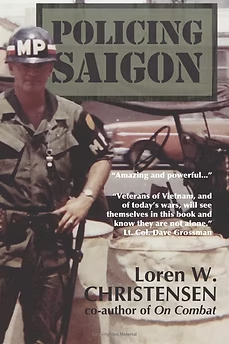
Book Corner: Policing Saigon, written by Loren Christensen.

War stories have always fascinated the public, ranging from Erich Maria Remarque’s

World War One novel All Quiet on the Western Front, to Alistair MacLean’s World War Two thriller The Guns of Navarone, up to the more recent American Sniper,

Chris Kyle’s autobiography of his combat experience in Iraq. Ex-cop and noted martial artist Loren Christensen throws his hat into the ring with Policing Saigon, the story of his

year as a military policeman patrolling the capital city of South Vietnam during the Vietnam War. Told mostly as a series of vignettes, Policing Saigon is at times dark-humored, shocking, sad, grisly, and even touching. (A note about terminology – in 1975 Saigon was renamed Ho Chi Minh City, and in 1976 South Vietnam merged with North Vietnam to become simply Vietnam.)

A cop in Portland, Oregon for 25 years, and a karate practitioner since his teens, Christensen is known mostly for a series of well-regarded policing and martial arts books. In Policing Saigon, he tells his story slowly and methodically. Growing up in suburban Washington state, his goal in college in the late 60’s was to break into radio and theater. Christensen took the initiative of enlisting, viewing the military police as an experience to draw upon for the acting world and incorrectly thinking that MP volunteers don’t receive overseas assignments (he notes that he was lied to by the recruiter).

After basic training, Christensen went through the range of military police courses such as language school and dog training. But after landing in Saigon in 1969, the 23-year old quickly realized that he was unprepared for the tough and thankless job. The MPs worked 12-hour shifts, seven days a week that often went hours into overtime in a sprawling, stifling hot and dirty city, hit hard by the war. The roads were clogged with haphazard and unregulated traffic that resulted in frequent accidents, some of which Christensen witnessed and some in which he was involved. The city was known for wretched poverty and was full of beggars, often children forced by their parents. The pollution was so severe – and the humidity was so brutal – that he developed both respiratory and fungal infections that took months into his discharge to heal.

The job was dangerous and unpredictable. The military police were hated by everyone, especially by those that were sympathetic to the Vietcong. The hate extended even to American GIs, since the MPs were often called in to arrest violent and drunken soldiers letting off steam on leave from the jungle. Christensen and his partners were also frequently called in to arrest AWOL (absent without leave) GIs, who flocked to Saigon in staggering numbers. He writes that in his tenure the number of AWOL soldiers never dipped below eighteen hundred. The American soldiers did not always go quietly and often resisted arrest, sometimes turning the scene into a brawling and bloody mess where the MPs needed backup.

As Christensen writes, the military police were also sitting ducks for all forms of terror, the perpetrators of which were impossible to catch. Snipers were liable to pick at them from nearby rooftops or windows, or bombs could be placed quickly and inconspicuously inside the military jeeps – even by children. Their job sometimes had them chasing thieves down dangerous, narrow, and winding alleys, frazzling their nerves and keeping them on edge. Even worse, as he writes, off-duty MPs were often unable to truly relax. Nighttime brought the sounds of artillery from the war’s front lines, serving as an uneasy and troubling background noise. Other MPs reacted to the stress of the war and their job in a number of ways. One of his early roommates casually kept a live python in a locker, mere meters from Christensen’s bed. Another inexplicably began shooting from the MP barrack’s balcony towards a truck transporting America’s allies, the South Vietnamese soldiers.

Crime against the American soldiers was rampant. Christensen writes that gangs of local thieves devised creative ways to steal from the American supply trucks, fueling the black market. Riding on motorbikes behind and alongside the trucks, they performed gravity-defying gymnastics while in motion as they would grab merchandise off the vehicle and speed off before unsuspecting driver realized what happened. Other crimes involved hookers. Sex-starved soldiers on leave would follow a hooker down an alley for a quick hookup and would instead be robbed. Others would actually engage in the act in the hooker’s room, while under the bed an unseen partner-in-crime (sometimes the girl’s mother) would reach out and pluck a few bills from the unsuspecting soldier’s wallet.

There are touching moments in the book, if one can call it that. Christensen isn’t a touchy-feely guy and his descriptions of these interactions come across as matter-of-fact and straight-forward. He writes of his admiration for the mainstream Saigon residents, mostly decent people trying hard to eke out a living. He notes their survivors’ mentality, and describes as they shrug off hardships and get back on their feet. In another chapter, he writes of meeting a group of cute Vietnamese kids, friendly and smiling to the MPs. But they were basically homeless street urchins living a hard life, sadly sleeping in a nearby cemetery. He writes of saying goodbye to his parents before shipping out to the army, facing an unknown future. And in one of the book’s most touching moments, he writes of his homecoming a year later, sitting quietly in his childhood room, the horrors of the war behind him.

Christensen was discharged in mid-1970 and less than 48 hours later was back home, a transition that was so fast it was jarring. He writes of his difficulty in adjusting to civilian life, suffering from PTSD until the return to martial arts would quiet his soul. He would later draw upon his MP experience for his police career, viewing it at five years’ experience combined into one year. A brown belt in karate at the time of his service, he realized that a more realistic and practical street-fighting style was needed, which he later taught privately and also to the police and military.

Christensen would be the first to admit that this not a book of heroics. This is not Band of Brothers or The Sands of Iwo Jima. But he took his job and his service in an unpopular war very seriously. The book clocks in at over 300 pages but his stories will hook you in. A worthwhile and moving read.

If you want to read another Book Corner article, please visit this review by Evan Rothfeld: https://www.angrymetatraders.com/post/ten-more-ok-now-twenty-finish-thirty-next-run-the-hill.

postN29

Ten More, OK, Now Twenty, Finish Thirty, Next Run the Hill

Ten More, OK, Now Twenty, Finish Thirty, Next Run the Hill

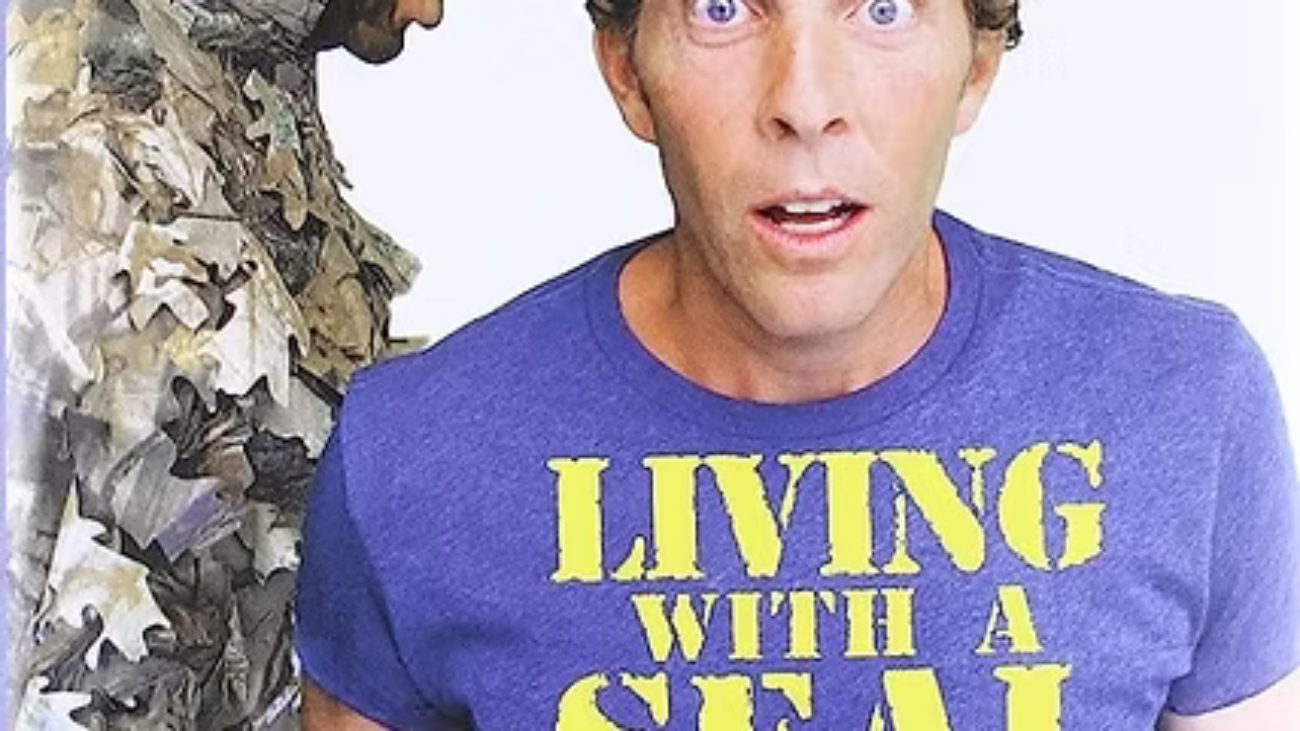
Book Corner: Living with a Seal: 31 Days Training with the Toughest Man on the Planet, written by Jesse Itzler

Living with a seal | Jesse Itzler

We all have had days where we couldn’t get out of bed to exercise, whether it be going for a morning run or hitting the gym at opening time. What would you do if you had a former Navy SEAL living with you and training you twenty-four hours a day, seven days a week for an entire month? And with the agreement that you had to do everything he said – every gym rep, every run, push-up, pull-up and burpee?

In Living with a SEAL: 31 Days Training with the Toughest Man on the Planet, a true story, that’s exactly what happened to author, former rapper, and entrepreneur (part owner of the NBA’s Atlanta Hawks) Jesse Itzler.

Itzler met the SEAL at an ultramarathon where the latter dominated. Itzler refers to the man only as “SEAL” and never reveals his identity, although it has become known since the book’s publication and SEAL has become a well-known fitness celebrity and author in his own right. Impressed by his astonishing physical shape, steely-eyed grit and laconic demeanor, Itzler inked a deal for SEAL to move into the Manhattan apartment where he lived with his family and train him for one complete month in the only way that SEAL knows – hard and nasty – where your limits are constantly pushed to the maximum.

Despite being a fitness buff, Itzler is yanked out of his comfort zone and challenged from day one. This begins a month of exercise sessions on a level that Itzler previously never experienced, such as grueling runs in and around Central Park with endless hills and thigh-splitting sprints in the frigid NYC winter. Other times, SEAL would command Itzler to do endless sets of upper body work comprised of weights, machines, and military-style calisthenics, sometimes on a moment’s notice or little to no sleep. And with SEAL, failure was not an option.

Itzler kept a diary during this month and the book is formatted as such. Additionally, each chapter begins with a SEAL quote. One of my favorites was, “you can get through any workout because everything ends.” And then there are thoughts on people and interaction gems like, “I don’t like to talk to strangers. Actually, I don’t like to talk, period.”

Despite the tortuous sessions that he endured, Jesse Itzler relates it all with humor and of course pride: his fitness level improved tremendously. He treats SEAL with great respect and admiration, something that we, as readers will share. SEAL comes across as a man of integrity who is true to his word. And how can one not admire a man who talks little, eats little, needs very little to get by in life, and runs in five-degree Fahrenheit weather wearing only gym shorts and a T-shirt?

The book is quick, light, and enjoyable. It’s also quite motivating. After reading it, you’ll be laying out your running clothes and setting your alarm clock for five in the morning.

If you want to read another Book Corner article, please visit this review by Evan Rothfeld: https://www.angrymetatraders.com/post/the-despair-of-ice-and-ability-to-lead-people-through-storms

postN22

The Intended Goal is to Make Money, but in an Honest Manner

The Intended Goal is to Make Money, but in an Honest Manner

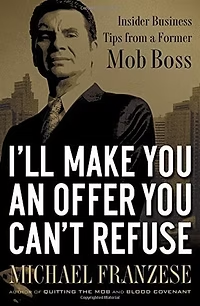
Book Corner: I’ll Make You An Offer You Can’t Refuse, written by Michael Franzese

Who says gangsters have marketable skills? Michael Franzese says so. Brooklyn-born Franzese, a former caporegime (which is a mobster who is second in line under a Mafia capo) and made-man in New York’s Colombo crime family, went legit following a religious awakening during an early ‘90s prison stretch. Franzese left behind a life of crime and became a motivational speaker, Mafia analyst for the media, writer, commentator, and even actor.

In this book – one out of seven that he’s written – Franzese argues that despite the criminality that he now abhors, gangsters have skills in running businesses that if copied, can put the average business or corporation ahead of the pack. I’ll Make You an Offer You Can’t Refuse is divided into eleven standalone sections, or rather lessons. In contrast to his former life, Franzese discusses running your business with honesty, transparency, and integrity.

He stresses the importance of choosing a good crew and surrounding yourself with capable people, starting your day as early as possible, proper planning, eliminating clutter, seeking counsel only from the wise, customer service, listening more than talking, learning from failures, etc. For example, one interesting section deals with the importance of effective negotiations – the famed “sit-down” as known to anyone who has seen The Sopranos and most other gangster portrayals in TV shows and movies.

Franzese informs us that unlike the sensationalist portrayal of crowded rooms, and long meetings with tempers flaring, sit-downs are short, sober, curt meetings attended by very few where the intended goal is to reach a mutually-acceptable compromise as soon as possible. After all, time wasted in long meetings is time better served making money, right?

At 160 pages, this book is relatively compact, nor does the author re-invent the wheel. Franzese’s skill is not only taking material that might be part of stuffy business textbooks and delivering it to the readers as filtered by his experience, but peppering the book with illustrative examples that keep them within a known cultural framework. As a result, the book comes out easy to digest.

Overall, we may not agree with how Franzese gained his business knowledge, but the lessons in I’ll Make You an Offer You Can’t Refuse are valid. His former crew would probably agree.