postN68

Mets, New York City, and the Most Astounding Baseball Season

Mets, New York City, and the Most Astounding Baseball Season

Book corner: They Said it Couldn’t be Done by Wayne Coffey

In 1969, the Apollo 11 moon landing and the 400,000-strong Woodstock concert weren’t the only miracles in the United States. Wayne Coffey’s They Said it Couldn’t be Done focuses on major league baseball, where the New York Mets – a team with a losing record since its founding and who came in ninth place in the National League the year before – won the World Series to become baseball’s champions. Who says that miracles don’t happen?

Coffey is an experienced sportswriter, having written about hockey (The Boys of Winter: The Untold Story of a Coach, a Dream, and the 1980 U.S. Olympic Hockey Team), plus soccer, football, and basketball. In They Said it Couldn’t be Done, he tells the story of the championship ’69 year.

Coffey describes the history of the team. The Mets grew from the wake that was left in New York baseball when two of its three major league teams – the Brooklyn Dodgers in 1957 and the New York Giants in 1958 – relocated to California (referenced by the line “California baseball” in Billy Joel’s hit We Didn’t Start the Fire), leaving the southern boroughs without a team of their own. Created as one of two National League expansion teams in 1962 (the other being the Houston Colt 45s, later renamed as the Astros), the Mets played in the Giant’s old homestead, the Polo Grounds in upper Manhattan, until moving to Shea Stadium in Flushing, Queens in 1964.

A word about expansion teams. These teams usually comprise older players whose baseball chops have begun to erode, together with lesser-skilled players who – to put it mildly – weren’t the top prospects upon entering the league. The Mets went 40-120 their first year, a losing record for the twentieth century (and so far for the twenty-first). For the boys in Flushing, the early-to-mid-60s were a ballplaying comedy of errors, a farce with endless losing streaks, blowout games, and (as one can guess) a horrendously poor level of play. Fans would turn up to the game and watch dropped balls, outfield collisions, and balls careening off gloves. But the fiercely loyal New York fans stuck with them, taking the team to their hearts. In fact, an endearing and fun aura surrounded the young team, viewed by the fans as goofy but lovable losers.

As Coffey explains, the change began in mid-decade. Older players retired or were traded, and younger and more skilled players joined the team, such as the nimble shortstop Bud Harrelson. In 1967, two pitchers were introduced who would have a major role in the Mets future win, the left-handed Jerry Koosman and the right-handed Tom Seaver. These players – and others – were hungry for winning and were offended by the stigma of mediocrity that surrounded the team. In 1968, former Dodger star Gil Hodges began his tenure as manager, replacing the old-timer Casey Stengal. Coffey describes Hodges’ character and managerial style, and how it affected the team for the better. A decorated US marine in World War 2, and a man of the highest integrity, Hodges was calm, methodical, unflappable, with an uncanny knack for eliciting the maximum performance of his players, who respected him greatly. The ’68 team might not have even reached .500 (meaning the number of wins equals the number of losses), but for those watching closely, there were seeds of future victory being sown, as shown by good performances from catcher Jerry Grote, outfielders Cleon Jones and Ron Swoboda, and others.

Even with all the young and eager talent, the Mets began the ’69 season still outgunned in the National League, posting a losing record for the first month. But in May, they went .500 for the first time since their founding, and at the end of the month lurched ahead after a winning streak. Coffey describes the additional winning streaks in August and September where, trailing the Chicago Cubs for most of the year, the Mets edged out the Windy City boys to win, in champagne-drenched excitement, the National League East division. On this backdrop, the bulk of the book – the ’69 post-season – begins.

Going up against the Atlanta Braves in the National League Championship was frightening. Even though the Mets won more regular season games, the Braves – with powerful hitters such as Orlando Cepeda and top slugger Hank Aaron, and a pitching staff led by the right-handed All-Star Phil Niekro – were still favored to win. But in an unpredicted upset, the Mets swept the Braves, three games to zero, scoring a cumulative 27 runs compared to the Braves’ 15.

Defeating the Braves was one thing. Defeating the American League championship Baltimore Orioles in the World Series was another. With bat-wielding gladiators such as Brooks Robinson, Boog Powell, Paul Blair, and Frank Robinson, the Mets were going up against a baseball-playing war machine with almost no weak spots. Their pitching staff included four starters who won 20 games apiece, such as left-handed Mike Cuellar and Dave McNally, and right-handed Jim Palmer. Palmer, considered today one of the best pitchers ever, was still young when he took the mound against the Mets, turning 24 on the day of Game 4. But he already had five seasons under his belt, and was an experienced postseason warrior, including a World Series pitching duel in 1966 against the mighty Sandy Koufax.

The Mets went on to defeat the Orioles, four games to one, playing like lions in a World Series that has become legendary. Coffey describes these games – as he does with the Braves – in play-by-play detail, but does a good job of leaving out anything of lesser importance while highlighting the important plays, the latter including Ron Swoboda’s gravity-defying catch in Game 4 that saved the game for the Mets. A writer of lesser skill might over-indulge the reader, or conversely, skimp too much on details. Coffey is able to walk that fine line between the two, and the book’s climax bounces along at an exciting pace, with a breezy, page-turning feel. Coffey did his homework well, by conducting scores of interviews with the key players and obviously watching all the championship and World Series games (all are currently available on YouTube, for anyone interested). He includes interesting commentaries at various points, telling us what the players were thinking, analyzing their moves, and putting various key at-bats in context.

Coffey fills up the book with light vignettes of Met fans of the era, such as Howie Rose, the popular Mets sportscaster, and describes the season’s impact on New York society in general. He also delves into the background and personal stories of many players, including the hardships they endured – such as that of veteran third basemen Ed Charles, an African-American who came up from the Jim Crow South – to make it to the major leagues.

The classic baseball expression, “it ain’t over ‘til it’s over”, truly symbolized the ’69 Mets. They Said it Couldn’t be Done is a great read. Baseball fans will love the book but so will fans of any sport.

If you want to read another Book Corner article, please visit this review by Evan Rothfeld: https://www.angrymetatraders.com/post/dangerous-and-unpredictable-duties-during-the-vietnam-war

postN45

Dangerous and Unpredictable Duties During the Vietnam War

Dangerous and Unpredictable Duties During the Vietnam War

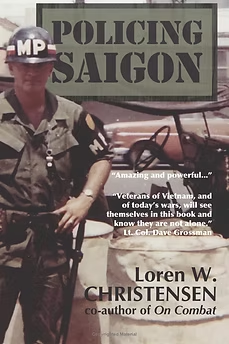
Book Corner: Policing Saigon, written by Loren Christensen.

War stories have always fascinated the public, ranging from Erich Maria Remarque’s

World War One novel All Quiet on the Western Front, to Alistair MacLean’s World War Two thriller The Guns of Navarone, up to the more recent American Sniper,

Chris Kyle’s autobiography of his combat experience in Iraq. Ex-cop and noted martial artist Loren Christensen throws his hat into the ring with Policing Saigon, the story of his

year as a military policeman patrolling the capital city of South Vietnam during the Vietnam War. Told mostly as a series of vignettes, Policing Saigon is at times dark-humored, shocking, sad, grisly, and even touching. (A note about terminology – in 1975 Saigon was renamed Ho Chi Minh City, and in 1976 South Vietnam merged with North Vietnam to become simply Vietnam.)

A cop in Portland, Oregon for 25 years, and a karate practitioner since his teens, Christensen is known mostly for a series of well-regarded policing and martial arts books. In Policing Saigon, he tells his story slowly and methodically. Growing up in suburban Washington state, his goal in college in the late 60’s was to break into radio and theater. Christensen took the initiative of enlisting, viewing the military police as an experience to draw upon for the acting world and incorrectly thinking that MP volunteers don’t receive overseas assignments (he notes that he was lied to by the recruiter).

After basic training, Christensen went through the range of military police courses such as language school and dog training. But after landing in Saigon in 1969, the 23-year old quickly realized that he was unprepared for the tough and thankless job. The MPs worked 12-hour shifts, seven days a week that often went hours into overtime in a sprawling, stifling hot and dirty city, hit hard by the war. The roads were clogged with haphazard and unregulated traffic that resulted in frequent accidents, some of which Christensen witnessed and some in which he was involved. The city was known for wretched poverty and was full of beggars, often children forced by their parents. The pollution was so severe – and the humidity was so brutal – that he developed both respiratory and fungal infections that took months into his discharge to heal.

The job was dangerous and unpredictable. The military police were hated by everyone, especially by those that were sympathetic to the Vietcong. The hate extended even to American GIs, since the MPs were often called in to arrest violent and drunken soldiers letting off steam on leave from the jungle. Christensen and his partners were also frequently called in to arrest AWOL (absent without leave) GIs, who flocked to Saigon in staggering numbers. He writes that in his tenure the number of AWOL soldiers never dipped below eighteen hundred. The American soldiers did not always go quietly and often resisted arrest, sometimes turning the scene into a brawling and bloody mess where the MPs needed backup.

As Christensen writes, the military police were also sitting ducks for all forms of terror, the perpetrators of which were impossible to catch. Snipers were liable to pick at them from nearby rooftops or windows, or bombs could be placed quickly and inconspicuously inside the military jeeps – even by children. Their job sometimes had them chasing thieves down dangerous, narrow, and winding alleys, frazzling their nerves and keeping them on edge. Even worse, as he writes, off-duty MPs were often unable to truly relax. Nighttime brought the sounds of artillery from the war’s front lines, serving as an uneasy and troubling background noise. Other MPs reacted to the stress of the war and their job in a number of ways. One of his early roommates casually kept a live python in a locker, mere meters from Christensen’s bed. Another inexplicably began shooting from the MP barrack’s balcony towards a truck transporting America’s allies, the South Vietnamese soldiers.

Crime against the American soldiers was rampant. Christensen writes that gangs of local thieves devised creative ways to steal from the American supply trucks, fueling the black market. Riding on motorbikes behind and alongside the trucks, they performed gravity-defying gymnastics while in motion as they would grab merchandise off the vehicle and speed off before unsuspecting driver realized what happened. Other crimes involved hookers. Sex-starved soldiers on leave would follow a hooker down an alley for a quick hookup and would instead be robbed. Others would actually engage in the act in the hooker’s room, while under the bed an unseen partner-in-crime (sometimes the girl’s mother) would reach out and pluck a few bills from the unsuspecting soldier’s wallet.

There are touching moments in the book, if one can call it that. Christensen isn’t a touchy-feely guy and his descriptions of these interactions come across as matter-of-fact and straight-forward. He writes of his admiration for the mainstream Saigon residents, mostly decent people trying hard to eke out a living. He notes their survivors’ mentality, and describes as they shrug off hardships and get back on their feet. In another chapter, he writes of meeting a group of cute Vietnamese kids, friendly and smiling to the MPs. But they were basically homeless street urchins living a hard life, sadly sleeping in a nearby cemetery. He writes of saying goodbye to his parents before shipping out to the army, facing an unknown future. And in one of the book’s most touching moments, he writes of his homecoming a year later, sitting quietly in his childhood room, the horrors of the war behind him.

Christensen was discharged in mid-1970 and less than 48 hours later was back home, a transition that was so fast it was jarring. He writes of his difficulty in adjusting to civilian life, suffering from PTSD until the return to martial arts would quiet his soul. He would later draw upon his MP experience for his police career, viewing it at five years’ experience combined into one year. A brown belt in karate at the time of his service, he realized that a more realistic and practical street-fighting style was needed, which he later taught privately and also to the police and military.

Christensen would be the first to admit that this not a book of heroics. This is not Band of Brothers or The Sands of Iwo Jima. But he took his job and his service in an unpopular war very seriously. The book clocks in at over 300 pages but his stories will hook you in. A worthwhile and moving read.

If you want to read another Book Corner article, please visit this review by Evan Rothfeld: https://www.angrymetatraders.com/post/ten-more-ok-now-twenty-finish-thirty-next-run-the-hill.

postN37

Business Success Techniques Used by the Amish Communities

Business Success Techniques Used by the Amish Communities

Book corner: Success Made Simple, An Inside Look at Why Amish Businesses Thrive, written by Erik Wesner

Success Made Simple

Can old stereotypes disappear? That’s the question one faces when reading Success Made Simple, An Inside Look at Why Amish Businesses Thrive, by Erik Wesner. Wesner, a sales and management professional who has done business with the Amish in several states, plus interviewed and studied them, changes our perspective of the Amish as he sets out to explain a staggering statistic: 95% of Amish businesses succeed as opposed to 34% for the remaining population.

A few words about the Amish. A U.S based Anabaptist Christian community with roots in Switzerland, the Amish are closely related to Mennonites and have traditionally believed in simple living, pacifism and non-violence, rural life, manual labor, Bible study, and the eschewing of modern technology. Easily recognized by their traditional clothing, they speak a form of Old German between themselves. They are literate (and speak English, which they learn at school) but their education stops at the eighth grade, where they begin working full-time. Perhaps the most well-known portrayal in the media is the 1985 crime drama Witness, starring Harrison Ford as a Philadelphia police detective seeking shelter with the Amish from corrupt rogues on his force. A major success, the movie cast into the public’s consciousness a rigid community of simple farmers and craftsmen who minimize all encounters with the outside world and look at the English – their word for all non-Amish – with extreme suspicion.

Erik Wesner’s book, written in 2010, presents a very different, or rather changed, group of people. Wesner interviewed fifty Amish small to medium business owners, some who he already knew personally. They were accommodating, friendly and content to discuss their success stories and business philosophy, although true to Amish form, they were modest in their achievements and strict about not coming across as showing off or bragging in any way.

Wesner explains that as the twentieth century drew to a close, the Amish realized that their high birthrate and limited remaining available farmland left farming as an increasingly unrealistic option for newer generations. They also realized that they can maintain their way of life and values while benefiting from the increasingly unavoidable interactions with the English, so they began turning to creating businesses that serve the outside world. As Wesner explains, what they lack in education – there is not a high school graduate or an MBA among those interviewed – they make up for with a hardcore work ethic instilled in them since birth. (Just a note – a few of the those interviewed have attended business lectures and seminars.)

Wesner divides his findings into eight chapters, with each chapter explaining a different business concept and containing personal stories as to how the Amish run their businesses and embody that concept. I was surprised to learn that although modern technology plays no part in their homes (for example, their home lighting and dairies are powered by gas), those who maintain offices, stores and workshops outside the community are completely well-equipped, with computers, internet, phones, etc.

The common sense wisdom espoused by the interviewees is powerful. The Amish wisely believe in staying with what they know and what they are good at, such as crafts, construction, restaurants, supermarkets, furniture, etc., and will not stray beyond the sphere of familiarity. Wesner credits this homey approach to producing a more quality product. This is just the beginning. The book describes their wise, old-school approach to, for example, customer service. They believe in honesty and integrity with their customers (their religious beliefs forbid them from any dishonest dealings anyway) and giving excellent service. They are always eager for constructive feedback from their customers, and strive for a good reputation and repeat business.

Additional subjects are hiring/firing (they tend to give lagging employees chances at success), nepotism (they believe in family businesses but are just as demanding with their families as they are with their other employees), job training (their lack of book education gives them a natural inclination and leg up in using “hands-on” approaches to training), leading from the front (Amish bosses will do the most menial tasks when needed), staff relations (they are quick to praise their employees), expense control (their frugal background gives them a natural advantage at controlling what goes in versus what goes out), and employee benefits (they have summer campouts, picnics and paid breakfasts for their teams).


So can old stereotypes disappear? With the Amish, they certainly can. An absorbing and interesting read.

If you want to read another Book Corner article, please visit this review by Evan Rothfeld: https://www.angrymetatraders.com/post/ten-more-ok-now-twenty-finish-thirty-next-run-the-hill

postN29

Ten More, OK, Now Twenty, Finish Thirty, Next Run the Hill

Ten More, OK, Now Twenty, Finish Thirty, Next Run the Hill

Book Corner: Living with a Seal: 31 Days Training with the Toughest Man on the Planet, written by Jesse Itzler

Living with a seal | Jesse Itzler

We all have had days where we couldn’t get out of bed to exercise, whether it be going for a morning run or hitting the gym at opening time. What would you do if you had a former Navy SEAL living with you and training you twenty-four hours a day, seven days a week for an entire month? And with the agreement that you had to do everything he said – every gym rep, every run, push-up, pull-up and burpee?

In Living with a SEAL: 31 Days Training with the Toughest Man on the Planet, a true story, that’s exactly what happened to author, former rapper, and entrepreneur (part owner of the NBA’s Atlanta Hawks) Jesse Itzler.

Itzler met the SEAL at an ultramarathon where the latter dominated. Itzler refers to the man only as “SEAL” and never reveals his identity, although it has become known since the book’s publication and SEAL has become a well-known fitness celebrity and author in his own right. Impressed by his astonishing physical shape, steely-eyed grit and laconic demeanor, Itzler inked a deal for SEAL to move into the Manhattan apartment where he lived with his family and train him for one complete month in the only way that SEAL knows – hard and nasty – where your limits are constantly pushed to the maximum.

Despite being a fitness buff, Itzler is yanked out of his comfort zone and challenged from day one. This begins a month of exercise sessions on a level that Itzler previously never experienced, such as grueling runs in and around Central Park with endless hills and thigh-splitting sprints in the frigid NYC winter. Other times, SEAL would command Itzler to do endless sets of upper body work comprised of weights, machines, and military-style calisthenics, sometimes on a moment’s notice or little to no sleep. And with SEAL, failure was not an option.

Itzler kept a diary during this month and the book is formatted as such. Additionally, each chapter begins with a SEAL quote. One of my favorites was, “you can get through any workout because everything ends.” And then there are thoughts on people and interaction gems like, “I don’t like to talk to strangers. Actually, I don’t like to talk, period.”

Despite the tortuous sessions that he endured, Jesse Itzler relates it all with humor and of course pride: his fitness level improved tremendously. He treats SEAL with great respect and admiration, something that we, as readers will share. SEAL comes across as a man of integrity who is true to his word. And how can one not admire a man who talks little, eats little, needs very little to get by in life, and runs in five-degree Fahrenheit weather wearing only gym shorts and a T-shirt?

The book is quick, light, and enjoyable. It’s also quite motivating. After reading it, you’ll be laying out your running clothes and setting your alarm clock for five in the morning.

If you want to read another Book Corner article, please visit this review by Evan Rothfeld: https://www.angrymetatraders.com/post/the-despair-of-ice-and-ability-to-lead-people-through-storms

postN22

The Intended Goal is to Make Money, but in an Honest Manner

The Intended Goal is to Make Money, but in an Honest Manner

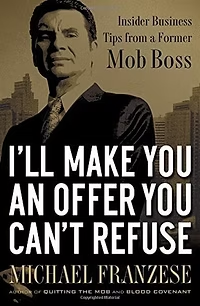
Book Corner: I’ll Make You An Offer You Can’t Refuse, written by Michael Franzese

Who says gangsters have marketable skills? Michael Franzese says so. Brooklyn-born Franzese, a former caporegime (which is a mobster who is second in line under a Mafia capo) and made-man in New York’s Colombo crime family, went legit following a religious awakening during an early ‘90s prison stretch. Franzese left behind a life of crime and became a motivational speaker, Mafia analyst for the media, writer, commentator, and even actor.

In this book – one out of seven that he’s written – Franzese argues that despite the criminality that he now abhors, gangsters have skills in running businesses that if copied, can put the average business or corporation ahead of the pack. I’ll Make You an Offer You Can’t Refuse is divided into eleven standalone sections, or rather lessons. In contrast to his former life, Franzese discusses running your business with honesty, transparency, and integrity.

He stresses the importance of choosing a good crew and surrounding yourself with capable people, starting your day as early as possible, proper planning, eliminating clutter, seeking counsel only from the wise, customer service, listening more than talking, learning from failures, etc. For example, one interesting section deals with the importance of effective negotiations – the famed “sit-down” as known to anyone who has seen The Sopranos and most other gangster portrayals in TV shows and movies.

Franzese informs us that unlike the sensationalist portrayal of crowded rooms, and long meetings with tempers flaring, sit-downs are short, sober, curt meetings attended by very few where the intended goal is to reach a mutually-acceptable compromise as soon as possible. After all, time wasted in long meetings is time better served making money, right?

At 160 pages, this book is relatively compact, nor does the author re-invent the wheel. Franzese’s skill is not only taking material that might be part of stuffy business textbooks and delivering it to the readers as filtered by his experience, but peppering the book with illustrative examples that keep them within a known cultural framework. As a result, the book comes out easy to digest.

Overall, we may not agree with how Franzese gained his business knowledge, but the lessons in I’ll Make You an Offer You Can’t Refuse are valid. His former crew would probably agree.

postN12

The Despair of Ice and Ability to Lead People through Storms.

The Despair of Ice and Ability to Lead People through Storms.

Book Corner: Shackleton’s Way: Leadership Lessons from the Great Antarctic Explorer, written by Margot Morrell and Stephanie Capparel

There is a vast library on offer for readers who want to study leadership books from historical figures. Shackleton’s Way adds to the fray and our knowledge by analyzing the famous 1915 Antarctic Endurance expedition of legendary explorer Sir Ernest Shackleton (1874-1922) for his leadership skills.

A word about Shackleton. Born in Ireland and raised in London, he cut his teeth on the Discovery expedition with Captain Robert Falcon Scott that explored the Antarctic regions in 1901 – 1904, one of the most brutal and inhospitable places on the planet. Later while leading on his own, he garnered international fame for a further series of Antarctic expeditions where he set distance records. Although in his lifetime he was considered a key figure in what is today known as the Heroic Age of Antarctic Exploration, he died in debt and fell out of the public eye for many years.

In the late 1950s, a series of books began to appear around Shackleton’s exploits, and his achievements began to be celebrated by a whole new generation of enthusiasts, leading to documentaries plus biographical TV miniseries (1983 and again in 2002, the latter featuring Kenneth Branagh). He has been acknowledged by the US Navy, and major universities have given management courses where his unique leadership style has been analyzed and promoted.

Shackleton’s Way tells the story of the Endurance expedition with an odd, but interesting, spin. For some background, the ship got stuck in ice and Shackleton was forced to abort and then lead his men to safety, with dwindling supplies, in the frigid wilderness. Morrell and Capparel analyze the expedition not as a success – which it wasn’t – but how Shackleton’s excellent leadership abilities saved his men and brought them all back alive and relatively unharmed (one man, however, lost his foot).

The Endurance story is told chronologically through eight sections, each highlighting a different leadership skill and how Shackleton embodied it, such as Creating a Spirit of Camaraderie and Leading Effectively in a Crisis. Each section concludes by focusing on a modern leader – from such diverse fields as business, education, and government – and how they in turn have been influenced by Shackleton and embody his style in their respective fields.

Shackleton was calm under pressure, led from the front, broke down the rigid hierarchies that were the norm on these expeditions, created cohesive and bonded teams, and was a master motivator. His crew respected and worked hard for him, and had full faith in his abilities. He had uncanny interviewing skills, creating a tight, professional team out of thousands of applicants with seemingly unconventional questions.

Shackleton was a fascinating man, and the lessons contained within this book are pure wisdom. The story itself is really an exciting adventure and you’ll get hooked after a few pages.

postN4

The Ten Commandments of Business and How to Break Them

The Ten Commandments of Business and How to Break Them

Book Corner: Ten Commandments of Business and How to Break Them, written by Bill Fromm

When Fromm wrote this book in the early 1990s, he was the president of Barkley and Evergreen (now Barkley), a Kansas City-based advertising agency and was a known and respected veteran in the advertising field. The book describes his personal philosophy of managing employees and dealing with customers, which, according to this book, breaks the mold of standard – and sometimes stodgy – corporate culture. Fromm provides a quick and interesting read, (the book clocks in at a tight 170 pages) with each “commandment”, or rather lesson, backed up with snippets from his personal experience.

Fromm writes about eliminating the tendency to hide behind memos and reports, calling it the “CYO” (cover your ass) culture. He states that the most effective form of communication is face-to-face. Same for suggestion boxes – he says to get rid of them. If your employees cannot comfortably speak their minds, then your company has a serious communication problem that must be dealt with on its own before you start taking suggestions. Fromm also tackles the modern management culture: when you separate the company into “officers” and “enlisted men” with layers of bureaucracy, perks, privileges (such as reserved parking for management) and physical barriers, you end up instead with an “us vs. them” attitude where the company is two teams, not one. And, as Fromm says, the company must be one team, not two.

Overall, Fromm places a heavy emphasis on treating employees with respect and class, resulting in what he says are happier and more productive workers. The most memorable example is his insistence that business cards be given to everyone, regardless of position – even the custodian. It makes the employees feel special and provides great advertising for the company. He gives the example of summer interns who were given business cards, and when polled later about their experience at the company, all the interns listed the cards as one of the most memorable experiences there. Fromm also stresses the importance of company events and fun meetings as enjoyable means to build and maintain morale.

In addition to culture and morale, Fromm writes about profits, marketing, customers, and more. Not every one of Fromm’s commandments is applicable to every company, and not every company needs to adhere to every commandment to be successful. But in a world where the successful reach their achievements by putting radical spins on standard thinking, Fromm’s book has much food for thought.