post241

Quick Trading Lesson and Mantra to Practice Patience

Quick Trading Lesson and Mantra to Practice Patience

Current speculative conditions are difficult for day traders. In most cases the market environments are likely very costly too. The amount of recent volatility over the past few months has made brokers very happy and traders very poor in many cases. Traders seeking to profit with limited resources who are using too much leverage have certainly lost money in many cases. No one talks about losses at dinner parties, folks like to brag only about their winning bets.

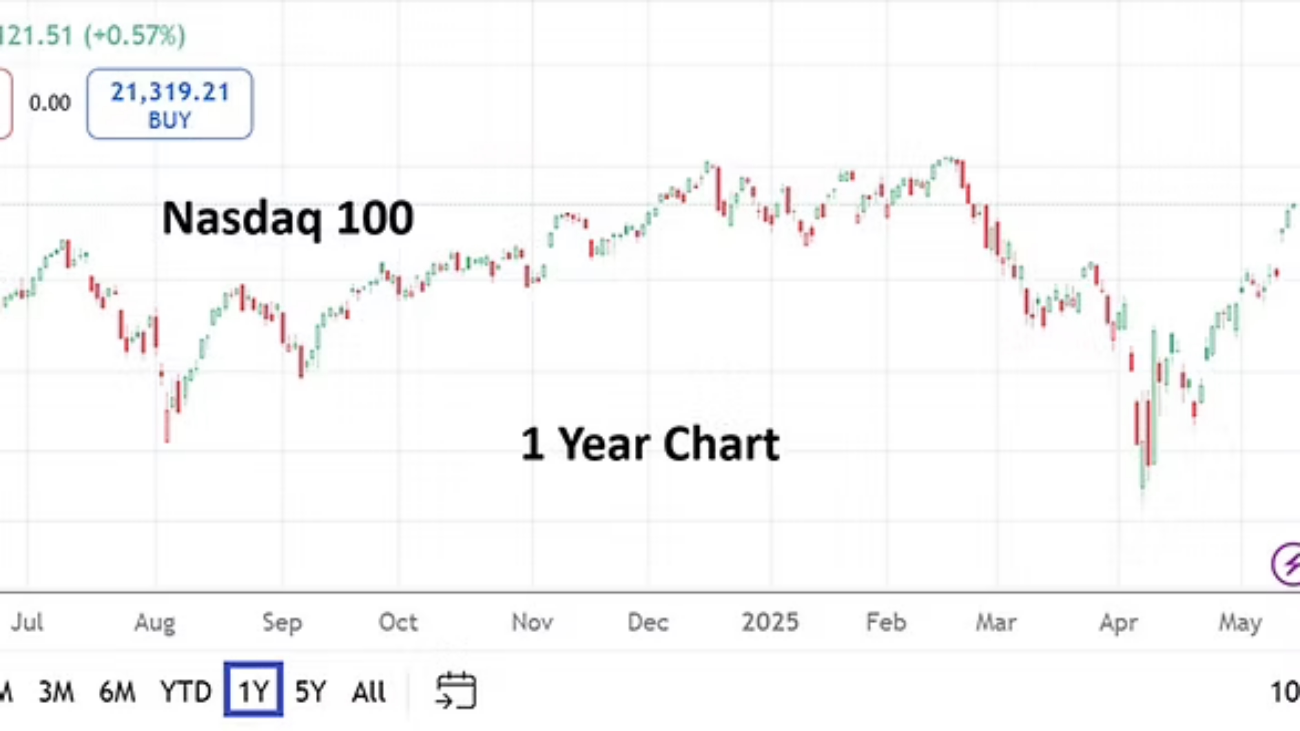
Nasdaq 100 One Year Chart as of 15th May 2025

To trade effectively in current circumstances a speculator needs patience, very limited leverage, and even the ability to carry trades overnight. The markets via Forex, equity indices and commodities due to the Trump Effect are fast and volatile. Having too much leverage on one single trade can create devastating losses. An other item to practice under present market chaos is to limit your trading. Do NOT have more than a couple of trades on at one time. Do not divert your attention if you are not able to handle the speed of the markets with too many wagers at one time.

In order to get an effective outcome, you need to not only be focused and use conservative amounts of money to wager on a position, but you also need to be able to handle the volatility of a trade while it losses money. And under the present markets – for instance CFD trading of stock indices like the Nasdaq100 or SP500 – results are dynamic via their reversals. Thus, you need to be able to handle the intraday volatility and perhaps consider carrying a trade overnight which creates other expenses from brokers who charge for the pleasure of near-term trading compared to quick short-term bets. Stop losses are important, but if you use conservative leverage this allows you the ability to let an asset trade via a wider range.

The markets are likely to stay chaotic for a while. Conditions do seem to be improving, but a broad spectrum of assets are still seeing daily moves that suggest nervousness has not disappeared fully yet. Optimism is showing slivers of light for bullish perspectives, but short-term players will watch their visions turn into mirages if they are over leveraged and over confident. Speculators need to remain wary of their perspectives because sentiment will continue to shift rapidly. Clarity may be on the horizon, but in order to profit from more optimistic outcomes patience is needed. The markets as they stand today are a fine example of the tortoise and hare race – a slow steady approach is safer than a helter-skelter rocket ride for traders.

post230

FX Trends: Brutal Months for Day Traders and Happy Brokers

FX Trends: Brutal Months for Day Traders and Happy Brokers

The past few months for day traders have likely not been pleasant experiences for many. Forex, equity indices and other assets have experienced plenty of volatility and finding a trend has not been easy. While speculators who are wagering on the ups and downs in the marketplace have been getting crushed, their brokers likely have not been getting hurt.

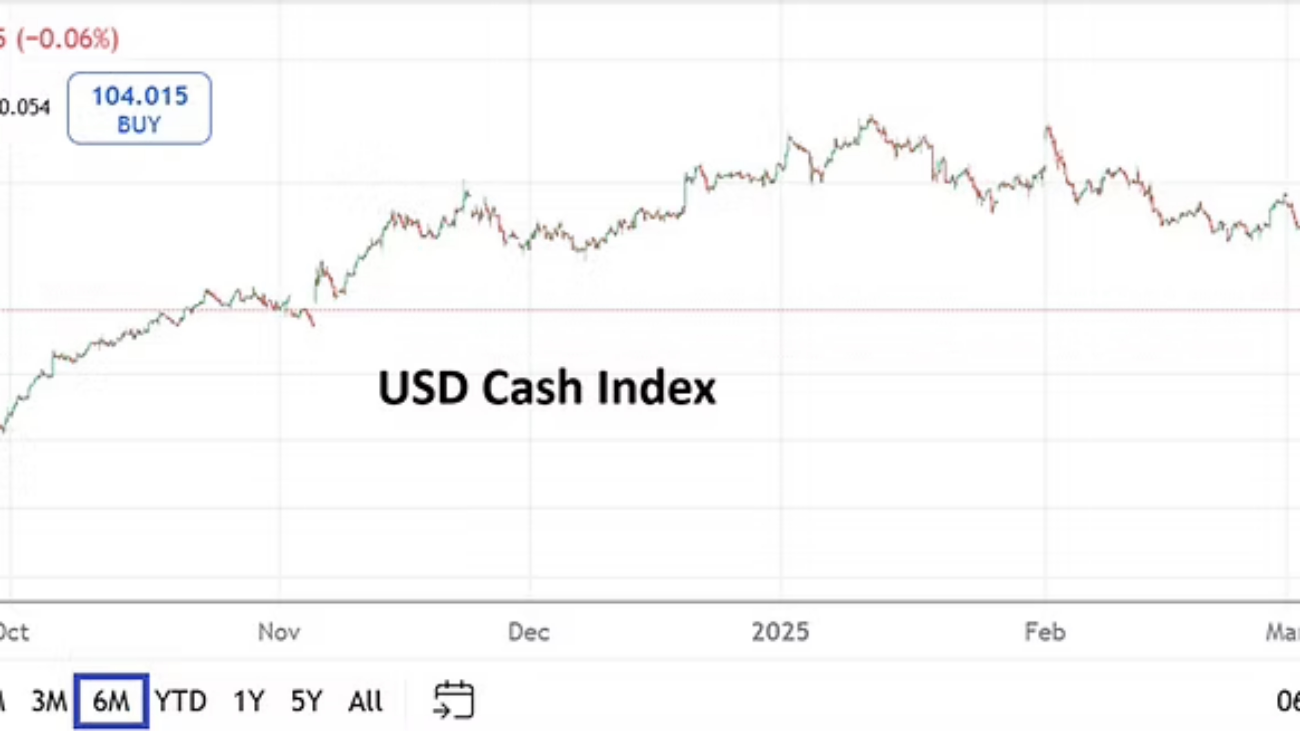
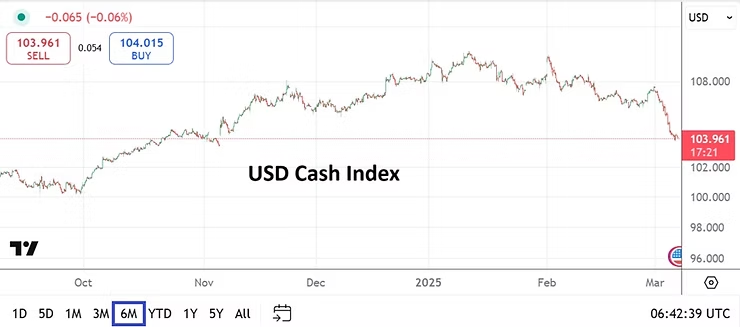
USD Cash Index Six Month Chart as of 7th of March 2025

Day traders need to understand that CFDs are virtual. Your broker is merely placing a wager for you on chosen direction, in most cases they are acting as ‘the house’ and know the volatility is going to knock you out of your trade. They pocket your losses as their winnings in many cases. The brokers are not only making money from the differentials from the bids and asks (the spread), they might also be charging you a transaction fee.

If a broker feels less confident about their ability to make a profit off your poor results (I am not kidding about this), then they sometimes insure your wager via a liquidity provider who in many cases is literally betting against your broker, because the liquidity providers believe your broker is likely being overly cautious. (A vicious circle). In other words brokers allow your trades to work virtually (not in the real marketplace) on something many risk management rooms in Forex call the B Book. If the broker is not certain if you will lose money, they put your trades into something called an A Book. And, yes, many liquidity providers (the A Book providers) are betting against their clients (who are brokers seeking to mitigate their risks).

Again, the brokers and the liquidity providers do not believe you will make money most of the time. They are allowing you to bet and they are happy to take your wager, because historical evidence shows retail bettors in Forex tend to lose money via their trading accounts at least 85% over long durations. Depending on what source you look at regarding CFD statistics, speculators tend to do a little better against their brokers but still lose money more than 50% of the time. Some statistics claim up to 75% of the CFD outcomes via trading accounts equate into losses for speculators.

And if all of this sounds like sour grapes, it is not, it is a warning to you the bettor. Brokers in many cases are glorified casinos that provide you an opportunity to wager. You need to acknowledge the above before your start trading. Speculating on Forex and CFDs ( via equities, indices and commodities) is like betting on a horse. The racetrack doesn’t lose money, they know most bettors simply enjoy the thrill of gambling and don’t mind losing. Racetracks are happy to pay the occasional winner. If you choose to wager on Forex and CFDs you need to practice risk management.

You probably didn’t come here to be reminded about risk management, you have heard it before – conservative leverage, price targets, timeframe parameters, entry – stop loss – take profit orders are standard warnings. You want to read about trends, you want to know which direction you should take, yet there are no guarantees and that is why speculating is gambling. You are wagering.

If you intend on improving your odds, by following solid risk taking tactics – including trying to understand behavioral sentiment via the financial institutions you are trying to emulate, you might find better results. And still, speculating will be tough.

The U.S will release Non-Farm Employment Change numbers today, but traders should pay attention to the Average Hourly Earnings report which will give insights about inflation too. However, the jobs numbers may prove to be a false narrative, because more importantly, whether you like him or not, there is the Trump Effect to ponder.

Tariff mantras and fears, negotiations regarding the fate of Ukraine, and a myriad of other concerns have financial institutions anxious as they try to seek clarity. Equity indices have been a mess. Yet, the USD Cash Index has given back a lot of its gains since February the 4th – this after the Forex bloodshed caused by nervous reactions to fear of tariffs being implemented. And now, not so coincidently the USD Cash Index is traversing values it saw on the 5th of November 2024, yes, U.S Election Day. Speculators and financial institutions have returned full circle to big unknowns.

postN93

Leverage and the Holidays Often Leads to Costly Volatility

Leverage and the Holidays Often Leads to Costly Volatility

This may seem like an unfriendly reminder for this time of year, but holiday trading can lead to dangerous storms for traders. Keeping a realistic viewpoint regarding your ambitions during Christmas and New Year’s is important.

Most day traders cannot afford to have an outlook that is beyond the short and near-term. This is an ugly fact many speculators with less than deep pockets have to acknowledge if they are new to speculating. While large traders and financial institutions can maintain mid and long-term outlooks, day traders who do not have the funds to keep overnight positions need to operate in an entirely different fashion.

Trends via technical charts and fundamentals are crucial for all traders. Behavioral sentiment is a key ingredient too for all participants chasing assets. However, day traders also need to understand unique risk management limitations. The use of leverage is a vital dynamic, and can cause devastation fast when too much money has been wagered. The use of leverage by day traders effectively raises the probability that a trade will lose money.

Incremental changes in value to a Forex pair, commodity and equity share being traded on a brokers platform by a speculator using ‘borrowed’ money via an account that allows for margin often leads to quick outcomes that fail. Many brokers offer traders ‘polite’ leverage ranging from 10% to 100% in extra funds, this while enticing the speculator to the potential of profiting in a quicker and more robust manner. It should also be noted that when a broker is offering vast amounts of leverage, they are knowingly increasing a traders likelihood of losing. The use of leverage beyond 10% leads to plenty of expensive mistakes.

Unfortunately, the simple truth is if you can make fast money trading, you can lose fast money while trading. The use of the word speculating is simply a gentle way of not using the word ‘gambling’.

Traders tempted to pursue wagers during the next couple of weeks should remember a lack of normal volumes make many asset classes more volatile, meaning the use of leverage by speculators often leads to dangerous gyrations within their accounts.

Risk appetite has taken on a optimistic tone globally because of the upside U.S equity markets have been producing, while U.S Treasury yields are decreasing, but dangers still lurk. Day traders need to remain realistic regarding their pursuit of quick hitting trades during the holiday season, and make sure they use solid tactics while pursuing their outlooks. The trend may appear to be your friend, but short-term reversals in the wrong direction can cost money.

No one wishes for bad things, but speculators should also note that if risk adverse events occur during the holidays, that ‘negative news’ can often become amplified this time of year and cause more volatility. Speculative positions in Forex, Crude Oil and gold can produce rather wild results, and thin trading volumes can add to the swift changes in values.

postN17

AMT Warning: Many Brokers Do Not Care if you Lose your Money

AMT Warning: Many Brokers Do Not Care if you Lose your Money

Sounds like the title has been written wrong doesn’t it? Reads as if the editor clearly doesn’t understand the nature of the financial markets and how they work. Certainly anyone who offers their services to you would like to see you make money, or so you would like to think if you are an idealist who remains innocent and trusts all people.

Unfortunately, the title of this artcle which has lured you into reading this WARNING is not wrong. It has been written as cautionary advice for new and even experienced speculators. Many of the ‘financial’ websites and people you are considering to engage with via their day trading platforms and ‘expert’ systems are not worthy. Many do not care if you make money and some in fact are planning on ripping you off.

Blackjack Betting and Sitting at the Table with Too Much Leverage

Volatility is in the eye of the beholder, brokers like when day traders without deep pockets use leverage, because they expect their ‘clients’ to get wiped out. Yes, brokers are not your friends in many cases, in fact they are rooting against you in the back rooms of their trading operations. Why? Because they are not actually putting your trade into the cash markets, they are allowing you to trade virtuallly. Think of it as entering a casino.

The casino wants you to bet outrageous sums of money, because they know statistically most gamblers will lose. Again, you have been warned. Your use of leverage is music to the ears of your broker, because they know the volatility of the market will knock you out of a trade if your margin trading is too high and the slightest of technical reversals will produce a losing position for you. Then they will ask you if you want to make another wager. You can continue to sit at the ‘blackjack’ table or walk away.

Learn To Trade Without Getting Ripped Off

The first thing you might want to ask and acknowledge when you begin to trade is how much money can be lost? The answer is all of your money. If the answer being given to you is that there is minimal risk and that you are guaranteed profits – immediately close the website you are looking at and find another. Guaranteed profits equates into assured losses for unsophisticated traders most of the time.

If you are speaking to someone on the phone and the person keeps asking you how much money you want to make, please hang up the phone and speak to someone else. Self proclaimed gurus should be shunned. As someone once said, people tend to use the word guru, because the word charlatan takes too long to spell.

Yes, even in the most reputable and best of companies who provide trading platforms, you are going to lose money sometimes. The art of speculating and successsful trading is a delicate balance between losing money and making money. It is probable if you are a new trader, that unfortunately you are going to lose money and you will become uncomfortable. Sure you could get lucky or be a prodigy who is supremely talented, but you should understand many folks lose money in the beginning. There is a learning curve for day traders and you need good teachers. You also need a calm emotional state of mind.

Finding a Pro to Trade for You

You might want to consider letting someone that you trust and who has a proven track record with verifiable clients you can authenticate to invest your money. However to have a pro trade for you, the amount of money as a minimum you will need for them to consider trading your cash is likely sizeable. It doesn’t seem like a fair question from a social perspective, but are you wealthy enough to allow someone to trade for you?

If you find a person that is reputable to trade for you, make sure they have explained their modus operandi and you agree with their outline. In other words have them discuss their plan of attack and how they perceive complexities within the markets. What sectors do they invest in, what is the break down via percentages regarding the amounts of money they put into various financial assets? Asking questions may seem a bit impolite, but reputable fund managers and family offices should not get flustered by your questions, and they should have answers that are easy to understand. Do not let them talk over your head with fancy words and equations. Clear and concise language is necessary.

You shoud ask how often they rebalance their portfolios and if they issue a quartertly report. Importantly, ask for an example of transparent accounting which shows transaction fees that will be charged in full, including services they are charged by other financial providers within your account. Commission and banking fees can add up quickly. And then ask the magic question regarding drawdowns, and what are the allowable losses in a trade and in an account that can happen before they have to stop trading. You should get clear explanations regarding all of your inquiries.

But You Likely Still Want to Trade for Yourself

If your emotions do not let you take into consideration that there are going to be negative days, perhaps declines for weeks and bad months – simply put, trading isn’t for you. Learning to handle your money and investing should not be a speculative adventure, this is not about having fun. Oh you will certainly experience thrills, but you should try your best to limit crises. Risk management is a way to curb the elements of gambling which every day trader is undertaking.

Will you become a professional investor? What is a professional investor? Nothing like semantics and flattery to get the juices of a prospective investor going. Do not be fooled by flattery. Do not be fooled by the fact that you have a degree. There are folks who do not have high school graduation certificates looking to take advantage of you, some of them are great traders and will eat you alive. Education at the best of colleges or universities is no guarantee you will become a good trader. There is a difference between paper trading and having skin in the game.

The marketplace is waiting for you to enter and anticipates taking your money. Brokers are trying to get you to come to their trading platforms because they want to make money from your transactions and wagers if they are not reputable. These brokers actually do not believe you will make money. Until you prove you know what you are doing you will be treated like a ‘mark’. When you do prove you know what you are doing you will be treated differently in more ways than one, and it might prove difficult to withdraw your winnings.

Trust is Important, but Facts and Regulations Help

You must deal with people and companies you trust. Make sure to do a deep examination of the folks you are about to forge a trading association. Trading virtually via digitalized CFD and Forex houses that are not regulated can lead to financial disaster. And ask where your broker is regulated, and then check on the mandates of the entity and government which has written the rules for brokers – are they legitimate supervisors and who do the regulations favor? There is a lot of work involved before you trade, you must practice due diligence.

AngryMetaTraders wants you to understand the game of trading. We talk about sports often because the world of trading can be closely compared. If you are good and lucky, perhaps the world of investing awaits your success. If you suffer a learning curve like many, you can compare yourself to an athlete that must train to beat the best. You will need patience and dedication. Surround yourself with reputable firms and people to asssociate your speculative endeavors with in order to get solid results long-term.