postN3.1

India Insider: Working with the West as it Deals with Others

India Insider: Working with the West as it Deals with Others

India’s Prime Minister Narendra Modi visited Tianjin, China for the 2025 Shanghai Cooperation Organization Summit in early September, which was attended by over twenty nations. Before India visited the conference in August, Washington D.C had already imposed a 50% punitive tariff on India’s exports. The initial tariff was a 25% duty, but included another 25% penalty because India purchases a large amount of Russian Oil, which the U.S seeks to reduce. An uneasy trade dilemma looms for India.

Many Western analysts quickly concluded that Prime Minister Modi was tilting India towards a stronger relationship with the Russian and Chinese camps, by potentially embracing warmer associations with Presidents Vladimir Putin and Xi Jinping, and defying Washington’s previous warnings.

Yet, the trade composition and the underlying reality highlights a different story. Despite India being positioned in the global South politically, the nation recognizes its higher value exports – which include textiles, gems and jewelry, apparel, and pharmaceuticals are primarily sold to the West. The United States clearly remains India’s biggest consumer. In essence President Trump holds a trump card.

In contrast, China’s total exports to the global South (excluding Western Europe, Australia, New Zealand, and North America) has doubled since 2015. Chinese exports to the U.S were $525 billion USD in 2024, but to the global South, China’s exports grew to nearly $1.3 trillion USD.

As Professor Michael Pettis accurately points out, “countries with expanding trade surpluses with the U.S, use their higher revenues to fund deficits with the rest of the world.”

India Exports More to the West:

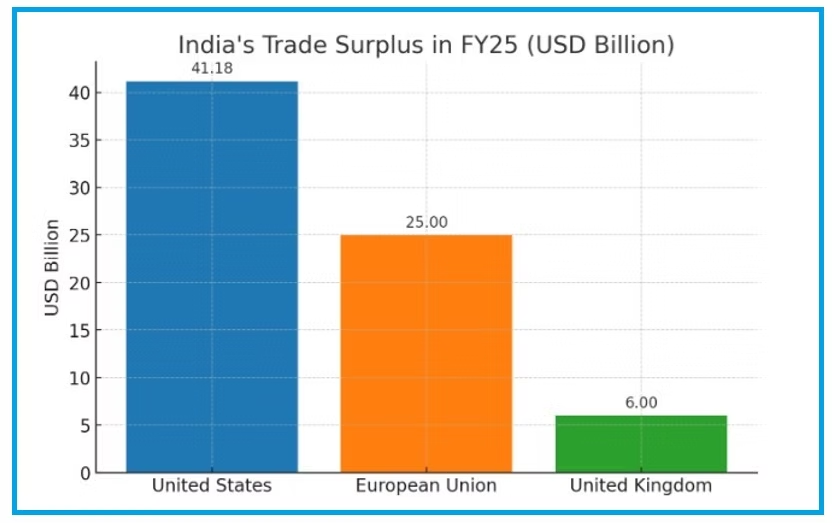
India’s trade surplus with United States, the European Union and U.K stands at $72.18 billion USD. If India wants to be competitive with China in terms of manufacturing, it should affiliate more astutely with the Western camp.

Dependence on Anti-Western Countries Hurts India’s Trade Balance:

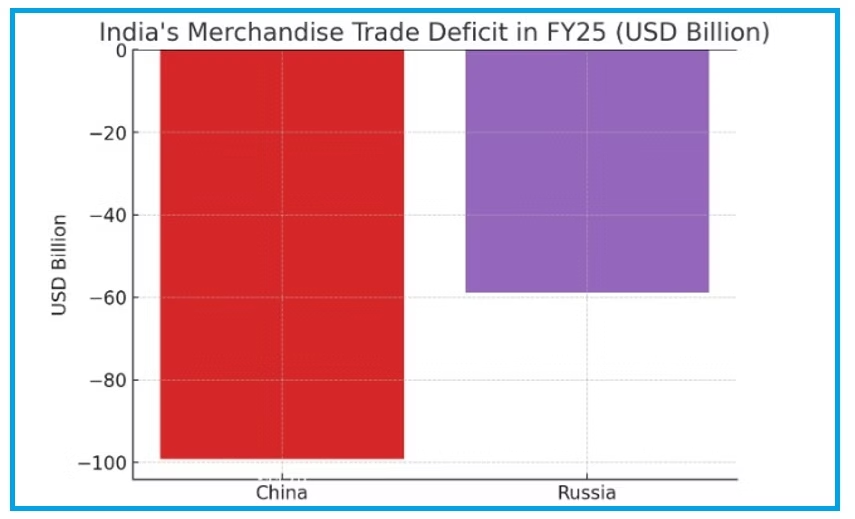
India’s combined trade deficit with Russia and China is approximately $158 billion USD, which demonstrates how much less India exports to these two countries. India’s overall merchandise trade deficit is $282 billion USD, with a deficit of almost 56% in total attributed to Russia and China.

Service Exports a Crucial Metric in India’s Balance of Payments:

India’s services exports stood at $383 billion USD in financial year 2025, earned primarily from the U.S and other Western countries. Washington has imposed tariffs on India’s tradable goods sector, while the nation’s non-tradable sector has been operating without much stress.

India’s overall trade deficit stood at minus $94.26 billion USD in financial year 2025. Without service exports (predominately from the software services sector), India’s current account deficit would be much larger and the Indian Rupee would face greater depreciation pressures.

India’s economic stability is precarious, equilibrium needs to be found. Solid domestic outcomes for manufacturing and a stable Rupee, including exchange rates, could be achieved with a well-defined calibration that looks West but does not weaken India’s stance as a non-aligned nation. New Delhi should focus on maintaining neutrality and strategic autonomy.

While India may shake hands with Presidents Vladimir Putin and Xi Jinping, an important economic lifeline runs firmly through Washington, Brussels, and London. Crucial negotiations are said to be taking place between Prime Minister Narendra Modi’s team and President Trump’s White House behind closed doors. New Delhi could become vulnerable if it does not find adequate solutions. President Trump has recently reiterated his friendship with the Prime Minister Modi, perhaps an agreement can be produced in the mid-term.

post238

Trump: Will He or Won’t He Day and Uncertainty for Investors

Trump: Will He or Won't He Day and Uncertainty for Investors

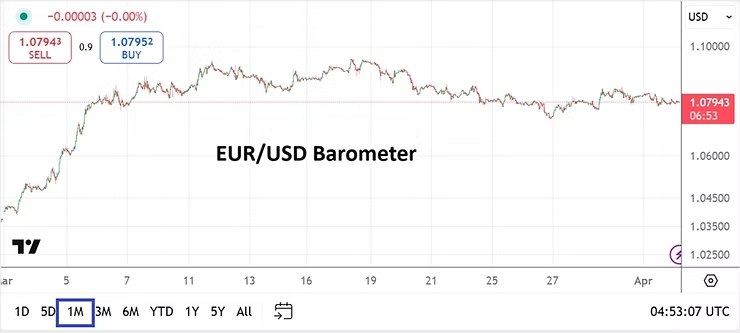
EURUSD One Month Chart as of 2nd April 2025

Liberation/Tariff Day will blow onto the global financial shores this morning. President Trump and his team are certain to take a victory lap as they announce their decisions regarding actions being imposed on commodities and products. Nations who are on the other end of the drama will be braced for the rhetoric and policies. Investors, trade ministers, financial institutions will have to sift through the pronouncements and consider their outlooks amidst uncertainty.

Trading today will be rough for smaller speculators. Choppy conditions should be expected as behavioral sentiment twists according to shifting winds and interpretations. President Trump is likely to announce aggressive penalties, but he may also try to soothe those who have worried about being punished. As an example, Trump has said recently that India has acted upon many of the White House’s wishes. Mexico, Canada, the European Union and China are likely to be mentioned as the U.S President speaks later today. Will a public scolding take place again?

Equities have faltered the past month, Forex has been volatile and commodity prices have also reflected fragile sentiment as outlooks became grey. The tariff policies announced today will affect all aspects of the financial world. Day traders thinking about wagering on the outcome should be patient and wait for the reactions which unfold from Asia, Europe, Africa, and the Americas. Wall Street will certainly be a barometer, along with the EUR/USD, USD/MXN, USD/JPY, GBP/USD, USD/SGD and gold.

While President Trump declares this is a great and magnificent day for the U.S, it will be of keen interest if an olive branch is offered to trading partners. After talking tough the past few months, financial institutions would like to hear words of optimism from the White House. If belligerence is heard and punitive actions are enacted, which are considered unproductive by investors and financial institutions the broad markets will show their disdain promptly.

President Trump’s skills as a negotiator will be judged today. The White House must play towards its constituency and show they are putting America First, but will the President also display he is cognizant that international trade provides benefits? Trump will point to his claim that he is merely putting tariffs on those who have treated the U.S unjustly and use levies against U.S goods.

It will be an important day for the Trump Presidency, because in many respects the global audience watching will decide whether or not the U.S sees itself as part of the global fabric or seeks a position which is isolationist. Brazil will look on the tariff theater intently, its position as a trading center may find increased demand from a host of nations.

Predicting the results: On the 3rd of February a fast and dangerous Forex market developed which witnessed USD centric strength exhibited with spikes in many currency pairs. In early March reactionary trading was displayed in equity indices, Forex and bonds too. Today will see wide spreads emerge in Forex with near-term resistance and support levels proving vulnerable.

Equities which sold off in March via the Nasdaq 100, S&P 500, Dow 30 and the Russell index are certainly hoping for a dose of cheer. The question is if Trump will deliver a positive message. The likelihood is that today’s events will not be the last of the tariff tirades and some proposed actions remain under deliberation. Today is unlikely to produce final results and the broad markets are probably going to be choppy as outlooks stay mitigated and absent of clear resolutions.

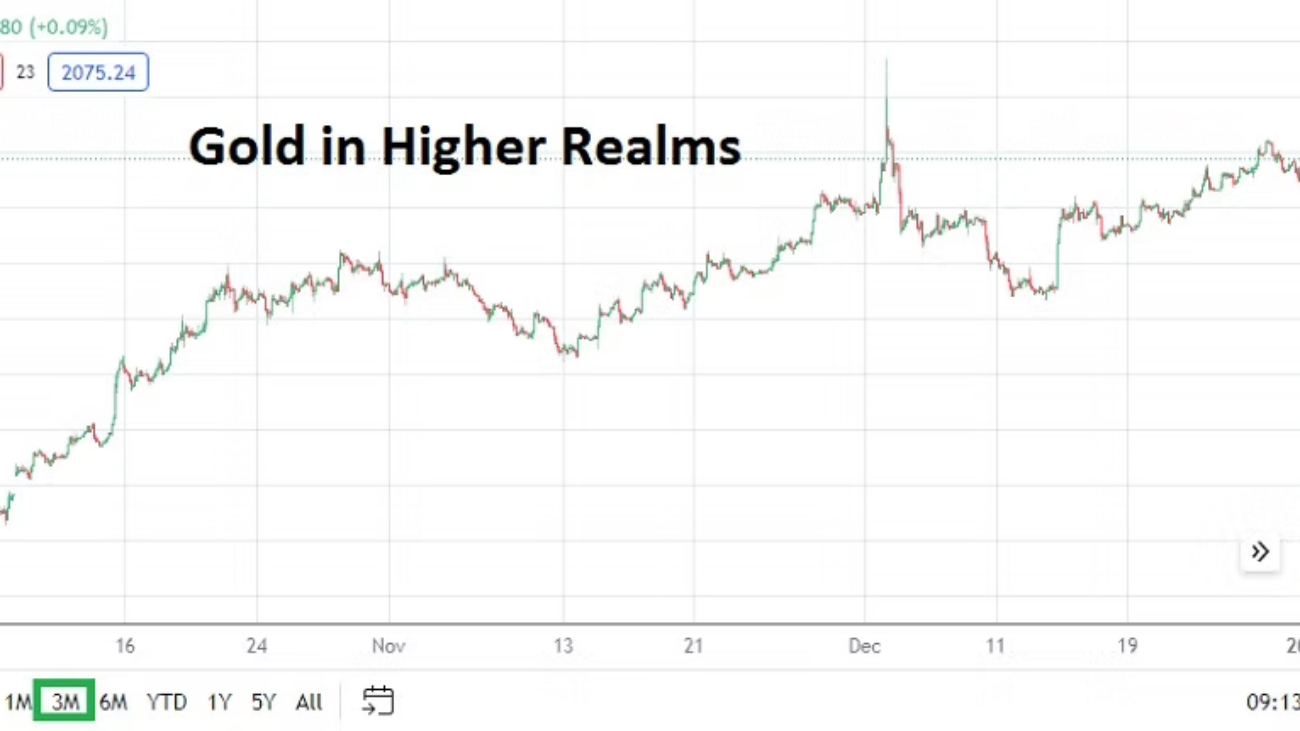
Gold Three Month Chart as of 4th April 2025

Day traders should think safety first today. Gold remains within record territory. If unpredictability rules near-term and the reactions of investors and financial institutions create fast conditions, the precious metal and bonds will find takers. Uncertainty breeds cravings for risk adverse assets.

postN2.1

Impact: Powell’s White Flag, Inflation Data, and the BoJ

Impact: Powell's White Flag, Inflation Data, and the BoJ

Federal Reserve Chairman Jerome Powell’s waving of the ‘white flag’ last Tuesday, when he admitted that inflation was producing stronger than anticipated data had been essentially wagered on since the second week of March by financial institutions. Powell’s speech acknowledging the Fed will find it difficult to cut the Federal Funds Rate in the mid-term (and probably at best not until late this summer) simply verified Forex positions which had already been taken by large players who could afford to make mid-term wagers.

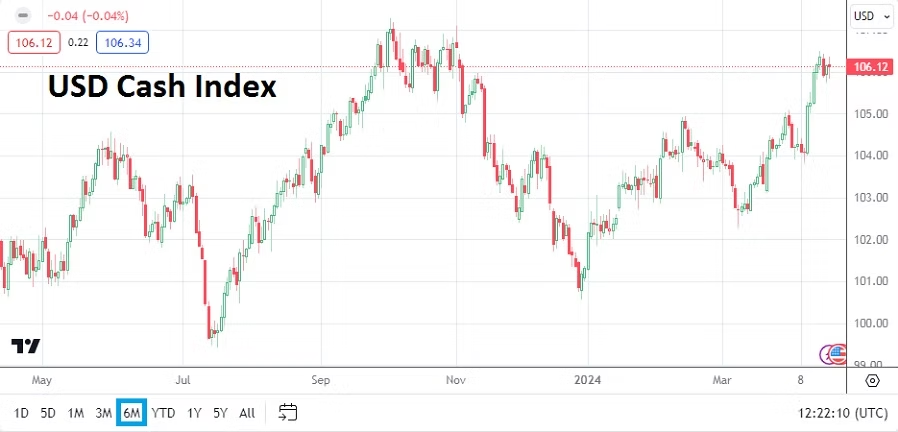
The USD Index has returned to early November 2023 values, and appears able to challenge late September and October prices if inflation data this week causes more volatility, which should put traders of major currencies like the GBP, EUR, JPY and others on full alert. After the USD spiked higher from the 10th to the 12th of April, Forex speculators have seen dynamic action incrementally flirting with stronger USD results the past week and a half.

USD Cash Index Six Month Chart as of 21st April 2024

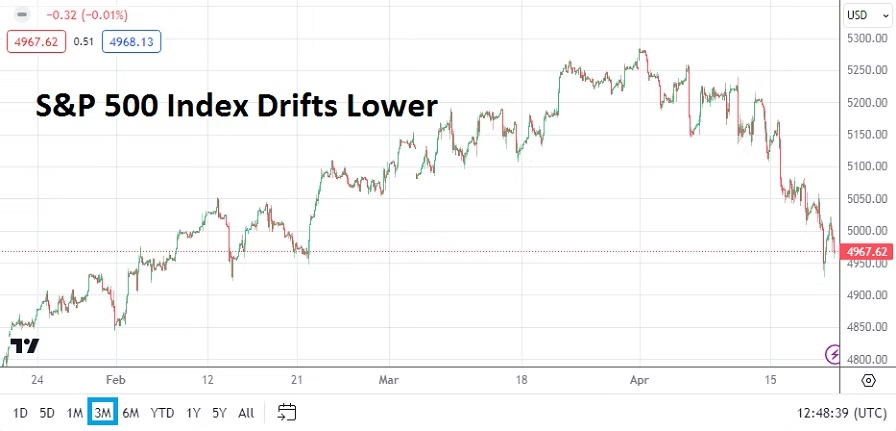
Nervous trading continues to be seen in U.S equity indices. The Dow 30 and the Nasdaq 100 are fighting near ratios they touched in the last week of January. And the S&P 500 is traversing ground from the first week of February.

S&P 500 Three Month Chart as of 21st April 2024

Content

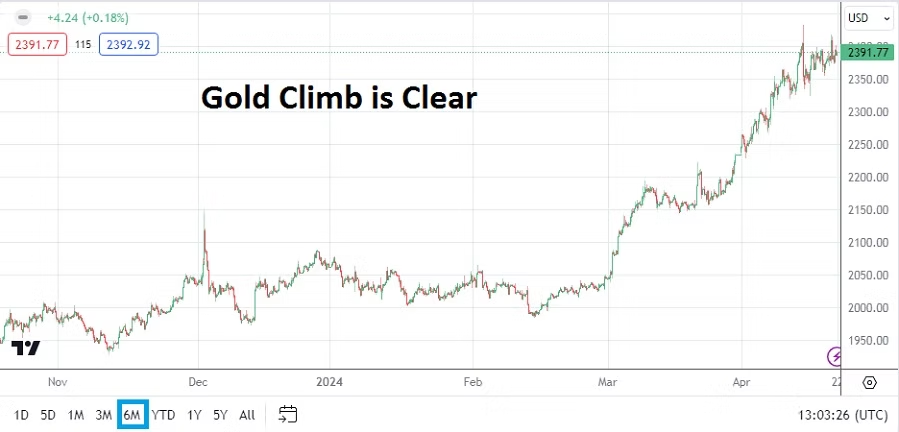
Gold Six Month Chart as of 21st April 2024

Gold remains speculatively high as its hovers near 2,400.00 USD per ounce. The price of the precious metal has not given back its gains made since the start of March and this is intriguing because of the ‘known’ USD inverse correlation, which had proven to work well with the precious metal over the past couple of years but has been stopped in its tracks for the moment. Technically Gold may look overbought, but geopolitical concerns and the prospect that some central banks may be strong buyers could be fueling the rather incremental gains. Retail traders of Gold need to be careful because price action is likely to produce more surprises.

Forex has been turbulent the past handful of months as shifting behavioral sentiment has created choppy conditions. This coming week contains large fundamental risk events via data releases traders should monitor. USD/JPY speculators will also have to contend with the Bank of Japan.

Monday, 22nd of April, China Loan Prime Rates – borrowing costs are anticipated to remain at the current benchmarks. China produced slightly better Gross Domestic Product results last week, but Industrial Production numbers were weaker. Consumers in China remain burdened by decreasing home values and concerns about the economy.

Tuesday, 23rd of April, European Union and U.K Manufacturing and Services PMI – E.U results via the PMI readings are expected to show slight improvements. However the readings from the United Kingdom are anticipated to come in flat. The EUR/USD and GBP/USD will be affected by the results, but the currency pairs will likely remain focused on U.S data later in the day.

Tuesday, 23rd of April, U.S Purchasing Managers Index – the Manufacturing and Services sectors are expected to produce slightly better readings than the previous month. These results will be interesting taking into consideration the Empire State Manufacturing Index numbers last week were bad. The PMI statistics will provide some impetus to the broad Forex market.

Wednesday, 24th of April, Australia Consumer Price Index – inflation data is anticipated to be higher than the previous month’s results. While stronger inflation is not something that will make consumers happy in Australia, stubborn price results may keep the AUD/USD slightly steadier. The currency pair is traversing values last seen in the second week of November 2023 as of this writing.

Thursday, 25th of April, U.S Advance Gross Domestic Product and Price Index – these numbers are certain to have an impact on all financial assets. A decline in growth is anticipated in the U.S compared to the previous month’s result, but the Price Index is expected to show an increase. Jerome Powell having come out last week and said inflation is causing uncertainty within the Federal Reserve, may have a bit of inside knowledge regarding this GDP inflation number and ‘tipped his hand’. If this inflation gauge is higher than anticipated it could pour fuel onto the already volatile USD. All Forex traders need to pay attention to these results and be prepared with solid risk management.

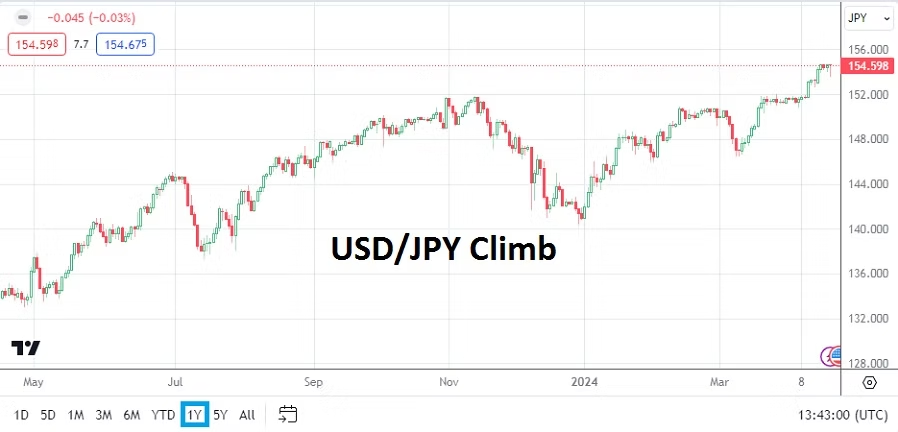
USD/JPY One Year Chart as of 21st April 2024

Friday, 26th of April, Bank of Japan – in what has already proven to be a couple of weeks filled with drama for the USD/JPY, the BoJ will step into the limelight. During their last central bank meeting the Bank of Japan increased the Policy Rate to 0.10%. It was the first time the BoJ hiked interest rates in 17 years. The USD/JPY is trading at values last seen in June of 1990. The Nikkei 225 has come off of recent record heights, but the famed Japanese stock index is also trading within territory seen in January of 1990. Business activity via the Core Machine Orders and the Tertiary Industry data last week were stronger than anticipated.

The Bank of Japan may want to maintain a weaker USD/JPY equilibrium to continue fostering domestic growth. However, many financial analysts have been calling on the BoJ to become more hawkish regarding monetary policy. The interest rate decision is certain to cause immediate volatility before and after the Policy Rate is made public. USD/JPY traders need to be prepared for fireworks. A slight raise of the interest rate seems to be needed, but after the March hike the BoJ may prove conservative again. The 34 year lows now being seen in the Japanese Yen are astonishing.

Friday, 26th of April, U.S Core PCE Price Index, and Inflation Expectations – the data from the government, and the reading from the University of Michigan will close the curtain on a big week of economic statistics for all traders. The USD will react to these outcomes. It should be noted the previous Inflation Expectations data from the University of Michigan caused a storm in Forex when it came with 3.1% gain.

postN95.1

Trading Optimism for 2024 and Pursuit of Castles in the Air

Trading Optimism for 2024 and Pursuit of Castles in the Air

Traders may feel like horses being kept in their stables right now. The desire to run freely in Forex and other markets is certainly being felt, this as many analysts have jumped onto optimistic bandwagons and are pointing to the U.S Federal Reserve and its rather dovish outlook for 2024. Gold in early trading this morning is lingering near highs and the USD remains within weaker territory when technical charts are inspected via one month results.

Gold Three Month Chart as of 2nd January 2024

Yet, thin holiday trading is full in effect. Light volumes will continue to be seen early this week after the New Year’s celebrations. Financial institutions will open their doors today, but their corporate clients around the world will have plenty of employees who will remain on vacation until the 8th of January. Thus, while day traders may feel enticed to wager in the markets with various CFDs, they should be careful and understand unbalanced positions may cause temporary chaos. Risk taking tactics should be carefully considered.

The desire to dream about castles in the air is a source of comfort for many new day traders. But remaining realistic about potential results, while not getting overly ambitious about targets is an important aspect for all speculators. While trends may look attractive in Forex, commodities and equities a well planned approach regarding risk taking is a practical road. Castles in the air tend to vanish.

Optimism will be a word frequently heard in the coming days and weeks, and here’s to wishing everyone a prosperous and peaceful 2024. The potential of a more dovish U.S Federal Reserve regarding monetary policy and declining Treasury yields sparking more risk appetite in equities as investors seek solid returns is alluring, however risks remain on the table. The economy of China continues to worry analysts and tensions in the Middle East are still a long way from being solved.

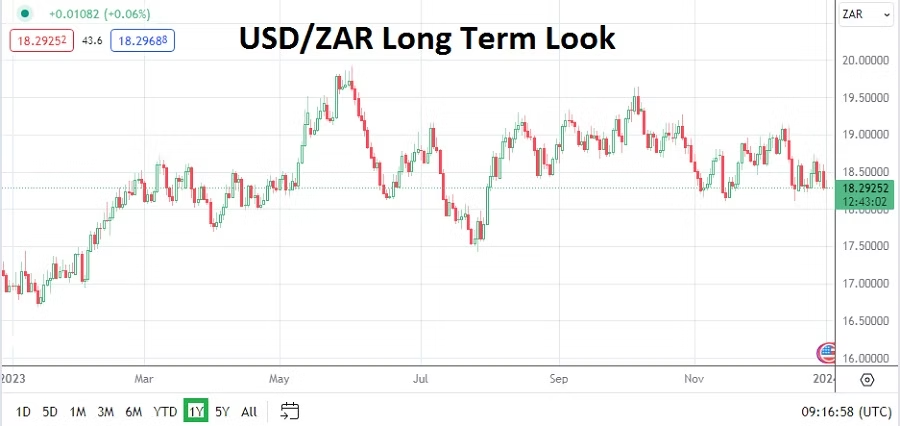
However, the biggest cause for speculative concerns during 2024 may come from elections in Taiwan, India, South Africa and the United States. Taiwan’s presidential vote is on the 13th of January. China will certainly be watching the results, and traders should expect to hear swords rattling afterwards and then hope the noise calms down.

USD/ZAR One Year Chart as of 2nd January 2024

Tranquil voting results in India will be welcomed by investors. India is becoming a noteworthy economic giant, its rapid growth and ascension as an important investment vehicle needs to remain stable. South Africa remains troubled domestically by concerns regarding corruption and inefficiency, its upcoming spring election results may not solve the problems it faces. There will be many elections in Africa this year, which could spur on considerations regarding geopolitical alliances and the price of commodities.

The U.S election late in 2024 will start to grow in noise as the months progress and by early this summer behavioral sentiment will begin to become nervous regarding the outcomes for the White House and Congress. The U.S appears to be braced for an election between Joe Biden and Donald Trump and this will certainly cause skittish storms.

Traders should feel confident about risk appetite in the global markets improving, but they should keep in mind that impetus coming from many different spheres can affect the financial world.

Tuesday, 2nd of January, U.S Final Manufacturing PMI – today’s Purchasing Managers Index is expected to show a slight improvement, but the results may fall on deaf ears because many market participants will not be around to react due to the fact they are still on vacation.

Wednesday, 3rd of January, U.S ISM Manufacturing Prices – this inflation survey from purchasing managers may be given a bit of attention, but its effect may be limited because of light trading volumes still being exhibited.

Thursday, 4th of January, Germany Preliminary CPI – the inflation data from Germany will get some consideration, and the result is expected to show a slight increase. Services PMI data will also come from European Union nations, the U.K and U.S.

Friday, 5th of January, U.S Non-Farm Employment Change and Average Hourly Earnings – the jobs reports will get the notice of financial institutions. The results for employment and wages are expected to be slightly weaker than the previous month’s outcomes. Typically these numbers would cause a stir, but unless there are surprises, most financial institutions may not react massively to the reports because it remains a ‘holiday’ week. If the numbers come in weaker than expected this could cause interesting reactions on the 8th of January and weaker USD sentiment.