postR164.1

USD/ZAR and EUR/USD as South Africa and ECB Create FX Shadows

USD/ZAR and EUR/USD as South Africa and ECB Create FX Shadows

Risks for day traders will abound this week in Forex. Taking advantage of trends in the days to come will rely on interpretations of behavioral sentiment, which may become rather reactionary from financial institutions if they feel existing positions are vulnerable. For the moment there is calm but day traders should not expect this to last.
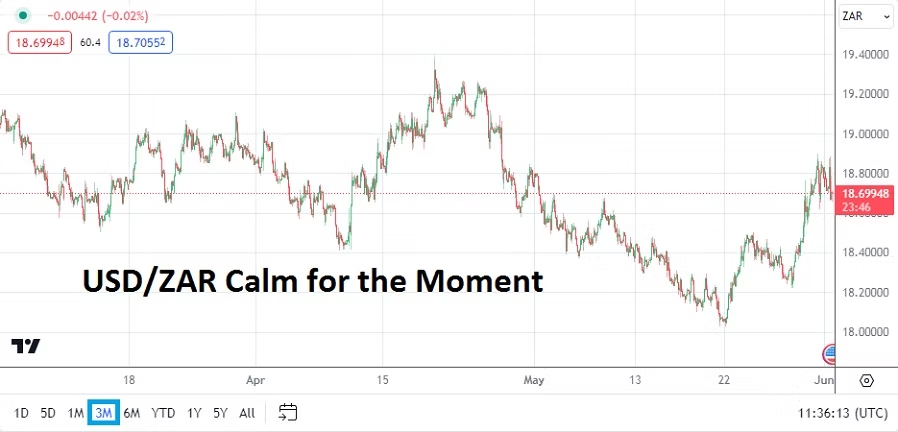
USD/ZAR Three Month Chart on the 3rd of June 2024

The results from the South Africa election have delivered the need for a government coalition. The USD/ZAR will certainly move according to degrees of nervousness being generated in South Africa. While the African National Congress has publicly called for unity and openness to achieve a working government, there are legitimate fears the ANC may consider a left wing coalition known as the Doomsday approach, which could include political parties that are not seen as being pro-business or inclusive for the entire population. Financial institutions in South Africa and abroad will have their trust of the ANC tested in the days ahead.

South Africa political concerns may cause the USD/ZAR to step out of line and not correlate to the broad Forex market. The ANC has two working weeks to reach a coalition deal. The ANC has never been in such a weak position before, and if the ANC makes a political deal which is interpreted as being against free enterprise it will not be welcomed by many businesses. Will the ANC be able to admit a new path can be followed in South Africa that creates a space for more transparency regarding fiscal policy and oversight, or will the ANC become stubborn and make a deal with a political party that moves the nation backwards economically and causes more strain via geopolitics?
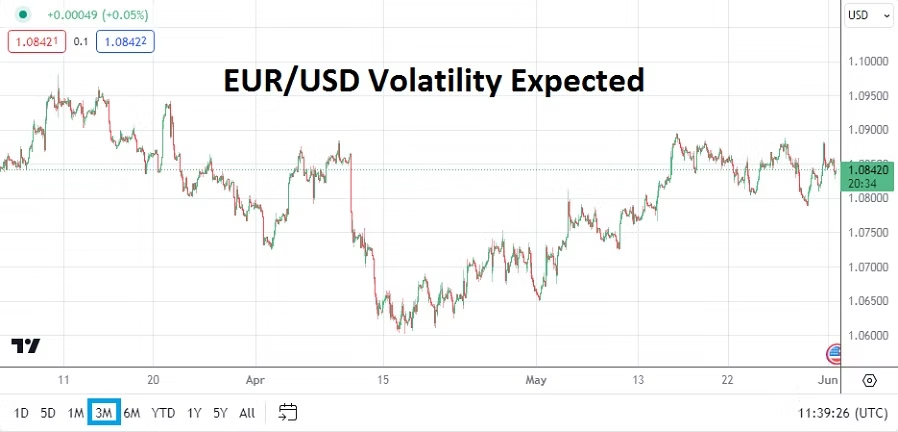
EUR/USD Three Month Chart on the 3rd of June 2024

From Europe, the ECB will step into the spotlight this coming Thursday. Following last week’s lower than expected Consumer Price Index data from Germany, the ECB is widely anticipated to cut its Main Refinancing Rate by 0.25%. Day traders need to be aware of this, because on Thursday if and when the ECB does cut the interest rate, the reaction in the EUR/USD may not move the market as much as small retail speculators anticipate.

Instead the volatile reaction could come from the inspection and understanding of the published Monetary Policy Statement, and the Press Conference which will follow half an hour later. The EUR/USD it should be noted jumped higher last Wednesday on the weaker than expected inflation report from Germany, which may mean some of the EUR/USD bullishness has already been bought into the currency pair.

The thought that the ECB has seemingly stood in the shadow of the Fed for the past year and largely reacted only after the U.S central bank is important. If the ECB actually goes out on a limb and cuts its interest rate this week, and says it is considering another later this summer it will cause a reaction. The differentiation between the Main Refinancing Rate from the ECB and the Fed’s Federal Fund Rate will cause momentary headaches too.

However, this might ignite thinking within financial institutions that the Fed has given the ECB a quiet ‘green light’ and assured the ECB that the Federal Reserve will become dovish over the mid-term. However, the Fed is not expected to cut the Federal Funds Rate next week. What should happen is that the Fed delivers a December 2023 repeat performance on the 12th of June, in which it expresses a rather dovish perspective – but this time delivers, but there are no guarantees.

The U.S jobs numbers this Friday will play into the EUR/USD sentiment too and all other Forex pairs. Importantly, traders do not want to see a retraction from the Fed again in the coming months and cautious talk about inflation. While higher prices may be the reality for the moment, financial institutions appear to be hoping on proactive actions from the ECB and Fed combined. If dovish rhetoric isn’t seen Forex choppiness will become intense again.

Political rhetoric and its influence on Forex will not only come from South Africa and Europe, but India as its election results are finalized tomorrow and Mexico after the outcome of its vote held this past weekend. The results in India and Mexico have produced the anticipated outcomes, so the USD/INR and USD/MXN should expect to become calmer in the days ahead.

After the anticipated U.S Fed FOMC meeting rhetoric on the 12th of June, and the Bank of Japan’s policy tidbits on the 14th perhaps things will become relatively tranquil. However, financial institutions will be busy over the next ten business days as they try to make sure they have balanced Forex positions, which take into account their commercial transactions and cash forward outlooks for clients which could add to the potential for volatility.
postR161.1

Market Trading Risks: Speculative, Anxious Impatient Results

Market Trading Risks: Speculative, Anxious Impatient Results

Monday’s trading provided a solid oversight for day traders to observe market conditions in commodities, Forex and equities. Financial institutions appear to be leaning towards a belief the U.S Federal Reserve will have to become more dovish, but financial institutions and other large players are worried about shadows being caused by inflation concerns and timeframes which are likely sparking nervous wagers.

Via the commodities, results saw Gold come down from highs on Friday which approached the 2,380.00 USD perch, and drop to lows around 2333.00 yesterday. The precious metal remains within sight of record values, this as questions persist about USD direction, and speculative forces bet. WTI Crude Oil meanwhile climbed from a selloff late Friday and into yesterday’s opening while challenging the 77.75 USD vicinity, and as of early Tuesday is now over the 79.00 mark again.

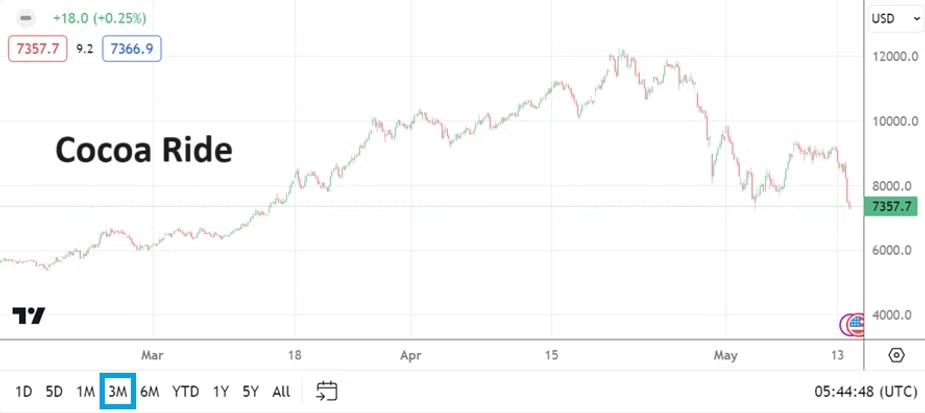
Also within the volatile world of commodities it needs to be mentioned that Cocoa which regained a portion of its higher price values last week and finished Friday above 9,000.0 USD per metric ton, fell swiftly in yesterday’s trading session and is now traversing 7,357.0 USD. Cocoa has enjoyed a spectacularly wide ride of maneuvering via market forces. The commodity is still valued within loftier heights when compared to its historical averages, and demonstrates the speed and danger (and opportunity) of price velocity.

Cocoa Three Month Chart on the 14th of May 2024

Further signs of risk appetite and fragile notions are being exhibited via U.S equity indices, which produced sideways price action yesterday as important economic data awaits and will certainly churn short-term and mid-term perspectives. The S&P 500 is again within sight of record levels, while investors of it and the Dow Jones 30 and Nasdaq 100 all brace for this week’s data which will affect their risk outlooks.

S&P 500 Index Three Month Chart on the 14th of May 2024

Monday, 13th of May, New Zealand Inflation Expectations – yesterday’s quarterly result came in slightly below the previous report. The decrease of inflation concerns likely helped the NZD/USD spark Monday’s climb above 0.60300 briefly. This morning’s early trading is seeing sideways action as U.S inflation reports are anticipated and the currency pair ebbs around 0.60180.

GBP/USD Three Month Chart on the 14th of May 2024

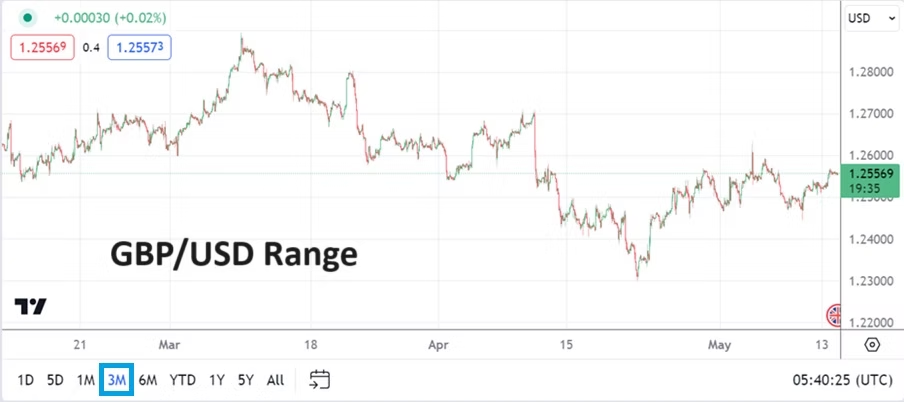
Tuesday, 14th of May, U.K Average Earnings Index, a gain of 5.7% has just been posted. This result will make GBP/USD traders nervous because it highlights that inflation remains sticky in Britain. While last week’s GDP numbers from the U.K showed an improvement, the growth certainly was not spectacular. The range of the GBP/USD remains choppy and bullish day traders targeting higher ratios on the belief the currency pair remains in oversold territory need to consider their timeframes and bias. While the 1.26000 may look like a logical target, it will take weaker U.S inflation and USD centric price action to get there.

Tuesday, 14th of May, U.S Core Producer Price Index – last month’s core report matched expectations. However, the PPI numbers occasionally spell trouble in Forex. Higher inflation results from the U.S would certainly kickstart volatility for all major currency pairs today.

Wednesday, 15th of May, U.S Consumer Price Index – this reading could prove to be the prime mover for financial assets this week because of its potential affect on behavioral sentiment. The Federal Reserve watches this number because of the influence it has on the American public. Forex will react to this report and if it is weaker than anticipated this would create weaker USD centric price action. The U.S will also report Retail Sales and the Empire State Manufacturing Index statistics on Wednesday.

USD/JPY Three Month Chart on the 14th of May 2024

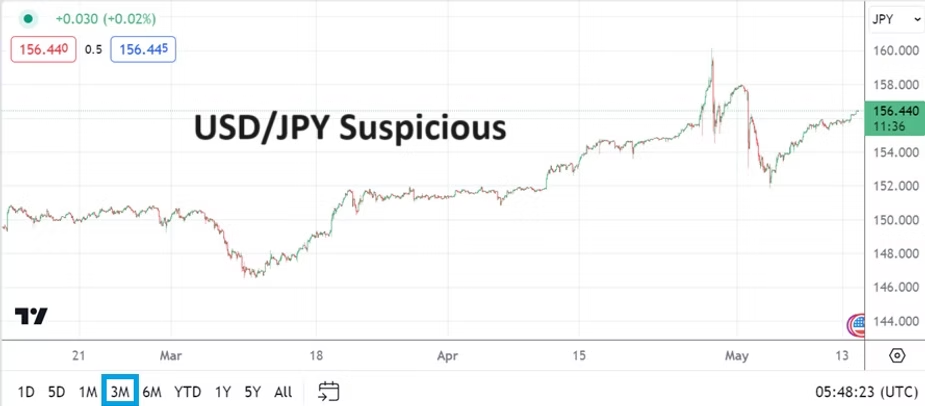
Thursday, 16th of May, Japan Preliminary Gross Domestic Product – last month’s report came in with a gain of 0.1%. This GDP data carries an expectation of minus -0.4%. Traders who like fundamentals should pay attention to revisions within the statistical pages. The Bank of Japan remains in a curious and suspicious predicament. After two interventions, the USD/JPY has climbed incrementally once again. The BoJ is certainly keeping their eyes on the USD/JPY and know financial institutions are still wagering against the Japanese Yen.

Day traders should be extremely cautious with the USD/JPY because the BoJ has the ability to strike with a massive blow when not expected. Risk management is essential for speculators wagering on this currency pair. Evidence of speculative interest in the USD/JPY correlates to the notion that while the USD has been weaker against many major currencies recently, the Japanese Yen remains within a weaker and elevated price range.

Friday, 17th of May, China Industrial Production and Retail Sales – economic dark clouds continue to cascade on Asia’s largest economy. The industrial numbers will be watched by investors certainly, but the overall health of Chinese consumers will likely be the focal point. The USD/CNY remains within bullish terrain, but the Shanghai Stock Exchange’s SSE Index has done well since its lows in the first week of February.