postN88

Iran, Oil and The Crumbling of a Criminal Dictatorial Wall

Iran, Oil and The Crumbling of a Criminal Dictatorial Wall

Step aside for a moment from the conspiracy theorists and let’s consider that the U.S did not take out Maduro of Venezuela in order to facilitate more supply of oil. Let’s consider the possibility that Maduro was removed because he did not facilitate free enterprise and ran a criminal enterprise that did not favor the U.S.
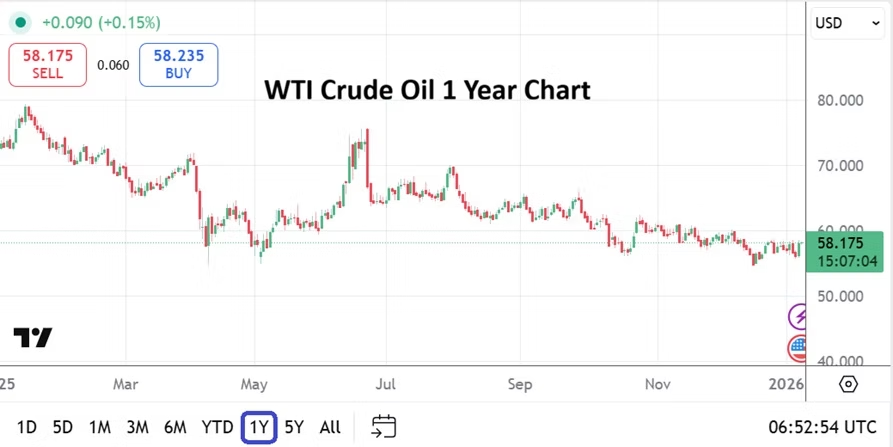
WTI Crude Oil One Year Chart as of 9th January 2026

Venezuela has the largest demonstrated oil reserves in the world, but the U.S has done rather well without it for years. The Trump administration’s move to take over Venezuela deters China and Russia’s influence in the Americas, while also putting another nail in the coffin of the Cuban regime. The word regime is used implicitly to point out that Venezuela, Russia, China and Cuba are all regimes of one sort via their one party ruling systems. Yes, you can argue the United State has returned to an imperialist philosophy, but that doesn’t mean it has dictatorial rule. Some will argue that point, I understand. But let’s step away from the complexity of political biases – including my own – and insights and discuss oil for a moment.

The takeover of the Venezuelan oil infrastructure, which has not happened in full yet via the U.S military action, does not mean U.S oil companies will make trillions of dollars from the adventure immediately. In fact a glut of oil is one of the potential consequences if Venezuela were to return to an open market system with its energy supply. Yes, the price of oil would in theory likely get cheaper. While it can be argued that this will help the U.S consumers, however many U.S producers of the shale oil industry would be put in a difficult spot. Producing oil from shale deposits requires hydraulic fracturing – known as fracking – and is an expensive endeavor. Cheaper oil from Venezuela in other words could put small and medium producers in the U.S out of business if supply becomes too ample

Now let’s turn our attention to Iran and the attempted revolution that is fomenting a reaction from the regime of that nation. Oil supply is certainly at stake for the world, but there is the overwhelmingly important possibility of allowing 90 million plus people to live in a system without repression. As of last night internet and telephone lines have been shuttered by the dictatorial government. There is a legitimate fear that many people protesting for their rights to be free now face the risk of violence and some have already begun to pay with their lives. Freedom is more important than oil for the people of Iran and Venezuela. It should also be pointed out that Venezuela and Iran are members of OPEC and this is likely not going to change.

The Trump administration is threatening military action against the Iranian rulers, but it is questionable how the regime of Iran could be overthrown by outside forces if there are not active combat boots the ground. While it may be possible to attempt a Venezuela like mission in Iran, that would be difficult at best considering the regime is already paranoid and on high alert. The civilians of Iran will have to do a lot of the work by themselves. Which means the populace of Iran will need to be able to organize and collectively topple a dictatorship, and this is unlikely to be done by handing out flowers. The regular army of Iran must disobey orders and the police must decide not to participate in violence against the protesters, allowing a seizure of power by the people.

At this juncture it remains difficult to say what will happen in Iran, except to say that there is likely going to be blood spilled. The Berlin Wall fell after decades of Cold War between the West and East. The wall of the Islamic Republic of Iran which was declared in the first week of April 1979 has nearly been running its dictatorship as long as the communists controlled Eastern Europe.

If and it is a big if, the Iranian people are able to topple the Islamic Republic of Iran it would be a game changer the world over. The complexity of the mafia style state that the current dictatorship has controlled not only in the Middle East, but throughout South America and elsewhere via influence with its proxies like Hezbollah is enormous. The dismantling of this network would take longer than the toppling of the Iranian regime. The world is unlikely to ever know in full detail the criminal activity of the current Iranian government and its proxies worldwide.

This is not about oil, it is about freedom. However, if the oil of Iran suddenly came under the control of a Western looking Iran that was unshackled, yes it would add to a vast amount of energy that the world already enjoys, but OPEC would find a way to manage the supply.

If Iran were to join the ranks of free nations and castoff its current leadership the world would benefit greatly. Only nations and proxies that gain from the exploitation of the Iranian dictatorship would worry. If the Iranian dictatorship falls there will not be paradise, but the event would be significant and transform the current state of global affairs.

Copy and paste the text from AMT that you want to share

post246

An Expanding Axis – Will Egypt and Pakistan Become Members?

An Expanding Axis - Will Egypt and Pakistan Become Members?

Opinion: The following article is commentary and its views are solely those of the author. This article was first published the 26th of May via The Angry Demagogue.

China seems to be taking advantage of the transition from the Obama-Biden appeasement based foreign policy to the Trump commercial based system. Whereas Obama-Biden had no problem punishing allies that dared to oppose the US-EU appeasement and woke revolution, Trump is looking to create alliances based on commerce – and threatens allies that don’t go along. While the Obama-Biden policy failed utterly and arguably caused the wars in Ukraine and the Middle East, the Trump administration seems to be playing for time as it restructures the global security order.

China however does not seem to care to wait and are stretching their sway not only in the South China Sea but westward towards the Middle East. The four member Axis – Russia, China, Iran and North Korea seems to be expanding to other countries with strong military dictatorships. Egypt and Pakistan will be the next members of the Axis. While much of China’s belt and road policy deals with bankrupting poor, weak countries, they seem now to concentrate on strong military dictatorships. Egypt and Pakistan are being pried from the western camp as we speak.

Pakistan has, for awhile not been firmly in the western camp. It was a cold war U.S ally as India, while democratic, sided with the Soviets on most international issues. While the US was busy in Afghanistan, the Pakistanis played double agent. Now that the U.S is not in the region and the U.S and India have become closer, Pakistan is now firmly in the Chinese camp.

In addition to Pakistan, Egypt becoming the next major member of the Axis.

Let’s take a few steps back and examine the burgeoning relationship between Egypt – a military dictatorship and Communist China. As we have written China and Egypt had joint military maneuvers that included deliberate violations of the Egyptian-Israeli peace treaty guaranteed by the United States. Egypt, in thumbing its nose not only at Israel but at the United States, allowed Chinese planes to approach the Israeli border in order to test Israeli reaction to a possible invasion. Multiple Chinese military cargo jets flew in undisclosed hardware in the days leading up to the maneuvers.

Three more Chinese Y-20 cargo planes landed in Egypt last week again, carrying unknown hardware. At least one of these planes came from Pakistan. Egypt also seems to be signing major arms deals with France as Macron reeks of desperation in his attempt to remain relevant – but a de Gaulle he is not, and he will not be able to create a force or policy independent of the U.S. Egypt will be glad to take advanced French weaponry while it creates a stronger alliance with China.

Back to Pakistan one has to wonder if the Pakistan-Indian flareup a prelude to what can happen in other theatres – or worse, a purposeful conflagration to test Chinese weapons systems in actual combat and keep the West on its back feet? According to most reports they were able to shoot down between 3 and 5 of France’s most advanced Rafal fighters without even entering Indian territory. The confrontation started with a heinous terrorist attack against Indians in Kashmir by a terror group associated with the Pakistani armed forces. India claims that Pakistan is directly involved in the attack. If so, this would not have been the first one.

The downing of the Indian French built Rafal fighters by Pakistan’s Chinese produced 10-C was, according to expert reports, not just or even mainly superior piloting but with a Chinese strategy and technology that includes all aspects of air power – including recognition of the target, locking on and attack from distances in what an American air expert called a perfect air based killing machine. This would seem to be the first real test of Chinese advanced air-power and it something that needed to be done before any invasion of Taiwan. This may not test their own pilots but it does test the strategy and the technology.

China has a main medium term goal here and it is not a secret. They are planning to take Taiwan by force and need to make sure their soldiers, sailors and hardware are up to the job. They have seen how poorly the Russian army has performed and have seen how Israel has dismantled Iran’s defenses and swatted away Iran’s offensive attacks. China has not fought a major war for decades and for all the advances they say they have made – all have been untested. Until now.

China will not risk a war with India itself but would be more than happy to have its proxy involved. Chinese fighters and their new “over the horizon” missiles are key in their plans to deter the U.S from defending Taiwan – or in defeating U.S naval airpower if the U.S does get actively involved. However, as close as French technology is to America’s it is not the same and the one country that seems to have taken U.S technology to the next level is Israel. How would Chinese weaponry due against American arms in the hands of an air force equivalent in skill and bravery to the American air forces? That has yet to be tested but that brings us back to Egypt. Is it in China’s interests for Egypt to make a major break with the U.S at China’s urging much as they made a break with the Soviet Union at America’s urging? Of course. Would that mean that China might help Egypt provoke a military confrontation with Israel in order to test Chinese arms and relieve pressure on Iran? Maybe.

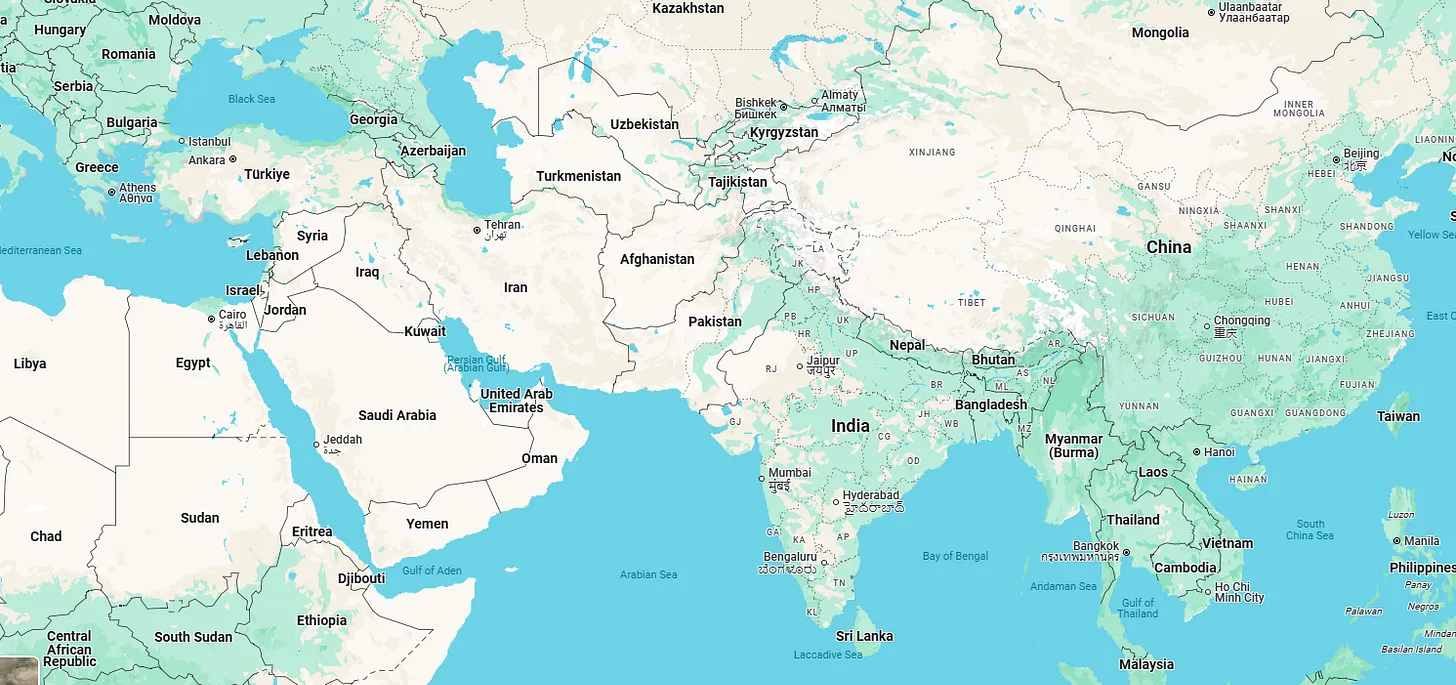
On to Iran then, where it does not seem that the Americans or Israelis understand the nature of the Iranian-Chinese relationship. Not only does China get the bulk of its oil (subsidized) from Iran but they have just completed a rail link from Xinjiang, China to Teheran, Iran – running through four countries. This rail line can ship oil as well as other cargo, cutting into the American (and Indian) naval superiority around the Persian Gulf and Indian Ocean. The assumption by military planners has always been that the U.S can cut off Chinese access to oil, if necessary. That is no longer the case.

China is not standing still – they are expanding their axis of dictatorships to countries in which the army is in control. Pakistan and Egypt qualify. Iran, while a theocracy is controlled by the Iranian Revolutionary Guards. No matter the “deal” that the Trump administration negotiates with Iran they will not be pried away from Iran. China has more to offer an ideological dictatorship then commercial deals with the United States. What the alleged realists in foreign policy refuse to understand is that dictatorships have no interest in commercial success if it weakens their grip on power. They are interested in deals that enrich their regimes since that also strengthens their grip on their people.

The trillion of so dollars in deals that the U.S has now made with the Persian Gulf states ensures that America remains a player in the middle east. Those who think that the Mideast is a tertiary region at best – after Asia and South America – need to rethink their strategies. As China closes in on control of the world from the Pacific to the Mediterranean the U.S is left with just two military powers it can depend on – Israel and India – to help defend its old/new commercial interests. It is not only oil – it is not Boeing jets, Nvidia chips and many other products that are moving from the US to the Gulf as opposed from the Gulf to the U.S. The U.S is no longer a commercial client of the Gulf states but the country who needs to protect its clients. The relationship has changed but the security relationship has only gotten more important.

The addition of Egypt and Pakistan to the Axis means that the Chinese threat has expanded. They are not giving up on Taiwan, nor are they giving up on South America and the Pacific Ocean but rather, China is using its experience as a dictatorship to strengthen ties with other freedom hating countries. We can all pretend that values and culture don’t matter, but that doesn’t mean that they don’t. This Axis is one where the interest of each member is to stay in power, force its will on its people and enrich itself at the expense of its people. This is an Axis, not only of the unfree, but of those who need to eradicate freedom to “thrive”.

Disclaimer: the views expressed in this opinion article are solely those of the author, and not necessarily the opinions reflected by angrymetatraders.com or its associated parties.

You can follow Ira Slomowitz via The Angry Demagogue on Substack https://iraslomowitz.substack.com/ 

post20

USDINR: 83/$ & Above is a Possibility

USDINR: 83/$ & Above is a Possibility

The Indian Rupee continues to remain under pressure as volatility in the global market triggers capital outflows amid investors concerns over the stress levels in banks worldwide especially in the U.S and in Europe.

RBI Governor Das yesterday, said in a conference that India today has a well regulated and well supervised banking sector.

Not to forget, India has past issues with some private banks that have been lending to corporations that defaulted on their debt . Yes Bank and Lakshmi Villas Bank are some of these examples, and today these banks are well capitalized and their loan books are diversified as the RBI has tightened its grip on regulatory frameworks.

Also, the loan books of Indian banks are being more diversified, and Government Bonds portfolios are comprising only 18-22% of the total assets, meaning banks are not at greater risk than their western counterparts.

The central bank of India holds Forex reserves of over $560 billion USD and has been actively intervening in the Spot & Forward markets since 2022 as the U.S Federal Reserve started to raise rates to tackle higher inflation. Governor Das also cautioned, ”the worst of inflation is behind us,” but pointed out that with the Russia – Ukrainian war, along with monetary tightening by major central banks, that there is still stress for nations that have high external debt and more capital outflows, which can put pressure on their currencies and trigger imported inflation.

India also has sticker inflation of around 6.4% down from 6.52% in January, this while the RBI is expected to raise rates by 25 bps in the April monetary policy meeting . The Indian Rupee was among the worst-performing currencies among emerging Asian peers last year, counter weighed by a stronger dollar and outflows from local assets. 

As a net importer of oil from Russia which grew 4 times in 2022, and less exposure to external debt means headwinds from shocks will be minimal which will help the Indian Rupee. However, as growth slows down in the West, this means more capital outflows and a flight to safer assets possibly taking place.

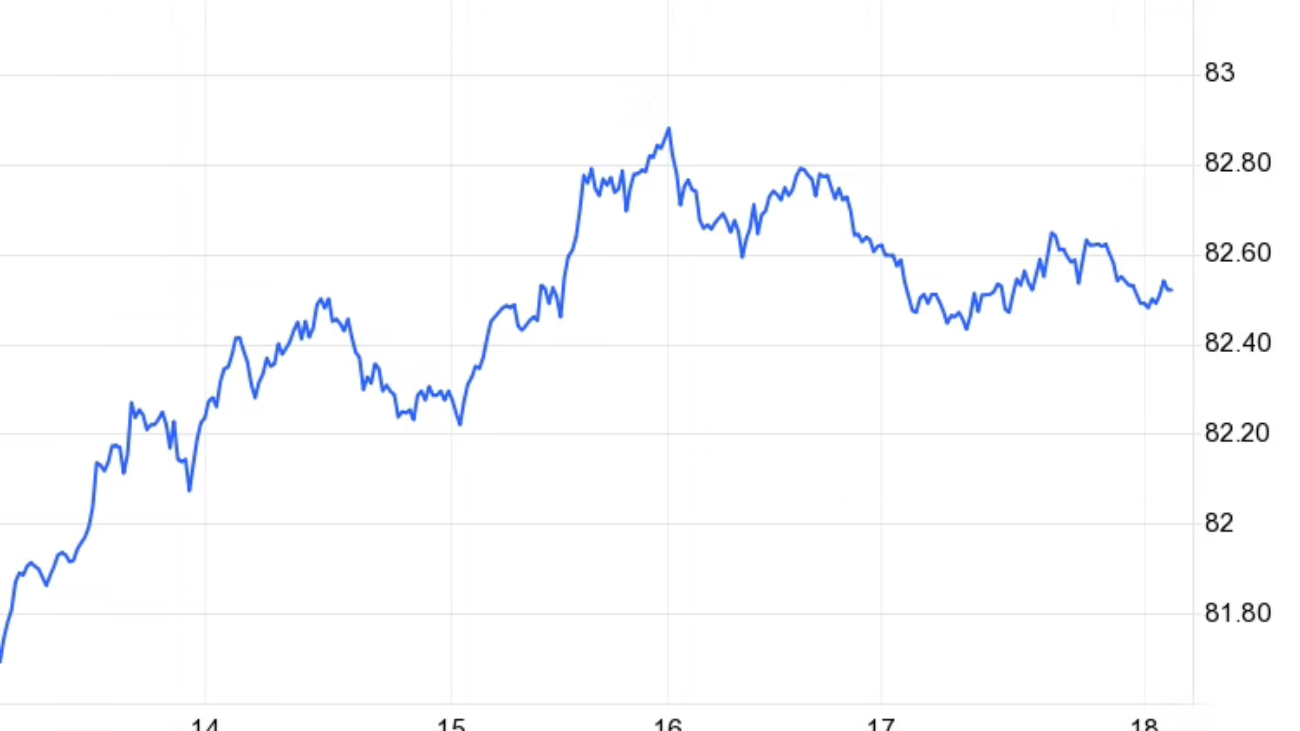
The RBI stance is very different than a month ago, where it didn’t allow markets to take the Indian Rupee above 83/$, but now it’s significant that the central bank could let to the USD/INR depreciate above 83 to save foreign exchange reserves.

The RBI’s equation is very simple as the Federal Reserve reduced its rates to zero back in 2020 because of Covid19, more money chased speculative assets especially in the emerging markets. And the RBI accumulated a lot of Forex reserves. Now the tables have changed. In addition to this, India also is not keen to add its bonds to global indexes due to concerns over potential ensuing market volatility not supporting capital inflows, and thus perhaps damaging the Rupee.

With current account deficits widening to 4.4% of India GDP in Q2, this means India needs to work hard to achieve better capital flows, particularly as tensions on some important global banks continue to be demonstrated.