
postN32

Profits: Business Ethics in an Age of Subjective Expediency

Profits: Business Ethics in an Age of Subjective Expediency

This article was originally written in the summer of 2006, Jeremy Blatch suggests current business governance remains shadowed by the same concerns.

Most of us in business today, be we entrepreneurs, professionals or key employees, recognize that our customers, clients and staff require us to act in their best interests and that our actions should reflect this.

A code of practice or some kind of ethical standard or guideline will be needed to ensure some degree of accountability and consistency. In this we encounter the first hurdle, as the degree to which corporate and governmental governance is superimposed by regulatory bodies on business, varies between industries, businesses, professional sectors and political divides.

The effectiveness to which this is policed in reality depends on the will of those in supervision, and the willingness of those in business to conform to requirements. Many areas are of course not covered by statutory regulation and getting on with the daily running of a business requires constant decisions which often involve a degree of ethical consideration. In reality any ethical stance is at best subjective and open to subversion and expediency in the quest for profitability, which after all is the main reason for being in business in the first place.

Service providers that fail to make a profit irrespective of the quality of service that they offer will inevitably cease to be able to provide that service. But at what cost do we surrender integrity for the expediency of justifying a decision on the grounds of corporate strategy or profitability. And at what point does adopting a rigid ethical stance become a statement of moral judgment? Moralizing about the world and the problems faced by modern society has never been wise. Morality is also a subjective term, often influenced by personal experience and strongly held beliefs, but not necessarily shared.

When some of the world’s most successful entrepreneurs met recently in Monaco at the invitation of the BBC World Service and the international accountants, Ernst Young, to debate how to ‘feed the starving and save the planet’, there was broad agreement that amongst most people there is a distrust of corporate motives and skepticism of Corporate Social Responsibility, currently a trendy buzz word amongst the business elite.

Is not the sole responsibility of companies to make money, but at what costs? Does it really matter how they make money, after all is a woman with a starving child going to refuse a plate of food because it has been purchased with money from the sale of narcotics? If we have a view against investing in armaments, are we prepared therefore to open our borders to anyone who wishes to attack us for any reason, or do we wish for a society in which the strongest take all and those with weapons will be strongest?

Someone receiving a pension has strong views on the tobacco or gambling or arms production or certain drugs, and whilst they are quite happy to receive the pension income and rejoice at the level of payment, are they also prepared to self-select how the investment is managed? Business is fraught with hypocrisy in this area.

Google have weakened their ethical case by caving in to the demands of China for expediency. Brands like Nike and Gap are having their reputations challenged by allegations of sweat shop labor despite spending millions on marketing a different image. Yet people still keep buying their trendy brands. Walmart the most successful US retailer attracts more shoppers than any other store despite allegations of a poor record of employee relations. Does anyone care? Shoppers go where they can find the best quality at the keenest price.

One can make a difference in society without trying to gain the ethical high ground or slipping into moral judgment by simply giving away something you don’t need, to those who most need it. We have witnessed this last week two instances of philanthropist ‘walking the walk’ not just ‘talking the talk’ with Warren Buffet, one of the most successful investors of this century, donating much of his personal wealth to the Bill and Melina Gates Family Foundation. This injection of cash now gives the Gates Foundation around USD 30 billion, more than three times the total amount of charitable donations in the U.K, putting them with Andrew Carnegie, Henry Ford and John D Rockefeller, as the hitherto best known philanthropists of modern times.

A few days after the very public announcement of Warren Buffet’s donation, a U.K hedge fund has emerged as one of the U.K’s most generous philanthropists with a donation of around GBP 50m to charity assisting children in poverty. The Investors Forum, registered in Gibraltar, was created to give a highly professional service to investors covering the wider investment process. It comprises of an association of firms and banks committed to acting professionally, whilst giving something back to those most in need.

A unique investment concept called the “Solidarity Fund” will hopefully be launched from Gibraltar, which will give both corporate and individual investors the opportunity to make money whilst directly helping those in need. In today’s business world making a profit is essential for survival, but how we make it and what we do with it will determine what sort of people we are, and ultimately what legacy we will leave behind.

Jeremy Blatch is the Founder and Consultant of Ein Harod Family Office. You can find more of his articles at www.ehh.gi

postN9

India’s Speculative Real Estate Bubble and Values: Part One

India’s Speculative Real Estate Bubble and Values: Part One

India’s Real Estate Sector is a Well Known Affair to its own Citizens and to Global Asset Management Companies

India’s major cities like Mumbai, the financial capital of India, Gurgaon, Delhi, Bengaluru and Hyderabad, the tech hub of the nation, serve as major attractions for local players and international corporate giants who want to participate in the real estate sector. While transparency still remains a challenge that needs to be addressed in Tier 2 and Tier 3 cities of India, underlying demand continues to expand throughout the nation. The Real Estate Regulatory Authority, passed a bill known as the RERA Act, by the serving government in March of 2016, to create transparency and fairness between buyers and sellers in the residential real estate market, however these measures do not always help circumstances as hoped.

Well known companies like Blackstone which is based in New York, and Brookfield Asset Management of Toronto have vast operations in the commercial real estate sector of India. Their estimated investments are significant. Amounts spent are believed respectively to be nearly 50 billion USD by Blackstone, and the Brookfield figure is likely around 22 billion USD. The companies concentrate money for real estate, and infrastructure like telecommunications, roads and other spheres crucial to create value.

The reason why private equity giants allocate massive investments into India commercial real estate is due to the remarkable advantages of the locations available for property, and the capability to turn a profit. The land purchased and developed is usually situated close to burgeoning information technology companies. It is easily understood these IT companies have expansive needs to function properly which include plenty of area for employees to work. This is relevant in the north of India where Brookfield has invested in places like Mumbai and Gurgaon. Apart from the commercial demand for property, the employees who work in these type of companies also drive residential apartment sales in these cities.

The real estate market in Gurgaon has seen remarkable growth in the recent years where prices have experienced double digit appreciation. Readers need to understand that Gurgaon, is a city near India’s capital of New Delhi in northern

India. It’s known as a financial and technology hub. The rise of e-commerce players like Amazon and the Walmart owned Flipkart are important. Walmart spent around 16 USD billion to buy about 77% of Flipkart in 2018 and their vast operations also have sparked demand for huge amounts of property, including warehouses. This activity has certainly attracted the attention and desire of global players to invest in commercial real estate operations.

The residential real estate market has grown fast, and continues to achieve huge growth even after the coronavirus pandemic. An extremely rapid pace is fueled because low interest rates have appealed to new home buyers to initiate purchases of apartments and condominiums in metropolitan cities like Chennai, Mumbai, Hyderabad, and Bengaluru. Many affluent families in India from these major cities continue to own and rent residential homes in the areas, taking advantage of demand. According to a survey conducted by the global property consultancy firm Savills, now 70% of families in the metropolitan cities mentioned previously from the north and south of India have answered positively when asked if they would like to buy a second home in the next couple of years.

Residential real estate sales have been rising after the pandemic, especially for double bedroom apartments averaging 1200 square feet of housing, usually within a category that is priced in a range above 5,000,000 Rupees (around 60,000 USD). India’s benchmark mortgage rate is in the 8.7% to 9.7% range as of this writing, this is higher than it was one year ago. But Indian home buyers haven’t yet stepped back from buying, this because interest rates in India have not increased too much in percentage terms. The average time to pay a loan for residential mortgages ranges from 10 to 20 years in India. This allowable time frame makes it affordable for employees to pay via Monthly EMI, Equated Monthly Installments. The mortgages come with a floating rate meaning the buyers can reset their rates when the local interest rate falls. Yes, floating rates certainly do contain dangers if interest rates climb too high.

A Speculative Roulette Game: The Least Known and Unequal Affair

But there is another reality and a very different story in certain areas of India where data misses critical elements of the real estate business. Speculative participation in property is done by the most affluent who are the dominant buyers and sellers; speculative buying and selling is too expensive for most citizens. Real estate has frequently been used as a tool to hide wealth and avoid taxes by many within certain segments of India. The real estate speculative bubble creates vast distortions in the costs of rents, and affects employment opportunities for the masses. Government offices may sometimes turn a blind eye to these circumstances, because as long as cities and regions can collect money from the speculative frenzy there is little reason to turn off the revenue streams.

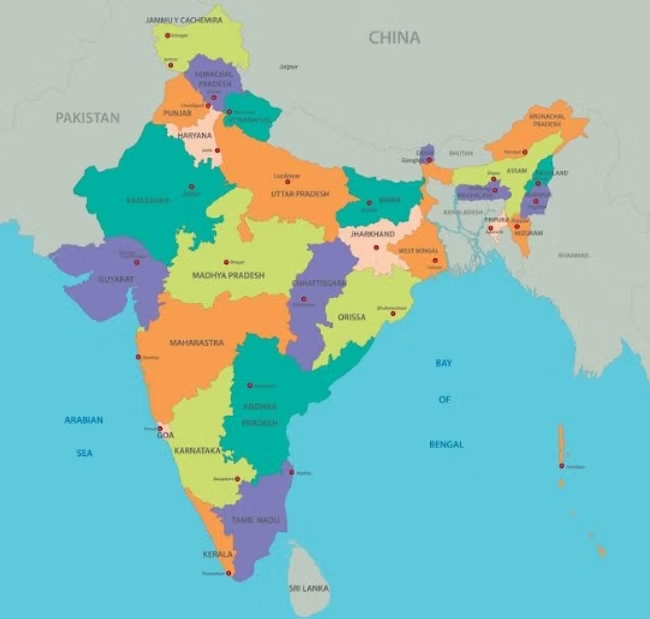
Frequently there is someone who is capable of bidding higher for lands in most of the Tier 2 and Tier 3 cities discussed, compared to those who actually need the property to live there and function properly. It is important to mention Tier 2 and Tier 3 cities and what is taking place in these areas, because these locations frequently lack substantial income generation opportunities for people and don’t have massive infrastructure or enough office space to employ people where wages have stagnated for many years. Take for example the Tamil Nadu, a state in southern India where I live, the average price of a double bedroom 1200 sq’ft residential apartment in the capital city of Chennai is around 6,000,000 Rupees (around $73,000 USD).

Readers need to note that the Indian ‘middle class’ prefers to have 2 bedroom 1200 sq’ft residential houses and apartments on average, thus builders construct houses and units based on land availability. Market prices for the property equals the costs of building materials and labor along with the speculative factors worked into the total value.

A look at the town of Madurai where the same apartment is available at a comparable price tag like Chennai is important to critique. Because wages in Madurai are a quarter, and sometimes less than half of what one could earn in Chennai, the disparities in the income distribution and the property prices in India become evident and need to be recognized.

In some rural towns where wages have not grown more than 5% per year,

India has seen real estate prices doubling every 4 years. For example, the rural town called Ponnamaravathy near to Madurai, which is my hometown, speculation in the real estate sector has seen frenzied pricing in an unprecedented manner for land and newly built houses. There is a great divergence between real per capita income versus the escalating real estate prices and rents in the interiors of India in towns such as Ponnamaravathy.

According to real estate analysts, most land parcels and their inventory of projects within metropolitan cities that are under construction has been bought by speculators. When units in new projects are sold to speculators, these generally change hands multiple times during the construction period, which generally lasts three to four years. Such heavy ‘churning’ means fast price increases. Also, the builders who market their own projects as investments raise list prices frequently to keep existing investors happy with notional gains, so they can point to the ‘attractiveness’ of potential speculation.

While it may not matter to some citizens in the larger cities, the problem of speculative influences do matter in the small towns where community wages have not grown properly. Inflation and speculative investments in these towns do not create sufficient job growth either. Surplus cash profits earned by many businesses, and foreign remittances, which were close to 108 billion USD in 2022, goes back into real estate speculation causing higher rents and forcing lower income households to struggle.

Rural Wages Haven’t Grown but Prices are Increasing for Homes

According to economists data, Average Nominal Wages in rural India is approximately 15,000 Rupees per month for men and 8,000 Rupees per month for women.There is an ample real estate supply in the rural market, but speculative demand has created steep pricing, typically initiated by large ‘investors’ willing to pay top money for any asset irrespective of its location, affordability or current market price based on the assumption values will continue to increase.

The difference between rural wages and costs for homes creates heavy disparities and inequalities for households living within the lower thresholds of society. For example, a double bedroom 1200 sq’ft residential apartment in Ponnamaravathy can be selling at a whopping 7,000,000 Rupees (approximately 85,365 USD). This is 20% more than what we have seen before on average in Chennai, and Madurai, a Tier 2 city, in Tamil Nadu state. The wages in the rural town of Ponnamaravathy are just 10% compared to what one could earn in Chennai annually, making the purchase of a residence priced at these higher values difficult for most residents and making many people renters for life.