post303

India and the U.S Govt Shutdown: Quick Market Thoughts

India and the U.S Govt Shutdown: Quick Market Thoughts

President Trump has been ramping up his claims that India is no longer going to buy Russian oil, he made a statement regarding this belief yesterday once again. As the White House threatened to initiate tougher sanctions against India, there seems to have been some movement towards a reconciliation between the two powerful nations.

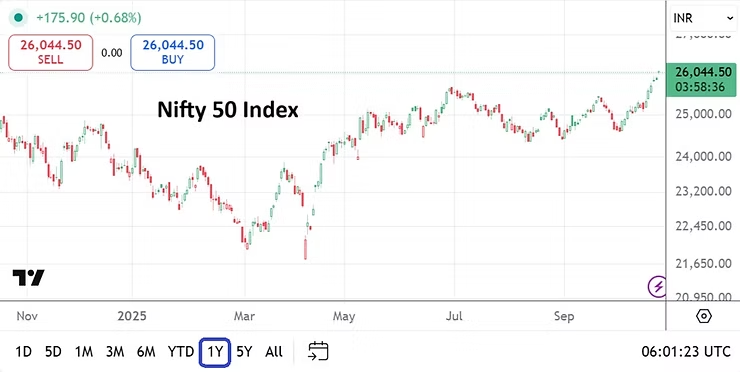
The Trump administration is clearly trying to limit the amount of purchases of Russian oil by India to increase economic pressures on Russia, and reportedly India may be starting to actually buy less oil. India has certainly not stopped buying Russian oil in a maximum ‘fait accompli’, but if the nation continues to show a willingness to purchase less energy resources from Russia, this will go a long way in preserving a good U.S and India association. A stronger relationship between the U.S and India can achieve a vital economic and military correlation for the both nations. Improved friendlier tones from New Delhi and Washington D.C appear to have reassured investors in the Indian equity markets via highs currently being seen on Nifty 50, which are now within sight of apex values from late September last year.

Nifty 50 One Year Chart as of 23rd October 2025

India is a vital and important part of U.S policy as it attempts to also create pressure on China too. By maintaining political and business dealings with India, the U.S can and should look upon this joint relationship as a vast long-term strategic interest. India understands this as well. The ability of India and the U.S to remain ‘friendly’ allies, and the prospect of creating a vigorous economic and military partnership should be one of the U.S government’s essential missions.

India does have strong connections to Russia the past handful of decades politically and economically via its non-aligned status. India will certainly maintain its dialogue and sometimes cooperative dealings with Russia. However, if India and the U.S maintain a solid relationship with the prospect of increasing their economic and political ties this could substantially change dynamics on the Asian continent.

U.S Government Shutdown Since the 1st of October

The U.S government has now been shutdown for over three weeks as Republicans and Democrats remain stubborn about compromise. Both sides have made the shutdown a political game. While each party claims they are doing what is best for the nation and preach to their collective voting bases, the stalemate could start to have uglier effects regarding wages not paid for many U.S employees on the 1st of November.

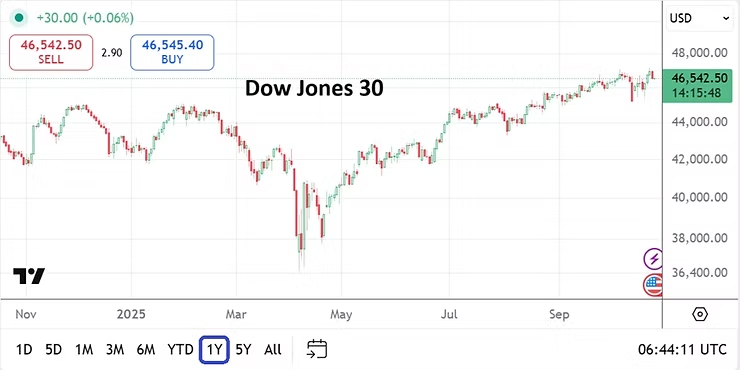
Dow Jones 30 One Year Chart as of 23rd October 2025

A lack of government salaries not being dispersed will cause an economic hit via consumer spending and create at a minimum some temporary damage for GDP numbers. Remarkably, and to be clear about this potential impact, Wall Street hasn’t seemed to care yet, but this could start to change. As the U.S economy rumbles powerfully forward without a major downturn in the major equity indices, politicians appear to be comfortable acting like spoiled children on both sides of the aisles engaged in accusing the other side of misdeeds.

Likely to start changing attitudes among Republicans and Democrats in the next two weeks are the coming Federal Reserve’s FOMC Statement during the end of October, and voting results via key political races in the first week of November.

Wall Street wants clarity regarding interest rate outlooks for November, December and early next year. Investors might not get a clear picture from the Fed next week, taking into consideration the Federal Reserve will not have up to date official U.S economic data because of the government shutdown. Meaning the Fed will likely issue a 25 basis point rate cut on the 29th of October and say it is uncertain about the coming few months because it does not have enough inflation, employment and GDP information to form a concrete opinion. The joke of coarse being the Fed seldom seems to have a strong opinion, but now can use the government shutdown as an excuse.

And now for contemplation, let’s look at the election in NYC for Mayor. A bona fide socialist may get elected in New York City who carries the historically misguided and dangerous wisdom of a Marxist. The economic and social practices of Marxism have proven utter failures for over one hundred years consistently. If NYC suffers a victory from the socialist candidate running as a Democrat, Wall Street and many financial institutions based in the city will not react favorably.

In the meantime, U.S equity indices remain elevated, cautious and within sight of record highs. The Nasdaq, Dow Jones and S&P along with other financial assets are producing choppy dangerous conditions for day traders who are attempting to wager on daily changes and suffering from the cautious behavioral sentiment being generated. Investors who look towards the mid and long-term are likely more comfortable, but are certainly keeping an eye on what is going to transpire over the next two weeks. Gold and Silver have come off their speculative highs. Forex continues to create volatile conditions as financial institutions appear unready to make bold predictions about what the Federal Reserve will do into January 2026.
post261

Unpredictability of President Trump and the Markets

Unpredictability of President Trump and the Markets

Everyone wants to know what will happen in the future in the financial world. Most everyone also knows that this is impossible. However, clarity about the mid-term is a legitimate focal point that financial institutions strive. Risk managers define their considerations on assorted perspectives depending on their backgrounds.

While some may like him and others clearly are are not fans, President Trump has a reputation for wanting to get things done. His calling card for a long time has been an ability to make business deals. President Trump however has put himself in a rather difficult position and the next two weeks may prove to be an important milestone. One in which those who like the President and those who don’t will be given more credence to debate.

The Federal Reserve will announce their FOMC decision on the 30th of July. Tariff deadlines will supposedly come on the 1st of August. President Trump has made it clear he does not like the lack of aggressiveness which Fed Chairman Jerome Powell is displaying. Trump has called for the Federal Funds Rate to be cut and Powell has not acquiesced.

President Trump has openly spoken about trying to replace the Fed Chairman, but at this juncture the Trump White House knows this will be difficult unless they can prove Jerome Powell has done something maliciously. Not lowering the Federal Funds Rate because of a fear inflation will develop because of potential effects due to tariff fallout is a legitimate reason not to act. Even if the Fed Chairman is wrong, he appears to still be working on a basis which is based on an economic interpretation.

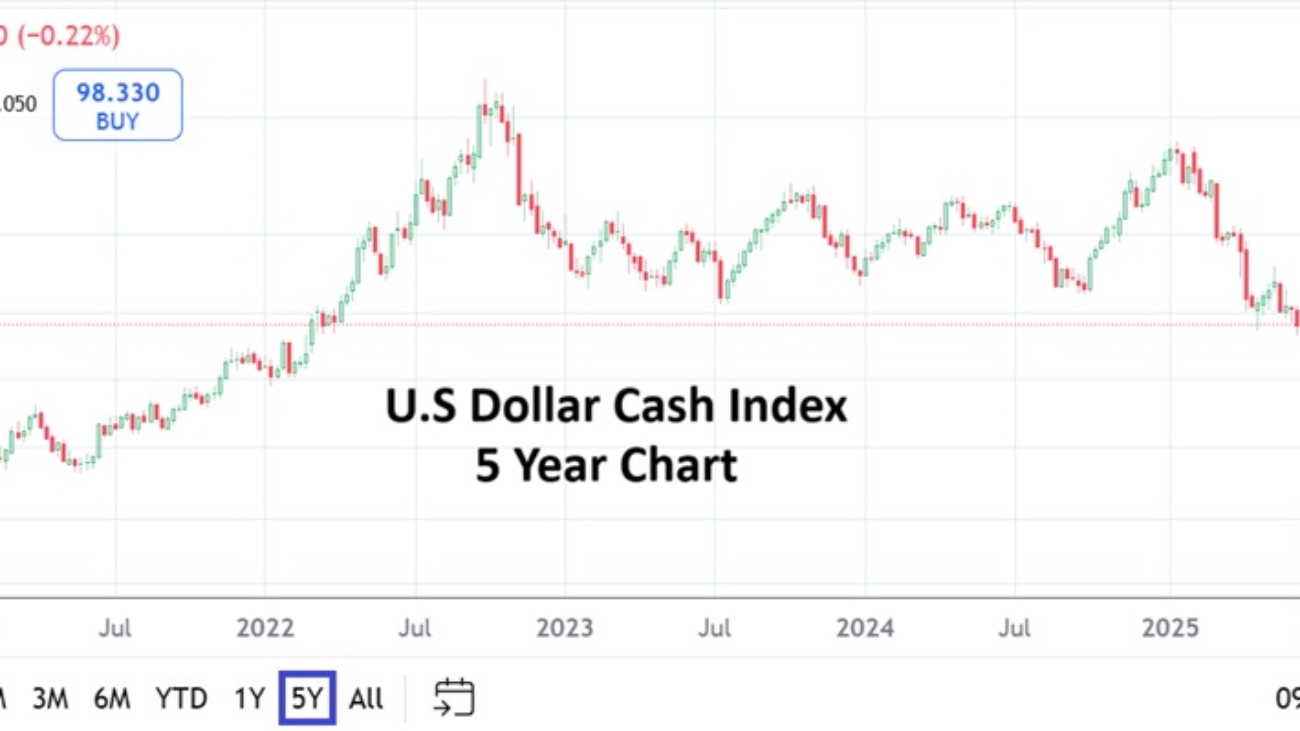
For the next two weeks the broad markets will hear about the Trump and Powell disagreement. It has been argued the Federal Reserve should have lowered the Federal Funds Rate a few months ago, clearly this was not done. However, the USD did trade with weaker sentiment in Forex from early April until the beginning of July. In the past few weeks the USD has garnered some strength, but remains within the lower part of its long-term realms via the U.S Dollar Cash Index. The weakness in the USD was likely due to financial institutions betting on rate cuts to come over the mid and long-term, and which they still believe will happen.

The upwards momentum generated recently by the USD has put the greenback in a position that seems to indicate financial institutions are transacting their cash forward orders cautiously for the moment, while waiting on the next round of impetus. And that is where Federal Reserve clarity and tariff threats now shadow mid-term outlooks.

U.S Dollar Cash Index Five Year Chart as of 21st July 2025

We have entered an unpredictable window and President Trump apparently doesn’t mind allowing a little danger into the mindsets of the financial markets. It is one thing to proclaim tremendous results and great, magnificent prospects, but how long will investors tolerate a lack of clarity regarding tariff agreements? President Trump has postponed the tariff deadlines several times and what should be considered is the potential that at some point he will have to take action to prove he means business. If the August 1st deadline is extended again this may not cause much of a shock, but it will not be met with optimism.

Instead, the main interpretation from financial institutions may be that Trump is struggling to get agreements done as he had promised. While that might lead to the idea that global commerce will continue on as is, this will certainly not help create the positive impetus which President Trump desired. At some juncture President Trump may begin to be perceived as the little boy that cried wolf. No one will pay attention and the markets will proceed without him. But President Trump will not likely let that happen, he does like attention.

The Nasdaq 100 and the S&P 500 are near record highs, so there isn’t a lot to complain about by index investors. The U.S economy has shown signs of green shoots regarding better retail sales and the recent Philly Fed Manufacturing Index. The grey area for many remains inflation, which has been coming in rather well behaved although the most recent report showed a slightly higher outcome with the yearly CPI reading. However, the Federal Reserve actually has evidence that inflation has been tame. Yes, there are questions regarding the coming influence of tariffs on the U.S economy, but for the moment inflation has not risen.

The lack of clarity and not having a mid-term comfort level which is unperturbed may be problematic for small U.S business owners that face tariff concerns on their imported goods. And the bigger picture remains unclear for large U.S corporations – but they certainly continue to try being optimistic. And this is where it gets more dangerous, plenty of perspectives are being driven (inspired) by analysts who have confirmation bias. For instance the downturn in the USD from April until early July was amplified by many who saw this as a sign the USD was being punished by foreign governments opposed to President Trump. This in fact was highly unlikely, traders need to remain alert to false narratives.

The next two weeks need to be treated carefully. There will be a running monologue among many analysts that changes daily as behavioral sentiment moves depending on what is being spoken about the Federal Reserve and tariffs. However, until there are actual answers the financial markets are likely to remain rather choppy. Self awareness will be crucial for speculators. Also, a large factor in the financial markets will be played by the U.S White House regarding how incoming results are presented. Until then day traders may want to watch technical charts and try to figure out where programmed trading lurks regarding support and resistance levels. Price velocity in Forex, bond yields and gold should be monitored.

post240

Market Volatility Shelf Life Doesn’t Have an Expiration Date

Market Volatility Shelf Life Doesn't Have an Expiration Date

Updated: Apr 11

An associate in the financial world just wrote to me that “all bets are off”. Perhaps that is a solid way to think about the present speculative and investment situation. The tumultuous wave of hysteria in equity indices, Forex, commodities and U.S Treasuries are evident to everyone. President Trump’s tariff policies released last week lacked precision via perspectives for many investment institutions who suddenly had their mirage of calm destroyed. The realization that President Trump was undertaking what he had promised caught many by surprise who thought he was bluffing. Trump’s ‘Art of the Deal’ tactics are now being confronted by middlegame chess strategies from opponents.

While the broad markets have boiled and folks look for calm to return, the prospect that current volatility has the potential to carry a long shelf life with no expiration date has to be considered. Yes, the financial world will become serene again. The return of semi-tranquil trading has been seen in the Nasdaq, S&P 500 and Dow 30 the past couple of days – only because the losses and gains depending on the index have been moderate compared to last Thursday’s and Friday’s results.

Yet the shadow of more violent trading remains crystal clear. China and the U.S are now exchanging loud threats which include higher tariffs and retaliatory measures. The USD/CNY is under scrutiny as devaluation by China appears an evident threat. And U.S Treasuries are being watched as some contemplate that China is undertaking a selloff of U.S bonds. Higher U.S yields on long-term Treasuries will create pressure via the amount of debt the U.S will be obligated to pay.

Vice President J.D Vance’s peasant comments about China were not helpful on Tuesday. Why must a hornets nest must be stirred up? China has now been hit with a 104% tariff from the U.S, this while China has vowed to ‘fight till the end’ in its media. Asian markets are selling off cautiously this morning as tensions reignite. Forex pairs such as the USD/SGD, USD/ZAR and USD/BRL should be watched as a barometer not only by currency traders, but by those who want metrics regarding how global economic sentiment and credibility of policies are being contemplated. Risk adverse trading in emerging markets will cause harm and has the earmarks of looking like a stiff penalty for nations trying to develop and raise their standards of living.

While the start of this week has been smoother in relative terms compared to last week, the lack of a comprehensive end game is still missing. There is merit to treat current circumstances with cautious respect. The mid-term outlook remains highly questionable as President Trump and his negotiation gambits are tested publicly.

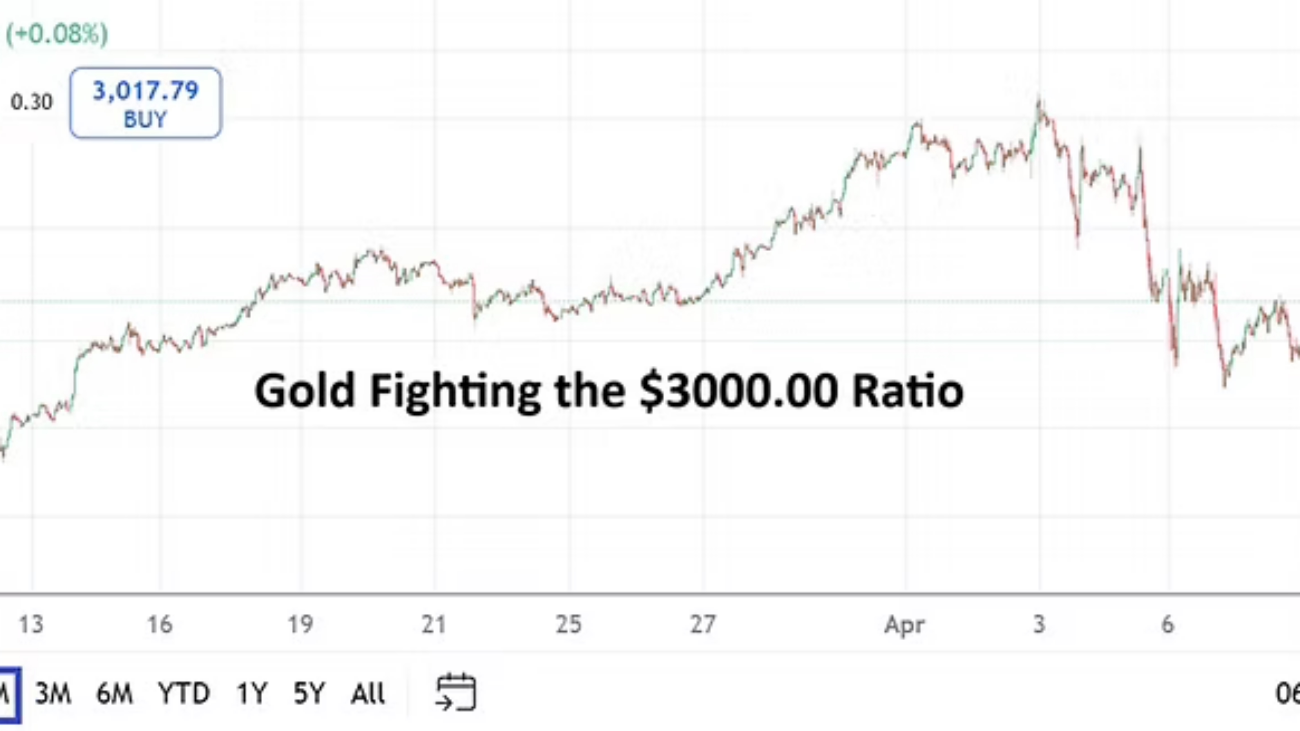
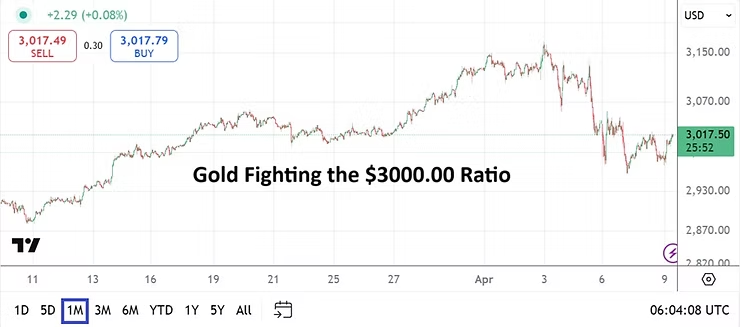
Gold One Month Chart as of 9th April 2025

Gold has stumbled back to the 3000.00 USD level, WTI Crude Oil is down and these two commodities are intriguing as a looking glass into the hearts of large players. Are people selling gold short-term because they believe inflation will lessen because of a recession which some are forecasting, or is it merely a speculative move? Gold certainly carries an important risk adverse power and its lower move showed be looked upon skeptically.

WTI Crude Oil One Month Chart as of 9th April 2025

Is WTI Crude Oil selling off because there is a belief there will be less demand due to fear tariff policies will influence a stumbling global economy? This viewpoint is plausible, the price of the commodity falling below 60.00 USD is a warning that large players are not comfortable with their outlooks and view downside risks as legitimate. The energy selloff in the past couple of hours is a negative barometer for what potentially is in store the remainder of the day in the broad markets.

The lack of finesse exhibited during these tariff negotiations is not palatable, the taste in the mouths of financial institutions has them worried. And outlooks via talking heads and analysts must be treated carefully by traders, this as they try to digest the onslaught of information and complex economic scenarios. Importantly, day traders should avoid getting caught up in the deleveraging talks surrounding the notion that large financial institutions will now pull money out of their U.S based investments in companies via stocks and Treasuries. Traders need to consider the bias of the people they are listening to and reading, and consider the scope and might of the U.S economy mid and long-term. There will be value found after the massive selloffs.

As a side note Warren Buffett has let it be known for a while he is sitting on a large amount of cash via Berkshire Hathaway. And folks should note that the annual meeting for Berkshire Hathaway is on Saturday the 3rd of May, which means people should get ready for insights from Buffett and his legions of admirers in the coming weeks. Certainly, Buffett’s comments and potential actions will be watched carefully.

The U.S Federal Reserve has taken a wait and see approach to the Trump tariff implications. Calls for an immediate cut of the Federal Funds Rate have not caused Fed Chairman Jerome Powell to shift his cautious stance yet. The coming days could bring a different attitude from the Fed if equity markets and U.S Treasuries perform badly. In the meantime some central banks have said they might become more proactive – the Reserve Bank of New Zealand cut its interest rate by 25 basis points this morning to 3.50% and said it will continue to cut their Official Cash Rate if tariff policies create more negativity.

The consideration by financial institutions regarding the beginning of a paradigm shift of the global economy is justified. However, the ramifications of the Trump tariff policies have a long way to go before these present days will be able to be pointed to as the moment the world decided that it no longer wants to participate in the U.S marketplace. That notion seems farfetched. The USD remains the world’s reserve currency, its corporations remain extraordinarily large and valuable, and U.S Treasuries as they absorb current volatility and see yields moving higher in the 30 Year bonds cannot be viewed as an economic apocalypse – yet. Yes, the warning signs are meaningful and the Trump White House will need to respond diligently.

Again, the past week of trading has seen vast disarray, but we have been here before. It is important to recognize that current circumstances however do remain dangerous, this because we are still in the midst of the crisis. At some point, egos will have to be put to the side. The Trump White House will have to negotiate with China. China may be vulnerable, but so is the U.S. Why be belligerent and show no respect to each other? The remainder of this week’s trading will produce more whipsaw results. Selling looks to be in vogue once again this morning. Behavioral sentiment and understanding its power need to be contemplated as folks await sunnier days.

post238

Trump: Will He or Won’t He Day and Uncertainty for Investors

Trump: Will He or Won't He Day and Uncertainty for Investors

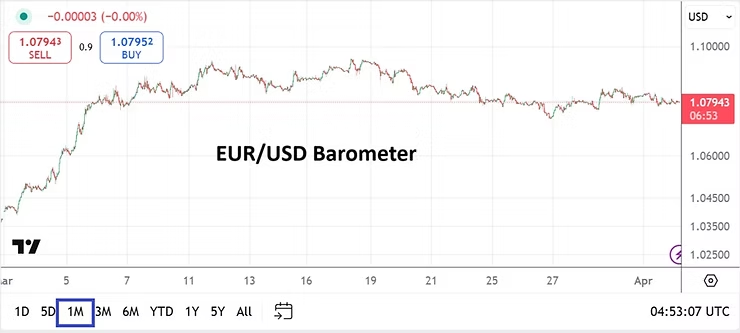
EURUSD One Month Chart as of 2nd April 2025

Liberation/Tariff Day will blow onto the global financial shores this morning. President Trump and his team are certain to take a victory lap as they announce their decisions regarding actions being imposed on commodities and products. Nations who are on the other end of the drama will be braced for the rhetoric and policies. Investors, trade ministers, financial institutions will have to sift through the pronouncements and consider their outlooks amidst uncertainty.

Trading today will be rough for smaller speculators. Choppy conditions should be expected as behavioral sentiment twists according to shifting winds and interpretations. President Trump is likely to announce aggressive penalties, but he may also try to soothe those who have worried about being punished. As an example, Trump has said recently that India has acted upon many of the White House’s wishes. Mexico, Canada, the European Union and China are likely to be mentioned as the U.S President speaks later today. Will a public scolding take place again?

Equities have faltered the past month, Forex has been volatile and commodity prices have also reflected fragile sentiment as outlooks became grey. The tariff policies announced today will affect all aspects of the financial world. Day traders thinking about wagering on the outcome should be patient and wait for the reactions which unfold from Asia, Europe, Africa, and the Americas. Wall Street will certainly be a barometer, along with the EUR/USD, USD/MXN, USD/JPY, GBP/USD, USD/SGD and gold.

While President Trump declares this is a great and magnificent day for the U.S, it will be of keen interest if an olive branch is offered to trading partners. After talking tough the past few months, financial institutions would like to hear words of optimism from the White House. If belligerence is heard and punitive actions are enacted, which are considered unproductive by investors and financial institutions the broad markets will show their disdain promptly.

President Trump’s skills as a negotiator will be judged today. The White House must play towards its constituency and show they are putting America First, but will the President also display he is cognizant that international trade provides benefits? Trump will point to his claim that he is merely putting tariffs on those who have treated the U.S unjustly and use levies against U.S goods.

It will be an important day for the Trump Presidency, because in many respects the global audience watching will decide whether or not the U.S sees itself as part of the global fabric or seeks a position which is isolationist. Brazil will look on the tariff theater intently, its position as a trading center may find increased demand from a host of nations.

Predicting the results: On the 3rd of February a fast and dangerous Forex market developed which witnessed USD centric strength exhibited with spikes in many currency pairs. In early March reactionary trading was displayed in equity indices, Forex and bonds too. Today will see wide spreads emerge in Forex with near-term resistance and support levels proving vulnerable.

Equities which sold off in March via the Nasdaq 100, S&P 500, Dow 30 and the Russell index are certainly hoping for a dose of cheer. The question is if Trump will deliver a positive message. The likelihood is that today’s events will not be the last of the tariff tirades and some proposed actions remain under deliberation. Today is unlikely to produce final results and the broad markets are probably going to be choppy as outlooks stay mitigated and absent of clear resolutions.

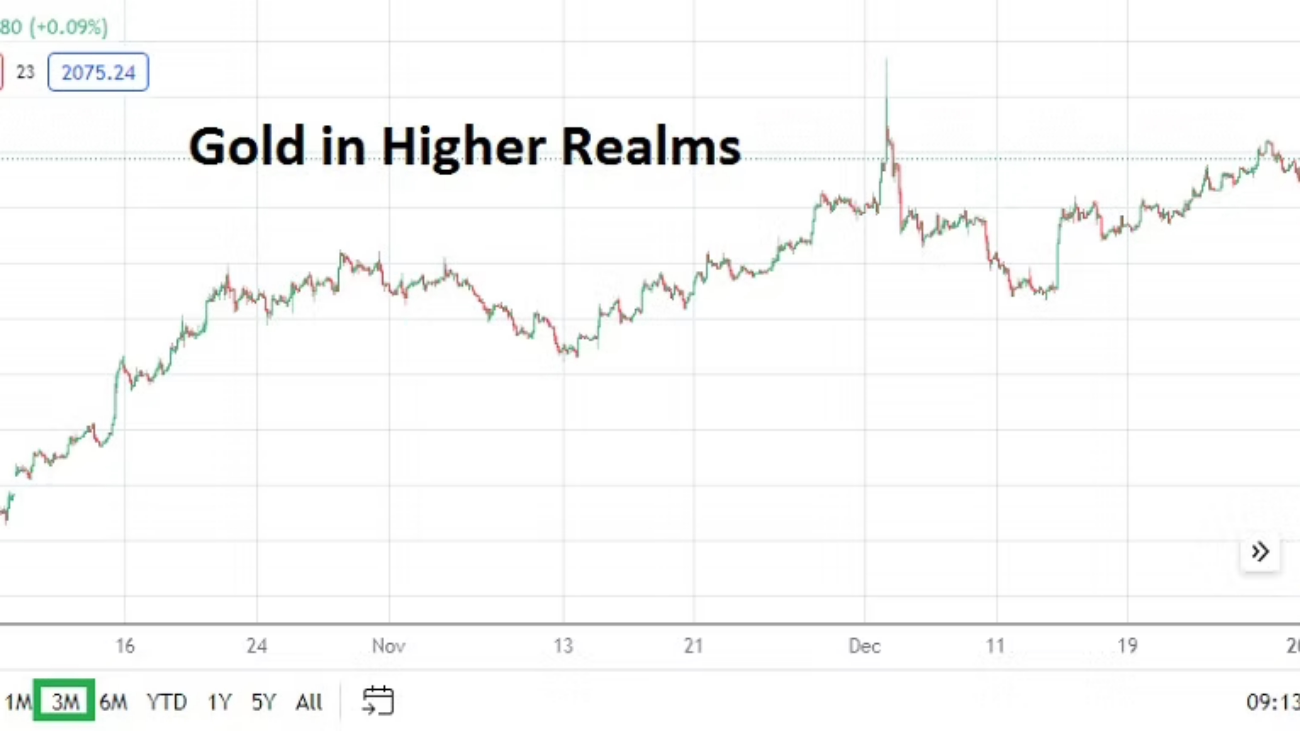
Gold Three Month Chart as of 4th April 2025

Day traders should think safety first today. Gold remains within record territory. If unpredictability rules near-term and the reactions of investors and financial institutions create fast conditions, the precious metal and bonds will find takers. Uncertainty breeds cravings for risk adverse assets.

post225

Reserve Bank of New Zealand Expected to Cut 0.50 from Rate

Reserve Bank of New Zealand Expected to Cut 0.50 from Rate

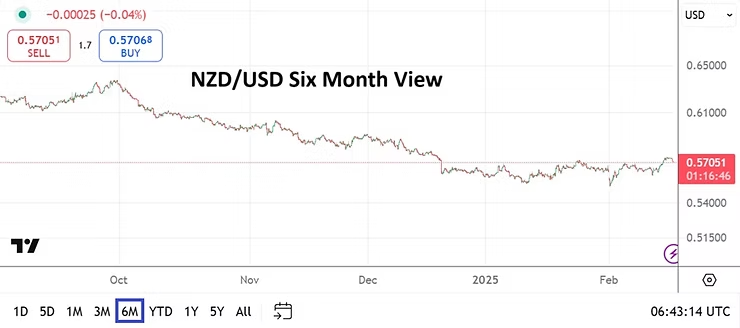
NZD/USD Six Month Chart as of 18th February 2025

NZD/USD Revival Mid-Term Coming? Reserve Bank of New Zealand is expected to cut its Official Cash Rate by 0.50 on Wednesday. N.Z govt is being proactive as they try to ignite the economy. The RBNZ also cut by 0.50 basis points in November. The central bank is expected to continue to remain aggressive tomorrow and suggest further cuts will be seen, perhaps via 0.25% afterwards.

The NZD/USD was trading around 0.63600 in late September of 2024 after gaining in correlation against the USD with the broad Forex market, via a bullish run which began in July. The NZD/USD is still traversing within its lower realms and it is logical to assume many financial institutions feel that support levels around the 0.56000 vicinity will prove rather durable going forward.

Day traders who believe the mid-term holds an optimistic bullish run for the NZD/USD may be correct, but speculators cannot be overly confident about a sustained surge higher quite yet. Conservative leverage is urged while looking for upside while betting. Speculators also need to remember tomorrow’s expected interest rate cut from the RBNZ has already been factored into the currency pair.

The rate cut is important for Wednesday, but it is the stance the Reserve Bank of New Zealand takes via its Monetary Policy Statement that affect behavioral sentiment among financial institutions. If the RBNZ sounds cautiously aggressive, meaning they suggest further cuts are being strongly considered this could help firm the NZD/USD and create more optimism regarding the potential for a move higher.

Yes, the shadow of the U.S White House administration looms over the Forex landscape. Decision making will remain tentative via financial institutions, but it is reasonable to suspect large players would treat clarity from the Reserve Bank of New Zealand with a positive Forex stance.

postR176

Make Common Sense Great Again: On Moving Away from Nuance

Make Common Sense Great Again: On Moving Away from Nuance

Opinion: The following article is commentary and its views are solely those of the author. This article was first published the 23rd of July 2024 via The Angry Demagogue.

Has there been a total breakdown of readiness in the West? When we look at seemingly unrelated events we see that people in responsible positions in governments around the Western world have missed signs that are obvious – and not only after the fact. The attempted Trump assassination just got me thinking how no one seems to react to the obvious anymore. It seems that both the local police and the Secret Service knew that this young man was on a roof with a rifle and no one took the most elementary actions of delaying Trump’s appearance or trying to stop the shooter or even ascertain his motives all of which was obvious to everyone else. We are not talking about someone missing a shot at him or even forgetting to check a specific place, but an active decision was made – to do nothing.

On October 6 and 7 the IDF Chief of Staff and his senior advisors on the General Staff heard of possible Hamas plans to attack, knew of previous intelligence that detailed the exact attack that happened and even refused a request of the head of the Southern Command to move 4 helicopters closer to Gaza. Instead of doing even the minimum, they just did nothing. They ignored the obvious and ruled purposely against common sense and in favor of their own preconceived notions.

As Russia was massing troops on the border and as Putin’s talk was becoming more and more belligerent the US administration did nothing that might have at least hinted to Putin that this could only lead to disaster. Putting US troops on a higher alert, inviting the Ukrainian ambassador to the White House as a show of support – anything really, might have given Putin food for thought. As Iran moves closer and closer to attaining a nuclear weapon and taking control of the middle east, the West just does nothing. Destroying Houthi assets (as the Israelis have just done), sending B52’s into the sky for training missions to destroy Islamic Republic assets – all that might have made the Iranian rulers wonder what was in store for them and limiting the war to Gaza. But again, against common sense, nothing was done because …. Wishful thinking.

If those responsible were acting like boys in the school playground (are boys still allowed to play in the playground?) they would have done more than they did in all these cases. 

Since the end of the Cold War we have seen the abandonment of common sense in favor of sophisticated analyses where nuance trumps simplicity and bias dominates the analysis of data and where cliches overtake serious policy. In classical Jewish biblical exegesis, there is one rule which nearly all (non-mystical) commentators hold and that is that the exegesis cannot contradict the simple meaning of the words of the Bible.  True enough, that is stretched to points of wonder sometimes – but they still cling to the rule. 

Common sense is underrated in policy analysis and often in business, but those who ignore it now will be challenged later. Common sense means the acceptance of what people say and looking at data without bias. Common sense means that you have to understand the person you are talking to and don’t assume they think like you. 

Back in my university days I read a lot of Hannah Arendt, who, in spite of the banality of her banality of evil theory had a lot to say. In her book “The Human Condition” she speaks of common sense – or as she often puts it “the sense of the common”.

I would like to quote her here, even though I tend to think she would not have thought that it was the rulers, the policy makers and the writers who are ignoring common sense:

“The only character of the world by which to gauge its reality is its being common to us all, and common sense occupies such a high rank in the hierarchy of political qualities because it is the one sense that fits into reality as a whole our five strictly individual senses and the strictly particular data they perceive.  It is by virtue of common sense that the other sense perceptions are known to disclose reality …. A noticeable decrease in common sense in any given community and a noticeable increase in superstition and gullibility are therefore almost infallible signs of alienation from the world.”

Arendt of course assumed that the lower or working classes were susceptible to superstition and gullibility but in these times it is the ruling classes that have abandoned common sense in favor of superstition and gullibility. It is they who are alienated from the world. Preconceived notions that contradict the plain meaning of the world is today’s superstition – and it is no less dangerous and irrational than the superstitions of times past.

Let’s take a brief look at these policy decisions by nearly all western countries, regardless of their geographical location or economic outlooks, their demographic trends or the overall culture of their people and their neighbors resulting directly or indirectly of the perilous situation the free world is now in.

Defense Spending and Force Size

The post-cold war “peace dividend” became an idol of western policy makers.  Massive cuts in defense spending even in things that were very necessary to the maintenance of said “peace dividend” – like naval power – was the preferred way of dealing with the end of the Soviet Union. The “End of History” was read simplistically instead of realizing that other ideologies and other powers might very soon challenge the victorious west. Some thinkers, I think of a professor of mine (Elie Krakowski) who back in 1979-80, before the collapse of the Soviet Union, spoke of Islam as the third force which will challenge the West and the East. I studied in a small university and if we were discussing it back then how are policy makers in Washington, London, Tel Aviv and Paris not speaking of it today?

While Edward Said’s “Orientalism” was the talk of the town, Bernard Lewis and Fouad Ajami were, despite their posts at Princeton and Johns Hopkins, not taken seriously enough. If they were, the US Navy would not have gone from 594 ships in 1987 to 275 in 2016. The British Navy  went from about 170 ships in 1970 to well under 50 in 2017. The rest of Western Europe we all know about. But at least countries like Netherlands, Belgium and Denmark don’t face hostile neighbors and were never meant to have forces that would do more than assist in minor operations.

Israel on the other hand has always faced neighbors who have desired to destroy it.  Even the countries with which it signed peace treaters, Jordan and Egypt, have never been able to translate these treaties into popular support and are always a coup away from belligerence. The history of dictatorships in general and of the Middle East in particular ought to have given the Israeli high command at least a hint as to what they might be facing. With the advent of Iran as a major regional power with the means and desire to spread its theo-revolutionary ideology, Israel ought to have realized that the era of wars was not over. Yet, since 2000 Israel has cut 6 divisions and decommissioned 2,000 tanks from its forces. It has cut military service for men from 36 to 32 months, even as it has not increased the mandatory service for woman from 24 months even though it has increased the amount of women in combat and combat support roles. The ultra-orthodox still don’t serve (they are about 16% of the draft class) zero even after October 7 and the number of youth who have received exemptions due to “psychological” reasons has skyrocketed to nearly 13% of the draft class. I don’t mean to belittle those with true psychological issues but rather the high numbers signify that many if not most are of a class that allows them to afford to pay psychologists for convenient diagnoses.

In other words – the IDF, the Finance Ministry and the political class all found it convenient to reduce the size of the army – both manpower and equipment – and used the excuse that there will be no more ground wars to justify the move.

The Ukraine conflict revealed to the world that US arms production of even the most basic arms is not enough for the US itself to maintain minimal levels during wartime.   The current Middle East conflict has magnified this disaster.

Common sense readiness has been ignored throughout the Western world due to sophisticated thinking more wishful than realistic. This is nothing less than a messianic and superstitious belief in the end of wars.

Immigration and Assimilation

If there is one issue that common sense has missed it is immigration. The reactions of average citizens to unlimited immigration in Western democratic countries has been uniform – NO! In some countries the yelling is louder but in all western countries there is significant opposition, on common sense grounds often, to the establishment immigration policies.

I am an immigrant to Israel and my grandparents were immigrants to the United States. Immigration, the movement of peoples from place to place has been going on since people left Africa – and before. But there is no separating immigration from assimilation unless your immigration is due to imperialism and conquest.  The Romans, Greeks, Chinese and Persians of ancient times, the Arabs of late antiquity were all imperialists. There was of course the age of imperialism that ended in WWI. But 21st century immigration is not of national conquest but of individual movement of people and families. One by definition must adapt to the local cultures – in the widest sense of the word. If a cotton farmer from Arizona wants to move to Iowa, he better adapt to the climate and figure out how to grow wheat or soybeans instead of cotton. If an aristocrat from England decides to move to the United States, he needs to know that his family heritage and titles won’t get him much. If a Spanish or Chinese speaker moves to Germany, the expectation is that he will learn to speak German.

An immigrant who does not respect the local culture in all its manifestations needs to get permission in order to stay in the new country. That is the way of the nation-state that has protected freedom in the western world so well (if not always so well). We can’t compare the 21st century to the pre-WWI world where borders were porous and people that survived the trip across a continent or an ocean could settle in that new land. Some more successfully than others. 

Common sense dictates that an immigrant that does not respect the laws of his new home has no right to live there. Yet, time and again, immigration policy has been separated from the law and being law abiding has no bearing on future citizenship.  Therefore, there is no demand from the immigrant and no opportunity for the immigrant to assimilate and be part of the social fabric of his new country. That being said, the mass Islamic immigration into Europe could be said to be imperialistic as the leaders of these communities have discouraged any type of rapprochement with Western values and law. That, along with the demographic collapse of indigenous Europe has put Europe on the brink of either a civil war or a peaceful surrender to Islamic imperial forces.  

Free Trade and Social Peace

There is no doubting that free trade brings prosperity and that economic growth better than any other global trading system. Free trade  is also the best way to lift the global poor out of poverty. The U.S constitution understood the importance of free trade, as states were prohibited from starting trade wars with each other.   This has also been the “good” in the E.U and has produced much prosperity in that Union.

Yet, free trade with allies needs to be differentiated between free trade with enemies  – meaning those that oppose our system. Free trade that allows your enemies to defeat you militarily is not free trade but suicide. So too, trade policies need to have social issues taken into consideration. This is not a call for tariffs or against free trade pacts, especially with neighbors, but rather they need to be adjusted with common sense solutions to employment and other problems that will arise from any economic change. 

Social peace is the second half of this section because, besides immigration, the erosion, not to say destruction of physically intensive jobs can and often does lead to social violence for reasons obvious to those with common sense.

Energy and Food Supply

For the most part, you would think that after national defense, it is a government’s first responsibility to its citizens to guarantee the food and energy supply of its citizens. Before we get to luxury and access to travel, the ready supply of food and energy seems to be the minimum that a government ought to do. And yet, when we speak of issues related to climate change (and lets not get into the “is it or isn’t it real” argument) the solutions first mandated to the problem have to do with limiting both of these items without which we cannot live. In California, farmer’s access to water is limited even after the drought due to concerns about some fish and climate, and in the Netherlands they want to pay farmers to stop producing food so that the Earth will not suffer. 

What is the plan here? Regarding energy supply, one would think that shoring up access to alternative energy would take priority over banning current ways of producing energy. In California, they have been having rolling blackouts in the summer for years and they are looking to ban gas stoves and ovens and gasoline powered cars. Private jets and yachts though are off limits for obvious reasons. What is the plan there? Is there any real preparation?

As for food supply, is the  plan to reduce population or to reduce calory intake? To what levels? Is there an expectation that people will starve themselves to “save the planet”? Again – I am not arguing for or against human causes of climate change but rather, for the common sense understanding that securing the world’s food supply takes priority over closing farms or turning them into organic utopias.

A perfect example is Sri Lanka where those in power bought into the organic farming ideology of Western aristocrats and they ended all non-organic farming causing a famine and a depression. People who worked hard their whole lives lost all their savings as they were unwilling participants in a cruel experiment to see if organic farming can feed a small island nation.  

In sum – a bit less nuance and a bit more common sense – a bit more sensing what is “common to us all” would be welcome in political and policy matters. Maybe if we pursued more common sense policies and a lot less superstition and bias there would be less yelling and screaming in the public square. 

Disclaimer: the views expressed in this opinion article are solely those of the author, and not necessarily the opinions reflected by angrymetatraders.com or its associated parties.

You can follow Ira Slomowitz via The Angry Demagogue on Substack https://iraslomowitz.substack.com/ 

postR196

AMT Top Ten Miscellaneous Punches for the 28th of June 2024

AMT Top Ten Miscellaneous Punches for the 28th of June 2024

10. Cricket: The ICC T20 World Cup Championship will feature South Africa vs. India. The two teams are familiar with each other competitively and the final match will be held at the Kensington Oval in Bridgetown, Barbados on Saturday.

9. Selling Pressure: Lows are being challenged in Bitcoin as it hovers above 61,000.00 USD. Cocoa has stumbled dramatically this week and is below 8,000.00 per metric ton. Who will be courageous and wager on reversals higher? Speculators should remain cautious and understand price velocity that looks tantalizing can also prove costly to trading accounts.

8. Grounded: Boeing’s Starliner remains docked to the International Space Station. Problems have plagued The Boeing Company the past handful of months, and their ambitions of becoming a power within NASA’s explorations are also underachieving. SpaceX and Airbus are certainly paying attention to Boeing’s ineffectiveness.

7. Teetering: The African National Congress and Democratic Alliance political parties in South Africa are feuding about how coalition power will be shared within the National Unity Government. The USD/ZAR has become volatile and is near 18.21000 as tensions mount and reversals hit. Financial institutions are waiting for an optimistic resolution, while also fearing the possibility of an abandonment to positive visions.

6. Inflation: Core Personal Consumer Expenditures Price Index statistics will be released today from the U.S. Yesterday’s GDP Price Index came in slightly higher than anticipated which kept USD centric bullish positions relatively strong. However, other American statistics have weakened significantly and the mid-term looks troubling for the U.S economically. Stagflation remains a concern. The Federal Reserve is likely hoping to see today’s PCE numbers come in weaker than expected, which would allow the central bank to hint towards Federal Fund Rate cuts later this year.

5. Ennui: President Macron could find his political power further eclipsed after France’s first round voting results this coming Sunday. French voters appear ready to deliver a resounding message of dissatisfaction to the listless ruling government. Election turnout statistics should be watched. The second round of voting will be on the 7th of July. Financial institutions have braced for a shift of power already, but the EUR/USD will still produce volatility in the days ahead.

4. Geopolitical Risks: Russia, China and their allies are likely considering how they will prepare for a potential change in the U.S White House. Foreign policy following last night’s debate between Biden and Trump must be planned. The fact that Trump is viewed as a rather flamboyant personality and not bound by cautious diplomatic attitudes creates a calculus that U.S adversaries will have to consider. While the potential exists that some nations may try to be more aggressive now, they also know that a Trump victory in November would change the international political landscape long-term.

3. Bank of Japan: The Core Tokyo Consumer Price Index produced a gain of 2.1%, which was above the forecasted amount of 2.0% earlier today. The BoJ continues to remain far too dovish regarding interest rate policy and financial institutions are buying the USD/JPY in massive waves. The USD/JPY is around 160.750 as of this writing and did traverse above 161.000 earlier, these are Forex levels not seen since the late 1980’s for the USD/JPY. Japan’s attempt to stimulate the economy with a weaker Japanese Yen may work, but the U.S and others may start to look at the BoJ’s soft devaluation in a very negative light. Speculators of the currency pair need to be extremely careful, because the BoJ has the ability to intervene violently and cause momentary spikes which could prove deadly for day traders trying to take advantage of the outlandish bullish trend.

2. Behavioral Sentiment: Markets will be a looking glass into the future today, this as trading houses react to the realization that Donald Trump is likely going to be the next U.S President. While there are no guarantees regarding the U.S election outcome yet, the broad markets will certainly feel a shift of momentum in the coming days as large players adjust from a cautious approach to more aggressive postures regarding a Trump presidency. U.S equity indices remain near record highs, and the potential of a more business friendly White House which doesn’t threaten tax hikes on U.S corporations will likely affect speculative outlooks.

1. Power: The resounding defeat of Joe Biden last night in the Presidential debate will spark a heated battle among Democratic power brokers. Biden will certainly be asked to step aside after last night’s poor performance. However, Biden is stubborn, and Dem leaders like Nancy Pelosi and Barak Obama among others will have a difficult task to try and convince Biden for the sake of the nation that he must do the honorable thing and release his political delegates at the August Democratic National Convention in Chicago. If this doesn’t happen, the Republicans may be able to achieve a landslide victory by taking control of not only the White House but the Senate too, along with maintaining power in the House of Representatives. All the camouflage in the world last night, including the liberal media, couldn’t mask the inability of Joe Biden to be coherent.

postN95.1

Trading Optimism for 2024 and Pursuit of Castles in the Air

Trading Optimism for 2024 and Pursuit of Castles in the Air

Traders may feel like horses being kept in their stables right now. The desire to run freely in Forex and other markets is certainly being felt, this as many analysts have jumped onto optimistic bandwagons and are pointing to the U.S Federal Reserve and its rather dovish outlook for 2024. Gold in early trading this morning is lingering near highs and the USD remains within weaker territory when technical charts are inspected via one month results.

Gold Three Month Chart as of 2nd January 2024

Yet, thin holiday trading is full in effect. Light volumes will continue to be seen early this week after the New Year’s celebrations. Financial institutions will open their doors today, but their corporate clients around the world will have plenty of employees who will remain on vacation until the 8th of January. Thus, while day traders may feel enticed to wager in the markets with various CFDs, they should be careful and understand unbalanced positions may cause temporary chaos. Risk taking tactics should be carefully considered.

The desire to dream about castles in the air is a source of comfort for many new day traders. But remaining realistic about potential results, while not getting overly ambitious about targets is an important aspect for all speculators. While trends may look attractive in Forex, commodities and equities a well planned approach regarding risk taking is a practical road. Castles in the air tend to vanish.

Optimism will be a word frequently heard in the coming days and weeks, and here’s to wishing everyone a prosperous and peaceful 2024. The potential of a more dovish U.S Federal Reserve regarding monetary policy and declining Treasury yields sparking more risk appetite in equities as investors seek solid returns is alluring, however risks remain on the table. The economy of China continues to worry analysts and tensions in the Middle East are still a long way from being solved.

However, the biggest cause for speculative concerns during 2024 may come from elections in Taiwan, India, South Africa and the United States. Taiwan’s presidential vote is on the 13th of January. China will certainly be watching the results, and traders should expect to hear swords rattling afterwards and then hope the noise calms down.

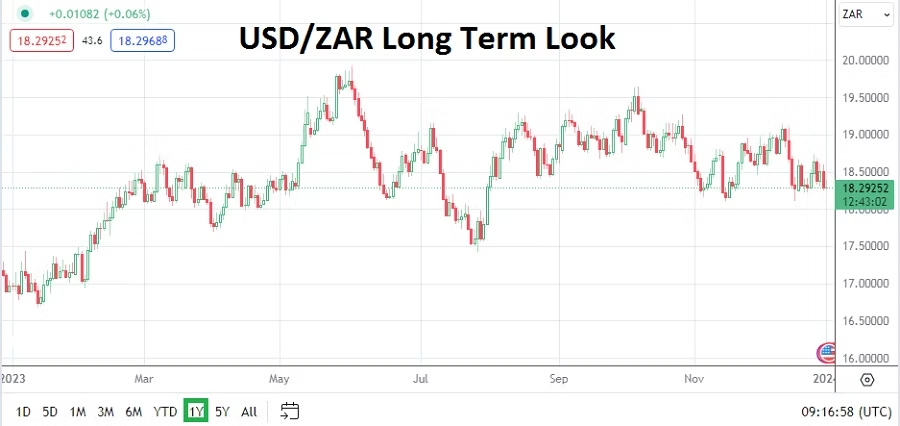
USD/ZAR One Year Chart as of 2nd January 2024

Tranquil voting results in India will be welcomed by investors. India is becoming a noteworthy economic giant, its rapid growth and ascension as an important investment vehicle needs to remain stable. South Africa remains troubled domestically by concerns regarding corruption and inefficiency, its upcoming spring election results may not solve the problems it faces. There will be many elections in Africa this year, which could spur on considerations regarding geopolitical alliances and the price of commodities.

The U.S election late in 2024 will start to grow in noise as the months progress and by early this summer behavioral sentiment will begin to become nervous regarding the outcomes for the White House and Congress. The U.S appears to be braced for an election between Joe Biden and Donald Trump and this will certainly cause skittish storms.

Traders should feel confident about risk appetite in the global markets improving, but they should keep in mind that impetus coming from many different spheres can affect the financial world.

Tuesday, 2nd of January, U.S Final Manufacturing PMI – today’s Purchasing Managers Index is expected to show a slight improvement, but the results may fall on deaf ears because many market participants will not be around to react due to the fact they are still on vacation.

Wednesday, 3rd of January, U.S ISM Manufacturing Prices – this inflation survey from purchasing managers may be given a bit of attention, but its effect may be limited because of light trading volumes still being exhibited.

Thursday, 4th of January, Germany Preliminary CPI – the inflation data from Germany will get some consideration, and the result is expected to show a slight increase. Services PMI data will also come from European Union nations, the U.K and U.S.

Friday, 5th of January, U.S Non-Farm Employment Change and Average Hourly Earnings – the jobs reports will get the notice of financial institutions. The results for employment and wages are expected to be slightly weaker than the previous month’s outcomes. Typically these numbers would cause a stir, but unless there are surprises, most financial institutions may not react massively to the reports because it remains a ‘holiday’ week. If the numbers come in weaker than expected this could cause interesting reactions on the 8th of January and weaker USD sentiment.