postN3.1

India Insider: Working with the West as it Deals with Others

India Insider: Working with the West as it Deals with Others

India’s Prime Minister Narendra Modi visited Tianjin, China for the 2025 Shanghai Cooperation Organization Summit in early September, which was attended by over twenty nations. Before India visited the conference in August, Washington D.C had already imposed a 50% punitive tariff on India’s exports. The initial tariff was a 25% duty, but included another 25% penalty because India purchases a large amount of Russian Oil, which the U.S seeks to reduce. An uneasy trade dilemma looms for India.

Many Western analysts quickly concluded that Prime Minister Modi was tilting India towards a stronger relationship with the Russian and Chinese camps, by potentially embracing warmer associations with Presidents Vladimir Putin and Xi Jinping, and defying Washington’s previous warnings.

Yet, the trade composition and the underlying reality highlights a different story. Despite India being positioned in the global South politically, the nation recognizes its higher value exports – which include textiles, gems and jewelry, apparel, and pharmaceuticals are primarily sold to the West. The United States clearly remains India’s biggest consumer. In essence President Trump holds a trump card.

In contrast, China’s total exports to the global South (excluding Western Europe, Australia, New Zealand, and North America) has doubled since 2015. Chinese exports to the U.S were $525 billion USD in 2024, but to the global South, China’s exports grew to nearly $1.3 trillion USD.

As Professor Michael Pettis accurately points out, “countries with expanding trade surpluses with the U.S, use their higher revenues to fund deficits with the rest of the world.”

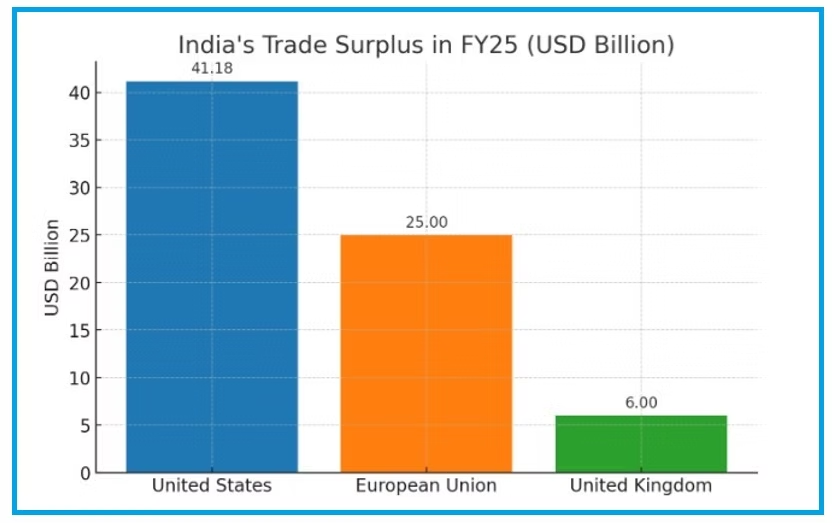
India Exports More to the West:

India’s trade surplus with United States, the European Union and U.K stands at $72.18 billion USD. If India wants to be competitive with China in terms of manufacturing, it should affiliate more astutely with the Western camp.

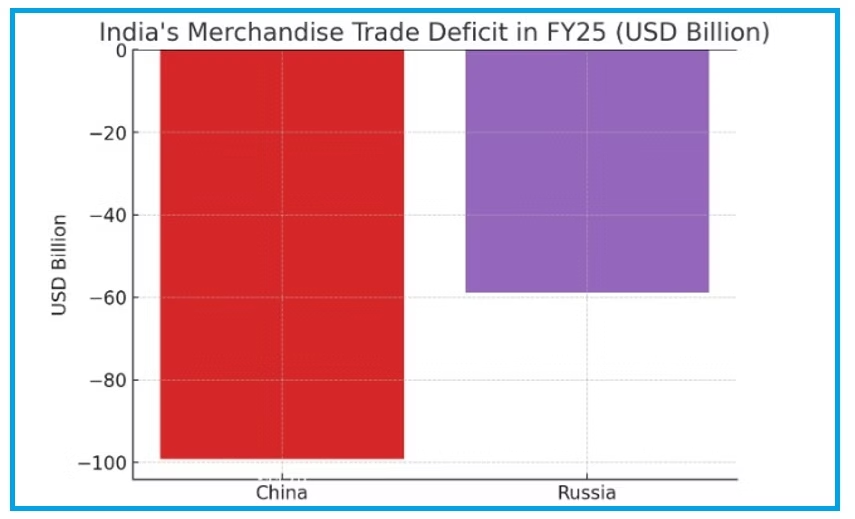
Dependence on Anti-Western Countries Hurts India’s Trade Balance:

India’s combined trade deficit with Russia and China is approximately $158 billion USD, which demonstrates how much less India exports to these two countries. India’s overall merchandise trade deficit is $282 billion USD, with a deficit of almost 56% in total attributed to Russia and China.

Service Exports a Crucial Metric in India’s Balance of Payments:

India’s services exports stood at $383 billion USD in financial year 2025, earned primarily from the U.S and other Western countries. Washington has imposed tariffs on India’s tradable goods sector, while the nation’s non-tradable sector has been operating without much stress.

India’s overall trade deficit stood at minus $94.26 billion USD in financial year 2025. Without service exports (predominately from the software services sector), India’s current account deficit would be much larger and the Indian Rupee would face greater depreciation pressures.

India’s economic stability is precarious, equilibrium needs to be found. Solid domestic outcomes for manufacturing and a stable Rupee, including exchange rates, could be achieved with a well-defined calibration that looks West but does not weaken India’s stance as a non-aligned nation. New Delhi should focus on maintaining neutrality and strategic autonomy.

While India may shake hands with Presidents Vladimir Putin and Xi Jinping, an important economic lifeline runs firmly through Washington, Brussels, and London. Crucial negotiations are said to be taking place between Prime Minister Narendra Modi’s team and President Trump’s White House behind closed doors. New Delhi could become vulnerable if it does not find adequate solutions. President Trump has recently reiterated his friendship with the Prime Minister Modi, perhaps an agreement can be produced in the mid-term.

post273

China’s Economic Future: Speculation & Transparency Question

China's Economic Future: Speculation & Transparency Question

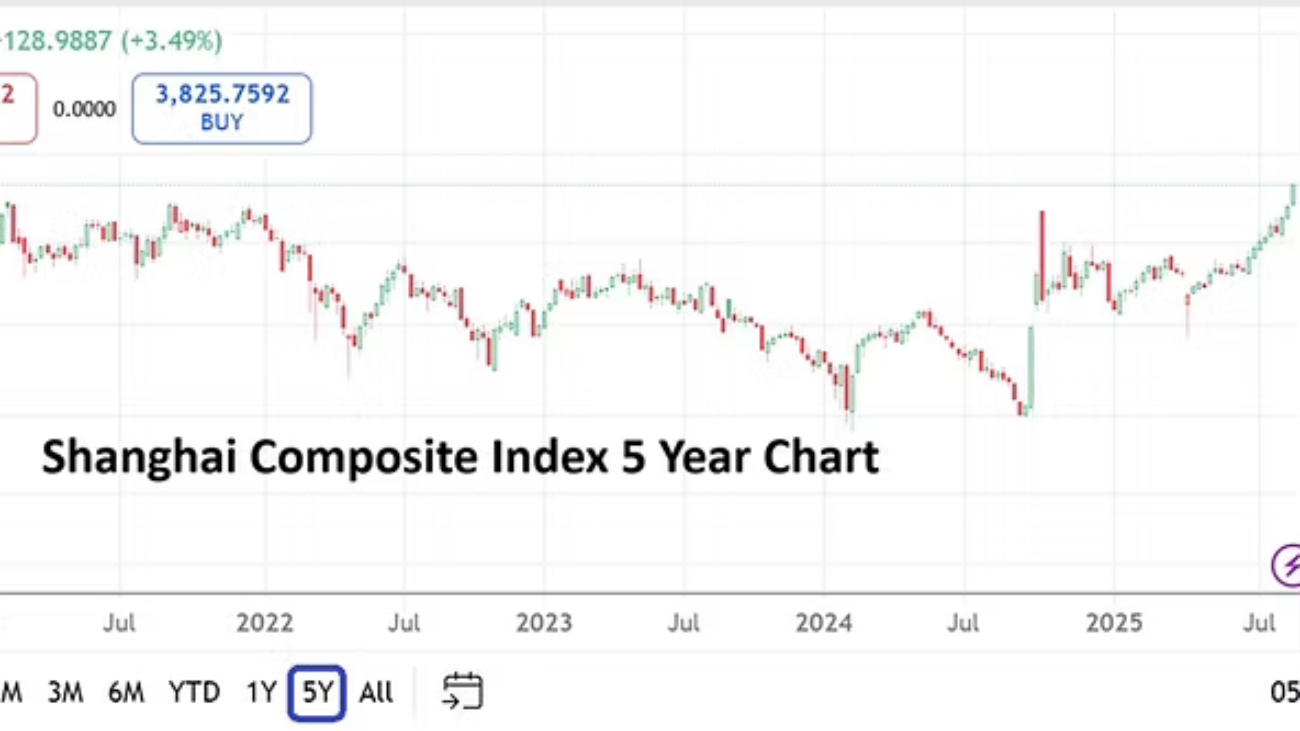
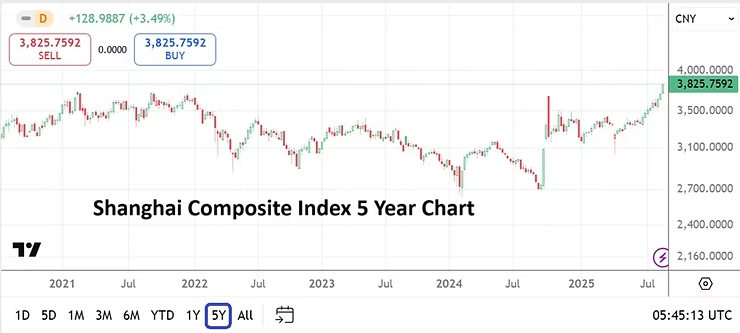
China’s economy has been underperforming for a handful of years. Growth has not only stagnated but has experienced a downturn, deflation has been experienced. Strong leadership from Xi Jinping has led to a firm approach regarding the management of China’s political and economic affairs. Until this year, Xi’s grip on power had grown significantly since he took office as the President and General Secretary of the Chinese Communist Party in 2012, but his control appears to be waning. Yet even as lackluster Chinese economic data has persisted, the Shanghai Composite Index (SSE 000001) has mirrored many global equity indices and done remarkably well since April of this year.

The SSE is near 3,826 currently. In early April the SSE was around 3,080, and in the middle of September 2024 the Shanghai Composite Index was close to 2,700, which was clearly within sight of long-term lows. The current heights of the SSE have not been seen since August of 2015. Yes, the Shanghai Composite Index was over 5,000 in April of 2015 and also in 2007. The point being that highs being traversed have not been seen in a long time. But is the positive speculation in the SSE a sign that economic conditions and political considerations in China are positive? Where is the transparency?

Shanghai Composite Index Five Year Chart as of 24th August 2025

China’s ability to create significant growth over the past four decades has transformed the nation into a global powerhouse economically and militarily. Yet, the past few years have begun to show cracks in the single handed approach to centralized decision making regarding the economy, government data presented has become suspicious. Rampant speculative forces in the SSE have been seen before. Is now the time to buy more Chinese equities or is it time to become cautious? Reliable statistics remain a troublesome aspect for investors.

China’s real estate market collapsed under the weight of too much building and speculative buying of apartments. Yes, inflated property and sudden deflation has been seen in capitalist countries in the past and will be witnessed again in the future. But the bubble in Chinese real estate and its crash also points out problems regarding a lack of transparency. While the Chinese government has tried to fix the fiscal problems caused by the real estate implosion, it has also created significant fractures within its banking system, which are confronting the Chinese government and public, and sometimes feels like a coverup trying to hide bad news. When will there be a recovery in the China real estate sector, is the worst of the crisis fixed?

Chinese political questions and some evidentiary circumstances point to intriguing considerations. There is evidence in China that a change of leadership is progressing. In the past couple of months small hints have been allowed to be published via China’s state media, the Xinhua News Agency. Rule changes have been made regarding decision making processes in the Chinese Communist Party, this was published by Xinhua in late June and republished by the South China Morning Post of Hong Kong in early July. While paraphrasing, both news entities expressed that rule changes meant Xi Jinping would officially have to delegate more decision making.

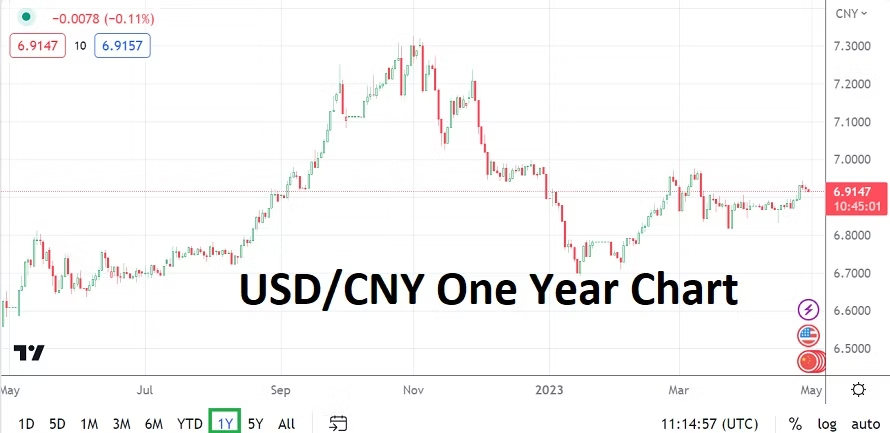
USD/CNY One Year Chart as of 24th August 2025

Speculation is growing beyond a mere whisper that the Chinese military has become a wildcard and a source of power that is potentially ready to help remove Xi Jinping. The military apparently is not supporting Xi and wants a more collective approach to decision making via the Chinese government. Yes admittedly, this information can be described as being from news services and podcasts that do not favor the Chinese government, but they seem to be singing in unison. It appears that China’s People’s Liberation Army have decided it is time for a change and is ready to play a role in the selection of new Chinese leadership.

The 80th Anniversary Victory Day Parade in Beijing will be held on the 3rd of September, what role will Xi Jinping play in the show of military force? Will it become apparent that Xi is merely a figurehead until an official decision is made on how the Chinese Communist Party will be led? Importantly, the 15th Five Year Planning Conclave for the Chinese Communist Party will be held in October and this is where a leadership change could take place including the official removal of Xi Jinping.

There appears to be – yes, via the dissident information heard, two factions within the Chinese Communist Party vying for power – hardliners and reformers. The army still hasn’t made it clear if they are backing the hardliners or the reformers. What is evident however via many publications, is that China’s PLA has decided along with other important leadership circles in China’s Communist Party that Xi had too much control and they want a more collective leadership.

Regarding the Chinese economy which has undergone a period of stagnation and lackluster results the past handful of years under Xi’s strong centralized approach, something big is about to happen which will have ramifications for the next five years. Who will lead China? The hardliners who are true believers in ideological communism or reformers who want China to move towards more of a market economy? This is a huge question. This type of political infighting has been seen in China during the past four decades and played a role in key leadership changes. It is not a conspiracy plot which is being sounded, it is the possibility of a transfer of power which happens cyclically in many nations when changes are warranted.

China’s Shanghai Index has done well recently. Perhaps this is a correlation reflecting optimism being sparked globally in equities in recent months. Or is it also possible that some folks in the know are betting on the reformists to take control of the Chinese government? Tariff concerns have seemingly been brushed to the side in China and something bigger is certainly at play. President Donald Trump is not the story here. Investors participating in China need to pay attention to the political changes that seem to be brewing. While speculation has certainly brought the Shanghai Composite Index to long-term highs, transparency from China is a concern economically and politically and there will be an impact if changes to leadership occur.

post256

Crude Oil: A Guess from the Underbelly On What Happens Next

Crude Oil: A Guess from the Underbelly On What Happens Next

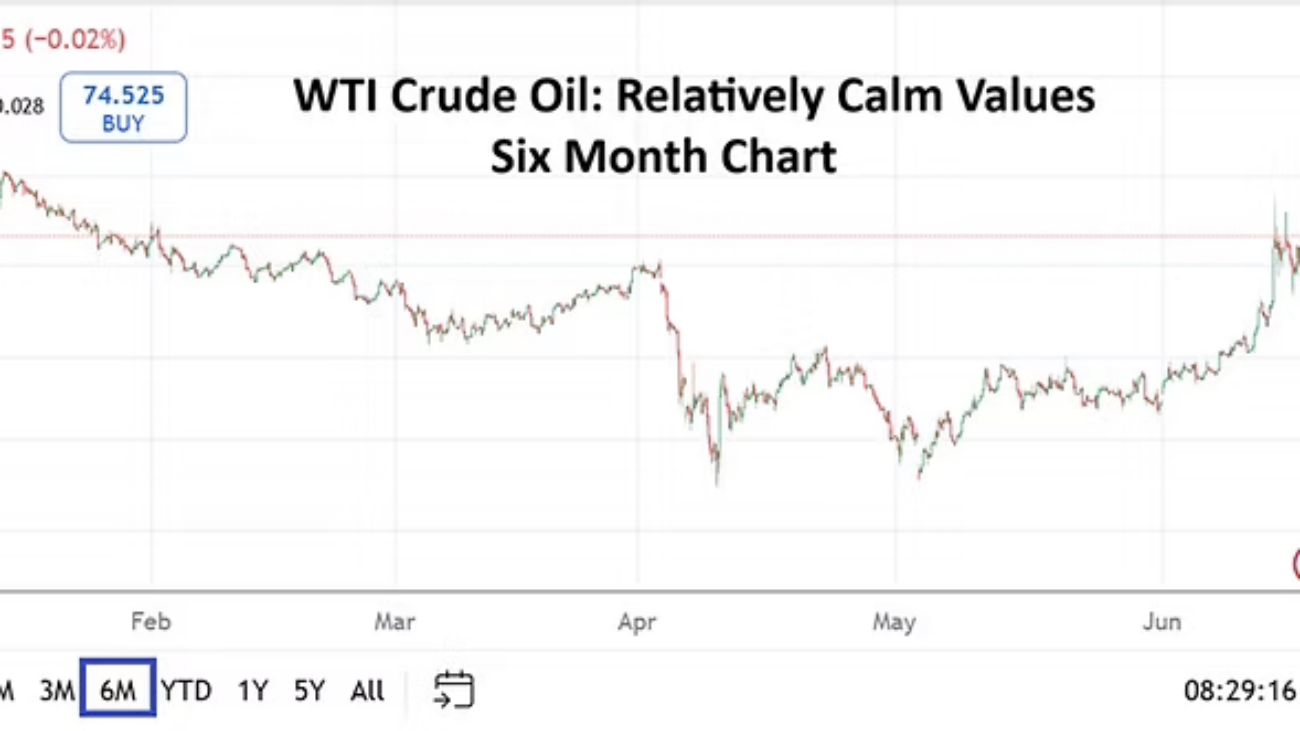
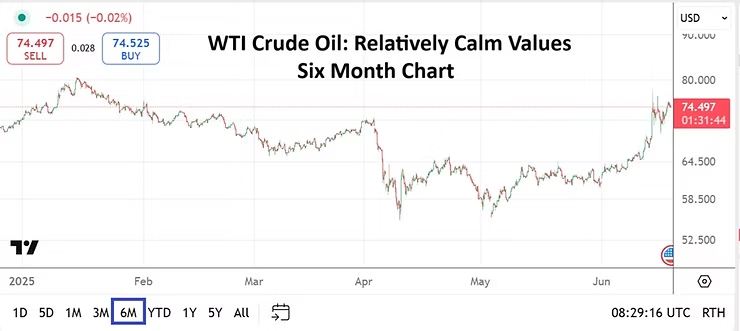
Why has the WTI Crude Oil Spot price remained relatively calm? The war between Israel and Iran has been going on per this latest violent phase since Friday the 13th. While tensions have been high between the two nations from the 7th of October 2023 in a very outward manner, and missiles were fired from Iran towards Israel on two separate dates in 2024 which then featured Israeli retaliation, the past handful of days is a new escalation.

WTI Crude Oil Spot Price Six Month Chart as of 18 June 2025

Day traders of WTI Crude Oil need to understand that large players in the energy sector have a vast amount of experience and intel regarding production and supply worldwide when they make their buying and selling decisions. However, the biggest oil traders do not always share the same political viewpoints, except to say most large players in the energy sector practice the art of realpolitik. Day traders of WTI Crude Oil should try to get into the minds of the real movers of WTI Crude Oil via realpolitik considerations.

As of this writing the price for WTI Crude Oil is around 73.930 Spot, late yesterday it did move higher to within sight of the 75.750 USD mark – this when information that President Trump is considering a U.S military strike on Iran heightened. Traders need to understand Spot Crude Oil and Futures pricing can be different. The current value of WTI Spot is higher than the Futures pricing because of the short and near-term known risks.

However, volatility in WTI Crude Oil Spot has remained fairly muted, almost tame as Israel and Iran wage war. Other spot energy prices like Brent and Natural Gas are being affected directly too because of shifts in behavioral sentiment. But again, the prices within the energy sector have remained calm considering what is at stake for global economics. Here are points that may be affecting the WTI Crude Oil landscape and energy complex, which some large traders may be contemplating:

  • It is highly likely the U.S has told Israel not to harm Iranian Oil production or supply sites, including shipping.

  • The U.S does not want the price of WTI to jump rapidly because of the current war between Israel and Iran.

  • Inflation would be a scrouge for the global economy, not to mention President Trump’s ambitions.

  • Even though the U.S has its own energy supply, the price of WTI is affected by behavioral sentiment within the global Crude Oil complex.

  • Meaning conflicts in the Middle East and elsewhere always cause ripple affects, even if Crude Oil is flowing freely in the U.S via its own production.

  • The U.S doesn’t want China to be given a reason to consider becoming an open belligerent in the Middle East war.

  • China gets a lot of Crude Oil from Iran. The stated percentage is around 15% of its total supply, but it could be more if Iran sends oil to other locations and then reroutes supply to China afterwards.

The U.S not only wants to keep China calm about its energy supply, but also doesn’t want to give China an excuse to escalate political or military tensions elsewhere – read Taiwan.

As an aside there are a lot facts and rumors coming from China, highlighting that a powerplay is emerging between competing factions for leadership in China’s military, this may include the authority that Xi Jinping has too. China will be conducting Politburo meetings in the coming weeks that will get plenty of attention via Beijing analysts. If U.S intelligence knows an internal political fight is taking place in China, they will want to keep China calm regarding external considerations and not give China excuses to act. Concerns regarding the Middle East as a justification for more Chinese actions against Taiwan in some type of economic political/ military theatre is a threat.

By telling Israel not to attack Iranian oil infrastructure, this allows the U.S to placate China. Only if Iran were to attack U.S infrastructure – including military assets or interests in the Persian Gulf via attacks on Gulf States like the UAE, Bahrain or Saudi Arabia would the U.S consider retribution against Iranian Crude Oil.

While the U.S has an interest in global politics certainly, it also wants to maintain a stable global economic environment. President Trump knows this and so does his cabinet supposedly. The Federal Reserve meets later today and they will certainly speak about uncertainty regarding inflation. Whether or not they mention the Middle East war will be interesting.

Thus, it is likely the U.S will only allow an attack on Iranian Crude Oil production and supply if it has been directly threatened. And this is where it gets potentially more interesting for Crude Oil traders. It appears likely the U.S will get involved directly in Iran by hitting known Iranian nuclear facilities deep underground with heavy U.S ordinance. If the U.S does attack Iran via B2s using heavy bombs, how will Iran’s Revolutionary Guard Corps react?

Will the existing IRGC allow for the destruction of its nuclear ambitions and accept that it will have to prepare for a new political environment in which their power will likely be challenged by not reacting? Or will those in power of the IRGC double down on stupidity and attack U.S assets with some of the Iranian military weaponry that still remains? An attack on U.S ‘interests’ would risk aggravating the U.S more – giving the U.S reasons to attack Iranian economic infrastructure which is mostly Crude Oil, and likely close the door on the chances of the IRGC to survive after the war concludes.

Things often do not work out via political and military outlooks. The law of unintended consequences is always a danger. The end game is quickly approaching for Iran’s current leadership. The U.S and Israel also hopefully have taken this into account. Recent outcomes in Iraq and Afghanistan have not gone as planned for the U.S when seeking a serene endgame.

As an example, it might be better not to eliminate the current Ayatollah Khamenei, and allow the people of Iran an opportunity to remove him if they want. The Iranian Revolutionary Guard Corps and its various factions are probably eyeing what will come after a capitulation. There will be a fight for survival politically and a leadership vacuum.

The IRGC fiefdom gets most of its money from Crude Oil revenues. It is quite possible in a forward looking manner the IRGC may choose not to risk having the U.S ruin Iran’s one giant economic asset, thinking rightly or wrongly that they can continue to profit from Crude Oil the day after the war ends.

postR195

Impolite Opinion: BRICS and a Western Loss of Power Part 2

Impolite Opinion: BRICS and a Western Loss of Power Part 2

BRICS Future Members and Potential Strangleholds

The West is moving too slowly as if stuck in an abyss of indifference, this while BRICS adds members, including the prospects of Saudi Arabia, Malaysia and others to participate. The ability of BRICS to work alone via trade agreements and increase collective strength is growing.

Some BRICS nations have expressed their perspectives the West is an antagonist that practices unfair trade and environmental colonialism. The West is accused of attaining important resources from the developing world, destroying the habitats of these nations as minerals are mined, food is grown and harvested, and energy is sought and produced that create degraded ecosystems. The West is cited for keeping their landscapes pristine, while using the ‘cheap’ land and labor of the underprivileged to procure needs. And as the West has increased their reliance on commodities attained from afar, they have become vulnerable to the threat of a potential stranglehold on resources controlled by BRICS like rare metals.

BRICS will certainly attain additional nations via the FOMO adage. The enticement of membership and ability to cease underdog statuses and stop being mere supply conduits to richer nations is appealing. Mexico is said to be considering potential BRICS inclusion, and we are probably not far away from a European State asking to join.

The Power of Commodity Prices and BRICS Influence

The West must engage and rethink associations and to make sure countries are not treated as lower tier. If nations like Mexico join the BRICS dynamic, and newly created cartels strengthen economic practices and policies of the organization, the prospects could eventually lead to the creation of a new fiat currency. For the moment BRICS has wisely pushed this goal to the side, but the idea of a unified currency is certainly being discussed openly. An increase of BRICS economic power derived from robust trade would tempt financial institutions to consider start buying bonds if offered as investments.

The West must ask what the dangers are if a needed commodity supply is controlled by a BRICS cartel that could suddenly initiate boycotts and trade limitations upon those BRICS does not agree. Food, energy, and mineral scarcity if controlled by nations not seen as allies of the West would be dangerous. Economic power within BRICS would certainly turn into geopolitical strength. The ability of developing nations to have a collective economic voice and create supply dynamics within commodities would ignite hazards for the West.

BRICS, U.S Government and USD Reserve Currency Status

While the West worries about domestic issues such as creating a politically correct happy tent for everyone, the larger powers within BRICS are engaged in the big picture which might be uglier but may carry more importance long-term. Because a lot of BRICS political power comes from more authoritarian stances, they are able to plan policy not only with five, but ten and twenty year outlooks. Western leadership needs to be willing to engage in a complex world and make sure nations that are not seen as natural bedfellows are treated with respect and brought under an economic umbrella that allows them to engage on equal terms.

The long-term future of the USD as a reserve currency is coming under increasing doubt, the trading of the currency in Forex is slowly and surely losing its footing via incremental percentage changes that point to deterioration. A void in solid leadership in the U.S and unrestrained spending are making the tasks harder for the Treasury and Federal Reserve to protect the strength of the USD. Fiscal deficits are one thing, 35.6 trillion USD of debt is another matter. How long can the U.S carnival sell tickets and expect people to be entertained in a magic act that prints money and backs it with increasingly vulnerable bonds? The U.S needs to change its fiscal policies efficiently.

There are ways of looking at this per different perspectives, but if BRICS does achieve its economic aim of creating more equitable trading coalitions, it could sustain alliances which the West may not be comfortable and actually be susceptible. The phrase that money talks and nonsense walks should be kept in mind regarding BRICS. The promise of fair trade among its members is important, but the ability to be unified politically and create economic transparency is important too. Many of the nations who are members of BRICS have not practiced solid economic policies and are still looked upon as suspicious fiscally.

Gold and a Decoupling of the USD

Importantly, we must begin to ask if financial institutions have figured a lot of what is mentioned above out and started to position themselves. Financial institutions and nations may be starting to look for a balance between the world’s reserve currency which is the USD, and the ambition stated by China’s Xi Jinping at the latest BRICS summit to create an alternative financial system.

If this alternative financial system includes BRICS as one of its foundations, and is based on organized cartels which use commodities as a backbone a new paradigm will be introduced. And if BRICS evolves and has the means to introduce a new currency along the lines of the EUR with a coalition of associated nations, the West will be faced with competitive questions. This new currency – let’s calls it the BRICS Unit (as reported by others), if it can trade calmly and with significant volume, and also offer innovation like a digital currency would change the balance of global power. The potential lose of status for the USD as the world’s reserve currency would weaken the U.S immeasurably. We have seen this show before via the GBP and the Britain.

A battle between a legacy reserve currency and an innovative upstart which wants to become a reserve currency could cause mayhem – potentially leading to a winner or all currencies losing confidence. Folks thinking ahead of the curve may already be putting money into gold because it is a historical store of value. Can the rise in gold seen the past year be quantified via not only a fear of inflation, speculation, and concerns about central banks, but also a reaction because of a looking glass into the future that does not trust the outlook of the USD? It is just a theory, but what if safe haven buying of gold signals a decoupling is taking place with the USD as its status weakens?

It should be added that the lack of a declared currency by BRICS as of yet, shows a level of political maturity and understanding of the current economic landscape. BRICS has shown the ability to take a long view and not act impulsively. A coalescing of commodity strength via gold, crude oil and other resources with organized cartels and solidified trading would give the BRICS Unit more credence upon its birth, but patience will be needed. And, like the EUR, the BRICS Unit could suffer from internal political strife, and particularly if the West wakes up and takes action to engage nations who are sitting on the economic fence and offers beneficial trading agreements.

The Western method of nonchalance that all will be well is naive. However, BRICS still face hurdles. Grievances could prevail in BRICS and cause it to falter and perish, some member nations which have had difficult relationships will need to put their distrust aside. An example of potential problems could come from Egypt and Ethiopia that have a long history with each other, both have massive populations and centuries of political intrigue when dealing with each other. However, BRICS represents the thinking of realpolitik vs. the winsome misguided aspirations of some Western nations with leaders who have their collective heads in the sand. The West needs to advocate collective interests, which includes freedom, solid enterprise agreements and large consumer markets. The West needs to focus on the competition emerging with BRICS. Pretending the danger doesn’t exist amounts to negligence and a potential lose of economic power the West cannot afford.

If you have not read Part 1, here is the link:

post26.1

BRICS and a Potential New Currency Paradigm

BRICS and a Potential New Currency Paradigm

The BRICS nations are causing alarm in some ‘Western’ financial circles as they seek to strengthen their trading alliance reflecting their ability to be large producers and consumers. BRICS has a common goal of creating better trade and financial conditions for each other, and as a potential byproduct to possibly create an alternative to USD dominance.

While political crisis and global security concerns have grown the past few years and are causing uncertainty and instability, the strength of the USD has also caused inflationary problems for many nations including BRICS members. Cash reserve shortages of USD have become problematic and have been fueled measurably by decisions from the U.S government, Federal Reserve system and U.S Treasury. This has ignited many emerging market nations to seek dialogue about potential BRICS membership.

Alliance intrigue and concerns also shadow BRICS members often, the February 2023 naval exercise held between Russia, China and South Africa within waters near Cape Town raised anger in the United States and the European Union. The fact that the joint military exercise was held during the first anniversary of the Russian invasion of Ukraine did not go unnoticed. While no signed military alliance exists between these nations, it should be noted that Russia, China and South Africa also held a naval exercise in November 2019 also within proximity to Cape Town, South Africa.

USD/ZAR 1 Year Chart as of 28th April 2023

Formation and Agenda as Members Scoff at the ‘King Dollar.

The agenda of the BRICS nations often appears a desire to topple the dominance of the USD to those watching from outside, but is it realistic? Trading alliances are important certainly in order to create better economic stability. The BRICS potential effect on the USD is concerning, although not critically dangerous at this juncture the bloc needs to be monitored. In addition there are worries from some in the West that new military alliances could be formed, but historical and cultural differences within BRICS makes this rather questionable for the time being when contemplated in total.

BRIC was an acronym coined by then Goldman Sachs Chief Economist Jim O’Neill to identify potential opportunities for investors within emerging market nations. Members in this ‘bloc’ are countries that have begun to work in unison. About two months ago, Jim O’Neill reiterated the same refrain and alluded to the BRICS theme of suppressing USD strength and its reliance in global trade. BRIC (Brazil, Russia, India and China) was formed in 2009, and they added South Africa as a member in 2010 formally initiating BRICS. This coalition has met annually to discuss coordinated policies regarding trade, finance and investment opportunities. The next annual meeting will be held in August 2023 in South Africa. Vladimir Putin’s potential attendance at this year’s meeting is being monitored widely.

Plenty of discussions have already been articulated internationally about undermining USD dominance in global trade, but little effect has come to fruit in reality and the USD retains its moniker of ‘King Dollar’. However, countries being affected by the rise of inflation and the strength of the USD are becoming numerous and this has caused a diverse group of nations to seek conversations with BRICS leadership about being able to join the trading alliance. Iran, Algeria, Argentina, Mexico, Nigeria, Saudi Arabia, Indonesia, Pakistan, Egypt, Sudan, Syria, the United Arab Emirates, Bahrain, Turkey, Venezuela, Sri Lanka and Zimbabwe are some of the nations that have expressed interest in BRICS membership.

Impact of Sanctions on Russia and its Ability to Counter via BRICS

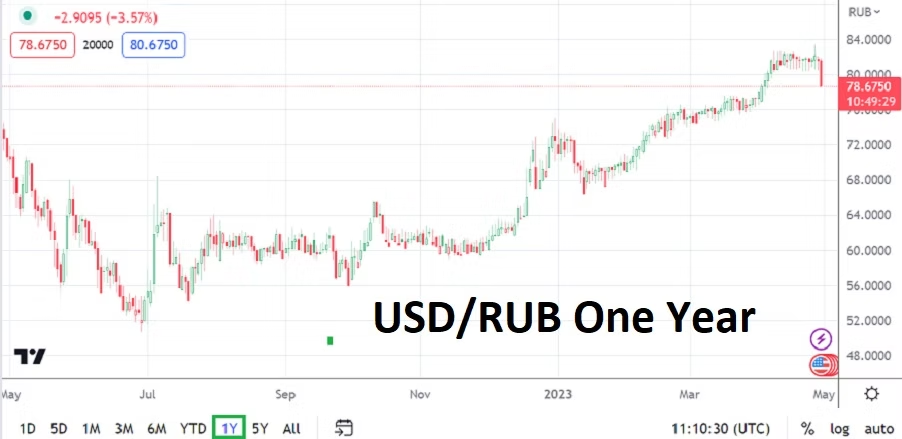
Russia has been waging a war with Ukraine for over a year and is currently under many Western sanctions. It’s been kicked out of the SWIFT banking system, which means it has limited opportunity to trade the RUB with Western countries. This in theory also limits the amount of USD that Russia can get its hands on.

Russia last year asked to be paid in Rubles (RUB) for gas and other energy purchases when dealing with E.U countries, trying to play a game of chess which largely failed. This while China too, tries to make the Yuan (CNY), a more significant currency in order to suppress USD dominance. China certainly has plenty of political and economic reasons to have the CNY emerge as a global power.

Russia has supposedly wanted to get out of Western currencies and especially the USD, this to punish the West, but will it work out and is it pragmatic? No. Russia’s attempts are high on rhetoric, but low on quantified changes thus far. The USD is far too dominant within the global banking system, and while incremental challenges to the USD have been tested, chipping away at USD strength remains difficult at best. The Kremlin has tried to inoculate itself from the pain caused to its trade balance because of sanctions, and create problems respectively for countries that oppose its invasion of Ukraine by cutting off gas supplies which were used for heating and to generate power for industrial purposes. Threatening to not allow grain to flow from Ukraine has also been a rather constant noise made by Russia.

Prices were capped on Russian energy via the G7 beginning in 2022 as a retaliatory move to limit revenues for Russia, and alternative gas agreements were sought by many European nations creating a loss of momentum for the Kremlin’s chess game. The Nord Stream pipeline was also damaged via sabotage. Russia used to supply Europe with 50% of its energy until sometime in 2021, it now provides less than 20% after Western sanctions. Russia has moved its eye towards other nations hungry for energy, ones that are not obligated to make transactions in USD, which brings BRICS into focus.


USD/RUB 1 Year Chart as of 28th April 2023

Inflation and a Strong USD have Caused Harm Globally

Inflation has caused problems across the globe following the impact of the coronavirus epidemic. The Federal Reserve, BoE and ECB have raised rates to try and cool inflation in their respective economies. This has made the USD attractive against emerging market currencies and caused capital outflows. An economic nightmare has occurred in Sri Lanka which is suffering from staggering political and economic problems the past two years, and nations like Pakistan and Egypt have been hit hard too by inflation’s impact and debt. USD reserves dwindled in these nations and they found it difficult to service their USD denominated debt in 2022, and troubles persist in 2023. Import without any USD reserves is difficult and sometimes impossible.

Russia and China as Major Players in ‘Their’ Bipolar World with ‘Friends’

Global trade is still dominated by the “King Dollar”. Almost 88% of global trade happens with the USD. The USD accounted for more than 71% of currency reserves at central banks in 2000, but has now declined to slightly below 59%. Oil and gas exports are important for Russia as these revenues constitute nearly 45% of its Federal Budget and it’s already been in deficit since February 2023, because oil revenues have slumped by half. Russia has a growing dependence on BRICS and is actively trying to get other nations to join the trading coalition, this because it has few other places to turn, and there appears to be no end in sight regarding the war with Ukraine.

Trading with other nations and signing currency agreements which would not include USD transactions is a long term goal of Russia and China, this if monetary values via the other nations currencies can remain firm. And then there is a wished for and ‘feared’ long-term dream of creating an alternative ‘super’ currency to compete against the USD.

Even before the escalation of fighting in the Russia and Ukrainian War, Russia was strongly advocating an end to USD dominance in global trade via rhetoric, particularly during previous BRICS Summits. We need to understand the political implications and complexities within BRICS, when talk of a decoupling from USD dominance news flares up. The U.S certainly keeps an eye on BRICS and so do other Western nations. At this moment South Africa has a delegation in Washington, D.C regarding the questionable South African policy behavior, particularly in light of recent military exercises with Russia and China, to try and smooth its U.S relationship. South Africa membership in AGOA, the Africa Growth and Opportunity Act, which grants special trade benefits to the nation and other members is being questioned strongly by U.S politicians. Getting kicked out of AGOA would cost South Africa billions of dollars in aid.

China and Russia seemingly want to create a bipolar power sphere, one in which U.S dominance is not so easy. Chinese President Xi Jinping and Vladimir Putin have met several times recently and are certainly collaborating regarding trade and investments. The developing news regarding the potential of BRICS enlargement shows that China and Russia maybe preaching multi-polarities such as their involvement with South Africa, but may actually be working towards a bipolar constellation of forces in which they would lead a broad alliance of countries in countering the preponderance of Western economies and potentially military might.

USD/CNY 1 Year Chart as of 28th April 2023


By allowing membership of BRICS to expand, U.S influence and the dominance of the USD would be lessened incrementally. A long game seems to be in play and if that is the case, the game of chess being played by Russia and China together against the West is complex and the U.S and its allies will need to be ready with a response if they want to protect the USD.

From the China point of view, the internationalization of the CNY is a positive. It has recently brokered a peace deal between Saudi Arabia and Iran, long-term arch rivals which surprised many in the West and seemingly caught the U.S unaware. China has also lent close to 1 trillion in USD value to Ghana, Pakistan, Nigeria and other smaller African countries. China is wielding power via trade and investment leverage into these respective nations strategically, pushing its global trade agenda even as Washington quietly threatens to punish China for backing Russia in the war with Ukraine.

Changing Role of China on the World Stage and BRICS

China’s role today is very different than in 2009 when BRIC was founded, this as the nation has become more secure regarding its stature globally. In the initial stages of BRICS there were talks about challenging USD dominance in global trade by member countries, but China vehemently avoided discussing this proposition openly to avoid conflict. The game has changed significantly regarding rhetoric, this as U.S – China relations have worsened as global trade, military security and corporate surveillance issues become more troubling. Political tensions with Taiwan as China rattles swords is a drama that nations are also watching attentively.

For China, the developing alliance with Russia has been a complex and sometimes slowly evolving plan historically, but one that has grown amidst tensions with Washington since the Trump presidency. The Russia and Ukraine war has accelerated the desire to break U.S led global dominance, and that means trying to break the USD internationally when it is possible. It is a long game and BRICS is part of this equation.

China and Russia view themselves at the vanguard in the struggle against Western global predominance, and they are eager to bring others on board. At the last summit of BRICS in June 2022, both Chinese President Xi Jinping and Russian President Vladimir Putin argued in favor of expanding into BRICS Plus. Beijing has become particularly interested with developing BRICS as a counterweight to the G7. While it has been difficult to establish a consensus on expansion among the current BRICS members, it appears to be a certainty that expansion is coming and the summit in South Africa this August will provide insights.

China is promoting the CNY in exchange for getting oil from Russia. The CNY is now ranked fifth regarding global transactions according to many banking sources. From the Kremlin’s point of view accumulating CNY reserves is good for Putin in the short-term; this creates more buying power for goods from countries that are friendly to Russia and China collectively and creates strategic momentum.

Yes, there are long-term historical complexities between Russia and China which will likely prove difficult politically to solve, but for the moment money is helping grease their wheels of diplomacy. Differences of opinion between Russia and China cannot be ruled out in these kinds of power games. Putin is an astute politician and liable to act in a surprising manner, this while trying to help Russia and its place among nations. Russia is certainly not keen on becoming a puppet state of China.

Trust is Almost a Four Letter Word for Some Economically and Politically

In his acclaimed book ‘Trust: The Social Virtues and the Creation of Prosperity’, the political economist Francis Fukuyama illustrates how degrees of trust in a society and indeed in a company can be decisive for prosperity and the ability to compete. In “low-trust” societies such as China, Russia and Italy, you cannot assume that everyone is willing to follow the rules. Members of these societies must frequently renegotiate ‘asserted’ rules, and often have to go to court to decide on matters. Ironically, one can see that this also applies to trading of the CNY.

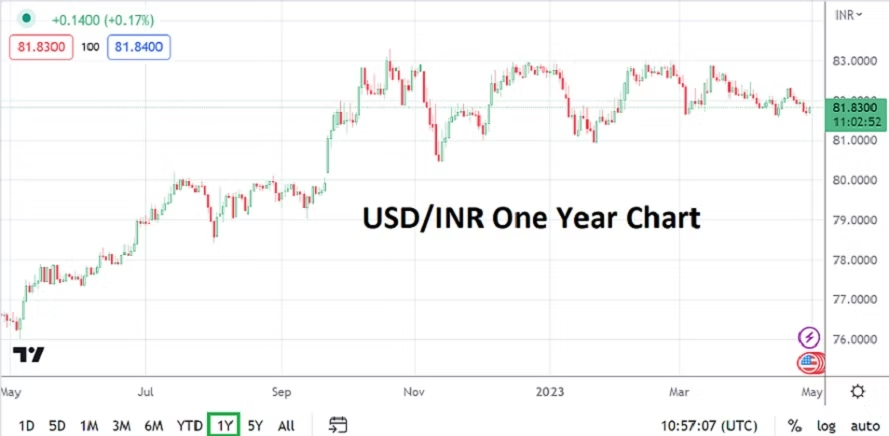
USD/INR 1 Year Chart as of 28th of April 2023

For instance, while China promotes the use of the CNY, countries like India are still using UAE Dirham (AED) for buying oil from Russia. BRICS still needs to sort out which currency they will use extensively for trade, this while many members try not to make enemies of other nations. South Africa exports are significantly more to the E.U, U.S and the U.K compared to Russia. Its share of exports to Russia are minuscule compared to the other three. Not only is South Africa risking free trade agreements with the U.S, E.U and U.K, but membership in key groups like AGOA as it tries to play on both sides of the fence politically is in jeopardy. Western observers are certainly watching South Africa and they will watch any other nation that joins BRICS. How long will the ANC led government of South Africa will be allowed to flirt with Russia and China militarily before it is stopped?

India has a Large Role in BRICS and is Growing in Stature

India is a vital member of BRICS, but also an important member of the QUAD alliance, the Quadrilateral Security Dialogue. Japan, Australia, the U.S and India are members and confer over trade and security. India is the largest democracy in Asia – and the world – and a Western advocate in South East Asia, even as China plays a dominant role in geopolitics. While BRICS wishes may be good for conducting bilateral trade among members, it is not necessarily good for global trade and political understandings. Complications from long-term political and historical disagreements between India and China cannot be discounted either.

Is the Indian Rupee (INR) or CNY more relevant for international trade? Use of the INR and the CNY needs coordination with other countries many times. Australia is a good example regarding the ability to trade INR internationally. If Australia and India agree to make their payments for exports and imports in their respective nation’s currencies, trade can be conducted rather well, but then Australia would have to find another nation for its ‘extra’ INR, because it would likely suffer due to trade imbalances. It would be important for another country outside of India to agree to take INR from Australia for other trades. Potentially some Gulf countries could be open to these types of INR transactions. A bigger group of BRICS nations would help India certainly.

Saudi Arabia has recently agreed to sell oil for CNY, but shoring up CNY in their coffers has long-term implications. This as Saudi Arabia wrangles politically with the U.S occasionally. Saudi Arabia has demonstrated a desire to take on a seemingly more neutral tone and perhaps wants to limit its exposure to the strength of the USD, particularly if the U.S tries to make a weapon of the USD via political policy. Thus, India as the most populated nation in the world and a growing economic sphere of importance, has to make careful considerations moving forward as it positions its economic stature for complexities that will develop. India and Saudi Arabia may have visions of becoming great ‘neutral’ economic powers moving into the next one hundred years.

The Indian Government has made economic deals with Egypt, Sri Lanka and Malaysia for bilateral INR trade, but still no pure INR trades of significance have materialized according to official banking data. There are multiple headwinds for BRICS nations to overcome USD dominance in international finance. Whenever exchanges of INR or CNY to other currencies for trade settlement are needed, they need to first change the base currency to USD to buy RUB or AED. Few exporting countries will accumulate CNY without a total need. Holders of these currencies would likely dump the INR and CNY for USD via Forex.

China Economic Transparency is Lacking and the Future of India in BRICS

China doesn’t make it easy for foreigners to own assets in their nation. The China government does not want massive trade deficits and free capital flows are restricted with force. Who would invest in China and risk having their money being stuck in the nation without guarantees? China continues to ramp up its oversight and aggressive tactics of supervision of foreign owned companies that have operations in the nation.

Now and into the foreseeable future, the Chinese government will control transactions of CNY with an iron fist. The United States will likely remain the predominant place for trade because of its huge economy, and as a nation that allows many other countries and foreign citizens to own and invest their assets within it boundaries. There is still something to be said for transparency. Any new nation or coalition trying to challenge U.S government debt instruments are likely to fail. The U.S continues to be a place where nations can hold ‘safe assets’ with a guaranteed return of interest for the long-term. No country equals the asset size and security of U.S Treasury Bonds. On that basis alone, there will be a no challenge to the USD in the near future.

Liquidity remains an issue for capital flows and convertibility within BRICS. A lot of hard work via transparent trade agreements will have to be signed to get these issues resolved. Plenty of questions exist regarding China’s economic data and its reliability because of a lack of oversight from ‘recognized’ outside agencies which are often forbidden.

India is still having border issues with China and these problems remain unresolved. India’s role of leadership in G20 is hard to ignore despite its alliance with BRICS. The Indian government has advised traders not to speculate in CNY. This shows that strained relationships between China and India remain and a lack of trust regarding clarity continues. In the U.S, New Delhi is considered an important partner, one that can be trusted regarding the growing rivalry between the U.S and China. Prime Minister Narendra Modi, said last year, “this is not an era for wars”, and this shows India wants stability and wants to play a global role in diplomacy.

There is a definite strategy for BRICS to grow with the nations of the Middle East and others. Using their currencies for mutual trade arrangements could eventually work out, but it will take a long time for this to change the dynamics of USD dependence and dominance.

However, we shouldn’t forget that almost 40% of the world’s population lives in Asia. Yet, even if oil producing nations will trade in a BRICS backed currency basket, which has been dreamed about for a long time, China’s leader Xi didn’t highlight this goal while in Moscow or in Saudi Arabia during recent summits. China is certainly playing a long game, but it also shows they remain cautious and vulnerable to the strength of the USD globally. If Xi wanted to cause the greatest pain to the United States, he would liberalize his financial sector and make the CNY a true competitor to the USD with complete economic transparency, but that would take him in the direction of free markets and levels of openness that are likely the opposite of China’s domestic ambitions. A strong due diligence of the Chinese economy, is something Chinese leadership likely wants to avoid for the foreseeable future.

BRICS: A Multi-Polar World and Avoiding Confrontation

Many developing countries will want to avoid a confrontation consisting of China and Russia on one side, and Western powers on the other side. India has overtaken China regarding population numbers, and will likely become the world’s third largest economy before the end of this decade. India will become a strong voice in favor of a multi-polar world. Arguably, ideas of a more multi-polar world are being worked towards in pragmatic ways, but the BRICS coalition will not develop their own asset backed common currency unless they can resolve issues regarding trade and monetary agreements with transparency. It is a matter of trust.