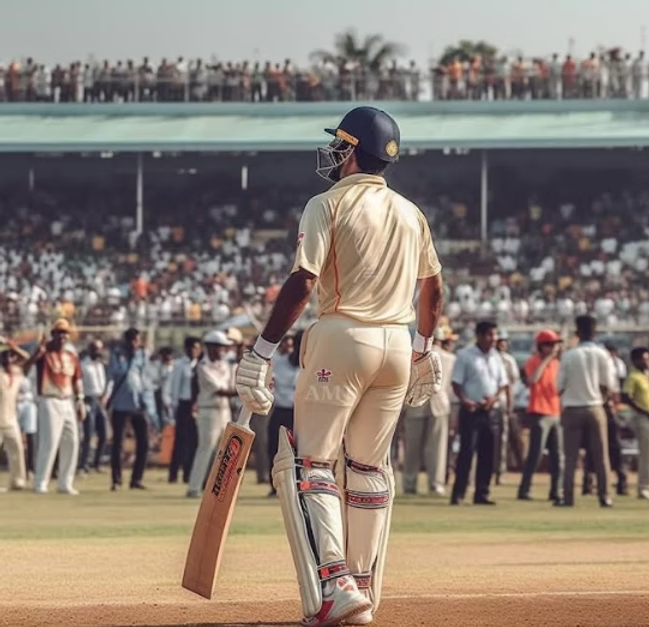
The sport of cricket was a remnant from the British rule in India which lasted until 1947. Cricket was considered an upper-class pastime, and probably not expected to survive in an independent India which was mostly poor. Yet cricket managed to endure at first, thanks to private clubs which played the sport for the prestige the British attached to it; and secondly with an even bigger thanks to the famous day of June 25th 1983, when India won the Cricket World Cup against all odds by defeating the mighty West Indies team. The icing on the cake was that the finals were held in London. It was at this point that India put the world on notice, that Indians could and would compete at something their colonial rulers of the past adored. The sense of pride created in India was uninhibited, and the first batch of Indian cricket stars were born out of this event. Naturally the interest and following of the game increased.
Second the Economy: Cricket Rules and the Power of Advertising
In the 1990’s the Prime Minister of India, P.V. Narsimha Rao, opened the economy to allow foreign companies to facilitate their business enterprises in India. Lowering the barriers for entry meant a liberal economy, which brought the likes of Honda, Leyland, Suzuki, Sony, and other well-known corporations to come in and partner with local Indian firms. Foreign capital brought jobs and fresh market competition which meant that India waded out of economic lethargy. International media companies were allowed to broadcast news, shows and sports on prime time television. The business impetus helped kick start the growth of television ads, which would be instrumental in pushing cricket popularity to new heights. How? It so happens that the rules of cricket are structured perfectly well to allow TV broadcasters to show ads every 4-6 minutes. No other sport in India (or probably the world) can boast of this unique set of advertising advantages. This meant there was plenty of advertising revenues to be made, which the broadcasters of course loved. The television broadcasters and BCCI realized these powers quickly and turned the sport into the business of cricket. Wait, who is BCCI?
Third the BCCI: Power to Organize and Create Fame
The Board of Cricket Control in India (BCCI) is a private body that manages cricket activities in India. In the mid 1990’s as the economy opened, the BCCI sold the TV rights to broadcast Indian matches to Transworld International (TWI). This broke the monopoly of Doordarshan (a state backed broadcaster which did not pay fees to BCCI). After a bitter legal battle, the Supreme Court of India decided that matches were a commodity the BCCI owned, and broadcasters must pay the BCCI if they wanted to air the matches. From the late 1990s to 2000s the BCCI went from strength to strength and hosted several international cricket events, which were a commercial success leading to high profits for the BCCI itself and the International Cricket Council (ICC), a governing body of cricket. These circumstances turned the BCCI into a very profitable entity, and it helped that the BCCI was organized in a focused manner and run like a free business not harmed by government bureaucracy that other sports in India faced.
As the popularity of cricket and its talented players increased, so did the value of its teams and its players sponsorship deals. During the early 2000’s Indian cricket players began to be featured in adverts for shaving creams, sodas, motorcycles, shoes, credit cards and anything else they could pose with on camera. Indian cricketers were now household names and the business of cricket gained critical velocity regarding valuation. The BCCI had become very influential on the world stage and with their ample funds in the coffers, and ready for use the organization took the step to launch the Indian Premier League (IPL) in 2007.
The Indian Premier League is a high-intensity short-format (T20) cricket league, which is held annually and is contested by franchise teams. The league uses the shorter format of cricket to maximize viewer entertainment (including cheerleaders, fireworks and DJs) as opposed to showcasing traditional elements of the game like technique, proper form, and mental resilience.
The strength and stature of the BCCI is such that it negotiated with other international cricket boards to block out an exclusive window where fewer international cricket games happened during the IPL season. This meant that cricketers from all over the world (except Pakistan, for political reasons) were available to participate in the IPL. The Indian Premier League is huge.
Here are some important facts and monetary insights to consider:
· The Indian Premier League is the most influential cricket league in the world and attracts a huge audience because of the size and scope of its Indian fans.
· By the year 2014, the IPL was ranked sixth in average attendance via its games compared to all global sports.
· The Indian Premier League broadcast a game live on YouTube in 2010, becoming the first sports event to be officially shown live on the site.
· The IPL brand was valued at nearly 90,038 ‘crore’ (11 billion USD) already in 2022
· It was estimated in 2015 by the BCCI that the Indian Premier League had added 1,150 ‘crore’ (140 million USD) to the economy of India in Gross Domestic Product.
· The IPL achieved the status as a ‘decacorn’ valued at 10.9 billion USD in December of 2022.
· Thus producing a large statistical growth in USD compared to 2020, when the Indian Premier League had an accepted value of approximately 6.2 billion USD, this according to a report compiled by D & P Advisory, a consultant firm which inspected the IPL’s business.
· Recently the IPL championship final for 2023, became the most streamed live event ever on the internet with an estimated 3.2 ‘crore’ (32 million) viewers.
· The Indian Premier League sold its media rights early this year for the 2023–2027 seasons for a price of 6.4 billion USD to the Viacom18 and Star Sports companies.
· Creating a value for every match in the IPL of nearly 13.4 million USD, proving again the might of the gigantic Indian audience which appears to still be growing in stature.
With growing popularity and its ability to expand its audience, naturally corporations have lined up to advertise during the games. Celebrities have vied to own IPL teams and players have been traded at auctions for ridiculous amounts of money. The need for constant fresh talent has brought players from the small nooks and crannies of India to play alongside the international stars, allowing them to gain experience. This element of new players has added to the excitement of IPL for its viewers, while creating a framework to uncover new faces that could go on to play long-term for the Indian national team.
The synergy of the world’s best players along with the development of new talent from India and beyond is a win-win for the BCCI, and it continues to enjoy the growing fruits of success. No one knows when this high will end for cricket in India, but for the moment and foreseeable future expect cricket in India to generate revenues that other international cricket boards can only dream of, while the nation also contends as a top power in the sport globally.