postN72

U.S National Security: USD Reserve Currency Importance

U.S National Security: USD Reserve Currency Importance

Opinion: The following article is commentary and its views are solely those of the author. This article was first published the 23rd of December via The Angry Demagogue.

We would like to start going through the U.S administration’s National Security Strategy released last month. There is a lot in there – much of it the same as in past administrations and much of it different. The tone of course is full Trump and while the introductory parts try to make it into a revolutionary document it does in fact build upon much of what has been American foreign policy for decades. One thing it most certainly gets right is that American foreign policy since the end of the Cold War has not found its compass. From a unitary world to one dependent upon global organizations, from a sharing of goals with western Europe to a pivot to Asia, from the war on terror and the middle east to Russia-Ukraine, the United States has struggled to find its way in the post-Cold War world.

We however will concentrate today on one aspect of the strategy, the third bullet in part III – “What Are America’s Available Means to Get What We Want?”. The third bullet point speaks of America having “The world’s leading financial system and capital markets, including the Dollar’s global reserve currency status” – a point that no one with any knowledge of global capital markets can not accept. The end of the bullet point – the Dollar’s global reserve currency status – is the most important because it underscores America’s leadership and essentially allows the United States of America to finance its military and its welfare state. The U.S Dollar as the “reserve currency” means that nearly all the world’s goods are quoted and therefore sold in Dollars.

Why is that important to the United States? Because the U.S government depends on its ability to issue Treasury bonds and bills at will – something no other government can do. It can do this because for another country to buy oil or copper or titanium or corn or soybeans from a country that is not their own– they need access to Dollars. Saudi Arabia and the other gulf states quote the price of oil in U.S Dollars and demand payment in U.S Dollars. The Saudis can deposit those Dollars in American banks or in what is called Eurodollar deposits in foreign banks (there are some 13 trillion Dollars in Eurodollar accounts globally). The Eurodollar accounts are essentially promises by the bank to give U.S Dollars to the holder when he makes a withdrawal. This strengthens the U.S capital markets and allows investors to have better and more investment choices. It is not only America’s often superior companies that bring profits to 401k’s and pension funds but the liquidity and vastness of America’s capital markets that can list domestic and foreign corporations. The reserve currency leading to the advanced capital markets allows the world – and America – to do this.

The U.S Treasury market is so liquid because every country needs Dollars in order to trade. They need to have enough dollar reserves since no one actually wants their own currency. In Israel, for example, local gas companies cannot buy oil with Israeli Shekels, since what will Azerbaijan, for example, do with them? There are only so many products that Israel can sell them. They need Dollars so that they are free to buy other commodities or other products.

The U.S Dollar as a reserve currency also is a break on inflation since the price of oil and other commodities is always in U.S Dollars. A weak or strong U.S Dollar influences the inflation rate in non-USD countries. A weak Israeli Shekel, South African Rand or Chinese Yuan does not influence the price of gasoline in the United States.

In short – as the Trump Administration understands well, the dollar as a reserve currency is a luxury the U.S cannot give up. The lack of the USD as a reserve currency could cause the Dollar to collapse and along with it the price of U.S Treasuries. As UST prices drop, their yields will rise and the cost of financing the U.S government will make interest payments on debt to rise well beyond its already absurd figure of over 4% of GDP – while debt itself is 120% of GDP. The U.S government currently pays over $1 trillion in debt service (interest payments on its bonds and bills). By contrast, the U.S defense budget for 2024 was $836 billion (about 3.3% of GDP).

We need to ask ourselves what can challenge the USD as the reserve currency and what could happen that would encourage the world to change? While the E.U had dreams of making the Euro an alternative reserve currency, the lack of growth in the E.U’s economy and population have put that dream to rest. The only other country that could theoretically replace the United States as the global economic go to country could be China. While in the long run, China’s lack of openness would probably mean that the Yuan would not last long as the reserve currency, that does not mean that they couldn’t jolt the global economy just enough to force it to use the Yuan to buy oil and other commodities.

China is already cornering the market on rare earth minerals and it making inroads in Africa where it mines all sorts of commodities from gold to copper to platinum and so many others (Africa has about 30% of global mineral reserves). That in itself is not enough to rock the global markets and cause a change in how the world does business.

Oil though, is that one thing that could allow China to challenge the USD as the reserve currency, even if it just presents the Yuan as an alternative.

How could that happen?

A Chinese takeover of Taiwan, by whatever means it uses would give the Chinese Communist Party control not only of the South China Sea but also allow its noisier and inferior (to America’s) submarine fleet to enter the Pacific and patrol it freely. The Chinese Navy, with a base on the “other” side of Taiwan would give it control of the north-south sea lanes that Japan and South Korea are dependent upon. Essentially, Chinese control of Taiwan would put Japan, South Korea, Vietnam and the Philippines at the mercy of the Chinese Navy. China could blockade these countries but that would be an act of war and then involve the navies of those countries and possibly the United States. It would affect the global economy negatively but it would not cause a change in world’s reserve currency. But, what if China works out a deal with Saudi Arabia to quote and sell their oil in Yuan (or the Chinese Petro-Yuan it wants to create) and then tells these countries, especially industrial powerhouses and energy poor Japan and South Korea that it will allow the passage of oil as long as they purchase the oil in Yuan?

Russia is already trying to get India to pay it for its oil in Yuan, to some success. Adding economies the size of Japan and South Korea would mean that any country that wants to buy oil could buy it in Yuan instead of Dollars. Once in Yuan, these countries would need to use the Yuan to buy Chinese products, deposit cash there and buy Chinese treasury bills. If China were to combine that with demands that all chips made in Taiwan also be sold in Yuan, the U.S Dollar would suddenly and forcefully no longer be the only reserve currency in the world.

Obviously, the way to stop this from happening is by stating outright that the United States will not tolerate a Chinese takeover of Taiwan. It is true, that the Strategy claims that the US “will also maintain our longstanding declaratory policy on Taiwan, meaning that the United States does not support any unilateral change to the status quo in the Taiwan Strait” but in practice the administration has criticized Japan’s tough talk on China instead of leaving it be. A strong silence on Prime Minister Takaichi’s remarks on China would have served the purpose of keeping the status quo more than telling her to tone down her rhetoric. There is a strong “no intervention ever” strain in the country and the President must make the case that that is not an option if the United States wants to maintain its leadership position, way of life and general prosperity.

In short, the threat to the Dollar as the reserve currency heads right through Taiwan. For those who think that the investment the U.S makes in keeping the Dollar where it is, is too expensive, just think of going on vacation and having the change to Yuan before you leave the country, wondering how much to change because of currency fluctuation and how much fun it is to return with hundreds of dollars in banknotes that you can’t use. Imagine your credit card bill on such travels and wondering how you went 15% over budget but didn’t get anything extra for it. Now imagine the national economy working that way.

Disclaimer: the views expressed in this opinion article are solely those of the author, and not necessarily the opinions reflected by angrymetatraders.com or its associated parties.

You can follow Ira Slomowitz via The Angry Demagogue on Substack https://iraslomowitz.substack.com/ 

postre1

India Insider: Why Russian Oil Should Be Treated Skeptically

India Insider: Why Russian Oil Should Be Treated Skeptically

As Russian President Vladimir Putin arrives in New Delhi for a bilateral summit, the mood in India’s capital is one of profound strategic tension. The core of the problem is India’s massive appetite for discounted Russian Crude Oil, which has shielded the economy from high energy prices but is now causing significant financial and geopolitical risks. This move comes at a time when India’s most important trade surpluses lies with the West, raising anxieties about U.S sanctions and shrinking strategic space.

Trapped Rupee Problem

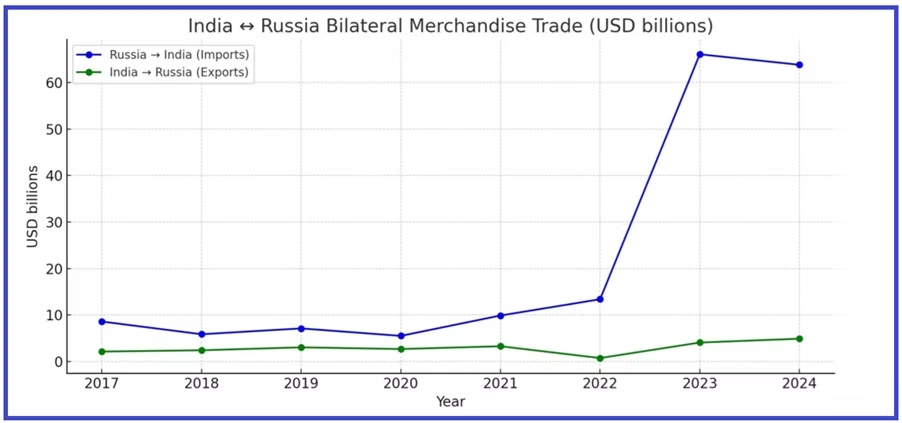
Since the Ukraine war, Russia’s share of India’s Crude Oil imports has surged from under 2% to nearly 40%. This has simultaneously inflated India’s trade deficit with Russia to nearly $59 billion.

The transactions are largely settled in Indian Rupees (INR). Moscow has accumulated billions of Rupees in Indian banks. However, because the Rupee is not fully convertible on the global market, Russia has very limited ways to use this huge surplus within India. These billions of Rupees are essentially ‘trapped liquidity’ – a problem neither country can easily solve.

India – Russia Bilateral Merchandise Trade Chart from 2017 – 2024

The Kremlin, meanwhile, is shifting its financial allegiance. It is preparing to issue Yuan denominated sovereign bonds, a decisive step that deepens its reliance on Beijing’s financial system amid a cut off from the Western financial system. This financial trajectory clearly signals the next logical step: Russia will inevitably demand that India begin paying for its oil shipments in Chinese Yuan (CNY).

Structural Risk of Holding Chinese Yuan

India has never been comfortable holding Chinese Yuan or settling trades in the currency. That’s partly strategic as New Delhi wants to protect its geopolitical autonomy and position itself as the democratic anchor of the Global South while staying closely aligned with the West.

But Russia’s financial plumbing is now increasingly routed through China. As the Kremlin becomes more deeply integrated into China’s banking and payments system, its dependence on the Yuan becomes structural. Moscow needs Yuan not only to service Chinese creditors, but also to pay for its expanding list of manufactured imports from China. The Ruble, being a largely non-convertible currency, simply cannot support this scale of trade.

For now, Russia-China trade is balanced enough because Beijing still buys large quantities of Russian energy. But this equilibrium can shift quickly. As the Ukraine war drags on and Moscow’s defense spending rises, the Kremlin will be forced to rely even more heavily on Chinese financing, Chinese goods, and ultimately the Yuan itself, tightening its economic dependency on Beijing.

When that moment arrives, the Reserve Bank of India (RBI) will be forced to accumulate Yuan as part of its Forex reserves to ensure the continued flow of oil. This decision, born of necessity, introduces a structural vulnerability into India’s financial system as the adoption of Yuan as a reserve currency subject to China’s capital controls.

Risks of Holding the Yuan

China may have both the onshore (CNY) and offshore (CNH) Yuan, but the currency is ultimately controlled by the PBOC, which makes it a risky reserve asset for India. In a crisis, Beijing’s capital controls could restrict liquidity and prevent the RBI from freely converting yuan into hard currency like the USD, effectively trapping India’s capital.

Beyond this financial rigidity, large Yuan holdings also expose India to CCP driven political risk, tying its external stability to China’s domestic decisions. And unlike the Dollar which can be deployed anywhere, Yuan reserves are usable mainly for transactions with China or countries in its financial orbit, sharply limiting India’s strategic and financial flexibility.

Strategic Win for Beijing

For Beijing, this shift delivers a double strategic win, cementing the Yuan as the dominant settlement currency across Eurasia especially among countries squeezed by Western sanctions and it allows the yuan to slip into India’s financial system indirectly, not through Chinese pressure but through Russia’s growing dependence on Chinese finance and India’s reliance on discounted Russian oil.

For Moscow, this is a reluctant compromise: giving up some monetary autonomy in exchange for necessary financial support from China.

For India, however, it introduces a new long term structural risk with a slow but steady Yuan encroachment into its trade and reserve system, operating alongside the dominant U.S Dollar. The oil corridor that was meant to offer an independent strategic opportunity for India is now becoming a channel which Beijing can strengthen its monetary footprint. In this complex triangle, India risks paying a dangerous tactical long-term price for its energy security.

post256

Crude Oil: A Guess from the Underbelly On What Happens Next

Crude Oil: A Guess from the Underbelly On What Happens Next

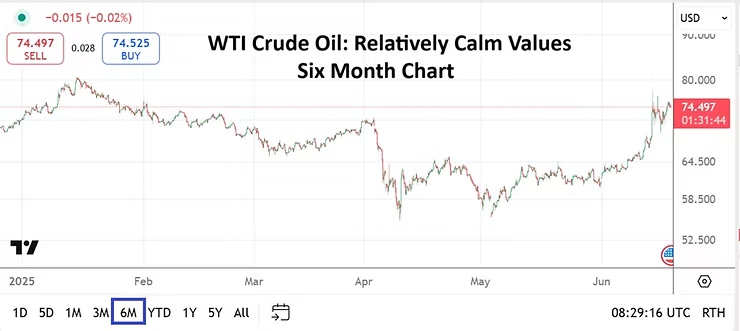
Why has the WTI Crude Oil Spot price remained relatively calm? The war between Israel and Iran has been going on per this latest violent phase since Friday the 13th. While tensions have been high between the two nations from the 7th of October 2023 in a very outward manner, and missiles were fired from Iran towards Israel on two separate dates in 2024 which then featured Israeli retaliation, the past handful of days is a new escalation.

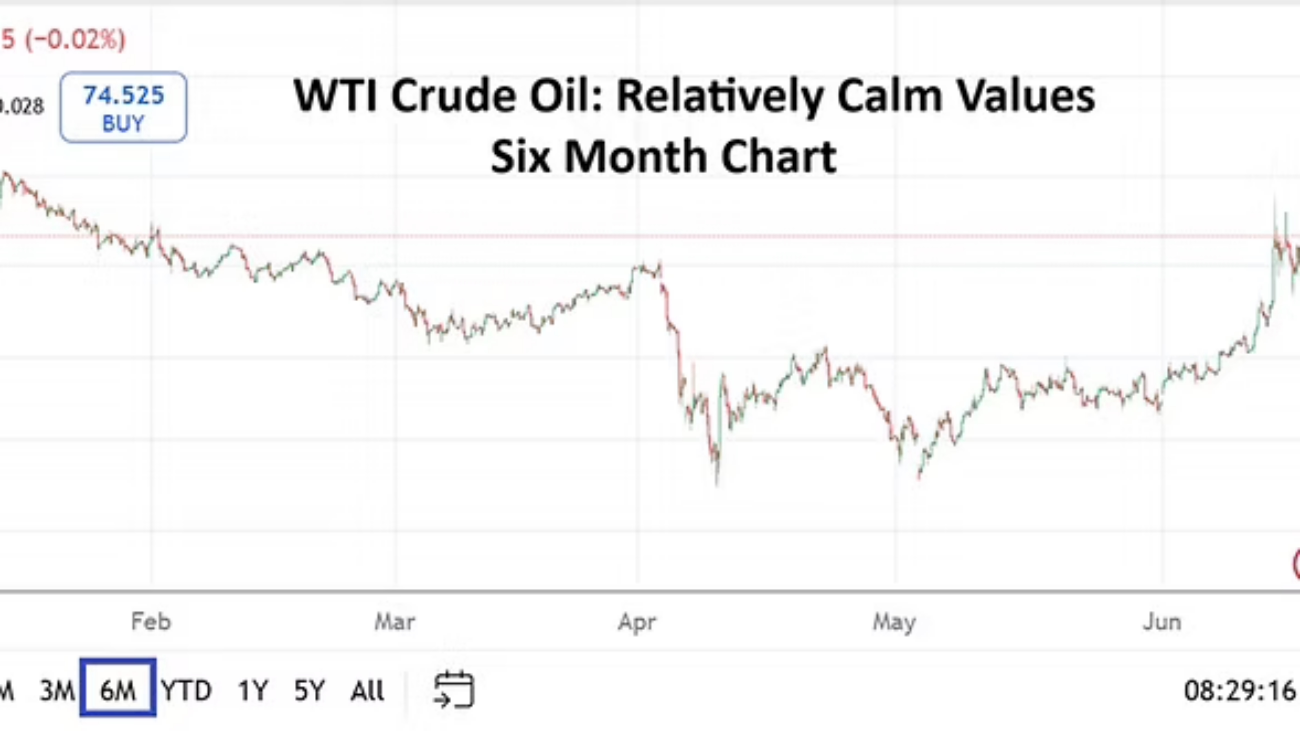
WTI Crude Oil Spot Price Six Month Chart as of 18 June 2025

Day traders of WTI Crude Oil need to understand that large players in the energy sector have a vast amount of experience and intel regarding production and supply worldwide when they make their buying and selling decisions. However, the biggest oil traders do not always share the same political viewpoints, except to say most large players in the energy sector practice the art of realpolitik. Day traders of WTI Crude Oil should try to get into the minds of the real movers of WTI Crude Oil via realpolitik considerations.

As of this writing the price for WTI Crude Oil is around 73.930 Spot, late yesterday it did move higher to within sight of the 75.750 USD mark – this when information that President Trump is considering a U.S military strike on Iran heightened. Traders need to understand Spot Crude Oil and Futures pricing can be different. The current value of WTI Spot is higher than the Futures pricing because of the short and near-term known risks.

However, volatility in WTI Crude Oil Spot has remained fairly muted, almost tame as Israel and Iran wage war. Other spot energy prices like Brent and Natural Gas are being affected directly too because of shifts in behavioral sentiment. But again, the prices within the energy sector have remained calm considering what is at stake for global economics. Here are points that may be affecting the WTI Crude Oil landscape and energy complex, which some large traders may be contemplating:

  • It is highly likely the U.S has told Israel not to harm Iranian Oil production or supply sites, including shipping.

  • The U.S does not want the price of WTI to jump rapidly because of the current war between Israel and Iran.

  • Inflation would be a scrouge for the global economy, not to mention President Trump’s ambitions.

  • Even though the U.S has its own energy supply, the price of WTI is affected by behavioral sentiment within the global Crude Oil complex.

  • Meaning conflicts in the Middle East and elsewhere always cause ripple affects, even if Crude Oil is flowing freely in the U.S via its own production.

  • The U.S doesn’t want China to be given a reason to consider becoming an open belligerent in the Middle East war.

  • China gets a lot of Crude Oil from Iran. The stated percentage is around 15% of its total supply, but it could be more if Iran sends oil to other locations and then reroutes supply to China afterwards.

The U.S not only wants to keep China calm about its energy supply, but also doesn’t want to give China an excuse to escalate political or military tensions elsewhere – read Taiwan.

As an aside there are a lot facts and rumors coming from China, highlighting that a powerplay is emerging between competing factions for leadership in China’s military, this may include the authority that Xi Jinping has too. China will be conducting Politburo meetings in the coming weeks that will get plenty of attention via Beijing analysts. If U.S intelligence knows an internal political fight is taking place in China, they will want to keep China calm regarding external considerations and not give China excuses to act. Concerns regarding the Middle East as a justification for more Chinese actions against Taiwan in some type of economic political/ military theatre is a threat.

By telling Israel not to attack Iranian oil infrastructure, this allows the U.S to placate China. Only if Iran were to attack U.S infrastructure – including military assets or interests in the Persian Gulf via attacks on Gulf States like the UAE, Bahrain or Saudi Arabia would the U.S consider retribution against Iranian Crude Oil.

While the U.S has an interest in global politics certainly, it also wants to maintain a stable global economic environment. President Trump knows this and so does his cabinet supposedly. The Federal Reserve meets later today and they will certainly speak about uncertainty regarding inflation. Whether or not they mention the Middle East war will be interesting.

Thus, it is likely the U.S will only allow an attack on Iranian Crude Oil production and supply if it has been directly threatened. And this is where it gets potentially more interesting for Crude Oil traders. It appears likely the U.S will get involved directly in Iran by hitting known Iranian nuclear facilities deep underground with heavy U.S ordinance. If the U.S does attack Iran via B2s using heavy bombs, how will Iran’s Revolutionary Guard Corps react?

Will the existing IRGC allow for the destruction of its nuclear ambitions and accept that it will have to prepare for a new political environment in which their power will likely be challenged by not reacting? Or will those in power of the IRGC double down on stupidity and attack U.S assets with some of the Iranian military weaponry that still remains? An attack on U.S ‘interests’ would risk aggravating the U.S more – giving the U.S reasons to attack Iranian economic infrastructure which is mostly Crude Oil, and likely close the door on the chances of the IRGC to survive after the war concludes.

Things often do not work out via political and military outlooks. The law of unintended consequences is always a danger. The end game is quickly approaching for Iran’s current leadership. The U.S and Israel also hopefully have taken this into account. Recent outcomes in Iraq and Afghanistan have not gone as planned for the U.S when seeking a serene endgame.

As an example, it might be better not to eliminate the current Ayatollah Khamenei, and allow the people of Iran an opportunity to remove him if they want. The Iranian Revolutionary Guard Corps and its various factions are probably eyeing what will come after a capitulation. There will be a fight for survival politically and a leadership vacuum.

The IRGC fiefdom gets most of its money from Crude Oil revenues. It is quite possible in a forward looking manner the IRGC may choose not to risk having the U.S ruin Iran’s one giant economic asset, thinking rightly or wrongly that they can continue to profit from Crude Oil the day after the war ends.

postR192

Impolite Opinion: BRICS Long-Term Plans & Implications Part 1

Impolite Opinion: BRICS Long-Term Plans & Implications Part 1

The global Forex market is spastic and many major currencies are traversing within weaker whipsaw value ranges against the USD. The currency pairs are trading in price bands seen before the Fed cut its Federal Funds Rate by 0.50 basis points on the 18th of September. And there is still one and a half weeks of assured volatility that will be demonstrated. Crucial U.S data is on the schedule in the coming days via the Advance GDP and Non-Farm Employment Change statistics, and the U.S Presidential election is edging closer. Israel and Iran continue to play a game of cat and mouse in the Middle East, which thus far has led to a controlled chaos and not worldwide bedlam. Financial institutions have plenty of reasons to be apprehensive.

Expansion of BRICS Feels Inevitable

Now let’s turn our attention to a tectonic foundational shift building in global trade and geopolitics. Attention on short-term behavioral sentiment which is fragile and has a less than clear mid-term perspective, needs long-term considerations too. Investors are required to contemplate possible dangers that are hiding in open sight and will pose a problem in the future.

The BRICS 2024 Summit was conducted this week in Kazan, Russia. This included the new member nations of Egypt, Ethiopia, Iran and the United Arab Emirates. I am not here to give you a major recap on what took place behind closed doors. I wasn’t invited. But we should look at some of the results and statements made and what they imply strategically.

The BRICS attendees to this year’s conference included powerful dignitaries from approximately 36 nations. One major result of this BRICS conference was to award Partner State status to 13 countries including Algeria, Turkey, Malaysia, Indonesia, Vietnam, Thailand, Nigeria, Uganda, Kazakhstan, Uzbekistan, Belarus, Cuba and Bolivia. Saudi Arabia was invited last year and has not made their full participation official yet, but they attended this year’s conference as an invited guest. The trend appears clear, we are entering a new paradigm in which long-term thinking by the BRICS nations could out maneuver the short-term nonchalance of the West and this has implications for the USD long-term.

There were high level meetings between leaders of BRICS countries including China, India and Russia. Perhaps, more importantly was Vladimir Putin’s bold statement about BRICS desire to start its own grain exchange. Putin also advocated for the creation of a BRICS cartel in other commodities such as metals, including gold. Gemstones such as diamonds and emeralds could develop into a sizeable entity too. This needs to be taken seriously by the West.

Credence must be given because the BRICS nations already are among the largest producers of grains, legumes and oilseeds. The scope of commodity production and supply capabilities by BRICS could certainly turn into a painful thorn in the side of existing large trading companies. And a potentially coordinated energy sector via Iran, Saudi Arabia, Nigeria, Russia and others must be taken into account.

Russia and China as Friends of the Underdogs

Historical entanglements put Western nations like France and others in a vulnerable spot diplomatically as they try to maintain alliances with many BRICS nations. France serves as a good example of diminishing Western influence. France remains on the ground overtly in Africa while dealing with vestiges of a colonial past. But France’s influence in Africa is under stress and their ability to use the continent as a source of power and financial gain is being confronted. France still maintains the Presidential Council for Africa, but France is likely perceived by many of the participants as a wolf dressed in sheep’s clothing. Coups in French influenced African nations have a bloody and present history when political diplomacy does not go well.

Exploiters of the past in many African nations are looked upon with derision and scorn. Russia and China are often viewed as friendly countries who helped fight along the side of certain African nations who sought and achieved independence. The ability to create ascendancy in Africa by Russia and China needs to be looked at within a prism that suggests additional spheres of power will develop in BRICS. Many nations that dealt with colonial statuses in the past are rightfully intent on shaking off the notion of being considered laggards.

The West certainly knows in no uncertain terms it cannot return to colonialism. However, African governments should make sure they are not replacing old masters for new. While some might say it is wishful thinking – and I am still on the fence contemplating the notion – on the part of Russia and China to create powerful commodity cartels, if achieved this actually could prove to be an emphatic first step in attempting to secure a new and powerful currency by backing it with a foundation of intrinsic value. Brazil and South Africa would be a big part of this underpinning too. Russia and China’s foray into Africa via their military and money lending excursions, and the already created organizational and trade structures which exists within BRICS opens the door for the perceived underdogs to battle together against the power of Western riches.

A competition is certainly underway between the West and BRICS. What exactly is the U.S doing in Angola? The planed visit of Joe Biden in the first week of December, which was supposed to take place in mid-October was postponed due to the recent hurricanes. Will the U.S presidential visit be anything more than a sideshow, particularly if the Democrats do not win the election on November the 5th? Angola has a massive amount of Crude Oil and is an OPEC member. American energy companies and other Western corporations are active commercial participants in the African nation. However, China has a firm financial stake in Angola via infrastructure projects too. The political and financial implications between BRICS and the West is a growing dynamic, one that will be further discussed in Part 2.

postR189.1

Hurricanes, Wars, U.S Election and Inflation Reports Noise

Hurricanes, Wars, U.S Election and Inflation Reports Noise

Between hurricanes, wars, the coming U.S election what could possibly go wrong for day traders? Oh wait, the U.S will also issue their Consumer Price Index reports today to throw some fuel onto the Federal Reserve outlooks of financial institutions. As the loud headlines get attention and try to scare us, it should be noted that markets have actually behaved rather calmly this week. Perhaps volatility was already traded heavily into assets the past week and a half, and tranquility is returning. However, there is the possibility that experienced smart money has simply positioned investments and speculative endeavors, and now await outcomes via objectives in order to react.

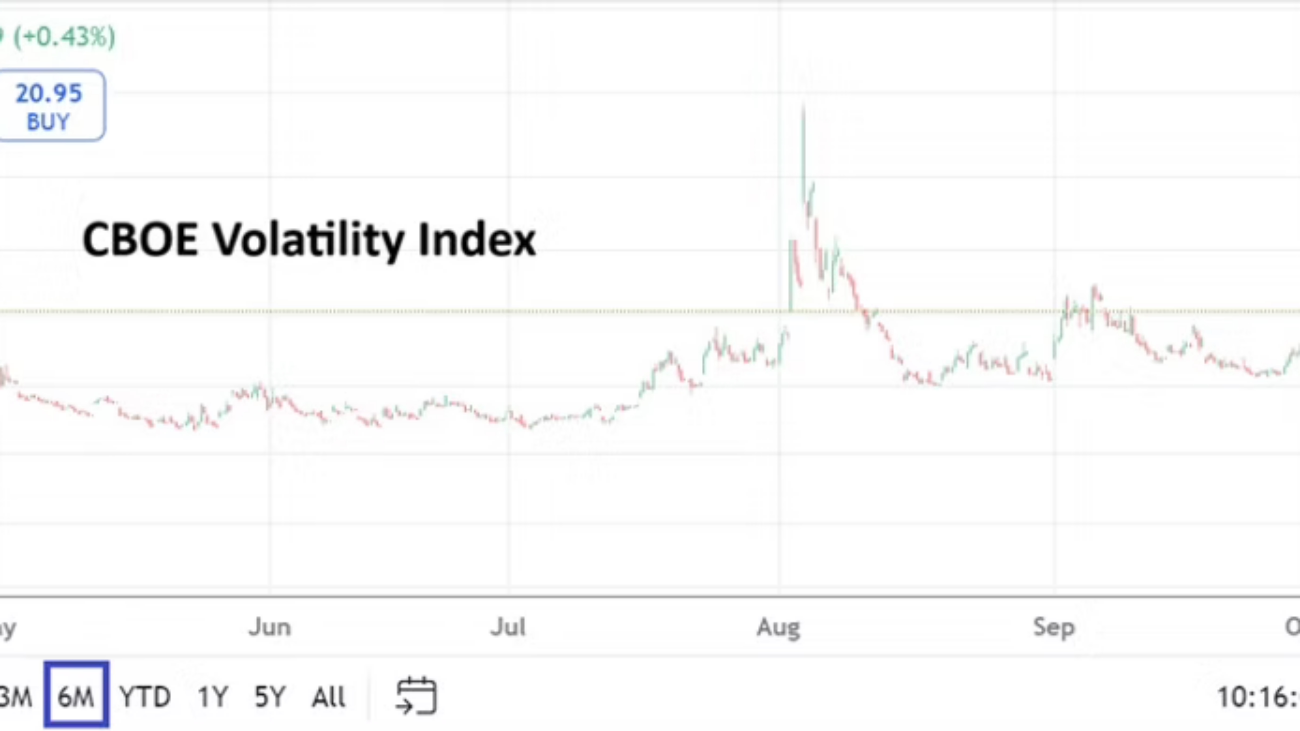
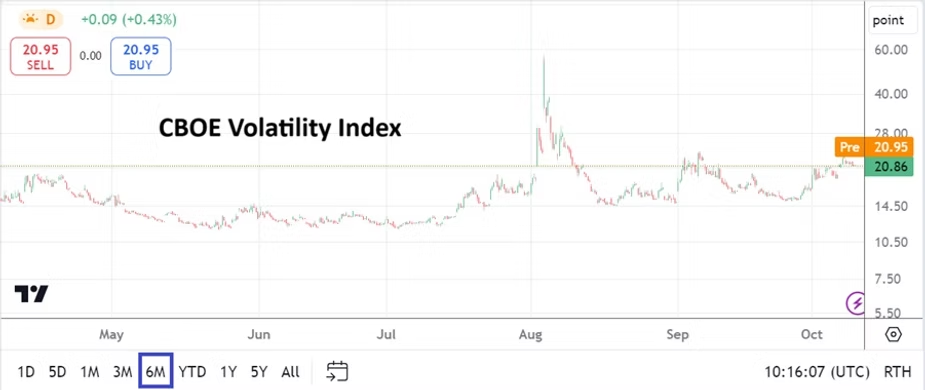
CBOE Volatility Index Six Month Chart on the 10th of October 2024

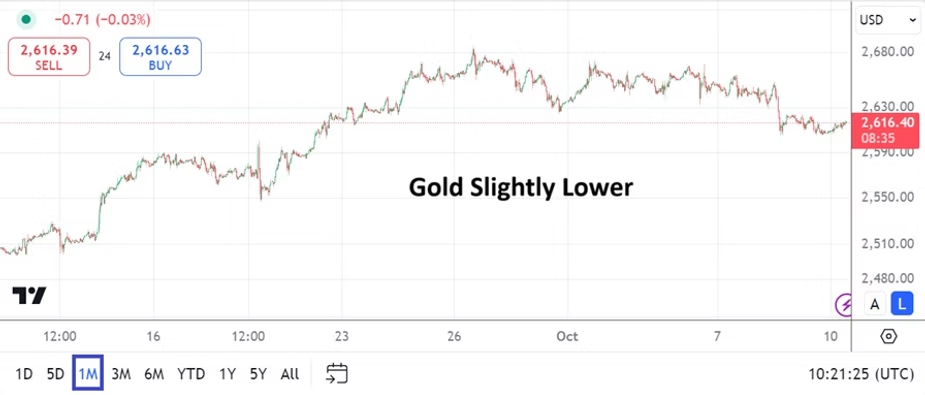
The Chicago Board Options Exchange’s Volatility Index (VIX) has risen since the last week of September, but remains within known realms. Gold while definitely within the higher levels of its long-term price range has ebbed lower during the same timeframes. And WTI Crude Oil while flirting with short-term highs today, actually remains within the known realms of its six month range. In other words while short-term day traders potentially get caught up in fearmongering rants and tremble, financial institutions continue to trade with an outlook that remains rather tame mid-term.

Gold One Month Chart on the 10th of October 2024

Financial institutions were dealt a perplexing blow last Friday when the U.S Non-Farm Employment Change hiring numbers came in stronger than anticipated. However, what is not getting enough attention is another revision downwards to the previous month’s totals did happen. Today’s Consumer Price Index statistics and tomorrow’s U.S Producer Price Index results are expected to show that inflation remains under control. If the coming data meets estimates or can show a slight decrease this could ease the fear of some financial institutions regarding what’s coming next from the Federal Reserve. If higher inflation numbers are displayed this would spark more volatility.

WTI Crude Oil Six Month Chart on the 10th of October 2024

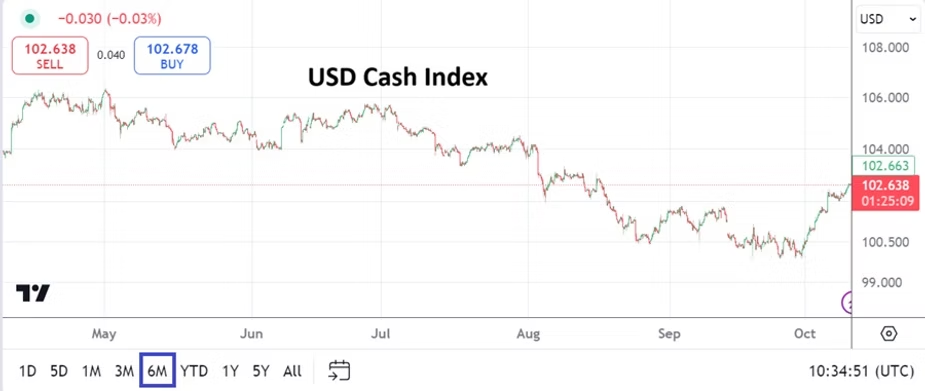
Certainly, USD selling got ahead of itself by the end of September. Day traders need to understand there are seldom one way avenues in Forex. Intraday reversals aside, when equilibrium and outlooks do not mesh via the insights of financial institutions, volatility occurs. The buying of the USD since September’s end has been noteworthy, but it was not entirely unexpected. The CPI and PPI reports from the U.S on the calendar will provide impetus. Let’s see if the markets remain calm as a swirl of other risk events linger in the air. Risk adverse tendencies have caused caution in the broad markets.

USD Cash Index Six Month Chart on the 10th of October 2024

Traders need to know there will be one more jobs report from the U.S on the 1st of November. There are some people around us that no doubt believe the U.S government is showing better than expected jobs numbers to try and ramp up support for certain political candidates. However, if analysts do their jobs well enough and point to the revisions downwards that have been consistently seen, this could help alleviate fear of conspiracies.

The Fed is still in a position to cut the Federal Funds Rate by another 0.25 on the 7th of November. Yes, the FOMC Statement is coming only two days after the U.S election, so the Fed’s decision which will be garnered during meetings on the 6th and 7th will carry some significance depending on who has been elected U.S President. While U.S economic data has been mixed via a combination of jobs numbers which had been faltering until last week, and consumers suddenly showing greater confidence and manufacturing sentiment in important sectors with improved optimism, interest rates are still high. The Federal Reserve has a dilemma and likely will want to try continuing to incrementally cut borrowing costs when they have the opportunity.

Day traders should not be too concerned with what will happen a few weeks away, particularly when they are interested in the results of trades consisting of a few minutes, half hour, and other limited durations. But they should always understand their positions in Forex, equity indices, commodities, and elsewhere have little to no effect on the real marketplace. Day traders need to be able to catch onto the technical trends and behavioral sentiment being created by larger players and financial institutions.

postR196

AMT Top Ten Miscellaneous Concerns for the 6th of October

AMT Top Ten Miscellaneous Concerns for the 6th of October

10. Ya Gotta Believe: The New York Mets are finding ways to score in the late innings. Having won with last minute runs against the Atlanta Braves in the 8th and 9th innings early last week to save their season, hitting a home run to take the lead against the Brewers in the deciding game of the Wild Card in the 9th, and last night’s 5 runs in the 8th to take the lead in Game One against the Phillies in the Division Series has been rather remarkable. Game two between the Mets and Philadelphia will be played later today.

9. Information Technology: OpenAI’s value is now estimated around 157 billion USD, this after their latest round of investments garnered that includes both Nvidia and Microsoft funding. The search engine arms race will continue to get tougher and more competitive, but recent data released by Statcounter shows that Google still has over 90% of the U.S search engine traffic. While it has lost some ground in the search engine battles to upstarts statistically, Google remains dominant. Microsoft has made inroads with Bing, and Yahoo has also gained, but Google’s stranglehold via browser usage remains strong.

8. Helene Meets Milton: A pair of hurricanes – this if Milton fulfills forecasts and becomes a major storm – are not helping create easy days in the U.S Southeast, nor for the Biden administration. Criticism regarding a lack of government help has been heard in the aftermath of Helene and with another potential punch about to be delivered by Milton, U.S relief agencies like FEMA will certainly be pushed to the limit organizationally.

7. Oil Alerts: WTI Crude Oil went into the weekend close to 75.00 USD per barrel as nervousness increased about the potential of an attack on Iranian oil infrastructure. While many nations in the West do not purchase Iranian Crude Oil openly, the Iranian commodity is sold to China at nearly an 89% ratio. This allows oil from other suppliers like Saudi Arabia, the U.S and Mexico to sell elsewhere and the price of Crude Oil to remain relatively tame. However, if the supply of Iranian Crude Oil were suddenly to be crippled for any length of time, the price of the commodity from the other major suppliers would certainly go higher if expanded demand needs to be met. Speculators should pay attention to strike prices in the energy sectors via options trading in the future markets to understand potential vulnerabilities that large players may be anticipating.

6. Precious Metal: Gold prices remain within sight of record values, but below the apex values seen on the 26th of September. Risk sentiment, speculative forces and long-term investors are seemingly creating resilient support levels. Gold went into this weekend near the 2,653.00 USD ratio. Silver remains near 32.00 USD per ounce, which is where its price was traversing in May. Speculators intent on betting that silver will rise because nervous market conditions will create more demand need to be careful. A vast supply of silver exists in known mines globally, and producers simply need to extract more of the commodity to garner profits which is relatively easy. In other words, gold and silver do not correlate as much as some people believe.

5. Forex Chaos: Day traders of USDJPY, NZDUSD, EURUSD and a slew of other major currency pairs were taken on a wild ride last week as USD centric strength surged and fragile conditions in global markets grew. The coming days will remain difficult for FX retail traders as they face a whirlwind of threats. Technical and fundamental traders are being hit by shifting winds generating via a myriad of worries. Speculators without deep pockets are advised to remain cautious in the coming days because trading dynamics are not likely to ease. Yes, there will be price velocity which allows for quick profits, but those who are willing to bet on the prospects of fantastic gains must also accept the dangerous proposition that wildly expensive losses if they are on the wrong side of a trade are equally possible. Brokers will certainly welcome their clients with open arms this coming week because the volatility may entice many with the potential of getting rich. However, brokers will not tell you about the poor house on the other side of the street.

4. Unscripted: There are a little more than four weeks before the 2024 U.S elections on the 5th of November. Trump appears to be gaining momentum in polls, but certainly remains vulnerable per his ability to speak without a script and create verbal firestorms. Kamala Harris ran into problems recently with a suspected malfunctioning teleprompter and her inability to escape repeating the words ’32 days’. While the two candidates battle for voter supremacy, questions persists about the current leadership from the White House and who exactly is running the show.

3. Noisy Data: The Federal Reserve and economic data remain concerns. This Thursday the Consumer Price Index data will be released. If the inflation statistics can come in below expectations this may soothe financial institutions who have leaned into the notion the Fed needs to remain aggressive in November. Another interest rate has been expected, but some are nervous the Fed may not be able to cut as fully as wished. However, day traders need to also understand politics are playing a role in the bombastic soundbites being generated by the media, this as they try to deliver messaging which reflect their viewpoints. If inflation numbers remain under control the mid-term outlook continues to point towards more interest rate cuts. While the U.S jobs numbers on Friday were better than expected it should be noted revisions downward were seen again. There is one more Non-Farm Employment Change report before the election, by then it will probably not have an impact on potential voters, but its affect on the Fed will certainly be felt.

2. End Game: As the Iranian and Israel conflict escalates and threatens to become a dark spiral, some are still hoping for an avenue which will allow normality to return. That appears to be wishful thinking for the moment. Reports, perhaps paranoid, regarding an earthquake in Iran yesterday with a magnitude 4.5 seismic rating which was 48 kilometers from Semnan was noted by the USGS. The reason why it is potentially scary notion is because some are questioning if this was a nuclear test being conducted by Iran.

1. Risk Adverse: A trifecta of nervous behavioral sentiment is shadowing the financial markets via Fed outlook, Middle East tensions, and the approaching U.S election. Unfortunately none of these components are likely to disappear soon and in fact may grow in stature as outlooks potentially create more anxiousness. Safe havens in the USD, gold and U.S Treasuries may find they deliver some calm for those that are nervous. However, it must be noted that U.S equity indices gained nicely late last week after gains on Friday. The Dow 30 and S&P 500 remain near apexes and the Nasdaq Composite is within sight of highs. In other words, for all the talk about dark days, financial markets and investors are still active.

postR196

AMT Top Ten Miscellaneous Items on the 21st September 2024

AMT Top Ten Miscellaneous Items on the 21st September 2024

10. Shohei Ohtani: The slugger hit another home run last night bringing his total to 52 for the season. There is more than a week of regular season action remaining. Incredibly, if Ohtani pitches next season while also hitting, his current statistics could be outshined. The Dodgers pitching staff is in tatters as the MLB playoffs approach, and it has been opined that Ohtani could pitch in the postseason. However, this option is highly unlikely. Ohtani is an outstanding athlete and has surpassed many expectations.

9. Beep, Beep: The purchasing of technology, including their production and logistics sources are likely coming into question in many diverse places around the globe. The detonation of pagers and walkie talkies used by the terrorist group Hezbollah which is largely based in Lebanon has certainly created panic about vulnerabilities. Contemplation in many nations regarding the buying of equipment that could be prone to spyware and other harmful acts is a reality.

8. Michael J. Saylor: MicroStrategy led by its Executive Chairman has added to their Bitcoin holdings. MicroStrategy is reported to have around 252,220 Bitcoins. The current value of BTC/USD is around 63,000 as of this writing. Part of Saylor’s love for Bitcoin rests in his belief that value is due to scarcity, and secure durability as a store of value technologically. However, each Bitcoin holds 100 million Satoshis, the units each Bitcoin is divided by digitally as source code. Even if conservatively there are only 15 million Bitcoin in circulation in ten years time, 15 million times 100 million is 1.5e + 15, meaning more than a quadrillion Satoshis in circulation. That is not scarcity, particularly when quantum computers could create lightning quick digital trading via coding sources. The premise and concern for a major devaluation in Bitcoin is legitimate. Do you disagree?

7: Equity: Intel has apparently been made a sales offer by Qualcomm. Intel’s market cap is 93.19 billion USD, and Qualcomm’s is 188.18 billion USD. The biggest shareholders of Intel are Vanguard, Blackrock and State Street, interestingly enough Qualcomm’s three biggest shareholders are identical. So if the largest shareholders are practically alike, it comes down to a management question, can Qualcomm run Intel better?

6. Closer: The U.S election will be in a little over six weeks times. The race for the White House according to many polls is very close and the outcome will depend on important swing States. There is still enough time for Harris and Trump to pick up votes, but also enough time for each to unwittingly make an error which can cost votes. Not only is the White House up for grabs, but the House and Senate are at stake too for the Democrats and Republicans.

5. Europe’s ability to put on blinders as the Ukraine and Russia battle in a not so distant land, and bickering between E.U nations while finding no solutions for the conflict have many historical comparisons within the continent. The ability to look the other way as chaos grows and inflicts harm on neighbors has a long tradition in Europe. Since the Middle Ages into the present Europe has a significant track record of negotiating harmony and procuring tenuous treaties, which eventually lead to additional discord.

4. USD/JPY: The currency pair closed at nearly 143.850 yesterday. Analysts are trying to create narratives regarding the climb higher the past handful of days, this after the USD/JPY touched the 139.600 level approximately last Monday. Here’s the thing: financial institutions that trade the Japanese Yen had positioned for a more dovish Federal Reserve and more hawkish BoJ. The Fed delivered their end of the bargain on Wednesday, confirming actions which had already been factored into the currency pair. The USD/JPY ‘correction’ higher is within equilibrium that financial institutions have to recalibrate as they make their new mid-term outlooks and decide how to shift their cash forward positions incrementally. The move higher has not been massive and is a natural reaction as large players rearrange their commercial paper. Incremental is the key word.

3. Energy Calm: WTI Crude Oil and Brent Oil continue to trade slightly above their lower price realms, which saw long-term values in the second week of September tested. Current ratios are still flirting with technical considerations seen in the late spring of 2023. While hyperbole is communicated far and wide regarding potential Black Swan events in the Middle East which could cause Crude Oil to increase rapidly, the energy resources remain rather tranquil and seemingly transfixed on concerns about mid-term demand globally due to recessionary pressures.

2. All-Time Highs: Gold created new record values going into this weekend near 2,622.00. In September of 2022, gold was trading near 1,600.00 USD per ounce. The move higher in the precious metal has come on the heels of global inflation. Some also correctly point to a distrust of global central banks and fiscal concerns regarding the world’s largest economies. The bullish run upwards in gold has been significant and the commodity will remain an important store of value for investors. Speculatively, some short and mid-term traders are wondering about gold’s ability to maintain a trajectory skywards and if sideways price action and possible downturns will ensue for a while. Long-term investors remain serene.

1. Applause: The Federal Reserve issued an aggressive interest rate cut of 0.50%. The Fed seemingly is acting as if they are trying to please financial institutions because of past incompetence. The U.S central bank now needs economic data to behave according to their prescribed outlooks. What could go wrong? Another Federal Funds Rate cut is likely in November, after that a lot will depend on behavioral sentiment and data which may be affected by as of yet unknown leadership from the White House starting in early 2025. Fed Chairman Jerome Powell sounded almost too optimistic about the U.S economy during his Press Conference this past Wednesday. The U.S Final GDP numbers coming this Thursday will prove interesting, the growth numbers carry an expected gain of 2.9%.

postR196

AMT Top Ten Miscellaneous ‘Just the Facts Jack’ on the 14th of Sept.

AMT Top Ten Miscellaneous 'Just the Facts Jack' on the 14th of Sept.

10. Word of the Day: Quaestuary, the usage of the word comes from William Manchester’s book A World lit only by Fire. The word is now considered obsolete. Manchester used the Latin word, quaestiarii, to describe profit making by the Roman Catholic Church during the Middle Ages and into the Renaissance. Church ‘officials’ would use their positions of power to raise money dubiously. Promising absolution to the naive via treacherous claims which included the charging of payments for potential sins committed in the future, and a more lenient purgatory for already deceased members of a family who were waiting to be allowed into heaven because of past transgressions.

9. Undecided: With less than two months before the U.S election for President, swing States are crucial battlegrounds for candidates Trump and Harris. Turning purple into red or blue is the prime task for the Republicans and Democrats. Economy, immigration, foreign policy, reproductive rights are among the talking points. Which side can receive the most votes via promises that will be hard to accomplish?

8. Artificial Intelligence: Early this week Oracle Corporation released revenue results and projections showing that profits are increasing due to demand for data centers as the use of AI expands. Cloud services provided by Oracle has become the corporation’s largest source of growth. Investments in big data centers are getting competitive. Data4 has recently announced they are going to invest approximately 300 million EUR into a data center facility in Paiana, Greece. Data4 led by Olivier Micheli, CEO, has announced that it plans on investing around 7 billion EUR into 2030 for expansion.

7. Crude Oil: WTI Crude Oil briefly went above the 70.00 USD mark on Friday, but went into the weekend near 69.33. U.S economic data this coming week (besides the U.S Fed on the 18th) will be limited to manufacturing readings and retail sales data. The notions that the U.S economy is struggling via weaker employment numbers and lackluster GDP, European data remaining murky, while China is not exactly robust is likely causing speculative demand in Crude Oil to remain low. Global energy supply is solid and the Middle East conflict remains somewhat muted.

6. Whipsaw Gains: Major U.S equity indices moved upwards as the Dow 30, S&P 500 and Nasdaq 100 all produced better weekly results. However, improved momentum mostly occurred as equities reversed from nervous lows on Wednesday. The Dow 30 and S&P 500 are within sight of apex values, while the Nasdaq isn’t far behind. U.S Treasury yields also dropped lower via their totals for the week with the 5, 7, and 10 Year Notes approaching yields last seen in the spring of 2023. The 30 Year Bonds are traversing lower too, but will have to penetrate early 2024 levels to then challenge depths from early 2023.

5. Inflation: Global central banks are having a large internal debate about their target inflation numbers. Trying to agree on what the neutral rate – mean average – over the next year should be is causing central banks to remain cautious about inflation projections. While it is clearly evident that Europe and the U.S are facing economic headwinds the ECB, Fed and BoE seemingly refuse to step on the gas pedal and become aggressively dovish. However, financial institutions who frequently use their mid-term outlooks as guidance continue to lean into their trading positions and seemingly wager on the central banks having to become more dovish. How much can each central bank cut by over the next 6 months? Why not cut by 0.50% to inject easier borrowing rates now? Because apparently it seems all the central banks remain nervous about inflation remaining stubborn. The word stagflation still comes to mind. The decline in Crude Oil prices seen the past few weeks may be a hopeful sign for lower costs.

4. USD/JPY: The currency pair finished trading near the 140.775 ratio on Friday. Trading in the USD/JPY appears to be driven by the notion that financial institutions believe the U.S Federal Reserve is going to have to cut the Federal Funds Rate by 0.75% over the next six months. Behavioral sentiment has a breathtaking history of producing strong trends in the USD/JPY. The Bank of Japan will announce their Monetary Policy Statement on the 20th of September. The USD/JPY was trading near 162.000 in July and its decline lower seems to have surprised some, but why? The BoJ is likely going to sound cautious this coming week, but sitting on their hands and allowing their global counterparts to become more dovish may be enough to keep the USD/JPY within its lower price realm.

3. China Data: Numbers published early this morning showed that New Home Prices continue to fall, Industrial Production has decreased, Retail Sales have dropped, and the Unemployment Rate has risen. China’s economy is suffering. The USD/CYN looks too low at the current rate of 7.0925. The Shanghai Composite (SSE) has fallen to nearly 2,704 and touching lows from early February of 2024. The SSE is down roughly -13.46% over the last year. The Chinese government’s desire to manage the economy with a tight grip continues to produce fractures and should be reconsidered.

2. Gold: The precious metal finished Friday’s trading near 2,577.00. Yesterday’s values hit all-time record prices for Gold versus the USD. The 2,586.00 vicinity was touched before reversing slightly lower. The ability to remain near apex highs going into the weekend highlights large traders likely still have a taste for gold and that long-term investors remain bullish. Is nervousness due to perceived global central bank ineptitude helping to create more gold buying? Short-term speculators need to remain careful within these heights.

1. FOMC Prediction: The European Central Bank’s decision to cut by only 0.25% this past Thursday is almost a sure sign the Federal Reserve will mirror the ECB on the 18th of September. Last week’s prediction by AMT that the ECB would only cut by 0.25% proved to be true, and our outlook for the FOMC’s Federal Fund Rate decision is also a cautious 0.25% cut. While the U.S Consumer Price Index and PPI info published this past Wednesday and Thursday showed inflation is under control, the data also shows a stubborn streak. However, an erosion of inflation is taking place and while the target ‘neutral’ rate is likely being debated behind closed doors, it is also apparent to most outside observers that the Fed is being too cautious and will be ‘forced’ to cut this coming week, November 2024, and early in 2025.

Content

postR179

AMT Top Ten Miscellaneous Rays of Light for 23rd of August

AMT Top Ten Miscellaneous Rays of Light for 23rd of August

10. Word of the Day: Like crepuscular animals which are active during twilight, large market players are ruminating as their summer hiatus draws to an end over the next week and a half. Plans for coming hunts are being formulated as leisure concludes for financial institutions preparing to work in the shadows.

9. Scrolling Failures: Lack of solid results on search engines are becoming a growing annoyance. Is it just us? An abundance of poor information via defined searches on the internet and finding what is sought is becoming increasingly problematic. Is AI being allowed to do too much while still too dumb? AI doesn’t know when it is wrong. Competitors to Google and others are sought.

8. How Dare Us: The postponement of imposed dates regarding energy policy changes are multiplying. The end for the classical use of oil, coal and nuclear is not near. Efficient power is evolving, but this will have to include ‘antique’ generation and grids. The demand for electric vehicles are being confronted with declining sales via U.S consumers. Tangible technology needs precise planning, not apocalyptic rhetoric which tries to scare people.

7. Middle East Calm: The storm is being limited within a tea cup for the moment. The potential for a dangerous boiling painful mess still exists. ‘Serenity now’ remains a mantra for those who need to pay attention as chagrin and anxiousness mix.

6. Fed Retreat: The FOMC Meeting Minutes released this week showed some Fed members remained cautious, while others banged the drum louder regarding interest rate cuts. However, a Fed Funds Rate reduction is almost a 100% certainty for the 18th of September. The question now is what the Fed will do in November. Fed Chairman Powell and a slew of other renowned global central bankers will speak today and tomorrow at the Jackson Hole Symposium. Financial institutions largely believe they know what is going to be said, but comments from Bank of Japan and Brazilian leadership could prove to be informative and entertaining for central bank nerds. Monday could be volatile for USD/BRL traders.

5. VIX: The CBOE’s Volatility Index climbed to the 56 vicinity on the 5th of August as panic grew via widespread overreactions to hyperbole ripping through the markets. The fear gauge is near the 17.55 ratio as of this writing. Market calm has resumed across the board as financial institutions and day traders have been able to achieve a pleasant tone again. Traders who use the VIX as a template regarding the potential of risks suddenly cascading into assets should keep their eyes on the index, which went to a low around the 14.45 mark on Monday. Yet, the slight incremental climb the past few days could be coming from folks still speculating on volatility which may not develop near-term.

4. Barometers: Gold is lingering slightly below 2,500.00 for the moment, this after having achieved a record high on Tuesday when it touched the 2532.00 apex. WTI Crude Oil is near 74.00 USD per barrel and is maintaining a polite value range. Speculatively, Cocoa is again above 9,000 USD per ton and Bitcoin has fought its way above 61,000 this morning. Risk appetite remains stable for the moment.

3. Forex: USD/JPY, EUR/USD, even the USD/ZAR have been able to hold onto their recent trends as USD centric weakness remains viable. Traders who were looking for huge moves in FX this week have likely been disappointed. Retail speculators need to understand financial institutions have been positioning for a weaker USD since the tail end of July. Market players may be quite pleased regarding current Forex equilibrium, which may allow technical traders the ability to take advantage of existing behavioral sentiment, this as reversals flourish and the next big wave of impetus is awaited. Next Thursday’s U.S Preliminary GDP numbers may deliver some noise.

2. Cassandras: Market experts who proclaimed a long-term stock market crash in early August have crawled back into their caves to take cover and percolate their next fear mongering tactics. This after the latest round of predicted catastrophes have vanished. While the major U.S stock indices are not at record highs, they have recovered plenty of lost ground and appear ready for more days in the sun.

1. Political Winds: The curtain closed on the Democratic National Convention in Chicago last night without a serious hiccup. Kamala Harris and Donald Trump now enter a crucial phase of campaigning, and will get plenty of attention as they go into attack mode. The next big event for Harris and Trump will be their televised debate on the 10th of September. Will the outcome prove to be a devastating storm for one of the candidates?

postN87

AMT Top Ten Miscellaneous Notions for 12th of January 2024

AMT Top Ten Miscellaneous Notions for 12th of January 2024

10. Music: School Days by Stanley Clarke. Recorded in 1976, the ‘song’ is one of the best jazz fusion pieces ever played.

9. Coaches: Bill Belichick and Pete Carroll have been ‘politely’ fired, Nick Saban has retired. NFL and college football remain the ‘Kings of Sport’ in the United States.

8: Taiwan: Presidential election will be held tomorrow. Expect noise from China this weekend regarding Taiwan’s sovereignty.

7. Forex: Volatility struck yesterday in USD based currency pairs, whipsawing as financial institutions reacted to the Consumer Price Index reports. More inflation data will come from the U.S today.

6. Gold and Crude Oil: Precious metal value has been ‘almost’ steady, and WTI Crude Oil price remains rather calm.

5. China Deflation: CPI and PPI numbers were lackluster this morning. Export numbers from the nation have also delivered troubling declines.

4. Houthis: U.S and U.K missile strikes in Yemen have been conducted, diatribes from the extremists have been sounded, and may cause some investors concerns and potential risk adverse trading considerations going into weekend.

3. Bitcoin: SEC ETF funds approval has been completed, and launch is set to allow retail traders and ‘investors’ to purchase the digital asset. BTC/USD is near 45,960.00 currently. CFD products from brokers will likely be introduced and flourish soon, which will be based on the ETF notional values and allow day traders to wager on upside and downward momentum.

2. PPI Data: U.S Producer Price Index inflation results today could rattle the broad markets. No changes are forecasted. A surprise increase would worry those betting against the USD. Traders should also keep their eyes open for potential revisions to previous months.

1. Risk Appetite: Dow Jones 30, S&P 500 and Nasdaq 100 continue to flirt with apex values. The Nikkei 225, from Japan, is challenging highs not seen since 1990 as it trades above 35,575.00 for the moment. Equity indices remain optimistic.

postN93

Leverage and the Holidays Often Leads to Costly Volatility

Leverage and the Holidays Often Leads to Costly Volatility

This may seem like an unfriendly reminder for this time of year, but holiday trading can lead to dangerous storms for traders. Keeping a realistic viewpoint regarding your ambitions during Christmas and New Year’s is important.

Most day traders cannot afford to have an outlook that is beyond the short and near-term. This is an ugly fact many speculators with less than deep pockets have to acknowledge if they are new to speculating. While large traders and financial institutions can maintain mid and long-term outlooks, day traders who do not have the funds to keep overnight positions need to operate in an entirely different fashion.

Trends via technical charts and fundamentals are crucial for all traders. Behavioral sentiment is a key ingredient too for all participants chasing assets. However, day traders also need to understand unique risk management limitations. The use of leverage is a vital dynamic, and can cause devastation fast when too much money has been wagered. The use of leverage by day traders effectively raises the probability that a trade will lose money.

Incremental changes in value to a Forex pair, commodity and equity share being traded on a brokers platform by a speculator using ‘borrowed’ money via an account that allows for margin often leads to quick outcomes that fail. Many brokers offer traders ‘polite’ leverage ranging from 10% to 100% in extra funds, this while enticing the speculator to the potential of profiting in a quicker and more robust manner. It should also be noted that when a broker is offering vast amounts of leverage, they are knowingly increasing a traders likelihood of losing. The use of leverage beyond 10% leads to plenty of expensive mistakes.

Unfortunately, the simple truth is if you can make fast money trading, you can lose fast money while trading. The use of the word speculating is simply a gentle way of not using the word ‘gambling’.

Traders tempted to pursue wagers during the next couple of weeks should remember a lack of normal volumes make many asset classes more volatile, meaning the use of leverage by speculators often leads to dangerous gyrations within their accounts.

Risk appetite has taken on a optimistic tone globally because of the upside U.S equity markets have been producing, while U.S Treasury yields are decreasing, but dangers still lurk. Day traders need to remain realistic regarding their pursuit of quick hitting trades during the holiday season, and make sure they use solid tactics while pursuing their outlooks. The trend may appear to be your friend, but short-term reversals in the wrong direction can cost money.

No one wishes for bad things, but speculators should also note that if risk adverse events occur during the holidays, that ‘negative news’ can often become amplified this time of year and cause more volatility. Speculative positions in Forex, Crude Oil and gold can produce rather wild results, and thin trading volumes can add to the swift changes in values.

postN51

AMT Top Ten Miscellaneous Shivers for Friday the 13th of Oct

AMT Top Ten Miscellaneous Shivers for Friday the 13th of Oct

10. Roseanne Roseannadanna: It just goes to show ya. It’s always something. If it’s not one thing, it’s another.

9: Book: Longitude: The True Story of a Lone Genius Who Solved the Greatest Scientific Problem of His Time by Dava Sobel.

8. World Cup Rugby: Ireland vs. New Zealand in a quarterfinal match on Saturday.

7. Crypto: Binance Coin slump continues as it edges towards 200.00 USD value.

6. Crude Oil: Price near 84.00 USD per barrel in a mixed week of trading.

5. Gold: Will stable price hold after increase via inflation data and stronger USD?

4. Indices: U.S stock markets declined yesterday, but not significantly in wake of inflation news.

3. USD: Burst of buying for USD took GBP, EUR and JPY and others back to lows.

2. CPI: Consumer Price Index rise yesterday was slight, but reinforced Fed policy.

1. U.S Treasuries: Bond yields a key barometer today and will affect broad markets.