postN75

U.S National Security, Part 3: Don’t Underemphasize Freedom

U.S National Security, Part 3: Don't Underemphasize Freedom

Opinion: The following article is commentary and its views are solely those of the author. This article was first published the 30th of December via The Angry Demagogue.


Conclusion

The post-Cold War world that the Strategy Paper tries to figure out is much more than the collapse of the Soviet Union and the rise of China. One of the main goals of the Trump administration is to turn the clock back on “globalization”, be it via tariffs, other economic ways or even, military means.

While the world is panicking over AI’s destruction of good white collar jobs, it has, paradoxically, created a world where the auto industry can’t find enough qualified mechanics at nice six figure salaries. Not even ten years ago the journalists were haranguing out of work blue collar workers with “go learn to code”, the beer guzzling crew can now tell the tearful journalists and Hollywood “writers” who can’t write better than AI to “go learn how to weld” (or at least handle a screwdriver). But the strategic issues we are facing go beyond manufacturing jobs.

The challenge to the United States and to other free countries is how to handle a new reality where massive debt threatens the diminution, if not the destruction, of the life style we have all come to take for granted and where revanchist regimes don’t quite understand that their power and “prestige” is a result of what has been built in those free countries they want to replace. China, like Russia, Iran, Turkey, Qatar and the non-state actors like Hamas, Hezbollah, the Moslem Brotherhood and others don’t quite understand that while they can use, and even sometimes improve on what freedom has provided them, they will stagnate once they attain their goal of defeating and destroying the free world.

As advanced as China becomes and even if it flies to the moon, overtakes the United States in AI and quantum computing and manages to make the United States into only the breadbasket of the world, they will stagnate as only free markets and free people can move the world to the next step. Growth can only be accomplished by free people. True enough, the economy often grows in ways that we don’t always like, the alternative is stagnation and a return to the pre-scientific age. For all the talk of “new man” and “progress” and everything else that the Soviet Union strived to create, they produced no medicines, no medical devices and no medical treatments.

Therefore, the defeat of the revanchist world and the preservation of freedom needs to be the paramount goal of American foreign policy. This does not mean the creation of democracies where none have ever existed and it does not mean sending troops in every time a political prisoner is arrested or even a plan to militarily defeat the CCP, but it does mean always supporting free countries against the unfree even when the United States is also “friends” with the unfree one.

This means that it will also give free countries leeway when their interests do not align perfectly with America’s (non-core) interests. America as sole protector of the free world has leverage that America as midwife to a set of regional alliances does not. This is a choice that America can make and a correct reading of the Strategy Paper tells us that the United States no longer wants to or can be the main power in every region in the world. This means that there needs to be a change in attitude in America so that it cannot force its will on its allies just because there is another contract to be had or another “cause” that has caught the eye of the country’s establishment.

Encouraging regional alliances of free countries such as the new Eastern-Med Alliance that has already been established between Greece, Cyprus and Israel is a prime example. In addition to the economic cooperation there has been joint defense training and there are agreements that will lead to a defense cooperation pact if not a NATO-like security treaty. Turkey is the common competitor, or enemy, of these three countries. Turkey claims certain Greek islands, occupies parts of Cyprus and has designs on Israel as it strives to be the Islamic “liberator” of Jerusalem. There are gas exploration agreements and cooperation and there would have been a pipeline to Europe if the Biden administration had not stopped it (while they approved the Russian-German pipeline).

Italy ought to be a natural member of the East-Med Alliance and maybe the dissolution of NATO will make them realize that they have more in common with Israel and Greece than they think they do. If Italy were to join then that would create a powerful naval and air deterrence of free countries against aggressors in the eastern Mediterranean. The addition of Malta, a small but strategically important country south of Sicily would provide naval bases that could control the sea lanes between north Africa and Europe helping to stem illegal migration and Turkish attempts to control those same lanes. Malta also brings with it a history of defeating Suleiman the Magnificent in a four month siege when the Ottomans tried to conquer this important island. As we stated before, the United States as a “midwife” to alliances cannot instruct countries on their own national interests. That means that allies of the United States will clash but America must always come down on the side of the free countries and not the revanchist power – in this case, Turkey.

There are of course other regional alliances that can come into being and a remake of the post-WWII world is in order. The end of the cold war created economic booms across the globe raising hundreds of millions of people out of poverty, but recent decades have seen an increase in terror and tyranny and that itself needs to be dealt with. If not by the United States alone then by the US along with the regional alliances that the Strategy Paper has highlighted and we have demarcated (partially) here. But concepts like “territorial integrity” (see Syria, Somalia and the rest of Africa) and “sovereignty” have lost their moral imperative as they are used as excuses by tyrants (and their enablers at the UN) to further their cruelty. One of the faults of the old “liberal international order” has been allowing tyrannies the same rights and respect as free countries. During the Cold War, when nuclear war loomed, this might have made sense but after the fall of the Soviet Union these “principles” have created more harm than good.

In the National Security Strategy of the administration, the words “free” and “freedom” appear twenty times, but never in the context of an alliance of free countries. While it speaks of freedom of religion and speech and free markets it never speaks of the need to put allies that are free ahead of friends that are not free. Allies are those countries that share values and will come to your aid because of that. Friends, in international affairs, are those that look to short-term gain and have no desire to further your values or interests. There is no reason that the United States, in its current fiscal condition needs to fight the fight of freedom around the world alone, but neither can it abandon that fight in the pursuit of short-term contracts or frivolous causes.

Disclaimer: the views expressed in this opinion article are solely those of the author, and not necessarily the opinions reflected by angrymetatraders.com or its associated parties.


You can follow Ira Slomowitz via The Angry Demagogue on Substack https://iraslomowitz.substack.com/ 

postN73

U.S National Security, Part 2: Regional Alliances – Europe

U.S National Security, Part 2: Regional Alliances - Europe

Opinion: The following article is commentary and its views are solely those of the author. This article was first published the 25th of December via The Angry Demagogue.

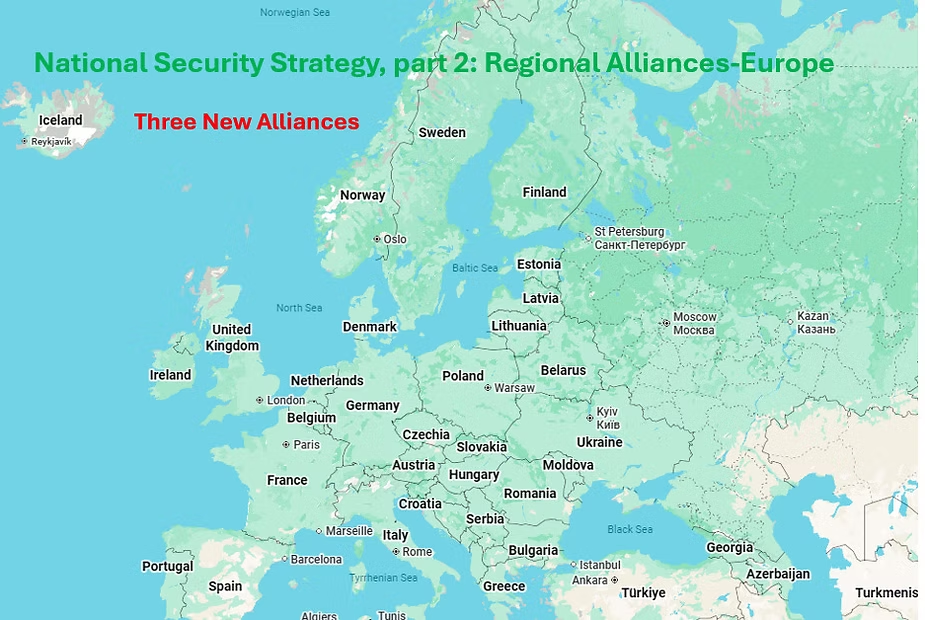
As we continue our tour of the administration’s National Security Strategy we will stay with “part III: What Are America’s Available Means to Get What We Want?” and move to the sixth bullet point: “A broad network of alliances, with treaty allies and partners in the world’s most strategically important regions” and work through the important regions that the strategy documents – Asia, Europe, the Mideast and Africa. For good or for bad we will need to split these regions up since the key point is forming coalitions that can handle their actual region. Sweden can’t be part of a coalition to protect Italy’s interests in the Mediterranean and Japan won’t be protecting Singapore.

Some U.S allied countries, like Australia, Israel and India will be involved in multiple regions helping lead alliances in all areas important to them. With that in mind we will point out the first mistake of the discussion on regions and that is Europe. We will suggest something here that would not usually come from the mouth of a hawk and pessimist and that is that NATO has no real mission and needs to be replaced by a series of alliances that make more sense. While the fear during the Cold War was a Warsaw Pact ground invasion into Germany and beyond which would have required the totality of American and European forces, Europe now is facing a Russia that could not conquer Ukraine in nearly four years of war. That is not to say that Russia is not to be feared only that each part of Europe needs to ally to face a Russian onslaught in its own theatre.

Italy is not going to send troops to Sweden to prevent an attack and Norway won’t be helping Greece in any fight. Turkey is a country that other NATO countries fear more than trust, especially regarding Russia.

In short, NATO needs to be broken up into different alliances where each country will be allied with countries whose fall would affect its national security. The United States can either be a signatory to these alliances or it can decide how involved it wants to get in any conflagration depending on its own interests at that time. It can decide to position ground troops in the countries, supply air cover or, as in the 12-day war between Israel and Iran, help with missile defense and in providing the final blow with weapons only America has. Or – it can decide that it will never participate. One hopes that that won’t happen, but each alliance will need to be ready to fight on its own.

We can include France and the U.K as large countries with advanced armed forces as allies to all of these alliances. France certainly can contribute air power to each of the alliances that are faced against Russia. As for the U.K, it is difficult to know where that country is going but its navy and air force are still powerful.

Today we will deal with north, central and western Europe.

The Baltic Alliance

This would be an alliance that includes Poland, Germany, Sweden, Finland, Norway, Denmark, Latvia, Lithuania and Estonia and would provide cover for land, air and naval battles. Each of these countries, with the exception of Germany, has a border with Russia and all are on the Baltic Sea – a key waterway for them and for Russia.

An alliance of these countries would force them to concentrate on those areas necessary for their defense. An incursion, for example into Finland would force Poland to mass forces on its border with Russia and Belarus (Poland borders Russia in Kaliningrad which is separated from Russia proper by Lithuania) and Germany to move forces to Poland. All countries could also contribute ground forces to Finland as well as naval and air power.

The only thing missing is the lack of a nuclear umbrella. That is no small issue but can be dealt with by support or threats from France or the U.K.

The Atlantic Alliance

Aside from helping the Baltic Alliance, France and the U.K will have major responsibility along with the Netherlands for patrolling the North Atlantic and, with help from Portugal, and Spain the South Atlantic. As the Atlantic Ocean can be considered one of America’s seas, this alliance will need to have the close cooperation if not outright membership of the United States. Canada too, will need to be part of this alliance. We can include the increasingly important Arctic Ocean into this alliance’s responsibilities.

As we move towards the south Atlantic countries such as Morocco, can be included as well as other western African allies of the west. An alliance like that could encourage western African countries to abandon close security and economic ties with China and Russia. The “border” of this alliance would be that squiggly line in the middle of the Atlantic that separates the Eastern and Western hemispheres.

The Central European Alliance

We can look at the smaller central European countries that formed the heart of what was the Hapsburg Empire but are not front line countries bordering Russia – Romania, Hungary, Slovakia, Czech Republic, Austria, Serbia and Bulgaria – and we have an alliance that, backed by Germany, Poland and the United States, would create a further deterrence to Russian encroachment into Europe proper.

Where, do you ask does Ukraine fall in this European alliance structure? That answer will have to come from the major European powers in concert with the United States. Adding Ukraine to the Baltic alliance might be viewed as another attempt to NATO-ize them by the Russians. However, attaching them to the less threatening Central European Alliance of smaller countries might be the excuse and “victory” that Putin would need to end the war. But we are getting ahead of ourselves here. Ukraine is a problem that can only be solved if the West decides to actively join the fight against Russia (unlikely) or when Putin and Russia get tired of the fight and look for a way out that could allow them to claim victory (more likely than the former, but sadly, a long way off).

The Administration’s concentration on regions and how certain countries can become leaders in support of western and American interests is correct – but the breakdown of the regions has to go beyond the post WWII world. The place of America in the post-cold war world, with a China that wants to challenge America’s economic and military interests and leadership needs to break down old alliances into more manageable and logical pieces.

The wild card in all of this is, of course, the will of the European powers to take their own defense seriously. The Baltic Alliance we spoke about seems to be filled with countries that understand the threat from Russia, but do they recognize the threat to them from the alignment, the Axis if you will, of Russia, Iran, North Korea and China? And of more importance have they yet come to understand the threat to their countries, as they know them, from open immigration and from their own abhorrence of families? The former is something only the governments can handle, the latter though, must come from the people themselves.

A whole generation (or two in many instances) of Europeans have grown up not only as “only children” but in families that have no aunts and no uncles, no cousins and only very elderly grandparents, if that. They have grown up in other words without families. Will the young generation see the importance of families to themselves and their countries or will they continue the nihilistic lives that they parents have “sanctified”? Religious institutions, too will have a major role in this challenge. No amount of “parental leave” and childcare subsidies will convince the young to marry and have children – will only come from a change in the culture. Is Europe up to it?

Disclaimer: the views expressed in this opinion article are solely those of the author, and not necessarily the opinions reflected by angrymetatraders.com or its associated parties.
You can follow Ira Slomowitz via The Angry Demagogue on Substack https://iraslomowitz.substack.com/ 

postN72

U.S National Security: USD Reserve Currency Importance

U.S National Security: USD Reserve Currency Importance

Opinion: The following article is commentary and its views are solely those of the author. This article was first published the 23rd of December via The Angry Demagogue.

We would like to start going through the U.S administration’s National Security Strategy released last month. There is a lot in there – much of it the same as in past administrations and much of it different. The tone of course is full Trump and while the introductory parts try to make it into a revolutionary document it does in fact build upon much of what has been American foreign policy for decades. One thing it most certainly gets right is that American foreign policy since the end of the Cold War has not found its compass. From a unitary world to one dependent upon global organizations, from a sharing of goals with western Europe to a pivot to Asia, from the war on terror and the middle east to Russia-Ukraine, the United States has struggled to find its way in the post-Cold War world.

We however will concentrate today on one aspect of the strategy, the third bullet in part III – “What Are America’s Available Means to Get What We Want?”. The third bullet point speaks of America having “The world’s leading financial system and capital markets, including the Dollar’s global reserve currency status” – a point that no one with any knowledge of global capital markets can not accept. The end of the bullet point – the Dollar’s global reserve currency status – is the most important because it underscores America’s leadership and essentially allows the United States of America to finance its military and its welfare state. The U.S Dollar as the “reserve currency” means that nearly all the world’s goods are quoted and therefore sold in Dollars.

Why is that important to the United States? Because the U.S government depends on its ability to issue Treasury bonds and bills at will – something no other government can do. It can do this because for another country to buy oil or copper or titanium or corn or soybeans from a country that is not their own– they need access to Dollars. Saudi Arabia and the other gulf states quote the price of oil in U.S Dollars and demand payment in U.S Dollars. The Saudis can deposit those Dollars in American banks or in what is called Eurodollar deposits in foreign banks (there are some 13 trillion Dollars in Eurodollar accounts globally). The Eurodollar accounts are essentially promises by the bank to give U.S Dollars to the holder when he makes a withdrawal. This strengthens the U.S capital markets and allows investors to have better and more investment choices. It is not only America’s often superior companies that bring profits to 401k’s and pension funds but the liquidity and vastness of America’s capital markets that can list domestic and foreign corporations. The reserve currency leading to the advanced capital markets allows the world – and America – to do this.

The U.S Treasury market is so liquid because every country needs Dollars in order to trade. They need to have enough dollar reserves since no one actually wants their own currency. In Israel, for example, local gas companies cannot buy oil with Israeli Shekels, since what will Azerbaijan, for example, do with them? There are only so many products that Israel can sell them. They need Dollars so that they are free to buy other commodities or other products.

The U.S Dollar as a reserve currency also is a break on inflation since the price of oil and other commodities is always in U.S Dollars. A weak or strong U.S Dollar influences the inflation rate in non-USD countries. A weak Israeli Shekel, South African Rand or Chinese Yuan does not influence the price of gasoline in the United States.

In short – as the Trump Administration understands well, the dollar as a reserve currency is a luxury the U.S cannot give up. The lack of the USD as a reserve currency could cause the Dollar to collapse and along with it the price of U.S Treasuries. As UST prices drop, their yields will rise and the cost of financing the U.S government will make interest payments on debt to rise well beyond its already absurd figure of over 4% of GDP – while debt itself is 120% of GDP. The U.S government currently pays over $1 trillion in debt service (interest payments on its bonds and bills). By contrast, the U.S defense budget for 2024 was $836 billion (about 3.3% of GDP).

We need to ask ourselves what can challenge the USD as the reserve currency and what could happen that would encourage the world to change? While the E.U had dreams of making the Euro an alternative reserve currency, the lack of growth in the E.U’s economy and population have put that dream to rest. The only other country that could theoretically replace the United States as the global economic go to country could be China. While in the long run, China’s lack of openness would probably mean that the Yuan would not last long as the reserve currency, that does not mean that they couldn’t jolt the global economy just enough to force it to use the Yuan to buy oil and other commodities.

China is already cornering the market on rare earth minerals and it making inroads in Africa where it mines all sorts of commodities from gold to copper to platinum and so many others (Africa has about 30% of global mineral reserves). That in itself is not enough to rock the global markets and cause a change in how the world does business.

Oil though, is that one thing that could allow China to challenge the USD as the reserve currency, even if it just presents the Yuan as an alternative.

How could that happen?

A Chinese takeover of Taiwan, by whatever means it uses would give the Chinese Communist Party control not only of the South China Sea but also allow its noisier and inferior (to America’s) submarine fleet to enter the Pacific and patrol it freely. The Chinese Navy, with a base on the “other” side of Taiwan would give it control of the north-south sea lanes that Japan and South Korea are dependent upon. Essentially, Chinese control of Taiwan would put Japan, South Korea, Vietnam and the Philippines at the mercy of the Chinese Navy. China could blockade these countries but that would be an act of war and then involve the navies of those countries and possibly the United States. It would affect the global economy negatively but it would not cause a change in world’s reserve currency. But, what if China works out a deal with Saudi Arabia to quote and sell their oil in Yuan (or the Chinese Petro-Yuan it wants to create) and then tells these countries, especially industrial powerhouses and energy poor Japan and South Korea that it will allow the passage of oil as long as they purchase the oil in Yuan?

Russia is already trying to get India to pay it for its oil in Yuan, to some success. Adding economies the size of Japan and South Korea would mean that any country that wants to buy oil could buy it in Yuan instead of Dollars. Once in Yuan, these countries would need to use the Yuan to buy Chinese products, deposit cash there and buy Chinese treasury bills. If China were to combine that with demands that all chips made in Taiwan also be sold in Yuan, the U.S Dollar would suddenly and forcefully no longer be the only reserve currency in the world.

Obviously, the way to stop this from happening is by stating outright that the United States will not tolerate a Chinese takeover of Taiwan. It is true, that the Strategy claims that the US “will also maintain our longstanding declaratory policy on Taiwan, meaning that the United States does not support any unilateral change to the status quo in the Taiwan Strait” but in practice the administration has criticized Japan’s tough talk on China instead of leaving it be. A strong silence on Prime Minister Takaichi’s remarks on China would have served the purpose of keeping the status quo more than telling her to tone down her rhetoric. There is a strong “no intervention ever” strain in the country and the President must make the case that that is not an option if the United States wants to maintain its leadership position, way of life and general prosperity.

In short, the threat to the Dollar as the reserve currency heads right through Taiwan. For those who think that the investment the U.S makes in keeping the Dollar where it is, is too expensive, just think of going on vacation and having the change to Yuan before you leave the country, wondering how much to change because of currency fluctuation and how much fun it is to return with hundreds of dollars in banknotes that you can’t use. Imagine your credit card bill on such travels and wondering how you went 15% over budget but didn’t get anything extra for it. Now imagine the national economy working that way.

Disclaimer: the views expressed in this opinion article are solely those of the author, and not necessarily the opinions reflected by angrymetatraders.com or its associated parties.
You can follow Ira Slomowitz via The Angry Demagogue on Substack https://iraslomowitz.substack.com/ 

post246

An Expanding Axis – Will Egypt and Pakistan Become Members?

An Expanding Axis - Will Egypt and Pakistan Become Members?

Opinion: The following article is commentary and its views are solely those of the author. This article was first published the 26th of May via The Angry Demagogue.

China seems to be taking advantage of the transition from the Obama-Biden appeasement based foreign policy to the Trump commercial based system. Whereas Obama-Biden had no problem punishing allies that dared to oppose the US-EU appeasement and woke revolution, Trump is looking to create alliances based on commerce – and threatens allies that don’t go along. While the Obama-Biden policy failed utterly and arguably caused the wars in Ukraine and the Middle East, the Trump administration seems to be playing for time as it restructures the global security order.

China however does not seem to care to wait and are stretching their sway not only in the South China Sea but westward towards the Middle East. The four member Axis – Russia, China, Iran and North Korea seems to be expanding to other countries with strong military dictatorships. Egypt and Pakistan will be the next members of the Axis. While much of China’s belt and road policy deals with bankrupting poor, weak countries, they seem now to concentrate on strong military dictatorships. Egypt and Pakistan are being pried from the western camp as we speak.

Pakistan has, for awhile not been firmly in the western camp. It was a cold war U.S ally as India, while democratic, sided with the Soviets on most international issues. While the US was busy in Afghanistan, the Pakistanis played double agent. Now that the U.S is not in the region and the U.S and India have become closer, Pakistan is now firmly in the Chinese camp.

In addition to Pakistan, Egypt becoming the next major member of the Axis.

Let’s take a few steps back and examine the burgeoning relationship between Egypt – a military dictatorship and Communist China. As we have written China and Egypt had joint military maneuvers that included deliberate violations of the Egyptian-Israeli peace treaty guaranteed by the United States. Egypt, in thumbing its nose not only at Israel but at the United States, allowed Chinese planes to approach the Israeli border in order to test Israeli reaction to a possible invasion. Multiple Chinese military cargo jets flew in undisclosed hardware in the days leading up to the maneuvers.

Three more Chinese Y-20 cargo planes landed in Egypt last week again, carrying unknown hardware. At least one of these planes came from Pakistan. Egypt also seems to be signing major arms deals with France as Macron reeks of desperation in his attempt to remain relevant – but a de Gaulle he is not, and he will not be able to create a force or policy independent of the U.S. Egypt will be glad to take advanced French weaponry while it creates a stronger alliance with China.

Back to Pakistan one has to wonder if the Pakistan-Indian flareup a prelude to what can happen in other theatres – or worse, a purposeful conflagration to test Chinese weapons systems in actual combat and keep the West on its back feet? According to most reports they were able to shoot down between 3 and 5 of France’s most advanced Rafal fighters without even entering Indian territory. The confrontation started with a heinous terrorist attack against Indians in Kashmir by a terror group associated with the Pakistani armed forces. India claims that Pakistan is directly involved in the attack. If so, this would not have been the first one.

The downing of the Indian French built Rafal fighters by Pakistan’s Chinese produced 10-C was, according to expert reports, not just or even mainly superior piloting but with a Chinese strategy and technology that includes all aspects of air power – including recognition of the target, locking on and attack from distances in what an American air expert called a perfect air based killing machine. This would seem to be the first real test of Chinese advanced air-power and it something that needed to be done before any invasion of Taiwan. This may not test their own pilots but it does test the strategy and the technology.

China has a main medium term goal here and it is not a secret. They are planning to take Taiwan by force and need to make sure their soldiers, sailors and hardware are up to the job. They have seen how poorly the Russian army has performed and have seen how Israel has dismantled Iran’s defenses and swatted away Iran’s offensive attacks. China has not fought a major war for decades and for all the advances they say they have made – all have been untested. Until now.

China will not risk a war with India itself but would be more than happy to have its proxy involved. Chinese fighters and their new “over the horizon” missiles are key in their plans to deter the U.S from defending Taiwan – or in defeating U.S naval airpower if the U.S does get actively involved. However, as close as French technology is to America’s it is not the same and the one country that seems to have taken U.S technology to the next level is Israel. How would Chinese weaponry due against American arms in the hands of an air force equivalent in skill and bravery to the American air forces? That has yet to be tested but that brings us back to Egypt. Is it in China’s interests for Egypt to make a major break with the U.S at China’s urging much as they made a break with the Soviet Union at America’s urging? Of course. Would that mean that China might help Egypt provoke a military confrontation with Israel in order to test Chinese arms and relieve pressure on Iran? Maybe.

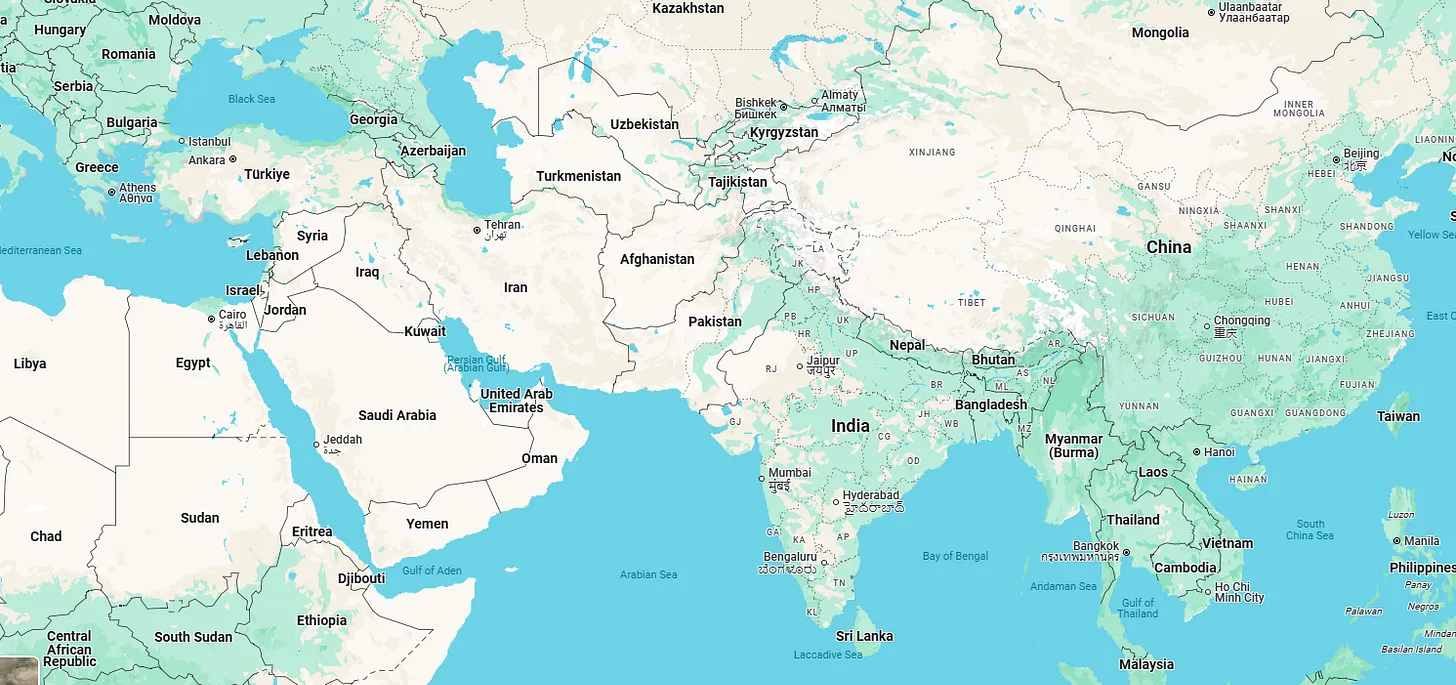
On to Iran then, where it does not seem that the Americans or Israelis understand the nature of the Iranian-Chinese relationship. Not only does China get the bulk of its oil (subsidized) from Iran but they have just completed a rail link from Xinjiang, China to Teheran, Iran – running through four countries. This rail line can ship oil as well as other cargo, cutting into the American (and Indian) naval superiority around the Persian Gulf and Indian Ocean. The assumption by military planners has always been that the U.S can cut off Chinese access to oil, if necessary. That is no longer the case.

China is not standing still – they are expanding their axis of dictatorships to countries in which the army is in control. Pakistan and Egypt qualify. Iran, while a theocracy is controlled by the Iranian Revolutionary Guards. No matter the “deal” that the Trump administration negotiates with Iran they will not be pried away from Iran. China has more to offer an ideological dictatorship then commercial deals with the United States. What the alleged realists in foreign policy refuse to understand is that dictatorships have no interest in commercial success if it weakens their grip on power. They are interested in deals that enrich their regimes since that also strengthens their grip on their people.

The trillion of so dollars in deals that the U.S has now made with the Persian Gulf states ensures that America remains a player in the middle east. Those who think that the Mideast is a tertiary region at best – after Asia and South America – need to rethink their strategies. As China closes in on control of the world from the Pacific to the Mediterranean the U.S is left with just two military powers it can depend on – Israel and India – to help defend its old/new commercial interests. It is not only oil – it is not Boeing jets, Nvidia chips and many other products that are moving from the US to the Gulf as opposed from the Gulf to the U.S. The U.S is no longer a commercial client of the Gulf states but the country who needs to protect its clients. The relationship has changed but the security relationship has only gotten more important.

The addition of Egypt and Pakistan to the Axis means that the Chinese threat has expanded. They are not giving up on Taiwan, nor are they giving up on South America and the Pacific Ocean but rather, China is using its experience as a dictatorship to strengthen ties with other freedom hating countries. We can all pretend that values and culture don’t matter, but that doesn’t mean that they don’t. This Axis is one where the interest of each member is to stay in power, force its will on its people and enrich itself at the expense of its people. This is an Axis, not only of the unfree, but of those who need to eradicate freedom to “thrive”.

Disclaimer: the views expressed in this opinion article are solely those of the author, and not necessarily the opinions reflected by angrymetatraders.com or its associated parties.

You can follow Ira Slomowitz via The Angry Demagogue on Substack https://iraslomowitz.substack.com/ 

post234

New Alternatives for Regional Alliances & Global Effects?

New Alternatives for Regional Alliances & Global Effects?

Opinion: The following article is commentary and its views are solely those of the author. This article was first published the 14th of March, 2025 via The Angry Demagogue.

There is so much going on that it really is difficult to keep up. Israel is at the center of many of the regional developments, as would be expected. But it is not just Israel as Israel, but Israel as an ally of the United States that is interesting. The Syria problem we have written about and it is still not clear what the Trump administration’s policy is there as they look skeptically but hopefully at Al-Julani’s Syria. In our opinion that decision will be made for them, since the chances that Al-Julani has changed his stripes to a Western democrat is small and even if we are wrong there – the armed Jihadist groups that he needs to control seem more interested in ridding Syria of ‘heretics’ than stabilizing the country.

Lebanon has changed enough for the United States and Israel to take chances. While it is too bad that Israel did not do more in ridding the country of Hezbollah, the fact that Syria is no longer part of the Shiite crescent means that they are isolated and not able to get funding and arms from Iran with the same ease. What is important about the current Lebanese government is that Hezbollah is not a part of it. That does not leave them powerless, but it allows the government to act more independently. The Lebanese Shiites, under Hezbollah and the less but still militant Amal, will have to rethink their loyalty to these two organizations. At the least, it should move Amal away from their stronger partner.

Iran now has no land route to Hezbollah and will have a harder time arming the Houthis, too. But it is in Iraq that they are facing problems which could cause as much damage to their projection of power as did the loss of Syria. Due to US pressure, Iraq has stopped buying Iranian electricity although they can still buy gas. It seems that the US is giving Iraq some time to find alternatives to Iranian gas and the Iraqi government is moving away from Iran on other issues too and are trying to get rid of Iran’s Shiite militias.

But the most interesting thing to happen is Israel’s attempt to strengthen America’s relationship with Azerbaijan, a country that Israel is in close contact with regarding Iran. Israel has always been rumored to plan to use Azeri air force bases in a possible attack on Iran. The Azeri official responsible for regional development was in Israel last month and is trying to bridge differences between Israel and Turkey. The Azeri’s next stop after Israel was to Turkey. Steve Witkoff is reported to have stopped in Baku after his visit to Moscow.

An Azeri company has also bought rights to Israel’s Tamar gas field. Israel currently gets oil from Azerbaijan via a pipeline that goes through Turkey so the energy relationship is strong and longstanding between Israel and Azerbaijan. It seems that Turkey’s relationship with Azerbaijan is more important to them than their animosity towards Israel – probably because the Azeris and Armenians are enemies. It seems that sometimes not only friendships have to be ranked but enemies, too.

Trump’s game with Ukraine is not necessarily to my taste but it could be that there is something much bigger going on here and that is connecting Israel, Russia, Central Asia and Turkey to a grand alliance with the United States. I don’t think that Trump will succeed in pulling Russia away from Iran and China and that Erdogan’s Turkey will not give up their dream of destroying Israel. But what if the Iranian regime falls after a combination of harsh sanctions, economic collapse and Israeli military attacks? What if Iran is pulled away from the alliance leaving Russia with just China? What if a Russian base in Syria is dependent upon their moving away from China?

Last year the Axis held a near continuous land bridge from the Pacific to the Mediterranean. China was moving into Russia’s “sphere of influence” in the “Stans” of Central Asia with their economic bear hugs. This was something that the Biden administration ignored, but could be a bigger headache for Putin than a well armed but non-NATO Ukraine with American businessmen instead of soldiers as a tripwire.

Are we giving too much credit to Trump and his foreign policy team and to Israel’s influence in the expanded region that reaches beyond Syria? Is there more going on than we know or less?

On October 7 and the days that followed, the Biden Administration was sure that Israel was in such a panic that it would agree to anything, and they could force the Obama Middle East of a hegemonic Iran and a Palestinian state down Israel’s throats – and overthrow Netanyahu as an extra. None of those things happened.

Only a fool would predict what will be in a year, but what we have discussed above is one scenario no one would have considered even six months ago. The post WWII world looked nothing like the world of 1937, and the post WWIII world (the one we wrote about a year ago and may or may not have happened!) will look nothing like September 2023 – no matter how hard the UN yells and screams.

Could Israel and Azerbaijan be the keys to a realigned world?

It is against my nature to be optimistic, especially since Israel is still not done with Gaza, the hostages are not yet home and the internal politics are reaching levels that border on a soft coup.

However, while we don’t know where the aces are, we know that the Obama-Biden jokers are no longer in the deck.

Disclaimer: the views expressed in this opinion article are solely those of the author, and not necessarily the opinions reflected by angrymetatraders.com or its associated parties.
You can follow Ira Slomowitz via The Angry Demagogue on Substack https://iraslomowitz.substack.com/ 

post205

The Wigged and the Robed: All Hail the ICC in The Hague

The Wigged and the Robed: All Hail the ICC in The Hague

Opinion: The following article is commentary and its views are solely those of the author.

There is an old saying that extreme cases make bad law and that is mostly the case. Regarding policy though, sometimes it takes a disaster to shake people out of their mindset. Regarding the absurdly named International Criminal Court, or The Hague, as we like to call it, we have to admit that the recent decision to issue arrest warrants to Israel’s Prime Minister and ex-Defense Minister should be one of those decisions that will push the civilized world to correct its self-righteous post-Holocaust decision to create that court. 

What better way to make amends for the crimes of Europe, they thought way back when, than to judge, honestly and fairly all such “crimes against humanity” that happen in the world?

How much better the guilty Europeans will feel when they bring the less civilized to trial in their palatial courtrooms, especially as they will train the non-European judges themselves in the fineries of “human rights law”? The next Hitlers of the world will never be able to do their dastardly deeds since the civilized world will deter them with lawyers in fancy wigs and robes. Just look at all the tyrants and mass murderers who have been deterred over the past 70 years. The people of Cambodia, Rwanda, Sudan and Biafra (remember that?) thank their betters in European capitals. The Bangladeshis, too. 

I am sure that those men, women and children in Darfur have an annual party celebrating the brave men and women in wigs who sit in the Hague, for saving their lives. We understand that the hundred’s of thousands of women and girls in the Congo who have been raped (many multiple times) give a prayer of thanks to the judges in the ICC for saving them from their next rape, since the rapists have certainly been deterred by the brilliant legal analysis done in the Hague.

With the issuing of arrest warrants for Israel’s Prime Minister Benjamin Netanyahu and ex-Defense Minister Yoav Gallant, the ICC has done a great deed for all the suffering women in Congo and families in Sudan, to say nothing of all those hundreds of thousands of Syrians who have been killed or made homeless by the Syrian regime and their Russian, Iranian and Lebanese helpers. The young Iranian women who have been jailed for showing their hair and the Uighurs in China who are right now in concentration camps are now in a better place since Netanyahu and Gallant will be hunted down and shackled to be judged by the robed and wigged in The Hague.

But most important, all those European Jew haters, those of Marxist, Jihadist, Aristocratic or Nazi bent no longer must feel guilty for killing Jews. They have learned the lessons of the Holocaust very well – the lessons taught by the enablers of the perpetrators in the universities, courtrooms and media outlets.

What can the civilized world do to make sure that the wonderful gains the ICC in The Hague don’t disappear? Make the ICC disappear. There is nothing so satisfying for those of us who love truth and justice than ridding the world of another symbol of global hypocrisy and self-righteousness. I can assure you that those that actually suffer from mass murder and rape will not be worse off.

Disclaimer: the views expressed in this opinion article are solely those of the author, and not necessarily the opinions reflected by angrymetatraders.com or its associated parties.
You can follow Ira Slomowitz via The Angry Demagogue on Substack https://iraslomowitz.substack.com/ 

postR170

Middle East is Proving to be a New Playground for the Axis

Middle East is Proving to be a New Playground for the Axis

Opinion: The following article is commentary and its views are solely those of the author. This article was first published the 4th of July with an addendum on the 5th via The Angry Demagogue.

Blinken Gets Pushed to the Back of the Line

While the Biden-Blinken Administration is obsessing on “non-escalation” and telling allies they are on their own if they attack an Axis member that attacks the ally,  or that they will help the ally “defend itself” but not take the offensive (how you do that is a mystery) the Axis itself is establishing itself all over the Middle East.

Let’s start with a statement, quoted in Israel, by Alexander Dugin who is Putin’s ideological advisor advising the Russian leadership to arm Hezbollah and the Houthis in their fight against Israel. Earlier this week, Newsweek reported that Russia is considering arming the Houthis with cruise missiles. These could be used against Israel and against Saudi Arabia – or maybe U.S bases in the area. As Russia seeks to cement its ties with anti-Western countries and forces around the world, it seems to be partnering with Iran so as to increase the potency of Iran’s proxies and press their goal to rid the region of U.S forces. Toward this goal Iran and even Russia are manufacturing tanks together in Iran.

The Houthis themselves, under with the guidance of Iran, are attempting to expand their sea blockade from Bab al Mandab straits connecting the Gulf of Aden with the Red Sea, to the east African coast by cooperating with the Sunni and al-Qaeda based Somali terrorist group al-Shabaab al-Mujahadin. Reports in Israel quoting U.S intelligence sources claim that the two groups are cooperating and that the Houthis will supply weapons to al-Shabaab in order to interdict global shipping off the Somali coast and in order to harass U.S forces stationed in the area.

The anti-U.S alliance seem to be able to cross religious and ideological boundaries in ways that western intelligence thought impossible. That is because western (and Israeli) intelligence mis-categorize all of these groups and countries. The issue is not who is Sunni and who is Shiite, who is Russian Orthodox and who is Communist, but rather, who is for keeping the international status-quo and who’s for, to use a phrase meant for different times – a “new global order”.  

The Houthis, feeling confident in having defeated the U.S Navy in the Red Sea are now threatening Saudi Arabia for saying no to a Russian negotiated deal (under the auspices of the U.N and opposed by the U.S) which would bring an end to the embargo against the Houthis including their export of oil as well as Saudi financing of the Houthi civil government in the part of Yemen they occupy (they learned from Hamas and Qatar/PA/Israel that you really can have your enemies pay your salaries) amongst other goodies. They blame Saudi Arabia for allowing U.S jets to bomb Houthi sites from airbases inside Saudi Arabia – with no U.S carriers in the Red Sea that certainly could be true. In their threat they included videos of their bombing of Saudi oil fields in 2019 just in case the Saudis forgot. 

The Houthis, with their experience stopping shipping, have, according to a JCPA report been the point men for Iran’s plan to extend the sea embargo against Israel to the Mediterranean. This would not only hurt Israeli shipping but also the ability of its Air Force to operate properly. We wrote recently about Iran’s possible plans for Cyprus, including Hezbollah’s open threat to them, and this fits nicely with their plan to ring Israel with fire on all sides. We already know that Russian intelligence vessels are in the Mediterranean tracking Israeli submarines and that the Russian naval base in Syria is a safe haven for Iranian shipping. 

Just this week an Iranian vessel filled with arms for Hezbollah anchored in the Syrian port of Latakia (why did Israel not sink this??!!) which is 100kms (60 miles) north of the Russian naval base in Tartus, Syria – was it escorted in by the Russian Navy? Is that why?  

The U.S now has three main allies in the Middle East – Israel, Saudi Arabia and UAE, and with the exception that the UAE administration has a habit of criticizing and threatening these allies. 

It boggles the mind that Blinken does not see what the entire world sees – a so far successful effort rid the Middle East of the U.S and its allies. For Israel that means annihilation and for Saudi Arabia it means probably surrender to the Iranians while its royal family is allowed to enjoy their money (best case scenario). For the UAE it means it will be used even more than it currently is as an Axis financial center. For the U.S it means a withdrawal, not to the Western Hemisphere – but to the northern half of it. 

The Middle East is slowly becoming the playground of the Axis and it is just a matter of time before the West won’t be able to get a turn on the swings.

Addendum: A short follow regarding the Houthi ultimatum to Saudi Arabia

The Houthi’s gave the Saudis 72 hours to respond and respond they did. The Saudis have agreed to all the demands of the Houthis as they realized that the United States will not defend them from attack and are unwilling or unable to deter, let alone to destroy the Houthis offensive capabilities.

Amongst the Houthi demands that the Saudis agreed to are:

1. The re-opening of the airport in Sana’a, Yemen.  They will allow direct flights to bring pilgrims to Mecca, flights to Jordan and soon flights to everywhere. This will allow the Houthis to be re-armed by the Iranians via air transport.

2. Payment, by Saudi Arabia of Houthi government employees.

3. Allowing the Houthis to sell oil – ending the embargo.

This is a plan, as stated, sponsored by Russia and not opposed by the United States. It is a further move by the Axis into pushing the U.S out of the region. It is not clear if part of this agreement is for the Saudis to disallow U.S use of the Prince Sultan Ari Base for attacks on the Houthis.  

As an aside, the UAE has suggested that the U.S setup a base in Somaliland – a breakaway country in the horn of Africa on the coast of the Gulf of Aden and bordered by Djibouti and Ethiopia (and of course Somalia). This seems to be an attempt to rid the Gulf States of the responsibility to host U.S forces that attack Iranian proxies.  Could Biden’s “you are on your own if you attack Iran” (back in April after the 300 projectile attack on Israel) have influenced their decision?

Russia and Iran are on the rise in the region as the U.S administration preaches de-escalation and appeasement. 

Disclaimer: the views expressed in this opinion article are solely those of the author, and not necessarily the opinions reflected by angrymetatraders.com or its associated parties.
You can follow Ira Slomowitz via The Angry Demagogue on Substack https://iraslomowitz.substack.com/

post197

Iran Front and Center: 60 Tons of Explosives Sent Towards Israel

Iran Front and Center: 60 Tons of Explosives Sent Towards Israel

The Israel-Iran War is soon to enter its 7th month even though last night was the first face to face confrontation between the two countries.

There was much less panic in the air on the “Israeli street” than one would expect after Iranian threats over the last week. I was clearly wrong in my assessment that Iran would not want to start something big with Israel and risk having a chunk of their strategic power degraded but it is hard predicting what fanatics will do. The question is if the utter failure of the attack will bring Iran shame in the Muslim world or if the fact that they sent missiles and drones will be counted as a “victory” even if no damage was done to Israel. Or it could be that Iran was counting on Biden-Blinken holding back Israel from responding and sure enough, NBC is reporting exactly that:

President Joe Biden has privately expressed concern that Israeli Prime Minister Benjamin Netanyahu is trying to drag the U.S. more deeply into a broader conflict, according to three people familiar with his comments.

Last night at about 8:15pm IDF Homefront Command announced that all schools and all educational activity would be cancelled until further notice, angering parents everywhere. A few minutes later they announced that 10’s or hundreds of drones were launched from Iran and on their way to Israel. The news reported that it would take 8-10 hours to arrive, sparking this to make its round on the Whatsapp groups in this very interconnected country:

Google maps also cooperated:

Friends and family in Jerusalem and surrounding areas were awakened by alarms and scurried to the bomb shelters, children in their arms. There were alarms also in the West Bank, the Golan Heights and the Northern Negev dessert. Apparently, the main targets were two air force bases. One was hit by one missile and minor damage was done and the other was untouched. One 7 year old Bedouin girl was critically injured from pieces of a rocket that was shot down. The headline ought to read: Shiite Missile Critically Injures 7 year old Sunni Girl. 

The effectiveness of Israel’s air defense system seems to have surprised even the Israeli Air Force and special thanks has to be given to President Ronald Reagan for ignoring the comics and media (but I repeat myself) and many scientists and engineers (the experts!) as they made fun of his Strategic Defense Initiative and called it “Star Wars” – claiming that it was something undo-able and dangerous even to talk about.

Then Senator Joe Biden, using his favorite word, “provoke”, is quoted in this 1985 NY Times article:

Senator Joseph R. Biden Jr., Democrat of Delaware, pressed hard for reassurance about whether the proposed defensive weapons might be fired by mistake, thus provoking the Soviet Union to launch a real attack.
 

The Biden foreign policy theory for the last 40 years or more is based on not “provoking” your enemy, no matter the cost and appeasing your enemy at any cost.

Special thanks to the U.S armed forces who shot down numerous drones as did the U.K’s air force as well as Jordan’s. There might have been other Middle Eastern countries involved as there is an unofficial regional air defense system set up with Abraham Accord countries and others not part of the Accords. 100% of the suicide drones and 100% of the cruise missiles and 92% of the ballistic missiles were shot down by Israel’s layered “star wars” system. 

If the IRG is honest with themselves, they will understand that they have been defeated. A combination of 300 drones, cruise missiles and ballistic missiles were shot at Israel at once and no drones and no cruise missiles got through. Of the 110 ballistic missiles shot at Israel, 101 were intercepted and only one reached its target. Israeli defense firms closed higher in Tel Aviv Stock Exchange trading today. I imagine Iran’s potential clients are having second thoughts. China too, must be wondering about their own offensive and defensive systems.  

So where does this leave us now?

The War Cabinet assigned to Netanyahu, Gantz and Defense Minister Gallant needs to decide on an Israeli response. I am not sure that Israel has the firepower to destroy Iran’s nuclear sites on its own and there is almost no chance we will see U.S B52’s involved.

So the most obvious target is probably off the table.  It seems that the U.S Administration is pressuring Israel not to respond at all and to leave things as they are. This should not surprise anyone who has been awake for the last six months.

Israel and Iran have been at war for the last 6 months – one could say for the last two decades. This was clear to everyone except Biden-Blinken who could have shortened the war and the suffering by punishing Iran for their attacks on US sailors and soldiers.  Instead, they appeased Iran and released $10 billion to them essentially letting Iran hit Israel with this money.   

 The Scroll is reporting that:

We are now waiting to see how Israel responds. Although an unnamed “senior Israeli official” has been quoted promising a “significant response” to the attacks, Iran appears to have pre-cleared the attacks with the United States via the Oman diplomatic backchannel. And according to Roi Kais of Israel’s Kan News, a U.S. official told Saudi Arabia’s Al-Arabiya on Friday, “the United States will take part in the response to the Iranian response if Tehran escalates the situation inappropriately”—which means that the United States tacitly approved an appropriate level of Iranian escalation, such as, we don’t know, a “symbolic” drone-and-missile attack.

The United States has also, as Barack Ravid reported Friday, demanded to “have a say before decisions are made about any retaliation by Israel.”

If true, that is cynicism taken to the ‘Nth degree’. True enough, the United States needs to watch after its own national interests, but is it possible that the U.S government considers Iran its equal and Israel its vassal? Were Israel faced with a missile attack from China an argument could be made that U.S interests take precedence over Israel’s – but Iran? The Iranian economy is in shambles, the Rial is at record lows, its only economic lifeline comes from China, bankrupt Russia, the $10 billion Biden gave them and illegal activities. As Israel just showed– Iran’s vaunted missile force is worth less than advertised. We have not even spoken about the way it treats women and gays and how it treats opponents to its theocracy, how it spreads terror throughout the Middle East and Africa, how it helps Russia destroy Ukraine, how it is a key player in the global drug trade and money laundering.  

We have also not spoken about its foothold in the Western hemisphere and its attempts to infiltrate the United States itself via the porous southern border. 

Worst of all, if the Scroll story is correct, it shows how Biden-Blinken don’t understand what the office of the Presidency of the United States is. It is not just another head of state or head of government, but rather the President’s warnings ought always to be backed up with actions. Biden’s “Don’t Speech 2.0” was laughed at by Iran in public, for all to see. And the Biden-Blinken response is to tell Israel, “don’t”.

Ignoring Biden-Blinken for the moment, Israel must think deeply about its response. It is clear that any response will be followed by more of the same from Iran. Israel must think a few moves ahead and not just attack for the sake of attacking or it will be in the middle of yet another war of attrition. The end of the multiple rounds of attacks must leave Israel in better strategic shape than it is now and must leave Iran substantially weaker.

Whatever Israel decides to do, it must degrade Iran’s military capability by destroying its weapons and bases and killing as many IRG officers as possible. Israel should not bomb the power stations in Tehran or do other non-military strikes. Air force bases, missile silos and Iran’s navy should be targeted in such a way that degrades capabilities. They could start by sinking the Iranian spy ship that is helping the Houthis in the Red Sea.

Israelis seem to think that by “allowing” Iran to attack them it gives them many diplomatic credits, but we already know that these “credits” do not last long.  Whatever Israel does, it ought not to play the “message” game. Its attacks ought to provide tactical advantages in the coming months and not just “warnings to Iran” and “messages to Hezbollah”.

But let’s not ignore Biden-Blinken for a moment.  What if they decide to threaten Israel that if Israel retaliates the US will sit on their hands? 

This would be the time for Israel to do a little threatening of itself. The worst thing for a sitting President running for re-election is a summer gasoline price spike. Israel could certainly threaten to destroy Iran’s oil facilities and help push the price of oil. High gallon gasoline prices this summer will lose Biden more votes than he can gain in Dearborn, Michigan. In exchange for leaving Iran untouched, Israel can demand a free hand in Gaza, including Rafah as well as in Lebanon.  

Would that be worth letting Iran off the hook? It might. Iran was defeated in this battle, but it still believes it will win the war. Giving Israel free reign to destroy Hamas and then Hezbollah means that Iran will lose the war, too. Without Hezbollah, Iran will lose its most important asset in its overall goal of destroying Israel, chasing the US from the Middle East and establishing Shiite dominance in the region. It would turn October 7th into the day that Iran started on its road to defeat.

Israel needs to be opportunistic and aggressive in its dealings with its allies and its enemies. It has to let its allies know that it too is playing the long game and that it will not only hurt those who hurt it – as Netanyahu loves saying – but that it will destroy all who even try to harm it.

More importantly it needs to show its enemies with actions and not with words that threatening Israel means you will be destroyed. 

The Biden-Blinken team must be told in no uncertain terms that Israel is not a vassal.  The end result of this war cannot only be the destruction of Hamas, it must also be the destruction of the Islamic Republic of Iran as a regional power. By sending over nearly 60 tons of explosives to Israel, they have put themselves front and center.

Disclaimer: the views expressed in this opinion article are solely those of the author, and not necessarily the opinions reflected by angrymetatraders.com or its associated parties.

You can follow Ira Slomowitz via The Angry Demagogue on Substack https://iraslomowitz.substack.com/ 

post 183

An India-Israel Alliance: Prospects to Serve Global Freedom

An India-Israel Alliance: Prospects to Serve Global Freedom

Opinion: The following article is commentary and its views are solely those of the author.

We wrote a few weeks ago in response to Nassim Taleb’s claim that Israel was fragile due to its over-dependence on the United States, and we came to the conclusion that in general he was correct although not in every aspect Is Israel a Fragile Country?.

Also, we compared Israel’s fragility with that of other free or status-quo countries (as opposed to revolutionary countries like Russia, Iran and China) and thought that Israel was certainly not more fragile than other free countries in difficult neighborhoods.  We then gave a general outline of how the free-status-quo world might look should we actually see the end of America’s commitment to global freedom The Day After Pax Americana.  

I would like to examine in a more detailed way about Israel and India and how their potential relationship could be a model for this world. With the U.S reluctantly and belatedly responding to attacks from Iranian backed groups in Syria, Iraq and Yemen and their stubborn resistance to attacking Iran itself each free or status-quo country needs to look into its own defense. The U.S also needs to see how it can help midwife these alliances so as to guarantee a free world after their voluntary end to the Pax Americana.

Israel will need  to expand its reach and move towards a more anti-fragile existence without damaging the all important U.S relationship. We can’t underestimate the importance of the U.S relationship to Israel and how important it is to maintain and even expand it – but as the U.S political landscape is changing and as the elite part of the younger generation is, for some reason, excusing violence against Jews in general and Israel in particular, Israel needs new strategic partners if it is to thrive and move at least part of the way towards anti-fragility.

Israel’s relationships with the Arab world, the Abraham Accords along with its older peace treaties with Jordan and Egypt are dependent upon dictators remaining in power. The most vocal and belligerent voice against Israel by a government in the (non-Iranian influenced) Arab comes from Jordan and the most vocal and belligerent non-governmental voice in the (non-Iranian influenced) Arab world probably comes from Egypt. These treaties are all important and they are based upon the self interest of the current rulers of the countries (which is a good thing), but no one can know how long they can last and how firm they really are.

Israel also has a strong and growing relationship with Greece and Cyprus in the eastern Mediterranean and have joint military exercises together. Their navies and air forces train together and even their ground forces have joint exercises but neither of those two countries have the economic, military or diplomatic heft that Israel needs.

If Israel is looking for a second strong ally but one that itself lives in a dangerous neighborhood then the place to turn to is India. With the largest population in the world, a democratic government and a growing economy, India is the ideal strategic ally for Israel. Both are countries that live in dangerous neighborhoods, are working democracies and have experience dealing with terrorism. India, under with the premiership of Narendra Modi already has a strong relationship with the Israeli military. Israel has sold more than $600 million worth of military equipment to India (second only to Russia) and the two militaries have cooperated on anti-terror policy. The Israeli navy also reportedly has close ties to the Indian navy including submarine exercises in the Indian Ocean. Israel already has nearly $5 billion in trade with India (import and export) and it is time for Israel to start purchasing basic military supplies from India. India has five domestic manufacturers of the standard 155 mm artillery shells and it has large small arms industry – this should be an alternative to total dependence on the U.S for this standard equipment.

There is now a consensus in the country that Israel needs to broaden its military manufacturing and acquisition and the best way to do this would be to expand its relations with India. In order for this to make sense the time has come for Israel to say a very big “thank you very much” to the United States for the $3.9 billion in military aide it gets annually and instead purchase directly from the U.S and other sources.   India could also help in building factories in Israel – which could even be operated by Indian nationals through Israel’s guest worker program.

The military cooperation should be expanded to the air-force as well as ground forces.  There ought to be joint officer training, just as there is now with the U.S and some European countries. There should be a process in place that will eventually lead to a freedom of the seas treaty in the waters between India and Israel’s Gulf of Eilat. This should include cooperation between naval, air and anti-missile forces. 

The foreign worker program should also be expanded. Israel is trying to free itself from dependence upon Palestinian labor – from both Gaza and the West Bank – and India and Israel have been talking about an expanded guest worker program. Currently there are Indian citizens working as aides to the elderly and disabled and that needs to be expanded to construction and agriculture. 

Israel is a small country with around 10 million people and due to its large birthrate and legal immigration there is a lack of new housing construction in the country. The guest worker program in place with countries like Philippines, Thailand, Sri Lanka and others allows workers to work for up to five years and earn much more than they can earn in their home countries. They are provided with the same health care as Israeli citizens (paid for by their employers) and are even given pension benefits which they take with them when they return to their home countries. Israel could probably host up to 100,000 Indian workers a year.  

Scientific and student cooperation should be increased. This will not only help both countries develop important technology in areas such as healthcare and biotech, but will help India and Israel retain some of the scientists that would otherwise emigrate to the U.S and U.K. The exchange programs at university science and technology departments could lead to the creation of world class companies in the respective fields. 

Finally, cooperation regarding the capital markets could help both countries develop world class markets. India has the potential to be a global financial center in the coming decades and Israel, while far from being a financial powerhouse could be a link to European markets and investors with the time zone 1-2 hours ahead and close connections with those markets. 

The United States will be Israel’s main ally for the next few decades but it will be healthy for both countries if Israel was able to share interests – political, diplomatic, cultural and military with another major country. While France was that country until 1967 no European power has the position or the disposition to ally with Israel. India is democratic and attained its independence at the same period Israel did and from the same (then) major colonial power.  Also, both countries have overcome their socialist beginnings to thrive on the global economic stage. 

Now is the time for Israel and India to take the next step on the road to a true alliance. If we have truly reached the end of the Pax Americana, then this can be an example to the rest of the free-Status-quo world on how to manage without the vast power that is the United States. If somehow America shows the will to continue to lead the free world an Israel-India alliance will only contribute to the freedom that a continued Pax Americana protects. It would be helpful in any future conflict in the Pacific and the alliance could expand to the Gulf countries, East Africa and maybe even Egypt. 

Economically and technologically the obvious expansion would be towards South Korea and Japan. Militarily, it could aide and potentially replace the U.S naval presence in the Persian Gulf and allow it to concentrate its forces more in the Pacific. We are not talking here of a relationship that will replace the U.S military tomorrow or even next year. 

This is a long term process and requires the governments, corporations and individuals in both countries to be aggressive in turning a relationship into an alliance.  And it will require the cooperation and encouragement of the United States which will have to agree to support this and similar alliances even if it does not agree with all the tactics used in a moment of crisis.     

It is time to start looking forward and to stop depending on the goodwill of the American people as America, too faces major fiscal, strategic and military challenges of its own. 

Disclaimer: the views expressed in this opinion article are solely those of the author, and not necessarily the opinions reflected by angrymetatraders.com or its associated parties.
You can follow Ira Slomowitz via The Angry Demagogue on Substack https://iraslomowitz.substack.com/ 

postN96

Is Israel a Fragile Country? Can it Move Towards Anti-Fragility?

Is Israel a Fragile Country? Can it Move Towards Anti-Fragility?

Opinion: The following article is commentary and its views are solely those of the author.

One of the great books of the last decade is Nassim Taleb’s “Anti-Fragile”. 

I read it years ago and bought one for each of my (grown) children and suggested they read it and think about it when making decisions. I said at the time that this should be required reading for all IDF officers. In a nutshell, Taleb differentiates between fragile, non-fragile and anti-fragile. Glass is the classic fragile substance and concrete the classic non-fragile. Both can be destroyed with correct instruments and non-fragile items will slowly decay when things like water infect them.  

Anti-fragile items on the other hand, gain strength from chaos. The more an anti-fragile substance gets hit, the stronger it gets. Nature for Taleb is the classic anti-fragile system. Nature “knows” how to respond to any disturbance, and it “learns” how to adapt and survive. This adaption and survival might hurt parts of the natural world – but nature as a system will survive and be stronger – think of natural immunity from a virus. 

Another of the ideas in Taleb’s book is “optionality” – decisions in life are often like buying options. When buying an option, you want a high upside and a low downside.   A simple non-financial example is crossing a street. If you see a car 50 yards away and are pretty sure you can make it across the street without getting hit – you can take that “pretty sure” chance and save yourself the 10 seconds it takes for the car to pass, or you can wait the 10 seconds. The upside here is saving 10 seconds. The downside is getting hit by the car. The decision is pretty obvious for those who think of optionality.

In short – Taleb is a serious man and a serious thinker. Born in Lebanon in 1960 he is a polymath, making his name in trading and finance, and his previous book “The Black Swan”.

In any event, in a recent interview with the French newspaper L’Orient Le-Jour he called Israel a fragile country due to its dependence on the United States and said that top-down peace agreements, like that between Israel and Egypt, or the Abraham accords are doomed to fail (I don’t read French and read a summary of the interview in the Hebrew language Globes financial newspaper – the original is here – if you read French and I got it wrong, please let me know).

Is Israel a fragile country? And if so, is it more fragile than other small free countries? And finally, how can it move on the road to anti-fragility? And are fragile peace agreements worthless?

Taleb’s claim that Israel is fragile due to its dependence on the US is true in an of itself. Changes in U.S foreign policy either via elections or changes in US interests have in the past put Israel in difficult situations. When Prime Minister Yitzchak Shamir requested U.S loan guarantees from then President Bush (1) in order to fund the absorption of masses of emigrants from the falling Soviet Union he was turned down until Israel halted settlement activity in the West Bank and attended the (failed) Madrid peace conference. Today, it is very clear that if the US would decide to halt arms shipments to Israel or to stop supporting it in the Security Council, the country would be put in a situation many believe would be existential.

A big issue in Israel at the moment has to do not only with Israel’s dependence on the US for military hardware but in the relationship of its top generals with the Pentagon. There is a claim that much of the “globalized” attitudes of Israeli generals comes from the influence of the politically correct elite in the US Defense Department. It reached a point where, just a few weeks before the current war broke out, the general in charge of military intelligence stated that he fears that global warming is a greater threat to Israel than Hamas. Whatever one’s views on global warming or climate change it does seem odd that the one Israeli in charge of making life and death intelligence assessments has the time to worry about those issues to such an extent that he feels it is his job – as intelligence chief – to warn Israel about it. Further, the October 7 attack itself showed the fragility of the defense strategy of Israel’s top generals and politicians. It had a conception of Hamas and other enemies and had no allowance for its being wrong. 

However, the initial response of Israel’s soldiers and officers, without the centralized support of the General Staff, show how many of Israel’s combat soldiers are “anti-fragile”. Israel’s people can also be said to be anti-fragile in Taleb’s definition of it where chaos or tragedy make one stronger. Over the 48 hours after October 7 Israel already had 350,000 reservists mobilized who were all motivated to fight for their country. That is no mean feat – for the most part these reservists went to their units before being called up or called their commanders demanding to be called up. Many thousands returned from abroad at their own expense in order to join their units and fight. In contrast – Ukraine had to forbid all men under 50 from leaving the country.   In Israel, a divided, shocked and demoralized people became a strong fighting force with the home-front in total support, within hours.

Military tactics are another area where Israel is anti-fragile. Due to the utter failure of military intelligence and the lack of central control over the first hours of the war that Saturday morning, the junior and mid-level officers and soldiers took command and figured out on their own how to face down the thousands of terrorists who took over towns and villages as well as military bases. Instead of waiting for orders and making sure everything was organized for attack, a delay which would have cost many more civilian lives, Israel’s soldiers improvised with what they had and took back the territory under very difficult circumstances. Many soldiers lost their lives through many acts of bravery but the decisions they made on the spot made them, the army and the country stronger.

The same can be said in the fighting now in Gaza. Israeli intelligence understood that there were tunnels, but it seems that they didn’t know the extent of the network and therefore had no good tactics to defeat it. It was the need to penetrate them without causing casualties to soldiers as well as the potential of hostages in the tunnels, that caused them to developed tactics to deal with it. We won’t know for sure how well it has or will work, since this is now classified information, but this could be an area of anti-fragility.

But this does not disprove Taleb’s point since Israel is clearly has a “single point of failure” and that is the U.S Government. However, nearly all free countries in the world have that single point of failure and have had it since the start of the atomic age.   One of Konrad Adenauer’s great fears in developing West Germany’s defense policy was that, when push came to shove, there would be no US nuclear umbrella. He was not convinced that the US would risk its own cities in defense of Europe in general and West Germany in particular. That is why he supported France’s independent nuclear deterrent and why he and De Gaulle were so close. The U.K too, when deciding on its Trident nuclear submarines had the same doubts. 

Today, we can say the same about the Baltic countries. They are part of NATO now, but, like the rest of NATO are totally dependent upon the United States military to keep the Russians at bay. The rest of Europe is dependent upon the U.S but they are no longer front line states so it is less important. Newly NATO-ized Finland is probably closer to Israel in its combination of fragility and anti-fragility.

Taiwan too, is fragile in this sense and so are the weaker Indo-Pacific nations like Philippines and Singapore. It would be difficult to find a non-Axis free or semi-free country that is not dependent upon the U.S to defend its freedom – either with sailors and soldiers or with arms, money and diplomacy.  

But the question Taleb poses, or the claim he makes, deals with Israel. Israel is clearly partly fragile – but is it too fragile currently that it can’t survive without the US? Or can Israel do anything to make it, if not more anti-fragile, at least more non-fragile? We have to separate out Israel’s fragility due to its dependence on the U.S and the free world’s fragility due to the same dependence. The Pax Americana that free (and non-free) countries have enjoyed since the end of WWII has probably contributed more to freedom, economic growth and a reduction of poverty in the world than any other force in human history. The question for all free countries then is how to make them less dependent upon the U.S if they want to remain strong and free -and less fragile.  

That is as true for Israel as it is for Latvia, Finland, Australia and Japan. 

But we will only look at solutions for Israel and leave the general question for a later time.

Israel receives from the US $3.8 billion in military aide, all of which must be spent in the United States. The annual aide started in 1999 and was $2.67 billion. Israel’s GDP in 1999 was $120.92 billion – meaning the aide constituted 4.5% of Israel’s GDP.  In 2022 Israel’s GDP stood at $525 billion so its $3.8 billion in aide was just 0.7% of GDP. Israel’s 2022 defense budget was $23.4 billion – 4.45% of GDP.

Giving up the entire U.S aide is certainly do-able from an economic perspective and there have been economists in Israel who claim that the aide actually hurts the Israeli economy since all the money must be spent in the U.S. One result of this has been the demise of Israel’s textile industry since the IDF no longer purchases uniforms from Israeli companies (one has to wonder that, since clothes bought in the U.S are rarely made in the U.S, if Israel is buying uniforms made in Bangladesh but sold via U.S middlemen). Giving up the aide would be one step towards a less fragile existence for a number of reasons.

The first would be, in my opinion, to cement the U.S public’s support for Israel. Giving up U.S taxpayer aide during a time of fiscal uncertainty would certainly be looked upon positively, in spite of the fact that all the aide gets recycled into the U.S economy (there has been some money that Israel has been allowed to spend on R&D in Israel). Israel is not the same country it was in 1999 and its economy is robust and probably more anti-fragile than most other western economies.

A second positive would be in allowing Israel to spread out its arms purchases. It could buy small arms from India, artillery from South Korea, etc. It could also rejuvenate local Israeli arms manufacturing. There is no doubt that all the large ticket items like fighter jets and smart bombs will still be purchased in the U.S and there is no doubt the U.S arms industry will continue its good relations with Israel – and in fact might be made more competitive since the IDF will be free to chose from amongst many providers for various weapons systems. 

Another move that Israel can make that would decrease its fragility would be to make sure it always has a 12 month supply of weapons and spare parts in order to fight a three front land war and a 5 front air war. It would have to beef up its navy and ground forces without hurting its crown jewel – the Air Force. This would make it less dependent upon the importation of arms in case of war.

An area where it will be difficult to be less fragile is the diplomatic arena as woke-ness takes over the western narrative about the world and many of the less and non free countries can’t manage to fight off Arab money and propaganda. India could be a country that could help diplomatically as they are large and powerful enough to ignore much of the pressure from the Arab and western-woke world. The problem is that the Security Council still holds sway in the world and India is not a permanent member with a veto. Of course they should replace the U.K and probably France but that won’t happen as long as India doesn’t have a reliable, permanent left-wing majority – which it won’t have for some time.

The only other major country that could help diplomatically would be Japan – but they have historically not been friendly to Israel and only in the current war have they backed it fully. They are certainly sympathetic to Israel’s plight as they figure out how to face a hegemonic China.

But under the current global situation, Israel relies on the U.S for diplomatic cover making it fragile, diplomatically. That won’t change for some time.

Economically, Israel is probably more anti-fragile than most other countries in the world. This is true for two reasons. First, Israel has a strong domestic market including a very productive real estate market. It has an agricultural center that produces enough for export and of course world class hi-tech and bio-tech industries. Most important – it has children. It is the only western country that has a high birthrate and that is something that has been underestimated in the west. Israel’s fertility rate – births per woman – stands at 2.9. The next highest western country is France at 1.8.  Replacement rate is 2.1.  Search out Nicholas Eberstadt for all the details.

Regarding the top-down peace agreements, Taleb himself understands for sure that the non-democratic top-down nature of most Arab countries makes this less important than in western-free countries. However, he does have a point here. Regarding Egypt, from the beginning the people – or more accurately, the professional and intellectual classes, have been opposed to Sadat’s peace. However, in spite of that, the peace has held for 45 years, which is quite a long time. I remember as a child reading the Biblical Book of Judges where the Israelites would sin, to be saved by a Judge who would rule and keep the country “quiet” for 40 years. At the time I thought – what is the big deal of 40 years of peace? As I grew (much) older I realized that 40 years of peace would be an incredible feat. So, 45 years of non-war between Israel and Egypt is quite a success. Will this continue for another 45 years? I think that if Israel remains strong, it will. 

Regarding the Abraham accords, the jury is still out. We will have to see where it all progresses. This war has certainly shown that even mass violence has not caused violent reactions from the Abraham accord countries. The one peace agreement most fragile and more worrisome though is the one with Jordan. The Hashemites are first and foremost survivors and if survival means breaking the agreement, they will do it in a second.

http://angrymetatraders.com

In summary, Israel’s dependence on the US is crucial for its survival and that in itself makes it fragile. However, there are things Israel can do to make it less fragile and the will and determination of its people make it, in many senses anti-fragile in Taleb’s description (invention?) of that term. Compared to other small, free countries though, all of whom depend on the US for at least part of its defense, it is difficult to say that Israel is worse off – except that, besides the Baltic countries, its neighbors are worse and more dangerous.

In the coming days we will examine a more radical solution to the “fragility” problem of Israel and other free countries.

Disclaimer: the views expressed in this opinion article are solely those of the author, and not necessarily the opinions reflected by angrymetatraders.com or its associated parties.

You can follow Ira Slomowitz via The Angry Demagogue on Substack https://iraslomowitz.substack.com/

postN19

Preventing WWIII: Part 2 – Reviving Western Deterrence

Preventing WWIII: Part 2 - Reviving Western Deterrence

Opinion: The following article is commentary and its views are solely those of the author.

Aggressive Western Action Can over-extend China and Revive Needed Deterrence.

Some cliches are just correct, in spite of their being cliches – “if you want peace, prepare for war” is one. But really it should be “if you want to avoid war, deter war”.

Therefore, it is not clear to me why there is opposition by some in the Republican party to fighting Russian aggression in Ukraine. For some, I guess it is a knee jerk reaction against Biden administration policy while for others it seems to be a general loathing of American involvement in the world. 

Each is understandable on its own but does not take into effect the appeasement of Russia will have on Western deterrence around the world – including in the Western hemisphere and the Indo-Pacific. While most Americans understand that Russian control of Ukraine threatens the main Western European countries, the key to Russian imperialism really is in the south. Historically, Russia has always tried to find a warm water port to call its own. For nearly four centuries Czarist Russia fought Ottoman Turkey so that Russia could expand its territory southward and have a warm water presence in the Mediterranean. Currently, a Ukrainian presence in the Black Sea denies Russia even the opportunity to pressure modern Turkey to abide its wishes.

A Russian victory in Ukraine would mean dominance of the Black Sea by the Russian Navy and directly challenge Turkey to appease Russian power by giving them free passage through the Dardanelles to the Mediterranean. That in itself would not be worth much to the Russians without a port in the Mediterranean, which they currently have. That they have one goes back to the disastrous decision by the Obama administration to invite Russia back into the Mideast in order to take care of Syrian chemical weapons. This came, we all remember, when the Syrians laughed at Obama and crossed his “red line” about using chemical weapons against its own people. We might also remember when then Secretary of State John Kerry (the one who was never right on a single foreign policy issue ever) who, first demanded that Syria turn over all chemical weapons in a week, then reassured them that even if we attack it will be “unbelievably small”.

In 1973-4, Henry Kissinger brilliantly took advantage of the Israeli-Arab War’s outcome with Israel’s surrounding the Egyptian 3rd Army in the south and controlling the road to Damascus in the north, by brokering a cease fire on both fronts. This led directly to the expulsion of Russia/Soviet Union from the Middle East. While Russia continued friendly ties with the murderous Assad family – first Hafez and then his son, Bashar, they did not have a military, air or naval presence there. Due to this longstanding relationship with Assad’s Syria, Obama and Kerry thought it a brilliant idea to have them come in and do the dirty work that they didn’t want to do – prevent Assad from gassing his own people. 

As Russia came in and established air and sea bases in Syria and introduced the infamous Wagner group to carry out its brutal ground operations, Russia slowly started to strengthen its position in the region. While slyly allowing Israel to attack Iranian arms shipments meant for Hezbollah while pretending to be its ally, Russia formed a close  relationship with Iran. Wagner, which fought hand in hand with Hezbollah in order to prop up the Assad regime (and attack American forces fighting ISIS) is now rumored to be training Hezbollah in the use of Russian anti-aircraft systems. 

In addition, reports last week that an Iranian Ilyushin 76 cargo jet has now landed in one of the Russian air-bases they established after Obama’s kind invitation to return to the Mideast. This plane, filled with Iranian arms destined for Hezbollah has been unable to land in regular Syrian airports or bases because Israel continuously puts them out of service. Knowing that Israel would never attack a Russian base – this is a safe haven that Russia gladly supplies. 

When free countries unite in warfare there is usually one joint goal  – that they are all united to defend freedom – that is why they fight together.  While autocratic and totalitarian regimes fight together it is usually a combination of a negative goal – disturbing or destroying the current world or regional order – as well as the goal for each power in itself. Currently, the joint goal in the Mideast (of Russia, China, Iran and North Korea) is to hurt the main ally of the US in the region – Israel, in order to weaken and embarrass the US. For Iranians, they also want Israel destroyed. For Russia, they want Israel weakened so they can replace the US as the power broker in the Mideast. For China, it is to dismantle America’s control of the flow of oil and, eventually, the replacement of the USD in the global economy with the Yuan.

Ukraine is important in this calculus because, as we said above it gives Russia complete control of the Black Sea and will pressure Turkey – whose NATO membership is uses only to its own advantage – to break permanently with the West. While the Chinese theory is that the two fronts the US is supplying arms to, Ukraine and the Mideast, are tying it down and expending its resources it would otherwise use in the Pacific, in truth, an aggressive strategy on both fronts would be to over-extend Russian and Chinese resources in order to keep China from moving on Tiawan. A credible threat of destruction or even marginalization of the Axis allies in the Mideast – including (besides the soon to be gone Hamas) Hezbollah, Shiite-Iranian proxies in Iraq and Syria, as well as Iran itself combined with a major offensive in Ukraine will tie down Axis resources and possibly prevent a Chinese blockade or attack on Taiwan.   If its two main allies need full supply and full readiness to be able to respond to credible and massive attacks by Ukraine, Israel and the US, China itself might have to expend resources to prop up its own allies. 

Add to that a major show of naval force in the Indo-Pacific by Japan, India, Australia and South Korea combined with US forces will give China the choice of destroying their own wavering economy by attacking or blockading Taiwan or in maintaining peaceful Pacific trade routes while trying to prevent the collapse of its Axis allies. 

An immediate and radical change in policy can restore Western deterrence quickly.   Re-arming Ukraine and leaving Israel to do its job without pressure to stop in Gaza and to respond forcefully in Lebanon will send a strong message. Biden brought two carrier groups to the Mideast and told Hezbollah, “don’t”. But they did.  

In spite  of that  US Secretary of Defense Austin told Israel that its response to Hezbollah aggression in the north is “provoking” them.  

And the US hesitates even against Iranian proxies. Just now, the NY Times has reported that Biden-Blinken have turned down a Pentagon plan to be more aggressive in response to Iranian attacks against US forces in Syria and Iraq for fear of “provoking Iran” (this seems to tell us that the Austin complaint from Austin to Israel is really from Blinken).  

Iran never seems to fear provoking the US.   

Israel fooled itself by thinking Hamas was deterred by its destruction of an arms factory or two (as the US is doing now in Iraq/Syria) when proper deterrence would have meant them knowing we can and will go into Gaza and destroy their underground city as Israel is doing now. Instead, media fear mongers, backed by Israeli ex-Generals on the payroll of the US progressive left (via cushy think-thank jobs) combined with policy directives by successive governments have told us and Hamas time and time again that Israel cannot destroy Hamas as the cost is too high. I don’t want to speak too early, but that seems to have been as wrong as their assurance that Hamas is deterred since they want to drink white wine in the evening overlooking the Mediterranean while watching their children play innocent video games.

It is time to stop calling for cease fires and repeating UN hypocrisy and to start being aggressive and provocative in the defense of freedom. 

Disclaimer: the views expressed in this opinion article are solely those of the author, and not necessarily the opinions reflected by angrymetatraders.com or its associated parties.
You can follow Ira Slomowitz via The Angry Demagogue on Substack https://iraslomowitz.substack.com/