postN73

U.S National Security, Part 2: Regional Alliances – Europe

U.S National Security, Part 2: Regional Alliances - Europe

Opinion: The following article is commentary and its views are solely those of the author. This article was first published the 25th of December via The Angry Demagogue.
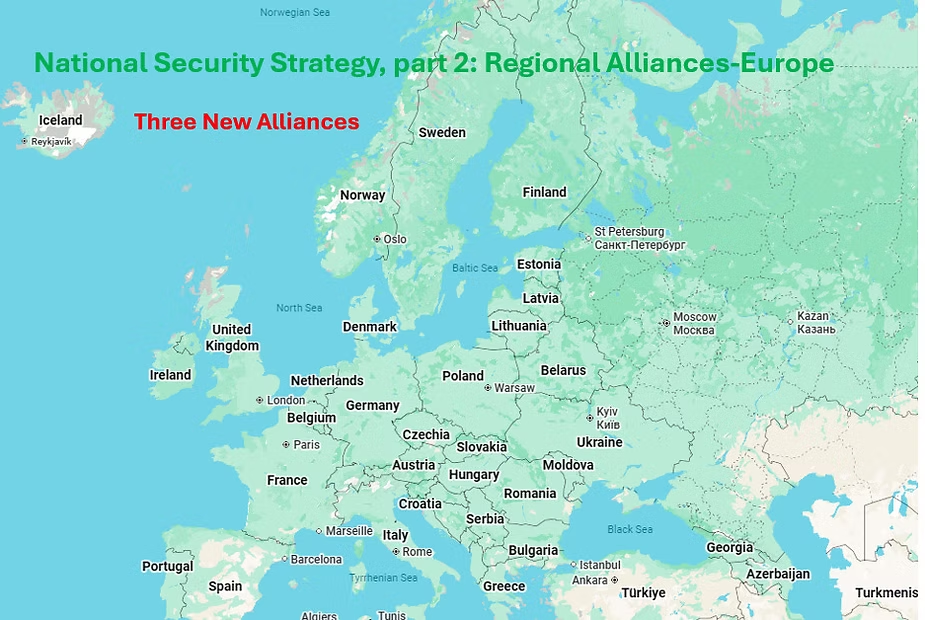
As we continue our tour of the administration’s National Security Strategy we will stay with “part III: What Are America’s Available Means to Get What We Want?” and move to the sixth bullet point: “A broad network of alliances, with treaty allies and partners in the world’s most strategically important regions” and work through the important regions that the strategy documents – Asia, Europe, the Mideast and Africa. For good or for bad we will need to split these regions up since the key point is forming coalitions that can handle their actual region. Sweden can’t be part of a coalition to protect Italy’s interests in the Mediterranean and Japan won’t be protecting Singapore.

Some U.S allied countries, like Australia, Israel and India will be involved in multiple regions helping lead alliances in all areas important to them. With that in mind we will point out the first mistake of the discussion on regions and that is Europe. We will suggest something here that would not usually come from the mouth of a hawk and pessimist and that is that NATO has no real mission and needs to be replaced by a series of alliances that make more sense. While the fear during the Cold War was a Warsaw Pact ground invasion into Germany and beyond which would have required the totality of American and European forces, Europe now is facing a Russia that could not conquer Ukraine in nearly four years of war. That is not to say that Russia is not to be feared only that each part of Europe needs to ally to face a Russian onslaught in its own theatre.

Italy is not going to send troops to Sweden to prevent an attack and Norway won’t be helping Greece in any fight. Turkey is a country that other NATO countries fear more than trust, especially regarding Russia.

In short, NATO needs to be broken up into different alliances where each country will be allied with countries whose fall would affect its national security. The United States can either be a signatory to these alliances or it can decide how involved it wants to get in any conflagration depending on its own interests at that time. It can decide to position ground troops in the countries, supply air cover or, as in the 12-day war between Israel and Iran, help with missile defense and in providing the final blow with weapons only America has. Or – it can decide that it will never participate. One hopes that that won’t happen, but each alliance will need to be ready to fight on its own.

We can include France and the U.K as large countries with advanced armed forces as allies to all of these alliances. France certainly can contribute air power to each of the alliances that are faced against Russia. As for the U.K, it is difficult to know where that country is going but its navy and air force are still powerful.

Today we will deal with north, central and western Europe.

The Baltic Alliance

This would be an alliance that includes Poland, Germany, Sweden, Finland, Norway, Denmark, Latvia, Lithuania and Estonia and would provide cover for land, air and naval battles. Each of these countries, with the exception of Germany, has a border with Russia and all are on the Baltic Sea – a key waterway for them and for Russia.

An alliance of these countries would force them to concentrate on those areas necessary for their defense. An incursion, for example into Finland would force Poland to mass forces on its border with Russia and Belarus (Poland borders Russia in Kaliningrad which is separated from Russia proper by Lithuania) and Germany to move forces to Poland. All countries could also contribute ground forces to Finland as well as naval and air power.

The only thing missing is the lack of a nuclear umbrella. That is no small issue but can be dealt with by support or threats from France or the U.K.

The Atlantic Alliance

Aside from helping the Baltic Alliance, France and the U.K will have major responsibility along with the Netherlands for patrolling the North Atlantic and, with help from Portugal, and Spain the South Atlantic. As the Atlantic Ocean can be considered one of America’s seas, this alliance will need to have the close cooperation if not outright membership of the United States. Canada too, will need to be part of this alliance. We can include the increasingly important Arctic Ocean into this alliance’s responsibilities.

As we move towards the south Atlantic countries such as Morocco, can be included as well as other western African allies of the west. An alliance like that could encourage western African countries to abandon close security and economic ties with China and Russia. The “border” of this alliance would be that squiggly line in the middle of the Atlantic that separates the Eastern and Western hemispheres.

The Central European Alliance

We can look at the smaller central European countries that formed the heart of what was the Hapsburg Empire but are not front line countries bordering Russia – Romania, Hungary, Slovakia, Czech Republic, Austria, Serbia and Bulgaria – and we have an alliance that, backed by Germany, Poland and the United States, would create a further deterrence to Russian encroachment into Europe proper.

Where, do you ask does Ukraine fall in this European alliance structure? That answer will have to come from the major European powers in concert with the United States. Adding Ukraine to the Baltic alliance might be viewed as another attempt to NATO-ize them by the Russians. However, attaching them to the less threatening Central European Alliance of smaller countries might be the excuse and “victory” that Putin would need to end the war. But we are getting ahead of ourselves here. Ukraine is a problem that can only be solved if the West decides to actively join the fight against Russia (unlikely) or when Putin and Russia get tired of the fight and look for a way out that could allow them to claim victory (more likely than the former, but sadly, a long way off).

The Administration’s concentration on regions and how certain countries can become leaders in support of western and American interests is correct – but the breakdown of the regions has to go beyond the post WWII world. The place of America in the post-cold war world, with a China that wants to challenge America’s economic and military interests and leadership needs to break down old alliances into more manageable and logical pieces.

The wild card in all of this is, of course, the will of the European powers to take their own defense seriously. The Baltic Alliance we spoke about seems to be filled with countries that understand the threat from Russia, but do they recognize the threat to them from the alignment, the Axis if you will, of Russia, Iran, North Korea and China? And of more importance have they yet come to understand the threat to their countries, as they know them, from open immigration and from their own abhorrence of families? The former is something only the governments can handle, the latter though, must come from the people themselves.

A whole generation (or two in many instances) of Europeans have grown up not only as “only children” but in families that have no aunts and no uncles, no cousins and only very elderly grandparents, if that. They have grown up in other words without families. Will the young generation see the importance of families to themselves and their countries or will they continue the nihilistic lives that they parents have “sanctified”? Religious institutions, too will have a major role in this challenge. No amount of “parental leave” and childcare subsidies will convince the young to marry and have children – will only come from a change in the culture. Is Europe up to it?

Disclaimer: the views expressed in this opinion article are solely those of the author, and not necessarily the opinions reflected by angrymetatraders.com or its associated parties.

You can follow Ira Slomowitz via The Angry Demagogue on Substack https://iraslomowitz.substack.com/ 

postN72

U.S National Security: USD Reserve Currency Importance

U.S National Security: USD Reserve Currency Importance

Opinion: The following article is commentary and its views are solely those of the author. This article was first published the 23rd of December via The Angry Demagogue.

We would like to start going through the U.S administration’s National Security Strategy released last month. There is a lot in there – much of it the same as in past administrations and much of it different. The tone of course is full Trump and while the introductory parts try to make it into a revolutionary document it does in fact build upon much of what has been American foreign policy for decades. One thing it most certainly gets right is that American foreign policy since the end of the Cold War has not found its compass. From a unitary world to one dependent upon global organizations, from a sharing of goals with western Europe to a pivot to Asia, from the war on terror and the middle east to Russia-Ukraine, the United States has struggled to find its way in the post-Cold War world.

We however will concentrate today on one aspect of the strategy, the third bullet in part III – “What Are America’s Available Means to Get What We Want?”. The third bullet point speaks of America having “The world’s leading financial system and capital markets, including the Dollar’s global reserve currency status” – a point that no one with any knowledge of global capital markets can not accept. The end of the bullet point – the Dollar’s global reserve currency status – is the most important because it underscores America’s leadership and essentially allows the United States of America to finance its military and its welfare state. The U.S Dollar as the “reserve currency” means that nearly all the world’s goods are quoted and therefore sold in Dollars.

Why is that important to the United States? Because the U.S government depends on its ability to issue Treasury bonds and bills at will – something no other government can do. It can do this because for another country to buy oil or copper or titanium or corn or soybeans from a country that is not their own– they need access to Dollars. Saudi Arabia and the other gulf states quote the price of oil in U.S Dollars and demand payment in U.S Dollars. The Saudis can deposit those Dollars in American banks or in what is called Eurodollar deposits in foreign banks (there are some 13 trillion Dollars in Eurodollar accounts globally). The Eurodollar accounts are essentially promises by the bank to give U.S Dollars to the holder when he makes a withdrawal. This strengthens the U.S capital markets and allows investors to have better and more investment choices. It is not only America’s often superior companies that bring profits to 401k’s and pension funds but the liquidity and vastness of America’s capital markets that can list domestic and foreign corporations. The reserve currency leading to the advanced capital markets allows the world – and America – to do this.

The U.S Treasury market is so liquid because every country needs Dollars in order to trade. They need to have enough dollar reserves since no one actually wants their own currency. In Israel, for example, local gas companies cannot buy oil with Israeli Shekels, since what will Azerbaijan, for example, do with them? There are only so many products that Israel can sell them. They need Dollars so that they are free to buy other commodities or other products.

The U.S Dollar as a reserve currency also is a break on inflation since the price of oil and other commodities is always in U.S Dollars. A weak or strong U.S Dollar influences the inflation rate in non-USD countries. A weak Israeli Shekel, South African Rand or Chinese Yuan does not influence the price of gasoline in the United States.

In short – as the Trump Administration understands well, the dollar as a reserve currency is a luxury the U.S cannot give up. The lack of the USD as a reserve currency could cause the Dollar to collapse and along with it the price of U.S Treasuries. As UST prices drop, their yields will rise and the cost of financing the U.S government will make interest payments on debt to rise well beyond its already absurd figure of over 4% of GDP – while debt itself is 120% of GDP. The U.S government currently pays over $1 trillion in debt service (interest payments on its bonds and bills). By contrast, the U.S defense budget for 2024 was $836 billion (about 3.3% of GDP).

We need to ask ourselves what can challenge the USD as the reserve currency and what could happen that would encourage the world to change? While the E.U had dreams of making the Euro an alternative reserve currency, the lack of growth in the E.U’s economy and population have put that dream to rest. The only other country that could theoretically replace the United States as the global economic go to country could be China. While in the long run, China’s lack of openness would probably mean that the Yuan would not last long as the reserve currency, that does not mean that they couldn’t jolt the global economy just enough to force it to use the Yuan to buy oil and other commodities.

China is already cornering the market on rare earth minerals and it making inroads in Africa where it mines all sorts of commodities from gold to copper to platinum and so many others (Africa has about 30% of global mineral reserves). That in itself is not enough to rock the global markets and cause a change in how the world does business.

Oil though, is that one thing that could allow China to challenge the USD as the reserve currency, even if it just presents the Yuan as an alternative.

How could that happen?

A Chinese takeover of Taiwan, by whatever means it uses would give the Chinese Communist Party control not only of the South China Sea but also allow its noisier and inferior (to America’s) submarine fleet to enter the Pacific and patrol it freely. The Chinese Navy, with a base on the “other” side of Taiwan would give it control of the north-south sea lanes that Japan and South Korea are dependent upon. Essentially, Chinese control of Taiwan would put Japan, South Korea, Vietnam and the Philippines at the mercy of the Chinese Navy. China could blockade these countries but that would be an act of war and then involve the navies of those countries and possibly the United States. It would affect the global economy negatively but it would not cause a change in world’s reserve currency. But, what if China works out a deal with Saudi Arabia to quote and sell their oil in Yuan (or the Chinese Petro-Yuan it wants to create) and then tells these countries, especially industrial powerhouses and energy poor Japan and South Korea that it will allow the passage of oil as long as they purchase the oil in Yuan?

Russia is already trying to get India to pay it for its oil in Yuan, to some success. Adding economies the size of Japan and South Korea would mean that any country that wants to buy oil could buy it in Yuan instead of Dollars. Once in Yuan, these countries would need to use the Yuan to buy Chinese products, deposit cash there and buy Chinese treasury bills. If China were to combine that with demands that all chips made in Taiwan also be sold in Yuan, the U.S Dollar would suddenly and forcefully no longer be the only reserve currency in the world.

Obviously, the way to stop this from happening is by stating outright that the United States will not tolerate a Chinese takeover of Taiwan. It is true, that the Strategy claims that the US “will also maintain our longstanding declaratory policy on Taiwan, meaning that the United States does not support any unilateral change to the status quo in the Taiwan Strait” but in practice the administration has criticized Japan’s tough talk on China instead of leaving it be. A strong silence on Prime Minister Takaichi’s remarks on China would have served the purpose of keeping the status quo more than telling her to tone down her rhetoric. There is a strong “no intervention ever” strain in the country and the President must make the case that that is not an option if the United States wants to maintain its leadership position, way of life and general prosperity.

In short, the threat to the Dollar as the reserve currency heads right through Taiwan. For those who think that the investment the U.S makes in keeping the Dollar where it is, is too expensive, just think of going on vacation and having the change to Yuan before you leave the country, wondering how much to change because of currency fluctuation and how much fun it is to return with hundreds of dollars in banknotes that you can’t use. Imagine your credit card bill on such travels and wondering how you went 15% over budget but didn’t get anything extra for it. Now imagine the national economy working that way.

Disclaimer: the views expressed in this opinion article are solely those of the author, and not necessarily the opinions reflected by angrymetatraders.com or its associated parties.

You can follow Ira Slomowitz via The Angry Demagogue on Substack https://iraslomowitz.substack.com/ 

post256

Crude Oil: A Guess from the Underbelly On What Happens Next

Crude Oil: A Guess from the Underbelly On What Happens Next

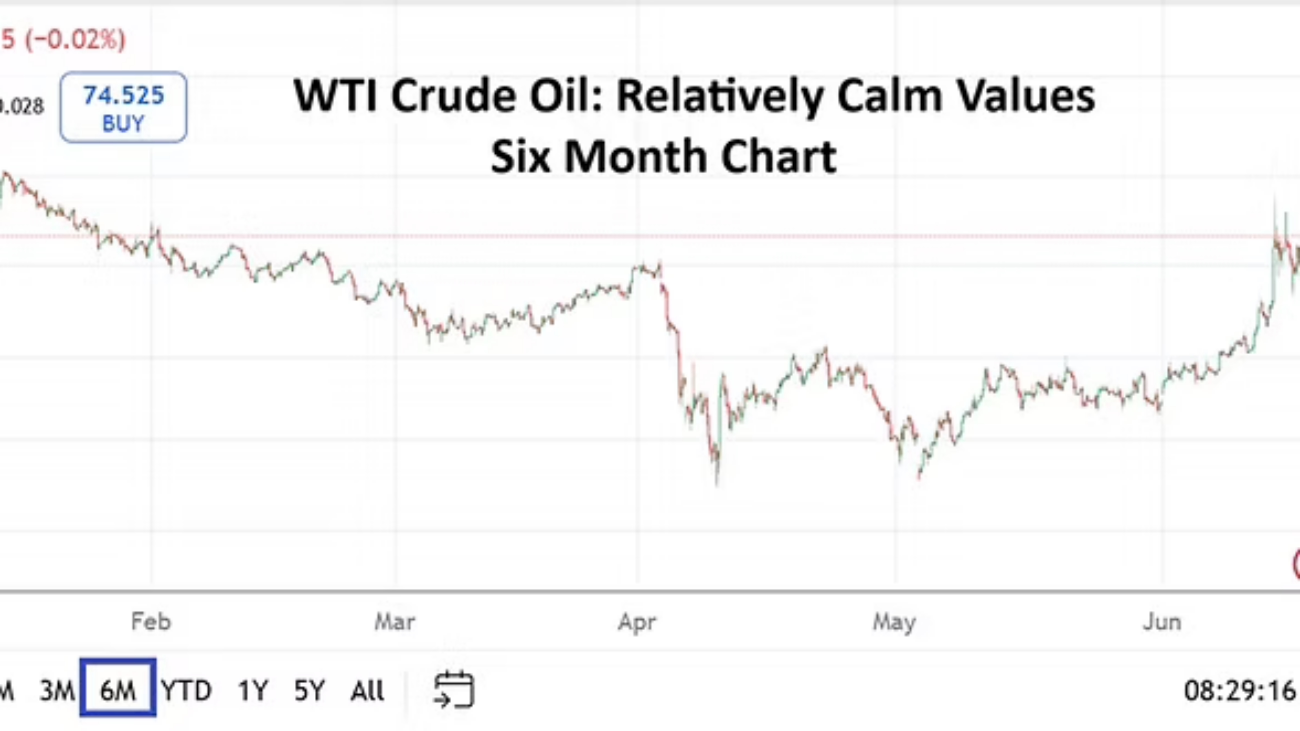
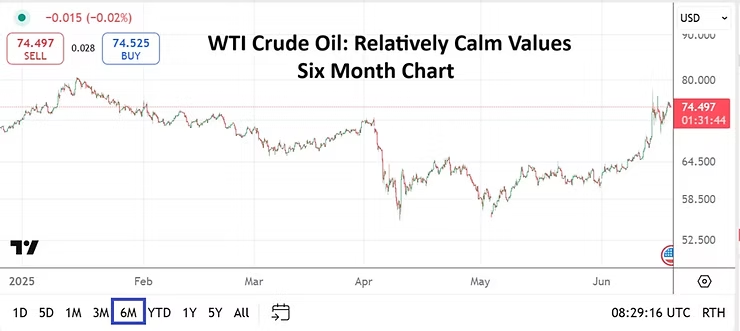
Why has the WTI Crude Oil Spot price remained relatively calm? The war between Israel and Iran has been going on per this latest violent phase since Friday the 13th. While tensions have been high between the two nations from the 7th of October 2023 in a very outward manner, and missiles were fired from Iran towards Israel on two separate dates in 2024 which then featured Israeli retaliation, the past handful of days is a new escalation.

WTI Crude Oil Spot Price Six Month Chart as of 18 June 2025

Day traders of WTI Crude Oil need to understand that large players in the energy sector have a vast amount of experience and intel regarding production and supply worldwide when they make their buying and selling decisions. However, the biggest oil traders do not always share the same political viewpoints, except to say most large players in the energy sector practice the art of realpolitik. Day traders of WTI Crude Oil should try to get into the minds of the real movers of WTI Crude Oil via realpolitik considerations.

As of this writing the price for WTI Crude Oil is around 73.930 Spot, late yesterday it did move higher to within sight of the 75.750 USD mark – this when information that President Trump is considering a U.S military strike on Iran heightened. Traders need to understand Spot Crude Oil and Futures pricing can be different. The current value of WTI Spot is higher than the Futures pricing because of the short and near-term known risks.

However, volatility in WTI Crude Oil Spot has remained fairly muted, almost tame as Israel and Iran wage war. Other spot energy prices like Brent and Natural Gas are being affected directly too because of shifts in behavioral sentiment. But again, the prices within the energy sector have remained calm considering what is at stake for global economics. Here are points that may be affecting the WTI Crude Oil landscape and energy complex, which some large traders may be contemplating:

  • It is highly likely the U.S has told Israel not to harm Iranian Oil production or supply sites, including shipping.

  • The U.S does not want the price of WTI to jump rapidly because of the current war between Israel and Iran.

  • Inflation would be a scrouge for the global economy, not to mention President Trump’s ambitions.

  • Even though the U.S has its own energy supply, the price of WTI is affected by behavioral sentiment within the global Crude Oil complex.

  • Meaning conflicts in the Middle East and elsewhere always cause ripple affects, even if Crude Oil is flowing freely in the U.S via its own production.

  • The U.S doesn’t want China to be given a reason to consider becoming an open belligerent in the Middle East war.

  • China gets a lot of Crude Oil from Iran. The stated percentage is around 15% of its total supply, but it could be more if Iran sends oil to other locations and then reroutes supply to China afterwards.

The U.S not only wants to keep China calm about its energy supply, but also doesn’t want to give China an excuse to escalate political or military tensions elsewhere – read Taiwan.

As an aside there are a lot facts and rumors coming from China, highlighting that a powerplay is emerging between competing factions for leadership in China’s military, this may include the authority that Xi Jinping has too. China will be conducting Politburo meetings in the coming weeks that will get plenty of attention via Beijing analysts. If U.S intelligence knows an internal political fight is taking place in China, they will want to keep China calm regarding external considerations and not give China excuses to act. Concerns regarding the Middle East as a justification for more Chinese actions against Taiwan in some type of economic political/ military theatre is a threat.

By telling Israel not to attack Iranian oil infrastructure, this allows the U.S to placate China. Only if Iran were to attack U.S infrastructure – including military assets or interests in the Persian Gulf via attacks on Gulf States like the UAE, Bahrain or Saudi Arabia would the U.S consider retribution against Iranian Crude Oil.

While the U.S has an interest in global politics certainly, it also wants to maintain a stable global economic environment. President Trump knows this and so does his cabinet supposedly. The Federal Reserve meets later today and they will certainly speak about uncertainty regarding inflation. Whether or not they mention the Middle East war will be interesting.

Thus, it is likely the U.S will only allow an attack on Iranian Crude Oil production and supply if it has been directly threatened. And this is where it gets potentially more interesting for Crude Oil traders. It appears likely the U.S will get involved directly in Iran by hitting known Iranian nuclear facilities deep underground with heavy U.S ordinance. If the U.S does attack Iran via B2s using heavy bombs, how will Iran’s Revolutionary Guard Corps react?

Will the existing IRGC allow for the destruction of its nuclear ambitions and accept that it will have to prepare for a new political environment in which their power will likely be challenged by not reacting? Or will those in power of the IRGC double down on stupidity and attack U.S assets with some of the Iranian military weaponry that still remains? An attack on U.S ‘interests’ would risk aggravating the U.S more – giving the U.S reasons to attack Iranian economic infrastructure which is mostly Crude Oil, and likely close the door on the chances of the IRGC to survive after the war concludes.

Things often do not work out via political and military outlooks. The law of unintended consequences is always a danger. The end game is quickly approaching for Iran’s current leadership. The U.S and Israel also hopefully have taken this into account. Recent outcomes in Iraq and Afghanistan have not gone as planned for the U.S when seeking a serene endgame.

As an example, it might be better not to eliminate the current Ayatollah Khamenei, and allow the people of Iran an opportunity to remove him if they want. The Iranian Revolutionary Guard Corps and its various factions are probably eyeing what will come after a capitulation. There will be a fight for survival politically and a leadership vacuum.

The IRGC fiefdom gets most of its money from Crude Oil revenues. It is quite possible in a forward looking manner the IRGC may choose not to risk having the U.S ruin Iran’s one giant economic asset, thinking rightly or wrongly that they can continue to profit from Crude Oil the day after the war ends.

post234

New Alternatives for Regional Alliances & Global Effects?

New Alternatives for Regional Alliances & Global Effects?

Opinion: The following article is commentary and its views are solely those of the author. This article was first published the 14th of March, 2025 via The Angry Demagogue.

There is so much going on that it really is difficult to keep up. Israel is at the center of many of the regional developments, as would be expected. But it is not just Israel as Israel, but Israel as an ally of the United States that is interesting. The Syria problem we have written about and it is still not clear what the Trump administration’s policy is there as they look skeptically but hopefully at Al-Julani’s Syria. In our opinion that decision will be made for them, since the chances that Al-Julani has changed his stripes to a Western democrat is small and even if we are wrong there – the armed Jihadist groups that he needs to control seem more interested in ridding Syria of ‘heretics’ than stabilizing the country.

Lebanon has changed enough for the United States and Israel to take chances. While it is too bad that Israel did not do more in ridding the country of Hezbollah, the fact that Syria is no longer part of the Shiite crescent means that they are isolated and not able to get funding and arms from Iran with the same ease. What is important about the current Lebanese government is that Hezbollah is not a part of it. That does not leave them powerless, but it allows the government to act more independently. The Lebanese Shiites, under Hezbollah and the less but still militant Amal, will have to rethink their loyalty to these two organizations. At the least, it should move Amal away from their stronger partner.

Iran now has no land route to Hezbollah and will have a harder time arming the Houthis, too. But it is in Iraq that they are facing problems which could cause as much damage to their projection of power as did the loss of Syria. Due to US pressure, Iraq has stopped buying Iranian electricity although they can still buy gas. It seems that the US is giving Iraq some time to find alternatives to Iranian gas and the Iraqi government is moving away from Iran on other issues too and are trying to get rid of Iran’s Shiite militias.

But the most interesting thing to happen is Israel’s attempt to strengthen America’s relationship with Azerbaijan, a country that Israel is in close contact with regarding Iran. Israel has always been rumored to plan to use Azeri air force bases in a possible attack on Iran. The Azeri official responsible for regional development was in Israel last month and is trying to bridge differences between Israel and Turkey. The Azeri’s next stop after Israel was to Turkey. Steve Witkoff is reported to have stopped in Baku after his visit to Moscow.

An Azeri company has also bought rights to Israel’s Tamar gas field. Israel currently gets oil from Azerbaijan via a pipeline that goes through Turkey so the energy relationship is strong and longstanding between Israel and Azerbaijan. It seems that Turkey’s relationship with Azerbaijan is more important to them than their animosity towards Israel – probably because the Azeris and Armenians are enemies. It seems that sometimes not only friendships have to be ranked but enemies, too.

Trump’s game with Ukraine is not necessarily to my taste but it could be that there is something much bigger going on here and that is connecting Israel, Russia, Central Asia and Turkey to a grand alliance with the United States. I don’t think that Trump will succeed in pulling Russia away from Iran and China and that Erdogan’s Turkey will not give up their dream of destroying Israel. But what if the Iranian regime falls after a combination of harsh sanctions, economic collapse and Israeli military attacks? What if Iran is pulled away from the alliance leaving Russia with just China? What if a Russian base in Syria is dependent upon their moving away from China?

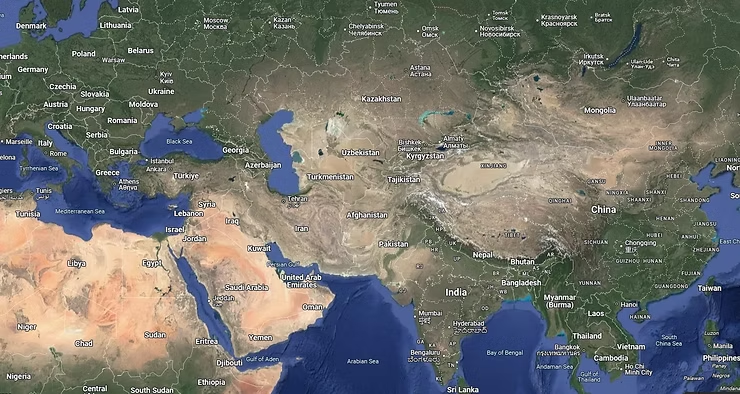
Last year the Axis held a near continuous land bridge from the Pacific to the Mediterranean. China was moving into Russia’s “sphere of influence” in the “Stans” of Central Asia with their economic bear hugs. This was something that the Biden administration ignored, but could be a bigger headache for Putin than a well armed but non-NATO Ukraine with American businessmen instead of soldiers as a tripwire.

Are we giving too much credit to Trump and his foreign policy team and to Israel’s influence in the expanded region that reaches beyond Syria? Is there more going on than we know or less?

On October 7 and the days that followed, the Biden Administration was sure that Israel was in such a panic that it would agree to anything, and they could force the Obama Middle East of a hegemonic Iran and a Palestinian state down Israel’s throats – and overthrow Netanyahu as an extra. None of those things happened.

Only a fool would predict what will be in a year, but what we have discussed above is one scenario no one would have considered even six months ago. The post WWII world looked nothing like the world of 1937, and the post WWIII world (the one we wrote about a year ago and may or may not have happened!) will look nothing like September 2023 – no matter how hard the UN yells and screams.

Could Israel and Azerbaijan be the keys to a realigned world?

It is against my nature to be optimistic, especially since Israel is still not done with Gaza, the hostages are not yet home and the internal politics are reaching levels that border on a soft coup.

However, while we don’t know where the aces are, we know that the Obama-Biden jokers are no longer in the deck.

Disclaimer: the views expressed in this opinion article are solely those of the author, and not necessarily the opinions reflected by angrymetatraders.com or its associated parties.

You can follow Ira Slomowitz via The Angry Demagogue on Substack https://iraslomowitz.substack.com/ 

postR196

AMT Top Ten Miscellaneous Votes for the 4th of November

AMT Top Ten Miscellaneous Votes for the 4th of November

10. Priorities: Not to dismiss the execution of beloved Peanut the Squirrel by New York authorities recently, but lets reflect on the fact that this little fellow made international news while wars are raging, and nearly 300 people in the U.S are dying from drug overdoses per day. Social media is rather powerful.

9. NBC: Kamala Harris appeared on Saturday Night Live for roughly 90 seconds this weekend, this created criticism and questions about unfair airtime for the Vice President. SNL is lucky to get more than 5 million viewers per episode on average. To try and apologize for the potential trouble, NBC then gave Donald Trump free commercial airtime twice yesterday, once during a NASCAR race which on average attracts over 3 million viewers, and on a Sunday night NFL broadcast which averages sometimes up to 22 million viewers.

8. Saber-Rattling: There is a potential Iran is waiting on the outcome of the U.S vote for President before undertaking more military actions. Deciding if and how they are going to launch another attack on Israel, depending on who wins the U.S election because of the potential ramifications is likely part of their military strategy.

7. BTC/USD: Bitcoin as of this writing is trading near 68,500 USD. The digital asset continues to bounce around rather intriguing resistance. On Tuesday of last week Bitcoin traded near 73,500 momentarily, while the highs are certainly noteworthy, support for the speculative asset has been around 66,000 since the middle of October. There are reasons to suspect Bitcoin will display a large amount of volatility this week, particularly when the new U.S President is known.

6. Forex: As of this writing the USD/JPY is slightly below 152.000, the EUR/USD is around 1.09000, the GBP/USD is near 1.29650. The question is where these currency pairs and other major FX assets will be in three nights. Day traders dreaming of riding momentum via financial institutions need to understand the equilibrium of risk and reward. In other words, the same amount of money you can make, is likely the same amount of money you can lose. Risk management will be a life preserver for many speculators this week.

5. U.S. Data: This past Friday the Non-Farm Employment Change numbers came in wildly below the 106,000 jobs added estimate, the result of only 12,000 hired was rather shocking, but met with almost muted bewilderment. Also, the jobs numbers showed another revision lower from the previous month. Advanced GDP quarterly numbers, on Wednesday the 30th of October, also missed their estimate coming in with a 2.8% gain compared to anticipated growth of 3.0%. The U.S economy is still under stress.

4. Barometers: Risk adverse trading has been widespread the past handful of weeks. While gold has reached new highs and is slightly below the 2,750.00 mark for the moment, one month from now will be a telltale for gold and many assets. Since the end of September a number of narratives have been heard trying to explain the results seen across the board, but the simple answer is caution has entered the markets. U.S equity indices are still flirting with highs, even as they have suffered downturns in recent trading. WTI Crude Oil is near 71.50 USD per barrel. Gold, U.S equities and WTI Crude Oil will react to the outcome of the U.S election and serve as solid behavioral sentiment indicators in one month when compared to current prices.

3. Federal Reserve: If last week’s U.S economic data had been delivered without the fanfare of the U.S election approaching, Fed observers would likely be anticipating a dovish sounding FOMC Statement coming on the 7th of November. Instead, the USD has remained rather strong as risk adverse trading has been demonstrated in the broad markets. The Fed is certainly in a position to cut the Federal Funds Rate by another 0.25 basis points, some could even argue for another 0.50% cut. However, the Fed is likely to cut interest rates by a quarter of a point and sound rather cautious as they too read the landscape in the wake of the U.S voting results. Mid-term outlook from the Fed will be scrutinized this Thursday.

2: Nervousness: Day traders who decide to participate in the broad markets near-term may also enjoy walking outside and looking at approaching storms and dreaming about the fury about to come. Being anxious before and during large risk events when outcomes are unknown is a survival instinct. Speculators need to protect themselves over the next couple of days. Tranquil trading in all major assets may appear, but as tomorrow grows long assets will begin to percolate and by Wednesday almost all financial markets will be boiling. While this is certainly being hailed as the most important week of the year because of the U.S election and the Federal Reserve, it is also a very dangerous time to be trading. Those with limited funds may want to hunker down in a safe place and watch the markets create bedlam over the next 48 hours.

1. U.S Election: The vote is less than one day away when old standards are considered. However, more than 72 million votes have been cast early in the U.S already. That’s more than 45% of the total U.S vote during 2020, when 158,434,567 votes were counted. While the media bangs the drum regarding the incoming results tomorrow, it is important to note that many Americans and global observers are merely waiting for the final results to be announced. The end of the election campaign is nearly upon us, now financial institutions and traders await clarity. Wednesday the 6th of November is going to be an interesting day for the markets.

postR196

AMT Top Ten Miscellaneous Frights for the 28th of October

AMT Top Ten Miscellaneous Frights for the 28th of October

10. MLB Concern: Baseball executives are hoping the Yankees can start to make the World Series more competitive this evening. The Los Angeles Dodgers have won the first two games of the championship battle. Significant hopes for a drama filled, seven game World Series would be dampened badly if the Yankees do not win tonight. Television ratings which were expected to be high could suffer appreciably if the Yankees go down three games to none. A non-competitive championship would mean a loss of revenue.

9. Israel and Iran: The Middle East saga is at number nine, and hopefully doesn’t become number one. A dangerous game of poker is being played by the participants. If Iran decides to up the ante once again, it would be a dangerous decision, because it appears Israel has positioned itself via this weekend’s retaliation to be more aggressive if need be.

8. WTI Crude Oil: The ability of the energy to move below 70.00 USD upon this morning’s trading is a sign the Middle East conflict remains tranquil in the minds of large participants in the oil sector. However, if Iran decides to test Israel again directly, Iran may find that its oil infrastructure is vulnerable. As the price hovers below 68.00 USD during this writing, it appears buyers who bought speculative positions the past few weeks might be capitulating.

7. BRICS: The inclusion of 13 additional nations as Partner States to the international organization led by Russia, China and India shows the entity sees itself as a growing alternative geo-political force and trading sphere with real power. The West should be paying attention, but often seems like it is not concerned about the potential strength of BRICS, and instead makes believe the group is a fallacy and much ado about nothing – this is a mistake by the West.

6. North Korea: The potential of North Korean combat troops entering the Ukraine – Russia war is a dangerous notion. However, it opens the door for Ukraine and South Korea to offer surrendering deserters the possibility of being allowed into South Korea, if soldiers can prove they are not spies. Unfortunately, the temptation of desertion by enemy troops could prove to be wishful thinking because North Korean soldiers will have intense supervision at all times; the threat of being shot as a liable traitor is a likely constant menace.

5. Gold: Record values continue to be seen, the price of the precious metal as of this writing is near 2,732.00. Noted as a store of value, gold is also seen as a safe haven by its buyers. Now may be the time to consider behavioral sentiment as a main driver because of anxiousness in the global marketplace. Speculative forces are certainly involved in the move higher too. With so many risk events shadowing, it may be very unwise for day traders to bet against the rise of gold near-term.

4. U.S Data and the Fed: Advance GDP numbers will be published this Wednesday, the Core Personal Consumption Expenditures Price Index will be seen this Thursday, and on Friday the Non-Farm Employment Change statistics will be presented. Fireworks should be anticipated by day traders. The combination of these reports, the approaching U.S election, and the Federal Reserve’s FOMC Meeting decision on the 7th of November will be enough to make most analysts hearts beat faster.

3. USD/JPY: Japan’s election results today now require a coalition government because the ruling Liberal Democratic Party has lost its majority. The Bank of Japan has a meeting this Thursday and is expected to hold its BoJ Policy Rate in place. The Japanese Yen has returned to values above the 153.000 level as of this writing. While many major currencies have lost value against the USD since the end of September, the USD/JPY needs to be watched as a dynamic combination of risks abound. Political gridlock, inflation, and lackluster economic data in Japan are not ingredients which will provide financial institutions with optimism in the near-term. The historically cautious attitude of the Bank of Japan will be severely tested in the coming weeks.

2. U.S Election: There is a little more than one week to go before the Presidential vote begins. While many folks are focused on the White House, the race for the Senate looks to be a stiff competition too. Republicans are hoping to regain the majority in the Senate and retain their power in the House of Representatives. Financial institutions are apprehensive about the outcomes for Congress, which will have an important role in fiscal and regulatory management. The Democrats appear to be nervous. Noise from the campaign trail and media will become heightened over the next seven days. Top bureaucrats in offices like the SEC, CFTC, FCC and other agencies know their jobs are on the line.

1. Market Volatility: U.S economic data, the coming election, and the Fed means the next week and a half of trading in the global markets are going to be packed with violent firework displays. Day traders who do not have experience should watch from afar, because the coming price action can cause fast losses for those caught on the wrong side. Trading sentiment is fragile, this is evident via the choppy results seen in equities, Forex, many commodities, and rising U.S Treasury yields. Over stating the obvious for the moment about risk management is a public service.

postR196

AMT Top Ten Miscellaneous Concerns for the 6th of October

AMT Top Ten Miscellaneous Concerns for the 6th of October

10. Ya Gotta Believe: The New York Mets are finding ways to score in the late innings. Having won with last minute runs against the Atlanta Braves in the 8th and 9th innings early last week to save their season, hitting a home run to take the lead against the Brewers in the deciding game of the Wild Card in the 9th, and last night’s 5 runs in the 8th to take the lead in Game One against the Phillies in the Division Series has been rather remarkable. Game two between the Mets and Philadelphia will be played later today.

9. Information Technology: OpenAI’s value is now estimated around 157 billion USD, this after their latest round of investments garnered that includes both Nvidia and Microsoft funding. The search engine arms race will continue to get tougher and more competitive, but recent data released by Statcounter shows that Google still has over 90% of the U.S search engine traffic. While it has lost some ground in the search engine battles to upstarts statistically, Google remains dominant. Microsoft has made inroads with Bing, and Yahoo has also gained, but Google’s stranglehold via browser usage remains strong.

8. Helene Meets Milton: A pair of hurricanes – this if Milton fulfills forecasts and becomes a major storm – are not helping create easy days in the U.S Southeast, nor for the Biden administration. Criticism regarding a lack of government help has been heard in the aftermath of Helene and with another potential punch about to be delivered by Milton, U.S relief agencies like FEMA will certainly be pushed to the limit organizationally.

7. Oil Alerts: WTI Crude Oil went into the weekend close to 75.00 USD per barrel as nervousness increased about the potential of an attack on Iranian oil infrastructure. While many nations in the West do not purchase Iranian Crude Oil openly, the Iranian commodity is sold to China at nearly an 89% ratio. This allows oil from other suppliers like Saudi Arabia, the U.S and Mexico to sell elsewhere and the price of Crude Oil to remain relatively tame. However, if the supply of Iranian Crude Oil were suddenly to be crippled for any length of time, the price of the commodity from the other major suppliers would certainly go higher if expanded demand needs to be met. Speculators should pay attention to strike prices in the energy sectors via options trading in the future markets to understand potential vulnerabilities that large players may be anticipating.

6. Precious Metal: Gold prices remain within sight of record values, but below the apex values seen on the 26th of September. Risk sentiment, speculative forces and long-term investors are seemingly creating resilient support levels. Gold went into this weekend near the 2,653.00 USD ratio. Silver remains near 32.00 USD per ounce, which is where its price was traversing in May. Speculators intent on betting that silver will rise because nervous market conditions will create more demand need to be careful. A vast supply of silver exists in known mines globally, and producers simply need to extract more of the commodity to garner profits which is relatively easy. In other words, gold and silver do not correlate as much as some people believe.

5. Forex Chaos: Day traders of USDJPY, NZDUSD, EURUSD and a slew of other major currency pairs were taken on a wild ride last week as USD centric strength surged and fragile conditions in global markets grew. The coming days will remain difficult for FX retail traders as they face a whirlwind of threats. Technical and fundamental traders are being hit by shifting winds generating via a myriad of worries. Speculators without deep pockets are advised to remain cautious in the coming days because trading dynamics are not likely to ease. Yes, there will be price velocity which allows for quick profits, but those who are willing to bet on the prospects of fantastic gains must also accept the dangerous proposition that wildly expensive losses if they are on the wrong side of a trade are equally possible. Brokers will certainly welcome their clients with open arms this coming week because the volatility may entice many with the potential of getting rich. However, brokers will not tell you about the poor house on the other side of the street.

4. Unscripted: There are a little more than four weeks before the 2024 U.S elections on the 5th of November. Trump appears to be gaining momentum in polls, but certainly remains vulnerable per his ability to speak without a script and create verbal firestorms. Kamala Harris ran into problems recently with a suspected malfunctioning teleprompter and her inability to escape repeating the words ’32 days’. While the two candidates battle for voter supremacy, questions persists about the current leadership from the White House and who exactly is running the show.

3. Noisy Data: The Federal Reserve and economic data remain concerns. This Thursday the Consumer Price Index data will be released. If the inflation statistics can come in below expectations this may soothe financial institutions who have leaned into the notion the Fed needs to remain aggressive in November. Another interest rate has been expected, but some are nervous the Fed may not be able to cut as fully as wished. However, day traders need to also understand politics are playing a role in the bombastic soundbites being generated by the media, this as they try to deliver messaging which reflect their viewpoints. If inflation numbers remain under control the mid-term outlook continues to point towards more interest rate cuts. While the U.S jobs numbers on Friday were better than expected it should be noted revisions downward were seen again. There is one more Non-Farm Employment Change report before the election, by then it will probably not have an impact on potential voters, but its affect on the Fed will certainly be felt.

2. End Game: As the Iranian and Israel conflict escalates and threatens to become a dark spiral, some are still hoping for an avenue which will allow normality to return. That appears to be wishful thinking for the moment. Reports, perhaps paranoid, regarding an earthquake in Iran yesterday with a magnitude 4.5 seismic rating which was 48 kilometers from Semnan was noted by the USGS. The reason why it is potentially scary notion is because some are questioning if this was a nuclear test being conducted by Iran.

1. Risk Adverse: A trifecta of nervous behavioral sentiment is shadowing the financial markets via Fed outlook, Middle East tensions, and the approaching U.S election. Unfortunately none of these components are likely to disappear soon and in fact may grow in stature as outlooks potentially create more anxiousness. Safe havens in the USD, gold and U.S Treasuries may find they deliver some calm for those that are nervous. However, it must be noted that U.S equity indices gained nicely late last week after gains on Friday. The Dow 30 and S&P 500 remain near apexes and the Nasdaq Composite is within sight of highs. In other words, for all the talk about dark days, financial markets and investors are still active.

postR188.1

Trading Risks: Easy to be Nervous Now, But Calm is Needed

Trading Risks: Easy to be Nervous Now, But Calm is Needed

Simply put it is too easy to be nervous when contemplating the markets if you are a day trader. Today the Non-Farm Employment Change data will be published in the U.S and the Middle East conflict continues to reverberate. However, if a speculator looks at the markets they will see risk adverse trading has produced rather predictable results in many assets.

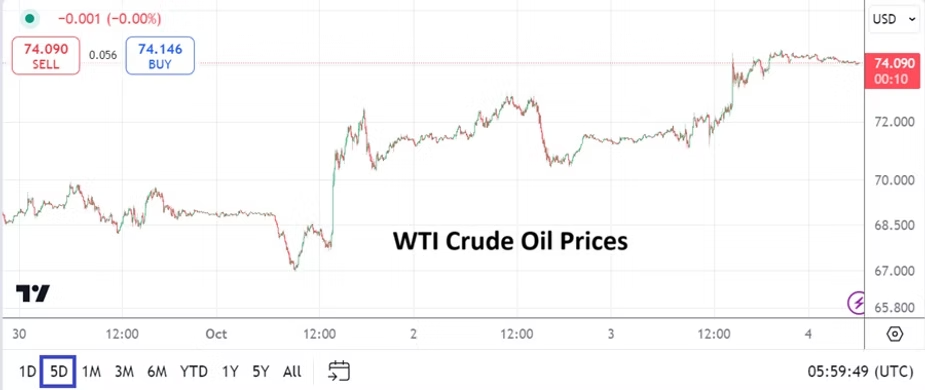
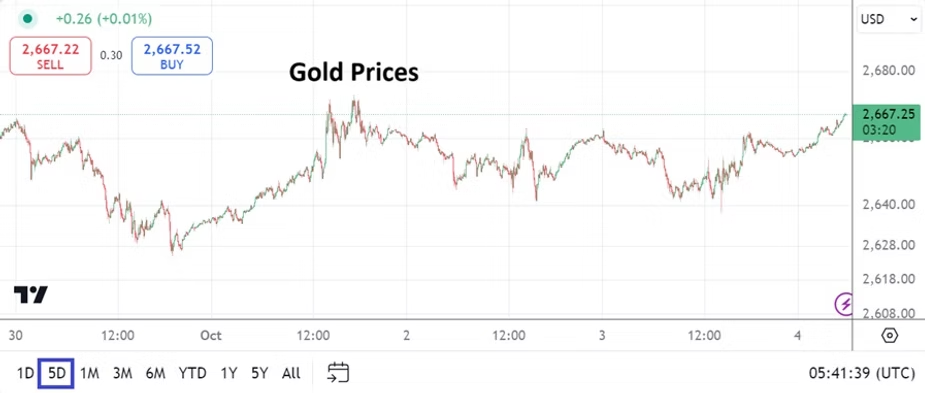
Gold remains within its higher known price realm, and WTI Crude Oil is trading around 74.00 USD after President Joe Biden for some odd reason felt it was necessary to discuss publicly potential targets Israel may pursue against Iran. Also, Biden’s influence on the decision making in the Middle East appears to be fleeting and this is making financial institutions additionally anxious.

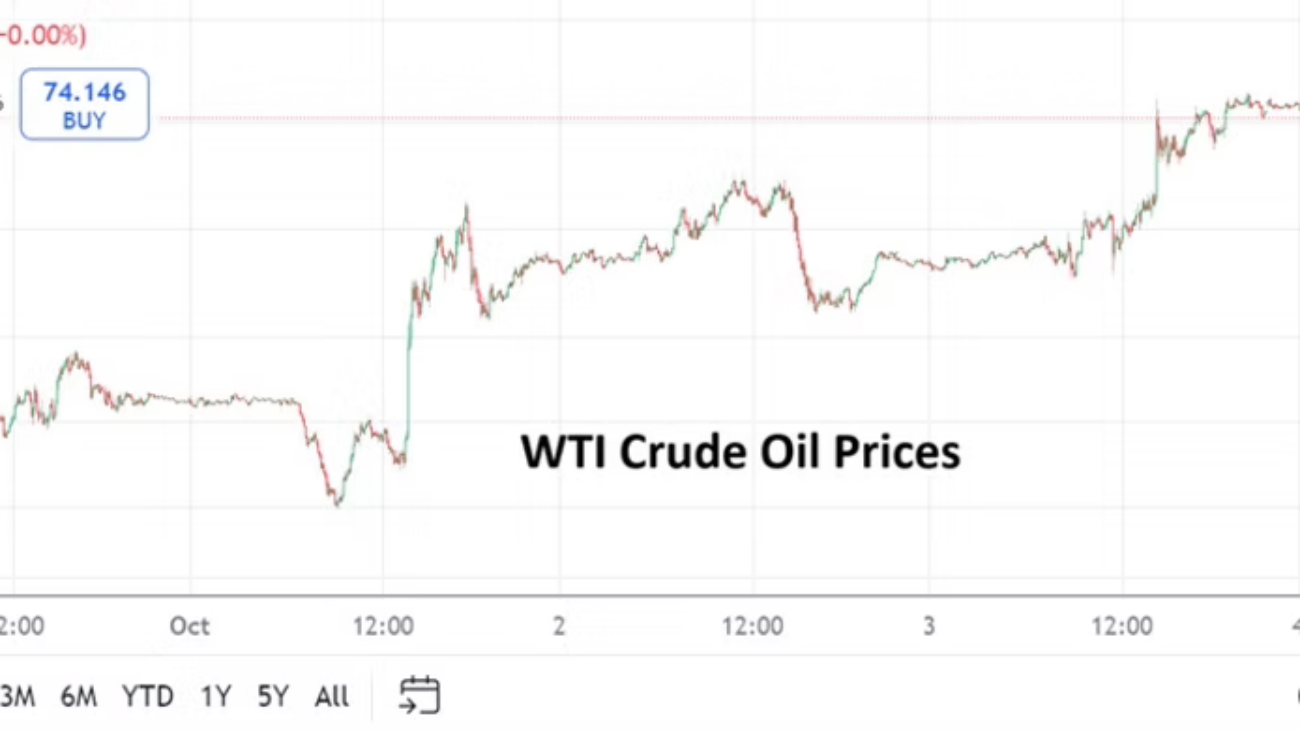
WTI Crude Oil Five Day Chart as of 4th of October 2024

The employment numbers from the U.S today are vital regarding the Federal Reserve’s interest rate decision for November. If today’s jobs statistics come in weaker than expected this could help the USD lose some ground in Forex against major currencies. However, there is also the prospect that headwinds via concerns from the Middle East will keep a steady diet of risk adverse trading a driver for behavioral sentiment going into the weekend. Forex remains dangerous for day traders in the near-term.

Traders who believe more volatility will come because of the ramifications in the Middle East can certainly pursue assets like gold and WTI Crude Oil. Correlations with risks that are flourishing as potential conflict brews is not a foolish wager, but it is also difficult for speculators to pursue these trades via CFDs offered by many brokers, this because day traders may have to hold onto their positions too long in order to take advantage of potential moves. If a speculator can pursue options positions via future markets, this could prove to be a solid tool, provided strike prices are not outrageously expensive and the prospect of time erosion is not too fast.

Gold Five Day Chart as of 4th of October 2024

This is not an easy time to be a day trader and those that are nervous should choose to remain on the sidelines. U.S Treasury yields have increased this week as behavioral sentiment has become jittery. It is important to remember however that short-term reactions are frequently not related to long-term outlooks. Treasury yields have come down significantly in the mid-term and remain within the lower part of their range. The same can be said for equity indices this week. The notion that the world will not spin out of total control should be considered. Risk adverse trading will certainly begin to gravitate towards optimism at some point, it is only a question of time.

The point for day traders is this, it is easy to be nervous. Watching television all day and looking at smartphones for updates on developing sagas does not help create calm. Large institutional traders have been within these volatile waters before. Yes, large players also have to remain diligent, but they will certainly do their best to remain realistic. Short-term price velocity often leads to reversals and you can be assured large financial institutions will take advantage of this insight.

If today’s U.S jobs numbers meet or come around expectations this would be a welcome result for markets which appear to be standing on fragile ground. Traders while looking at today’s Non-Farm Employment Change numbers and Average Hourly Earnings statistics should also be mindful of downward revisions to previous reports which have occurred almost consistently for a handful of months. Initial trading reactions to the publication of jobs data are often met with sudden reversals due to revisions in numbers being spotted a few moments later by analysts.

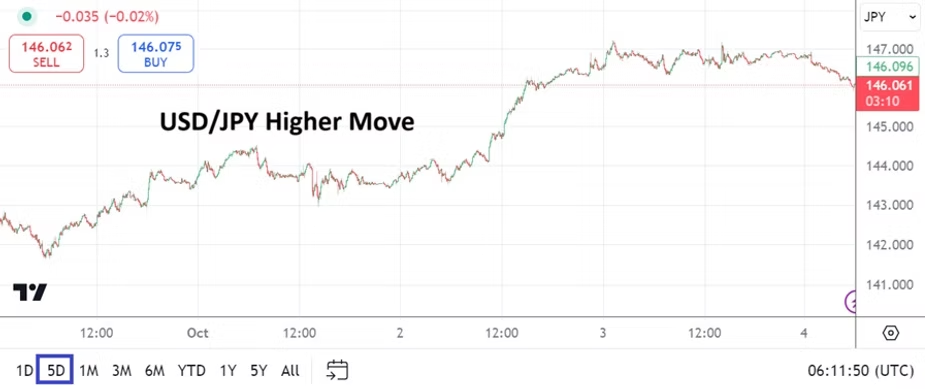
USD/JPY Five Day Chart as of 4th October 2024

As for the Middle East, financial institutions and traders are all in the same boat. Patience and deep breaths are needed. The trillion dollar question lurking, is there an end game that is viable and can restore calm, or will retribution and hatred cause the conflict to spiral out of control?

The volatility seen in Forex the past handful of days, including the USD/JPY, have caused dynamic results. There is no denying risk adverse trading has taken hold of the marketplace. The trifecta of U.S jobs numbers today, tensions in the Middle East, and the approaching U.S election have set the table for a tumultuous meal. At some point day traders may want to walk away from the table to avoid indigestion and return only when tranquility has been restored.

postR187.1

Trading with Tomorrow in Mind as Risk Adverse Emotions Grow

Trading with Tomorrow in Mind as Risk Adverse Emotions Grow

Speculators by nature have to be optimistic about perceived outcomes. As risk adverse conditions hit global markets both financial institutions and traders are still engaged with tomorrow and the days ahead. Tomorrow is definitely going to happen. Calmer heads at some point will prevail. Current nervousness will subside. Thus far today relatively tranquil trading has been seen as prices remain within known technical equilibriums.

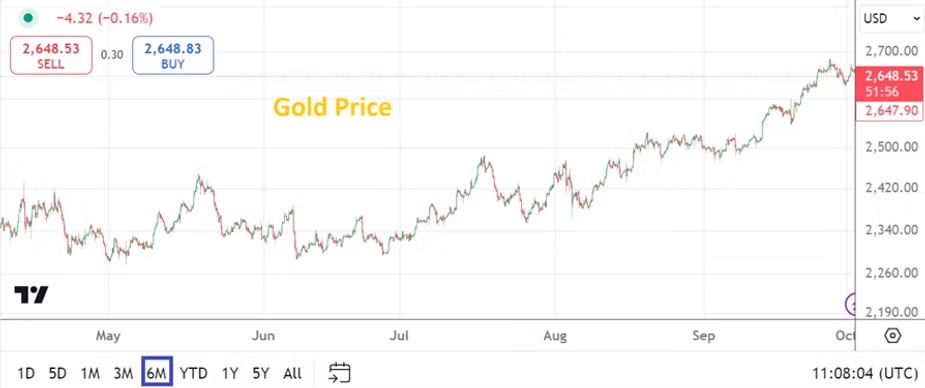
Gold Six Month Chart as of 2nd October 2024

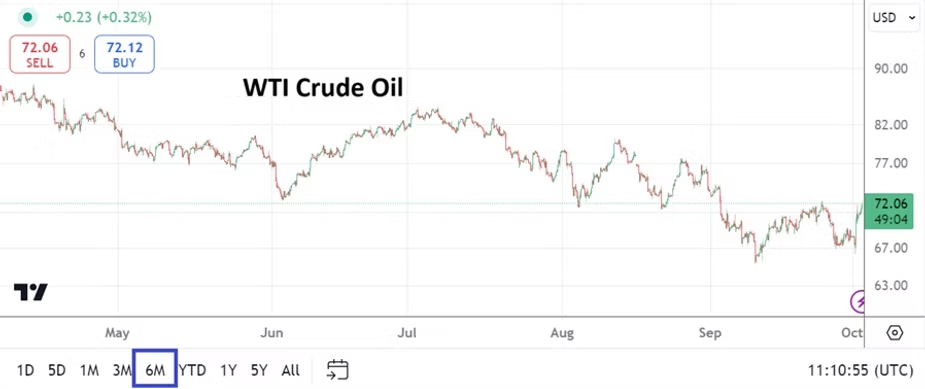
While people contemplate the tensions from the Middle East the markets remain quite active. Gold as of this writing is near 2,650.00 USD per ounce. And WTI Crude Oil is trading around 72.00 USD per barrel. The value of Gold has been in a strong bullish trend the past year it could be argued, and WTI has been bearish throughout the mid-term.

WTI Crude Oil Six Month Chart as of 2nd October 2024

While saber rattling in the Middle East threatens to escalate, financial institutions are still gearing towards Friday’s Non-Farm Employment Change numbers. The data is expected to come within the grasp of last month’s hiring figures, but Average Hourly Earnings are expected to drop slightly. If the jobs numbers come in weaker this could spark USD centric weakness. That is if risk adverse trading moderates.

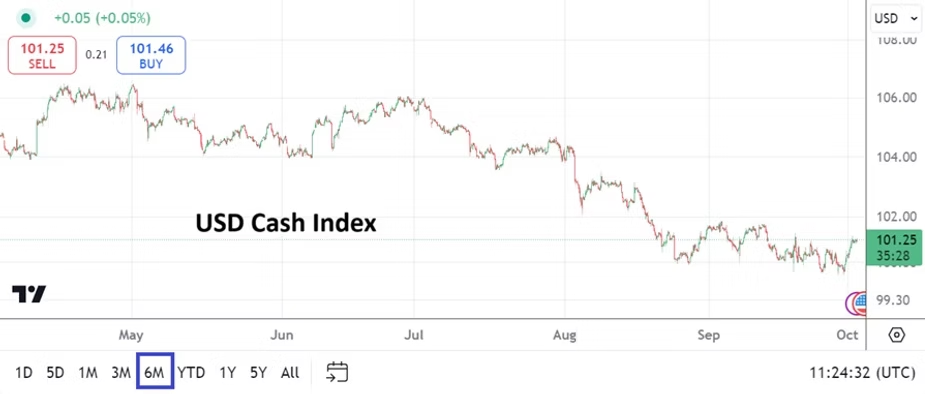
USD Cash Index Six Month Chart as of 2nd October 2024

The past day has seen heightened nervousness, but it must be pointed out that value realms are still maintaining rather optimistic outlooks regarding the Fed’s ability to remain dovish. What needs to happen now for the markets to turn tranquil are jobs reports on Friday to confirm outlooks, and for Israel and Iran not to engage in an all encompassing war. A look at the USD Cash Index shows a slight uptick, but it is definitely maintaining lower realms.

While risk adverse trading can be blamed for the results seen in the markets the past couple of days, it should also be pointed out that cautious perspectives are being practiced by some financial institutions who simply may believe values via USD centric weakness may have been overdone in the near-term. While many financial houses certainly believe the USD is bound to be weaker mid-term because of the Federal Reserve, do not mistake their short-term trading with their long-term outlooks.

Many people believe banks do not bet on the direction of Forex. But a look at the cash forward trading that banks do for their commercial clients demonstrates banks have skin in the game, and are trying to protect themselves via a multitude of layered hedging which still amounts to speculation.

Leaving us with the final point, day traders need to protect their accounts too by understanding market conditions. Volatility in the near-term is almost a certainty. Speculators should be careful not to get caught up in the amplitude of fear that is being generated by media sources looking to gain viewers. Betting blindly on outcomes because of fear will lead to costly mistakes. Eliminate the noise.

Optimistic attitudes frequently win. Day traders need to remain patient, keep an eye on developing news from the Middle East, but understand that U.S economic data results still provide the most navigable winds. Impetus will move gold, WTI Crude Oil, the USD, and equity indices via dynamic thrusts over the next few days.

postR196

AMT Top Ten Miscellaneous Salvos for the 29th of September

AMT Top Ten Miscellaneous Salvos for the 29th of September

10. Profit: OpenAI has announced plans to become a money making corporation. Founded in 2015 the artificial intelligence company had the stated goal of creating ‘safe and beneficial’ technologies via its foundation, and now will face the slings and arrows of investors and potential critics. The AI boom the past two years has produced many new competitors. Can Sam Altman, the CEO of OpenAI, sustain the momentum generated or will negative organizational impetus turn the company into an also-ran?

9. Softs: Cocoa, Coffee and Sugar all remain volatile and playgrounds for day traders who like casino experiences via CFDs. Cocoa is again over 9,000 USD, Sugar touched February highs this past week as it shows signs of extreme speculation, and Coffee Arabica surged to record prices on Thursday and Friday. Over exuberance however is not being created by day traders, it is the work of large institutional traders who are in control. While the ‘softs’ may look overbought it would be unwise to bet against trends while big players pursue bullish notions. Massive money is being made in these commodities, but losses are also being felt by those who wager incorrectly.

8. Escalation: Risks in the Middle East have become a focal point, this as the region appears to have generated more must watch television. The noise which the media seemingly craves is hard to escape. Market participants cannot be blamed for maintaining vigilance as sabers rattle, especially after Friday’s events in Beirut when Hassan Nasrallah, the Hezbollah leader, was eliminated by Israel. However, experienced traders who are also strategic analysts have seen this show before and may turn the channel knowing there will be reruns in the future.

7. WTI Crude Oil: Prices closed within the lower elements of the commodity’s long-term depths. Traders did have a chance to react to Friday’s developing news from Beirut, but the energy sector remained calm. The price of WTI was around 68.57 going into this weekend, after trading at highs earlier in the week. For all the talk about fear of escalation from the Middle East, the price of Crude Oil remains within a remarkable bearish stance as large traders appear to be more concerned about lackluster economic growth globally.

6. Apex Gold: The price of the precious metal flirted with 2,685.00 momentarily on Thursday. The price of gold going into this weekend finished near 2,658.00 USD. Sustained highs have certainly continued to catch the attention of short-term speculators, but they need to be aware the commodity does remain susceptible to sudden spikes. While alluring, gold remains dangerous for day traders.

5. Countdown: The U.S Presidential vote is slightly more than 5 weeks away. Interestingly, the Fed will announce their Federal Funds Rate decision only two days after the election results. Will the outcome of the vote change the Fed’s perspective on interest rates? Financial institutions will definitely brace for the outcome of the U.S vote. Cautious winds will start to prevail as the 5th of November draws closer.

4. China: A huge stimulus package from the Chinese government has been initiated, but talk regarding potential effects and outcomes are being debated. The notion that the Chinese economy is be driven too much with a top to down centralized approach is being vocalized by some worried ‘outside’ observers. The USD/CNY is trading near 7.0105. The Shanghai Composite is near 3,087, this after massive gains via a reversal upwards which was sparked from lows around 2,691 which were seen on the 18th of September.

3. Risk Appetite: U.S equity indices continue to challenge record values in the Dow 30 and S&P 500. Yes, the Nasdaq remains beneath its highs, but is still within sight of all-time heights. Trading this week will work under the shadow of the jobs numbers coming this Friday. Financial institutions have produced rather positive behavioral sentiment and do not seem like they are ready to back away from this stance. Are some large market participants starting to quietly bet on the possibility of a Trump victory which they believe would be good for U.S stocks?

2. Forex: USD centric notions remain the impetus in foreign exchange. The USD Cash Index is within the lower boundaries of its long-term values as it trades near July 2023 realms. If the USD Cash Index moves lower it would then start to technically be within price calculations not seen since the spring of 2022. Action in the USD/JPY and GBP/USD, and other major currency pairs have been volatile, choppy conditions should be expected this week for traders leading into Friday’s key data.

1. Jobs Numbers: Last week’s GDP statistics met expectations, while inflation numbers via the Core PCE Price Index came in slightly below estimates. The growth and inflation outcomes set the table for the Non-Farm Employment Change and Average Hourly Earnings which will be reported on the 4th of October. If the employment numbers continue to trend lower and there are additional negative revisions this coming Friday, this could propel USD selling. Financial institutions are trying to figure out if the Fed will cut by 0.25% or 0.50% in November. The Fed was aggressively dovish when they cut the Federal Funds Rate by 0.50% on the 18th of September, but the U.S central bank might want to be cautious in November following the election and wait for all the dust to settle and cut by only 0.25%. Thus allowing for another interest rate cut in early 2025 if needed. The broad markets are in a reflexive mode for the time being, this Friday’s data will be important and cause an immediate reaction that day traders will notice.

postR176

Make Common Sense Great Again: On Moving Away from Nuance

Make Common Sense Great Again: On Moving Away from Nuance

Opinion: The following article is commentary and its views are solely those of the author. This article was first published the 23rd of July 2024 via The Angry Demagogue.

Has there been a total breakdown of readiness in the West? When we look at seemingly unrelated events we see that people in responsible positions in governments around the Western world have missed signs that are obvious – and not only after the fact. The attempted Trump assassination just got me thinking how no one seems to react to the obvious anymore. It seems that both the local police and the Secret Service knew that this young man was on a roof with a rifle and no one took the most elementary actions of delaying Trump’s appearance or trying to stop the shooter or even ascertain his motives all of which was obvious to everyone else. We are not talking about someone missing a shot at him or even forgetting to check a specific place, but an active decision was made – to do nothing.

On October 6 and 7 the IDF Chief of Staff and his senior advisors on the General Staff heard of possible Hamas plans to attack, knew of previous intelligence that detailed the exact attack that happened and even refused a request of the head of the Southern Command to move 4 helicopters closer to Gaza. Instead of doing even the minimum, they just did nothing. They ignored the obvious and ruled purposely against common sense and in favor of their own preconceived notions.

As Russia was massing troops on the border and as Putin’s talk was becoming more and more belligerent the US administration did nothing that might have at least hinted to Putin that this could only lead to disaster. Putting US troops on a higher alert, inviting the Ukrainian ambassador to the White House as a show of support – anything really, might have given Putin food for thought. As Iran moves closer and closer to attaining a nuclear weapon and taking control of the middle east, the West just does nothing. Destroying Houthi assets (as the Israelis have just done), sending B52’s into the sky for training missions to destroy Islamic Republic assets – all that might have made the Iranian rulers wonder what was in store for them and limiting the war to Gaza. But again, against common sense, nothing was done because …. Wishful thinking.

If those responsible were acting like boys in the school playground (are boys still allowed to play in the playground?) they would have done more than they did in all these cases. 

Since the end of the Cold War we have seen the abandonment of common sense in favor of sophisticated analyses where nuance trumps simplicity and bias dominates the analysis of data and where cliches overtake serious policy. In classical Jewish biblical exegesis, there is one rule which nearly all (non-mystical) commentators hold and that is that the exegesis cannot contradict the simple meaning of the words of the Bible.  True enough, that is stretched to points of wonder sometimes – but they still cling to the rule. 

Common sense is underrated in policy analysis and often in business, but those who ignore it now will be challenged later. Common sense means the acceptance of what people say and looking at data without bias. Common sense means that you have to understand the person you are talking to and don’t assume they think like you. 

Back in my university days I read a lot of Hannah Arendt, who, in spite of the banality of her banality of evil theory had a lot to say. In her book “The Human Condition” she speaks of common sense – or as she often puts it “the sense of the common”.

I would like to quote her here, even though I tend to think she would not have thought that it was the rulers, the policy makers and the writers who are ignoring common sense:

“The only character of the world by which to gauge its reality is its being common to us all, and common sense occupies such a high rank in the hierarchy of political qualities because it is the one sense that fits into reality as a whole our five strictly individual senses and the strictly particular data they perceive.  It is by virtue of common sense that the other sense perceptions are known to disclose reality …. A noticeable decrease in common sense in any given community and a noticeable increase in superstition and gullibility are therefore almost infallible signs of alienation from the world.”

Arendt of course assumed that the lower or working classes were susceptible to superstition and gullibility but in these times it is the ruling classes that have abandoned common sense in favor of superstition and gullibility. It is they who are alienated from the world. Preconceived notions that contradict the plain meaning of the world is today’s superstition – and it is no less dangerous and irrational than the superstitions of times past.

Let’s take a brief look at these policy decisions by nearly all western countries, regardless of their geographical location or economic outlooks, their demographic trends or the overall culture of their people and their neighbors resulting directly or indirectly of the perilous situation the free world is now in.

Defense Spending and Force Size

The post-cold war “peace dividend” became an idol of western policy makers.  Massive cuts in defense spending even in things that were very necessary to the maintenance of said “peace dividend” – like naval power – was the preferred way of dealing with the end of the Soviet Union. The “End of History” was read simplistically instead of realizing that other ideologies and other powers might very soon challenge the victorious west. Some thinkers, I think of a professor of mine (Elie Krakowski) who back in 1979-80, before the collapse of the Soviet Union, spoke of Islam as the third force which will challenge the West and the East. I studied in a small university and if we were discussing it back then how are policy makers in Washington, London, Tel Aviv and Paris not speaking of it today?

While Edward Said’s “Orientalism” was the talk of the town, Bernard Lewis and Fouad Ajami were, despite their posts at Princeton and Johns Hopkins, not taken seriously enough. If they were, the US Navy would not have gone from 594 ships in 1987 to 275 in 2016. The British Navy  went from about 170 ships in 1970 to well under 50 in 2017. The rest of Western Europe we all know about. But at least countries like Netherlands, Belgium and Denmark don’t face hostile neighbors and were never meant to have forces that would do more than assist in minor operations.

Israel on the other hand has always faced neighbors who have desired to destroy it.  Even the countries with which it signed peace treaters, Jordan and Egypt, have never been able to translate these treaties into popular support and are always a coup away from belligerence. The history of dictatorships in general and of the Middle East in particular ought to have given the Israeli high command at least a hint as to what they might be facing. With the advent of Iran as a major regional power with the means and desire to spread its theo-revolutionary ideology, Israel ought to have realized that the era of wars was not over. Yet, since 2000 Israel has cut 6 divisions and decommissioned 2,000 tanks from its forces. It has cut military service for men from 36 to 32 months, even as it has not increased the mandatory service for woman from 24 months even though it has increased the amount of women in combat and combat support roles. The ultra-orthodox still don’t serve (they are about 16% of the draft class) zero even after October 7 and the number of youth who have received exemptions due to “psychological” reasons has skyrocketed to nearly 13% of the draft class. I don’t mean to belittle those with true psychological issues but rather the high numbers signify that many if not most are of a class that allows them to afford to pay psychologists for convenient diagnoses.

In other words – the IDF, the Finance Ministry and the political class all found it convenient to reduce the size of the army – both manpower and equipment – and used the excuse that there will be no more ground wars to justify the move.

The Ukraine conflict revealed to the world that US arms production of even the most basic arms is not enough for the US itself to maintain minimal levels during wartime.   The current Middle East conflict has magnified this disaster.

Common sense readiness has been ignored throughout the Western world due to sophisticated thinking more wishful than realistic. This is nothing less than a messianic and superstitious belief in the end of wars.

Immigration and Assimilation

If there is one issue that common sense has missed it is immigration. The reactions of average citizens to unlimited immigration in Western democratic countries has been uniform – NO! In some countries the yelling is louder but in all western countries there is significant opposition, on common sense grounds often, to the establishment immigration policies.

I am an immigrant to Israel and my grandparents were immigrants to the United States. Immigration, the movement of peoples from place to place has been going on since people left Africa – and before. But there is no separating immigration from assimilation unless your immigration is due to imperialism and conquest.  The Romans, Greeks, Chinese and Persians of ancient times, the Arabs of late antiquity were all imperialists. There was of course the age of imperialism that ended in WWI. But 21st century immigration is not of national conquest but of individual movement of people and families. One by definition must adapt to the local cultures – in the widest sense of the word. If a cotton farmer from Arizona wants to move to Iowa, he better adapt to the climate and figure out how to grow wheat or soybeans instead of cotton. If an aristocrat from England decides to move to the United States, he needs to know that his family heritage and titles won’t get him much. If a Spanish or Chinese speaker moves to Germany, the expectation is that he will learn to speak German.

An immigrant who does not respect the local culture in all its manifestations needs to get permission in order to stay in the new country. That is the way of the nation-state that has protected freedom in the western world so well (if not always so well). We can’t compare the 21st century to the pre-WWI world where borders were porous and people that survived the trip across a continent or an ocean could settle in that new land. Some more successfully than others. 

Common sense dictates that an immigrant that does not respect the laws of his new home has no right to live there. Yet, time and again, immigration policy has been separated from the law and being law abiding has no bearing on future citizenship.  Therefore, there is no demand from the immigrant and no opportunity for the immigrant to assimilate and be part of the social fabric of his new country. That being said, the mass Islamic immigration into Europe could be said to be imperialistic as the leaders of these communities have discouraged any type of rapprochement with Western values and law. That, along with the demographic collapse of indigenous Europe has put Europe on the brink of either a civil war or a peaceful surrender to Islamic imperial forces.  

Free Trade and Social Peace

There is no doubting that free trade brings prosperity and that economic growth better than any other global trading system. Free trade  is also the best way to lift the global poor out of poverty. The U.S constitution understood the importance of free trade, as states were prohibited from starting trade wars with each other.   This has also been the “good” in the E.U and has produced much prosperity in that Union.

Yet, free trade with allies needs to be differentiated between free trade with enemies  – meaning those that oppose our system. Free trade that allows your enemies to defeat you militarily is not free trade but suicide. So too, trade policies need to have social issues taken into consideration. This is not a call for tariffs or against free trade pacts, especially with neighbors, but rather they need to be adjusted with common sense solutions to employment and other problems that will arise from any economic change. 

Social peace is the second half of this section because, besides immigration, the erosion, not to say destruction of physically intensive jobs can and often does lead to social violence for reasons obvious to those with common sense.

Energy and Food Supply

For the most part, you would think that after national defense, it is a government’s first responsibility to its citizens to guarantee the food and energy supply of its citizens. Before we get to luxury and access to travel, the ready supply of food and energy seems to be the minimum that a government ought to do. And yet, when we speak of issues related to climate change (and lets not get into the “is it or isn’t it real” argument) the solutions first mandated to the problem have to do with limiting both of these items without which we cannot live. In California, farmer’s access to water is limited even after the drought due to concerns about some fish and climate, and in the Netherlands they want to pay farmers to stop producing food so that the Earth will not suffer. 

What is the plan here? Regarding energy supply, one would think that shoring up access to alternative energy would take priority over banning current ways of producing energy. In California, they have been having rolling blackouts in the summer for years and they are looking to ban gas stoves and ovens and gasoline powered cars. Private jets and yachts though are off limits for obvious reasons. What is the plan there? Is there any real preparation?

As for food supply, is the  plan to reduce population or to reduce calory intake? To what levels? Is there an expectation that people will starve themselves to “save the planet”? Again – I am not arguing for or against human causes of climate change but rather, for the common sense understanding that securing the world’s food supply takes priority over closing farms or turning them into organic utopias.

A perfect example is Sri Lanka where those in power bought into the organic farming ideology of Western aristocrats and they ended all non-organic farming causing a famine and a depression. People who worked hard their whole lives lost all their savings as they were unwilling participants in a cruel experiment to see if organic farming can feed a small island nation.  

In sum – a bit less nuance and a bit more common sense – a bit more sensing what is “common to us all” would be welcome in political and policy matters. Maybe if we pursued more common sense policies and a lot less superstition and bias there would be less yelling and screaming in the public square. 

Disclaimer: the views expressed in this opinion article are solely those of the author, and not necessarily the opinions reflected by angrymetatraders.com or its associated parties.

You can follow Ira Slomowitz via The Angry Demagogue on Substack https://iraslomowitz.substack.com/ 

postR170

Middle East is Proving to be a New Playground for the Axis

Middle East is Proving to be a New Playground for the Axis

Opinion: The following article is commentary and its views are solely those of the author. This article was first published the 4th of July with an addendum on the 5th via The Angry Demagogue.

Blinken Gets Pushed to the Back of the Line

While the Biden-Blinken Administration is obsessing on “non-escalation” and telling allies they are on their own if they attack an Axis member that attacks the ally,  or that they will help the ally “defend itself” but not take the offensive (how you do that is a mystery) the Axis itself is establishing itself all over the Middle East.

Let’s start with a statement, quoted in Israel, by Alexander Dugin who is Putin’s ideological advisor advising the Russian leadership to arm Hezbollah and the Houthis in their fight against Israel. Earlier this week, Newsweek reported that Russia is considering arming the Houthis with cruise missiles. These could be used against Israel and against Saudi Arabia – or maybe U.S bases in the area. As Russia seeks to cement its ties with anti-Western countries and forces around the world, it seems to be partnering with Iran so as to increase the potency of Iran’s proxies and press their goal to rid the region of U.S forces. Toward this goal Iran and even Russia are manufacturing tanks together in Iran.

The Houthis themselves, under with the guidance of Iran, are attempting to expand their sea blockade from Bab al Mandab straits connecting the Gulf of Aden with the Red Sea, to the east African coast by cooperating with the Sunni and al-Qaeda based Somali terrorist group al-Shabaab al-Mujahadin. Reports in Israel quoting U.S intelligence sources claim that the two groups are cooperating and that the Houthis will supply weapons to al-Shabaab in order to interdict global shipping off the Somali coast and in order to harass U.S forces stationed in the area.

The anti-U.S alliance seem to be able to cross religious and ideological boundaries in ways that western intelligence thought impossible. That is because western (and Israeli) intelligence mis-categorize all of these groups and countries. The issue is not who is Sunni and who is Shiite, who is Russian Orthodox and who is Communist, but rather, who is for keeping the international status-quo and who’s for, to use a phrase meant for different times – a “new global order”.  

The Houthis, feeling confident in having defeated the U.S Navy in the Red Sea are now threatening Saudi Arabia for saying no to a Russian negotiated deal (under the auspices of the U.N and opposed by the U.S) which would bring an end to the embargo against the Houthis including their export of oil as well as Saudi financing of the Houthi civil government in the part of Yemen they occupy (they learned from Hamas and Qatar/PA/Israel that you really can have your enemies pay your salaries) amongst other goodies. They blame Saudi Arabia for allowing U.S jets to bomb Houthi sites from airbases inside Saudi Arabia – with no U.S carriers in the Red Sea that certainly could be true. In their threat they included videos of their bombing of Saudi oil fields in 2019 just in case the Saudis forgot. 

The Houthis, with their experience stopping shipping, have, according to a JCPA report been the point men for Iran’s plan to extend the sea embargo against Israel to the Mediterranean. This would not only hurt Israeli shipping but also the ability of its Air Force to operate properly. We wrote recently about Iran’s possible plans for Cyprus, including Hezbollah’s open threat to them, and this fits nicely with their plan to ring Israel with fire on all sides. We already know that Russian intelligence vessels are in the Mediterranean tracking Israeli submarines and that the Russian naval base in Syria is a safe haven for Iranian shipping. 

Just this week an Iranian vessel filled with arms for Hezbollah anchored in the Syrian port of Latakia (why did Israel not sink this??!!) which is 100kms (60 miles) north of the Russian naval base in Tartus, Syria – was it escorted in by the Russian Navy? Is that why?  

The U.S now has three main allies in the Middle East – Israel, Saudi Arabia and UAE, and with the exception that the UAE administration has a habit of criticizing and threatening these allies. 

It boggles the mind that Blinken does not see what the entire world sees – a so far successful effort rid the Middle East of the U.S and its allies. For Israel that means annihilation and for Saudi Arabia it means probably surrender to the Iranians while its royal family is allowed to enjoy their money (best case scenario). For the UAE it means it will be used even more than it currently is as an Axis financial center. For the U.S it means a withdrawal, not to the Western Hemisphere – but to the northern half of it. 

The Middle East is slowly becoming the playground of the Axis and it is just a matter of time before the West won’t be able to get a turn on the swings.

Addendum: A short follow regarding the Houthi ultimatum to Saudi Arabia

The Houthi’s gave the Saudis 72 hours to respond and respond they did. The Saudis have agreed to all the demands of the Houthis as they realized that the United States will not defend them from attack and are unwilling or unable to deter, let alone to destroy the Houthis offensive capabilities.

Amongst the Houthi demands that the Saudis agreed to are:

1. The re-opening of the airport in Sana’a, Yemen.  They will allow direct flights to bring pilgrims to Mecca, flights to Jordan and soon flights to everywhere. This will allow the Houthis to be re-armed by the Iranians via air transport.

2. Payment, by Saudi Arabia of Houthi government employees.

3. Allowing the Houthis to sell oil – ending the embargo.

This is a plan, as stated, sponsored by Russia and not opposed by the United States. It is a further move by the Axis into pushing the U.S out of the region. It is not clear if part of this agreement is for the Saudis to disallow U.S use of the Prince Sultan Ari Base for attacks on the Houthis.  

As an aside, the UAE has suggested that the U.S setup a base in Somaliland – a breakaway country in the horn of Africa on the coast of the Gulf of Aden and bordered by Djibouti and Ethiopia (and of course Somalia). This seems to be an attempt to rid the Gulf States of the responsibility to host U.S forces that attack Iranian proxies.  Could Biden’s “you are on your own if you attack Iran” (back in April after the 300 projectile attack on Israel) have influenced their decision?

Russia and Iran are on the rise in the region as the U.S administration preaches de-escalation and appeasement. 

Disclaimer: the views expressed in this opinion article are solely those of the author, and not necessarily the opinions reflected by angrymetatraders.com or its associated parties.

You can follow Ira Slomowitz via The Angry Demagogue on Substack https://iraslomowitz.substack.com/