postR174

The Oldest Hate: Why The Hague Needs to Convict Israel

The Oldest Hate: Why The Hague Needs to Convict Israel

Opinion: The following article is commentary and its views are solely those of the author. This article was first published the 14th of June via The Angry Demagogue.

The oldest hate is also the most frustrating hate – why is there antisemitism and why does it never end?  All the reasons to hate the Jews have been refuted by Jewish actions. We are filthy capitalists and then communists. We are separatists and then assimilationists. We are stateless and we have a state. The list goes on and on and we can come to the conclusion that there is no answer.

The late Lutheran Pastor turned Catholic Priest, Richard John Neuhaus said years ago – I paraphrase as I don’t remember the exact quite – if you don’t like Christian America, just wait until you get post-Christian America. No one can doubt that for centuries Christianity was the source of antisemitism in the European continent as Jews were the easy scapegoats to everything from the Plague to economic crashes. But with the dawn of the scientific age, Christian antisemitism lost its cache along with Christianity itself. What we are dealing with now is an antisemitism of the nihilists.

The nihilists are those anti-semites who, like the operettist Wagner and the philosophers Karl Marx and Voltaire started a trend that reached it climax with Nazi and Stalinist totalitarianism and has now made a comeback with a combination of Islamist and progressive ideologies which are all based on the glorification of violence and cruelty that we see in ISIS, Hamas, Fatah, Al-Qaeda and now manifesting itself in America’s great cities and universities. The question still remains – why do all of these seemingly contradictory ideas all converge in anti-semitism?  

The answer, it seems to me lies in exactly that one international body that was created in the wake of the actions of greatest and most horrible of anti-semitic regimes – the Nazi perpetrators of the Holocaust. The Western world – the modern Christian west, led by the United States, felt it needed laws of war and international bodies that would continue the work of the Nuremberg Trials and make sure all those who would perpetrate genocide would, eventually, be brought to justice. That these bodies have failed miserably is proven by the genocides in Rwanda and Cambodia, the mass murders going on in Sudan and other parts of Africa, the genocide, still ongoing of Sunni Muslims in Syria and the Chinese incarceration in concentration camps (and who knows what else?) of the Uyghurs. 

So why Israel? Why is Israel, why are the Jews the main enemies of the new nihilists?

The enemy is the moral code that the Bible brought into the world – a code that protected slaves from cruel behavior, a code that did not allow the rape of women captured in war, a code that limited the number of horses and wives a king could have, a code with laws of war. Maimonides, writing in the middle ages in Spain and then Egypt, has a whole section of his Code on the laws of kings and war.  Jews didn’t always follow the law and the books of Joshua and Judges are filled with difficult passages but the commandments were there, nonetheless.

Hugo Grotius, writing in the 16th and 17th century developed Just War theory based on Christian thinking and that has formed the basis of the international laws of warfare ever since. This certainly would not have happened without the Bible and the codes that followed it and this is what the nihilists hate most of all.  

Israel is at the heart of the progressive Western, radical Islamic, pan-Slavic and Communist revolt against the containment of violence, cruelty and bloodlust under the rubric of a higher moral law. Maybe it is true that man’s natural state is war, as Hobbes believed.  Maybe Heraclitus is right that “war is the father of us all and our king” and maybe as he continued, it “discloses who is godlike and who is but a man” but the Judeo-Christian tradition taught us that we need to overcome this nature and to live with a moral code that can overcome it and change what it means to be “godlike”.   

The “court” in the Hague represents that pagan and nihilistic outlook on life and the desire to return to a time where violence and cruelty is unregulated, where war can be fought without the rules that the Jews foisted onto mankind. Camille Paglia writes in her magnum oppose “Sexual Personae” that society is the “defense against nature’s power”. Without society and the moral and behavioral codes that make it up, Paglia writes, we would be” storm-tossed on the barbarous sea that is nature”.

Convicting Israel of violating the very laws it itself created will finally put an end to the “farce that is morality” according to the nihilists and return us to that “barbarous sea that is nature”. The destruction of Israel will allow the world to finally defeat that 3,000 year old code that we call the Judeo-Christian heritage that prohibits the nihilists from living as they wish. The Hague needs to convict Israel and the woke left along with radical Islam need to finish the job on the battlefield so that they can return to their beloved state of nature.

They hate the Jews now because we have provided them with the framework to be civilized and they hate civilization most of all.  

Israel will be convicted in the Hague because to find it innocent means the nihilists will be shackled to a morality that prevents them from cruelly murdering, raping and destroying as they please. It means that Hollywood will not be able to continue glorifying the dismemberment of children in their “realistic” crime dramas. It means the universities will have to teach of truth and beauty and not perpetuate the bloody ideologies it loves. It means that they will have to subordinate their beloved blood thirsty ideologies to that horrible bourgeois virtue, human kindness.

Disclaimer: the views expressed in this opinion article are solely those of the author, and not necessarily the opinions reflected by angrymetatraders.com or its associated parties.


You can follow Ira Slomowitz via The Angry Demagogue on Substack https://iraslomowitz.substack.com/

post200

Retail Traders Caught Out by Shifting Sentiment as Data Hits

Retail Traders Caught Out by Shifting Sentiment as Data Hits

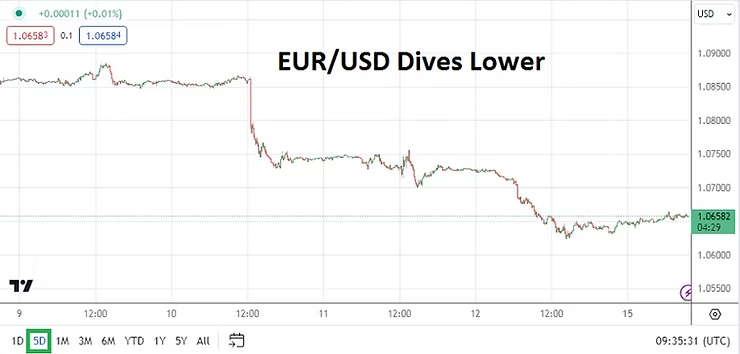
Forex speculators who relied heavily on technical data solely last week were likely punched in the gut by the rather surprising numbers from the Consumer Price Index results in the U.S last Wednesday, particularly if they were on the wrong side of trading trajectories. U.S inflation has shifted sentiment within many large investors with a rather seismic move regarding mid-term outlooks. Financial institutions which have been counting on cuts to the Federal Funds Rate have had to take a step backwards.

EUR/USD Five Day Chart as of 15th April 2024

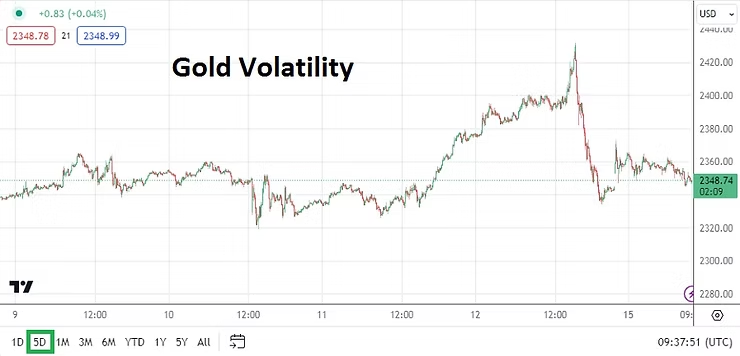
The dynamic momentum in Forex hit major currency pairs in the middle of last week and washed away support and resistance levels within a blink of the eye. Behavioral sentiment turned U.S Treasuries yields upwards and the major equity indices also experienced nervousness. Volatility also continued in Gold as new record values were produced, and then were followed by a rather strong reversal lower which likely hurt over-leveraged day traders.

Gold Five Day Chart as of 15th April 2024

Not only were U.S inflation numbers important last week, but geopolitical noise became heightened. Perhaps the climb in Gold before the weekend was helped by the anticipated conflict between Iran and Israel which did play out. The price of the precious metal and WTI Crude Oil have been more tranquil early today, which may be a signal for the moment that large market players are calm.

Monday, 15th of April, U.S Core Retail Sales – after last week’s larger than expected increase in the CPI results, the spending report today will get attention from financial institutions. Last Friday’s Preliminary Price Expectations reading from the University of Michigan did not allow investors to rest when it came in with a 3.1% elevated mark. If today’s Retail statistics are above expectations, this could make Forex roil again.

Tuesday, 16th of April, China Industrial Production and Gross Domestic Product – these economic reports will be watched closely by international investors. While there have been murmurs that China’s economy is improving, and media reports that the Biden administration is trying to engage diplomatically, the industrial and GDP results are expected to be weaker than the previous month’s outcomes. China will also release Retail Sales figures.

GBP/USD Five Day Chart as of 15th April 2024

Tuesday, 16th of April, U.K Claimant Count Change – last Friday’s GDP report from Britain did not produce any significant surprises. The U.K economy continues to struggle, but like most spheres inflation remains a problem. The GBP/USD sunk violently last week, while many speculators may believe it is currently oversold they may want to remain cautious.

Because of the U.S Federal Reserve’s own perilous fight against inflation, there are some who believe the Bank of England may need to cut interest rates before the U.S central bank. However, given the lack of proactive characteristics from the BoE and ECB which have been on full display as they dance in step with the Federal Reserve, this makes a BoE cut before the Fed a skeptical notion for the time being. The GBP/USD will stay largely USD centric even in the wake of this U.K employment report.

Tuesday, 16th of April, U.S FOMC Members – a parade of Federal Reserve voting policymakers will speak at various events, this includes Fed Chairman Jerome Powell. There will likely be little in the way of surprises from the Fed members as they likely all stick to ‘party’ lines and emphasize a cautious outlook.

Wednesday, 17th of April, U.K Consumer Price Index – the inflation report could prove to be catalyst for the GBP/USD. If the CPI number does come in weaker than expected it could spur on behavioral sentiment shifts regarding the potential for changes to BoE policy. Because the GBP/USD was so volatile the past week, day traders should be prepared for rather combustible price action from the currency pair which may look counter-intuitive. Smaller speculators should remember that ‘smart money’ from larger players may be positioned for the results of the U.K CPI data already.

Thursday, 18th of April, U.S Weekly Unemployment Claims – although not the most significant of reports usually, financial institutions are ‘waiting’ on a change of statistical direction via labor market evidence. If jobs numbers start to come in weaker than anticipated – meaning there are higher jobless claims – then the USD could react with some selling.

Friday, 19th of April, U.K Retail Sales – having endured a rather wild trading cycle, Great Britain will deliver one more important economic report to end this week. The GBP/USD will react to the consumer spending results.

post197

Iran Front and Center: 60 Tons of Explosives Sent Towards Israel

Iran Front and Center: 60 Tons of Explosives Sent Towards Israel

The Israel-Iran War is soon to enter its 7th month even though last night was the first face to face confrontation between the two countries.

There was much less panic in the air on the “Israeli street” than one would expect after Iranian threats over the last week. I was clearly wrong in my assessment that Iran would not want to start something big with Israel and risk having a chunk of their strategic power degraded but it is hard predicting what fanatics will do. The question is if the utter failure of the attack will bring Iran shame in the Muslim world or if the fact that they sent missiles and drones will be counted as a “victory” even if no damage was done to Israel. Or it could be that Iran was counting on Biden-Blinken holding back Israel from responding and sure enough, NBC is reporting exactly that:

President Joe Biden has privately expressed concern that Israeli Prime Minister Benjamin Netanyahu is trying to drag the U.S. more deeply into a broader conflict, according to three people familiar with his comments.

Last night at about 8:15pm IDF Homefront Command announced that all schools and all educational activity would be cancelled until further notice, angering parents everywhere. A few minutes later they announced that 10’s or hundreds of drones were launched from Iran and on their way to Israel. The news reported that it would take 8-10 hours to arrive, sparking this to make its round on the Whatsapp groups in this very interconnected country:

Google maps also cooperated:

Friends and family in Jerusalem and surrounding areas were awakened by alarms and scurried to the bomb shelters, children in their arms. There were alarms also in the West Bank, the Golan Heights and the Northern Negev dessert. Apparently, the main targets were two air force bases. One was hit by one missile and minor damage was done and the other was untouched. One 7 year old Bedouin girl was critically injured from pieces of a rocket that was shot down. The headline ought to read: Shiite Missile Critically Injures 7 year old Sunni Girl. 

The effectiveness of Israel’s air defense system seems to have surprised even the Israeli Air Force and special thanks has to be given to President Ronald Reagan for ignoring the comics and media (but I repeat myself) and many scientists and engineers (the experts!) as they made fun of his Strategic Defense Initiative and called it “Star Wars” – claiming that it was something undo-able and dangerous even to talk about.

Then Senator Joe Biden, using his favorite word, “provoke”, is quoted in this 1985 NY Times article:

Senator Joseph R. Biden Jr., Democrat of Delaware, pressed hard for reassurance about whether the proposed defensive weapons might be fired by mistake, thus provoking the Soviet Union to launch a real attack.
 

The Biden foreign policy theory for the last 40 years or more is based on not “provoking” your enemy, no matter the cost and appeasing your enemy at any cost.

Special thanks to the U.S armed forces who shot down numerous drones as did the U.K’s air force as well as Jordan’s. There might have been other Middle Eastern countries involved as there is an unofficial regional air defense system set up with Abraham Accord countries and others not part of the Accords. 100% of the suicide drones and 100% of the cruise missiles and 92% of the ballistic missiles were shot down by Israel’s layered “star wars” system. 

If the IRG is honest with themselves, they will understand that they have been defeated. A combination of 300 drones, cruise missiles and ballistic missiles were shot at Israel at once and no drones and no cruise missiles got through. Of the 110 ballistic missiles shot at Israel, 101 were intercepted and only one reached its target. Israeli defense firms closed higher in Tel Aviv Stock Exchange trading today. I imagine Iran’s potential clients are having second thoughts. China too, must be wondering about their own offensive and defensive systems.  

So where does this leave us now?

The War Cabinet assigned to Netanyahu, Gantz and Defense Minister Gallant needs to decide on an Israeli response. I am not sure that Israel has the firepower to destroy Iran’s nuclear sites on its own and there is almost no chance we will see U.S B52’s involved.

So the most obvious target is probably off the table.  It seems that the U.S Administration is pressuring Israel not to respond at all and to leave things as they are. This should not surprise anyone who has been awake for the last six months.

Israel and Iran have been at war for the last 6 months – one could say for the last two decades. This was clear to everyone except Biden-Blinken who could have shortened the war and the suffering by punishing Iran for their attacks on US sailors and soldiers.  Instead, they appeased Iran and released $10 billion to them essentially letting Iran hit Israel with this money.   

 The Scroll is reporting that:

We are now waiting to see how Israel responds. Although an unnamed “senior Israeli official” has been quoted promising a “significant response” to the attacks, Iran appears to have pre-cleared the attacks with the United States via the Oman diplomatic backchannel. And according to Roi Kais of Israel’s Kan News, a U.S. official told Saudi Arabia’s Al-Arabiya on Friday, “the United States will take part in the response to the Iranian response if Tehran escalates the situation inappropriately”—which means that the United States tacitly approved an appropriate level of Iranian escalation, such as, we don’t know, a “symbolic” drone-and-missile attack.

The United States has also, as Barack Ravid reported Friday, demanded to “have a say before decisions are made about any retaliation by Israel.”

If true, that is cynicism taken to the ‘Nth degree’. True enough, the United States needs to watch after its own national interests, but is it possible that the U.S government considers Iran its equal and Israel its vassal? Were Israel faced with a missile attack from China an argument could be made that U.S interests take precedence over Israel’s – but Iran? The Iranian economy is in shambles, the Rial is at record lows, its only economic lifeline comes from China, bankrupt Russia, the $10 billion Biden gave them and illegal activities. As Israel just showed– Iran’s vaunted missile force is worth less than advertised. We have not even spoken about the way it treats women and gays and how it treats opponents to its theocracy, how it spreads terror throughout the Middle East and Africa, how it helps Russia destroy Ukraine, how it is a key player in the global drug trade and money laundering.  

We have also not spoken about its foothold in the Western hemisphere and its attempts to infiltrate the United States itself via the porous southern border. 

Worst of all, if the Scroll story is correct, it shows how Biden-Blinken don’t understand what the office of the Presidency of the United States is. It is not just another head of state or head of government, but rather the President’s warnings ought always to be backed up with actions. Biden’s “Don’t Speech 2.0” was laughed at by Iran in public, for all to see. And the Biden-Blinken response is to tell Israel, “don’t”.

Ignoring Biden-Blinken for the moment, Israel must think deeply about its response. It is clear that any response will be followed by more of the same from Iran. Israel must think a few moves ahead and not just attack for the sake of attacking or it will be in the middle of yet another war of attrition. The end of the multiple rounds of attacks must leave Israel in better strategic shape than it is now and must leave Iran substantially weaker.

Whatever Israel decides to do, it must degrade Iran’s military capability by destroying its weapons and bases and killing as many IRG officers as possible. Israel should not bomb the power stations in Tehran or do other non-military strikes. Air force bases, missile silos and Iran’s navy should be targeted in such a way that degrades capabilities. They could start by sinking the Iranian spy ship that is helping the Houthis in the Red Sea.

Israelis seem to think that by “allowing” Iran to attack them it gives them many diplomatic credits, but we already know that these “credits” do not last long.  Whatever Israel does, it ought not to play the “message” game. Its attacks ought to provide tactical advantages in the coming months and not just “warnings to Iran” and “messages to Hezbollah”.

But let’s not ignore Biden-Blinken for a moment.  What if they decide to threaten Israel that if Israel retaliates the US will sit on their hands? 

This would be the time for Israel to do a little threatening of itself. The worst thing for a sitting President running for re-election is a summer gasoline price spike. Israel could certainly threaten to destroy Iran’s oil facilities and help push the price of oil. High gallon gasoline prices this summer will lose Biden more votes than he can gain in Dearborn, Michigan. In exchange for leaving Iran untouched, Israel can demand a free hand in Gaza, including Rafah as well as in Lebanon.  

Would that be worth letting Iran off the hook? It might. Iran was defeated in this battle, but it still believes it will win the war. Giving Israel free reign to destroy Hamas and then Hezbollah means that Iran will lose the war, too. Without Hezbollah, Iran will lose its most important asset in its overall goal of destroying Israel, chasing the US from the Middle East and establishing Shiite dominance in the region. It would turn October 7th into the day that Iran started on its road to defeat.

Israel needs to be opportunistic and aggressive in its dealings with its allies and its enemies. It has to let its allies know that it too is playing the long game and that it will not only hurt those who hurt it – as Netanyahu loves saying – but that it will destroy all who even try to harm it.

More importantly it needs to show its enemies with actions and not with words that threatening Israel means you will be destroyed. 

The Biden-Blinken team must be told in no uncertain terms that Israel is not a vassal.  The end result of this war cannot only be the destruction of Hamas, it must also be the destruction of the Islamic Republic of Iran as a regional power. By sending over nearly 60 tons of explosives to Israel, they have put themselves front and center.

Disclaimer: the views expressed in this opinion article are solely those of the author, and not necessarily the opinions reflected by angrymetatraders.com or its associated parties.

You can follow Ira Slomowitz via The Angry Demagogue on Substack https://iraslomowitz.substack.com/ 

post 183

An India-Israel Alliance: Prospects to Serve Global Freedom

An India-Israel Alliance: Prospects to Serve Global Freedom

Opinion: The following article is commentary and its views are solely those of the author.

We wrote a few weeks ago in response to Nassim Taleb’s claim that Israel was fragile due to its over-dependence on the United States, and we came to the conclusion that in general he was correct although not in every aspect Is Israel a Fragile Country?.

Also, we compared Israel’s fragility with that of other free or status-quo countries (as opposed to revolutionary countries like Russia, Iran and China) and thought that Israel was certainly not more fragile than other free countries in difficult neighborhoods.  We then gave a general outline of how the free-status-quo world might look should we actually see the end of America’s commitment to global freedom The Day After Pax Americana.  

I would like to examine in a more detailed way about Israel and India and how their potential relationship could be a model for this world. With the U.S reluctantly and belatedly responding to attacks from Iranian backed groups in Syria, Iraq and Yemen and their stubborn resistance to attacking Iran itself each free or status-quo country needs to look into its own defense. The U.S also needs to see how it can help midwife these alliances so as to guarantee a free world after their voluntary end to the Pax Americana.

Israel will need  to expand its reach and move towards a more anti-fragile existence without damaging the all important U.S relationship. We can’t underestimate the importance of the U.S relationship to Israel and how important it is to maintain and even expand it – but as the U.S political landscape is changing and as the elite part of the younger generation is, for some reason, excusing violence against Jews in general and Israel in particular, Israel needs new strategic partners if it is to thrive and move at least part of the way towards anti-fragility.

Israel’s relationships with the Arab world, the Abraham Accords along with its older peace treaties with Jordan and Egypt are dependent upon dictators remaining in power. The most vocal and belligerent voice against Israel by a government in the (non-Iranian influenced) Arab comes from Jordan and the most vocal and belligerent non-governmental voice in the (non-Iranian influenced) Arab world probably comes from Egypt. These treaties are all important and they are based upon the self interest of the current rulers of the countries (which is a good thing), but no one can know how long they can last and how firm they really are.

Israel also has a strong and growing relationship with Greece and Cyprus in the eastern Mediterranean and have joint military exercises together. Their navies and air forces train together and even their ground forces have joint exercises but neither of those two countries have the economic, military or diplomatic heft that Israel needs.

If Israel is looking for a second strong ally but one that itself lives in a dangerous neighborhood then the place to turn to is India. With the largest population in the world, a democratic government and a growing economy, India is the ideal strategic ally for Israel. Both are countries that live in dangerous neighborhoods, are working democracies and have experience dealing with terrorism. India, under with the premiership of Narendra Modi already has a strong relationship with the Israeli military. Israel has sold more than $600 million worth of military equipment to India (second only to Russia) and the two militaries have cooperated on anti-terror policy. The Israeli navy also reportedly has close ties to the Indian navy including submarine exercises in the Indian Ocean. Israel already has nearly $5 billion in trade with India (import and export) and it is time for Israel to start purchasing basic military supplies from India. India has five domestic manufacturers of the standard 155 mm artillery shells and it has large small arms industry – this should be an alternative to total dependence on the U.S for this standard equipment.

There is now a consensus in the country that Israel needs to broaden its military manufacturing and acquisition and the best way to do this would be to expand its relations with India. In order for this to make sense the time has come for Israel to say a very big “thank you very much” to the United States for the $3.9 billion in military aide it gets annually and instead purchase directly from the U.S and other sources.   India could also help in building factories in Israel – which could even be operated by Indian nationals through Israel’s guest worker program.

The military cooperation should be expanded to the air-force as well as ground forces.  There ought to be joint officer training, just as there is now with the U.S and some European countries. There should be a process in place that will eventually lead to a freedom of the seas treaty in the waters between India and Israel’s Gulf of Eilat. This should include cooperation between naval, air and anti-missile forces. 

The foreign worker program should also be expanded. Israel is trying to free itself from dependence upon Palestinian labor – from both Gaza and the West Bank – and India and Israel have been talking about an expanded guest worker program. Currently there are Indian citizens working as aides to the elderly and disabled and that needs to be expanded to construction and agriculture. 

Israel is a small country with around 10 million people and due to its large birthrate and legal immigration there is a lack of new housing construction in the country. The guest worker program in place with countries like Philippines, Thailand, Sri Lanka and others allows workers to work for up to five years and earn much more than they can earn in their home countries. They are provided with the same health care as Israeli citizens (paid for by their employers) and are even given pension benefits which they take with them when they return to their home countries. Israel could probably host up to 100,000 Indian workers a year.  

Scientific and student cooperation should be increased. This will not only help both countries develop important technology in areas such as healthcare and biotech, but will help India and Israel retain some of the scientists that would otherwise emigrate to the U.S and U.K. The exchange programs at university science and technology departments could lead to the creation of world class companies in the respective fields. 

Finally, cooperation regarding the capital markets could help both countries develop world class markets. India has the potential to be a global financial center in the coming decades and Israel, while far from being a financial powerhouse could be a link to European markets and investors with the time zone 1-2 hours ahead and close connections with those markets. 

The United States will be Israel’s main ally for the next few decades but it will be healthy for both countries if Israel was able to share interests – political, diplomatic, cultural and military with another major country. While France was that country until 1967 no European power has the position or the disposition to ally with Israel. India is democratic and attained its independence at the same period Israel did and from the same (then) major colonial power.  Also, both countries have overcome their socialist beginnings to thrive on the global economic stage. 

Now is the time for Israel and India to take the next step on the road to a true alliance. If we have truly reached the end of the Pax Americana, then this can be an example to the rest of the free-Status-quo world on how to manage without the vast power that is the United States. If somehow America shows the will to continue to lead the free world an Israel-India alliance will only contribute to the freedom that a continued Pax Americana protects. It would be helpful in any future conflict in the Pacific and the alliance could expand to the Gulf countries, East Africa and maybe even Egypt. 

Economically and technologically the obvious expansion would be towards South Korea and Japan. Militarily, it could aide and potentially replace the U.S naval presence in the Persian Gulf and allow it to concentrate its forces more in the Pacific. We are not talking here of a relationship that will replace the U.S military tomorrow or even next year. 

This is a long term process and requires the governments, corporations and individuals in both countries to be aggressive in turning a relationship into an alliance.  And it will require the cooperation and encouragement of the United States which will have to agree to support this and similar alliances even if it does not agree with all the tactics used in a moment of crisis.     

It is time to start looking forward and to stop depending on the goodwill of the American people as America, too faces major fiscal, strategic and military challenges of its own. 

Disclaimer: the views expressed in this opinion article are solely those of the author, and not necessarily the opinions reflected by angrymetatraders.com or its associated parties.

You can follow Ira Slomowitz via The Angry Demagogue on Substack https://iraslomowitz.substack.com/ 

postN99

Regional War Spreads: Will Blinken Wake Up to the Reality?

Regional War Spreads: Will Blinken Wake Up to the Reality?

Opinion: The following article is commentary and its views are solely those of the author.

Despite the denial of reality by the Blinken State Department the Middle East war gets hotter and spreads eastward (even without) Israel’s intervention. After spending years appeasing the Iranians the world is now faced with the results of that policy. 

Iran has trained and funded terrorists in Gaza and the West Bank where the high intensity battles continue. In Lebanon-Israel there are close to 100,000 Israelis displaced, and it seems more Lebanese have left the area south of the Litani as heavy rocket, tank, artillery and air attacks continue from both sides of the border. Attacks have intensified against Israel from Syria and Yemen, and Iranians and their militias are attacking U.S forces in Iraq and Syria. Turkey, Russia and Syrian forces continue bombing areas of northern Syria and now both Iran and Turkey are bombing Kurdish lands.  

We know what is going on in Yemen and the surrounding seas with global shipping coming to a standstill there, and diminishing Suez Canal traffic is slowly crippling an already disastrous Egyptian economy. The U.S and the U.K have been forced to bomb Houthi areas, but this of course is after the total failure of the Blinken foreign policy of ‘ending’ the war in Yemen by cutting arms sales to the side that was pro-West while encouraging Iran to continue funding, arming and training of their Houthi allies.

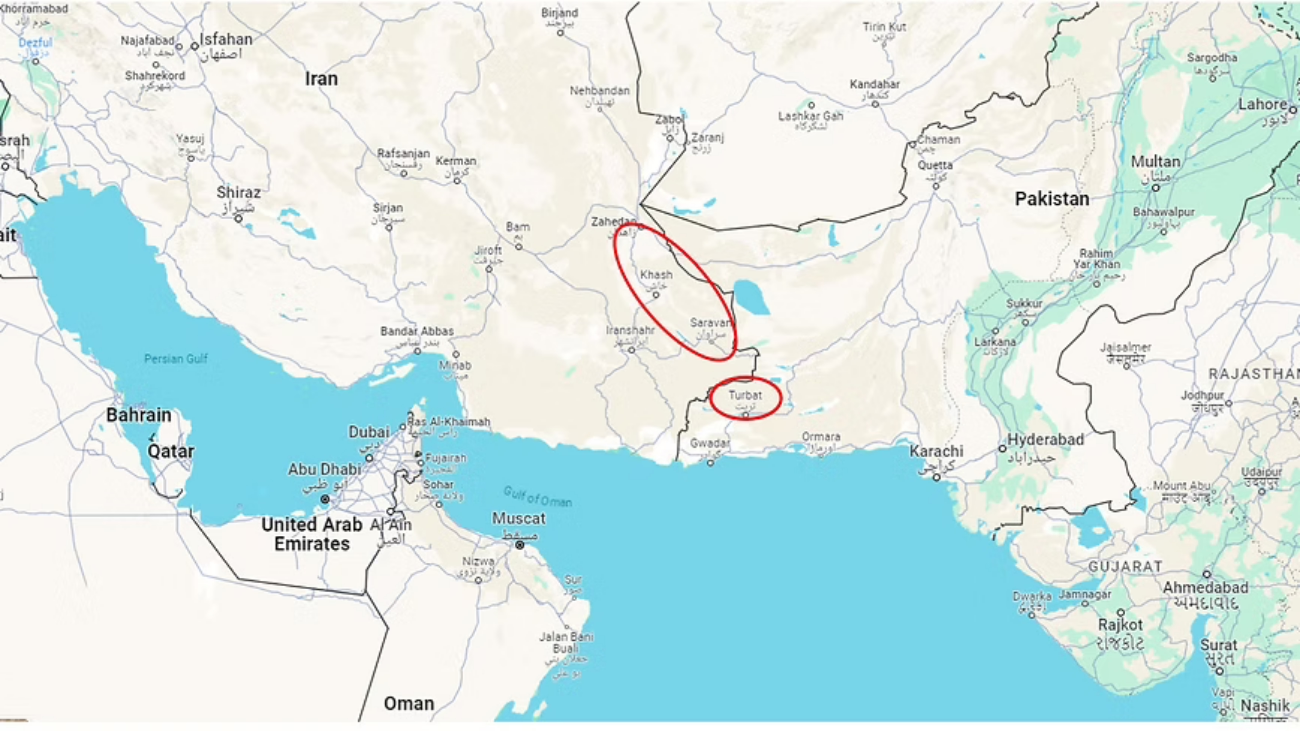
A new front has now opened between Pakistan and Iran. We spoke earlier of the Sunni-Shiite war heating up, but it has spread faster and more violently than we expected. 

Over the last few days fighting on the Iran-Pakistan border has heated up. It started with heavy fire between the Pakistani group Jaish ul-Adl and Iranian border guards in the Sistan-Baluchestan border area, and included the assassination of Iranian Hussain Gwadanfur on the Khash-Saravan road.

In other clashes between Iranian and Pakistani forces at least two Iranian Revolutionary Guard (IRG) soldiers were killed, and the IRG has shot rockets into Pakistan hitting Turbat and surrounding areas near the coast.

Pakistan’s Ministry of Foreign Affairs released a statement claiming that they “undertook a series of highly coordinated …. precision military strikes against terrorist hideouts in Siestan-o-Baluchistan province of Iran”. At the end of the press release they speak of Iran being a “brotherly country” with “great respect and admiration for the Iranian people”. It seems that Pakistan does not want to publicly admit that official Iranian forces were involved in the attacks.

What is incredible about Iran is that they have now attacked three nuclear armed states – the U.S, Pakistan and Israel – without fear of retaliation. We can only imagine what the Revolutionary Islamic Republic of Iran will do once they too have a nuclear weapon.

We are in a regional war with fighting going on daily from Pakistan to Libya. Iran, not Israel, is at the center and is the cause of nearly all the fighting and tough statements and tough actions need to be taken against Iran – not Israel. Senate majority leader Schumer has been quoted as saying that he wants to put extra conditions upon the sale of arms to Israel, but where was he when Obama sent planeloads of cash to Iran and Biden-Blinken released further billions in November of 2023? Where are the conditions placed on a terrorist state?  

The Biden-Blinken foreign policy of appeasing enemies and threatening allies that is at the core of its operation continues apace. First with the cutoff of arms to Saudi Arabia and their Yemeni allies in order to “end the war” and then to “advice” the Ukrainians not to provoke the Russians, and next heavy pressure on Israel to ‘surrender’ to Hamas by leaving them in power.  

One can make deals with countries that are interested in their people. One cannot make deals with terrorist groups or revolutionary states that are looking to upend the global order. That is Iran in a nutshell. 

Disclaimer: the views expressed in this opinion article are solely those of the author, and not necessarily the opinions reflected by angrymetatraders.com or its associated parties.
You can follow Ira Slomowitz via The Angry Demagogue on Substack https://iraslomowitz.substack.com/

postN96

Is Israel a Fragile Country? Can it Move Towards Anti-Fragility?

Is Israel a Fragile Country? Can it Move Towards Anti-Fragility?

Opinion: The following article is commentary and its views are solely those of the author.

One of the great books of the last decade is Nassim Taleb’s “Anti-Fragile”. 

I read it years ago and bought one for each of my (grown) children and suggested they read it and think about it when making decisions. I said at the time that this should be required reading for all IDF officers. In a nutshell, Taleb differentiates between fragile, non-fragile and anti-fragile. Glass is the classic fragile substance and concrete the classic non-fragile. Both can be destroyed with correct instruments and non-fragile items will slowly decay when things like water infect them.  

Anti-fragile items on the other hand, gain strength from chaos. The more an anti-fragile substance gets hit, the stronger it gets. Nature for Taleb is the classic anti-fragile system. Nature “knows” how to respond to any disturbance, and it “learns” how to adapt and survive. This adaption and survival might hurt parts of the natural world – but nature as a system will survive and be stronger – think of natural immunity from a virus. 

Another of the ideas in Taleb’s book is “optionality” – decisions in life are often like buying options. When buying an option, you want a high upside and a low downside.   A simple non-financial example is crossing a street. If you see a car 50 yards away and are pretty sure you can make it across the street without getting hit – you can take that “pretty sure” chance and save yourself the 10 seconds it takes for the car to pass, or you can wait the 10 seconds. The upside here is saving 10 seconds. The downside is getting hit by the car. The decision is pretty obvious for those who think of optionality.

In short – Taleb is a serious man and a serious thinker. Born in Lebanon in 1960 he is a polymath, making his name in trading and finance, and his previous book “The Black Swan”.

In any event, in a recent interview with the French newspaper L’Orient Le-Jour he called Israel a fragile country due to its dependence on the United States and said that top-down peace agreements, like that between Israel and Egypt, or the Abraham accords are doomed to fail (I don’t read French and read a summary of the interview in the Hebrew language Globes financial newspaper – the original is here – if you read French and I got it wrong, please let me know).

Is Israel a fragile country? And if so, is it more fragile than other small free countries? And finally, how can it move on the road to anti-fragility? And are fragile peace agreements worthless?

Taleb’s claim that Israel is fragile due to its dependence on the US is true in an of itself. Changes in U.S foreign policy either via elections or changes in US interests have in the past put Israel in difficult situations. When Prime Minister Yitzchak Shamir requested U.S loan guarantees from then President Bush (1) in order to fund the absorption of masses of emigrants from the falling Soviet Union he was turned down until Israel halted settlement activity in the West Bank and attended the (failed) Madrid peace conference. Today, it is very clear that if the US would decide to halt arms shipments to Israel or to stop supporting it in the Security Council, the country would be put in a situation many believe would be existential.

A big issue in Israel at the moment has to do not only with Israel’s dependence on the US for military hardware but in the relationship of its top generals with the Pentagon. There is a claim that much of the “globalized” attitudes of Israeli generals comes from the influence of the politically correct elite in the US Defense Department. It reached a point where, just a few weeks before the current war broke out, the general in charge of military intelligence stated that he fears that global warming is a greater threat to Israel than Hamas. Whatever one’s views on global warming or climate change it does seem odd that the one Israeli in charge of making life and death intelligence assessments has the time to worry about those issues to such an extent that he feels it is his job – as intelligence chief – to warn Israel about it. Further, the October 7 attack itself showed the fragility of the defense strategy of Israel’s top generals and politicians. It had a conception of Hamas and other enemies and had no allowance for its being wrong. 

However, the initial response of Israel’s soldiers and officers, without the centralized support of the General Staff, show how many of Israel’s combat soldiers are “anti-fragile”. Israel’s people can also be said to be anti-fragile in Taleb’s definition of it where chaos or tragedy make one stronger. Over the 48 hours after October 7 Israel already had 350,000 reservists mobilized who were all motivated to fight for their country. That is no mean feat – for the most part these reservists went to their units before being called up or called their commanders demanding to be called up. Many thousands returned from abroad at their own expense in order to join their units and fight. In contrast – Ukraine had to forbid all men under 50 from leaving the country.   In Israel, a divided, shocked and demoralized people became a strong fighting force with the home-front in total support, within hours.

Military tactics are another area where Israel is anti-fragile. Due to the utter failure of military intelligence and the lack of central control over the first hours of the war that Saturday morning, the junior and mid-level officers and soldiers took command and figured out on their own how to face down the thousands of terrorists who took over towns and villages as well as military bases. Instead of waiting for orders and making sure everything was organized for attack, a delay which would have cost many more civilian lives, Israel’s soldiers improvised with what they had and took back the territory under very difficult circumstances. Many soldiers lost their lives through many acts of bravery but the decisions they made on the spot made them, the army and the country stronger.

The same can be said in the fighting now in Gaza. Israeli intelligence understood that there were tunnels, but it seems that they didn’t know the extent of the network and therefore had no good tactics to defeat it. It was the need to penetrate them without causing casualties to soldiers as well as the potential of hostages in the tunnels, that caused them to developed tactics to deal with it. We won’t know for sure how well it has or will work, since this is now classified information, but this could be an area of anti-fragility.

But this does not disprove Taleb’s point since Israel is clearly has a “single point of failure” and that is the U.S Government. However, nearly all free countries in the world have that single point of failure and have had it since the start of the atomic age.   One of Konrad Adenauer’s great fears in developing West Germany’s defense policy was that, when push came to shove, there would be no US nuclear umbrella. He was not convinced that the US would risk its own cities in defense of Europe in general and West Germany in particular. That is why he supported France’s independent nuclear deterrent and why he and De Gaulle were so close. The U.K too, when deciding on its Trident nuclear submarines had the same doubts. 

Today, we can say the same about the Baltic countries. They are part of NATO now, but, like the rest of NATO are totally dependent upon the United States military to keep the Russians at bay. The rest of Europe is dependent upon the U.S but they are no longer front line states so it is less important. Newly NATO-ized Finland is probably closer to Israel in its combination of fragility and anti-fragility.

Taiwan too, is fragile in this sense and so are the weaker Indo-Pacific nations like Philippines and Singapore. It would be difficult to find a non-Axis free or semi-free country that is not dependent upon the U.S to defend its freedom – either with sailors and soldiers or with arms, money and diplomacy.  

But the question Taleb poses, or the claim he makes, deals with Israel. Israel is clearly partly fragile – but is it too fragile currently that it can’t survive without the US? Or can Israel do anything to make it, if not more anti-fragile, at least more non-fragile? We have to separate out Israel’s fragility due to its dependence on the U.S and the free world’s fragility due to the same dependence. The Pax Americana that free (and non-free) countries have enjoyed since the end of WWII has probably contributed more to freedom, economic growth and a reduction of poverty in the world than any other force in human history. The question for all free countries then is how to make them less dependent upon the U.S if they want to remain strong and free -and less fragile.  

That is as true for Israel as it is for Latvia, Finland, Australia and Japan. 

But we will only look at solutions for Israel and leave the general question for a later time.

Israel receives from the US $3.8 billion in military aide, all of which must be spent in the United States. The annual aide started in 1999 and was $2.67 billion. Israel’s GDP in 1999 was $120.92 billion – meaning the aide constituted 4.5% of Israel’s GDP.  In 2022 Israel’s GDP stood at $525 billion so its $3.8 billion in aide was just 0.7% of GDP. Israel’s 2022 defense budget was $23.4 billion – 4.45% of GDP.

Giving up the entire U.S aide is certainly do-able from an economic perspective and there have been economists in Israel who claim that the aide actually hurts the Israeli economy since all the money must be spent in the U.S. One result of this has been the demise of Israel’s textile industry since the IDF no longer purchases uniforms from Israeli companies (one has to wonder that, since clothes bought in the U.S are rarely made in the U.S, if Israel is buying uniforms made in Bangladesh but sold via U.S middlemen). Giving up the aide would be one step towards a less fragile existence for a number of reasons.

The first would be, in my opinion, to cement the U.S public’s support for Israel. Giving up U.S taxpayer aide during a time of fiscal uncertainty would certainly be looked upon positively, in spite of the fact that all the aide gets recycled into the U.S economy (there has been some money that Israel has been allowed to spend on R&D in Israel). Israel is not the same country it was in 1999 and its economy is robust and probably more anti-fragile than most other western economies.

A second positive would be in allowing Israel to spread out its arms purchases. It could buy small arms from India, artillery from South Korea, etc. It could also rejuvenate local Israeli arms manufacturing. There is no doubt that all the large ticket items like fighter jets and smart bombs will still be purchased in the U.S and there is no doubt the U.S arms industry will continue its good relations with Israel – and in fact might be made more competitive since the IDF will be free to chose from amongst many providers for various weapons systems. 

Another move that Israel can make that would decrease its fragility would be to make sure it always has a 12 month supply of weapons and spare parts in order to fight a three front land war and a 5 front air war. It would have to beef up its navy and ground forces without hurting its crown jewel – the Air Force. This would make it less dependent upon the importation of arms in case of war.

An area where it will be difficult to be less fragile is the diplomatic arena as woke-ness takes over the western narrative about the world and many of the less and non free countries can’t manage to fight off Arab money and propaganda. India could be a country that could help diplomatically as they are large and powerful enough to ignore much of the pressure from the Arab and western-woke world. The problem is that the Security Council still holds sway in the world and India is not a permanent member with a veto. Of course they should replace the U.K and probably France but that won’t happen as long as India doesn’t have a reliable, permanent left-wing majority – which it won’t have for some time.

The only other major country that could help diplomatically would be Japan – but they have historically not been friendly to Israel and only in the current war have they backed it fully. They are certainly sympathetic to Israel’s plight as they figure out how to face a hegemonic China.

But under the current global situation, Israel relies on the U.S for diplomatic cover making it fragile, diplomatically. That won’t change for some time.

Economically, Israel is probably more anti-fragile than most other countries in the world. This is true for two reasons. First, Israel has a strong domestic market including a very productive real estate market. It has an agricultural center that produces enough for export and of course world class hi-tech and bio-tech industries. Most important – it has children. It is the only western country that has a high birthrate and that is something that has been underestimated in the west. Israel’s fertility rate – births per woman – stands at 2.9. The next highest western country is France at 1.8.  Replacement rate is 2.1.  Search out Nicholas Eberstadt for all the details.

Regarding the top-down peace agreements, Taleb himself understands for sure that the non-democratic top-down nature of most Arab countries makes this less important than in western-free countries. However, he does have a point here. Regarding Egypt, from the beginning the people – or more accurately, the professional and intellectual classes, have been opposed to Sadat’s peace. However, in spite of that, the peace has held for 45 years, which is quite a long time. I remember as a child reading the Biblical Book of Judges where the Israelites would sin, to be saved by a Judge who would rule and keep the country “quiet” for 40 years. At the time I thought – what is the big deal of 40 years of peace? As I grew (much) older I realized that 40 years of peace would be an incredible feat. So, 45 years of non-war between Israel and Egypt is quite a success. Will this continue for another 45 years? I think that if Israel remains strong, it will. 

Regarding the Abraham accords, the jury is still out. We will have to see where it all progresses. This war has certainly shown that even mass violence has not caused violent reactions from the Abraham accord countries. The one peace agreement most fragile and more worrisome though is the one with Jordan. The Hashemites are first and foremost survivors and if survival means breaking the agreement, they will do it in a second.

http://angrymetatraders.com

In summary, Israel’s dependence on the US is crucial for its survival and that in itself makes it fragile. However, there are things Israel can do to make it less fragile and the will and determination of its people make it, in many senses anti-fragile in Taleb’s description (invention?) of that term. Compared to other small, free countries though, all of whom depend on the US for at least part of its defense, it is difficult to say that Israel is worse off – except that, besides the Baltic countries, its neighbors are worse and more dangerous.

In the coming days we will examine a more radical solution to the “fragility” problem of Israel and other free countries.

Disclaimer: the views expressed in this opinion article are solely those of the author, and not necessarily the opinions reflected by angrymetatraders.com or its associated parties.
You can follow Ira Slomowitz via The Angry Demagogue on Substack https://iraslomowitz.substack.com/

postN19

Preventing WWIII: Part 2 – Reviving Western Deterrence

Preventing WWIII: Part 2 - Reviving Western Deterrence

Opinion: The following article is commentary and its views are solely those of the author.

Aggressive Western Action Can over-extend China and Revive Needed Deterrence.

Some cliches are just correct, in spite of their being cliches – “if you want peace, prepare for war” is one. But really it should be “if you want to avoid war, deter war”.

Therefore, it is not clear to me why there is opposition by some in the Republican party to fighting Russian aggression in Ukraine. For some, I guess it is a knee jerk reaction against Biden administration policy while for others it seems to be a general loathing of American involvement in the world. 

Each is understandable on its own but does not take into effect the appeasement of Russia will have on Western deterrence around the world – including in the Western hemisphere and the Indo-Pacific. While most Americans understand that Russian control of Ukraine threatens the main Western European countries, the key to Russian imperialism really is in the south. Historically, Russia has always tried to find a warm water port to call its own. For nearly four centuries Czarist Russia fought Ottoman Turkey so that Russia could expand its territory southward and have a warm water presence in the Mediterranean. Currently, a Ukrainian presence in the Black Sea denies Russia even the opportunity to pressure modern Turkey to abide its wishes.

A Russian victory in Ukraine would mean dominance of the Black Sea by the Russian Navy and directly challenge Turkey to appease Russian power by giving them free passage through the Dardanelles to the Mediterranean. That in itself would not be worth much to the Russians without a port in the Mediterranean, which they currently have. That they have one goes back to the disastrous decision by the Obama administration to invite Russia back into the Mideast in order to take care of Syrian chemical weapons. This came, we all remember, when the Syrians laughed at Obama and crossed his “red line” about using chemical weapons against its own people. We might also remember when then Secretary of State John Kerry (the one who was never right on a single foreign policy issue ever) who, first demanded that Syria turn over all chemical weapons in a week, then reassured them that even if we attack it will be “unbelievably small”.

In 1973-4, Henry Kissinger brilliantly took advantage of the Israeli-Arab War’s outcome with Israel’s surrounding the Egyptian 3rd Army in the south and controlling the road to Damascus in the north, by brokering a cease fire on both fronts. This led directly to the expulsion of Russia/Soviet Union from the Middle East. While Russia continued friendly ties with the murderous Assad family – first Hafez and then his son, Bashar, they did not have a military, air or naval presence there. Due to this longstanding relationship with Assad’s Syria, Obama and Kerry thought it a brilliant idea to have them come in and do the dirty work that they didn’t want to do – prevent Assad from gassing his own people. 

As Russia came in and established air and sea bases in Syria and introduced the infamous Wagner group to carry out its brutal ground operations, Russia slowly started to strengthen its position in the region. While slyly allowing Israel to attack Iranian arms shipments meant for Hezbollah while pretending to be its ally, Russia formed a close  relationship with Iran. Wagner, which fought hand in hand with Hezbollah in order to prop up the Assad regime (and attack American forces fighting ISIS) is now rumored to be training Hezbollah in the use of Russian anti-aircraft systems. 

In addition, reports last week that an Iranian Ilyushin 76 cargo jet has now landed in one of the Russian air-bases they established after Obama’s kind invitation to return to the Mideast. This plane, filled with Iranian arms destined for Hezbollah has been unable to land in regular Syrian airports or bases because Israel continuously puts them out of service. Knowing that Israel would never attack a Russian base – this is a safe haven that Russia gladly supplies. 

When free countries unite in warfare there is usually one joint goal  – that they are all united to defend freedom – that is why they fight together.  While autocratic and totalitarian regimes fight together it is usually a combination of a negative goal – disturbing or destroying the current world or regional order – as well as the goal for each power in itself. Currently, the joint goal in the Mideast (of Russia, China, Iran and North Korea) is to hurt the main ally of the US in the region – Israel, in order to weaken and embarrass the US. For Iranians, they also want Israel destroyed. For Russia, they want Israel weakened so they can replace the US as the power broker in the Mideast. For China, it is to dismantle America’s control of the flow of oil and, eventually, the replacement of the USD in the global economy with the Yuan.

Ukraine is important in this calculus because, as we said above it gives Russia complete control of the Black Sea and will pressure Turkey – whose NATO membership is uses only to its own advantage – to break permanently with the West. While the Chinese theory is that the two fronts the US is supplying arms to, Ukraine and the Mideast, are tying it down and expending its resources it would otherwise use in the Pacific, in truth, an aggressive strategy on both fronts would be to over-extend Russian and Chinese resources in order to keep China from moving on Tiawan. A credible threat of destruction or even marginalization of the Axis allies in the Mideast – including (besides the soon to be gone Hamas) Hezbollah, Shiite-Iranian proxies in Iraq and Syria, as well as Iran itself combined with a major offensive in Ukraine will tie down Axis resources and possibly prevent a Chinese blockade or attack on Taiwan.   If its two main allies need full supply and full readiness to be able to respond to credible and massive attacks by Ukraine, Israel and the US, China itself might have to expend resources to prop up its own allies. 

Add to that a major show of naval force in the Indo-Pacific by Japan, India, Australia and South Korea combined with US forces will give China the choice of destroying their own wavering economy by attacking or blockading Taiwan or in maintaining peaceful Pacific trade routes while trying to prevent the collapse of its Axis allies. 

An immediate and radical change in policy can restore Western deterrence quickly.   Re-arming Ukraine and leaving Israel to do its job without pressure to stop in Gaza and to respond forcefully in Lebanon will send a strong message. Biden brought two carrier groups to the Mideast and told Hezbollah, “don’t”. But they did.  

In spite  of that  US Secretary of Defense Austin told Israel that its response to Hezbollah aggression in the north is “provoking” them.  

And the US hesitates even against Iranian proxies. Just now, the NY Times has reported that Biden-Blinken have turned down a Pentagon plan to be more aggressive in response to Iranian attacks against US forces in Syria and Iraq for fear of “provoking Iran” (this seems to tell us that the Austin complaint from Austin to Israel is really from Blinken).  

Iran never seems to fear provoking the US.   

Israel fooled itself by thinking Hamas was deterred by its destruction of an arms factory or two (as the US is doing now in Iraq/Syria) when proper deterrence would have meant them knowing we can and will go into Gaza and destroy their underground city as Israel is doing now. Instead, media fear mongers, backed by Israeli ex-Generals on the payroll of the US progressive left (via cushy think-thank jobs) combined with policy directives by successive governments have told us and Hamas time and time again that Israel cannot destroy Hamas as the cost is too high. I don’t want to speak too early, but that seems to have been as wrong as their assurance that Hamas is deterred since they want to drink white wine in the evening overlooking the Mediterranean while watching their children play innocent video games.

It is time to stop calling for cease fires and repeating UN hypocrisy and to start being aggressive and provocative in the defense of freedom. 

Disclaimer: the views expressed in this opinion article are solely those of the author, and not necessarily the opinions reflected by angrymetatraders.com or its associated parties.

You can follow Ira Slomowitz via The Angry Demagogue on Substack https://iraslomowitz.substack.com/ 

postN19

Preventing WWIII: This is a 1936 Moment for the Middle East

Preventing WWIII: This is a 1936 Moment for the Middle East

Opinion: The following article is commentary and its views are solely those of the author.

The wonderful historian and public intellectual Niall Ferguson has aptly called the current US-China relationship a “Cold War II” and the current debate in the punditry is if the Israel-Hamas war lead to a WWIII. But what if we are already in WWIII? While Russia and the rest of the world did not expect the war in Ukraine to still be fought nearly three years later, the Russia-Ukraine war is now clearly a part of the fight of the West vs the new Axis – Russia/Iran/China/North Korea. But it was the Hamas attack of Israel on October 7 and the response of the Axis and its allies that have more clearly established the battle lines.

We have Russian and Iranian weaponry vs. American and Israeli weaponry. The Russians and the Iranians are using what we so quaintly call “proxies” for a plausible (un)deniability, sheltering them from retaliation. Iran has its various Shiite militias, with Hezbollah being the strongest and most lethal. Hamas and Palestinian Islamic Jihad (PIF) are the Sunni useful idiots helping the Shiite empire to destroy their Sunni cousins by dying for the cause. The Shiite militias formed and fighting in Iraq and Syria along with the Houthis in Yemen round out Iran’s ability to pretend it is not fighting while creating a genocide of Sunnis in Syria and Iraq and Jews in Israel. On the Russian side we have of course the infamous Wagner Group which in its racist undertaking is taking over and subjugating sub-Saharan Africa in its run to control minerals, gold and diamonds. They are now helping Hezbollah with weaponry and training by providing anti-aircraft weapons. The two groups fought hand in hand saving Bashir Assad, the leader and butcher of Syria, to stay in power so they already have close ties. Wagner is Russia and Russia is Wagner. Hezbollah is Iran and Iran is Hezbollah. The quicker we understand this the better off we will be.

We don’t have any details on Chinese or North Korean weaponry being used by Hamas or Hezbollah, but that might just be a timing issue. China has already decided not to report Hamas atrocities to its people in its official Chinese language news service and are eliminating Israel from its maps. It only reports Israeli’s response and has taken a clear stance supporting its ally, Iran. Will they learn from their Axis allies and also form proxies in Asia to destabilize countries like the Philippines or Vietnam while being immune to retaliation? They don’t need to conquer or even blockade Taiwan if they can destabilize their neighbors while still selling the West all that it wants to buy and inundate our youth via Tik-Tok propaganda.

Japan has realized what this war is about, and is supporting Israel like it never has. Being totally dependent upon the Mideast for its oil, Japan has never been a close friend of Israel. But they have now condemned the Hamas attack while refusing the criticize Israel’s massive response. The Japanese understand well that an Israeli defeat can lead to Chinese dominance in the Indo-Pacific.

Back to the Mideast – it seems we always go back to the Mideast.

Iranian backed Hamas and PIJ launched a brutal attack on Israel.

The Iranian backed Houthis in Yemen declared war on Israel and launched cruise missiles and drones in their opening attack.

Iranian backed and financed Shiite militias are moving to Syria and Lebanon hoping to open two new fronts against Israel.

Iranian backed and financed Hezbollah is attacking from the north in what, for some reason, we are not yet considering a war.

And Iran itself is feeling safe from attack from Israel or the US/West since “only” its proxies are fighting.

This is the remilitarization of the Rhineland of 1936 and a Western betrayal of Israel by hamstringing the IDF by allowing gasoline into Gaza or by a forced cease fire, will be the Munich, 1938.

Are we in WWIII yet? Not being an expert, I don’t know. But the main link tying the Axis together is Iran. They are the most experienced in exporting terror and supporting anti-Western regimes from the Mideast to Africa to America’s doorstep – Latin America. They support and are supported by the Castroite regimes in Cuba and Venezuela and have made deep inroads in Argentina, Brazil and now even Mexico. They are currently nearly as great a threat to the west as is China and probably a greater threat than Russia. A nuclear Iran would create three nuclear powers that could threaten the West as an Axis or independently. The Obama-Biden Iranian policy has been proven a total disaster and its seems that the Biden team is finally understanding this. But they can, in Margaret Thatcher’s famous warning to the first President Bush, “go wobbly” at any moment.

The only way to prevent a full fledged WWIII is Iranian regime change. This would bring the entire Persian Gulf (and its oil) into the Western sphere of influence as China does not yet have the naval power to challenge the US. Hezbollah would be instantly neutralized reducing the threat of war and denying the anti-Western powers another presence in the Eastern Mediterranean. Although the Syrian butcher, Bashir Assad would still have Russia to back him, it is not clear that Russian power alone could keep him in power. In Latin America, Iranian export of terror would stop instantly.

This does not mean that the US needs to invade Iran in order to defeat it. A majority of the Iranian people are sick of the Islamist regime and sick of paying the price for their being ruled by terrorists. The destruction of Iranian nuclear and missile facilities along with the destruction, by air and cruise missiles, of the main Revolutionary Guard bases will be enough. It is not an easy task -but one within the capabilities of the US Navy and Air Force. It is only the Revolutionary Guards that keep the terrorists in power in Iran – the regular Iranian armed forces can be left alone to decide if they want to help overthrow the regime or stay in their barracks. Once they see that the Guards are weakened it is a good bet they will take the side of the Iranian people and help topple the Islamist-terrorist regime.

Regime change in Iran in 2023 will change the global dynamic just as regime change in Nazi Germany in 1936 would have saved 70 million lives in WWII. A failure to act against the source of evil and to cut off the main link in the current Axis will just kick the can down the road – once again. We have appeased Iran enough and if the West and the US don’t act quickly it will have to act while simultaneously fighting off a Chinese attack in the Indo-Pacific – on its own or with its very own proxies – as well as terrorist attempts coming from Latin America and Russian nuclear blackmail in Europe.

And we haven’t even spoken of the West’s moral obligation to prevent a second holocaust, which will be the very first task of a nuclear Iranian regime.

Disclaimer: the views expressed in this opinion article are solely those of the author, and not necessarily the opinions reflected by angrymetatraders.com or its associated parties.

You can follow Ira Slomowitz via The Angry Demagogue on Substack https://iraslomowitz.substack.com/

postN66.1

Ready for Risks as Nervous Markets Await Plenty of Outcomes

Ready for Risks as Nervous Markets Await Plenty of Outcomes

So you want to be a trader. You imagine that it will be fun and possibly easy to make money from the comfort of a cafe, office, maybe a bus or subway train with a simple touch to an app on your phone that allows seamless possibilities to take advantage of trends that are easy to spot. Yet, this may not be the week to decide on beginning your endeavor, perhaps you will want to watch the global markets and learn from the possible mistakes of others in the coming days.

Simple trends for the moment have largely disappeared and financial markets face a rather important week of data and global risk events that not even the most experienced trader can comfortably embrace. Risk events will shadow this week of trading. There will be a lot of drums beating and earplugs are recommended for speculators.

To get started the war in the Middle East, actually the war between Israel and Hamas is ongoing and it will not end soon. Israel doesn’t want U.S ground troops and while some media sources may make these claims, it is extremely unlikely to happen. Yes, the U.S has sent war ships to the Mediterranean, but this is largely to suggest to Iran that the nation not become overtly active in the conflict.

Global investors who have been around the block and have traded when other conflicts have escalated – Ukraine, Iraq, Afghanistan, African wars, and simmering feuds between China and India are somewhat used to these news flows and developing crisis forays. It does not make things easier, but at the same time being able to separate the noise from the actual reality of these events is essential. Learning to be mindful of the media and its frequent empty hyperbole regarding what could happen next is vital. Traders need to be critical thinkers.

If a day trader can step away from concerns regarding conflicts and focus on how behavioral sentiment is going to develop via the gyrations of financial institutions and larger investors, they will go a long way in starting to pursue a more tranquil path and find the ability to organize their thoughts quietly.

Gold is flirting with the 2000.00 USD mark per ounce. U.S indices continue to trade near lows and risk adverse tendencies will likely continue to flourish in the near term. There is a parade of important data releases and rhetoric that will come this week. Traders who are technically driven should consider paying attention to the economic reports and pronouncements that will come as they mix with business outlooks and varying time frames that must be considered when making bets on the financial markets.

Most of Monday’s economic reports are in already. Australia posted better than expected Retail Sales. German Preliminary Gross Domestic Product statistics came in with a slightly better than anticipated number, although growth is still negative.

Tuesday, 31st of October, China Manufacturing PMI – economic data from China came in slightly better than expected the past week, but shadows lurk and the manufacturing numbers will help provide insights regarding headwinds the nation is facing. The USD/CNY remains at elevated levels. Transparency remains a desire for international investors who want to participate in China.

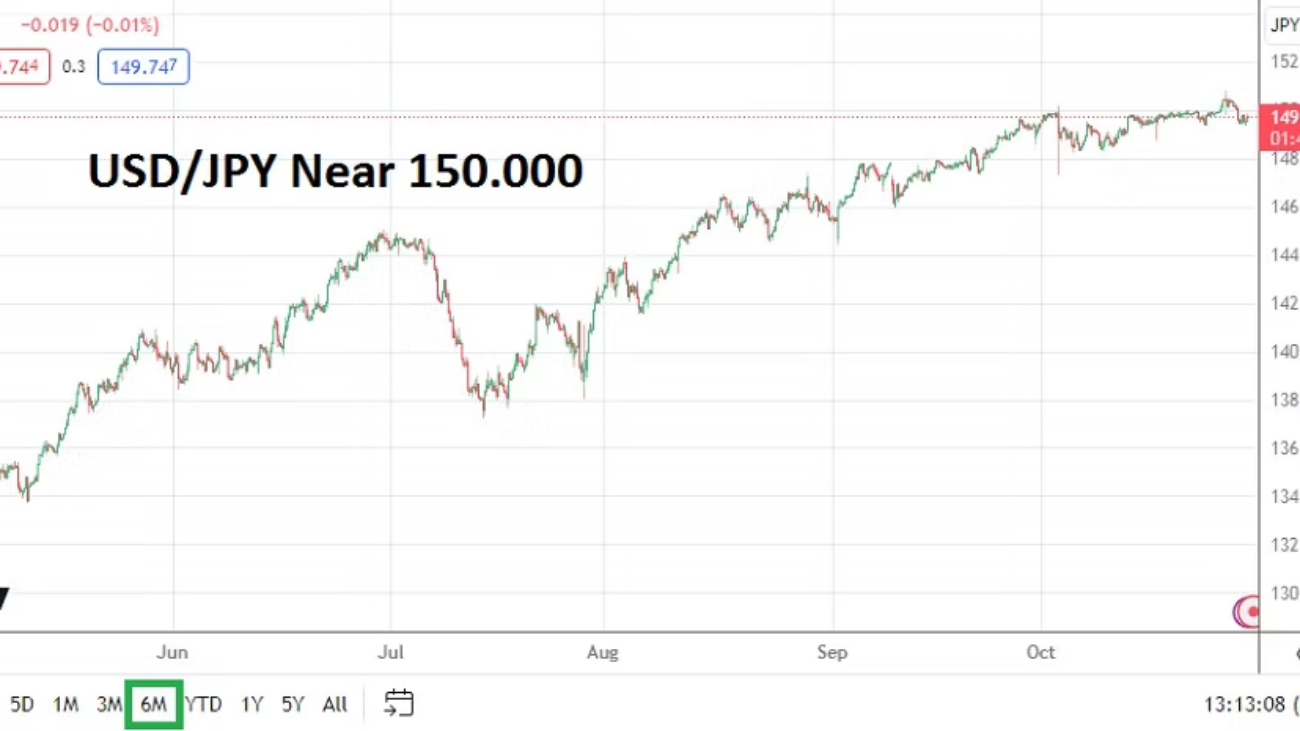
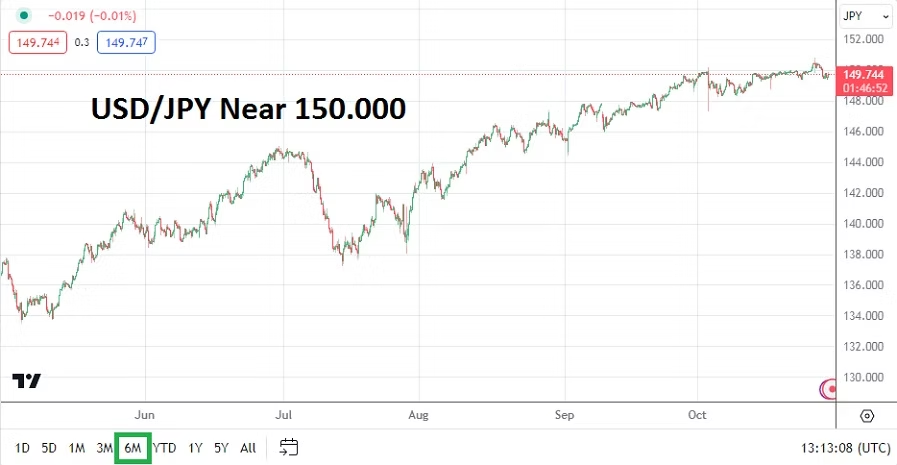
USD/JPY Six Month Chart as of 30th October 2023

Tuesday, 31st of October, Bank of Japan – the BoJ is expected to make no changes to interest rate policy (you have heard this song before), but the USD/JPY remains near the 150.000 level and the Bank of Japan is not comfortable with this higher ratio. The question remains how they can combat this value properly. By suggesting the notion the BoJ can intervene when they want to, can keep financial institutions from over aggressively buying the USD/JPY. Expect to hear some of these intervention warnings again tomorrow.

Wednesday, 1st of November, U.S Federal Reserve Funds Rate and FOMC Statement – Jerome Powell made it pretty clear in mid-October the U.S Fed will likely not raise its interest rate at this meeting. However, he warned the potential exist to raise rates down the road if inflation shows unwanted sparks. American consumers are a reason for concern too, although the Fed will not admit this – the U.S Fed would like to see less consumer demand which they believe would help decrease inflation. Problematically, U.S Treasuries are not only sticking near higher yields because of the potential of higher interest rates, but they are also being bought as a safe haven because of Middle East worries. This will continue to put pressure on the U.S government because paying off bonds with higher yielding rates of returns to investors can become increasingly difficult, particularly when U.S government spending appears to be nearly out of control.

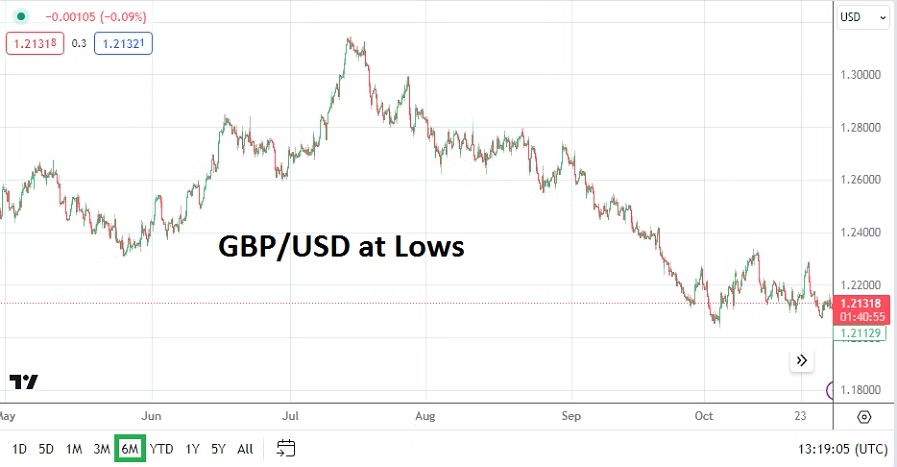
GBP/USD Six Month Chart as of 30th October 2023

Thursday, 2nd of November, U.K BoE Official Bank Rate and Monetary Policy Summary – no changes are expected by the Bank of England. Perhaps like the ECB last week the Bank of England will try to ‘sound’ a sedate level of rhetoric and say they are monitoring economic conditions which remain rather lackluster, but are showing slight signs of improvement via inflation and potential growth. The GBP/USD continues to fight near lows and the 1.20000 level is likely an important juncture.

Friday, 3rd of November, U.S Non-Farm Employment Change and Average Hourly Earnings – the jobs numbers are expected to come in less than the previous month’s results. The wages report could be important if there is a significant change not corresponding with the estimate. Inflation needs to show signs of decreasing before the U.S Fed backs down from its aggressive interest rate stance, if the Average Hourly Earnings number remains stubborn, so will the U.S Fed.

postN19

Broader Alliances: Sustaining Economic and Political Power

Broader Alliances: Sustaining Economic and Political Power

The following article is commentary and its views are solely those of the author.

If the United States decides to abandon its role as the premier global superpower and shall only be a Pacific and Atlantic power, withdrawing as defender of free seas, free trade and freedom in general, its democratic allies will have to start looking elsewhere for broader military alliances. This large group of nations would have to defend their interests against a revanchist China tied to Iran, Russia, North Korea and many of the Latin American countries – possibly including Brazil, and South Africa who have questionable politics and outlooks.

Eastern Mediterranean Alliance: A Strong Sea Power

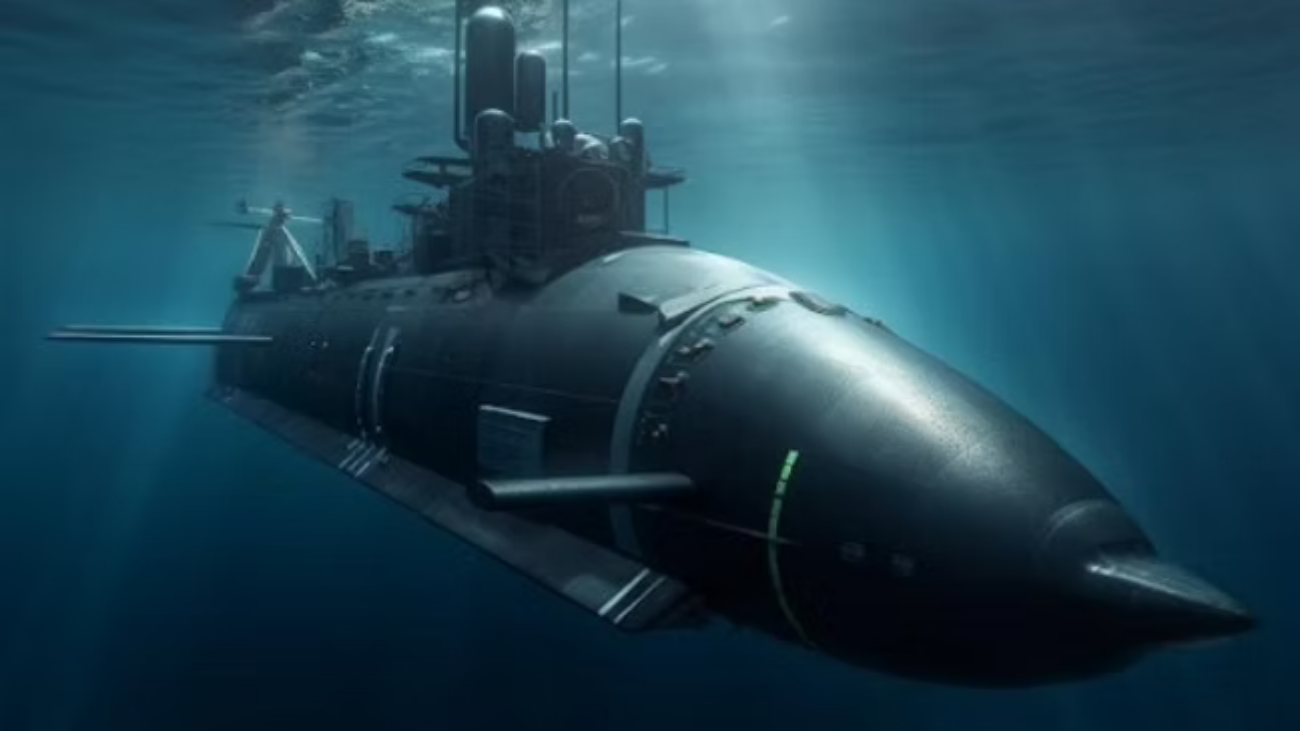
Here is a speculative, yet reasonable look at the future of the free world. Let’s start with the Eastern Mediterranean where the two major powers are Israel and Turkey. One cannot deny that both these countries outclass all others regarding military might in the region. Israel’s air force is second to none and its navy is becoming a strategic necessity as it needs to defend its natural gas fields miles offshore. It now has six submarines that are capable of projecting power anywhere in the Mediterranean and even into the Indian Ocean and Persian Gulf. Turkey is currently a NATO member, but it is not clear that this will outlast the first half of the 21st century.

There is currently an informal alliance among Israel, Greece and Cyprus (both NATO countries) via joint military exercises and intelligence sharing. The Israeli navy and air force train regularly with Greece and its special forces train in the Cyprian mountains with its army. It would be in all three countries interests to formalize a treaty – if not of mutual defense, at least of mutual aid during times of war. All three of these countries are democracies and all three have mutual economic interests.

A formalization of this alliance makes sense now and if there is a NATO collapse it turns into a necessity for Greece and Cyprus. Adding Egypt (although it would be the only non-democracy) to this group would only strengthen the alliance and keep Turkey at bay. A post-Erdogan Turkey that is comfortable with its Islamic character and its modern society could even join this grouping with Israel as a potential peacemaker between the historic Greek-Turkish rivalry.

This alliance without Turkey is a powerful force in the eastern Mediterranean, and this alliance with Turkey could neutralize a nuclear Iran. A Post-Hezbollah Lebanon which is in the interests of all of these alliance members (including Turkey and Egypt), could become a reality and another member.

A New Alignment: The United Border Nations

What about Eastern and Central Europe? Poland is rapidly becoming the major non-nuclear European military power. Within the next few years it will outshine Germany and the U.K and rival France. It is quite clear, nuclear weapons aside, Poland would probably defeat Russia in a number of weeks, if not days if a conflict were to ignite.

Whether the Russian-Ukrainian war ends in a Russian defeat or in some sort of face saving armistice, Russia will not lose its aggressive nature or nuclear capabilities and it will inevitably become aligned more closely with China and Iran because of its current political nature.

The important new alignment will be categorization of ‘countries bordering Russia’. A new alliance of Poland, Finland, Sweden, Norway and the Baltic states – Lithuania, Estonia and Latvia together would have the land, sea and air power necessary to deter and defeat, if necessary, any Russian imperialist expansion. Even with closer ties to China it would be difficult to imagine that, over the next 50 years, Russia would be a threat to this alliance. Adding Ukraine to this grouping would make a powerful force. Its joint population of over 100 million people, while not quite Russia’s 150 million – would be a formidable adversary, especially as the technological skills of these countries is first world and continuing to improve. Adding the other former Warsaw Pact countries like Czech, Slovakia, Romania, Moldova and Bulgaria can only increase its potency.

Unlike the Eastern Mediterranean alliance mentioned above, this would have to be based on a mutual defense treaty in order to properly deter any Russian-Chinese-Iranian attack. Linking up, informally with the ‘new’ Eastern Mediterranean Alliance would create a powerful grouping of free countries against any attempt by authoritarian adversaries. Adding an economic aspect to these border nations and an alliance with the Eastern Med group with free trade zones would create a strong challenge to any attempted Chinese hegemony.

Asian Border Nations Group: Potential Look Ahead at Potential

If we were to unite the Eastern Mediterranean and Border Alliances to an admittedly non-democratic Asian ‘stans nations, including Kazakhstan, Kyrgyzstan, Tajikistan, Turkmenistan and Uzbekistan with a joint population of around 80 million, we are beginning to see the creation of a multi-cultural alliance that extends from the Arctic Ocean through Central Europe, Northern Africa and into Asia.

The Crucial Partner in Order to Balance Power: India

Which leads us to the Indian Ocean; a dominant India can help control the sea lanes from the Persian Gulf to the Bay of Bengal and down to Australia. An Indian-Australian alliance, along with Israel would create a democratic economic and military force that would keep China and Iran from dominating the region. This would require an Indian navy that is not only large, but effective also because it would hold a main responsibility for patrolling the seas from the Persian Gulf up to Australia strongholds.

As India also reaches its potential as a global manufacturing giant, it will be a force to be reckoned with. Including into this potent mix of nations, is the possibility of adding authoritarian countries like Saudi Arabia and the other Gulf states; along with Thailand, Myanmar, Malaysia and Indonesia who have strong ‘western’ economic interests and would create a formidable bulwark against China’s imperialist Belt and Road project.

Without the need to project naval power worldwide the Unites States could use it massive naval, air and ground forces to take better control of the Pacific Ocean along with Japan, South Korea and Australia.

If we add countries like the Philippines and Vietnam, then China would be deterred from further aggression. The only other region that would fall under American responsibility would be the Atlantic Ocean – the shipping lanes to Europe, West Africa and the Mediterranean. Along with the UK and France there would be no challenger to the control of the Atlantic. This could also lead to a revival of the old Monroe Doctrine and maybe free South America from the destructive influences of Iran, China and Russia.

The Global Economy and Free Trade Zones with a Stable USD as Reserve Currency

What does all this mean for the global economy? The free world along with its less than free allies who fear China, Russia and Iran could still maintain a U.S dollar based world. Free trade zones amongst and between the various alliances along with a revival of manufacturing led by a technology revolution using AI, quantum computing, renewable energy and space exploration could lead to a global resurgence of free countries that could stop the authoritarian appetites of Russia, China and Iran in its tracks. This can only happen with a stable reserve currency the ‘West’ can rely upon which is the USD.

Potentially a U.S freed from being the sole defender of freedom in the world, would help get America’s fiscal house in order and allow it to focus on being a dominant economic power. Is there a future for the ‘free world’ without a United States that projects power globally? Currently, a U.S withdrawal from global military assertion would certainly cause the end of freedom (economic and political) in the world for many nations. However, with the new alliances described above and a fiscally responsible United States, freedom could yet make a comeback.

Disclaimer: the views expressed in this article are solely those of the author, and not necessarily the opinions reflected by angrymetatraders.com or its associated parties.