Challenge Part 3 20260729

The Challenge of October 7: Part 3 – Security and Foreign Policy

Towards a Definition of Israel's National Interests

Opinion: The following article is commentary and its views are solely those of the author. This article was first published the 24th of July via The Angry Demagogue.

Ever since the end of the first Lebanon War, Israeli military strategy has moved from active and aggressive defense of the homeland and its citizens via a policy of taking the fight to enemy territory to passive defense based on the threat of massive force – in other words, deterrence. The object was to create a situation where the enemy feared attacking us and to use our military force as a reason to go to the negotiating table. The assumption was that if we were strong enough, we could make concessions and deal with whatever situation arose. “The IDF is strong enough to deal with it” was the phrase de jour. Israel was at peace with Egypt and Syria’s Hafez Assad had no interest in a frontal attack after his air force was embarrassed in 1982 by losing over 60 aircraft in dogfights with Israel as well as 29 of their 30 SAM anti-aircraft batteries.

The PLO moved to Tunisia after the Lebanon War and other enemies, Iraq and Iran, were too far to be a non-terrorist threat. After Begin destroyed the Iraqi nuclear program, “only” terrorism seemed to be a threat. Terrorism though, to the Israeli leadership did not pose a “existential” threat to Israel, as Yitzchak Rabin was quick to repeat after Oslo, so deterrence seemed like a good military strategy for existential threats.
The Challenge of October 7: Part 3 – Security and Foreign Policy

On the diplomatic front, the Oslo accords of 1993 brought a thaw to the loneliness of the diplomats, but the diplomatic goals were still the same – get countries to like us by providing assistance where we can and by explaining how we are trying to come to a peace agreement with the Palestinians – and anyway, they are worse than we are. In diplomacy, like in the military realm, deterrence was the tool and the goal was quiet. In both realms of foreign policy reacting to the situation was the main tactic as both the generals and diplomats guiding principle to move the country forward was “quiet and prosperity will eventually lead to peace”. The political class might have disagreed amongst themselves with the details, but both the right and the left were sure that actively seeking out victory in foreign policy was not in the cards.

On the military side, the assumption was that the Israeli Air Force could deter any major attack while “minor” terrorist attacks and occasional localized rocket attacks did not threaten the existence of the country. Diplomatically, there were goals like having the U.S and other countries move their embassy to Jerusalem or moderating the inevitable anti-Israel resolutions in the UN and its agencies, but they did not seem to feel that the country had much to offer to the world around them or that Israel had any diplomatic heft so that was the sum of foreign policy.

The diplomats and politicians were circling the world with the thought that the more we meet people the less they will hate us. The politicians and diplomats forgot Lord Palmerston’s notion that countries “have no eternal allies, and we have no perpetual enemies. Our interests are eternal and perpetual, and those interests it is our duty to follow.” The military leaders lost interest in protecting the people, forgetting that in a democratic country individuals count even if the end of their individual lives are not “existential” to the country.

What has October 7th taught us and how do we move forward in our international and security affairs? We will go back to the main theme again and that is the “Jewish people and Israeli persons (Israeli, because there are non-Jewish citizens who need the protection and care of Israel’s security and foreign policies). The main discussion has been about the defense concept, the “conceptzia” in Anglicized Hebrew, where one could deter one’s enemies with a combination of walls, destruction of buildings and providing them with a “good life”. Protecting the people seemed to be secondary as the entire south spent weeks nearly every year in their safe rooms and shelters. Even in the year after October 7, the northern towns were sitting ducks to Hezbollah fire with no attempt to take the fight to their territory. The idea that in a democratic country the military strategy was to allow one’s citizens to be shot at by a foreign power on a regular basis is a strategy that cares about ideas and concepts of peace and land but not about the lives of one’s citizens.

Even in the north, where most of the pre-October 7 military planning occurred, there was an understanding that Hezbollah would be able to conquer some border communities – but that they would eventually be pushed back. Besides the defeatist attitude of the generals, it amazes that these same military minds could not imagine what would happen to these communities under the occupation of Hezbollah – and the politicians that approved these plans did not understand the psychological harm to its own citizens of allowing the enemy conquer its towns and the euphoria that would occur in Arab and Moslem lands who want to destroy Israel.

But we are not here to go through the failures but rather move forward with the reality that October 7 has presented us. Simcha Goldin, who fought for 12 years for the return of his son from the hands of Hamas, spoke during that time (and still does) about a return to values. This goes to the heart of where we need military doctrine to go. A value-full doctrine starts with the value of the lives of a country’s along with victory over one’s enemies. What a military doctrine post-October 7 cannot say is that we will allow our towns to be occupied and we will allow homes to be damaged by rockets or drones or anti-tank rockets, that we will allow our citizens and soldiers to be shot at so long as the “quiet” can last for a few months or even years.

Pre-October 7 deterrence meant that both sides were deterred, post-October7 deterrence can only mean that Israel deters its enemies by taking the military initiative and not only reacting. The value of the safety and comfort of all citizens needs to be at the center of Israel’s military doctrine. Victory over enemies is the only thing that can ensure that, as we know now (but should have known then).

As for Israel’s vital interests, one must be the fate of Jews around the world. That has military and diplomatic angles. Antisemitism cannot be tolerated in “allied” countries and both the Mossad and the foreign ministry must be activated to fight it. While it might not be acceptable for one to operate a spy network in an “allied” country, once antisemitism becomes rampant and Jews lives and livelihoods are at stake, a military response is warranted. That is not to mean tanks and jets and drones, but Mossad operations that put fear into antisemites need be planned and activated.

Diplomatically, simple protests by the foreign ministry will not suffice. The government must make it known, via whatever non-military power it has, that antisemitism is not acceptable. If that means recalling ambassadors or making certain diplomats persona non-grata or if that means creating a real diplomatic crisis, so be it. Antisemitism of the type formed after October 7 needs to be fought as terrorism is – on multiple fronts.

Regarding foreign policy in general, Israel has never established, even informally, its “vital national interests”. The post-October 7 world is forcing Israel to do what it ignored for the last 80 years.

Here is a modest proposal of key points of Israel’s national interests. Obviously these need to be fleshed out (maybe in a future piece) and certainly these points themselves can be debated. The problem is – Israel has never had this debate. Here is a start:

– Free movement of Israel’s people and goods throughout the world.

– Support and defense of diaspora Jewish communities wherever they are.

– Support and defense of non-Israeli communities of Israel’s minority groups – for example, Druze, Bahai, Circassian.

– Unrelenting and unapologetic defense of the country’s borders, citizens and infrastructure.

– Defense of its Jewish and democratic traditions, freedoms and values.

– Unrelenting fight against terrorism against Israeli citizens, diaspora Jews and allied countries.

– Establishment of alliances that support Israel’s national interests.

– Self-reliance on matters of national importance such as the defense industry, food and energy production.

The above points are just that – broad points. There is no expectation and there should be no expectation that everyone should agree on the details. For example, “defense of borders” might mean different things to different people, but the argument should only be on what those borders are and not on if Israel ought to vigorously defend its borders. So too, with the “Jewish and democratic traditions” and each point above. But disagreement on the details of the main points is different than disagreement on the outline of Israel’s national interests.

As we have stated, Israel’s security and foreign policies have mostly been reactive over the past few decades. We can blame the right or the left and anyone we don’t agree with, but the main problem has been a lack of understanding by the country’s decision makers of Israel’s national interests. Once Israel understands what that is, it can act pro-actively to further its own interests and not only to react against localized or even globalized threats to the country and its well-being.

Disclaimer: the views expressed in this opinion article are solely those of the author, and not necessarily the opinions reflected by angrymetatraders.com or its associated parties.

Follow Ira Slomowitz via The Angry Demagogue on Substack https://iraslomowitz.substack.com/

Copy and paste the text from AMT that you want to share

Challenge Part 2 20260723

The Challenge of October 7: Part 2 – The Intellectual Challenge

Stepping Away from Spinoza, Marx, Tolstoy, Post-Modernism and Current Religious Ideas

Opinion: The following article is commentary and its views are solely those of the author. This article was first published the 22nd of July via The Angry Demagogue.

In many ways Israel can be reduced to two things – the Middle Eastern shuk and the Eastern European shtetl. Day to day life in Israel resembles the chaotic, loud, richness and poverty of these two institutions. The shuk, the town market where people go to buy foodstuffs and other daily items still exists in most cities and towns in Israel. The two most famous, Jerusalem’s Machane Yehuda and Tel-Aviv’s Shuk Hacarmel still have their original look and feel (and smell) but have also been gentrified to include pubs and cafes. While modernity does not permit the shtetl to exist in spite of obvious similarities in some fundamentalist communities, it exists in the thoughts and actions of many of the descendants of the old shtetl.

The Challenge of October 7: Part 2 – The Intellectual Challenge

However, there is a philosophical backbone to Israel which started as a semi-socialist country with a vibrant agricultural sector and a European-German intellectual core that includes historical, scientific and cultural departments of the strictest standards. Jerusalem’s Hebrew University and Haifa’s Technion were both modelled on the German university and the other universities that have been established since then were formed on the same model.

There were exciting new subjects being pioneered, notably Gershom Scholem and Jewish mysticism and there was dialogue between many of the rabbis and these intellectuals, many of whom were trained in traditional yeshivot even if they no longer practiced halakhic Judaism. Gershom Scholem was in conversation with Chief Rabbi Avraham Kook (a person he called one of the few true contemporary kabbalists) and others. Shai Agnon, later a winner of the Nobel Prize for literature was a leading voice whose modernist fiction straddled both worlds.

But intellectual life was not found only in Jerusalem’s university and yeshivot – it was spread throughout the country in the new kibbutzim and towns that sprung up over the decades. Many of the pioneers – halutzim – were learned men and women in their own right and the first Kibbutz, Dagania, had its share. One was A.D. Gordon, a Tolstoyan thinker who wanted to turn the country into an agricultural idyll. Another resident of that first kibbutz, a wonderful poet known simply as Rachel the Poetess (Rachel Bluwstein), was a believer of the school of thought that, like Gordon, thought physical labor as liberating to the soul.

But as more kibbutzim were established to the softer Tolstoyan socialism of Gordon was added the harder scientific brand of Marx and Engels and the economic; social and pioneering success of these early kibbutzim along with their ability to “produce” great soldiers led to the acceptance of Marxism as the godfather of many of these socialist communities as well as the Histadrut trade union. Both the Tolstoyan and Marxist ways lasted well into the end of the 20th century. In the 21st century there is still a “romantic” view of Tolstoyan rural life and a neutral or often positive view of Marxist socialism.

The other major influence was that of Spinoza – the renegade Jewish philosopher who was excommunicated by the Amsterdam Jewish community but went on to be, arguably the most influential philosopher of his times. His radical rationalistic view of the world extended not only to his original Biblical analysis but also to the most complex of emotions such as love – in his greatest work, The Ethics. We see Spinoza’s influence in the universities today as an attempt to assume the irrationality of anything not scientifically proven (except that which supports their ideology as in Yuval Hararri’s foolhardy bestsellers). Spinoza is seen as a model of the rebel, honest, heretical Jew and his life is seen, ironically, as saintly in the academic world. It would be safe to say that his influence extends to the religious world too, as a bogeyman against whose heresies one must fight.

Although post-modernism is supposed to be the ultimate challenge to rationalists like Spinoza they are in fact, his grandchildren here in Israel as they take his critical abilities to challenge any and all truths as simple narratives to be adapted, or not. Even the Jewish fundamentalist world has succumbed to the post-modern narrative as they reject the very concept of historical truth and accept only their own fundamentalist narrative of history, as currently believed. As a narrative they have no problem changing it to match whatever is their political need – at the moment.

Something similar has happened in the religious-Zionist camp where the rabbis and academics have accepted this envelope that surrounds intellectual debate. The Tolstoyan idyll is combined with the tought of Rabbi Abraham Kook in many of the new farms that are being established to this day. While Marx himself is not accepted, the socialist dream of equality is often the basis of the economic “thought” of these rabbis.

Even in the arts, leading writers are more political than literary, art is seen to need to “challenge” and not beautify and architecture is more brutalist than anything else.

October 7 has changed all of this in Israel even if the intellectual, political and cultural classes have not yet caught on. Faith in the old guard across the board has been eroded as the intellectual infrastructure that the country counted on failed completely. Not only was it not able to deal with the pointed failures of October 7th but it encouraged the value-less ideas that led up to that failure. In the post October 7th world there were almost no intellectual, religious or artistic responses that tried to deal with these failures but, like the politicians and generals (which we will get to later in another piece), they looked back to justify their own mistaken views and prophecies. There have been attempts to deal with them of course, but they all lapse back into old, tired arguments.

The Israeli intellectual classes have not even been able to think through the rabid antisemitism that has enveloped their own world except to return to the same old cliches and complaints which usually blame their political opponents. This has been true across ideological and religious camps.

There have been exceptions of course. Two rabbis come to mind – Rabbis Ya’akov Madan and Tamir Granot – the latter who lost his son in battle and the former whose son lost both legs, also in in the war. They have challenged the fundamentalists in the religious camp, the secularists of the left and the right and their own religious-Zionist colleagues in an attempt to come to terms with what happened three years ago.

If there were three main secular thinkers, on the religious side we can look to three 20th century rabbis and one who was still active in the 21st century who have dominated the religious thought of the country – Rabbis Avraham KookJoseph Soloveitchik and Avraham Karelitz, also known as the Chazon Ish as well as Rabbi Ovadia Yoesf, who, arguably changed the religious and political life of the country through his authority and charisma in the Israeli Sephardi (Jews from Arab lands) community. Jewish tradition by its nature allows great flexibility in re-interpreting past statements to fit the times so there is hope that new and bold ideas can be teased out of these great thinkers.

There need to be better intellectual models than Marx and Spinoza and while Tolstoy was the artist par-excellence his philosophy of history in “War and Peace” and essays leaves much to be desired. Marx of course should be persona non grata for all freedom loving peoples, especially Jews. Spinoza was a revolutionary thinker but one who, despite the “Theologico-Political Treatise” has nothing new to say in the post-October 7 world. As for the Rabbis mentioned earlier, the current dominant interpretations will need to be overcome in order to breathe fresh air into these communities.

To us it seems that the vast majority of people in Israel are ready to move on from the current idols but the question remains will the universities, filled with thinkers who are afraid to face up to their own failures and afraid of losing their international status, find enough bold people to create a new intellectual framework to help the country move forward or will they be left behind and made to be irrelevant to those they are meant to teach and serve? Will the Rabbis, also cloistered in their own four walls be able to look past their previous modern dogmas to forge a way out of the ethical and religious morass formed by the disaster of October 7?

What does the country need intellectually and theologically to move forward? If the old thinkers needed to come to terms with the end of exile and then a post-Holocaust world, today’s thinkers need to help us face the main challenges of the post October 7, morally, spiritually and intellectually. Settling the land is still important but that in an of itself does not protect us. Learning Torah will help us and according to some, will help defend us but it also allows us to run away from the reality that is around us. Studying the great books, creating new narratives not found in history or reason or depending only on our reason did not stop the profound reintroduction of antisemitism in the academy and around the world.

In short – October 7 challenges not only our peace of mind and way of life, it challenges the very foundations of our intellectual and religious lives that were shattered that Shabbat and Simchat Torah morning. Each and every one of us can find the errors of those we never agreed with, but only a bold and creative thinker can re-examine his or her old, mistaken ways.

However, we need to understand where to start on the intellectual and theological journey and there is one thing that needs to be the center of our post-October 7 philosophical, ideational and theological quest. That one thing is the centrality of the “people of Israel”. Tradition calls it “clal Yisrael” and we need to understand that that must be a focus of our thought. All countries and all peoples have a natural sympathy for the pain of their fellow countrymen, or ethnicities but for the Jewish people, so small and so at risk of destruction in every generation that pain always feels existential.

This is a theme that will follow us in our following essays, but it is something that can unite the various thinkers. This is not a call for unity of ideas or a false political unity, but rather that the thoughts and ideas that come from each thinker needs to focus on the betterment of Jews as individuals and Jews as a people and not on the sectors they strive to represent. Maybe the sectorial thinking was necessary to build the country into what it was (or maybe not) but it is clear that the post October 7 Jewish world has changed and brought challenges that need to look beyond the factions that are at the center of the contemporary Israeli and Jewish life.

We claim now that no single Jewish thinker or group has the good of “clal Yisrael” in mind when they plan their future thoughts and actions. This is as true of the Reform movement as it is of Chabad. It is as true of the American Hasidic and non-Hasidic fundamentalist worlds as it is of the modern Orthodox. In Israel it is as true of the religious Zionist world as it is of the Israeli fundamentalist-Haredi as it is of the secular intellectual world.

What is required is an honest, creative and bold assessment by thinkers in all streams. That is not to say they all must agree on the solutions, but the cynical claim to speak for the Jewish people while really pushing for the success of their own group needs to end.

In the diaspora the explosion of antisemitism needs a solution focused on the Jewish people without the excuses we give to the antisemites for being antisemitic – this or that policy, this or that religious commitment. Bret Stephens opened up a new dialogue on antisemitism and that is a start – but it must go much further and much deeper. We too have proposed a modest way of dealing with this evil – but that too is just a start.

We await the honestly, creativity and boldness necessary to bring the country, the Jewish people and the world into the post-October 7th world. We say the world, because the antisemitic reaction to October 7th is not only a threat to the Jewish world, but also a threat to the free world. The intellectual climate in Israel is not conducive to solving the post-October 7th country as it has become politicized beyond recognition. A de-politicization of all intellectual and theological streams and a concentration on “clal Israel” is the only way out of the mess they, we, have all created.

It is not just the generals and the politicians that failed, but the Rabbis, Professors, writers and artists that have failed along with them.

Disclaimer: the views expressed in this opinion article are solely those of the author, and not necessarily the opinions reflected by angrymetatraders.com or its associated parties.

Follow Ira Slomowitz via The Angry Demagogue on Substack https://iraslomowitz.substack.com/

Copy and paste the text from AMT that you want to share

Challenge Part 1 20260721

The Challenge of October 7: Part 1 – Introduction

Cynicism and Wake Up Calls: World War I, Vietnam, October 7th

Opinion: The following article is commentary and its views are solely those of the author. This article was first published the 20th of July via The Angry Demagogue.

Europe and the UK had WWI, the United States had Vietnam. Israel had the birth of the post-Zionist left in the wake up call that was the Yom Kippur War, and now (learning that the wake up call did not last) the events of October 7 have demanded that the country face new challenges – intellectually, politically and socially.

The Challenge of October 7: Part 1 – Introduction

World War I and Vietnam gave birth to the cynicism and inferiority complex to Europe and the United States respectively that has reached its nadir in the contemporary West. The utter lack of self-confidence in the traditions, virtues and ideas that moved the West forward from ancient Athens and Jerusalem to the Middle Ages to the enlightenment and on to the computer age. As technology moved forward, the ideas that underpinned it retreated to a nihilistic denial of the monotheistic idea that is the basis of all Western life.

Today’s engineers, physicists, humanists and social scientists miss the historical arc that moves from Plato and Aristotle’s break from paganism and the Jewish intellectual monotheistic heritage from late Biblical and post-Biblical times through the Church Fathers and the medieval Jewish, Christian and Moslem thinkers to our current times. The bits and bytes of the computer age didn’t just happen to be created in this cultural milieu. That is not to say that the monotheistic religions over the past 2,500 years have not held back important thinkers, caused wars and acted (shall we say, pagan-like?) over this time. They have. Each of the monotheistic religions have something to atone for, as do great Eastern religions – Hinduism, Buddhism and Confucianism in their various forms. And no one can deny that in addition to freedom and scientific advances, the Western tradition also created evils such as fascism, Nazism and communism.

Racism, slavery and misogyny existed throughout history in all cultures and while it was the Judeo-Christian tradition that finally ended at least the “acceptance” of these practices, they seem to rear their ugly heads again and again. We see that in the rebound of antisemitism in polite society.

The fundamentalists of all religions and ideologies unable to live with the belief that what they hold dear can be challenged and therefore we have before us various post-modern narratives instead of historical honesty. In my own religion, the fundamentalists go so far as to deny that a great rabbi ever visited a Jewish library and read the stories of a non-religious Jewish writer. The hagiography and insistence that “the greats” never sinned is part and parcel of the fundamentalist narrative and is due at least as much to the same loss of self-confidence that the secular world has endured as it is to blind belief. On the other side, we have “great” historians who create theories that belittle ancient truths with as much scientific proof as the ancient traditions themselves.

In Israel, as we stated before, the Yom Kippur War was the shock that told the elites that maybe they were mistaken in their Zionism and that a new post-Zionist, post-nationalist, European style country is what should replace the pioneering, self-sacrificing, idealistic country that had been built. They looked at Western Europe and saw a peaceful, prosperous continent and wanted to copy it. What they ignored of course was the beginnings of a demographic crisis, the total dependence for their defense on the United States, and most importantly a loss of creativity and energy that comes with the cynicism and exhaustion of a continent that went through two world wars and was free only because outside powers fought their occupiers and tormentors. Half the continent was still under occupation of course in 1945, but that did not affect the post-Zionist worship of the free half then under the nihilistic force of post-modernism.

After the Yom Kippur War, the Israeli establishment and not only the establishment was ready to move on from the Zionism and Judaism that formed the basis of the Jewish and democratic state in order to move it from its pariah-hood in its own neighborhood. The lure of peace and stability and the hope of a comfortable future was put in the hands of those who felt it was Israeli pride and self-respect that was the reason why the country could not live in peace with its neighbors. Shimon Peres, the tactician, par excellence, who was more responsible for building up the IDF than any other single person, decided to turn into a strategist and went so far as to oppose the study of history in schools. Only forward-looking people need apply.

October 7 has brought the country to another crisis of confidence, but the consensus that is being established is neither a return to the post-Six Day War euphoria nor the post Yom Kippur War depression. Over the coming few days we will examine the intellectual, political, military, diplomatic, cultural, social and economic changes that the post-October 7 country is forcing on the old leadership of both the left and right, the religious, fundamentalist and secular. The current election battle is being fought along the old lines, but the country is moving away from them. It could be that the change will come in this October election, but it may take more time until the leadership is changed and the discussion moves from the old battle lines to new, unknown disagreements.

Over the next few days, we will examine the changes that need to happen in order for Israel to deal with the trauma and, dare we say, opportunities that the failure of October 7 has brought.

Disclaimer: the views expressed in this opinion article are solely those of the author, and not necessarily the opinions reflected by angrymetatraders.com or its associated parties.

Follow Ira Slomowitz via The Angry Demagogue on Substack https://iraslomowitz.substack.com/

Copy and paste the text from AMT that you want to share

Celtics and the Middle East 20260609

Falling into the Middle Eastern Trap

When Talking Becomes an Obsession

Opinion: The following article is commentary and its views are solely those of the author. This article was first published the 9th of June via The Angry Demagogue.

The United States is falling into the Middle Eastern trap that Israel fell into thirty years ago. This trap fits nicely with the post cold-war progressive Western way of diplomacy in that its goal is “talking”. Perpetual talking rather than deal making is the key to understanding the Middle Eastern way of things and Israel has become a practitioner in the “way” that led directly to October 7. The idea of perpetual talking is to reach a situation where you can defeat your opponent without making concessions. In the Middle East, they suck you in to a point where just “talking” becomes an obsession. The United States is heading into the same where results are less important than the act of discussion itself.

Falling into the Middle Eastern Trap – When Talking Becomes an Obsession 9th of June 2026

This obsession, this being sucked into something against your best interests reminds me of a wonderful episode of Cheers, the sitcom that takes place in a Boston bar – a bar in which pints of beer plus inane discussions over anything that leads to nowhere is its reason for being. The episode that I am thinking of has Boston Celtics great Kevin McHale as a guest and the two main instigators of irrelevant and purposeless conversation, Norm and Cliff, (not so) innocently ask McHale how may bolts are in the famous parquet floor at the Boston Garden.

The waitress Carla, Boston working class par excellence, begs the basketball star to ignore them, knowing he will become obsessed and sucked into something that clearly will lead to a disaster for him and her beloved Celtics. Sure enough, the episode ends with McHale driving towards the basket with what ought to be the winning shot only to get distracted by trying to figure out how many bolts are in the floor of the Boston Garden.

That is exactly what is happening now in in the Middle East where President Trump is the basketball star being distracted by Iran and their attempt to suck him into endless discussions that are meant to lead to nothing productive. We don’t know if McHale ever figured out the number of bolts, but besides going back to Cheers with the answer, it is a useless endeavor that can only lead to defeat. So too, with the Trump Administration and the sacred talks with Iran where the end game might be something he can bring back to a press conference in DC or a rally in Pennsylvania but will be worth as much as knowing the number of bolts in the Boston Garden floor.

Israel fell into this trap with the Palestinian Authority of Yasser Arafat and when talks ended, the only goal was to start them up again. Just return to talking. The result didn’t matter. This trap picked up again after October 7 when the goal seemed to be to always be talking with Hamas via Qatar or Egypt even if everyone knew it would lead to nowhere. Ironically, it was President Trump who realized this and was able to do his dealmaking magic to free the hostages – but only after the IDF put Hamas in an untenable situation and Qatar wanted a “great deal” with the Trump administration. Talks never led anywhere.

So here we are, the Trump Administration is hell bent on continuing discussions for the sake of discussions no matter how many times Kuwait, UAE, Bahrain, Israel, or even the U.S military get shot at by Iran. When the goal is talking – when the obsession becomes talking – you have fallen into the Middle Eastern trap much as Keven McHale fell into the trap of inane bar talk for the sake of inane bar talk.

While the American President is a deal maker par-excellence, the Middle Eastern leaders, this time Iran’s, are the experts at making you think that talking is always the best outcome – because it is, for them. Eventually, their experience tells them, you will make a mistake. The Administration has allowed Iran to attack allies at will in the Gulf and in Israel, as Iran gains concession after concession due to the trap that is “talks at all costs”. The first concession was linking Lebanon to the talks and the next, done just yesterday was in putting Iran and Israel on the same level.

This is the mistake one would expect from the Obama-Biden crowd where they always believed that talks were the purpose – they didn’t have to fall into any trap as they were there already. However, the Trump Administration understood the fallacy of forever talks which is what makes it so painful to see them fall into the same Middle-Eastern and Western, progressive trap. Obsession to make a deal is good because results oriented; but an obsession that is just to “get back to talking” will lead only to results that you never wanted in the first place.

Disclaimer: the views expressed in this opinion article are solely those of the author, and not necessarily the opinions reflected by angrymetatraders.com or its associated parties.

Follow Ira Slomowitz via The Angry Demagogue on Substack https://iraslomowitz.substack.com/

Copy and paste the text from AMT that you want to share

Perception Over Fact 20260603

Perception Over Fact: Iran as the Savior of Beirut

Trump Policy and The Art of a Middle Eastern Deal: Israel, Iran and Lebanon

Opinion: The following article is commentary and its views are solely those of the author. This article was first published the 2nd of June via The Angry Demagogue.

Although it is difficult to see where the negotiations between Iran and the United States are going – if anywhere – over the last 24 hours the United States has made Iran the “savior” of Beirut. Against American policy of creating a civil and unified Lebanon at peace with its neighbors, the Trump Administration has told the Lebanese government and people that Iran still controls what happens in Lebanon.

Perception over Fact: Iran as the Savior of Beirut

Even if this was not the case, in the art of the Middle Eastern deal, perception is more important than fact. Whether the Trump Administration actually twisted Israel’s arm due to Iran’s demands or not, the fact that Israel has agreed not to bomb the Dahiya section of Beirut after announcing that they would gives a message to the Lebanese people and government that Iran still calls the shots in Lebanon and not to rush to support those who wish to disarm or dismantle Hezbollah since you will be on the losing side.

Lebanon has been embroiled in civil wars since its inception. Beirut, the “Paris of the Middle East” has never known quiet times although that did not stop the partying (sort of like Paris itself today) and Iran’s involvement, much like Syria’s and the PLO’s before has not helped. Before the PLO inspired civil war in the mid 1970’s, after King Hussein threw them out of Jordan, the civil wars were about Lebanon itself. The French thought they created a formula for the creation of a semi-western state by dividing up the power centers amongst the religious and ethnic groups – Maronite-Christians got the Presidency, the Sunnis the Prime Minister-ship, the Shiites the speaker of the Parliament. The Druze historically were appointed Chief of the General Staff of the army.

This formula was, as can be imagined, not one for the free exchange of ideas but caused a rush to create power centers and led to conflict, civil and military. But it was all internal. Once the PLO and Yassir Arafat came, Israel became a factor in the civil war since Israel had to cross the border to stop the PLO from its numerous cross border terrorist attacks. After the First Lebanon War and the forced exit of the PLO, Iran created Hezbollah with the sole aim of using it, in the future, to destroy Israel. Therefore, from the late 1970’s until today, the Lebanese state has been embroiled, often against its will, in the Israeli-Palestinian conflict.

The goal of the Trump Administration’s negotiations in Washington between Israel and the Lebanese government is to break Iran’s stranglehold over Lebanese internal and external policy and allow it to either establish diplomatic relations with Israel or at least to put the two countries in the situation they were in before the late 1970’s – and that was a quiet, irrelevant border for both countries.

The real or even perceived notion that Beirut was “saved” from Israeli bombing by Iran’s demands has set back that goal and given Hezbollah and hence Iran, veto power over Lebanese government policy. The correct answer to Iran after their demands were made tying Lebanon to the cease fire was that Lebanon is none of your business and if your proxy decided to join your war then they will have to take responsibility for it. The time for “protecting” Lebanon was when you ordered Hezbollah to come to your aid and attack Israel’s north. The result of that – the administration needs to tell both Iran and the Lebanese government and people, is the loss of Lebanese sovereign territory to Israel and the destruction of Shiite villages in the south of the country. A further price is the destruction of the Beirut neighborhood in which Hezbollah has command and control facilities as well as underground arms depots.

Iran cannot be seen to be the savior of Beirut and Lebanon but the cause of its troubles. No amount of rhetoric to the contrary will prove to the Lebanese government and people what they see on the ground now – only Iran has the power to stop Israel’s bombing of their country. The Administration has set back its goals in Lebanon without aiding its war effort in Iran. The constant Iranian threat to make the war regional is coming true since the Administration is not taking seriously Iranian deal-making methods.

As we wrote two months ago in The Art of the (Middle Eastern) Deal” – “Each ‘concession’ by Iran will have to be paid for twice or three times – once upon agreement and then again before numerous times before implementation”. Iran agreed to open the Straits and then reneged and the US is negotiation for that again – AFTER Iran received the much needed cease fire.

Now, after the administration denied linkage to Lebanon, Iran is again demanding that linkage – not in order to open the Straits, but just to continue negotiations. This pushes both American interests to the back burner – the opening of the Straits of Hormuz and the normalization of Lebanon as a country free from Iranian influence. And the “concession” that Iran is giving for this is just a continuation of the negotiations that have been going on for over two months. In other words, like most negotiations in the middle east that are supposed to lead to “peace” – this too is moving backwards.

President Trump has asked for patience and has insisted that the United States will never accept a bad deal – and I am willing to be patient and believe that. But what if the goal of the Iranian government is not a deal at all but the ability to re-set their genocidal triad or missiles, proxies and nuclear weapons? These negotiations have given them time to dig out their underground missile cities, to keep their enriched uranium hidden and now to revive their flailing major proxy – Hezbollah. In the end, as the President said, it will be good, but by allowing Iran to take the initiative he is making it harder to get to that “good”.

What we have now is a continuation of American-Iranian negotiations where a concession was given to Iran and they are no closer to reaching an agreement. Iran is now perceived as the power to be reckoned with in Lebanon and Israel is put on a level with Hezbollah. Iran and the United States are now equals in this negotiation, something that was not the case when they started. While it might in fact end well, the journey is now a longer and more difficult one. The perception given by the last 24 hours that Iran controls Lebanon, is now the “fact” that the Middle East “knows”.

Disclaimer: the views expressed in this opinion article are solely those of the author, and not necessarily the opinions reflected by angrymetatraders.com or its associated parties.

Follow Ira Slomowitz via The Angry Demagogue on Substack https://iraslomowitz.substack.com/
Copy and paste the text from AMT that you want to share

Iran What Losing Looks Like 20260323

Iran: What Losing Looks Like

Who is Losing Militarily, Technologically, Economically and Diplomatically?

Opinion: The following article is commentary and its views are solely those of the author. This article was first published the 20th of March via The Angry Demagogue.

It is difficult for many to admit that the US and Israel are winning the war and that conquering a country the size of France, Germany, UK, Netherlands and Spain together with only air power does not take a day or two. However, by any objective (meaning without thinking that all Trump/Bibi/Hegseth, etc. bad) standard, the allied coalition is systematically destroying the military industrial complex that is the Islamic Republic of Iran (what it is not is a State dedicated to the good of its citizens). People forget that the American air campaign in Gulf War 1 was 38 days. It started on January 17, 1991 and only by February 24 did the generals feel that they could invade and take Kuwait.

The air campaign then poured over 88,000 tons of bombs in approximately 100,000 sorties. And this to capture a country a bit smaller than New Jersey.

As we finish the third week of this war we can assess who is winning and who is not. We have spent this past week discussing what it means to be victorious in this war (The Economy and The Military) and to state unequivocally that victory is the moral choice no matter the price of oil. That being said, the price of oil is rising and hit $120 a barrel before dropping. Economists see $138 barrel as the price that could send the US into a recession. So far, the US economy is holding firm. The S&P 500 closed on the Friday before the war at 6740 and yesterday’s close was 6624 – a drop of about 1.7% – not the panic that the front pages would have us think. The Eurostoxx 50 is actually up slightly from 5719 to 5736.

The Federal Reserve did not cut rates, signifying that they don’t need to prop up the economy and risk inflation as they do when they fear a collapse.

The economies of the West seem strong in spite of (or because of?) the war which should end with the cessation of the 47 year of Islamic Republic price premium. The Russian and Chinese economies meanwhile will be under stress for quite some time. While China will have to wonder about its oil supply, Russia understands that $100 a barrel oil will encourage increased US production (and now Russian and Chinese free Venezuelan?) that will hurt them when oil prices go back to normal levels. As we will now discuss, Chinese and Russian arms deals might start to go south, too.

Technologically, this war is a further test of American and Israeli technology and abilities, and they have passed with flying colors. The American and Israeli missile and drone defense systems are outperforming what they did less than a year ago in the “12 Day War” and the U.S Navy is untouchable. The Gulf States are also fairing better than expected although due to the short distance and the lack of experience, they are getting hit more than Israel is. To top it off, the Russians have forced Ukraine to become global leaders in the defense against drones and there are now 2,000 Ukrainian anti-drone personnel in the Gulf States.

But is the air-forces that are performing so well, that one would think that the Iranians did not invest in the most advanced Russian and Chinese air-defense systems over the past few years. The S-300 or S-400 advanced Russian systems or the Chinese HQ-9B long range surface to air missile and the JY-26 (alleged) anti-stealth radar, are performing so poorly, the Chinese themselves must be hoping it is a personnel issue and not a technological one.

Speaking of personnel, this war has shown that pilot skill still matters. It is the bravery, daring and success of American and Israeli aviators that matters as much as the technology. Just look at the Gulf countries who fear sending their combined force of around 400 F-15’s and French Rafale fighters into the air.

The Russian air force (and army) has already shown it is lacking the skill to compete with even poorly trained Ukrainian pilots, let alone with American or Israeli aviators. The Chinese too, must be wondering if their air force, made up of untested, pilots from one-child families will brave the fire coming from Taiwan as well as the American and Japanese navies in order to complete their missions.

Technology is great – especially if it works as advertised, but if the “operators” are inferior, even great technology will not be up to par. No one yet has been able to match American and Israeli personnel, in the air or on the ground.

Which brings us to that annoying wild-card, the Straits of Hormuz. While the Iranians have not succeeded in closing the straits they are scaring off shipping to an extent that it is a concern not only for the present but for the future. By using this tool, by playing this card, if you will, Iran has forced the United States to make the security of the Straits a war aim. The success of the U.S operation in the Straits will turn it from an international waterway under the veto power of Iran to a U.S controlled and protected gateway from the Persian Gulf. In times of war with China the U.S Navy will be able to turn it into a Chinese energy chokepoint. If the U.S was not there prior to the Iranian gamble, they will be there now.

As for pure military, Iran is losing as no one has lost before. The combined forces have destroyed nearly all their production capabilities for military hardware, have destroyed air defenses, command and control centers, leadership on multiple levels and most of their navy. We don’t need much more to declare Iran the military loser.

Diplomatically, things are not as they appear. While no western European countries support the fighting or even the aims of the war, the Gulf States, India and others are quietly forming an unofficial coalition against regional terror. As Europe tries to figure out how to pacify its growing radical Moslem population, other counties, including Moslem ones, are finally realizing that terror against Israel and Jews slowly but surely works its way back to them. For fanatics, no one is religiously or ideologically pure enough, even if you are descended from Mohammed.

Western Europe is a clear diplomatic loser in this war as President Trump is the last person who will forgive their teachery and allow them to share in the spoils of this war. Their role in the Middle East and in global politics generally is done. Their ability to use their victory in WWI to determine and influence events around the world is finished even though they have now backtracked and agreed to help on the Straits of Hormuz issue.

Regarding China, they have now abandoned one of their main allies and the country they have depended on to provide them not only oil but a strong military presence in the Middle East. The war was clearly coming and just as the United States sent carrier groups to protect its and its allies’ interests, so too, could have China. They could have sent naval vessels to help defend Iran – or at least deter the United States but did not, either because they don’t have the ability to do it or they don’t have the will. In either case, China is a diplomatic loser in this war.

Russia is also losing the diplomatic game as Ukraine becomes closer to the Gulf states and Israel and America are neutering their best technology. Regarding Israel’s recent sinking of Iranian naval ships in the Caspian Sea, reports are coming out that they were laden with Russian military aid. Russia, like China, has not raised a finger to help their main Mideast ally, making it hard for them to claim the loyalty of other purported allies.

And Israel? Israel seems always to be a diplomatic loser, war or peace. However, this war has strengthened the bonds between the American and Israeli military in ways that no one could have foreseen just months ago. The cooperation and trust between the two militaries is beyond anything America has had since its partnership with the UK in WWII. Western Europe’s continued irrelevance on the global scene has lightened the pain the Israeli public feels for western Europe’s betrayal.

India on the other hand has tightened its ties with Israel as Prime Minister Modi’s pre-war trip to the country showed. As for the Gulf Countries, the UAE seems to be interested in strengthening its Israeli ties while Qatar does not. While Qatar is angry at Iran for their attacks it is not clear that this will lead them to abandon their goals of Islamicizing the West and ridding the world of Israel. Saudi Arabia is hard to call. We don’t expect any diplomatic breakthroughs especially if the Islamic Republic actually falls.

Israel we can say is neither a winner nor a loser, yet, in the diplomatic arena – which, considering the beating Israel gets on the world stage, might be called a win but most certainly is not a loss.

The United States can hardly be considered a diplomatic loser in this war as they are the only major power to be able to come to the aid of allies when U.S interests are also involved. The tough talk out of western Europe is a very small thorn in the side of the United States.

To summarize, Iran is the big loser of course as their support comes from a neutered Russia, an apathetic China and a global progressive left that has no power to influence, let alone determine events. Iran’s main allies have been proven ineffectual at best, uninterested at worst and their “brand” has been diminished no matter what else happens in the war.

The only part of the war that the United States and Israel can be said to be losing is the news and propaganda (but I repeat myself) war.

For the things that count though, one thing is certain – the United States and Israel are not the losers.

Disclaimer: the views expressed in this opinion article are solely those of the author, and not necessarily the opinions reflected by angrymetatraders.com or its associated parties.

You can follow Ira Slomowitz via The Angry Demagogue on Substack https://iraslomowitz.substack.com/
Copy and paste the text from AMT that you want to share

Iran: What Victory Looks Like Part 2 - The Military

Iran: What Victory Looks Like, Part 2 – The Military

Missiles, Drones, the Straits and Regime Change

Opinion: The following article is commentary and its views are solely those of the author. This article was first published the 17th of March via The Angry Demagogue.

In a recent X post, Edward Luttwak, the elder statesmen amongst strategists and one who we ignore at our own peril, stated that “The regime is impotent viz the U.S but all-powerful against its own people. So, regime change with bombs may fail but without bombs it might last for ever.” In other words, American and Israeli bombing is a necessary, but not sufficient condition for the overthrow of the Islamic Republic. Luttwak also made it clear that the Iranian people cannot overthrow the regime without native military support.

Not only will bombing not be sufficient to overthrow the regime, but American and Israeli commandos combined with Mossad and CIA operations will not be enough because for the Islamic Republic, internal, Iranian opponents of the regime are a bigger religious and ideological threat than Americans, Israelis or Sunni Arabs and they will always have enough Kalashnikovs and machine guns to kill 30,000 Iranians a night.

But regime change is not the only path to military victory. The mistaken views of the war when the opponents are “shocked”, Casablanca style, when they realize that wars are difficult and unpredictable and come with speed bumps, unexpected ups as well as downs and that not everything is in your control.

The first path to victory is one that is occurring now. That is the destruction of the military and command and control assets of the Islamic Republic. That focuses as we know, on the Revolutionary Guards (IRGC) and the “Basaj” – essentially the IRGC’s domestic militia who are responsible for keeping Iranian citizens in line and are, for the most part, ideological hardheads. With other types of dictatorships, the embarrassing way their military has handled Israeli and American attacks past and present would have been enough to topple them. However, with Shiite fanatics who know no borders (morally or geographically) and whose main enemies are domestic, that is not the case – and no one expected that to be the case.

The attacks must continue until either the regime changes or until their military-industrial infrastructure is destroyed. This means its drone and missile production, its naval forces, air-defenses and underground missile storage and nuclear facilities must be done away with. It does not mean the nearly impossible attempt to secure enriched uranium. Regime change can lead to cease fire and negotiations but without regime change the attacks must continue until the mission is completed.

The second path to victory is the opening and complete control of the Strait of Hormuz. While there still are ships that make it through, this is the one thing that the regime still holds over the United States and the world. The missiles they send to Israel and the gulf will be degraded enough if the bombings continue, but the Western world cannot allow a vicious, cruel dictatorship to control any waterway. Freedom of navigation is one of the key reasons why Taiwan is so important (which Japan knows well – making us wonder why it has not sent ships to help with the Straits) and a key reason this war must be fought. We wrote the other day about the price premium that the Islamic Republic holds over the world (and there was a Jerusalem Post article quoting Peter Navarro, head of the White House Office of Trade and Manufacturing state that the price premium is between $5-15 a barrel – we think that is understated). The Islamic Republic must be denied this ability to blackmail the world.

Of course, it seems that Western Europe is happier with the Iranian regime not losing, than with the American (or Israeli) government winning, but that is something to be dealt with later

The third thing that will bring a military victory is of course, regime change. First, the presence of a new leader on Iranian soil must be attained. This can either be the Shah’s son, Reza Pahlavi, who has been encouraging his countrymen to revolt and therefore needs to show real leadership by making his way home, or someone, possibly a senior military figure, who is in Iran now. Pahlavi is the natural choice, but he must take some risks and show he has the pull and prestige with at least part of the military in order to be able to accomplish the mission of overturning the regime.

In order for that to happen, circumstances must be created where a few divisions of the regular army can protect Pahlavi as he enters the country and he can lead the people to revolt. Once a few divisions defect and with American and Israeli air-power, they can liberate territory, further army divisions will probably join in – assuming they see a path to victory. A revolution need not happen overnight but can come with the army moving across the country and the defeat or defection of some in the IRGC. A few million in Swiss or Dubai bank accounts will also encourage defection.

Without a leader and an organized armed force, the regime just needs small weapons fire to put down any citizen revolt – and they will.

Military victory can come either with the destruction of the drone/missile capabilities and stockpiles along with the forced re-opening of the Strait of Hormuz or with regime change. If the former two, then the Iranian people will continue to suffer, but the Persian Gulf countries, Israel, the United States and the rest of the free world will not. If the latter, then everyone except China and Russia will be winners.

Let us not forget what everyone has been saying since day 1 – that only the Iranians can overthrow the government and that will only be done if the regular army decides to throw itself to the side of the people. The United States and Israel can only create the necessary (but not sufficient) conditions for this to happen. Without regime change, but with the opening and complete control of the Straits, the destruction of the regime’s naval, air defense, missile and drone forces and production, along with the elimination of senior Basaj and IRGC commanders, will still constitute a satisfactory military victory.

Disclaimer: the views expressed in this opinion article are solely those of the author, and not necessarily the opinions reflected by angrymetatraders.com or its associated parties.

You can follow Ira Slomowitz via The Angry Demagogue on Substack https://iraslomowitz.substack.com/
Copy and paste the text from AMT that you want to share

Iran Pt One 20260316

Iran: What Victory Looks Like, Part 1 – The Economy

Ridding the World of the Islamic Republic Price Premium

Opinion: The following article is commentary and its views are solely those of the author. This article was first published the 16th of March via The Angry Demagogue.

There has been much chatter about what “victory” over the Islamic Republic means and it is mostly an attempt to deny the very concept of victory. We wrote about “The End of Defeatism and a Return to Victory” last week where we criticized the whole aversion to victory in Western society. The naysayers don’t like to admit that an anti-Western regime can be all that bad, and therefore endless diplomacy needs to be a goal until the final surrender of the West. They don’t really care about the cost of gasoline in the United States – they actually want it to rise – but as long as it was brought up, let us examine in part, the cost of the Islamic regime and what “economic victory” will look like.

Victory in WWII meant not only the defeat of the evil that was Nazi Germany, but it also meant the resurgence of Europe as an economically successful continent. The Marshall Plan that was the crux of the European revival was as much a part of the Allied (sans the Soviets) victory as the surrender signed by German generals.

What is “economic victory” in this war? The media is all over the costs of the war, but no one has examined the costs of allowing the Islamic Republic to continue as it is. No one has examined the cost that the mere existence of the Islamic Republic (as opposed to non-Islamic Iran) creates for the world in general and the United States in particular.

Let’s start first with the most talked about and panic-ridden event and that is the Strait of Hormuz, the gateway to the Persian Gulf and a chokepoint in international shipping to and from that region. It is the gateway to much of the oil shipped to the world, but also fertilizers and other products. The Wall Street Journal news section in another ignorant headline it considered a “scoop”, wrote that President Trump was told that the Straits might be closed in case of war and he attacked anyway. I am not sure there is a knowledgeable military or diplomatic figure or layman in the world who didn’t consider that an option, but to the WSJ news editors it was the surprise of the century.

As Condoleezza Rice said on the recent episode of Hoover Institutions “Goodfellows” a 50 cent rise in gasoline prices for a few weeks is not a reason not to attack a country who has been at war with you for 47 years. But before we even get to that point, has anyone analyzed the cost of giving Iran a veto over who gets to ship through those straits?

If we look at the insurance rates for shipping through the Strait of Hormuz from Lloyds of London we will get a first hint. From 1970-1979 (before the Islamic Republic) the typical premium was 0.01-0.05%. Once Khomeini took power the rates were 0.05-0.2%. During the Iran-Iraq war when there were the “tanker wars” (between 1984-7) those rates jumped to around 5% with a peak of 7.5%. The post Iran-Iraq and Gulf war period of 2004-19 ranged from .0.05-0.25% – well above the pre-Islamic Republic days.

As for absolute figures, a tanker valued at $200m with a rate of 0.01% (pre-Islamic Republic) cost $20,000 and .05% will cost $100,000. The cost at 0.5% is $1million. So, the pre-Islamic republic rate for a $200m tanker ranged from $20,000-$100,000 while the absolute rate at the lowest level since the Islamic Republic came into existence ranged from $100,000-$400,000 – during the best of times. This does not take into consideration the war premium for the many years Iran threatened and even hit tankers even without the excuse of American or Israeli bombing. The average “war premium” from 1979-2020 was 0.83% or $1.66 million for a $200 million vessel.

We don’t have the wherewithal to continue this analysis, but this is exactly the type of article that we used to expect from the pre-ideological WSJ (or even NY Times) news sections. Maybe some economist or even the WSJ editorial page can start to do the heavy lifting and tell us how much the Islamic Republic of Iran has added to the gasoline bill of the average American even during non-war periods.

In economic terms – victory means a eliminating the price premium for shipping energy and global trade in general brought on by the very existence of the Islamic Republic. We will know victory is here when there is a return to the insurance premiums of the pre-Islamic Republic days and when the price of oil, due to increased supply from a non-terrorist Iran reaches the levels it is capable of. A 50 cent or even a 1 dollar rise in gas prices for a month will be followed by $2-3 decreases permanently. We won’t reach the 28 cents a gallon I remember from my childhood (actually 27.9 cents), but neither will it be $4.00 (except maybe in California).

This economic victory will reverberate to other theatres. While the Russians might profit from a temporary rise in oil to $100 a barrel, in the medium and long term, if oil drops to $40 a barrel or even less, they will struggle to support the war effort.

The short term costs and dire predictions that the journalists and diplomats have foisted upon us will end up being a drop in the bucket after economic victory is achieved.

Disclaimer: the views expressed in this opinion article are solely those of the author, and not necessarily the opinions reflected by angrymetatraders.com or its associated parties.

You can follow Ira Slomowitz via The Angry Demagogue on Substack https://iraslomowitz.substack.com/ 

Copy and paste the text from AMT that you want to share

Slomowitz 20260307

End of Defeatism and a Return to Victory

The Iran War Brings a new Strategy Against Tyrants

Opinion: The following article is commentary and its views are solely those of the author. This article was first published the 8th of March via The Angry Demagogue.

We are witnessing not the end of some amorphous “rules-based international order”, but the end of defeatism and a return to victory.

The defeatist attitude amongst the talking heads regarding the Iran war stems from an inability to imagine victory. For the West, as a friend pointed out, victory has been absent from the vocabulary of war since the end of WWII. The “there is no military solution to the problem” crowd can’t imagine that force is sometimes not only necessary but is the only way to move forward. Giving up on diplomacy does not mean that force will attain the compromises that diplomacy looks for but rather attain the victory that diplomacy can never gain.

This is why the NY Times headline is “In War’s First Week, a Punishing Military Campaign with No Coherent Endgame” while the Wall Street Journal decided that the main story of the day is “Dread and paranoia spread across a 1,000-year-old city” – Teheran. The Financial Times quotes one of America’s foremost defeatists, Richard Haass – “America chose this war — and must now choose how to end it”. These are just small samples of the panic that encrusts the progressive mind when someone stands up to terrorists and tyrants with military force. For the defeatist, the “endgame” can never be victory and the deposing of an illegitimate, tyrannical and genocidal regime.

This is the hope of the tyrants worldwide and they have basically been correct in their assessment of western behavior. The so-called “rules-based international order” is not liberal in any sense of the word but a recipe for the spread of cruelty. This so-called “order” not only tolerated the disorder that tyrants and terrorists have brought for the past 70 years it has funded them, too. In South America, from Maoist terrorists in Peru to the Cuban and Venezuelan kleptocracies, they always knew there would be a chance to “negotiate”. Russia’s Putin was allowed to destroy Chechnya and occupy the Crimea, supported by European thirst for their oil and gas and American desires for a piece of the pie. In the middle east, Yassir Arafat’s Palestinian Authority and later Hamas were given billions of dollars by the United States and Western Europe in spite of their clear and present danger to the West by their spread of terror. Hezbollah and Iran run drugs throughout the world, engage in human trafficking and money laundering all to bring disorder and upset the national governments that support them by purchasing their oil and simply giving them planeloads of cash.

Off ramps are needed when victory is not possible but that is not the case regarding Iran. Imbecilic questions that the press likes to ask like “will you commit ground troops?” trying to trick the leaders of the free countries into showing their hand, are just part of the defeatist culture that has occupied the minds of the chattering classes since the French Revolution. That attitude was fine tuned in Vietnam when defeat was the preferred option and victory deemed immoral. The “end of diplomacy” in this and many other cases is not only the moral option it is the correct strategic option. The WSJ thinks there is no connection between an American victory in this and other theatres and the deterrence of China. The ignorant headline that the WSJ news section has today (one of many since the start of this war) “America’s Military Is Focused on Iran. Its Biggest Challenge Is China” cannot imagine that victory – absolute, total victory – is the greatest diplomatic weapon one can have when dealing with a country the size and strength of China.

A history professor once told me that the reason why diplomats hate war is because it means they have failed but the West has upped the ante on that failure by always insisting on a diplomatic (read: defeatist) end to whatever military action is or is about to take place. Diplomacy might be a necessary end to some conflicts but not to one that one is winning. Any description of the current war as a “quagmire” is bad faith reporting at best, traitorous propaganda at worst.

As we have stated here in the past, predicting President Trump is a fool’s game but it is also a fool’s game to assume this administration thinks in the same defeatist terms that has been the essence of the Western “rules-based international order” for the past half century and more. The same is true regarding Israel’s attitude towards this war. Israel too, has been caught up in the same defeatist attitude as it took the word “victory” out of the goals of the IDF. “Managing crises” is what brought us to October 7 as the IDF General Staff pre-October 7 were mediocrities who gained their positions for political reasons and because they “checked-off” two year stints in various jobs in the military.

Netanyahu was part of that defeatist attitude and that is why people still doubt his ability to see this through to the end. But he now has a military that is determined to win and we all hope he, under encouragement from the US administration, will follow suit. The headline that purposely plays to the anti-semitic woke and Tuckerist followers “Netanyahu Finally Got What He Wanted on Iran by Appealing to an Audience of One” misses the whole point – this is as much Trump’s pressure on Netanyahu as Netanyahu’s on Trump.

This is more than “whatever is good for Trump must be bad”. This is a failure of imagination by a large group of modern day “influencers” (yes, the so-called journalists reporting on the war are no better than Instagram and Tick Tock influencers) who can’t fathom what victory looks like and who believe that a military victory of any sort is one that is, by definition, immoral. The failure of diplomacy is not a failure of morality. Rather it is a realization that the moral way requires military force. The off ramp and the end-game is victory, plain and simple. The fact that some can’t imagine what that looks like does not mean it is not within reach.

The flip side of this of course is that the enemies of the west have an inability to admit defeat. This comes from the fact that the west seems to enjoy surrender in the name of diplomacy so these enemies can always count on the west playing the short game and demanding a return to negotiations. That is why these negotiations failed so miserably. The enemies of the west don’t seem to realize that things have changed and that the Starmer-Macron-Obama defeatist wing of the West is no longer making the decisions.

Contra all the defeatist headlines and analyses, the idea that the off ramp and endgame is now “victory” might actually deter the next tyrant and allow future negotiations to succeed.

Disclaimer: the views expressed in this opinion article are solely those of the author, and not necessarily the opinions reflected by angrymetatraders.com or its associated parties.

You can follow Ira Slomowitz via The Angry Demagogue on Substack https://iraslomowitz.substack.com/ 
Copy and paste the text from AMT that you want to share

postN73

U.S National Security, Part 2: Regional Alliances – Europe

U.S National Security, Part 2: Regional Alliances - Europe

Opinion: The following article is commentary and its views are solely those of the author. This article was first published the 25th of December via The Angry Demagogue.

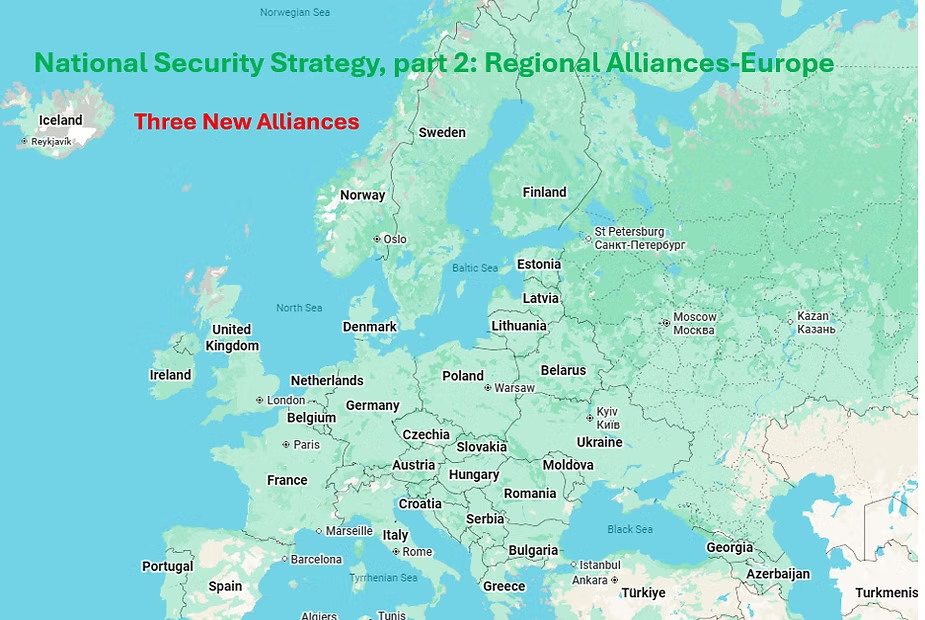
As we continue our tour of the administration’s National Security Strategy we will stay with “part III: What Are America’s Available Means to Get What We Want?” and move to the sixth bullet point: “A broad network of alliances, with treaty allies and partners in the world’s most strategically important regions” and work through the important regions that the strategy documents – Asia, Europe, the Mideast and Africa. For good or for bad we will need to split these regions up since the key point is forming coalitions that can handle their actual region. Sweden can’t be part of a coalition to protect Italy’s interests in the Mediterranean and Japan won’t be protecting Singapore.

Some U.S allied countries, like Australia, Israel and India will be involved in multiple regions helping lead alliances in all areas important to them. With that in mind we will point out the first mistake of the discussion on regions and that is Europe. We will suggest something here that would not usually come from the mouth of a hawk and pessimist and that is that NATO has no real mission and needs to be replaced by a series of alliances that make more sense. While the fear during the Cold War was a Warsaw Pact ground invasion into Germany and beyond which would have required the totality of American and European forces, Europe now is facing a Russia that could not conquer Ukraine in nearly four years of war. That is not to say that Russia is not to be feared only that each part of Europe needs to ally to face a Russian onslaught in its own theatre.

Italy is not going to send troops to Sweden to prevent an attack and Norway won’t be helping Greece in any fight. Turkey is a country that other NATO countries fear more than trust, especially regarding Russia.

In short, NATO needs to be broken up into different alliances where each country will be allied with countries whose fall would affect its national security. The United States can either be a signatory to these alliances or it can decide how involved it wants to get in any conflagration depending on its own interests at that time. It can decide to position ground troops in the countries, supply air cover or, as in the 12-day war between Israel and Iran, help with missile defense and in providing the final blow with weapons only America has. Or – it can decide that it will never participate. One hopes that that won’t happen, but each alliance will need to be ready to fight on its own.

We can include France and the U.K as large countries with advanced armed forces as allies to all of these alliances. France certainly can contribute air power to each of the alliances that are faced against Russia. As for the U.K, it is difficult to know where that country is going but its navy and air force are still powerful.

Today we will deal with north, central and western Europe.

The Baltic Alliance

This would be an alliance that includes Poland, Germany, Sweden, Finland, Norway, Denmark, Latvia, Lithuania and Estonia and would provide cover for land, air and naval battles. Each of these countries, with the exception of Germany, has a border with Russia and all are on the Baltic Sea – a key waterway for them and for Russia.

An alliance of these countries would force them to concentrate on those areas necessary for their defense. An incursion, for example into Finland would force Poland to mass forces on its border with Russia and Belarus (Poland borders Russia in Kaliningrad which is separated from Russia proper by Lithuania) and Germany to move forces to Poland. All countries could also contribute ground forces to Finland as well as naval and air power.

The only thing missing is the lack of a nuclear umbrella. That is no small issue but can be dealt with by support or threats from France or the U.K.

The Atlantic Alliance

Aside from helping the Baltic Alliance, France and the U.K will have major responsibility along with the Netherlands for patrolling the North Atlantic and, with help from Portugal, and Spain the South Atlantic. As the Atlantic Ocean can be considered one of America’s seas, this alliance will need to have the close cooperation if not outright membership of the United States. Canada too, will need to be part of this alliance. We can include the increasingly important Arctic Ocean into this alliance’s responsibilities.

As we move towards the south Atlantic countries such as Morocco, can be included as well as other western African allies of the west. An alliance like that could encourage western African countries to abandon close security and economic ties with China and Russia. The “border” of this alliance would be that squiggly line in the middle of the Atlantic that separates the Eastern and Western hemispheres.

The Central European Alliance

We can look at the smaller central European countries that formed the heart of what was the Hapsburg Empire but are not front line countries bordering Russia – Romania, Hungary, Slovakia, Czech Republic, Austria, Serbia and Bulgaria – and we have an alliance that, backed by Germany, Poland and the United States, would create a further deterrence to Russian encroachment into Europe proper.

Where, do you ask does Ukraine fall in this European alliance structure? That answer will have to come from the major European powers in concert with the United States. Adding Ukraine to the Baltic alliance might be viewed as another attempt to NATO-ize them by the Russians. However, attaching them to the less threatening Central European Alliance of smaller countries might be the excuse and “victory” that Putin would need to end the war. But we are getting ahead of ourselves here. Ukraine is a problem that can only be solved if the West decides to actively join the fight against Russia (unlikely) or when Putin and Russia get tired of the fight and look for a way out that could allow them to claim victory (more likely than the former, but sadly, a long way off).

The Administration’s concentration on regions and how certain countries can become leaders in support of western and American interests is correct – but the breakdown of the regions has to go beyond the post WWII world. The place of America in the post-cold war world, with a China that wants to challenge America’s economic and military interests and leadership needs to break down old alliances into more manageable and logical pieces.

The wild card in all of this is, of course, the will of the European powers to take their own defense seriously. The Baltic Alliance we spoke about seems to be filled with countries that understand the threat from Russia, but do they recognize the threat to them from the alignment, the Axis if you will, of Russia, Iran, North Korea and China? And of more importance have they yet come to understand the threat to their countries, as they know them, from open immigration and from their own abhorrence of families? The former is something only the governments can handle, the latter though, must come from the people themselves.

A whole generation (or two in many instances) of Europeans have grown up not only as “only children” but in families that have no aunts and no uncles, no cousins and only very elderly grandparents, if that. They have grown up in other words without families. Will the young generation see the importance of families to themselves and their countries or will they continue the nihilistic lives that they parents have “sanctified”? Religious institutions, too will have a major role in this challenge. No amount of “parental leave” and childcare subsidies will convince the young to marry and have children – will only come from a change in the culture. Is Europe up to it?

Disclaimer: the views expressed in this opinion article are solely those of the author, and not necessarily the opinions reflected by angrymetatraders.com or its associated parties.

You can follow Ira Slomowitz via The Angry Demagogue on Substack https://iraslomowitz.substack.com/ 
postN72

U.S National Security: USD Reserve Currency Importance

U.S National Security: USD Reserve Currency Importance

Opinion: The following article is commentary and its views are solely those of the author. This article was first published the 23rd of December via The Angry Demagogue.

We would like to start going through the U.S administration’s National Security Strategy released last month. There is a lot in there – much of it the same as in past administrations and much of it different. The tone of course is full Trump and while the introductory parts try to make it into a revolutionary document it does in fact build upon much of what has been American foreign policy for decades. One thing it most certainly gets right is that American foreign policy since the end of the Cold War has not found its compass. From a unitary world to one dependent upon global organizations, from a sharing of goals with western Europe to a pivot to Asia, from the war on terror and the middle east to Russia-Ukraine, the United States has struggled to find its way in the post-Cold War world.

We however will concentrate today on one aspect of the strategy, the third bullet in part III – “What Are America’s Available Means to Get What We Want?”. The third bullet point speaks of America having “The world’s leading financial system and capital markets, including the Dollar’s global reserve currency status” – a point that no one with any knowledge of global capital markets can not accept. The end of the bullet point – the Dollar’s global reserve currency status – is the most important because it underscores America’s leadership and essentially allows the United States of America to finance its military and its welfare state. The U.S Dollar as the “reserve currency” means that nearly all the world’s goods are quoted and therefore sold in Dollars.

Why is that important to the United States? Because the U.S government depends on its ability to issue Treasury bonds and bills at will – something no other government can do. It can do this because for another country to buy oil or copper or titanium or corn or soybeans from a country that is not their own– they need access to Dollars. Saudi Arabia and the other gulf states quote the price of oil in U.S Dollars and demand payment in U.S Dollars. The Saudis can deposit those Dollars in American banks or in what is called Eurodollar deposits in foreign banks (there are some 13 trillion Dollars in Eurodollar accounts globally). The Eurodollar accounts are essentially promises by the bank to give U.S Dollars to the holder when he makes a withdrawal. This strengthens the U.S capital markets and allows investors to have better and more investment choices. It is not only America’s often superior companies that bring profits to 401k’s and pension funds but the liquidity and vastness of America’s capital markets that can list domestic and foreign corporations. The reserve currency leading to the advanced capital markets allows the world – and America – to do this.

The U.S Treasury market is so liquid because every country needs Dollars in order to trade. They need to have enough dollar reserves since no one actually wants their own currency. In Israel, for example, local gas companies cannot buy oil with Israeli Shekels, since what will Azerbaijan, for example, do with them? There are only so many products that Israel can sell them. They need Dollars so that they are free to buy other commodities or other products.

The U.S Dollar as a reserve currency also is a break on inflation since the price of oil and other commodities is always in U.S Dollars. A weak or strong U.S Dollar influences the inflation rate in non-USD countries. A weak Israeli Shekel, South African Rand or Chinese Yuan does not influence the price of gasoline in the United States.

In short – as the Trump Administration understands well, the dollar as a reserve currency is a luxury the U.S cannot give up. The lack of the USD as a reserve currency could cause the Dollar to collapse and along with it the price of U.S Treasuries. As UST prices drop, their yields will rise and the cost of financing the U.S government will make interest payments on debt to rise well beyond its already absurd figure of over 4% of GDP – while debt itself is 120% of GDP. The U.S government currently pays over $1 trillion in debt service (interest payments on its bonds and bills). By contrast, the U.S defense budget for 2024 was $836 billion (about 3.3% of GDP).

We need to ask ourselves what can challenge the USD as the reserve currency and what could happen that would encourage the world to change? While the E.U had dreams of making the Euro an alternative reserve currency, the lack of growth in the E.U’s economy and population have put that dream to rest. The only other country that could theoretically replace the United States as the global economic go to country could be China. While in the long run, China’s lack of openness would probably mean that the Yuan would not last long as the reserve currency, that does not mean that they couldn’t jolt the global economy just enough to force it to use the Yuan to buy oil and other commodities.

China is already cornering the market on rare earth minerals and it making inroads in Africa where it mines all sorts of commodities from gold to copper to platinum and so many others (Africa has about 30% of global mineral reserves). That in itself is not enough to rock the global markets and cause a change in how the world does business.

Oil though, is that one thing that could allow China to challenge the USD as the reserve currency, even if it just presents the Yuan as an alternative.

How could that happen?

A Chinese takeover of Taiwan, by whatever means it uses would give the Chinese Communist Party control not only of the South China Sea but also allow its noisier and inferior (to America’s) submarine fleet to enter the Pacific and patrol it freely. The Chinese Navy, with a base on the “other” side of Taiwan would give it control of the north-south sea lanes that Japan and South Korea are dependent upon. Essentially, Chinese control of Taiwan would put Japan, South Korea, Vietnam and the Philippines at the mercy of the Chinese Navy. China could blockade these countries but that would be an act of war and then involve the navies of those countries and possibly the United States. It would affect the global economy negatively but it would not cause a change in world’s reserve currency. But, what if China works out a deal with Saudi Arabia to quote and sell their oil in Yuan (or the Chinese Petro-Yuan it wants to create) and then tells these countries, especially industrial powerhouses and energy poor Japan and South Korea that it will allow the passage of oil as long as they purchase the oil in Yuan?

Russia is already trying to get India to pay it for its oil in Yuan, to some success. Adding economies the size of Japan and South Korea would mean that any country that wants to buy oil could buy it in Yuan instead of Dollars. Once in Yuan, these countries would need to use the Yuan to buy Chinese products, deposit cash there and buy Chinese treasury bills. If China were to combine that with demands that all chips made in Taiwan also be sold in Yuan, the U.S Dollar would suddenly and forcefully no longer be the only reserve currency in the world.

Obviously, the way to stop this from happening is by stating outright that the United States will not tolerate a Chinese takeover of Taiwan. It is true, that the Strategy claims that the US “will also maintain our longstanding declaratory policy on Taiwan, meaning that the United States does not support any unilateral change to the status quo in the Taiwan Strait” but in practice the administration has criticized Japan’s tough talk on China instead of leaving it be. A strong silence on Prime Minister Takaichi’s remarks on China would have served the purpose of keeping the status quo more than telling her to tone down her rhetoric. There is a strong “no intervention ever” strain in the country and the President must make the case that that is not an option if the United States wants to maintain its leadership position, way of life and general prosperity.

In short, the threat to the Dollar as the reserve currency heads right through Taiwan. For those who think that the investment the U.S makes in keeping the Dollar where it is, is too expensive, just think of going on vacation and having the change to Yuan before you leave the country, wondering how much to change because of currency fluctuation and how much fun it is to return with hundreds of dollars in banknotes that you can’t use. Imagine your credit card bill on such travels and wondering how you went 15% over budget but didn’t get anything extra for it. Now imagine the national economy working that way.

Disclaimer: the views expressed in this opinion article are solely those of the author, and not necessarily the opinions reflected by angrymetatraders.com or its associated parties.

You can follow Ira Slomowitz via The Angry Demagogue on Substack https://iraslomowitz.substack.com/ 
post256

Crude Oil: A Guess from the Underbelly On What Happens Next

Crude Oil: A Guess from the Underbelly On What Happens Next

Why has the WTI Crude Oil Spot price remained relatively calm? The war between Israel and Iran has been going on per this latest violent phase since Friday the 13th. While tensions have been high between the two nations from the 7th of October 2023 in a very outward manner, and missiles were fired from Iran towards Israel on two separate dates in 2024 which then featured Israeli retaliation, the past handful of days is a new escalation.

WTI Crude Oil Spot Price Six Month Chart as of 18 June 2025

Day traders of WTI Crude Oil need to understand that large players in the energy sector have a vast amount of experience and intel regarding production and supply worldwide when they make their buying and selling decisions. However, the biggest oil traders do not always share the same political viewpoints, except to say most large players in the energy sector practice the art of realpolitik. Day traders of WTI Crude Oil should try to get into the minds of the real movers of WTI Crude Oil via realpolitik considerations.

As of this writing the price for WTI Crude Oil is around 73.930 Spot, late yesterday it did move higher to within sight of the 75.750 USD mark – this when information that President Trump is considering a U.S military strike on Iran heightened. Traders need to understand Spot Crude Oil and Futures pricing can be different. The current value of WTI Spot is higher than the Futures pricing because of the short and near-term known risks.

However, volatility in WTI Crude Oil Spot has remained fairly muted, almost tame as Israel and Iran wage war. Other spot energy prices like Brent and Natural Gas are being affected directly too because of shifts in behavioral sentiment. But again, the prices within the energy sector have remained calm considering what is at stake for global economics. Here are points that may be affecting the WTI Crude Oil landscape and energy complex, which some large traders may be contemplating:

  • It is highly likely the U.S has told Israel not to harm Iranian Oil production or supply sites, including shipping.

  • The U.S does not want the price of WTI to jump rapidly because of the current war between Israel and Iran.

  • Inflation would be a scrouge for the global economy, not to mention President Trump’s ambitions.

  • Even though the U.S has its own energy supply, the price of WTI is affected by behavioral sentiment within the global Crude Oil complex.

  • Meaning conflicts in the Middle East and elsewhere always cause ripple affects, even if Crude Oil is flowing freely in the U.S via its own production.

  • The U.S doesn’t want China to be given a reason to consider becoming an open belligerent in the Middle East war.

  • China gets a lot of Crude Oil from Iran. The stated percentage is around 15% of its total supply, but it could be more if Iran sends oil to other locations and then reroutes supply to China afterwards.

The U.S not only wants to keep China calm about its energy supply, but also doesn’t want to give China an excuse to escalate political or military tensions elsewhere – read Taiwan.

As an aside there are a lot facts and rumors coming from China, highlighting that a powerplay is emerging between competing factions for leadership in China’s military, this may include the authority that Xi Jinping has too. China will be conducting Politburo meetings in the coming weeks that will get plenty of attention via Beijing analysts. If U.S intelligence knows an internal political fight is taking place in China, they will want to keep China calm regarding external considerations and not give China excuses to act. Concerns regarding the Middle East as a justification for more Chinese actions against Taiwan in some type of economic political/ military theatre is a threat.

By telling Israel not to attack Iranian oil infrastructure, this allows the U.S to placate China. Only if Iran were to attack U.S infrastructure – including military assets or interests in the Persian Gulf via attacks on Gulf States like the UAE, Bahrain or Saudi Arabia would the U.S consider retribution against Iranian Crude Oil.

While the U.S has an interest in global politics certainly, it also wants to maintain a stable global economic environment. President Trump knows this and so does his cabinet supposedly. The Federal Reserve meets later today and they will certainly speak about uncertainty regarding inflation. Whether or not they mention the Middle East war will be interesting.

Thus, it is likely the U.S will only allow an attack on Iranian Crude Oil production and supply if it has been directly threatened. And this is where it gets potentially more interesting for Crude Oil traders. It appears likely the U.S will get involved directly in Iran by hitting known Iranian nuclear facilities deep underground with heavy U.S ordinance. If the U.S does attack Iran via B2s using heavy bombs, how will Iran’s Revolutionary Guard Corps react?

Will the existing IRGC allow for the destruction of its nuclear ambitions and accept that it will have to prepare for a new political environment in which their power will likely be challenged by not reacting? Or will those in power of the IRGC double down on stupidity and attack U.S assets with some of the Iranian military weaponry that still remains? An attack on U.S ‘interests’ would risk aggravating the U.S more – giving the U.S reasons to attack Iranian economic infrastructure which is mostly Crude Oil, and likely close the door on the chances of the IRGC to survive after the war concludes.

Things often do not work out via political and military outlooks. The law of unintended consequences is always a danger. The end game is quickly approaching for Iran’s current leadership. The U.S and Israel also hopefully have taken this into account. Recent outcomes in Iraq and Afghanistan have not gone as planned for the U.S when seeking a serene endgame.

As an example, it might be better not to eliminate the current Ayatollah Khamenei, and allow the people of Iran an opportunity to remove him if they want. The Iranian Revolutionary Guard Corps and its various factions are probably eyeing what will come after a capitulation. There will be a fight for survival politically and a leadership vacuum.

The IRGC fiefdom gets most of its money from Crude Oil revenues. It is quite possible in a forward looking manner the IRGC may choose not to risk having the U.S ruin Iran’s one giant economic asset, thinking rightly or wrongly that they can continue to profit from Crude Oil the day after the war ends.