postN88

Iran, Oil and The Crumbling of a Criminal Dictatorial Wall

Iran, Oil and The Crumbling of a Criminal Dictatorial Wall

Step aside for a moment from the conspiracy theorists and let’s consider that the U.S did not take out Maduro of Venezuela in order to facilitate more supply of oil. Let’s consider the possibility that Maduro was removed because he did not facilitate free enterprise and ran a criminal enterprise that did not favor the U.S.

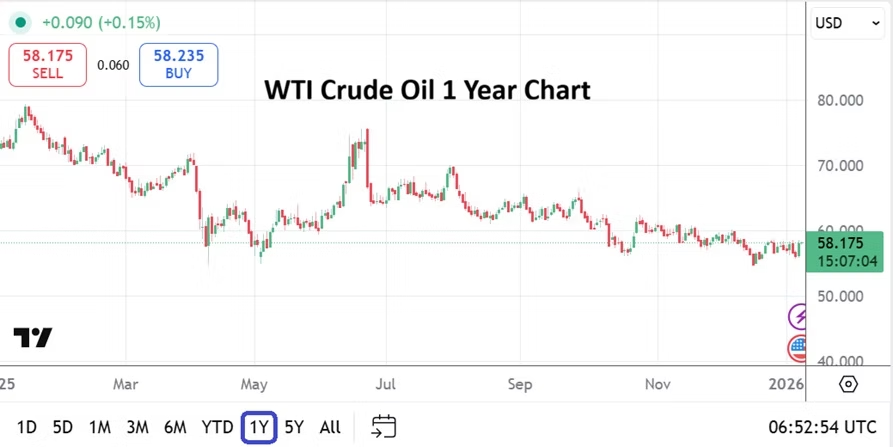
WTI Crude Oil One Year Chart as of 9th January 2026

Venezuela has the largest demonstrated oil reserves in the world, but the U.S has done rather well without it for years. The Trump administration’s move to take over Venezuela deters China and Russia’s influence in the Americas, while also putting another nail in the coffin of the Cuban regime. The word regime is used implicitly to point out that Venezuela, Russia, China and Cuba are all regimes of one sort via their one party ruling systems. Yes, you can argue the United State has returned to an imperialist philosophy, but that doesn’t mean it has dictatorial rule. Some will argue that point, I understand. But let’s step away from the complexity of political biases – including my own – and insights and discuss oil for a moment.

The takeover of the Venezuelan oil infrastructure, which has not happened in full yet via the U.S military action, does not mean U.S oil companies will make trillions of dollars from the adventure immediately. In fact a glut of oil is one of the potential consequences if Venezuela were to return to an open market system with its energy supply. Yes, the price of oil would in theory likely get cheaper. While it can be argued that this will help the U.S consumers, however many U.S producers of the shale oil industry would be put in a difficult spot. Producing oil from shale deposits requires hydraulic fracturing – known as fracking – and is an expensive endeavor. Cheaper oil from Venezuela in other words could put small and medium producers in the U.S out of business if supply becomes too ample

Now let’s turn our attention to Iran and the attempted revolution that is fomenting a reaction from the regime of that nation. Oil supply is certainly at stake for the world, but there is the overwhelmingly important possibility of allowing 90 million plus people to live in a system without repression. As of last night internet and telephone lines have been shuttered by the dictatorial government. There is a legitimate fear that many people protesting for their rights to be free now face the risk of violence and some have already begun to pay with their lives. Freedom is more important than oil for the people of Iran and Venezuela. It should also be pointed out that Venezuela and Iran are members of OPEC and this is likely not going to change.

The Trump administration is threatening military action against the Iranian rulers, but it is questionable how the regime of Iran could be overthrown by outside forces if there are not active combat boots the ground. While it may be possible to attempt a Venezuela like mission in Iran, that would be difficult at best considering the regime is already paranoid and on high alert. The civilians of Iran will have to do a lot of the work by themselves. Which means the populace of Iran will need to be able to organize and collectively topple a dictatorship, and this is unlikely to be done by handing out flowers. The regular army of Iran must disobey orders and the police must decide not to participate in violence against the protesters, allowing a seizure of power by the people.

At this juncture it remains difficult to say what will happen in Iran, except to say that there is likely going to be blood spilled. The Berlin Wall fell after decades of Cold War between the West and East. The wall of the Islamic Republic of Iran which was declared in the first week of April 1979 has nearly been running its dictatorship as long as the communists controlled Eastern Europe.

If and it is a big if, the Iranian people are able to topple the Islamic Republic of Iran it would be a game changer the world over. The complexity of the mafia style state that the current dictatorship has controlled not only in the Middle East, but throughout South America and elsewhere via influence with its proxies like Hezbollah is enormous. The dismantling of this network would take longer than the toppling of the Iranian regime. The world is unlikely to ever know in full detail the criminal activity of the current Iranian government and its proxies worldwide.

This is not about oil, it is about freedom. However, if the oil of Iran suddenly came under the control of a Western looking Iran that was unshackled, yes it would add to a vast amount of energy that the world already enjoys, but OPEC would find a way to manage the supply.

If Iran were to join the ranks of free nations and castoff its current leadership the world would benefit greatly. Only nations and proxies that gain from the exploitation of the Iranian dictatorship would worry. If the Iranian dictatorship falls there will not be paradise, but the event would be significant and transform the current state of global affairs.

Copy and paste the text from AMT that you want to share

postN73

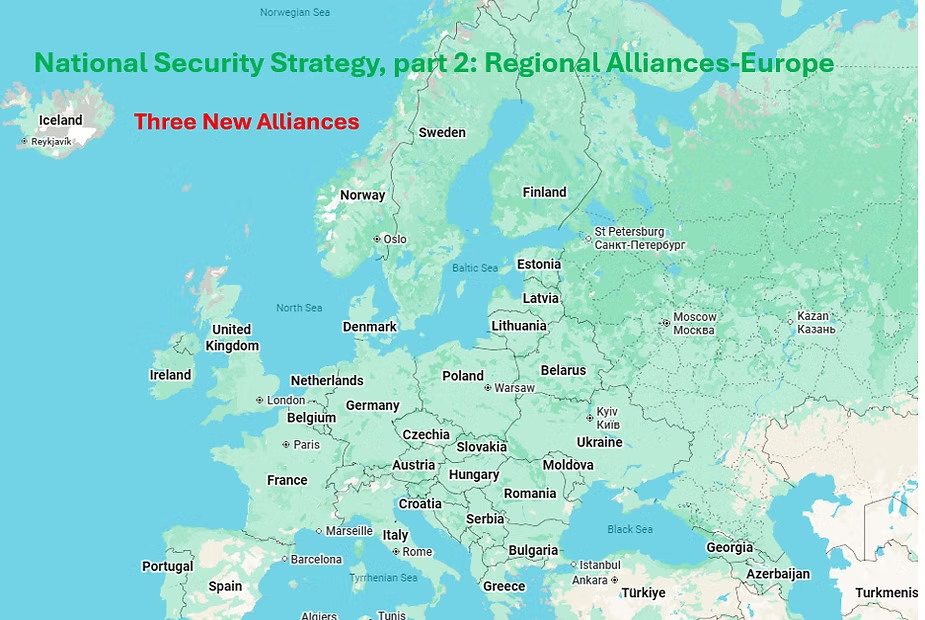
U.S National Security, Part 2: Regional Alliances – Europe

U.S National Security, Part 2: Regional Alliances - Europe

Opinion: The following article is commentary and its views are solely those of the author. This article was first published the 25th of December via The Angry Demagogue.

As we continue our tour of the administration’s National Security Strategy we will stay with “part III: What Are America’s Available Means to Get What We Want?” and move to the sixth bullet point: “A broad network of alliances, with treaty allies and partners in the world’s most strategically important regions” and work through the important regions that the strategy documents – Asia, Europe, the Mideast and Africa. For good or for bad we will need to split these regions up since the key point is forming coalitions that can handle their actual region. Sweden can’t be part of a coalition to protect Italy’s interests in the Mediterranean and Japan won’t be protecting Singapore.

Some U.S allied countries, like Australia, Israel and India will be involved in multiple regions helping lead alliances in all areas important to them. With that in mind we will point out the first mistake of the discussion on regions and that is Europe. We will suggest something here that would not usually come from the mouth of a hawk and pessimist and that is that NATO has no real mission and needs to be replaced by a series of alliances that make more sense. While the fear during the Cold War was a Warsaw Pact ground invasion into Germany and beyond which would have required the totality of American and European forces, Europe now is facing a Russia that could not conquer Ukraine in nearly four years of war. That is not to say that Russia is not to be feared only that each part of Europe needs to ally to face a Russian onslaught in its own theatre.

Italy is not going to send troops to Sweden to prevent an attack and Norway won’t be helping Greece in any fight. Turkey is a country that other NATO countries fear more than trust, especially regarding Russia.

In short, NATO needs to be broken up into different alliances where each country will be allied with countries whose fall would affect its national security. The United States can either be a signatory to these alliances or it can decide how involved it wants to get in any conflagration depending on its own interests at that time. It can decide to position ground troops in the countries, supply air cover or, as in the 12-day war between Israel and Iran, help with missile defense and in providing the final blow with weapons only America has. Or – it can decide that it will never participate. One hopes that that won’t happen, but each alliance will need to be ready to fight on its own.

We can include France and the U.K as large countries with advanced armed forces as allies to all of these alliances. France certainly can contribute air power to each of the alliances that are faced against Russia. As for the U.K, it is difficult to know where that country is going but its navy and air force are still powerful.

Today we will deal with north, central and western Europe.

The Baltic Alliance

This would be an alliance that includes Poland, Germany, Sweden, Finland, Norway, Denmark, Latvia, Lithuania and Estonia and would provide cover for land, air and naval battles. Each of these countries, with the exception of Germany, has a border with Russia and all are on the Baltic Sea – a key waterway for them and for Russia.

An alliance of these countries would force them to concentrate on those areas necessary for their defense. An incursion, for example into Finland would force Poland to mass forces on its border with Russia and Belarus (Poland borders Russia in Kaliningrad which is separated from Russia proper by Lithuania) and Germany to move forces to Poland. All countries could also contribute ground forces to Finland as well as naval and air power.

The only thing missing is the lack of a nuclear umbrella. That is no small issue but can be dealt with by support or threats from France or the U.K.

The Atlantic Alliance

Aside from helping the Baltic Alliance, France and the U.K will have major responsibility along with the Netherlands for patrolling the North Atlantic and, with help from Portugal, and Spain the South Atlantic. As the Atlantic Ocean can be considered one of America’s seas, this alliance will need to have the close cooperation if not outright membership of the United States. Canada too, will need to be part of this alliance. We can include the increasingly important Arctic Ocean into this alliance’s responsibilities.

As we move towards the south Atlantic countries such as Morocco, can be included as well as other western African allies of the west. An alliance like that could encourage western African countries to abandon close security and economic ties with China and Russia. The “border” of this alliance would be that squiggly line in the middle of the Atlantic that separates the Eastern and Western hemispheres.

The Central European Alliance

We can look at the smaller central European countries that formed the heart of what was the Hapsburg Empire but are not front line countries bordering Russia – Romania, Hungary, Slovakia, Czech Republic, Austria, Serbia and Bulgaria – and we have an alliance that, backed by Germany, Poland and the United States, would create a further deterrence to Russian encroachment into Europe proper.

Where, do you ask does Ukraine fall in this European alliance structure? That answer will have to come from the major European powers in concert with the United States. Adding Ukraine to the Baltic alliance might be viewed as another attempt to NATO-ize them by the Russians. However, attaching them to the less threatening Central European Alliance of smaller countries might be the excuse and “victory” that Putin would need to end the war. But we are getting ahead of ourselves here. Ukraine is a problem that can only be solved if the West decides to actively join the fight against Russia (unlikely) or when Putin and Russia get tired of the fight and look for a way out that could allow them to claim victory (more likely than the former, but sadly, a long way off).

The Administration’s concentration on regions and how certain countries can become leaders in support of western and American interests is correct – but the breakdown of the regions has to go beyond the post WWII world. The place of America in the post-cold war world, with a China that wants to challenge America’s economic and military interests and leadership needs to break down old alliances into more manageable and logical pieces.

The wild card in all of this is, of course, the will of the European powers to take their own defense seriously. The Baltic Alliance we spoke about seems to be filled with countries that understand the threat from Russia, but do they recognize the threat to them from the alignment, the Axis if you will, of Russia, Iran, North Korea and China? And of more importance have they yet come to understand the threat to their countries, as they know them, from open immigration and from their own abhorrence of families? The former is something only the governments can handle, the latter though, must come from the people themselves.

A whole generation (or two in many instances) of Europeans have grown up not only as “only children” but in families that have no aunts and no uncles, no cousins and only very elderly grandparents, if that. They have grown up in other words without families. Will the young generation see the importance of families to themselves and their countries or will they continue the nihilistic lives that they parents have “sanctified”? Religious institutions, too will have a major role in this challenge. No amount of “parental leave” and childcare subsidies will convince the young to marry and have children – will only come from a change in the culture. Is Europe up to it?

Disclaimer: the views expressed in this opinion article are solely those of the author, and not necessarily the opinions reflected by angrymetatraders.com or its associated parties.

You can follow Ira Slomowitz via The Angry Demagogue on Substack https://iraslomowitz.substack.com/ 

post309

India Insider: Nifty Defense Index Surges in 2025 Rearmament

India Insider: Nifty Defense Index Surges in 2025 Rearmament

2025 has marked a defining moment for defense equities, both globally and in India. The Nifty India Defence (Defense) Index, which tracks the country’s leading defense manufacturers, has surged sharply on the back of robust order flows, a structural policy shift, and increasingly volatile geopolitical conditions. This rise is not an isolated event but part of a broader global rearmament cycle that is reshaping the defense industrial landscape.

Nifty India Defence (Defense) Index One Year Chart as of 20th November 2025

India’s defense sector has been one of the standout performers in the domestic equity market. By mid-2025, the Nifty Defense Index had risen more than 25% year to date, outperforming most sectoral indices. This rally is primarily anchored in strong capital expenditure by the Government of India, which continues to accelerate indigenous military modernization. The Defense Ministry’s approvals which is running into tens of thousands of crores have expanded visibility for companies such as HAL, Bharat Electronics, Bharat Dynamics, and shipbuilding PSUs (Public Sector Undertakings). For investors, the nature of long durations within defense order books has provided earnings stability at a time when other manufacturing sectors have been grappling with cyclical softness.

The second driver has been a multi-year strategic shift toward import substitution. India’s reliance on foreign weapons systems has long strained its current accounts and created operational vulnerabilities. However, the ongoing indigenization push, reinforced by Production Linked Incentive schemes, procurement embargoes on foreign systems, and export incentives, has fundamentally realigned the sector. Defense exports have crossed record levels, and Indian firms are increasingly integrated into global supply chains for electronics, avionics, and ammunition.

Global Industrial Defense Rebirth

But the domestic story is tightly interconnected with developments abroad. The global defense market is undergoing its most significant expansion since the post 9/11 decade. Russia’s war in Ukraine, the Red Sea shipping crisis, conflict in the Middle East, and a renewed great power rivalry in the Indo-Pacific have pushed countries to reassess defense readiness. NATO’s decision in 2025 to raise defense spending targets from 2% of GDP to 5% by 2035 has far reaching implications. This commitment translates into trillions of dollars in additional defense outlays over the coming decade, making Europe one of the fastest-growing defense markets.

Companies such as Rheinmetall, BAE Systems, Lockheed Martin, and Northrop Grumman are already reporting record order inflows. Rheinmetall, Germany’s largest defense company, expects its revenues to quintuple by 2030, reflecting unprecedented demand for advanced artillery, ammunition, and combat vehicles. The United States, meanwhile, continues to channel significant funding into hypersonic, missile defense, and drone systems as competition with China intensifies.

India’s Edge in Rearmaments and Technology

This global rearmament wave has a direct spillover effect on India. International supply chain shortages particularly for semiconductors, propulsion systems, and munitions have created opportunities for Indian firms to plug capability gaps. With a cheaper cost base and growing technological sophistication, Indian defense manufacturers are emerging as viable exporters in segments such as UAVs, naval platforms, and electronic warfare systems.

In this environment, the rally in the Nifty Defense Index is not merely speculative exuberance, but a significant reflection of structural and synchronized global demand. As defense has evolved from a low beta sector to a strategic growth industry, India’s integration into the global defense economy positions its companies for sustained earnings expansion over the next decade.

post303

India and the U.S Govt Shutdown: Quick Market Thoughts

India and the U.S Govt Shutdown: Quick Market Thoughts

President Trump has been ramping up his claims that India is no longer going to buy Russian oil, he made a statement regarding this belief yesterday once again. As the White House threatened to initiate tougher sanctions against India, there seems to have been some movement towards a reconciliation between the two powerful nations.

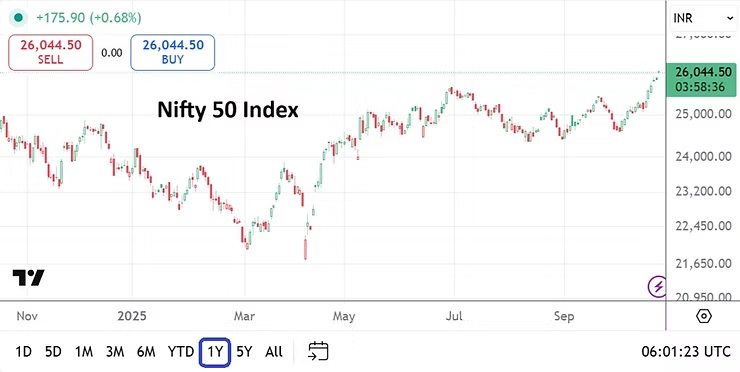
The Trump administration is clearly trying to limit the amount of purchases of Russian oil by India to increase economic pressures on Russia, and reportedly India may be starting to actually buy less oil. India has certainly not stopped buying Russian oil in a maximum ‘fait accompli’, but if the nation continues to show a willingness to purchase less energy resources from Russia, this will go a long way in preserving a good U.S and India association. A stronger relationship between the U.S and India can achieve a vital economic and military correlation for the both nations. Improved friendlier tones from New Delhi and Washington D.C appear to have reassured investors in the Indian equity markets via highs currently being seen on Nifty 50, which are now within sight of apex values from late September last year.

Nifty 50 One Year Chart as of 23rd October 2025

India is a vital and important part of U.S policy as it attempts to also create pressure on China too. By maintaining political and business dealings with India, the U.S can and should look upon this joint relationship as a vast long-term strategic interest. India understands this as well. The ability of India and the U.S to remain ‘friendly’ allies, and the prospect of creating a vigorous economic and military partnership should be one of the U.S government’s essential missions.

India does have strong connections to Russia the past handful of decades politically and economically via its non-aligned status. India will certainly maintain its dialogue and sometimes cooperative dealings with Russia. However, if India and the U.S maintain a solid relationship with the prospect of increasing their economic and political ties this could substantially change dynamics on the Asian continent.

U.S Government Shutdown Since the 1st of October

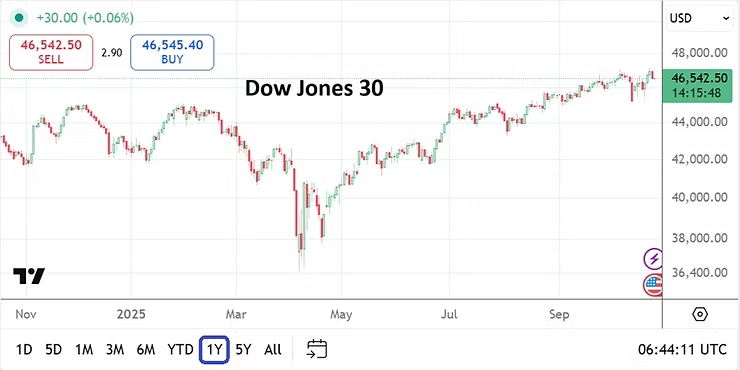
The U.S government has now been shutdown for over three weeks as Republicans and Democrats remain stubborn about compromise. Both sides have made the shutdown a political game. While each party claims they are doing what is best for the nation and preach to their collective voting bases, the stalemate could start to have uglier effects regarding wages not paid for many U.S employees on the 1st of November.

Dow Jones 30 One Year Chart as of 23rd October 2025

A lack of government salaries not being dispersed will cause an economic hit via consumer spending and create at a minimum some temporary damage for GDP numbers. Remarkably, and to be clear about this potential impact, Wall Street hasn’t seemed to care yet, but this could start to change. As the U.S economy rumbles powerfully forward without a major downturn in the major equity indices, politicians appear to be comfortable acting like spoiled children on both sides of the aisles engaged in accusing the other side of misdeeds.

Likely to start changing attitudes among Republicans and Democrats in the next two weeks are the coming Federal Reserve’s FOMC Statement during the end of October, and voting results via key political races in the first week of November.

Wall Street wants clarity regarding interest rate outlooks for November, December and early next year. Investors might not get a clear picture from the Fed next week, taking into consideration the Federal Reserve will not have up to date official U.S economic data because of the government shutdown. Meaning the Fed will likely issue a 25 basis point rate cut on the 29th of October and say it is uncertain about the coming few months because it does not have enough inflation, employment and GDP information to form a concrete opinion. The joke of coarse being the Fed seldom seems to have a strong opinion, but now can use the government shutdown as an excuse.

And now for contemplation, let’s look at the election in NYC for Mayor. A bona fide socialist may get elected in New York City who carries the historically misguided and dangerous wisdom of a Marxist. The economic and social practices of Marxism have proven utter failures for over one hundred years consistently. If NYC suffers a victory from the socialist candidate running as a Democrat, Wall Street and many financial institutions based in the city will not react favorably.

In the meantime, U.S equity indices remain elevated, cautious and within sight of record highs. The Nasdaq, Dow Jones and S&P along with other financial assets are producing choppy dangerous conditions for day traders who are attempting to wager on daily changes and suffering from the cautious behavioral sentiment being generated. Investors who look towards the mid and long-term are likely more comfortable, but are certainly keeping an eye on what is going to transpire over the next two weeks. Gold and Silver have come off their speculative highs. Forex continues to create volatile conditions as financial institutions appear unready to make bold predictions about what the Federal Reserve will do into January 2026.
post291

India Insider: Why is Gold Frequently Accumulated by Indians?

India Insider: Why is Gold Frequently Accumulated by Indians?

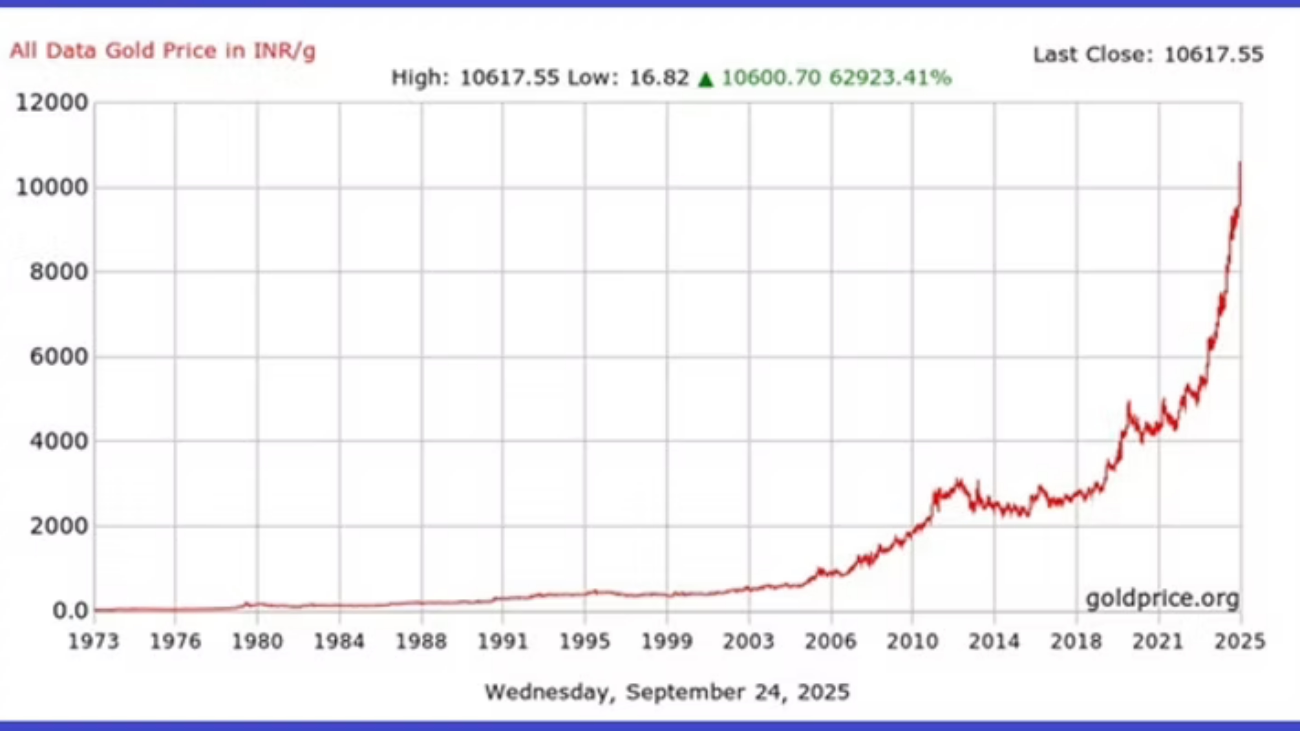
In a society like India in which I live gold hoarding is a fact of life. According to a recent report by the World Gold Council, Indian households are believed to hold around 25,000 tonnes of gold with a combined value of around $3 trillion USD.

Billionaire banker Uday Kotak applauded Indian women when he said they are ”the smartest fund managers in the world”. The precious metal has gained 42% in 2025 alone, and returned 700% in the last 20 years in Indian Rupee terms. In India consumers have a habit of monitoring daily gold prices. There is a gold festival in India called Aksayatritiyai, when gold is bought frequently in small grams but often also includes large purchases for religious sentiments. In Northern India, gold is bought during festival times like Dhanteras and believed to bring prosperity and good fortune.

It’s almost unthinkable for marriages to occur in India without gold. Many marriages have been postponed and even stopped if the requisite dowry is not given by a girl’s family. And there was a time in India when some families didn’t want to have a baby girl due to the excessive gold dowry they would be responsible for and have to give a boy’s family at the time of marriage. 

Adam Smith’s Case Against Gold:

Smith lashed out at gold for its lack of productiveness. He wrote in the The Wealth of Nations, “labour was the first price, the original purchase-money that was paid for all things. It was not by gold or by silver, but by labour, that all the wealth of the world was originally purchased; and its value, to those who possess it, and who want to exchange it for some few productions, is precisely equal to the quantity of labour which it can enable them to purchase or command.”

The act of hoarding, whether it is money or gold, depresses economic activity, as demonstrated by John Maynard Keynes in his ‘paradox of thrift’. Indeed, it was the Europeans by spending all the precious metals taken from the Americas which boosted economic activity, and ultimately sparked the rise of modern capitalism whereas Asians by hoarding ended up falling behind.

Ancient China Example:

In the past, China’s reliance on silver gave short-term stability but stunted long term growth. With no domestic silver, it depended on inflows from Spain and Japan, making its money supply hostage to global trade. Wars or disruptions cut silver inflows, draining liquidity while crippling tax collection. Unlike Europe, China clung to silver as ‘real’ money, while neglecting credit, banking and bonds. This rigid system weakened the nation’s fiscal capacity, leaving China unable to mobilize resources or industrialize effectively. In the end, silver ensured stability, but strangled flexibility and growth. Indian growth has been strangled too often because of an over-obsession towards gold.

Why Gold Prices are Moving Up?

The price of gold was relatively stable until the 2008 financial crisis and it’s been rising steadily ever since, doubling in 3 years from 2009 to 2012. After some broad consolidation, gold has been in a higher value band if you scrupulously study charts. Arguably, it is an influence due to lower interest rates that have helped gold prices move up for 15 years as inflation has been attempted to be camouflaged by Central Banks.

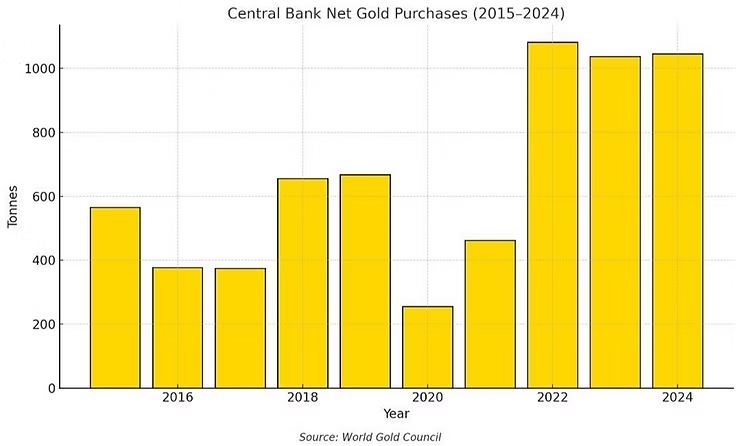
Accumulation of Central Bank Holding of Gold into 2024

Central Banks also accumulate gold for many reasons. One reason for this are rising bond yields that make existing fiscal obligations underperform for governments. Central Banks buy gold to diversify and hedge against risk. As the Official Monetary and Financial Institutions Forum – an independent body – noted recently, many European national bank systems endure massive losses because of quantitative easing. When the institutions try to undertake quantitative tightening, they are forced to sell at market prices, which deepen their balance sheets losses. Thus, Central Banks diversify into gold as a sacrosanct hedge against losses incurred and allows them to offset many liabilities. Gold has a long historical track record of working as a safeguard against inflation.

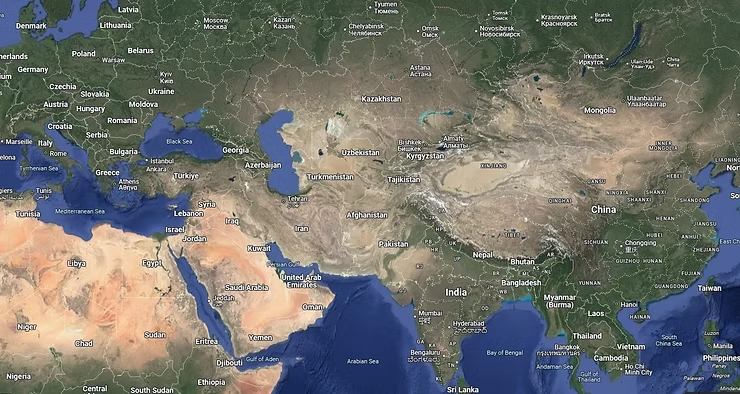
It’s also true that gold is often accumulated by Central Banks when hedging against geopolitical uncertainty. The Russia and Ukraine war offers intrigue regarding the nation of Kyrgyzstan, which China uses as a route for its exports to Russia, this due to Kyrgyzstan’s inherent ability to conduct trade via accessible routes. There is high plausibility that Kyrgyzstan might be converting Russian Ruble surpluses into gold.

Monetary Policy Matters for Gold:

Gold will remain vital for many years to come as a store of value and a safe haven. Buying the precious metal delivers investors and businesses a needed hedge against inflation. Protections against the lose of purchasing power within their own fiat currencies remains important for all people.

The Indian public and other societies need to remember, the value of gold within their own currencies often lies within the interest rate valuations sparked by Central Banks mechanisms which sometimes amount to magic shows and influence demand. While public buying of gold is important, it sometimes equates into mere speculation and does not always help economic activity.

post234

New Alternatives for Regional Alliances & Global Effects?

New Alternatives for Regional Alliances & Global Effects?

Opinion: The following article is commentary and its views are solely those of the author. This article was first published the 14th of March, 2025 via The Angry Demagogue.

There is so much going on that it really is difficult to keep up. Israel is at the center of many of the regional developments, as would be expected. But it is not just Israel as Israel, but Israel as an ally of the United States that is interesting. The Syria problem we have written about and it is still not clear what the Trump administration’s policy is there as they look skeptically but hopefully at Al-Julani’s Syria. In our opinion that decision will be made for them, since the chances that Al-Julani has changed his stripes to a Western democrat is small and even if we are wrong there – the armed Jihadist groups that he needs to control seem more interested in ridding Syria of ‘heretics’ than stabilizing the country.

Lebanon has changed enough for the United States and Israel to take chances. While it is too bad that Israel did not do more in ridding the country of Hezbollah, the fact that Syria is no longer part of the Shiite crescent means that they are isolated and not able to get funding and arms from Iran with the same ease. What is important about the current Lebanese government is that Hezbollah is not a part of it. That does not leave them powerless, but it allows the government to act more independently. The Lebanese Shiites, under Hezbollah and the less but still militant Amal, will have to rethink their loyalty to these two organizations. At the least, it should move Amal away from their stronger partner.

Iran now has no land route to Hezbollah and will have a harder time arming the Houthis, too. But it is in Iraq that they are facing problems which could cause as much damage to their projection of power as did the loss of Syria. Due to US pressure, Iraq has stopped buying Iranian electricity although they can still buy gas. It seems that the US is giving Iraq some time to find alternatives to Iranian gas and the Iraqi government is moving away from Iran on other issues too and are trying to get rid of Iran’s Shiite militias.

But the most interesting thing to happen is Israel’s attempt to strengthen America’s relationship with Azerbaijan, a country that Israel is in close contact with regarding Iran. Israel has always been rumored to plan to use Azeri air force bases in a possible attack on Iran. The Azeri official responsible for regional development was in Israel last month and is trying to bridge differences between Israel and Turkey. The Azeri’s next stop after Israel was to Turkey. Steve Witkoff is reported to have stopped in Baku after his visit to Moscow.

An Azeri company has also bought rights to Israel’s Tamar gas field. Israel currently gets oil from Azerbaijan via a pipeline that goes through Turkey so the energy relationship is strong and longstanding between Israel and Azerbaijan. It seems that Turkey’s relationship with Azerbaijan is more important to them than their animosity towards Israel – probably because the Azeris and Armenians are enemies. It seems that sometimes not only friendships have to be ranked but enemies, too.

Trump’s game with Ukraine is not necessarily to my taste but it could be that there is something much bigger going on here and that is connecting Israel, Russia, Central Asia and Turkey to a grand alliance with the United States. I don’t think that Trump will succeed in pulling Russia away from Iran and China and that Erdogan’s Turkey will not give up their dream of destroying Israel. But what if the Iranian regime falls after a combination of harsh sanctions, economic collapse and Israeli military attacks? What if Iran is pulled away from the alliance leaving Russia with just China? What if a Russian base in Syria is dependent upon their moving away from China?

Last year the Axis held a near continuous land bridge from the Pacific to the Mediterranean. China was moving into Russia’s “sphere of influence” in the “Stans” of Central Asia with their economic bear hugs. This was something that the Biden administration ignored, but could be a bigger headache for Putin than a well armed but non-NATO Ukraine with American businessmen instead of soldiers as a tripwire.

Are we giving too much credit to Trump and his foreign policy team and to Israel’s influence in the expanded region that reaches beyond Syria? Is there more going on than we know or less?

On October 7 and the days that followed, the Biden Administration was sure that Israel was in such a panic that it would agree to anything, and they could force the Obama Middle East of a hegemonic Iran and a Palestinian state down Israel’s throats – and overthrow Netanyahu as an extra. None of those things happened.

Only a fool would predict what will be in a year, but what we have discussed above is one scenario no one would have considered even six months ago. The post WWII world looked nothing like the world of 1937, and the post WWIII world (the one we wrote about a year ago and may or may not have happened!) will look nothing like September 2023 – no matter how hard the UN yells and screams.

Could Israel and Azerbaijan be the keys to a realigned world?

It is against my nature to be optimistic, especially since Israel is still not done with Gaza, the hostages are not yet home and the internal politics are reaching levels that border on a soft coup.

However, while we don’t know where the aces are, we know that the Obama-Biden jokers are no longer in the deck.

Disclaimer: the views expressed in this opinion article are solely those of the author, and not necessarily the opinions reflected by angrymetatraders.com or its associated parties.
You can follow Ira Slomowitz via The Angry Demagogue on Substack https://iraslomowitz.substack.com/ 

post211

AMT Top Ten Miscellaneous Reckonings for the 8th of December

AMT Top Ten Miscellaneous Reckonings for the 8th of December

10. France Falls: President Macron’s leadership is in peril after his anointed Prime Minister, Michael Bernier, suffered a no confidence vote outcome. French politics and finances are in shambles. Life for French citizens goes on as their politicians battle for their jobs, supremacy of voice and egos. With the restoration and presentation publicly of Notre Dame Cathedral yesterday, Macron now has to find something else to divert attention away from his misappropriation of power.

9. 100,000: Bitcoin came within sight of the 104,000 USD vicinity this Thursday, then sunk with a rapid pace and challenged 92,000. Once again traversing near 100 grand, large BTC whales and MicroStrategy’s Michael Saylor and his cult of followers are likely celebrating. However, if the wind changes direction what kind of damage will the low tides create this time for Bitcoin and speculative leveraged positions? The price of BTC/USD as of this writing is near 99,500.

8. Al-Assad: The Syrian regime is apparently coming to an end after 50 plus years in power. Bashar al-Assad’s whereabouts are unknown. Russia, Iran and Hezbollah appear for the moment to be big losers in this power play. The many factions will now have to see if they can create a semblance of government, but that remains doubtful. Syria will be a quagmire in the coming months as its cauldron stirs.

7. Martial Law: South Korean President Yoon Suk Yeol startled Asia and foreign investors by declaring martial law this past week, making one of the worst political miscalculations in recent memory. Yoon was quickly forced to rescind the decision. The USD/KRW spiked and KOSPI Composite sank via the instability. However, the South Korean National Assembly has shown the ability to provide leadership and display power of law prevails, this as they try to calm their citizens concerns and investor sentiment.

6. Roasted: Coffee Arabica has boiled again and commodity’s price is fighting within apex levels. Like Cocoa, both Arabica and Robusta Coffee have surged the past year as large players have created a strangulated grip which suggests the markets may be ‘cornered’. While some analysts are quick to point out weather conditions as a reason for the higher prices, the tenacity of Coffee and Cocoa to sustain upwards momentum is intriguing but also suspicious.

5. FX and Data: U.S jobs numbers this Friday were marginally better than anticipated and the Average Hourly Earnings came in slightly above expectations. Economists from different schools of thought are debating the potential of recession and inflation concerns, versus those who believe growth, greater transparency of U.S fiscal mandates and elimination of a bloated budget will be achieved when Trump’s economic policies takeover. Globally Forex conditions are showing signs of fragility because of the threat of tariffs and trade concessions by nations which may need to be made. Yet, it is quite possible the ‘bad news’ consisting of accusations of unfair trade agreements by Trump, and the reactions which have been cooked into the EUR, GBP, JPY, ZAR, MXN, CAD, NZD and others is overdone. While there could certainly be more weakness in major global currencies paired against the USD, upside potential mid-term may be more positive compared to near-term drawdowns. Retail traders still face difficult technical perceptions in the days ahead because financial institutions also remain shaky regarding their outlooks.

4. Pardon Me Joe: President Biden has forgiven his son, Hunter Biden, for crimes known and unknown for an eleven year period – that is not a round number ladies and gentlemen, with a Presidential Pardon. Why 11 years? Why not 10 or 15? There is conjecture that Joe Biden is also considering preemptive pardons for people his administration feels may face the wrath of the incoming Trump White House. However, if pardons are given to the likes of Anthony Fauci, won’t the pardons awarded to those who have not been charged with a crime yet look like an admission of guilt?

3. Central Banks: The ECB will deliver their interest rate decision on the 12th and the Federal Reserve will announce their Fed Funds Rate on the 18th. Behavioral sentiment however is seemingly more focused on the threat of potential storms that could suddenly appear due to the Trump effect. The ECB and Fed are both expected to cut their interest rates by a quarter of a point, while it appears many financial institutions no longer believe the Fed will cut again in January.

2. Chinese Gold: Tucked away in the quiet corners of the business news has been the discovery of a massive gold ore deposit in China. Some geologists claim the Wangu gold field could have up to 1,100 tons of the precious metal. If correct and the amount of gold meets or exceeds the expectations of the experts, the question about this becoming a deflationary event for gold is intriguing but likely wrong. Importantly, the gold will be a long-term benefit for China and potentially create a stronger national currency via the Renminbi (China Yuan). Perhaps also solidifying the idea of using the reserve as part of the backbone for a potential BRICS ‘Unit’ currency if and when that day ever arrives. Gold closed at nearly 2633.00 USD per ounce before going into this weekend.

1. Trump Effect: WTI Crude Oil is around 66.78 USD as the promise of easier energy production for U.S companies has created the conviction of steady and less expensive supply. The USD remains in the stronger elements of its long-term Forex range, and folks betting against the strength of the USD need to remain cautious. BRICS has been warned about not infringing on the USD by Donald Trump, and some member nations of the organization have affirmed they do not seek a BRICS currency (yet). Tariffs have been threatened, but China has responded by showing it has the ability to create potential hinderances this week via a tough negotiation stance by threatening to stop export of rare earth metals to the U.S. Mexico and Canada have felt the verbal wrath of the President-elect already and started to react. All of this while Donald Trump still has six full weeks before taking power.

post209

Forex: Trump Effect and Reasonable Trading Caution for All

Forex: Trump Effect and Reasonable Trading Caution for All

The Forex market the past two months has created a profoundly stronger USD against many major currencies. The combination of late September intrigue regarding U.S Federal Reserve outlook, then nervousness about the approaching U.S election, followed by the subsequent results have been a dumpster fire for many speculators looking for a sustained return to USD centric weakness. Hopefully risk taking tactics have included a solid dose of caution.

This week’s Non-Farm Employment Change numbers scheduled for Friday may give financial institutions a moment to focus on economic data instead of President-elect Donald Trump’s loud pronouncements, but the effect may prove to only be momentary. It isn’t data that is driving Forex for the moment it is nervousness and fear of the unknown.

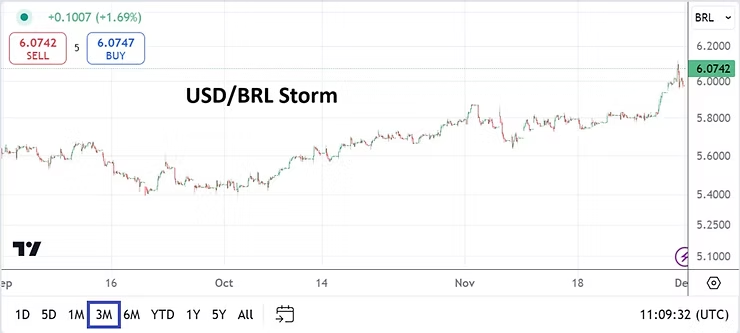
USD/BRL Three Month Chart as of 3rd December 2024

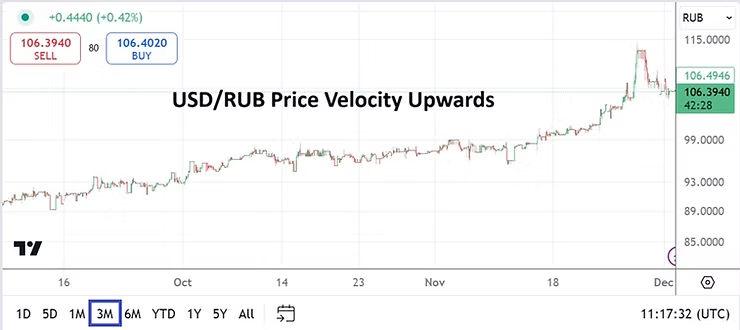
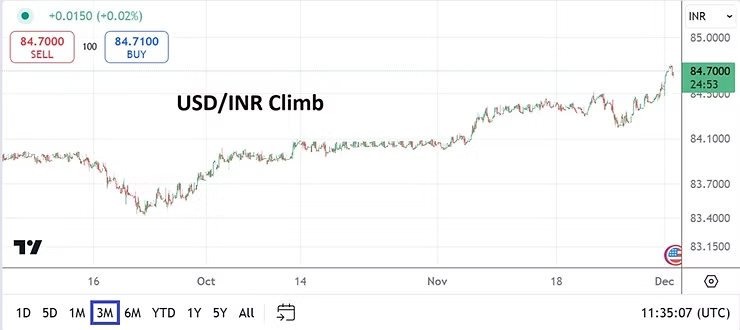
While many financial institutions and speculators trade only the major currency pairs, taking a look at the less obvious and more infrequently transacted major currencies may provide retail traders additional perspectives regarding the fragile nature of Forex. Many nations and large institutions are demonstrating concerns about possible sea changes to U.S foreign economic policy. Yes, the EUR/USD, GBP/USD and USD/JPY have all seen volatility via USD strength the past two months, but price velocity in the USD/BRL, USD/RUB, and USD/INR may be equally intriguing. And prove that mid-term forecasts (or lack of them) are causing bedlam for all.

USD/RUB Three Month Chart as of 3rd December 2024

While it is more than probable calmer heads will start to be seen in Forex and weakness eventually will return to the USD, trying to pick the exact moment this is going to happen remains a guessing game. Financial institutions via evidence in current Forex pricing remains rather cautious regarding their cash forward commercial enterprise. President-elect Donald Trump has certainly been dealt with before and his negotiation style is that of a businessman, it is not a coincidence that some global leaders who do not exactly see eye to eye with Trump are giving him respect because they understand he will act upon threats if not dealt with fairly.

Trump’s recent brief rhetoric regarding BRICS and the organization’s public consideration of creating a new currency to compete with the USD did not go unnoticed this weekend. Critics may want to proclaim Trump’s threats as belligerent, but BRICS is free to create a new currency still if they wish. While Trump cannot stop the birth of a BRICS currency, he can certainly try to initiate actions (via sanctions) against nations that attempt to create a new unified currency which tries to curtail the dominance of the USD. It would certainly help Trump’s bargaining position and the USD also, if better fiscal policy is practiced by the U.S Treasury and government.

USD/INR Three Month Chart as of 3rd December 2024

It needs to be pointed out that Trump’s warning to BRICS may not be needed. Even though the organization may be able to create a currency based on a commodities backbone, the lack of trust many financial institutions and nations would feel towards a non-transparent fiat currency powered by the fiscal monetary policies from the likes of Russia, China, Brazil and South Africa remains a difficult sell. Until many changes happen domestically within these nations via governance, creation of a BRICS currency remains wishful thinking.

Getting back to the big picture and the volatility recently seen in Forex. While the major currencies teamed against the USD have certainly faced hectic conditions, the fluctuations have not been unexpected. Day traders need to understand the month of December is likely going to remain choppy and see a test of technical support and resistance levels that are wide and full of fast reversals.

The question for the EUR, GBP, and JPY is if most of the negative inputs into these currencies has been factored into value. The suspicion may be yes, and that strength may rightfully appear in these big three sooner rather than later. However, the approaching holiday season and potential bluster from President-elect Trump will not make this a comfortable or easily wagered avenue.

Short-term retail traders looking to take advantage of the bloodbath created in Forex the past two months who seek opportunities should focus on perceived targets which aren’t overly ambitious. The coming U.S jobs data this Friday may allow the U.S Federal Reserve room to cut the Federal Funds rate on the 18th of December by another quarter of a point. As a point of attention, the European Central Bank will announce their Main Refinancing Rate on the 12th of December. The ECB’S actions may be a solid clue regarding the Fed’s approach to upcoming policy.

However, even if an interest rate cut were to take place via the Federal Reserve, it is likely the cut has already been factored into Forex. Which also highlights the high degree of nervousness that exists because of fears which permeate due to Donald Trump’s tough negotiation stances which have been made public. Meaning those who are looking for USD centric weakness to emerge still need to rely on a shift within behavioral sentiment to occur that is not generated because of the Federal Reserve. Nations need to show a willingness to amend existing trading agreements with the U.S, allowing for changes to internal policies regarding exuberant price duties they place on U.S goods in their own countries.

postR192

Impolite Opinion: BRICS Long-Term Plans & Implications Part 1

Impolite Opinion: BRICS Long-Term Plans & Implications Part 1

The global Forex market is spastic and many major currencies are traversing within weaker whipsaw value ranges against the USD. The currency pairs are trading in price bands seen before the Fed cut its Federal Funds Rate by 0.50 basis points on the 18th of September. And there is still one and a half weeks of assured volatility that will be demonstrated. Crucial U.S data is on the schedule in the coming days via the Advance GDP and Non-Farm Employment Change statistics, and the U.S Presidential election is edging closer. Israel and Iran continue to play a game of cat and mouse in the Middle East, which thus far has led to a controlled chaos and not worldwide bedlam. Financial institutions have plenty of reasons to be apprehensive.

Expansion of BRICS Feels Inevitable

Now let’s turn our attention to a tectonic foundational shift building in global trade and geopolitics. Attention on short-term behavioral sentiment which is fragile and has a less than clear mid-term perspective, needs long-term considerations too. Investors are required to contemplate possible dangers that are hiding in open sight and will pose a problem in the future.

The BRICS 2024 Summit was conducted this week in Kazan, Russia. This included the new member nations of Egypt, Ethiopia, Iran and the United Arab Emirates. I am not here to give you a major recap on what took place behind closed doors. I wasn’t invited. But we should look at some of the results and statements made and what they imply strategically.

The BRICS attendees to this year’s conference included powerful dignitaries from approximately 36 nations. One major result of this BRICS conference was to award Partner State status to 13 countries including Algeria, Turkey, Malaysia, Indonesia, Vietnam, Thailand, Nigeria, Uganda, Kazakhstan, Uzbekistan, Belarus, Cuba and Bolivia. Saudi Arabia was invited last year and has not made their full participation official yet, but they attended this year’s conference as an invited guest. The trend appears clear, we are entering a new paradigm in which long-term thinking by the BRICS nations could out maneuver the short-term nonchalance of the West and this has implications for the USD long-term.

There were high level meetings between leaders of BRICS countries including China, India and Russia. Perhaps, more importantly was Vladimir Putin’s bold statement about BRICS desire to start its own grain exchange. Putin also advocated for the creation of a BRICS cartel in other commodities such as metals, including gold. Gemstones such as diamonds and emeralds could develop into a sizeable entity too. This needs to be taken seriously by the West.

Credence must be given because the BRICS nations already are among the largest producers of grains, legumes and oilseeds. The scope of commodity production and supply capabilities by BRICS could certainly turn into a painful thorn in the side of existing large trading companies. And a potentially coordinated energy sector via Iran, Saudi Arabia, Nigeria, Russia and others must be taken into account.

Russia and China as Friends of the Underdogs

Historical entanglements put Western nations like France and others in a vulnerable spot diplomatically as they try to maintain alliances with many BRICS nations. France serves as a good example of diminishing Western influence. France remains on the ground overtly in Africa while dealing with vestiges of a colonial past. But France’s influence in Africa is under stress and their ability to use the continent as a source of power and financial gain is being confronted. France still maintains the Presidential Council for Africa, but France is likely perceived by many of the participants as a wolf dressed in sheep’s clothing. Coups in French influenced African nations have a bloody and present history when political diplomacy does not go well.

Exploiters of the past in many African nations are looked upon with derision and scorn. Russia and China are often viewed as friendly countries who helped fight along the side of certain African nations who sought and achieved independence. The ability to create ascendancy in Africa by Russia and China needs to be looked at within a prism that suggests additional spheres of power will develop in BRICS. Many nations that dealt with colonial statuses in the past are rightfully intent on shaking off the notion of being considered laggards.

The West certainly knows in no uncertain terms it cannot return to colonialism. However, African governments should make sure they are not replacing old masters for new. While some might say it is wishful thinking – and I am still on the fence contemplating the notion – on the part of Russia and China to create powerful commodity cartels, if achieved this actually could prove to be an emphatic first step in attempting to secure a new and powerful currency by backing it with a foundation of intrinsic value. Brazil and South Africa would be a big part of this underpinning too. Russia and China’s foray into Africa via their military and money lending excursions, and the already created organizational and trade structures which exists within BRICS opens the door for the perceived underdogs to battle together against the power of Western riches.

A competition is certainly underway between the West and BRICS. What exactly is the U.S doing in Angola? The planed visit of Joe Biden in the first week of December, which was supposed to take place in mid-October was postponed due to the recent hurricanes. Will the U.S presidential visit be anything more than a sideshow, particularly if the Democrats do not win the election on November the 5th? Angola has a massive amount of Crude Oil and is an OPEC member. American energy companies and other Western corporations are active commercial participants in the African nation. However, China has a firm financial stake in Angola via infrastructure projects too. The political and financial implications between BRICS and the West is a growing dynamic, one that will be further discussed in Part 2.

postR176

Make Common Sense Great Again: On Moving Away from Nuance

Make Common Sense Great Again: On Moving Away from Nuance

Opinion: The following article is commentary and its views are solely those of the author. This article was first published the 23rd of July 2024 via The Angry Demagogue.

Has there been a total breakdown of readiness in the West? When we look at seemingly unrelated events we see that people in responsible positions in governments around the Western world have missed signs that are obvious – and not only after the fact. The attempted Trump assassination just got me thinking how no one seems to react to the obvious anymore. It seems that both the local police and the Secret Service knew that this young man was on a roof with a rifle and no one took the most elementary actions of delaying Trump’s appearance or trying to stop the shooter or even ascertain his motives all of which was obvious to everyone else. We are not talking about someone missing a shot at him or even forgetting to check a specific place, but an active decision was made – to do nothing.

On October 6 and 7 the IDF Chief of Staff and his senior advisors on the General Staff heard of possible Hamas plans to attack, knew of previous intelligence that detailed the exact attack that happened and even refused a request of the head of the Southern Command to move 4 helicopters closer to Gaza. Instead of doing even the minimum, they just did nothing. They ignored the obvious and ruled purposely against common sense and in favor of their own preconceived notions.

As Russia was massing troops on the border and as Putin’s talk was becoming more and more belligerent the US administration did nothing that might have at least hinted to Putin that this could only lead to disaster. Putting US troops on a higher alert, inviting the Ukrainian ambassador to the White House as a show of support – anything really, might have given Putin food for thought. As Iran moves closer and closer to attaining a nuclear weapon and taking control of the middle east, the West just does nothing. Destroying Houthi assets (as the Israelis have just done), sending B52’s into the sky for training missions to destroy Islamic Republic assets – all that might have made the Iranian rulers wonder what was in store for them and limiting the war to Gaza. But again, against common sense, nothing was done because …. Wishful thinking.

If those responsible were acting like boys in the school playground (are boys still allowed to play in the playground?) they would have done more than they did in all these cases. 

Since the end of the Cold War we have seen the abandonment of common sense in favor of sophisticated analyses where nuance trumps simplicity and bias dominates the analysis of data and where cliches overtake serious policy. In classical Jewish biblical exegesis, there is one rule which nearly all (non-mystical) commentators hold and that is that the exegesis cannot contradict the simple meaning of the words of the Bible.  True enough, that is stretched to points of wonder sometimes – but they still cling to the rule. 

Common sense is underrated in policy analysis and often in business, but those who ignore it now will be challenged later. Common sense means the acceptance of what people say and looking at data without bias. Common sense means that you have to understand the person you are talking to and don’t assume they think like you. 

Back in my university days I read a lot of Hannah Arendt, who, in spite of the banality of her banality of evil theory had a lot to say. In her book “The Human Condition” she speaks of common sense – or as she often puts it “the sense of the common”.

I would like to quote her here, even though I tend to think she would not have thought that it was the rulers, the policy makers and the writers who are ignoring common sense:

“The only character of the world by which to gauge its reality is its being common to us all, and common sense occupies such a high rank in the hierarchy of political qualities because it is the one sense that fits into reality as a whole our five strictly individual senses and the strictly particular data they perceive.  It is by virtue of common sense that the other sense perceptions are known to disclose reality …. A noticeable decrease in common sense in any given community and a noticeable increase in superstition and gullibility are therefore almost infallible signs of alienation from the world.”

Arendt of course assumed that the lower or working classes were susceptible to superstition and gullibility but in these times it is the ruling classes that have abandoned common sense in favor of superstition and gullibility. It is they who are alienated from the world. Preconceived notions that contradict the plain meaning of the world is today’s superstition – and it is no less dangerous and irrational than the superstitions of times past.

Let’s take a brief look at these policy decisions by nearly all western countries, regardless of their geographical location or economic outlooks, their demographic trends or the overall culture of their people and their neighbors resulting directly or indirectly of the perilous situation the free world is now in.

Defense Spending and Force Size

The post-cold war “peace dividend” became an idol of western policy makers.  Massive cuts in defense spending even in things that were very necessary to the maintenance of said “peace dividend” – like naval power – was the preferred way of dealing with the end of the Soviet Union. The “End of History” was read simplistically instead of realizing that other ideologies and other powers might very soon challenge the victorious west. Some thinkers, I think of a professor of mine (Elie Krakowski) who back in 1979-80, before the collapse of the Soviet Union, spoke of Islam as the third force which will challenge the West and the East. I studied in a small university and if we were discussing it back then how are policy makers in Washington, London, Tel Aviv and Paris not speaking of it today?

While Edward Said’s “Orientalism” was the talk of the town, Bernard Lewis and Fouad Ajami were, despite their posts at Princeton and Johns Hopkins, not taken seriously enough. If they were, the US Navy would not have gone from 594 ships in 1987 to 275 in 2016. The British Navy  went from about 170 ships in 1970 to well under 50 in 2017. The rest of Western Europe we all know about. But at least countries like Netherlands, Belgium and Denmark don’t face hostile neighbors and were never meant to have forces that would do more than assist in minor operations.

Israel on the other hand has always faced neighbors who have desired to destroy it.  Even the countries with which it signed peace treaters, Jordan and Egypt, have never been able to translate these treaties into popular support and are always a coup away from belligerence. The history of dictatorships in general and of the Middle East in particular ought to have given the Israeli high command at least a hint as to what they might be facing. With the advent of Iran as a major regional power with the means and desire to spread its theo-revolutionary ideology, Israel ought to have realized that the era of wars was not over. Yet, since 2000 Israel has cut 6 divisions and decommissioned 2,000 tanks from its forces. It has cut military service for men from 36 to 32 months, even as it has not increased the mandatory service for woman from 24 months even though it has increased the amount of women in combat and combat support roles. The ultra-orthodox still don’t serve (they are about 16% of the draft class) zero even after October 7 and the number of youth who have received exemptions due to “psychological” reasons has skyrocketed to nearly 13% of the draft class. I don’t mean to belittle those with true psychological issues but rather the high numbers signify that many if not most are of a class that allows them to afford to pay psychologists for convenient diagnoses.

In other words – the IDF, the Finance Ministry and the political class all found it convenient to reduce the size of the army – both manpower and equipment – and used the excuse that there will be no more ground wars to justify the move.

The Ukraine conflict revealed to the world that US arms production of even the most basic arms is not enough for the US itself to maintain minimal levels during wartime.   The current Middle East conflict has magnified this disaster.

Common sense readiness has been ignored throughout the Western world due to sophisticated thinking more wishful than realistic. This is nothing less than a messianic and superstitious belief in the end of wars.

Immigration and Assimilation

If there is one issue that common sense has missed it is immigration. The reactions of average citizens to unlimited immigration in Western democratic countries has been uniform – NO! In some countries the yelling is louder but in all western countries there is significant opposition, on common sense grounds often, to the establishment immigration policies.

I am an immigrant to Israel and my grandparents were immigrants to the United States. Immigration, the movement of peoples from place to place has been going on since people left Africa – and before. But there is no separating immigration from assimilation unless your immigration is due to imperialism and conquest.  The Romans, Greeks, Chinese and Persians of ancient times, the Arabs of late antiquity were all imperialists. There was of course the age of imperialism that ended in WWI. But 21st century immigration is not of national conquest but of individual movement of people and families. One by definition must adapt to the local cultures – in the widest sense of the word. If a cotton farmer from Arizona wants to move to Iowa, he better adapt to the climate and figure out how to grow wheat or soybeans instead of cotton. If an aristocrat from England decides to move to the United States, he needs to know that his family heritage and titles won’t get him much. If a Spanish or Chinese speaker moves to Germany, the expectation is that he will learn to speak German.

An immigrant who does not respect the local culture in all its manifestations needs to get permission in order to stay in the new country. That is the way of the nation-state that has protected freedom in the western world so well (if not always so well). We can’t compare the 21st century to the pre-WWI world where borders were porous and people that survived the trip across a continent or an ocean could settle in that new land. Some more successfully than others. 

Common sense dictates that an immigrant that does not respect the laws of his new home has no right to live there. Yet, time and again, immigration policy has been separated from the law and being law abiding has no bearing on future citizenship.  Therefore, there is no demand from the immigrant and no opportunity for the immigrant to assimilate and be part of the social fabric of his new country. That being said, the mass Islamic immigration into Europe could be said to be imperialistic as the leaders of these communities have discouraged any type of rapprochement with Western values and law. That, along with the demographic collapse of indigenous Europe has put Europe on the brink of either a civil war or a peaceful surrender to Islamic imperial forces.  

Free Trade and Social Peace

There is no doubting that free trade brings prosperity and that economic growth better than any other global trading system. Free trade  is also the best way to lift the global poor out of poverty. The U.S constitution understood the importance of free trade, as states were prohibited from starting trade wars with each other.   This has also been the “good” in the E.U and has produced much prosperity in that Union.

Yet, free trade with allies needs to be differentiated between free trade with enemies  – meaning those that oppose our system. Free trade that allows your enemies to defeat you militarily is not free trade but suicide. So too, trade policies need to have social issues taken into consideration. This is not a call for tariffs or against free trade pacts, especially with neighbors, but rather they need to be adjusted with common sense solutions to employment and other problems that will arise from any economic change. 

Social peace is the second half of this section because, besides immigration, the erosion, not to say destruction of physically intensive jobs can and often does lead to social violence for reasons obvious to those with common sense.

Energy and Food Supply

For the most part, you would think that after national defense, it is a government’s first responsibility to its citizens to guarantee the food and energy supply of its citizens. Before we get to luxury and access to travel, the ready supply of food and energy seems to be the minimum that a government ought to do. And yet, when we speak of issues related to climate change (and lets not get into the “is it or isn’t it real” argument) the solutions first mandated to the problem have to do with limiting both of these items without which we cannot live. In California, farmer’s access to water is limited even after the drought due to concerns about some fish and climate, and in the Netherlands they want to pay farmers to stop producing food so that the Earth will not suffer. 

What is the plan here? Regarding energy supply, one would think that shoring up access to alternative energy would take priority over banning current ways of producing energy. In California, they have been having rolling blackouts in the summer for years and they are looking to ban gas stoves and ovens and gasoline powered cars. Private jets and yachts though are off limits for obvious reasons. What is the plan there? Is there any real preparation?

As for food supply, is the  plan to reduce population or to reduce calory intake? To what levels? Is there an expectation that people will starve themselves to “save the planet”? Again – I am not arguing for or against human causes of climate change but rather, for the common sense understanding that securing the world’s food supply takes priority over closing farms or turning them into organic utopias.

A perfect example is Sri Lanka where those in power bought into the organic farming ideology of Western aristocrats and they ended all non-organic farming causing a famine and a depression. People who worked hard their whole lives lost all their savings as they were unwilling participants in a cruel experiment to see if organic farming can feed a small island nation.  

In sum – a bit less nuance and a bit more common sense – a bit more sensing what is “common to us all” would be welcome in political and policy matters. Maybe if we pursued more common sense policies and a lot less superstition and bias there would be less yelling and screaming in the public square. 

Disclaimer: the views expressed in this opinion article are solely those of the author, and not necessarily the opinions reflected by angrymetatraders.com or its associated parties.

You can follow Ira Slomowitz via The Angry Demagogue on Substack https://iraslomowitz.substack.com/ 

postR170

Middle East is Proving to be a New Playground for the Axis

Middle East is Proving to be a New Playground for the Axis

Opinion: The following article is commentary and its views are solely those of the author. This article was first published the 4th of July with an addendum on the 5th via The Angry Demagogue.

Blinken Gets Pushed to the Back of the Line

While the Biden-Blinken Administration is obsessing on “non-escalation” and telling allies they are on their own if they attack an Axis member that attacks the ally,  or that they will help the ally “defend itself” but not take the offensive (how you do that is a mystery) the Axis itself is establishing itself all over the Middle East.

Let’s start with a statement, quoted in Israel, by Alexander Dugin who is Putin’s ideological advisor advising the Russian leadership to arm Hezbollah and the Houthis in their fight against Israel. Earlier this week, Newsweek reported that Russia is considering arming the Houthis with cruise missiles. These could be used against Israel and against Saudi Arabia – or maybe U.S bases in the area. As Russia seeks to cement its ties with anti-Western countries and forces around the world, it seems to be partnering with Iran so as to increase the potency of Iran’s proxies and press their goal to rid the region of U.S forces. Toward this goal Iran and even Russia are manufacturing tanks together in Iran.

The Houthis themselves, under with the guidance of Iran, are attempting to expand their sea blockade from Bab al Mandab straits connecting the Gulf of Aden with the Red Sea, to the east African coast by cooperating with the Sunni and al-Qaeda based Somali terrorist group al-Shabaab al-Mujahadin. Reports in Israel quoting U.S intelligence sources claim that the two groups are cooperating and that the Houthis will supply weapons to al-Shabaab in order to interdict global shipping off the Somali coast and in order to harass U.S forces stationed in the area.

The anti-U.S alliance seem to be able to cross religious and ideological boundaries in ways that western intelligence thought impossible. That is because western (and Israeli) intelligence mis-categorize all of these groups and countries. The issue is not who is Sunni and who is Shiite, who is Russian Orthodox and who is Communist, but rather, who is for keeping the international status-quo and who’s for, to use a phrase meant for different times – a “new global order”.  

The Houthis, feeling confident in having defeated the U.S Navy in the Red Sea are now threatening Saudi Arabia for saying no to a Russian negotiated deal (under the auspices of the U.N and opposed by the U.S) which would bring an end to the embargo against the Houthis including their export of oil as well as Saudi financing of the Houthi civil government in the part of Yemen they occupy (they learned from Hamas and Qatar/PA/Israel that you really can have your enemies pay your salaries) amongst other goodies. They blame Saudi Arabia for allowing U.S jets to bomb Houthi sites from airbases inside Saudi Arabia – with no U.S carriers in the Red Sea that certainly could be true. In their threat they included videos of their bombing of Saudi oil fields in 2019 just in case the Saudis forgot. 

The Houthis, with their experience stopping shipping, have, according to a JCPA report been the point men for Iran’s plan to extend the sea embargo against Israel to the Mediterranean. This would not only hurt Israeli shipping but also the ability of its Air Force to operate properly. We wrote recently about Iran’s possible plans for Cyprus, including Hezbollah’s open threat to them, and this fits nicely with their plan to ring Israel with fire on all sides. We already know that Russian intelligence vessels are in the Mediterranean tracking Israeli submarines and that the Russian naval base in Syria is a safe haven for Iranian shipping. 

Just this week an Iranian vessel filled with arms for Hezbollah anchored in the Syrian port of Latakia (why did Israel not sink this??!!) which is 100kms (60 miles) north of the Russian naval base in Tartus, Syria – was it escorted in by the Russian Navy? Is that why?  

The U.S now has three main allies in the Middle East – Israel, Saudi Arabia and UAE, and with the exception that the UAE administration has a habit of criticizing and threatening these allies. 

It boggles the mind that Blinken does not see what the entire world sees – a so far successful effort rid the Middle East of the U.S and its allies. For Israel that means annihilation and for Saudi Arabia it means probably surrender to the Iranians while its royal family is allowed to enjoy their money (best case scenario). For the UAE it means it will be used even more than it currently is as an Axis financial center. For the U.S it means a withdrawal, not to the Western Hemisphere – but to the northern half of it. 

The Middle East is slowly becoming the playground of the Axis and it is just a matter of time before the West won’t be able to get a turn on the swings.

Addendum: A short follow regarding the Houthi ultimatum to Saudi Arabia

The Houthi’s gave the Saudis 72 hours to respond and respond they did. The Saudis have agreed to all the demands of the Houthis as they realized that the United States will not defend them from attack and are unwilling or unable to deter, let alone to destroy the Houthis offensive capabilities.

Amongst the Houthi demands that the Saudis agreed to are:

1. The re-opening of the airport in Sana’a, Yemen.  They will allow direct flights to bring pilgrims to Mecca, flights to Jordan and soon flights to everywhere. This will allow the Houthis to be re-armed by the Iranians via air transport.

2. Payment, by Saudi Arabia of Houthi government employees.

3. Allowing the Houthis to sell oil – ending the embargo.

This is a plan, as stated, sponsored by Russia and not opposed by the United States. It is a further move by the Axis into pushing the U.S out of the region. It is not clear if part of this agreement is for the Saudis to disallow U.S use of the Prince Sultan Ari Base for attacks on the Houthis.  

As an aside, the UAE has suggested that the U.S setup a base in Somaliland – a breakaway country in the horn of Africa on the coast of the Gulf of Aden and bordered by Djibouti and Ethiopia (and of course Somalia). This seems to be an attempt to rid the Gulf States of the responsibility to host U.S forces that attack Iranian proxies.  Could Biden’s “you are on your own if you attack Iran” (back in April after the 300 projectile attack on Israel) have influenced their decision?

Russia and Iran are on the rise in the region as the U.S administration preaches de-escalation and appeasement. 

Disclaimer: the views expressed in this opinion article are solely those of the author, and not necessarily the opinions reflected by angrymetatraders.com or its associated parties.
You can follow Ira Slomowitz via The Angry Demagogue on Substack https://iraslomowitz.substack.com/

postR196

AMT Top Ten Miscellaneous Punches for the 28th of June 2024

AMT Top Ten Miscellaneous Punches for the 28th of June 2024

10. Cricket: The ICC T20 World Cup Championship will feature South Africa vs. India. The two teams are familiar with each other competitively and the final match will be held at the Kensington Oval in Bridgetown, Barbados on Saturday.

9. Selling Pressure: Lows are being challenged in Bitcoin as it hovers above 61,000.00 USD. Cocoa has stumbled dramatically this week and is below 8,000.00 per metric ton. Who will be courageous and wager on reversals higher? Speculators should remain cautious and understand price velocity that looks tantalizing can also prove costly to trading accounts.

8. Grounded: Boeing’s Starliner remains docked to the International Space Station. Problems have plagued The Boeing Company the past handful of months, and their ambitions of becoming a power within NASA’s explorations are also underachieving. SpaceX and Airbus are certainly paying attention to Boeing’s ineffectiveness.

7. Teetering: The African National Congress and Democratic Alliance political parties in South Africa are feuding about how coalition power will be shared within the National Unity Government. The USD/ZAR has become volatile and is near 18.21000 as tensions mount and reversals hit. Financial institutions are waiting for an optimistic resolution, while also fearing the possibility of an abandonment to positive visions.

6. Inflation: Core Personal Consumer Expenditures Price Index statistics will be released today from the U.S. Yesterday’s GDP Price Index came in slightly higher than anticipated which kept USD centric bullish positions relatively strong. However, other American statistics have weakened significantly and the mid-term looks troubling for the U.S economically. Stagflation remains a concern. The Federal Reserve is likely hoping to see today’s PCE numbers come in weaker than expected, which would allow the central bank to hint towards Federal Fund Rate cuts later this year.

5. Ennui: President Macron could find his political power further eclipsed after France’s first round voting results this coming Sunday. French voters appear ready to deliver a resounding message of dissatisfaction to the listless ruling government. Election turnout statistics should be watched. The second round of voting will be on the 7th of July. Financial institutions have braced for a shift of power already, but the EUR/USD will still produce volatility in the days ahead.

4. Geopolitical Risks: Russia, China and their allies are likely considering how they will prepare for a potential change in the U.S White House. Foreign policy following last night’s debate between Biden and Trump must be planned. The fact that Trump is viewed as a rather flamboyant personality and not bound by cautious diplomatic attitudes creates a calculus that U.S adversaries will have to consider. While the potential exists that some nations may try to be more aggressive now, they also know that a Trump victory in November would change the international political landscape long-term.

3. Bank of Japan: The Core Tokyo Consumer Price Index produced a gain of 2.1%, which was above the forecasted amount of 2.0% earlier today. The BoJ continues to remain far too dovish regarding interest rate policy and financial institutions are buying the USD/JPY in massive waves. The USD/JPY is around 160.750 as of this writing and did traverse above 161.000 earlier, these are Forex levels not seen since the late 1980’s for the USD/JPY. Japan’s attempt to stimulate the economy with a weaker Japanese Yen may work, but the U.S and others may start to look at the BoJ’s soft devaluation in a very negative light. Speculators of the currency pair need to be extremely careful, because the BoJ has the ability to intervene violently and cause momentary spikes which could prove deadly for day traders trying to take advantage of the outlandish bullish trend.

2. Behavioral Sentiment: Markets will be a looking glass into the future today, this as trading houses react to the realization that Donald Trump is likely going to be the next U.S President. While there are no guarantees regarding the U.S election outcome yet, the broad markets will certainly feel a shift of momentum in the coming days as large players adjust from a cautious approach to more aggressive postures regarding a Trump presidency. U.S equity indices remain near record highs, and the potential of a more business friendly White House which doesn’t threaten tax hikes on U.S corporations will likely affect speculative outlooks.

1. Power: The resounding defeat of Joe Biden last night in the Presidential debate will spark a heated battle among Democratic power brokers. Biden will certainly be asked to step aside after last night’s poor performance. However, Biden is stubborn, and Dem leaders like Nancy Pelosi and Barak Obama among others will have a difficult task to try and convince Biden for the sake of the nation that he must do the honorable thing and release his political delegates at the August Democratic National Convention in Chicago. If this doesn’t happen, the Republicans may be able to achieve a landslide victory by taking control of not only the White House but the Senate too, along with maintaining power in the House of Representatives. All the camouflage in the world last night, including the liberal media, couldn’t mask the inability of Joe Biden to be coherent.