postN72

U.S National Security: USD Reserve Currency Importance

U.S National Security: USD Reserve Currency Importance

Opinion: The following article is commentary and its views are solely those of the author. This article was first published the 23rd of December via The Angry Demagogue.

We would like to start going through the U.S administration’s National Security Strategy released last month. There is a lot in there – much of it the same as in past administrations and much of it different. The tone of course is full Trump and while the introductory parts try to make it into a revolutionary document it does in fact build upon much of what has been American foreign policy for decades. One thing it most certainly gets right is that American foreign policy since the end of the Cold War has not found its compass. From a unitary world to one dependent upon global organizations, from a sharing of goals with western Europe to a pivot to Asia, from the war on terror and the middle east to Russia-Ukraine, the United States has struggled to find its way in the post-Cold War world.

We however will concentrate today on one aspect of the strategy, the third bullet in part III – “What Are America’s Available Means to Get What We Want?”. The third bullet point speaks of America having “The world’s leading financial system and capital markets, including the Dollar’s global reserve currency status” – a point that no one with any knowledge of global capital markets can not accept. The end of the bullet point – the Dollar’s global reserve currency status – is the most important because it underscores America’s leadership and essentially allows the United States of America to finance its military and its welfare state. The U.S Dollar as the “reserve currency” means that nearly all the world’s goods are quoted and therefore sold in Dollars.

Why is that important to the United States? Because the U.S government depends on its ability to issue Treasury bonds and bills at will – something no other government can do. It can do this because for another country to buy oil or copper or titanium or corn or soybeans from a country that is not their own– they need access to Dollars. Saudi Arabia and the other gulf states quote the price of oil in U.S Dollars and demand payment in U.S Dollars. The Saudis can deposit those Dollars in American banks or in what is called Eurodollar deposits in foreign banks (there are some 13 trillion Dollars in Eurodollar accounts globally). The Eurodollar accounts are essentially promises by the bank to give U.S Dollars to the holder when he makes a withdrawal. This strengthens the U.S capital markets and allows investors to have better and more investment choices. It is not only America’s often superior companies that bring profits to 401k’s and pension funds but the liquidity and vastness of America’s capital markets that can list domestic and foreign corporations. The reserve currency leading to the advanced capital markets allows the world – and America – to do this.

The U.S Treasury market is so liquid because every country needs Dollars in order to trade. They need to have enough dollar reserves since no one actually wants their own currency. In Israel, for example, local gas companies cannot buy oil with Israeli Shekels, since what will Azerbaijan, for example, do with them? There are only so many products that Israel can sell them. They need Dollars so that they are free to buy other commodities or other products.

The U.S Dollar as a reserve currency also is a break on inflation since the price of oil and other commodities is always in U.S Dollars. A weak or strong U.S Dollar influences the inflation rate in non-USD countries. A weak Israeli Shekel, South African Rand or Chinese Yuan does not influence the price of gasoline in the United States.

In short – as the Trump Administration understands well, the dollar as a reserve currency is a luxury the U.S cannot give up. The lack of the USD as a reserve currency could cause the Dollar to collapse and along with it the price of U.S Treasuries. As UST prices drop, their yields will rise and the cost of financing the U.S government will make interest payments on debt to rise well beyond its already absurd figure of over 4% of GDP – while debt itself is 120% of GDP. The U.S government currently pays over $1 trillion in debt service (interest payments on its bonds and bills). By contrast, the U.S defense budget for 2024 was $836 billion (about 3.3% of GDP).

We need to ask ourselves what can challenge the USD as the reserve currency and what could happen that would encourage the world to change? While the E.U had dreams of making the Euro an alternative reserve currency, the lack of growth in the E.U’s economy and population have put that dream to rest. The only other country that could theoretically replace the United States as the global economic go to country could be China. While in the long run, China’s lack of openness would probably mean that the Yuan would not last long as the reserve currency, that does not mean that they couldn’t jolt the global economy just enough to force it to use the Yuan to buy oil and other commodities.

China is already cornering the market on rare earth minerals and it making inroads in Africa where it mines all sorts of commodities from gold to copper to platinum and so many others (Africa has about 30% of global mineral reserves). That in itself is not enough to rock the global markets and cause a change in how the world does business.

Oil though, is that one thing that could allow China to challenge the USD as the reserve currency, even if it just presents the Yuan as an alternative.

How could that happen?

A Chinese takeover of Taiwan, by whatever means it uses would give the Chinese Communist Party control not only of the South China Sea but also allow its noisier and inferior (to America’s) submarine fleet to enter the Pacific and patrol it freely. The Chinese Navy, with a base on the “other” side of Taiwan would give it control of the north-south sea lanes that Japan and South Korea are dependent upon. Essentially, Chinese control of Taiwan would put Japan, South Korea, Vietnam and the Philippines at the mercy of the Chinese Navy. China could blockade these countries but that would be an act of war and then involve the navies of those countries and possibly the United States. It would affect the global economy negatively but it would not cause a change in world’s reserve currency. But, what if China works out a deal with Saudi Arabia to quote and sell their oil in Yuan (or the Chinese Petro-Yuan it wants to create) and then tells these countries, especially industrial powerhouses and energy poor Japan and South Korea that it will allow the passage of oil as long as they purchase the oil in Yuan?

Russia is already trying to get India to pay it for its oil in Yuan, to some success. Adding economies the size of Japan and South Korea would mean that any country that wants to buy oil could buy it in Yuan instead of Dollars. Once in Yuan, these countries would need to use the Yuan to buy Chinese products, deposit cash there and buy Chinese treasury bills. If China were to combine that with demands that all chips made in Taiwan also be sold in Yuan, the U.S Dollar would suddenly and forcefully no longer be the only reserve currency in the world.

Obviously, the way to stop this from happening is by stating outright that the United States will not tolerate a Chinese takeover of Taiwan. It is true, that the Strategy claims that the US “will also maintain our longstanding declaratory policy on Taiwan, meaning that the United States does not support any unilateral change to the status quo in the Taiwan Strait” but in practice the administration has criticized Japan’s tough talk on China instead of leaving it be. A strong silence on Prime Minister Takaichi’s remarks on China would have served the purpose of keeping the status quo more than telling her to tone down her rhetoric. There is a strong “no intervention ever” strain in the country and the President must make the case that that is not an option if the United States wants to maintain its leadership position, way of life and general prosperity.

In short, the threat to the Dollar as the reserve currency heads right through Taiwan. For those who think that the investment the U.S makes in keeping the Dollar where it is, is too expensive, just think of going on vacation and having the change to Yuan before you leave the country, wondering how much to change because of currency fluctuation and how much fun it is to return with hundreds of dollars in banknotes that you can’t use. Imagine your credit card bill on such travels and wondering how you went 15% over budget but didn’t get anything extra for it. Now imagine the national economy working that way.

Disclaimer: the views expressed in this opinion article are solely those of the author, and not necessarily the opinions reflected by angrymetatraders.com or its associated parties.

You can follow Ira Slomowitz via The Angry Demagogue on Substack https://iraslomowitz.substack.com/ 

post256

Crude Oil: A Guess from the Underbelly On What Happens Next

Crude Oil: A Guess from the Underbelly On What Happens Next

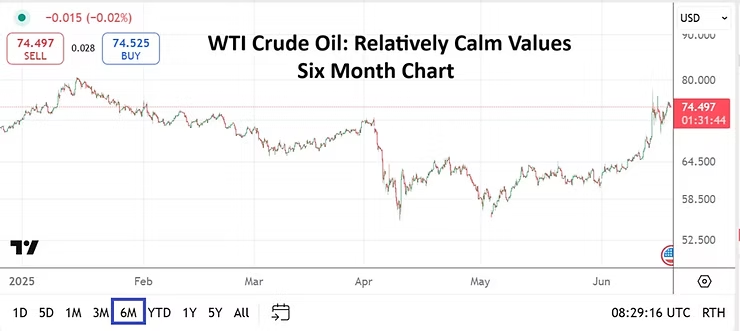
Why has the WTI Crude Oil Spot price remained relatively calm? The war between Israel and Iran has been going on per this latest violent phase since Friday the 13th. While tensions have been high between the two nations from the 7th of October 2023 in a very outward manner, and missiles were fired from Iran towards Israel on two separate dates in 2024 which then featured Israeli retaliation, the past handful of days is a new escalation.

WTI Crude Oil Spot Price Six Month Chart as of 18 June 2025

Day traders of WTI Crude Oil need to understand that large players in the energy sector have a vast amount of experience and intel regarding production and supply worldwide when they make their buying and selling decisions. However, the biggest oil traders do not always share the same political viewpoints, except to say most large players in the energy sector practice the art of realpolitik. Day traders of WTI Crude Oil should try to get into the minds of the real movers of WTI Crude Oil via realpolitik considerations.

As of this writing the price for WTI Crude Oil is around 73.930 Spot, late yesterday it did move higher to within sight of the 75.750 USD mark – this when information that President Trump is considering a U.S military strike on Iran heightened. Traders need to understand Spot Crude Oil and Futures pricing can be different. The current value of WTI Spot is higher than the Futures pricing because of the short and near-term known risks.

However, volatility in WTI Crude Oil Spot has remained fairly muted, almost tame as Israel and Iran wage war. Other spot energy prices like Brent and Natural Gas are being affected directly too because of shifts in behavioral sentiment. But again, the prices within the energy sector have remained calm considering what is at stake for global economics. Here are points that may be affecting the WTI Crude Oil landscape and energy complex, which some large traders may be contemplating:

  • It is highly likely the U.S has told Israel not to harm Iranian Oil production or supply sites, including shipping.

  • The U.S does not want the price of WTI to jump rapidly because of the current war between Israel and Iran.

  • Inflation would be a scrouge for the global economy, not to mention President Trump’s ambitions.

  • Even though the U.S has its own energy supply, the price of WTI is affected by behavioral sentiment within the global Crude Oil complex.

  • Meaning conflicts in the Middle East and elsewhere always cause ripple affects, even if Crude Oil is flowing freely in the U.S via its own production.

  • The U.S doesn’t want China to be given a reason to consider becoming an open belligerent in the Middle East war.

  • China gets a lot of Crude Oil from Iran. The stated percentage is around 15% of its total supply, but it could be more if Iran sends oil to other locations and then reroutes supply to China afterwards.

The U.S not only wants to keep China calm about its energy supply, but also doesn’t want to give China an excuse to escalate political or military tensions elsewhere – read Taiwan.

As an aside there are a lot facts and rumors coming from China, highlighting that a powerplay is emerging between competing factions for leadership in China’s military, this may include the authority that Xi Jinping has too. China will be conducting Politburo meetings in the coming weeks that will get plenty of attention via Beijing analysts. If U.S intelligence knows an internal political fight is taking place in China, they will want to keep China calm regarding external considerations and not give China excuses to act. Concerns regarding the Middle East as a justification for more Chinese actions against Taiwan in some type of economic political/ military theatre is a threat.

By telling Israel not to attack Iranian oil infrastructure, this allows the U.S to placate China. Only if Iran were to attack U.S infrastructure – including military assets or interests in the Persian Gulf via attacks on Gulf States like the UAE, Bahrain or Saudi Arabia would the U.S consider retribution against Iranian Crude Oil.

While the U.S has an interest in global politics certainly, it also wants to maintain a stable global economic environment. President Trump knows this and so does his cabinet supposedly. The Federal Reserve meets later today and they will certainly speak about uncertainty regarding inflation. Whether or not they mention the Middle East war will be interesting.

Thus, it is likely the U.S will only allow an attack on Iranian Crude Oil production and supply if it has been directly threatened. And this is where it gets potentially more interesting for Crude Oil traders. It appears likely the U.S will get involved directly in Iran by hitting known Iranian nuclear facilities deep underground with heavy U.S ordinance. If the U.S does attack Iran via B2s using heavy bombs, how will Iran’s Revolutionary Guard Corps react?

Will the existing IRGC allow for the destruction of its nuclear ambitions and accept that it will have to prepare for a new political environment in which their power will likely be challenged by not reacting? Or will those in power of the IRGC double down on stupidity and attack U.S assets with some of the Iranian military weaponry that still remains? An attack on U.S ‘interests’ would risk aggravating the U.S more – giving the U.S reasons to attack Iranian economic infrastructure which is mostly Crude Oil, and likely close the door on the chances of the IRGC to survive after the war concludes.

Things often do not work out via political and military outlooks. The law of unintended consequences is always a danger. The end game is quickly approaching for Iran’s current leadership. The U.S and Israel also hopefully have taken this into account. Recent outcomes in Iraq and Afghanistan have not gone as planned for the U.S when seeking a serene endgame.

As an example, it might be better not to eliminate the current Ayatollah Khamenei, and allow the people of Iran an opportunity to remove him if they want. The Iranian Revolutionary Guard Corps and its various factions are probably eyeing what will come after a capitulation. There will be a fight for survival politically and a leadership vacuum.

The IRGC fiefdom gets most of its money from Crude Oil revenues. It is quite possible in a forward looking manner the IRGC may choose not to risk having the U.S ruin Iran’s one giant economic asset, thinking rightly or wrongly that they can continue to profit from Crude Oil the day after the war ends.

post246

An Expanding Axis – Will Egypt and Pakistan Become Members?

An Expanding Axis - Will Egypt and Pakistan Become Members?

Opinion: The following article is commentary and its views are solely those of the author. This article was first published the 26th of May via The Angry Demagogue.

China seems to be taking advantage of the transition from the Obama-Biden appeasement based foreign policy to the Trump commercial based system. Whereas Obama-Biden had no problem punishing allies that dared to oppose the US-EU appeasement and woke revolution, Trump is looking to create alliances based on commerce – and threatens allies that don’t go along. While the Obama-Biden policy failed utterly and arguably caused the wars in Ukraine and the Middle East, the Trump administration seems to be playing for time as it restructures the global security order.

China however does not seem to care to wait and are stretching their sway not only in the South China Sea but westward towards the Middle East. The four member Axis – Russia, China, Iran and North Korea seems to be expanding to other countries with strong military dictatorships. Egypt and Pakistan will be the next members of the Axis. While much of China’s belt and road policy deals with bankrupting poor, weak countries, they seem now to concentrate on strong military dictatorships. Egypt and Pakistan are being pried from the western camp as we speak.

Pakistan has, for awhile not been firmly in the western camp. It was a cold war U.S ally as India, while democratic, sided with the Soviets on most international issues. While the US was busy in Afghanistan, the Pakistanis played double agent. Now that the U.S is not in the region and the U.S and India have become closer, Pakistan is now firmly in the Chinese camp.

In addition to Pakistan, Egypt becoming the next major member of the Axis.

Let’s take a few steps back and examine the burgeoning relationship between Egypt – a military dictatorship and Communist China. As we have written China and Egypt had joint military maneuvers that included deliberate violations of the Egyptian-Israeli peace treaty guaranteed by the United States. Egypt, in thumbing its nose not only at Israel but at the United States, allowed Chinese planes to approach the Israeli border in order to test Israeli reaction to a possible invasion. Multiple Chinese military cargo jets flew in undisclosed hardware in the days leading up to the maneuvers.

Three more Chinese Y-20 cargo planes landed in Egypt last week again, carrying unknown hardware. At least one of these planes came from Pakistan. Egypt also seems to be signing major arms deals with France as Macron reeks of desperation in his attempt to remain relevant – but a de Gaulle he is not, and he will not be able to create a force or policy independent of the U.S. Egypt will be glad to take advanced French weaponry while it creates a stronger alliance with China.

Back to Pakistan one has to wonder if the Pakistan-Indian flareup a prelude to what can happen in other theatres – or worse, a purposeful conflagration to test Chinese weapons systems in actual combat and keep the West on its back feet? According to most reports they were able to shoot down between 3 and 5 of France’s most advanced Rafal fighters without even entering Indian territory. The confrontation started with a heinous terrorist attack against Indians in Kashmir by a terror group associated with the Pakistani armed forces. India claims that Pakistan is directly involved in the attack. If so, this would not have been the first one.

The downing of the Indian French built Rafal fighters by Pakistan’s Chinese produced 10-C was, according to expert reports, not just or even mainly superior piloting but with a Chinese strategy and technology that includes all aspects of air power – including recognition of the target, locking on and attack from distances in what an American air expert called a perfect air based killing machine. This would seem to be the first real test of Chinese advanced air-power and it something that needed to be done before any invasion of Taiwan. This may not test their own pilots but it does test the strategy and the technology.

China has a main medium term goal here and it is not a secret. They are planning to take Taiwan by force and need to make sure their soldiers, sailors and hardware are up to the job. They have seen how poorly the Russian army has performed and have seen how Israel has dismantled Iran’s defenses and swatted away Iran’s offensive attacks. China has not fought a major war for decades and for all the advances they say they have made – all have been untested. Until now.

China will not risk a war with India itself but would be more than happy to have its proxy involved. Chinese fighters and their new “over the horizon” missiles are key in their plans to deter the U.S from defending Taiwan – or in defeating U.S naval airpower if the U.S does get actively involved. However, as close as French technology is to America’s it is not the same and the one country that seems to have taken U.S technology to the next level is Israel. How would Chinese weaponry due against American arms in the hands of an air force equivalent in skill and bravery to the American air forces? That has yet to be tested but that brings us back to Egypt. Is it in China’s interests for Egypt to make a major break with the U.S at China’s urging much as they made a break with the Soviet Union at America’s urging? Of course. Would that mean that China might help Egypt provoke a military confrontation with Israel in order to test Chinese arms and relieve pressure on Iran? Maybe.

On to Iran then, where it does not seem that the Americans or Israelis understand the nature of the Iranian-Chinese relationship. Not only does China get the bulk of its oil (subsidized) from Iran but they have just completed a rail link from Xinjiang, China to Teheran, Iran – running through four countries. This rail line can ship oil as well as other cargo, cutting into the American (and Indian) naval superiority around the Persian Gulf and Indian Ocean. The assumption by military planners has always been that the U.S can cut off Chinese access to oil, if necessary. That is no longer the case.

China is not standing still – they are expanding their axis of dictatorships to countries in which the army is in control. Pakistan and Egypt qualify. Iran, while a theocracy is controlled by the Iranian Revolutionary Guards. No matter the “deal” that the Trump administration negotiates with Iran they will not be pried away from Iran. China has more to offer an ideological dictatorship then commercial deals with the United States. What the alleged realists in foreign policy refuse to understand is that dictatorships have no interest in commercial success if it weakens their grip on power. They are interested in deals that enrich their regimes since that also strengthens their grip on their people.

The trillion of so dollars in deals that the U.S has now made with the Persian Gulf states ensures that America remains a player in the middle east. Those who think that the Mideast is a tertiary region at best – after Asia and South America – need to rethink their strategies. As China closes in on control of the world from the Pacific to the Mediterranean the U.S is left with just two military powers it can depend on – Israel and India – to help defend its old/new commercial interests. It is not only oil – it is not Boeing jets, Nvidia chips and many other products that are moving from the US to the Gulf as opposed from the Gulf to the U.S. The U.S is no longer a commercial client of the Gulf states but the country who needs to protect its clients. The relationship has changed but the security relationship has only gotten more important.

The addition of Egypt and Pakistan to the Axis means that the Chinese threat has expanded. They are not giving up on Taiwan, nor are they giving up on South America and the Pacific Ocean but rather, China is using its experience as a dictatorship to strengthen ties with other freedom hating countries. We can all pretend that values and culture don’t matter, but that doesn’t mean that they don’t. This Axis is one where the interest of each member is to stay in power, force its will on its people and enrich itself at the expense of its people. This is an Axis, not only of the unfree, but of those who need to eradicate freedom to “thrive”.

Disclaimer: the views expressed in this opinion article are solely those of the author, and not necessarily the opinions reflected by angrymetatraders.com or its associated parties.

You can follow Ira Slomowitz via The Angry Demagogue on Substack https://iraslomowitz.substack.com/ 

postN87

AMT Top Ten Miscellaneous Morsels for 5th of January 2024

AMT Top Ten Miscellaneous Morsels for 5th of January 2024

10. Book: Truth to Power – My Three Years Inside Eskom by Andre de Ruyter, an insider’s account about South Africa’s public energy company amidst corruption, mismanagement and scandal.

9. NBA: Last night’s Milwaukee and San Antonio game was the first ‘match’ of Giannis Antetokounmpo and Victor Wembanyama. Basketball is global and spectacular.

8. Noise: Clickbait media headlines about nervous results in financial markets this week have been exaggerated.

7. Horn of Africa: Ethiopia and Somalia are arguing about a port passage through ‘Somaliland’, astute eyes should be kept on the region and Egypt.

6. Diplomacy: U.S foreign policy has delivered poor statesmanship with India recently, allowing Russia to reinitiate its longstanding relationship with the nation.

5. Taiwan: Presidential election is on the 13th of January. President Tsai Ing-wen is not eligible to run again because she has now served two terms.

4. USD/JPY has ebbed higher and next week’s results promise to be rather insightful regarding the outlooks of financial institutions. Reversals coming?

3. China: Economic concerns in the Asian giant continue to mount as deflation threatens to become intractable and investors fret.

2. Data: U.S jobs numbers coming today, the results are anticipated to be slightly weaker. A reaction in the broad markets is certain, but it is full market volume next week which will set the tone.

1. Outlook: Anxious short-term trading results from the past two weeks are likely going to be confronted by optimism and risk appetite next week. Who will win?

postN95.1

Trading Optimism for 2024 and Pursuit of Castles in the Air

Trading Optimism for 2024 and Pursuit of Castles in the Air

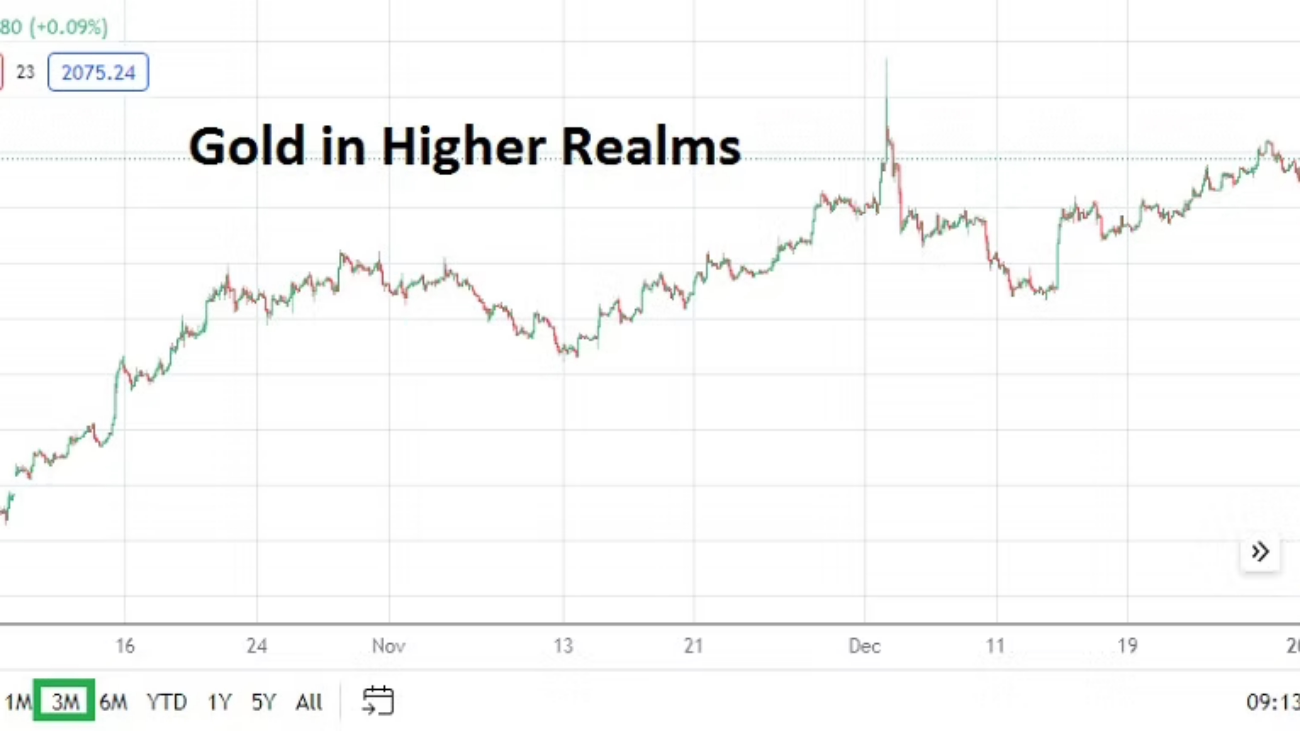
Traders may feel like horses being kept in their stables right now. The desire to run freely in Forex and other markets is certainly being felt, this as many analysts have jumped onto optimistic bandwagons and are pointing to the U.S Federal Reserve and its rather dovish outlook for 2024. Gold in early trading this morning is lingering near highs and the USD remains within weaker territory when technical charts are inspected via one month results.

Gold Three Month Chart as of 2nd January 2024

Yet, thin holiday trading is full in effect. Light volumes will continue to be seen early this week after the New Year’s celebrations. Financial institutions will open their doors today, but their corporate clients around the world will have plenty of employees who will remain on vacation until the 8th of January. Thus, while day traders may feel enticed to wager in the markets with various CFDs, they should be careful and understand unbalanced positions may cause temporary chaos. Risk taking tactics should be carefully considered.

The desire to dream about castles in the air is a source of comfort for many new day traders. But remaining realistic about potential results, while not getting overly ambitious about targets is an important aspect for all speculators. While trends may look attractive in Forex, commodities and equities a well planned approach regarding risk taking is a practical road. Castles in the air tend to vanish.

Optimism will be a word frequently heard in the coming days and weeks, and here’s to wishing everyone a prosperous and peaceful 2024. The potential of a more dovish U.S Federal Reserve regarding monetary policy and declining Treasury yields sparking more risk appetite in equities as investors seek solid returns is alluring, however risks remain on the table. The economy of China continues to worry analysts and tensions in the Middle East are still a long way from being solved.

However, the biggest cause for speculative concerns during 2024 may come from elections in Taiwan, India, South Africa and the United States. Taiwan’s presidential vote is on the 13th of January. China will certainly be watching the results, and traders should expect to hear swords rattling afterwards and then hope the noise calms down.

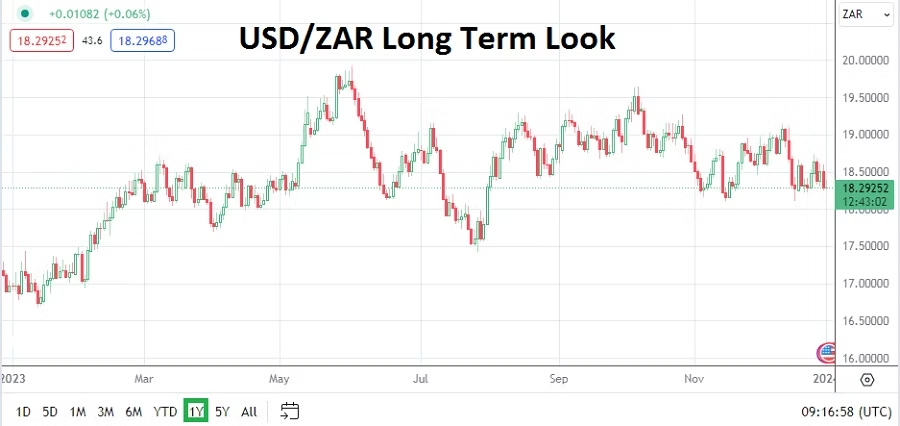
USD/ZAR One Year Chart as of 2nd January 2024

Tranquil voting results in India will be welcomed by investors. India is becoming a noteworthy economic giant, its rapid growth and ascension as an important investment vehicle needs to remain stable. South Africa remains troubled domestically by concerns regarding corruption and inefficiency, its upcoming spring election results may not solve the problems it faces. There will be many elections in Africa this year, which could spur on considerations regarding geopolitical alliances and the price of commodities.

The U.S election late in 2024 will start to grow in noise as the months progress and by early this summer behavioral sentiment will begin to become nervous regarding the outcomes for the White House and Congress. The U.S appears to be braced for an election between Joe Biden and Donald Trump and this will certainly cause skittish storms.

Traders should feel confident about risk appetite in the global markets improving, but they should keep in mind that impetus coming from many different spheres can affect the financial world.

Tuesday, 2nd of January, U.S Final Manufacturing PMI – today’s Purchasing Managers Index is expected to show a slight improvement, but the results may fall on deaf ears because many market participants will not be around to react due to the fact they are still on vacation.

Wednesday, 3rd of January, U.S ISM Manufacturing Prices – this inflation survey from purchasing managers may be given a bit of attention, but its effect may be limited because of light trading volumes still being exhibited.

Thursday, 4th of January, Germany Preliminary CPI – the inflation data from Germany will get some consideration, and the result is expected to show a slight increase. Services PMI data will also come from European Union nations, the U.K and U.S.

Friday, 5th of January, U.S Non-Farm Employment Change and Average Hourly Earnings – the jobs reports will get the notice of financial institutions. The results for employment and wages are expected to be slightly weaker than the previous month’s outcomes. Typically these numbers would cause a stir, but unless there are surprises, most financial institutions may not react massively to the reports because it remains a ‘holiday’ week. If the numbers come in weaker than expected this could cause interesting reactions on the 8th of January and weaker USD sentiment.

postN19

Preventing WWIII: Part 2 – Reviving Western Deterrence

Preventing WWIII: Part 2 - Reviving Western Deterrence

Opinion: The following article is commentary and its views are solely those of the author.

Aggressive Western Action Can over-extend China and Revive Needed Deterrence.

Some cliches are just correct, in spite of their being cliches – “if you want peace, prepare for war” is one. But really it should be “if you want to avoid war, deter war”.

Therefore, it is not clear to me why there is opposition by some in the Republican party to fighting Russian aggression in Ukraine. For some, I guess it is a knee jerk reaction against Biden administration policy while for others it seems to be a general loathing of American involvement in the world. 

Each is understandable on its own but does not take into effect the appeasement of Russia will have on Western deterrence around the world – including in the Western hemisphere and the Indo-Pacific. While most Americans understand that Russian control of Ukraine threatens the main Western European countries, the key to Russian imperialism really is in the south. Historically, Russia has always tried to find a warm water port to call its own. For nearly four centuries Czarist Russia fought Ottoman Turkey so that Russia could expand its territory southward and have a warm water presence in the Mediterranean. Currently, a Ukrainian presence in the Black Sea denies Russia even the opportunity to pressure modern Turkey to abide its wishes.

A Russian victory in Ukraine would mean dominance of the Black Sea by the Russian Navy and directly challenge Turkey to appease Russian power by giving them free passage through the Dardanelles to the Mediterranean. That in itself would not be worth much to the Russians without a port in the Mediterranean, which they currently have. That they have one goes back to the disastrous decision by the Obama administration to invite Russia back into the Mideast in order to take care of Syrian chemical weapons. This came, we all remember, when the Syrians laughed at Obama and crossed his “red line” about using chemical weapons against its own people. We might also remember when then Secretary of State John Kerry (the one who was never right on a single foreign policy issue ever) who, first demanded that Syria turn over all chemical weapons in a week, then reassured them that even if we attack it will be “unbelievably small”.

In 1973-4, Henry Kissinger brilliantly took advantage of the Israeli-Arab War’s outcome with Israel’s surrounding the Egyptian 3rd Army in the south and controlling the road to Damascus in the north, by brokering a cease fire on both fronts. This led directly to the expulsion of Russia/Soviet Union from the Middle East. While Russia continued friendly ties with the murderous Assad family – first Hafez and then his son, Bashar, they did not have a military, air or naval presence there. Due to this longstanding relationship with Assad’s Syria, Obama and Kerry thought it a brilliant idea to have them come in and do the dirty work that they didn’t want to do – prevent Assad from gassing his own people. 

As Russia came in and established air and sea bases in Syria and introduced the infamous Wagner group to carry out its brutal ground operations, Russia slowly started to strengthen its position in the region. While slyly allowing Israel to attack Iranian arms shipments meant for Hezbollah while pretending to be its ally, Russia formed a close  relationship with Iran. Wagner, which fought hand in hand with Hezbollah in order to prop up the Assad regime (and attack American forces fighting ISIS) is now rumored to be training Hezbollah in the use of Russian anti-aircraft systems. 

In addition, reports last week that an Iranian Ilyushin 76 cargo jet has now landed in one of the Russian air-bases they established after Obama’s kind invitation to return to the Mideast. This plane, filled with Iranian arms destined for Hezbollah has been unable to land in regular Syrian airports or bases because Israel continuously puts them out of service. Knowing that Israel would never attack a Russian base – this is a safe haven that Russia gladly supplies. 

When free countries unite in warfare there is usually one joint goal  – that they are all united to defend freedom – that is why they fight together.  While autocratic and totalitarian regimes fight together it is usually a combination of a negative goal – disturbing or destroying the current world or regional order – as well as the goal for each power in itself. Currently, the joint goal in the Mideast (of Russia, China, Iran and North Korea) is to hurt the main ally of the US in the region – Israel, in order to weaken and embarrass the US. For Iranians, they also want Israel destroyed. For Russia, they want Israel weakened so they can replace the US as the power broker in the Mideast. For China, it is to dismantle America’s control of the flow of oil and, eventually, the replacement of the USD in the global economy with the Yuan.

Ukraine is important in this calculus because, as we said above it gives Russia complete control of the Black Sea and will pressure Turkey – whose NATO membership is uses only to its own advantage – to break permanently with the West. While the Chinese theory is that the two fronts the US is supplying arms to, Ukraine and the Mideast, are tying it down and expending its resources it would otherwise use in the Pacific, in truth, an aggressive strategy on both fronts would be to over-extend Russian and Chinese resources in order to keep China from moving on Tiawan. A credible threat of destruction or even marginalization of the Axis allies in the Mideast – including (besides the soon to be gone Hamas) Hezbollah, Shiite-Iranian proxies in Iraq and Syria, as well as Iran itself combined with a major offensive in Ukraine will tie down Axis resources and possibly prevent a Chinese blockade or attack on Taiwan.   If its two main allies need full supply and full readiness to be able to respond to credible and massive attacks by Ukraine, Israel and the US, China itself might have to expend resources to prop up its own allies. 

Add to that a major show of naval force in the Indo-Pacific by Japan, India, Australia and South Korea combined with US forces will give China the choice of destroying their own wavering economy by attacking or blockading Taiwan or in maintaining peaceful Pacific trade routes while trying to prevent the collapse of its Axis allies. 

An immediate and radical change in policy can restore Western deterrence quickly.   Re-arming Ukraine and leaving Israel to do its job without pressure to stop in Gaza and to respond forcefully in Lebanon will send a strong message. Biden brought two carrier groups to the Mideast and told Hezbollah, “don’t”. But they did.  

In spite  of that  US Secretary of Defense Austin told Israel that its response to Hezbollah aggression in the north is “provoking” them.  

And the US hesitates even against Iranian proxies. Just now, the NY Times has reported that Biden-Blinken have turned down a Pentagon plan to be more aggressive in response to Iranian attacks against US forces in Syria and Iraq for fear of “provoking Iran” (this seems to tell us that the Austin complaint from Austin to Israel is really from Blinken).  

Iran never seems to fear provoking the US.   

Israel fooled itself by thinking Hamas was deterred by its destruction of an arms factory or two (as the US is doing now in Iraq/Syria) when proper deterrence would have meant them knowing we can and will go into Gaza and destroy their underground city as Israel is doing now. Instead, media fear mongers, backed by Israeli ex-Generals on the payroll of the US progressive left (via cushy think-thank jobs) combined with policy directives by successive governments have told us and Hamas time and time again that Israel cannot destroy Hamas as the cost is too high. I don’t want to speak too early, but that seems to have been as wrong as their assurance that Hamas is deterred since they want to drink white wine in the evening overlooking the Mediterranean while watching their children play innocent video games.

It is time to stop calling for cease fires and repeating UN hypocrisy and to start being aggressive and provocative in the defense of freedom. 

Disclaimer: the views expressed in this opinion article are solely those of the author, and not necessarily the opinions reflected by angrymetatraders.com or its associated parties.

You can follow Ira Slomowitz via The Angry Demagogue on Substack https://iraslomowitz.substack.com/ 

post26.1

BRICS and a Potential New Currency Paradigm

BRICS and a Potential New Currency Paradigm

The BRICS nations are causing alarm in some ‘Western’ financial circles as they seek to strengthen their trading alliance reflecting their ability to be large producers and consumers. BRICS has a common goal of creating better trade and financial conditions for each other, and as a potential byproduct to possibly create an alternative to USD dominance.

While political crisis and global security concerns have grown the past few years and are causing uncertainty and instability, the strength of the USD has also caused inflationary problems for many nations including BRICS members. Cash reserve shortages of USD have become problematic and have been fueled measurably by decisions from the U.S government, Federal Reserve system and U.S Treasury. This has ignited many emerging market nations to seek dialogue about potential BRICS membership.

Alliance intrigue and concerns also shadow BRICS members often, the February 2023 naval exercise held between Russia, China and South Africa within waters near Cape Town raised anger in the United States and the European Union. The fact that the joint military exercise was held during the first anniversary of the Russian invasion of Ukraine did not go unnoticed. While no signed military alliance exists between these nations, it should be noted that Russia, China and South Africa also held a naval exercise in November 2019 also within proximity to Cape Town, South Africa.

USD/ZAR 1 Year Chart as of 28th April 2023

Formation and Agenda as Members Scoff at the ‘King Dollar.

The agenda of the BRICS nations often appears a desire to topple the dominance of the USD to those watching from outside, but is it realistic? Trading alliances are important certainly in order to create better economic stability. The BRICS potential effect on the USD is concerning, although not critically dangerous at this juncture the bloc needs to be monitored. In addition there are worries from some in the West that new military alliances could be formed, but historical and cultural differences within BRICS makes this rather questionable for the time being when contemplated in total.

BRIC was an acronym coined by then Goldman Sachs Chief Economist Jim O’Neill to identify potential opportunities for investors within emerging market nations. Members in this ‘bloc’ are countries that have begun to work in unison. About two months ago, Jim O’Neill reiterated the same refrain and alluded to the BRICS theme of suppressing USD strength and its reliance in global trade. BRIC (Brazil, Russia, India and China) was formed in 2009, and they added South Africa as a member in 2010 formally initiating BRICS. This coalition has met annually to discuss coordinated policies regarding trade, finance and investment opportunities. The next annual meeting will be held in August 2023 in South Africa. Vladimir Putin’s potential attendance at this year’s meeting is being monitored widely.

Plenty of discussions have already been articulated internationally about undermining USD dominance in global trade, but little effect has come to fruit in reality and the USD retains its moniker of ‘King Dollar’. However, countries being affected by the rise of inflation and the strength of the USD are becoming numerous and this has caused a diverse group of nations to seek conversations with BRICS leadership about being able to join the trading alliance. Iran, Algeria, Argentina, Mexico, Nigeria, Saudi Arabia, Indonesia, Pakistan, Egypt, Sudan, Syria, the United Arab Emirates, Bahrain, Turkey, Venezuela, Sri Lanka and Zimbabwe are some of the nations that have expressed interest in BRICS membership.

Impact of Sanctions on Russia and its Ability to Counter via BRICS

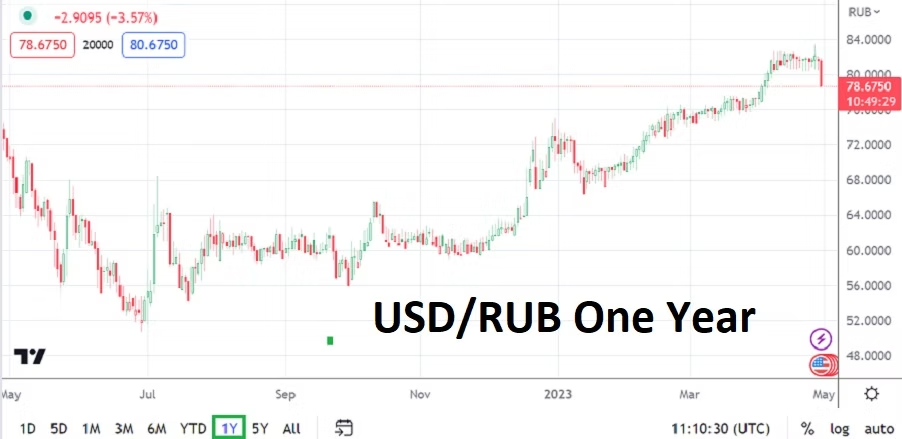
Russia has been waging a war with Ukraine for over a year and is currently under many Western sanctions. It’s been kicked out of the SWIFT banking system, which means it has limited opportunity to trade the RUB with Western countries. This in theory also limits the amount of USD that Russia can get its hands on.

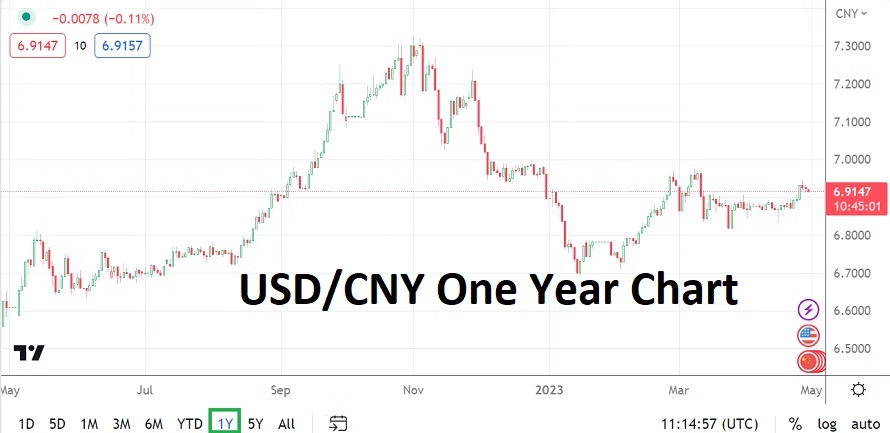
Russia last year asked to be paid in Rubles (RUB) for gas and other energy purchases when dealing with E.U countries, trying to play a game of chess which largely failed. This while China too, tries to make the Yuan (CNY), a more significant currency in order to suppress USD dominance. China certainly has plenty of political and economic reasons to have the CNY emerge as a global power.

Russia has supposedly wanted to get out of Western currencies and especially the USD, this to punish the West, but will it work out and is it pragmatic? No. Russia’s attempts are high on rhetoric, but low on quantified changes thus far. The USD is far too dominant within the global banking system, and while incremental challenges to the USD have been tested, chipping away at USD strength remains difficult at best. The Kremlin has tried to inoculate itself from the pain caused to its trade balance because of sanctions, and create problems respectively for countries that oppose its invasion of Ukraine by cutting off gas supplies which were used for heating and to generate power for industrial purposes. Threatening to not allow grain to flow from Ukraine has also been a rather constant noise made by Russia.

Prices were capped on Russian energy via the G7 beginning in 2022 as a retaliatory move to limit revenues for Russia, and alternative gas agreements were sought by many European nations creating a loss of momentum for the Kremlin’s chess game. The Nord Stream pipeline was also damaged via sabotage. Russia used to supply Europe with 50% of its energy until sometime in 2021, it now provides less than 20% after Western sanctions. Russia has moved its eye towards other nations hungry for energy, ones that are not obligated to make transactions in USD, which brings BRICS into focus.


USD/RUB 1 Year Chart as of 28th April 2023

Inflation and a Strong USD have Caused Harm Globally

Inflation has caused problems across the globe following the impact of the coronavirus epidemic. The Federal Reserve, BoE and ECB have raised rates to try and cool inflation in their respective economies. This has made the USD attractive against emerging market currencies and caused capital outflows. An economic nightmare has occurred in Sri Lanka which is suffering from staggering political and economic problems the past two years, and nations like Pakistan and Egypt have been hit hard too by inflation’s impact and debt. USD reserves dwindled in these nations and they found it difficult to service their USD denominated debt in 2022, and troubles persist in 2023. Import without any USD reserves is difficult and sometimes impossible.

Russia and China as Major Players in ‘Their’ Bipolar World with ‘Friends’

Global trade is still dominated by the “King Dollar”. Almost 88% of global trade happens with the USD. The USD accounted for more than 71% of currency reserves at central banks in 2000, but has now declined to slightly below 59%. Oil and gas exports are important for Russia as these revenues constitute nearly 45% of its Federal Budget and it’s already been in deficit since February 2023, because oil revenues have slumped by half. Russia has a growing dependence on BRICS and is actively trying to get other nations to join the trading coalition, this because it has few other places to turn, and there appears to be no end in sight regarding the war with Ukraine.

Trading with other nations and signing currency agreements which would not include USD transactions is a long term goal of Russia and China, this if monetary values via the other nations currencies can remain firm. And then there is a wished for and ‘feared’ long-term dream of creating an alternative ‘super’ currency to compete against the USD.

Even before the escalation of fighting in the Russia and Ukrainian War, Russia was strongly advocating an end to USD dominance in global trade via rhetoric, particularly during previous BRICS Summits. We need to understand the political implications and complexities within BRICS, when talk of a decoupling from USD dominance news flares up. The U.S certainly keeps an eye on BRICS and so do other Western nations. At this moment South Africa has a delegation in Washington, D.C regarding the questionable South African policy behavior, particularly in light of recent military exercises with Russia and China, to try and smooth its U.S relationship. South Africa membership in AGOA, the Africa Growth and Opportunity Act, which grants special trade benefits to the nation and other members is being questioned strongly by U.S politicians. Getting kicked out of AGOA would cost South Africa billions of dollars in aid.

China and Russia seemingly want to create a bipolar power sphere, one in which U.S dominance is not so easy. Chinese President Xi Jinping and Vladimir Putin have met several times recently and are certainly collaborating regarding trade and investments. The developing news regarding the potential of BRICS enlargement shows that China and Russia maybe preaching multi-polarities such as their involvement with South Africa, but may actually be working towards a bipolar constellation of forces in which they would lead a broad alliance of countries in countering the preponderance of Western economies and potentially military might.

USD/CNY 1 Year Chart as of 28th April 2023


By allowing membership of BRICS to expand, U.S influence and the dominance of the USD would be lessened incrementally. A long game seems to be in play and if that is the case, the game of chess being played by Russia and China together against the West is complex and the U.S and its allies will need to be ready with a response if they want to protect the USD.

From the China point of view, the internationalization of the CNY is a positive. It has recently brokered a peace deal between Saudi Arabia and Iran, long-term arch rivals which surprised many in the West and seemingly caught the U.S unaware. China has also lent close to 1 trillion in USD value to Ghana, Pakistan, Nigeria and other smaller African countries. China is wielding power via trade and investment leverage into these respective nations strategically, pushing its global trade agenda even as Washington quietly threatens to punish China for backing Russia in the war with Ukraine.

Changing Role of China on the World Stage and BRICS

China’s role today is very different than in 2009 when BRIC was founded, this as the nation has become more secure regarding its stature globally. In the initial stages of BRICS there were talks about challenging USD dominance in global trade by member countries, but China vehemently avoided discussing this proposition openly to avoid conflict. The game has changed significantly regarding rhetoric, this as U.S – China relations have worsened as global trade, military security and corporate surveillance issues become more troubling. Political tensions with Taiwan as China rattles swords is a drama that nations are also watching attentively.

For China, the developing alliance with Russia has been a complex and sometimes slowly evolving plan historically, but one that has grown amidst tensions with Washington since the Trump presidency. The Russia and Ukraine war has accelerated the desire to break U.S led global dominance, and that means trying to break the USD internationally when it is possible. It is a long game and BRICS is part of this equation.

China and Russia view themselves at the vanguard in the struggle against Western global predominance, and they are eager to bring others on board. At the last summit of BRICS in June 2022, both Chinese President Xi Jinping and Russian President Vladimir Putin argued in favor of expanding into BRICS Plus. Beijing has become particularly interested with developing BRICS as a counterweight to the G7. While it has been difficult to establish a consensus on expansion among the current BRICS members, it appears to be a certainty that expansion is coming and the summit in South Africa this August will provide insights.

China is promoting the CNY in exchange for getting oil from Russia. The CNY is now ranked fifth regarding global transactions according to many banking sources. From the Kremlin’s point of view accumulating CNY reserves is good for Putin in the short-term; this creates more buying power for goods from countries that are friendly to Russia and China collectively and creates strategic momentum.

Yes, there are long-term historical complexities between Russia and China which will likely prove difficult politically to solve, but for the moment money is helping grease their wheels of diplomacy. Differences of opinion between Russia and China cannot be ruled out in these kinds of power games. Putin is an astute politician and liable to act in a surprising manner, this while trying to help Russia and its place among nations. Russia is certainly not keen on becoming a puppet state of China.

Trust is Almost a Four Letter Word for Some Economically and Politically

In his acclaimed book ‘Trust: The Social Virtues and the Creation of Prosperity’, the political economist Francis Fukuyama illustrates how degrees of trust in a society and indeed in a company can be decisive for prosperity and the ability to compete. In “low-trust” societies such as China, Russia and Italy, you cannot assume that everyone is willing to follow the rules. Members of these societies must frequently renegotiate ‘asserted’ rules, and often have to go to court to decide on matters. Ironically, one can see that this also applies to trading of the CNY.

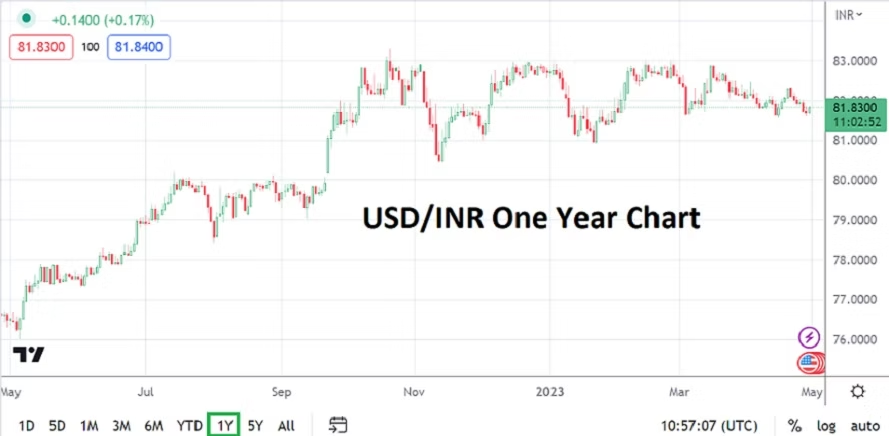
USD/INR 1 Year Chart as of 28th of April 2023

For instance, while China promotes the use of the CNY, countries like India are still using UAE Dirham (AED) for buying oil from Russia. BRICS still needs to sort out which currency they will use extensively for trade, this while many members try not to make enemies of other nations. South Africa exports are significantly more to the E.U, U.S and the U.K compared to Russia. Its share of exports to Russia are minuscule compared to the other three. Not only is South Africa risking free trade agreements with the U.S, E.U and U.K, but membership in key groups like AGOA as it tries to play on both sides of the fence politically is in jeopardy. Western observers are certainly watching South Africa and they will watch any other nation that joins BRICS. How long will the ANC led government of South Africa will be allowed to flirt with Russia and China militarily before it is stopped?

India has a Large Role in BRICS and is Growing in Stature

India is a vital member of BRICS, but also an important member of the QUAD alliance, the Quadrilateral Security Dialogue. Japan, Australia, the U.S and India are members and confer over trade and security. India is the largest democracy in Asia – and the world – and a Western advocate in South East Asia, even as China plays a dominant role in geopolitics. While BRICS wishes may be good for conducting bilateral trade among members, it is not necessarily good for global trade and political understandings. Complications from long-term political and historical disagreements between India and China cannot be discounted either.

Is the Indian Rupee (INR) or CNY more relevant for international trade? Use of the INR and the CNY needs coordination with other countries many times. Australia is a good example regarding the ability to trade INR internationally. If Australia and India agree to make their payments for exports and imports in their respective nation’s currencies, trade can be conducted rather well, but then Australia would have to find another nation for its ‘extra’ INR, because it would likely suffer due to trade imbalances. It would be important for another country outside of India to agree to take INR from Australia for other trades. Potentially some Gulf countries could be open to these types of INR transactions. A bigger group of BRICS nations would help India certainly.

Saudi Arabia has recently agreed to sell oil for CNY, but shoring up CNY in their coffers has long-term implications. This as Saudi Arabia wrangles politically with the U.S occasionally. Saudi Arabia has demonstrated a desire to take on a seemingly more neutral tone and perhaps wants to limit its exposure to the strength of the USD, particularly if the U.S tries to make a weapon of the USD via political policy. Thus, India as the most populated nation in the world and a growing economic sphere of importance, has to make careful considerations moving forward as it positions its economic stature for complexities that will develop. India and Saudi Arabia may have visions of becoming great ‘neutral’ economic powers moving into the next one hundred years.

The Indian Government has made economic deals with Egypt, Sri Lanka and Malaysia for bilateral INR trade, but still no pure INR trades of significance have materialized according to official banking data. There are multiple headwinds for BRICS nations to overcome USD dominance in international finance. Whenever exchanges of INR or CNY to other currencies for trade settlement are needed, they need to first change the base currency to USD to buy RUB or AED. Few exporting countries will accumulate CNY without a total need. Holders of these currencies would likely dump the INR and CNY for USD via Forex.

China Economic Transparency is Lacking and the Future of India in BRICS

China doesn’t make it easy for foreigners to own assets in their nation. The China government does not want massive trade deficits and free capital flows are restricted with force. Who would invest in China and risk having their money being stuck in the nation without guarantees? China continues to ramp up its oversight and aggressive tactics of supervision of foreign owned companies that have operations in the nation.

Now and into the foreseeable future, the Chinese government will control transactions of CNY with an iron fist. The United States will likely remain the predominant place for trade because of its huge economy, and as a nation that allows many other countries and foreign citizens to own and invest their assets within it boundaries. There is still something to be said for transparency. Any new nation or coalition trying to challenge U.S government debt instruments are likely to fail. The U.S continues to be a place where nations can hold ‘safe assets’ with a guaranteed return of interest for the long-term. No country equals the asset size and security of U.S Treasury Bonds. On that basis alone, there will be a no challenge to the USD in the near future.

Liquidity remains an issue for capital flows and convertibility within BRICS. A lot of hard work via transparent trade agreements will have to be signed to get these issues resolved. Plenty of questions exist regarding China’s economic data and its reliability because of a lack of oversight from ‘recognized’ outside agencies which are often forbidden.

India is still having border issues with China and these problems remain unresolved. India’s role of leadership in G20 is hard to ignore despite its alliance with BRICS. The Indian government has advised traders not to speculate in CNY. This shows that strained relationships between China and India remain and a lack of trust regarding clarity continues. In the U.S, New Delhi is considered an important partner, one that can be trusted regarding the growing rivalry between the U.S and China. Prime Minister Narendra Modi, said last year, “this is not an era for wars”, and this shows India wants stability and wants to play a global role in diplomacy.

There is a definite strategy for BRICS to grow with the nations of the Middle East and others. Using their currencies for mutual trade arrangements could eventually work out, but it will take a long time for this to change the dynamics of USD dependence and dominance.

However, we shouldn’t forget that almost 40% of the world’s population lives in Asia. Yet, even if oil producing nations will trade in a BRICS backed currency basket, which has been dreamed about for a long time, China’s leader Xi didn’t highlight this goal while in Moscow or in Saudi Arabia during recent summits. China is certainly playing a long game, but it also shows they remain cautious and vulnerable to the strength of the USD globally. If Xi wanted to cause the greatest pain to the United States, he would liberalize his financial sector and make the CNY a true competitor to the USD with complete economic transparency, but that would take him in the direction of free markets and levels of openness that are likely the opposite of China’s domestic ambitions. A strong due diligence of the Chinese economy, is something Chinese leadership likely wants to avoid for the foreseeable future.

BRICS: A Multi-Polar World and Avoiding Confrontation

Many developing countries will want to avoid a confrontation consisting of China and Russia on one side, and Western powers on the other side. India has overtaken China regarding population numbers, and will likely become the world’s third largest economy before the end of this decade. India will become a strong voice in favor of a multi-polar world. Arguably, ideas of a more multi-polar world are being worked towards in pragmatic ways, but the BRICS coalition will not develop their own asset backed common currency unless they can resolve issues regarding trade and monetary agreements with transparency. It is a matter of trust.