post245

Why No Major Panic in U.S Stock via Moody’s Downgrade?

Why No Major Panic in U.S Stock via Moody's Downgrade?

While Asian equity markets opened with initial nervousness yesterday after Friday’s late downgrade of U.S debt by Moody’s to Aa1. The U.S major indices did not respond with panic selling, By the end of yesterday’s trading the Dow30, Nasdaq100 and SP500 turned in rather mundane and positive results. Behavioral sentiment and knowing what experienced investors think remains important for people trying to mirror the actions of larger players while trying to take advantage of potential market action.
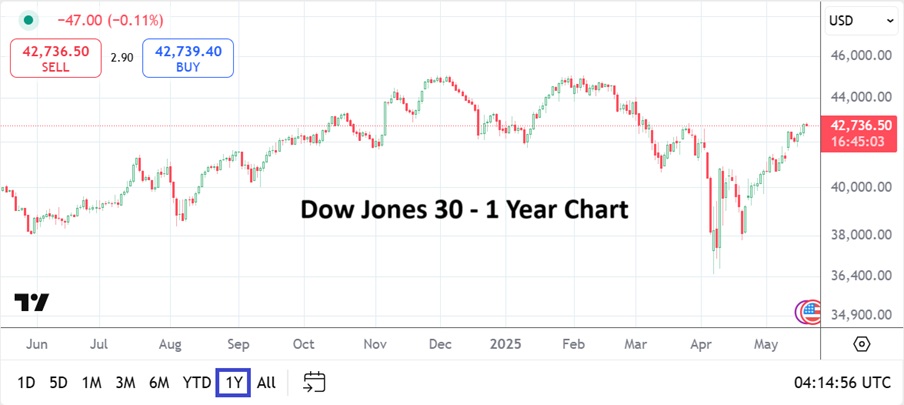
Dow Jones 30 One Year Chart as of 20th May 2025

What was NOT mentioned widely in the press yesterday were the facts that Standard & Poor’s had actually downgraded U.S debt in 2011 from AAA to AA+, also Fitch had been warning of a downgrade the past handful of years and did so in 2023 to AA+. U.S government debt remains a definite burden on the U.S economic outlook, but investment institutions have been discussing the dangers of the 36+ trillion USD deficit for years. Talking about something doesn’t mean it is fixed, but it does mean it has been acknowledged and this is where sentiment comes into play.

Wall Street remains in many respects the only game in town for large global investors looking for quiet steady returns. U.S exceptionalism – or at least the concept that the U.S economy remains a true safe haven compared to other investment vehicles worldwide – continues to spur on a confidence game that sees money pumped into it by global pension funds and long-term investors which seek yields that outpace inflation. It can certainly be argued that this endeavor is not always achieved, but the concept that the ability to grow money faster in equity investments via the likes of index investing compared to letting money sit in a bank is noteworthy. The ability of large institutions to place considerable amounts of money in more speculative pursuits like singular equities in sectors they are interested in like AI and quantum also creates a dimension to outperform benchmark indices., but is riskier.

The USD remains the world’s currency of choice for effective trade and protection against the dangers of volatile Forex. The Trump administration likely wants a weaker USD in order to spur on export from the U.S, but it certainly doesn’t want to see the greenback killed. Nor does the White House want to see U.S Treasury yields balloon too high. Day traders may not have been told to watch yields in the 10 Year U.S Treasuries by their brokers, but it is an open secret that should be used as a barometer for investor sentiment. The signals may not work everyday, but over the long-term if U.S yields on the 10 Year U.S Treasuries are soaring it likely means major U.S equity indices are struggling with anxiety – and when the yields are turning lower it can be expected that U.S equity indices are gaining.

An important piece of the confidence game that speculators should note regarding confidence in U.S markets is that 10 Year U.S Treasury yields yesterday declined, and are now lower than values seen last Friday after the ratings downgrade by Moody’s, and are testing values seen on the 14th of May. Traders should certainly stay alert, but they must remember the U.S investment landscape is resilient and is likely not going to perish suddenly. Investors like most humans tend to be optimistic and believe things will work out with positive results somehow developing. It doesn’t mean stock values will always go up, in fact they can move lower violently periodically, but a long-term vision helps when investing in U.S equities.

There has been no panic in U.S equities and the world continues to look at the SP500, Dow30 and Nasdaq100 as places to position investments. Yes, other spheres exists which can produce greater yields, but this also includes higher risks. International diversification is a solid focal point for investors, and day traders need to understand a complex game is being played. Reacting to every soundbite of developing news probably does more harm to speculators compared to good. A steady approach and conservative risk taking tactics are vital.

post228

Market Volatility Concerns While Deflecting Noise From Afar

Market Volatility Concerns While Deflecting Noise From Afar

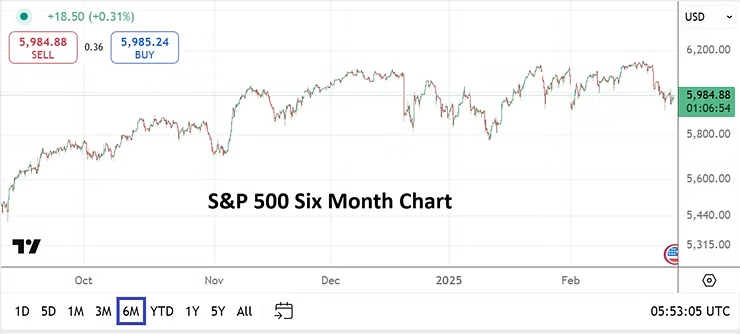
S&P 500 Six Month Chart as of 27th February 2025

The phrase if it bleed it leads is a fixture regarding the world of media. People and their companies want your attention. The addition of Donald Trump to the White House helps those that are content to see him in office, but it also helps those who oppose him because it gives his detractors a centerpiece to a lot of their ‘insights’. Perspectives abound and while watching the financial markets, we are bombarded with loud opinions formed by folks vying for our time. In many cases they are also trying to attract our money.

Wall Street has seen choppy results the past week, but speculators need to remain objective and not allow distractions to destroy their ability to gauge the marketplace. When looked upon with a mid-term reference it is rather easy to define the results upwards in the stock indices from the U.S have been rather good. There is no guarantee you are going to make money speculating. Losses occur and they do not only happen to speculators but they happen to investors too.

Timeframe speculative management and separating the noise from facts is difficult enough under normal circumstances. However, because of the notion if it ‘bleeds it leads’ which is dominating media for the moment, we are within a cycle when influencers can use headlines to catch our attention. Perhaps they believe what they say, perhaps they are trying to guide us towards a product, or perhaps they simply enjoy predicting misfortune.

EUR/USD Six Month Chart as of 27th February 2025

Yesterday during President Trump’s cabinet meeting when asked about the E.U, Trump stated a proclamation of love for Europe, but then added that the E.U was a special economic case and has been getting away with a lot of things like expensive tariffs on the import of U.S cars. He also said the E.U was created to compete with the U.S – though this needs to be taken into context and that Trump meant this only as a trade competitor.

Nearly as quickly as Trump made his statement, some began to use this loose remark as a narrative that the EUR/USD was struggling because of these new worries. Fears about a massive trade war were sounded from some legitimate but overly contrived media sources. Yet, a trade war between the U.S and E.U isn’t going to happen ladies and gentlemen.

The fact is that the EUR/USD has been struggling for a handful of months and is starting to show signs that support levels are durable. The greater likelihood is that financial institutions believe the EUR/USD is oversold and have a bullish perspective for the currency pair over the mid-term. Yes, Europe continues to produce lackluster economic data, but a lot of the value in the EUR/USD has had risk adverse concerns priced in already. Looking for upside from the currency pair around its current levels is not farfetched. Downside risks look limited compared to upside potential.

Once again the financial media who want your attention were given click bait material to get you to react. Day traders need to understand they are constantly being sold not only false narratives but false opportunities too. Speculators looking for profits with quick hitting trades can make money, but many times they lose money because they are working in conditions in which they do not have enough control of their emotions. Day traders should clearly understand they are operating within a gambling universe when they attempt to trade Forex, equities, Indices, commodities and needless to say cryptocurrency.

Traders must work on improving their decision making process. They need to take into consideration their perceptions of the financial landscape, but also understand what their counterparts are thinking too. Financial institutions certainly trade for short-term results, but they are also operating with mid-term outlooks. The likelihood that they are worried about an onslaught of tariffs from the Trump administration is contained by the realization that the current President of the U.S negotiates using tough methods. The bombastic hyperbole of President Trump’s business techniques are not loved by everyone, but they often get the job done regarding his intended desires.

So what should you do? First of all relax with a deep breath. The world is not coming to an end. The financial landscape is not facing a cataclysmic scenario. Many volatile financial events have been seen throughout time. Traders need to understand that the market action on the SP500, Dow30, and Nasdaq are vulnerable to selloffs occasionally that can last for unknown durations which makes daily speculative wagering prone to significant cash losses. This is why investors who have different perspectives regarding timeframes and take a slow and steady approach often come out better than folks who are merely gambling.

Day traders need to eliminate as much noise as possible. This is done with solid risk taking tactics using methods which involve knowledge gained through experience, and knowing that not everything they are hearing is meant to help. Practice a trading mantra by having realistic price targets, chosen timeframes, conservative leverage; using entry orders helps, adding stop loss and take profit orders to get out of positions are vital too.

The mid-term outlook for the EUR/USD and the stock markets likely remains bullish in the eyes of financial institutions. There are many factors in trading, and the virtues of patience and knowledge help considerably. Again, remain calm because while the financial markets often react to shortcomings via human fallibility, they frequently become optimistic once again.