postN57.1

Concerns Ahead and a Potentially Noisy Week for Day Traders

Concerns Ahead and a Potentially Noisy Week for Day Traders

In the wake of last week’s central banks follies, day traders have what may appear on the surface a rather comfortable week of economic data to consider as they make their wagers. However, there are outside risk events looming which will likely stir the emotions and positions of financial institutions, and cause knock on tremors that speculators feel caused by a noisy storm of experts and media pundits.
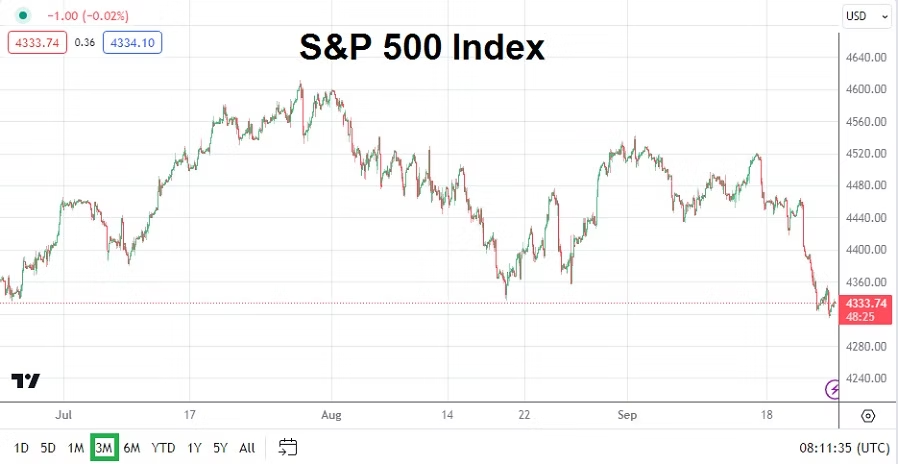
SP 500 Index Three Month Chart as of 25th of Sept. 2023

U.S equity indices have struggled recently and this should be viewed as a barometer of current behavioral sentiment. Concerns regarding higher Crude Oil prices, and talk of a growing U.S political crisis as a government shutdown is threatened (remember next year’s election is shadowing all spectacles in Washington D.C presently) highlight the nervous state of affairs. The USD has been stronger and gold has remained under pressure in recent trading. Risk adverse trading is proving rather flavorful for the moment.

The ongoing strong rhetoric from the U.S Federal Reserve and what appears to be an almost certain interest rate hike in November is causing market sentiment to remain anxious. Financial institutions are not only lining up to buy U.S Treasuries, but money market funds are also being sought too which offer the ability to accumulate returns from higher interest rates. While cash is being parked in ‘sure things’ because financial institutions and large investors are keen on locking in ‘known’ returns (profits), this creates potentially less money supply for buying of U.S and global equities momentarily.

Troubling economic data continues to mire the terrain also for financial institutions, and the heightened fear is causing a reaction which day traders need to deal with as short-term volatility mounts creating dangerous speculative conditions. Consumers face a rather large bag of ‘troubles’ via higher mortgages, debt obligations on credit cards and student loans, and inflation costs. Yet, intriguingly the U.S economy has shown resilience which is almost perplexing.

Current behavioral sentiment appears fragile and ready to crack open into a chaotic storm if too much pressure is exerted. Day traders should be cautious this week because plenty of diatribes and warnings are sure to be heard. Unfortunately the warnings being heard now for this coming week could prove correct.
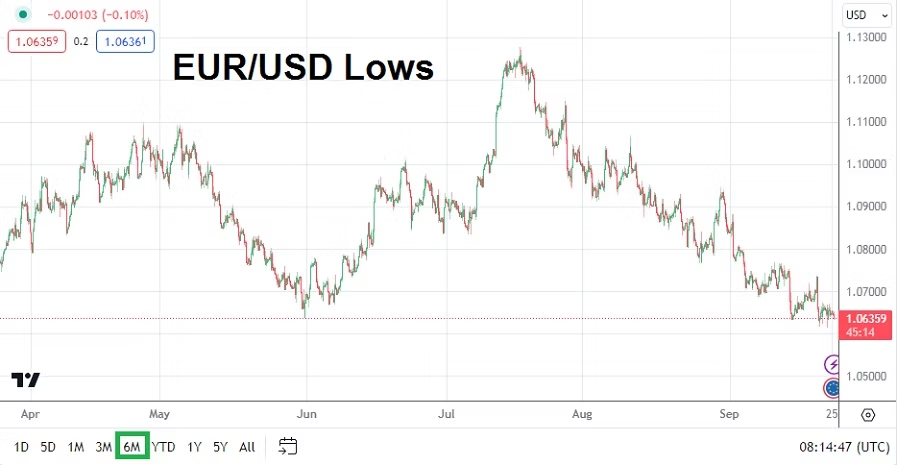
EUR/USD Six Month Chart as of 25th Sept. 2023

Monday, 25th September, Germany Business Climate via Ifo – investors will keep their eyes on the sentiment reading from Germany which is expected to be worse than last month’s results. The EUR/USD is trading at six month lows.

Tuesday, 26th September, U.S CB Consumer Confidence – the result is anticipated to be slightly negative compared to last month’s outcome. U.S consumers have remained strong and financial institutions will want to see if they remain optimistic regarding their outlooks. The outcome could affect the USD, particularly if the number is weaker than expected.

Wednesday, 27th September, U.S Durable Goods Orders – this report could prove noteworthy via the broad and core reports. Durable Goods Orders are a relatively important barometer on U.S big ticket spending and demand. The numbers are likely to cause a rumble in U.S equity markets.

Thursday, 28th September, Germany CPI – the inflation results will be watched carefully by EUR/USD speculators. Higher prices in Germany are not welcome and a larger number than anticipated would be troubling.

Thursday, 28th September, U.S GDP – the Gross Domestic Product data from the States on Thursday will be closely monitored and likely provide impetus for Forex and major indices. If the growth numbers are stronger than expected this will serve as another nail for the U.S Federal Reserve to hit when it makes its case for another interest rate hike. While it is good the U.S economic growth numbers have been relatively strong, better than expected data could play into U.S Treasury yields remaining high and spark additional complex considerations for investors.

Friday, 29th September, Canada GDP – the data from Canada is expecting a negative ‘growth’ result which would have an affect on the USD/CAD.

Friday, 29th September, U.S University of Michigan Consumer Sentiment – the revised numbers will give insights into American spending habits. The previous two months have been more lower than anticipated, this outcome is expected to produce a reading of 67.7.

Saturday, 30th September, China Manufacturing PMI – while the Purchasing Managers Index reports from China are forecast to show slight improvements, analysts remain worried about economic conditions in the nation. Transparency remains a focal point for investors who want to make sure the results they are being given are accurate.

postN23

Fed Spits into the Wind as Day Traders React to Volatility

Fed Spits into the Wind as Day Traders React to Volatility

Broad market analysts continue to spit up an eternal fountain of opinions and data to show why yesterdays moves happened and why tomorrows are going to have bright sunshine and positive outcomes. However, day traders know this is not the reality for them and understand the gyrations and volatility of the marketplace is actually quite dangerous in the short-term.

Day traders may even know market correlations looking backwards are also tales of fiction sometimes. Random results from various fronts are often viewed and assembled by analysts and data providers to give credence as to why ‘John Doe’ lost all of his money, because he was not paying attention to the storm that was ‘obviously’ developing in front of his face. Thus, wiping away any stains of responsibility the analysts and data providers may have for their clients loss of money.

Gold Five Year Chart as of 28th June 2023

Traders seemingly want to know what the U.S Federal Reserve is going to do every minute. If they could, short-term speculators would probably buy information on the amount of coffee breaks FOMC members take, and monitor what Fed officials daily meals are to understand their moods.

However, we should also understand that a lot of the day to day mechanics in the financial markets are tasks that have been done thousands of times before, in other words we know the history and results of many financial institutions. The U.S Federal Reserve is doing nothing new and their actions in July, August and onward really do not amount to much. The monthly decisions and annual manifestations of governments that spend too much cash and their officials trying to balance the value of their national currencies are well documented historically.

Markets in reality think long-term and this is where nearly all of the large money is invested. Day traders need to understand what they are doing is almost considered a ‘hobby’ by investment professionals who do not take the ‘hobby’ of the small speculators very seriously. This because the amount of money most day traders are using doesn’t affect market price very much, unless they form a ‘team’ like the Wall Street Bets ‘crew’ or act in unison via other social media groups influenced by people they mostly do not know personally, and should be wary of regarding motives. Let’s point out for a moment though, that long-term investors can lose money too based on faulty outlooks.

Long-term money is invested with perspectives that stretch often for periods of two to three years and beyond. Outcomes are projected not on data that cause daily momentary values to change, but rather on sophisticated insights which take a perspective the value of equities and certain indices, and other assorted assets tend to rise. Long-term investors mix their outlooks on economic road signs which will be affected by the investing landscape over a period of years. Meaning knowledge of geopolitics, interest rates, social stability and economic transparency are vital. History is a guide post for established financial institutions as they work. But sometimes these factors do not work, and employees at long-term thinking financial institutions find they need new jobs.

U.S Federal Reserve officials, after yesterday’s Core Durable Goods Orders and the CB Consumer Confidence reports which showed strength were published, might have raised their eyebrows. FOMC members likely acknowledged the long-term exuberance and nature of the U.S economy and thought ‘we need to raise interest rates again in July’ because growth data is too resilient. However, they have already said this via their FOMC Statement in June which warned about inflation and why it continues to be a concern, but the ‘words’ thus far have not been taken too seriously.

Yesterday’s reaction in the broad markets was not overly volatile because of the U.S data outcomes. Yes, short-term Forex traders were likely hurt or rewarded depending on the what lucky side of the coin they were betting. However, for the most part many long-term investors have already placed their positions and continue to do so, which they may not alter for the next two to three years depending on the amount of cash reserves they have in their arsenal. This ammunition of large capital, allows long-term players to remain in the game until a result can be quantified – good or bad.

Day traders and long-term investors are playing a different game. Their mode of operations work in different manners. Again, it must be stressed long-term investors do not take into consideration the outcome of most short-term traders, nor for that matter do global central banks. In fact most global central banks and the governments behind them, would rather see day traders simply give their money to investment ‘experts’ who put the ‘little peoples’ money into long-term savings and investment programs.

Speculative cash in the markets does exists, but the amounts of money being used by day traders and large ‘players’s looking for short-term results are quite different. It should also be pointed out that many day traders are using CFD’s – which largely means their positions are being wagered virtually – and are not really being deposited into the ‘cash markets’. In other words day traders can go broke much faster than their long-term counterparts who are investing in positions that have the power of time duration on their side. The virtual positions of CFD wagers are not going into the real cash market, thus not causing a reaction in the actual assets being traded.

Many day traders participating in the daily results of Forex, and equities and indices are merely trading on casino like platforms built for wagering on the results of what is happening elsewhere in the real cash markets of assets. It in a sense, it quite a bit like sports gamblers betting on the outcome of game they are not participating.

Tomorrow the GDP numbers will come from the U.S and the growth numbers will certainly be watched. The results will be consumed differently by day traders compared to long-term speculators. The Final Gross Domestic Product numbers from the States on Thursday are expected to show a slight rise. An outcome of 1.3% was seen last month, tomorrow’s anticipated number is a 1.4% gain.

If the growth number is stronger than expected, this would put the U.S Federal Reserve in a position in which it would almost certainly have to acknowledge another hike to the Federal Funds Rate is ‘needed’ in July. The Fed has learned the hard way that incremental rises in the costs of borrowing (Federal Funds Rate) are not curtailing the spending of U.S consumers. If the U.S doesn’t start to show recessionary like economic signs in the mid-term, the Fed may feel like it has been spitting into the wind. Day traders will find tomorrow’s GDP report causes volatility, but long-term investors will likely view this as just another day with a momentary price reaction.